Introduction
Based on evolutionary reasoning, Trivers & Willard (Reference Trivers and Willard1973) proposed the hypothesis that in certain species, including humans, sex composition of children and sex-selective parental investment is affected by parental resource levels: sex composition and parental investment should be biased to benefit male offspring for parents with high resource levels and to benefit female offspring for parents with low resource levels. This study focuses on testing this prediction with regard to parental investment. Previous studies were based on single investment indicators that cannot be easily compared. Here, instead, a central role for (unconscious) parental gender preferences in steering parental investment is investigated (cf. Cronk, Reference Cronk2007). An analysis of fertility stopping based on parental status and sex composition among previous offspring serves as a probe for the pattern predicted by Trivers & Willard (Reference Trivers and Willard1973) in parents' gender preferences.
Previous research shows that individual and social conditions can affect sex composition at birth (e.g. James Reference James2009; Catalano et al., Reference Catalano, Ahern, Bruckner and Galen2007, Reference Catalano, Zilko, Saxton and Bruckner2010; Margerison Zilko, Reference Margerison Zilko2010; Ruckstuhl et al., Reference Ruckstuhl, Colijn, Amiot and Vinish2010), yet it remains open exactly which mechanisms are responsible for producing the detected effects (James, Reference James2006; Grant, Reference Grant2007; Grant & Irwin, Reference Grant and Irwin2009). Researchers from both a biological and a sociological perspective have contributed to testing the Trivers–Willard (TW) hypothesis. Yet until today, the empirical results remain mixed and it cannot be finally decided whether or not the hypothesis needs to be rejected, both with regard to biased sex composition and parental investment (Almond & Edlund, Reference Almond and Edlund2007; see also Festa-Bianchet, Reference Festa-Bianchet1996; Freese & Powell, Reference Freese and Powell1999, Reference Freese and Powell2001; Brown & Silk, Reference Brown and Silk2002; Mackey & Immerman, Reference Mackey and Immerman2008; Pollet et al., Reference Pollet, Fawcett, Buunk and Nettle2009; Schnettler, Reference Schnettler2010).
Given this inconclusive evidence, it seems important to take a more analytical approach to dissect the physiological and behavioural mechanisms and the biological, cultural and social influences thereon that may be at play in shaping sex composition of children and sex-biased parental investment (cf. Hedström, Reference Hedström2005; Runciman, Reference Runciman2009). Researchers studying the hormonal pathways responsible for sex determination have made important advances in narrowing down the pool of potential physiological mechanisms playing a role in producing the TW effect (Grant & Irwin, Reference Grant and Irwin2005; Grant et al., Reference Grant and Irwin2008; James, Reference James2008). Other scholars have resorted to testing the TW hypothesis more generally in a correlational sense (Mackey & Immerman, Reference Mackey and Immerman2008; e.g. Mackey & Coney, Reference Mackey and Coney1987). But whereas this approach enables researchers to test whether the data behave consistently with the TW prediction, it tells little about the underlying mechanisms, i.e. whether the observed pattern is truly an effect of some kind of TW mechanism or rather a byproduct of other mechanisms.
Even less is known about the potential mechanisms responsible for orchestrating parental investment. Some evolutionary psychologists assume that the human mind consists of thousands of domain-specific mechanisms (Barkow et al., Reference Barkow, Cosmides and Tooby1992; Buss, Reference Buss1995). According to this view, a number of mechanisms steering parental investment in response to child characteristics, parental status and investment domain are theoretically conceivable. But the emerging consensus among psychologists seems to be that a domain-general architecture that allows humans to be rational and reflexive agents is coupled with a smaller number of domain-specific mechanisms that can, under certain conditions, bias the outcomes of the domain-general architecture (Baumeister, Reference Baumeister2005). According to this view, it seems plausible to assume that, if at all, one rather crude mechanism influences parental investment through parents' (unconscious) gender preferences.
The aim in this paper is to study status-based parental gender preferences in isolation. A good way to measure parental gender preferences is to look at fertility stopping in response to parental status and the sex composition of previous offspring. This approach is superior to asking parents about their gender preferences in a survey because the results are not affected by social desirability biases. By means of examining differences in parity progressions, both cross-nationally and over time, sociologists and demographers have provided increasing evidence that parents adjust their overall number of children to accommodate offspring gender preferences (e.g. Hank & Kohler, Reference Hank and Kohler2000; Andersson et al., Reference Andersson, Hank, Rønsen and Vikat2006). In populations like early 20th century China, parity progression ratios could differ by as much as 18% dependent on sex composition of previous children (Zhao, Reference Zhao1997). Fertility stopping based on a particular set of sex and family preferences gives parents a limited means of affecting the sex composition among their offspring. In fact, it is the only available way for parents to influence the sex composition of their children in Western societies where sex-selective abortion is absent and modern sex-selection techniques are not (yet) practised. It should be noted in this context that status-differential stopping behaviour may lead to a skewed distribution of sex composition types across status groups but does not affect status-group-specific sex ratios (for details see the ‘Theory and Previous Research’ section).
Whereas existing social science research thus indicates that parents generally use fertility stopping to accommodate sex preferences, it tells us little about the interaction between parental status and sex composition among previous offspring and therefore is not informative with regard to the TW hypothesis specifically. This paper fills this gap by applying event-history models to analyse the interaction of parental status and sex composition of previous offspring in determining the relative risks of parents at different parities to have another child. This is a methodologically and theoretically more powerful way to study the TW effect compared with an approach that simply correlates socioeconomic status and sex-specific parental investment on single investment indicators. Specifically, in following the TW prediction, we are interested to see whether parents with higher status are more likely to continue fertility to have at least one son and parents with lower status more likely to continue until they have at least one daughter.
This paper applies a very liberal test of the TW hypothesis. This is necessary for two reasons. First, the TW effect among humans is predicted to be lower than in many other species, given the comparatively high degree of paternal investment in humans as compared with other species (Trivers & Willard, Reference Trivers and Willard1973). To detect even small effects, common sample sizes in surveys are not sufficient. This problem is solved here by drawing on Swedish register data that provide a very large sample size. Second, a theory that predicts which parental resources should be most relevant for the activation of somatic or psychological mechanisms responsible for the TW effect does not exist (see Schnettler, Reference Schnettler2010). Other researchers have, with a few exceptions (e.g. Freese & Powell, Reference Freese and Powell1999), used different operationalizations of parental status (cf. Schnettler Reference Schnettler2010), making comparisons between studies difficult. This paper examines the interaction between social status and sex composition of previous offspring on a number of different status indicators, including income, post-transfer income, wealth, parental wealth, socioeconomic status and education. Swedish register data offer good information on income, wealth and other status variables in long time-series and for the complete population.
Theory and Previous Research
The TW effect in gender preferences and parental investment
Trivers & Willard (Reference Trivers and Willard1973) argued that it is very likely that some mechanisms leading to sex-ratio and parental-investment biasing may have evolved, leaving open exactly which types of mechanisms could be responsible for such biases. From a theoretical perspective, there are a number of possible stages at which a mechanism could be active: X- and Y-chromosome-carrying spermatozoa could have different survival chances prior to fertilization; they could have different chances of fertilizing the ovum; male or female fetuses could have different degrees of vulnerability during pregnancy; and/or sex-biased parental investment could lead to differential infant or child survival (see Lazarus, Reference Lazarus and Hardy2002). From an evolutionary perspective, costs associated with the respective mechanism should be minimized in order to maximize reproductive fitness. Therefore, the earlier a sex-selective mechanism gets activated, the less somatic energy has to be written off as sunk fitness costs. Given that humans, throughout their evolutionary and phylogenetic history, have probably been exposed to several changing environmental conditions (cf. Low & Clarke, Reference Low and Clarke1992, p. 464), it is likely that mechanisms have evolved that affect sex composition at different stages, but with a higher activation probability of less costly mechanisms.
Except for samples at the extreme ends of a society's wealth distribution (see Woods, Reference Woods1939a, b; Cameron & Dalerum, Reference Cameron and Dalerum2009), the effects on sex composition at birth are often rather small. And they are almost completely exogenous to human agency. Although Trivers & Willard (Reference Trivers and Willard1973) explicitly mention the possibility of evolved behavioural forms of parental discrimination, the evolutionary cost argument made above suggests that the average behavioural TW effect should be smaller than the effect of physiological forms of sex-ratio biasing. According to the cost argument, any discriminatory mechanism should occur as early as possible to avoid sunk fitness costs.
Empirical research proves the existence of parental discrimination during pregnancy or even after the child is born. In fact, extreme male biases with more than 130 boys for every 100 girls (cf. Hvistendahl, Reference Hvistendahl2011) bear witness to the possibility that sex-selective behaviour affecting sex composition and thereby sex ratios in a population can be much stronger than most of the enumerated physiological effects. Therefore research that aims at inferring the strength of a biological effect (TW mechanism) from sex ratios at birth needs to study the role behaviour plays in determining sex ratios. A difficulty in this endeavour is, however, that behaviours can simultaneously be shaped by cultural, social and biological selection (cf. Runciman, Reference Ruckstuhl, Colijn, Amiot and Vinish2009).
Parents may consciously or unconsciously bias their behaviour in many ways, ranging from subtle forms of discrimination in parental investment to extreme forms of disinvestment in the form of maltreatment, sex-selective abortion or infanticide (cf. Sudha & Rajan, Reference Sudha and Rajan1999; Bélanger, Reference Bélanger2002). Most research deals with either sex differences (Lye, Reference Lye1996) or class differences in parental investment (e.g. Lareau, Reference Lareau2003), but the interaction between the two has hardly been taken into account. Keller et al. (Reference Keller, Nesse and Hofferth2001) identify only eight studies that specifically test the TW hypothesis with data on parental investment. More recent studies have taken into account a wider variety of parental investment indicators, status measures and/or more appropriate research designs to facilitate within-family comparisons (Freese & Powell, Reference Freese and Powell1999, Reference Freese and Powell2001; Schnettler, Reference Schnettler2010), yet they have not provided any conclusive evidence for or against the TW hypothesis.
Sex-selective abortion and infanticide both, in theory, directly affect sex composition in families. These practices, along with sex-selection methods, play an influential role in producing strongly male-skewed sex ratios in large parts of Asia and North Africa (see, e.g., Sudha & Rajan, Reference Sudha and Rajan1999; George, Reference George2002; Hesketh & Xing, Reference Hesketh and Xing2006). Usually these types of disinvestment are known to occur under particular constellations of cultural and economic context conditions, that is, when male offspring implies extreme economic advantages and/or cultural preferences are extremely male biased (Nauck & Klaus, Reference Nauck and Klaus2007; cf. Nauck, Reference Nauck, Friedlmeier, Chakkarath and Schwarz2005). Structural encouragement or enforcement of fertility limits, e.g. the one-child policy in China, may even exacerbate this association (Hvistendahl, Reference Hvistendahl2011). Sex-selective abortion and infanticide play less of a role in developed ‘Western’ countries. Sex-selective abortion is legally prohibited in many countries and cases of infant deaths as a consequence of parental neglect are only heard of occasionally. Lesser forms of parental discrimination may occur, but given resource abundance and highly developed health care systems, they can be considered irrelevant for influences on sex ratios (Teitelbaum, Reference Teitelbaum, Harrison and Boyce1972, p. 90). Nevertheless, an evolved tendency of parents to develop discriminating sex preferences may still prevail as a psychological mechanism.
Empirical studies on the TW effect in parental investment (that is, on differences in parental investment in response to parental status and sex composition among previous offspring) report mixed findings. Comparing the Hungarian Gypsy population with the remaining population, Bereczkei & Dunbar (Reference Bereczkei and Dunbar1997) report differences in abortion rates, breast-feeding duration and length of education that are consistent with the TW hypothesis. Moderately supportive evidence also comes from a contemporary sample of Polish respondents where the authors use birth spacing and breast-feeding as measures of investment (Koziel & Ulijaszek, Reference Koziel and Ulijaszek2001). For the contemporary US, support for the TW hypothesis comes from a representative sample of 900 women with birth spacing, birth weight and breast-feeding as measures of parental investment and income and presence of a father as indicators of parental status (Gaulin & Robbins, Reference Gaulin and Robbins1991). Using considerably larger samples from two different representative US surveys and a variety of parental investment indicators, Freese & Powell (Reference Freese and Powell1999, Reference Freese and Powell2001) find no support for the TW hypothesis. Also Keller et al. (Reference Keller, Nesse and Hofferth2001), using data from the Child Supplement to the Panel Study of Income Dynamics, don't find support for the TW hypothesis. Yet, even the thousands of cases available in social surveys may not equip statistical tests with the required power to detect the small effects that we would expect on the basis of the theoretical argumentation above (cf. Gelman & Weakliem, Reference Gelman and Weakliem2009).
Schnettler (Reference Schnettler2010) draws attention to an additional problem that may contribute to a mixed empirical pattern, one that has hitherto been neglected in empirical research on the TW effect: research should focus on sex discrimination within families rather than between families, because even from a biological perspective we would not necessarily expect investment differences in a cross-family comparison with gender-homogenous families (e.g. comparing son-only with daughter-only families). Therefore, Schnettler uses fixed-effects models to compare investment differences in adolescent sibling dyads in gender-mixed families only. He concludes that there are hardly any signs of investment differences consistent with the TW hypothesis (ibid.). What may further drive the mixed results in the studies surveyed here is that they use a variety of parental investment indicators, making a comparison between studies difficult. A central problem is also that parents may discriminate on particular investment dimensions but make up for these differences in other domains. It is therefore difficult to derive a conclusion about a general pattern of discrimination from single investment indicators. A related point is illustrated in a study on a community in northern England between 1600 and 1800 (Scott & Duncan, Reference Scott and Duncan1999). In discussing their results, the authors argue that although parental investment intentions may be consistent with the TW hypotheses, the consequences of parental behaviour may not be: this could be the case when parents have limited or false knowledge about the effects of their investment. Finally, inconsistency in operationalizing parents' social status may contribute to a mixed empirical pattern. Trivers–Willard theory does not provide researchers with a clear indication as to which dimension of social status should be expected to most strongly affect parental investment decisions (and sex composition at birth, for that matter). Trivers & Willard (Reference Trivers and Willard1973) mention ‘physical’ condition of the mother as the relevant measure of condition, leaving many possibly relevant parental status measures that link social status and physical condition, e.g. mediated through stress and nutritional status. Disagreement about the right status operationalization is also expressed in the respective research literature (see e.g. Hopcroft, Reference Hopcroft2005).
The TW effect and fertility stopping
Both the lack of comparability when looking at single investment indicators and the need to distinguish parental intentions from investment consequences serve as motivation to shift the focus in this paper away from single investment indicators to a general measure of parental gender preferences. In sociology and demography, an established indicator for average parental gender preferences in a population or in special social substrata is fertility stopping in response to the gender of previous offspring. The neglect of the role of this behavioural mechanism in the literature on the TW effect surprises, given that in evolutionary biology fertility starting, stopping and spacing are together seen as strategies to increase fitness in response to environmental conditions and as such are part of a behavioural ecology of fertility behaviour (Low & Clarke, Reference Low and Clarke1992, pp. 464–465).
In the context of developing countries, where a common preference is to have at least one surviving son, fertility stopping, together with differential investment, is an important strategy for parents to achieve the desired offspring gender mix. In high-fertility populations like pre-modern China, parity progression ratios could differ by 18% dependent on sex composition of previous children (Zhao, Reference Zhao1997). Research on historical data for developed countries shows that stopping and spacing may have played a role before the fertility transition (e.g. Tsuya et al., Reference Tsuya, Feng, Alter and Lee2010; Kolk, Reference Kolk2011), often in response to current family composition. In recent years scholars have also increasingly looked at the role of parity-specific fertility behaviour in contemporary, developed countries (Hank, Reference Hank2007). Fertility stopping is the only available way for parents to influence the sex composition of their children in Western societies where sex-selective abortion is absent. Comparing data on the transition from the second to the third child in a total of seventeen European countries, Hank & Kohler (Reference Hank and Kohler2000) find that gender preferences are quite mixed: no clear gender preference can be found in some countries, a preference for a mixed sex composition is found in others, and a slight daughter preference in yet others. For the US, studies show a clear preference for a mixed gender composition, indicated by the higher probability of experiencing a third birth by parents with two sons or daughters as compared with parents of one son and one daughter, along with a small remaining son preference as indicated by the higher probability of having a third child among parents of two daughters when compared with parents of two sons. But the data also show a general decline of the influence of the sex composition of previous children on parents' fertility decisions (Hank, Reference Hank2007, p. 763). A recent study employing Nordic register data provides evidence for a strong and stable preference for at least one child of each sex. For third births the parity progression probability of parents with either two daughters or two sons is between 20 and 25% higher than for parents with one daughter and one son (Andersson et al., Reference Andersson, Hank, Rønsen and Vikat2006). In a review article, Hank (Reference Hank2007) concludes that gender preferences do still play a role in Western societies, if not as strongly as in many developing countries. Furthermore, gender preferences are often only revealed at higher parities. The most pervasive and clear preference is one for a balanced gender mix, but in some countries a slight daughter preference has emerged, whereas in others a slight son preference has persisted. In Sweden, and across educational groups, a daughter preference emerged in the early nineties (Andersson et al., Reference Andersson, Hank and Vikat2007).
Although the mechanisms for the emergence of gender preferences remain elusive (Hank, Reference Hank2007), research in the value-of-children framework has shown that the specific social, cultural and economic context in a country plays an important role in determining the sex-specific value of children and its influence on parental fertility and gender preferences (Nauck, Reference Nauck2001, Reference Nauck2005). Even in developed countries with high gender equality, and where economic incentives for having a son or a daughter can be seen as roughly equal, biased incentives may persist: a newly emerged daughter preference in some European countries, for example, is explained by the fact that women often remain the major caregivers for their parents in old age (cf. Brockmann, Reference Brockmann2001). This illustrates that not only biologically evolved mechanisms affect gender preferences but also social, cultural and economic influences do. Here, the question is whether in addition to the main effects stated, we do find status-group-specific differences in gender preferences that are consistent with the TW hypothesis.
But despite the central role of social status in sociology as a discipline, scholars in this field have not taken on the examination of the TW hypothesis in fertility stopping behaviour, or the interaction of sex composition of children and parental social status more generally (for an exception see Yamaguchi & Ferguson, Reference Yamaguchi and Ferguson1995). Theoretically, clear but opposing preferences for one gender in different status groups may be hidden behind a general preference for a balanced gender-mix. If, according to the TW hypothesis, some psychological mechanism led high-status parents to prefer male offspring and low-status parents to prefer female offspring, one way for parents to fulfil this preference would be through continued childbearing until the preferred proportion of children of each sex is reached. Although in reality it would be almost impossible for parents to reach their exact preference, on average we'd expect parents of high status to be more likely to stop fertility the higher the proportion of male offspring, whereas they should be more likely to continue childbearing if their existing offspring consisted mainly of daughters. The opposite should be true for low-status parents. And if such a psychological mechanism existed, it could exist alongside other physiological mechanisms. Therefore, in an attempt to further clarify the interplay of potential mechanisms responsible for biasing sex composition in families in response to socioeconomic status, it seems essential to determine how a possible psychological effect would have a neutral, reinforcing or levelling effect on sex composition biasing from physiological mechanisms (Yamaguchi & Ferguson, Reference Yamaguchi and Ferguson1995). It should be noted that fertility stopping theoretically links both sex composition in a family and sex-selective parental investment. It is assumed that the same parental gender preferences that drive parents' attempt to influence their family sex composition also affect parental investment.
But even though fertility stopping may play a role in explaining family sex composition, it is without consequence on population- and status-group-specific sex ratios. The following example illustrates why status-biased fertility stopping behaviour does not produce biased sex ratios. Assume that parents with higher status continue fertility until they have at least one son or they have a maximum of three children, and parents with lower status continue fertility until they have at least one daughter or a maximum of three children. Furthermore, for simplicity let's assume that at each birth the probability of a male or female birth was equal. In the case of the higher status group we would get the following distribution of family types: 50% with one son only, 25% with a first-born daughter and a second-born son, 12.5% with two daughters and a third-born son, and 12.5% with daughters only. In the case of the lower status group we would see the sex-reversed pattern: 50% with one daughter only, 25% with a first-born son and a daughter, 12.5% with two sons and a daughter, and 12.5% with three sons. That is, although in this example the distribution of family types is distinct for the two status groups, the overall number of sons and daughters in each status group would still be equal.
Research Question
As the summary of previous research shows, behavioural influences have been checked for consistency with the TW hypothesis with regard to parental investment but not with regard to stopping and spacing behaviour. Scholars who have examined stopping behaviour and gender preferences, on the other hand, have not taken into account the interaction of previous sex composition and social status. This study aims at closing this gap by testing empirically if gender preferences are status-biased in a way consistent with the TW hypothesis. That is, are parents with higher social status more likely to continue fertility if their previous children include no or few sons? And are parents with lower social status more likely to continue fertility if their previous children contain no or few daughters?
It should be noted that other types of preferences influence parental decisions as well, including preferences about family size, a minimum number of children of a specific gender, and a specific gender mix. As long as these other preferences are equally distributed across status groups, controlled for previous sex composition of children, the aggregate effects found in this study should not be systematically biased. A critique against the assumption of an equal distribution of the relative strength of family size versus gender preferences in different status groups is that only parents with a relatively high degree of resources can financially afford to have more children in an attempt to fulfil sex composition preferences, whereas parents with lower resource levels cannot. Even though research on data from the US has actually found such an effect for education and income (Seiver, Reference Seiver1978; Yamaguchi & Ferguson, Reference Yamaguchi and Ferguson1995), it is less likely to be found in a country like Sweden, which provides generous child support (cf. Esping-Andersen Reference Esping-Andersen1990; Kaufmann et al., Reference Kaufmann, Kuijsten, Schulze and Strohmeier1998, Reference Kaufmann, Kuijsten, Schulze and Strohmeier2002). If this is true, the status effect on differential stopping based on the gender mix among previous children may be reduced and one would only find an effect for higher status groups.
Based on the evolutionary cost argument made above, the existence of a psychological mechanism biasing stopping and spacing behaviour in a way that is consistent with the TW hypothesis should be unlikely (cf. Cronk, Reference Cronk2007). And if such a mechanism existed, it should be activated only under rare circumstances and therefore lead to a very small average effect on the level of status groups. Culturally and socioeconomically determined gender preferences generally lead to much stronger preferences. Previous findings on a mixed-gender preference in all status groups should therefore be replicated.
In addition, stopping behaviour should be related to status in more intricate ways, dependent on particular social status indicators, with non-linear effects of status on gender preferences. One such status-specific effect is that parents with higher education may be more likely to continue fertility to have at least one daughter, given more progressive gender values among the more educated group. But this effect should be specific to education and – with education controlled for – be unrelated to other status indicators. Another such status-group-specific effect may be that parents in the highest income and wealth stratum may have a higher preference for at least one son, given that women, even in a society with a high degree of gender equality like Sweden, still face ceiling effects that keep women from reaching the highest positions in the occupational hierarchy in equal numbers as men.
This study is based on women in Sweden and, given the absence of information on partners' status, uses their own status measures. It is possible that some of the new births as compared with earlier births, are from a different father with possibly different reproductive goals and socioeconomic status. This is relatively uncommon and would only bias the results if patterns by multi-father childbearing differed substantially by status group and sex of previous children. Under some circumstances, female status hypergamy could bias the results, particularly in cases when the woman does not participate in the labour market. However, this is less of a problem in Sweden than in many other countries given that female labour force participation is nearly universal. The association between fertility and income is very similar for both men and women in Sweden, with both male and female income having a strong (positive) independent effect (Duvander & Andersson, Reference Duvander and Andersson2003). On average, female educational hypergamy does not exist in Sweden, and women are on average even more highly educated than their partners (Dribe & Stanfors, Reference Dribe and Stanfors2010). Overall educational (Henz & Johnsson, Reference Henz, Johnsson, Blossfeld and Timm2003) and income (Henz & Sundström, Reference Henz and Sundström2001) homogamy is high, which means that status information from just one partner in a couple most often is a sufficiently good proxy for a couple's combined status.
Men do, however, earn a larger share of income, on average, than women do and they have higher occupational class membership, in particular in the earlier periods of study. Some care is therefore needed with the interpretation of the earlier periods with regard to occupation and income. But given a high overall degree of homogamy, low gender differentiation, and the fact that even with hypergamy, the female–male wage gap tends to be consistent across income levels, these worries should not be overstated. Overall, covariates on female status probably give a good picture of couple status, particularly for this study's measure on education. Status of the father at the previous birth could be included but, given that it was not possible to track union histories for cohabiting couples, this is a very problematic measure of status until next birth with a potential different father.
Data
Social science research on the sex-specific value of children in different sociocultural and socioeconomic contexts shows that certain institutional frameworks also affect parental gender preferences and fertility decisions (Nauck, Reference Nauck, Friedlmeier, Chakkarath and Schwarz2005; Nauck & Klaus, Reference Nauck, Friedlmeier, Chakkarath and Schwarz2007). Although these effects are not the product of a hypothesized TW mechanism, but can simply result from a general cost-benefit module (cf. Cronk, Reference Cronk2007), they may influence behaviour in a way that either suppresses or exaggerates an existing TW effect. As an individualistic welfare state with high gender equality, Sweden is a particularly good test case for examining the TW effect. Compared with other developed welfare states, Sweden, along with the other Nordic countries, has policies that target the individual (cf. Esping-Andersen, Reference Esping-Andersen1990) and can therefore be assumed to influence the economic and cultural opportunity costs of children less than in other historical and contemporary societies. In such a setting, the cost-benefit structure with regard to sons and daughters should be most exclusively determined by the potential interaction between parental status and child gender as predicted by the TW hypothesis. That is, a study in contemporary Sweden provides a more liberal test of the TW hypothesis than tests conducted in many other contexts.
Furthermore, for the purposes of the current study, Sweden is a good test case given that the negative association between socioeconomic status/education and completed family size, observed for a number of other European countries (Kaufmann et al., Reference Kaufmann, Kuijsten, Schulze and Strohmeier1998, Reference Kaufmann, Kuijsten, Schulze and Strohmeier2002), has been weak, both now (Hoem et al., Reference Hoem, Neyer and Andersson2006; Andersson et al., Reference Andersson, Rønsen, Knudsen, Lappegård, Neyer, Skrede, Teschner and Vikat2009) and in the past (Edin & Hutchinson, Reference Edin and Hutchinson1935; Wrong, Reference Wrong1980). When childless individuals are excluded – as in the current analysis – the association between income and fertility is only weakly negative for men and women and null for education (Fieder & Huber, Reference Fieder and Huber2007). Due to this rather weak association between status measures and fertility, the analysis of the interaction between social status and the sex of previous children in determining parity progression probabilities will not be complicated by a general interaction effect of status on parity progression – independent of the sex of previous children.
A counter-argument to Sweden as a good test case would be that the high degree of gender equality in Sweden leads parents who do have a gender preference to not admit it when asked for it. But as opposed to survey responses on gender preferences, such a social desirability bias should not be apparent in data on fertility stopping. Here, individual decisions, even if actually driven by gender preferences, may easily be concealed from others by referring to family size preferences and/or sex composition as a chance process. Another counter-argument is that Sweden has a relatively low degree of intergenerational status inheritance, thus deviating from one of the central conditions of the TW effect. But first, even though in Sweden status inheritance is much lower than in other modern developed countries, it is still considerable: depending on which type of social mobility one examines, inter-generational correlations are still at a level of about one-half to three-quarters of that in continental Europe, the UK and the US (Breen & Jonsson, Reference Breen2005). And second, according to the logic of evolutionary psychology, the preconditions for the TW effect do not necessarily have to be met in contemporary, developed societies: it may have been sufficient for the human species to have lived long enough in environments in which males in good condition out-reproduced women in good condition (Hopcroft, Reference Hopcroft2005, p. 1114). Evolutionary psychology assumes that we still carry many of these ancestral adaptations in our minds, given that the time since the Neolithic revolution, after which most societal changes are expected to have occurred, is considered too short for major evolutionary changes in the human psychological architecture (Barkow et al., Reference Barkow, Cosmides and Tooby1992).
But even though biological influences should come out most clearly in individualistic societies, it follows from the last section on the proposed research question that the TW effect should be small to non-existent. Basing the analyses in this paper on Swedish register data ensures sufficient statistical power to detect small effects (cf. Gelman & Weakliem, Reference Gelman and Weakliem2009). An additional advantage of these register data is that they cover a long duration of individuals’ fertility and status histories. Specifically, the data for this study are an assortment of Swedish administrative registers. In the analyses, registered vital events are used to create longitudinal birth histories, which are then analysed using event-history models. Census data and administrative registers on education and taxes are then linked with demographic data. Due to limited data availability, different registers and periods are studied for different status variables. The study population consists of all Swedish women born in Sweden after 1925 conditioned on the fact that they are present in the registers at some point after 1960. They are followed from age 16 and right-censored at death, first out-migration, twin birth, age 50 or the end of 2007. The study population used in the models on the transition from 2nd to 3rd births is: N=849,295 for income, post-transfer income, wealth and parental wealth; N=984,285 for education; and N=1,169,170 for socioeconomic status at 2nd birth. An overview of childbearing patterns for the population in the current study can be found in Andersson & Kolk (Reference Andersson and Kolk2011).
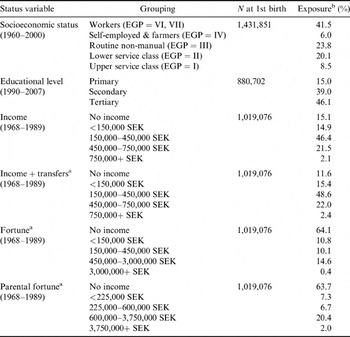
Data on income, post-transfer income, wealth and parental wealth for the mother are collected from Swedish tax registers and updated on a yearly basis (see Table 1 for descriptive statistics). Data are available from 1968 until 1989, which is also the start and end date of the models including those variables. Incomes are adjusted according to the wage development for industrial workers in Sweden using a time series with 2004 as reference year (Larsson, Reference Larsson2007). Adjustment of incomes according to income growth rather than inflation avoids a population in the data set that gets richer by decades, an important adjustment given that the focus of the current study is primarily on income relative to other individuals. Income data are for annual registered income from labour and have been collected from tax records. Disposable income after government transfers is also included and based on a combination of labour income and income from social support systems, e. g. sickness allowances, unemployment insurance and child allowances. Data on wealth and parental wealth are based on tax registers on taxable fortune. Due to a large number of tax exemptions it is unreliable for fortunes above approximately one million $US in contemporary currency. The tax agency data are susceptible to tax avoidance and evasion, but at lower levels than in other Western countries. Parents are connected using the Swedish multi-generational register. Parental wealth refers to the sum of the shared fortune of the biological mother and father of the index persons. Data on education are based on contemporary registers with yearly data from 1990 until 2007. The data are time-varying and measure highest achieved level of education. The period after 1990 is characterized by the emergence of a small girl preference at the national level (Andersson et al., Reference Andersson, Hank and Vikat2007).
Descriptive statistics for status variables

a Annual income/fortune indexed to wage time series with 2004 as reference year.
b For models on transition from 2nd to 3rd child.
EGP: Erikson, Goldthorpe and Portocarero class scheme.
SEK: Swedish Krona.
Data on socioeconomic status (SES) are based on information collected in censuses in 1960, 1970, 1980 and 1990. Original data collection and classification is by Statistics Sweden and based on the class measure ‘Socioekonomisk indelning’ SEI (SCB, 1982). For this study, the SEI was transformed according to the Erikson, Goldthorpe and Portocarero class scheme (EGP). Given that the data are based on decennial status, the population is grouped into cohorts according to the decade they were born, starting with 1930. In the census they are then assigned a SES value from the latest census according to group of birth cohort that is time-varying and updated on a 10-year basis. For example, the 1930–1940 cohorts are assigned a SES in 1960 when they are 20–29 years, a new SES in 1970 when they are 30–39 years, etc. In the SES models the population is followed between 1960 and 2000. Socioeconomic status data are based on occupation. If the woman is not working the occupation of the head of the household is used.
Methods
Event-history analysis is applied to model the transition to the next child. For each transition model, hazard rates (births/exposure) are modelled and examined to see if they differ by subgroup (primarily previous sex composition and socioeconomic variables). Sex composition of previous children and parental status preceding the time of that birth are controlled for in each model. The focus of the current study is on the effect of previous sex composition on fertility. Therefore, models are limited to the transitions to second, third and fourth births. The transition to first birth is excluded.
Separate piecewise exponential proportional hazard models are run for socioeconomic status, education, wealth, parental wealth, income and post-transfer income. Because of different underlying data, both study periods and measures vary between methods. Given that theoretically the TW effect could be stronger among elites, most of the categories are stratified with smaller sub-strata at the upper ends of the relative distributions for the applied status measures. In addition to the explanatory variables on the interaction between social-status measures and sex-composition of previous children, all event-history models include controls on period, age (time varying) and duration since last birth (baseline hazard). The modelling strategy is to first run event-history models in which the full interaction between the various operationalizations on socioeconomic status and the sex composition on previous children are estimated. This allows estimation of how the hazard of having a birth changes with socioeconomic status at each parity for all possible previous sex compositions.
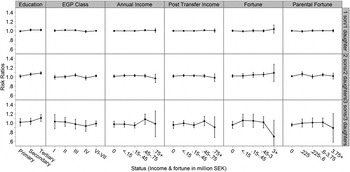
Furthermore, families with sons only and daughters only are compared at each parity (e.g. at parity 2 → 3, the risk of mothers of two sons is compared with that of mothers of two daughters). The TW hypothesis predicts that high-status parents should have a stronger desire for male children. That is, for example, high-status parents should have a lower risk of a new birth if they have two sons compared with a case in which they have two daughters (and vice versa for low-status parents). This is illustrated in Fig. 4 with plots of the ratio of relative risk for son-only families divided by the relative risk for daughter-only families for parities two, three and four.
An alternative to survival analysis would have been to use logistic regression on whether the parents have a next child, controlling for the sex composition of their previous children. But compared with logistic regression, survival analysis has two main advantages. First, one can examine both the timing and the occurrence of a next birth. Both these factors could be important to detect a TW-consistent pattern. Secondly, and more importantly, survival analysis allows the use of right-censored data. Applying logistic regression would have limited the analysis in this paper to cohorts that can be followed for their entire reproductive history. Given that for a large part of the data complete reproductive histories are not available, this approach would then have resulted in a large share of missing cases.
Results
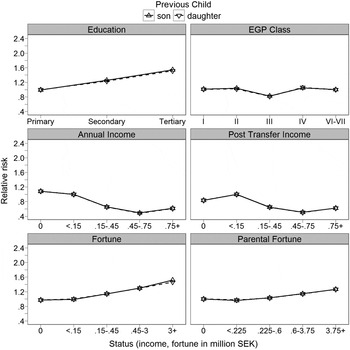
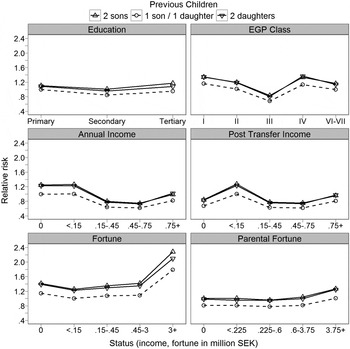
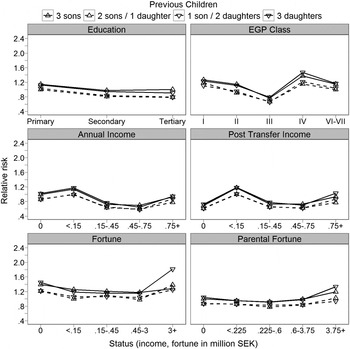
Figures 1–3 show the relative risks of parents having another child at parities one, two and three. The risk ratios result from the event-history models and take into account the interaction between the sex of previous children and social status on a number of status indicators. Here, three things can be interpreted. First, shifts of the lines upwards and downwards indicate the main effect of sex composition of previous children on the transition to the next child. Second, the slope of each line indicates the main effect of the status variables on the transition to the next child. And third, differences in slopes between different sex composition lines indicate an interaction effect between status and sex composition.
Overall, the data confirm previous findings of a preference for at least one son and one daughter, a preference that seems to be shared by parents in all status groups. But whereas the data reveal some interesting interactions between parental status and the gender balance of previous children in parents' decisions to continue to the next parity, no evidence for a TW effect or for a reverse TW effect in fertility stopping can be found. This holds true for all status indicators applied in this study, including socioeconomic status, education, wealth, parental wealth, income and post-transfer income. This has important implications for future studies on the TW effect that will be discussed in more detail in the concluding section of this paper.
Specifically, at parity one the risk of having another child is the same for parents of a son and those of a daughter. This can be seen in Fig. 1 and holds true for all status indicators. At parities two and three the data on the risk of progressing to the next parity show a clear preference for a gender mix with at least one son and one daughter: at parity two, parents of two sons or two daughters have a risk for continuing to parity three that is about equal. And their risks are higher than for parents with a mixed sex composition of one son and one daughter. This can be seen in Fig. 2. Each panel shows the relative risks of parents by sex composition of previous children for different status measures. The dashed line represents the relative risk of parents who have one daughter and one son. The two continuous lines represent relative risks of parents with either two sons or two daughters. As can clearly be seen, the dashed line is below the two continuous lines, thus indicating a lower relative risk of continuing fertility for parents with a mixed sex composition as compared to parents with a sex-homogenous composition among their previous children. Similarly at parity three: here, parents with three sons or three daughters have a risk of progressing to parity four that is, by and large, equal and bigger than the one for parents with either two daughters and one son or two sons and one daughter. This can be seen in the panels of Fig. 3 where the dashed lines, again representing relative risks of parents with a mixed sex composition among their previous children, are below the continuous lines, representing relative risks for parents with a homogenous sex distribution among their previous children. There are some minor exceptions to this pattern in higher status groups for some status indicators (income, income replacement, wealth and education), but with no clear overall pattern.
Relative risks of transitioning to next child at parity 1, by sex of previous child and social status, controlling for period and age.

Relative risks of transitioning to next child at parity 2, by sex of previous children and social status, controlling for period and age.

Relative risks of transitioning to next child at parity 3, by sex of previous children and social status, controlling for period and age.

In order to evaluate the TW hypothesis, relative risks of parents with either sons or daughters only among their previous children are compared in Fig. 4. Each panel represents data for a different status measure. The comparison is facilitated by calculating risk ratios. That is, at each parity the relative risks of progressing to the next parity for parents with sons only are divided by those for parents with daughters only. For example, the risk ratio at parity one compares the risk of progressing to the next parity of parents with one son to that of parents with one daughter. At parity two, it compares the risk of progressing to parity three of parents with two sons to that of parents with two daughters. According to the TW hypothesis, parents with higher status should have a stronger son preference. Therefore, with increasing status parents should have a higher relative risk of continuing fertility if the previous children consist of daughters only and a lower relative risk if the previous children consist of sons only. And, vice versa, it is expected that, with decreasing status, parents should have a lower relative risk of continuing fertility if their previous children are daughters only and a higher relative risk if their previous children are sons only. In the calculation of risk ratios, the relative risk of parents with sons only is entered in the numerator and the relative risk of parents with daughters only in the denominator. Overall, therefore, the TW prediction should translate into a gradient such that risk ratios decrease with status.
Relative risk ratios of transitioning to next child, comparing only-boy with only-girl families, by social status (with confidence intervals).

A look at Fig. 4 reveals that this is clearly not the case. Here, each column pertains to a different status measure and status is presented in an increasing order on the x-axes. The data provide evidence against the prediction of an increase in son preferences with increasing status. For none of the status indicators are the risk ratios clearly declining with increasing status. For most status and parity combinations the risk ratios hover around a value of one. And, as indicated by the 95% confidence intervals, hardly any deviation from this overall pattern is statistically significant. For education, there is a small, yet statistically insignificant, reverse TW effect: parents with higher education seem to have a slight daughter preference. Case numbers in the highest status groups and for parity three become small, which leads to rather wide confidence intervals for these groups. Therefore, even the comparatively high deviations of the risk ratios in the highest status groups at parity three on some of the status variables are not statistically significant.
Discussion
In the current paper, the literature on the TW hypothesis, which predicts that parents with higher status have more male offspring and parents with lower status have more female offspring and a similar bias for parental investment, is reviewed. The review of previous research shows that good advances have been made towards establishing a potential physiological mechanism, or set of mechanisms, affecting sex composition around conception and during pregnancy. However, less progress has been made with regard to a potential TW effect in parental preferences that may be responsible for biased parental investment and fertility stopping. Behavioural influences on sex composition, studied prominently in sociology and demography, have not been examined with regard to differences in gender preferences by social status. Here, this gap was closed by examining what role fertility stopping, as one important behavioural and preference-based mechanism, plays in shaping sex composition at birth. Furthermore, the analysis provides several advantages over previous research on the TW effect in parental investment. First, a focus on parents' gender preferences rather than on specific parental investment indicators allows an assessment of the overall picture of discrimination by avoiding the problem that parents may make up for investment differences in one domain by higher investment in another domain. Second, compared with surveys asking for gender preferences directly, the stopping approach avoids social desirability issues. Third, by using register data the analysis in this paper would allow even small effects to be detected. Fourth, the same Swedish register data made it possible to study fertility stopping with a prospective design; that is, it was ensured that parental status was measured before the respective birth event.
No support for fertility stopping that is in the predicted direction of the TW hypothesis can be found, nor support for a reverse effect. Therefore, the research in this paper contributes in an important way to dissecting the mechanisms that play a role in orchestrating the TW effect. In this case, a null result is meaningful, given that for the context of contemporary Sweden one mechanism of a possible set of biological and behavioural mechanisms that could together be relevant in producing TW-consistent behaviour and sex composition can be excluded. The result is particularly important with regard to research on the TW effect in parental investment. If no TW-consistent gradient in parental gender preferences can be found, it is unlikely that parents show a TW-consistent investment pattern. Therefore future research on the TW effect in contemporary societies, particularly those with a similar demographic and institutional profile to Sweden, should concentrate on exploring physiological effects producing status-biased sex composition and sex ratios. Whereas this finding is consistent with the evolutionary cost hypothesis, which predicts that a TW mechanism should occur as early as possible between conception and post-partum in order to avoid sunk fitness costs, it cannot be generalized for all types of societies. The literature suggests that TW-consistent parental gender preferences and investment may be strategies conditional on contextual factors such as the demographic dynamic of a society (Voland et al., Reference Voland, Dunbar, Engel and Stephan1997). The methodological approach suggested in this paper should therefore be used to examine if the findings are replicated under contextual variation both in cross-national and historical comparisons.
Acknowledgments
The authors thank the participants of the session on ‘Life Course: Intergenerational Aspects’ at the Oslo Meeting of the Nordic Sociological Association in 2011 for useful comments on an earlier draft of this paper. The study is supported by the Swedish Research Council, Vetenskapsrådet, via the Swedish Initiative for research on Microdata in the Social and Medical Sciences, SIMSAM.