


Introduction
There has been much debate about the role that cognitions play in the maintenance of anxiety, particularly about whether the focus should be on the content of thoughts or the relationship one has with thoughts. This distinction is highlighted when examining the two representative cognitive behavioral models of social anxiety presented below.
From a more traditional cognitive behavioral perspective, Rapee and Heimberg (Reference Rapee and Heimberg1997)Footnote 1 view social anxiety as a response to a perceived threat. According to this model, the individual with social anxiety thinks others are critical while also thinking that it is important to be positively appraised by others. The individual's attention is focused on a mental representation of how the audience perceives him or her, with a bias towards perceived threats. This prediction of negative outcomes leads to physiological, cognitive, and behavioral aspects of anxiety, which then become part of the mental representation continuing the cycle of anxiety. In this model, the focus is on the content of the cognitions in that elements of anxiety follow the judgments being made of the likelihood of negative outcomes. In fact, research on social anxiety has examined the role of cognitions in maintaining the disorder (see Heimberg and Becker, Reference Heimberg and Becker2002 for a review). From this perspective, emotion regulation strategies aimed at reinterpreting the meaning of internal stimuli, termed cognitive reappraisal (Gross, Reference Gross1998), should be associated with a decrease in anxiety. In fact, in an experimental study comparing emotion regulation strategies, individuals who employed reappraisal prior to giving a speech experienced less anxiety than those using suppression (Hofmann, Heering, Sawyer and Asnaani, Reference Hofmann, Heering, Sawyer and Asnaani2009).
In comparison, Herbert and Cardaciotto (Reference Herbert, Cardaciotto, Orsillo and Roemer2005) present a modification to social anxiety models that incorporates the construct of mindfulness, or a type of awareness characterized by sustained attention to the present moment coupled with an attitude of openness, curiosity and acceptance (Bishop et al., Reference Bishop, Lau, Shapiro, Carlson, Anderson and Carmody2004). According to this model, the anxiety-related thoughts and feelings encountered in an anxiety provoking situation lead to an increase in internal awareness and a decrease in awareness of external cues that trigger a variety of experiential control strategies in an attempt to change or suppress the anxious thoughts and feelings, referred to as experiential avoidance (Hayes, Wilson, Gifford, Follette and Stosahl, Reference Hayes, Wilson, Gifford, Follette and Strosahl1996). Although these control strategies sometimes are effective, they often fail, which subsequently leads to an increase in anxious-related arousal and increased self-focused awareness, which then leads to stronger efforts to engage in experiential avoidance, thus perpetuating the cycle of anxiety. Since anxiety is maintained by a self-evaluative internal focus of attention and the subsequent attempts at controlling internal experiences, then those who cultivate a broader and more accepting awareness towards their internal experiences should experience less distressing anxiety. In a laboratory study, Arch and Craske (Reference Arch and Craske2010) found that trait mindfulness was associated with diminished anxious responding above and beyond the impact of anxious or depressive symptoms. Likewise, therapy approaches such as Mindfulness Based Stress Reduction, which have a strong mindfulness component, have been shown to reduce social anxiety (Goldin and Gross, Reference Goldin and Gross2010).
Although these models have their differences, namely in that cognitions are seen to have a more causal role in the Rapee/Heimberg model whereas the relationship with the cognitions is more prominent in the Herbert/Cardaciotto model, they also have commonalities. Most notably, they both focus on an increase in self-focused attention and also a process by which one gets fused with internal experiences. In both models, the individual experiences an increase in internal awareness in which thoughts and images of social failure are seen as truths that either are happening or are going to happen. In the Rapee/Heimberg model, it is the belief that the imagined negative event will occur that leads to the physiological and behavioral responses. Likewise, in the Herbert/Cardaciotto model, when the negative thoughts occur, because they are seen as truths, there is a strong motivation to remove or reduce the thought, setting off the experiential avoidance cycle that results in increased physiological and behavioral responses.
On the surface these two perspectives appear to point to disparate emotion regulation strategies (mindfulness vs. reappraisal); however, in looking more closely, both mindfulness and cognitive reappraisal appear to exert their effect on anxiety by allowing for a different perspective in which thoughts are held more loosely so that the possibility that the thought is not truth can be entertained. This process of seeing thoughts or feelings as objective events in the mind rather than personally identifying with them has been called decentering (Safran and Segal, Reference Safran and Segal1990) and is closely related to defusion (Hayes, Strosahl and Wilson, Reference Hayes, Strosahl and Wilson1999), meta-cognitive awareness (Teasdale et al., Reference Teasdale, Moore, Hayhurst, Pope, Williams and Segal2002), and reperceiving (Shapiro, Carlson, Astin and Freedman, Reference Shapiro, Carlson, Astin and Freedman2006). The process of seeing thoughts and feelings as objective events both changes the reaction that one has to thoughts so that thoughts are less likely to trigger attempts to control the experience (Herbert/Cardaciotto model) and also allows for a shift in perspective, making it easier to evaluate the accuracy of the thought (Rapee/Heimberg model). Decentering has been described as a potential key mechanism underlying both cognitive reappraisal (Ingram and Hollon, Reference Ingram, Hollon and Ingram1986) and mindfulness (Shapiro et al., Reference Shapiro, Carlson, Astin and Freedman2006). In terms of reappraisal, Beck (Reference Beck1970) describes cognitive restructuring as helping individuals to step back from their thoughts to notice them as beliefs rather than facts. Similarly, Fresco, Segal, Buis and Kennedy (Reference Fresco, Segal, Buis and Kennedy2007) found that clients who received cognitive behavioral therapy for depression, which included cognitive reappraisal, reported significant increases in decentering compared to those who received antidepressant medication.
Although there is some preliminary research linking decentering and reappraisal, the link between decentering and mindfulness has been more established. Theoretical models of mindfulness have hypothesized that decentering (reperceiving) may be a meta-mechanism through which mindfulness leads to change (Shapiro et al., Reference Shapiro, Carlson, Astin and Freedman2006). In a test of this model, Carmody, Baer, Lykins and Oldendzki (Reference Carmody, Baer, Lykins and Olendzki2009) found a strong correlation between decentering and mindfulness among individuals completing Mindfulness-Based Stress Reduction. Two experimental studies have also examined the relationship between mindfulness and decentering. For example, Erisman and Roemer (Reference Erisman and Roemer2010) found that individuals who received a brief mindfulness induction reported more decentering than those in a control condition. In an active comparison study, Feldman, Greeson and Senville (Reference Feldman, Greeson and Senville2010) found that individuals who received brief mindful breathing instructions reported more decentering than did participants who received either progressive muscle relaxation or loving kindness meditation instructions.
Whereas previous studies have examined the relationships between anxiety and cognitive reappraisal or mindfulness separately and other studies have examined the relationship between decentering and cognitive reappraisal or mindfulness, these studies have not examined both cognitive reappraisal and mindfulness simultaneously in relation to social anxiety. Therefore, this study examined the relationships among cognitive reappraisal, mindfulness, decentering and social anxiety in a cross-sectional study to begin to understand whether or not both reappraisal and mindfulness influence social anxiety through decentering. Consistent with previous research, it was hypothesized that individuals who reported higher trait mindfulness and reappraisal would have lower levels of social anxiety. Since it was hypothesized that mindfulness and reappraisal increase decentering, it was expected that higher scores on mindfulness and reappraisal would be associated with reports of a more decentered perspective.
Method
Sample and procedures
This research was approved by the University of Massachusetts Boston Institutional Review Board (IRB). Questionnaires were completed online by 1097 participants recruited from a large, urban university campus. Participants were recruited through e-mails sent to students with a university e-mail address, through flyers distributed around campus, and through recruitment in classrooms. All individuals provided informed consent. Of the participants, 26.6% identified as men, 71.8% as women, 0.1% as transgender, and 1.2% as “other”. The mean age of the sample was 26.58 (SD = 9.40) years old. Self-identified racial/ethnic backgrounds for the participants were White (73.6%), Asian (11.5%), Hispanic or Latino(a) (8.6%), Black (8.6%), Native American (1.2%), and Other (7.0%). Please note that respondents were able to indicate multiple racial/ethnic backgrounds.
Measures
The Liebowitz Social Anxiety Scale - Self Report (LSAS-SR; Liebowitz, Reference Liebowitz1987) is a widely used 24-item self-report questionnaire that assesses difficulty with both social interaction and performance situations. For each item, participants respond on two 4-point Likert-type scales: one measuring fear and one that measures avoidance. Sample items include “talking to people in authority”, “going to a party” and “eating in public places”. The fear and avoidance subscales have yielded good internal consistency ranging from .82 to .91 among individuals with social anxiety disorder. Additionally, the LSAS-SR has demonstrated strong convergent validity (Fresco et al., Reference Fresco, Coles, Heimberg, Liebowitz, Hami and Stein2001). In the current sample, both the LSAS avoidance and fear subscales demonstrated good internal consistency with Cronbach's's Alpha coefficients of .89 and .91, respectively. Based on the suggested clinical cut-offs for the LSAS-SR (Rytwinski et al., Reference Rytwinski, Fresco, Heimberg, Coles, Liebowitz and Cissell2009), 64.7% of the sample would likely be classified as having social anxiety and 16.5% would likely have generalized social anxiety disorder.
The Five Factor Mindfulness Questionnaire (FFMQ; Baer, Smith, Hopkins, Krietemeyer and Toney, Reference Baer, Smith, Hopkins, Krietemeyer and Toney2006) is a 39-item measure of various aspects of mindfulness including nonreactivity to inner experience (e.g. “I watch my feelings without getting lost in them”), observing/attending to sensations (e.g. “I sense my body, whether eating, cooking, cleaning, or talking”), acting with awareness (e.g. “I rush through activities without being really attentive to them”), describing (e.g. “I'm good at finding the words to describe my feelings”), and nonjudging of experience (e.g. “I think some of my emotions are bad or inappropriate and I shouldn't feel them”). We chose not to use the nonreactivity to inner experience subscale of this measure because visual inspection of the items led us to feel that these items were closely related to decentering. On this measure, participants respond on a 5-point Likert-type scale that ranges from “never or very rarely true” to “very often or always true”. The five subscales demonstrated good internal consistency in a previous study of its psychometric properties (Alphas from .75 to .91) and all of the subscales loaded significantly on the higher-order factor of mindfulness (Baer et al., Reference Baer, Smith, Hopkins, Krietemeyer and Toney2006). The FFMQ has demonstrated incremental and discriminant validity (Baer et al., Reference Baer, Smith, Hopkins, Krietemeyer and Toney2006). In the current sample, each subscale demonstrated good internal consistency with Cronbach's Alpha coefficients of .92 (nonjudging of experience), .89 (acting with awareness), .89 (describing), and .81 (observing/attending to sensations).
The Emotion Regulation Questionnaire (ERQ; Gross and John, Reference Gross and John2003) is a 10-item self-report measure that assesses an individual's use of two emotion regulation strategies: cognitive reappraisal and suppression. Participants respond on a 7-point Likert-type scale that ranges from “Strongly Disagree” to “Strongly Agree” with each of the 10 statements. For the purposes of this study, the cognitive reappraisal subscale of this measure was used. Items on this subscale include “When I want to feel less negative emotion (such as sadness or anger), I change what I am thinking.” The cognitive reappraisal subscale demonstrated adequate reliability coefficients in four undergraduate samples averaging .79 (Gross and John, Reference Gross and John2003). Test-retest reliability over a 3- month period was .69. The subscale evidenced convergent and discriminant validity (Gross and John, Reference Gross and John2003). In this sample, the ERQ demonstrated adequate internal consistency with a Cronbach's's Alpha coefficient of .76.
The Experiences Questionnaire (EQ; Fresco, Moore et al., Reference Fresco, Moore, Van Dulman, Segal, Ma and Teasdale2007) is a 20-item self-report measure that includes two subscales designed to assess decentering and rumination. Here, only the decentering subscale was used. Participants respond on a 5-point Likert-type scale that ranges from “never” to “all the time”. Items on this subscale include: “I can separate myself from my thoughts and feelings” and “I can actually see that I am not my thoughts.” Convergent and discriminate validity of the decentering subscale have been demonstrated in an undergraduate and a clinically depressed sample (Fresco, Moore et al., Reference Fresco, Moore, Van Dulman, Segal, Ma and Teasdale2007). The decentering subscale of the EQ has demonstrated good internal consistency in a nonclinical sample of undergraduate students with a coefficient of .83 (Fresco, Moore et al., Reference Fresco, Moore, Van Dulman, Segal, Ma and Teasdale2007). In this sample, the decentering subscale of this measure demonstrated good internal consistency with a Cronbach's Alpha coefficient of .85.
Data analysis
Structural equation modeling with full information maximum likelihood estimation in Mplus 3.13 (Muthén and Muthén, Reference Muthén and Muthén2005) was used to examine the relationships between mindfulness, cognitive reappraisal, decentering, and social anxiety using the two-step procedure recommended by Anderson and Gerbing (Reference Anderson and Gerbing1988). Prior to testing the structural models, a measurement model was tested to assess the degree to which each of the latent variables was represented by its indicators. Parcels were created for the mindfulness, reappraisal, and decentering variables following the procedures described in Russell, Kahn, Spoth and Altmaier (Reference Russell, Kahn, Spoth and Altmaier1998) to reduce the number of indicators and enable the use of standard maximum likelihood estimation. To develop the parcels, a one-factor factor analysis model was fit to the items in each scale. The items were than rank ordered based on factor loadings and then were assigned so that the resulting item parcels would reflect the underlying structure to an equal degree (i.e. rank 1, 5, and 9 to Group 1; items 2, 6, and 8 to Group 2; and 3, 4, and 7 to group 3). The resulting parcels were continuous and normally distributed.
The goodness of fit of the models to the data was evaluated using the following indices: the Chi-square statistic, the Root-Mean-Square Error of Approximation (RMSEA), the Standardized Root-Mean-Square Residual (SRMR), the Comparative Fit Index (CFI), and the Tucker-Lewis Index (TLI). A model is considered to have good fit when the RMSEA is below .06, the SRMR is below .08, and the CFI and TLI are above .95 (Hu and Bentler, Reference Hu and Bentler1999).
Participants who were missing data on six of the eight subscales were deleted from the analyses (n = 55). To screen for the possibility of carelessness of reporting in this online survey, participants who responded inconsistently on two out of four pairs of selected questions were removed (n = 150). This resulted in the total sample of 1097 described above. All other missing data were handled using full information maximum likelihood. None of the variables exhibited substantial skewness or kurtosis.
Results
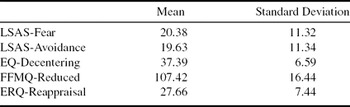
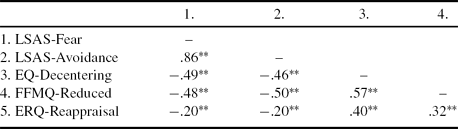
Table 1 presents the means and standard deviations for the variables. It is worth noting the LSAS-Fear and LSAS-Avoidance means in this sample (20.38 and 19.63, respectively) are higher than the means of 7.49 and 6.00 (for LSAS-Fear and LSAS-Avoidance, respectively) for the non-anxious control sample reported in Fresco et al. (Reference Fresco, Coles, Heimberg, Liebowitz, Hami and Stein2001). However, the means in the current sample are also substantially lower than those reported for a treatment seeking sample (means 38.72 and 35.90, respectively; Fresco et al., Reference Fresco, Coles, Heimberg, Liebowitz, Hami and Stein2001). Together this indicates that the present sample has a higher level of social anxiety than a typical non-clinical sample, but not as much social anxiety as would be expected in a clinical sample. Table 2 lists the zero-order correlations among the variables. Partial correlations among variables were run controlling for demographic variables such as gender, age, and race and ethnicity (dichotomized). There were no significant differences between any of the zero-order and partial correlations (Fisher's Z from 0.02 to 0.78); therefore none of the demographic variables were included in the models. As hypothesized, mindfulness and cognitive reappraisal were both negatively related to social anxiety and positively related to decentering. Likewise, there was a modest correlation between mindfulness and cognitive reappraisal.
Means and Standard Deviations of the social anxiety, decentering, mindfulness, and reappraisal variables

Notes: LSAS = Lebowitz Social Anxiety Scale; EQ = Experiences Questionnaire; FFMQ – Reduced = the Observing/Attending to Sensations, Describing, Acting with Awareness, and Nonjudging of Experience subscales of the Five Factor Mindfulness Questionnaire; ERQ = Emotion Regulation Questionnaire.
Correlations among study variables
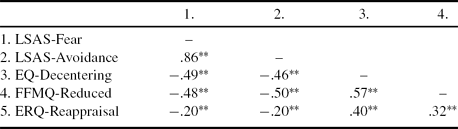
Notes: LSAS = Lebowitz Social Anxiety Scale; EQ = Experiences Questionnaire; FFMQ – Reduced = the Observing/Attending to Sensations, Describing, Acting with Awareness, and Nonjudging of Experience subscales of the Five Factor Mindfulness Questionnaire; ERQ = Emotion Regulation Questionnaire
** p < .001.
To better understand the combined influence of mindfulness and reappraisal on decentering and social anxiety, a set of models were run with the four latent variables and 12 observed variables. The initial model (Model 1) included direct paths from mindfulness and reappraisal to anxiety and indirect paths from both mindfulness and reappraisal through decentering to anxiety. As expected, the initial measurement model resulted in a fair fit to the data: χ2(49) = 235.94, p<.001; RMSEA = .07 (90% confidence interval: .06−.08); SRMR = .14; CFI = .97; and TLI = .96. The latent factors were well represented by their indicators as evidenced by the factor loadings all being significant (p<.001), with standardized factor loadings between .76 and .95. Examining the structural relationships in this model, the paths from mindfulness to anxiety [b = −0.93, SE = 0.13, 95%CI = −1.19 to −0.67, p < .001] and from decentering to anxiety [b = −1.78, SE = 0.26, 95%CI = −2.28 to −1.28, p < .001] were significant as were the direct paths from mindfulness to decentering [b = 0.33, SE = 0.02, 95%CI = 0.28 to 0.37, p < .001] and from reappraisal to decentering [b = 0.27, SE = 0.03, 95%CI = 0.20 to 0.33, p < .001]. The indirect paths from mindfulness through decentering to anxiety [b = −0.58, SE = 0.09, 95%CI = −0.75 to −0.40, p < .001] and from reappraisal through decentering to anxiety [b = −0.47, SE = 0.09, 95%CI = −0.65 to −0.30, p < .001] were both significant. However, with decentering in the model, the path from reappraisal to anxiety was not significant [b = 0.11, SE = 0.18, 95%CI = −0.24 to 0.46, p = .55].
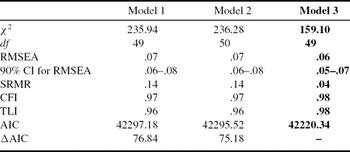
A series of two alternative models were compared to Model 1 (above) to determine the best fitting model. In addition to the fit statistics discussed above, the Akaike Information Criterion (AIC: Akaike, Reference Akaike1987) and the change in AIC values (ΔAIC) were also examined. Models with smaller AIC values represent better fitting models. To calculate the ΔAIC, the AIC from the best model is subtracted from the AIC of the current model. When ΔAIC values are greater than 10, the model is considered to have little or no support and it can be omitted from further consideration (Burnham and Anderson, Reference Burnham and Anderson2002). The fit statistics for each model are provided in Table 3. Given that the direct path from reappraisal to anxiety was not significant in Model 1 it was removed from Model 2. The results for Model 2 also showed a fair fit to the data. The chi-square difference test between Model 1 and Model 2 was not significant [χ 2diff(1) = 0.34, p = .56] and the ΔAIC value was less than 10. Therefore, Model 2 was retained. Next, because theory would suggest that there is a commonality between mindfulness and reappraisal, Model 3 included a path for the covariance between mindfulness and reappraisal. The chi-square difference test between Model 2 and Model 3 was significant [χ 2diff(1) = 77.18, p < .001] and the ΔAIC was greater than 10 indicating that the model including a relationship between mindfulness and reappraisal provided a better fit to the data.
Fit statistics for each of the structural equation models

Notes: Model 3 (in bold) was retained as the best fitting model. RMSEA = Root-Mean-Square Error of Approximation; 90% CI for RMSEA = confidence interval for the RMSEA; SRMR = Standardized Root-Mean-Square Residual; CFI = Comparative Fit Index; TLI = Tucker-Lewis Index; AIC = Akaike Information Criterion; ΔAIC values greater than 10 imply that the model has no support and can be omitted.
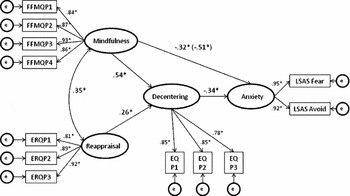
Taken together, Model 3 was retained as the best fitting model (see Figure 1). This model includes a significant direct effect from mindfulness [b = 0.32, SE = 0.02, 95%CI = 0.28 to 0.37, p < .001] and reappraisal to decentering [b = 0.25, SE = 0.04, 95%CI = 0.18 to 0.32, p < .001]. In other words, decentering increases by 0.32 points for every one point increase in mindfulness and 0.25 points for every one point increase in reappraisal. There are also significant direct effects from mindfulness [b = −0.93, SE = 0.14, 95%CI = −0.66 to −1.20, p < .001] and decentering to anxiety [b = −1.71, SE = 0.24, 95%CI = −1.24 to −2.17, p < .001] in that anxiety decreases by 0.93 points for every one point increase in mindfulness and decreases 1.71 points for every one point increase in decentering. Additionally, there were significant indirect effects from mindfulness and reappraisal through decentering to social anxiety [Mindfulness: b = −0.55, SE = 0.08, 95%CI = −0.39 to −0.72, p < .001; Reappraisal: b = −0.43, SE = 0.08, 95%CI = −0.26 to −0.60, p < .001]. Here social anxiety decreases by 0.55 points for every point increase in mindfulness and 0.43 points for every point increase in reappraisal after taking decentering into account. There was a significant correlation between mindfulness and reappraisal [r = .35, z = 7.85, p < .001]. Overall, this model accounted for 36% of the variance in anxiety and 46% of the variance in decentering.
Model of the relationships among mindfulness, reappraisal, decentering, and social anxiety (Model 3). Standardized parameter estimates are provided. Total effects (direct + indirect effects) are presented in parentheses.

Discussion
It was hypothesized that decentering is a key mechanism through which both mindfulness and cognitive reappraisal relate to social anxiety. Therefore, this study utilized structural equation modeling to examine the relationships between these variables using a cross-sectional design. Replicating previous research, individuals who reported higher levels of trait mindfulness or cognitive reappraisal also reported lower levels of social anxiety. In other words, individuals who either tend to approach the world with a more observant and non-judgmental stance or who are able to change what they are thinking or feeling in times of stress are more likely to report less social anxiety. Although causal relationships cannot be determined because of the cross-sectional design, it is possible that individuals who respond to potentially anxiety provoking situations with either mindfulness or reappraisal may be less likely to get caught in the spiral of anxiety. For example, if an individual can notice rising anxiety without reacting, he or she may not experience the experiential avoidance cycle that often results in increased anxious responding. Likewise, if he or she can notice the bias in interpretations of situations and reinterpret the situations, then it is possible that the anxiety will discontinue. However, it is also possible that this relationship is in the opposite direction in that with lower trait levels of social anxiety it may be easier to employ mindfulness or cognitive reappraisal. With lower levels of anxiety, individuals may have greater attentional resources to dedicate to these emotion regulation skills. Therefore, more prospective studies of the relationships among these variables are needed.
As expected, higher levels of mindfulness and cognitive reappraisal were both associated with more trait level decentering. There was also a medium-sized correlation between mindfulness and cognitive reappraisal indicating that individuals who report more mindfulness are also reporting more reappraisal. Taken together, it appears that there are both shared and unique components to mindfulness and reappraisal. In other words, whereas there is some expected overlap, the correlation is not so large as to suggest that the two measures are assessing the same construct.
Given that mindfulness and cognitive reappraisal were related to both decentering and social anxiety in this sample, we were interested in whether decentering accounted for the shared relationship between mindfulness or reappraisal and social anxiety. In these models, decentering accounted for a significant part of the shared variance between mindfulness and social anxiety, indicating that decentering may be one, but not the only mechanism linking mindfulness and social anxiety. As suggested in the Herbert/Cardaciotto model, one of the ways that anxiety is maintained is through an internally focused, often judgmental awareness. Therefore, mindfulness may help to shift this focus through decentering. However, as emphasized by Baer and colleagues (Reference Baer, Smith, Hopkins, Krietemeyer and Toney2006), there are several other facets of mindfulness making it likely that other aspects of mindfulness, such as self-compassion, are also impacting anxiety. More research is needed to determine which combination of theses aspects of mindfulness are most directly associated with social anxiety.
In this study, the link between cognitive reappraisal and social anxiety is fully explained by decentering. In other words, reappraisal may influence social anxiety because it is related to the ability to distance oneself from one's thoughts. According to the Rapee/Heimberg model, anxiety is maintained because the individual experiencing social anxiety is caught up in a cycle of predicting negative outcomes based on their internal representations of themselves in the situation compared to what they believe the audience expects. Therefore, being able to reappraise the situation should reduce anxiety. Given this, the important question is how do individuals engage in reappraisal in a meaningful way? Given the results of this study, it may be that reappraisal is related to anxiety because it involves a process of more objectively observing mental events. As stated by Blackledge (Reference Blackledge2007), a key component of decentering (defusion) is that it involves focused attention on the process of thinking rather than on the content of what is thought. Therefore it may not necessarily be a shift in the cognitions that is important for reappraisal, but rather the mental process through which reappraisal occurs. Future studies are needed to further assess whether reappraisal occurs specifically through this shift in cognitions or more generally from this mental process of thinking or from a combination of the two.
The implications and generalizability of this study are limited by the use of a predominately student sample; however, students at this urban, commuter school have demographic characteristics more similar to participants in typical community samples, rather than to typical undergraduate samples. The generalizability is further limited by the sample being predominantly female. Although this study is limited by the sample and the cross-sectional design, this study provides initial evidence that decentering may be a mechanism of change regardless of whether the focus is on the thought content (reappraisal) or on the thought process (mindfulness). As suggested by Arch and Craske (Reference Arch and Craske2008), it is important to start understanding the similarities and differences among these approaches and this study provides some initial evidence that decentering may be one of the commonalities. Decentering may be one of these commonalities; however, self-compassion (Van Dam, Sheppard, Forsyth and Earleywine, Reference Van Dam, Sheppard, Forsyth and Earleywine2011), perceived control (Leung and Heimberg, Reference Leung and Heimberg1996), and post-event rumination (Rachman, Gruter-Andrew and Shafran, Reference Rachman, Gruter-Andrew and Shafran2000), to name a few, also need to be considered. Likewise, although the sample used in this study was racially and ethnically diverse, it will be important to evaluate whether these relationships among mindfulness, reappraisal, decentering, and social anxiety remain consistent within individuals from specific racial or ethnic groups.
Although the current study is by no means a fair test of treatment strategies, it does have some modest implications for therapy. Whereas this model needs to be further tested in a clinical sample, the data from this study indicate that decentering, either through cognitive reappraisal or mindfulness, may be one strategy for lowering an individual's social anxiety. Although many of the current empirically supported therapies for social anxiety do have cognitive reappraisal or mindfulness components, these approaches do not always emphasize decentering as one of the mechanisms through which these components lead to change. Research is needed that specifically looks at mechanisms of change, such as decentering, across therapeutic approaches to further understand how it is that treatments for social anxiety lead to change. If in fact it is through decentering that both cognitive reappraisal and mindfulness have their effect, then training therapists to focus on enhancing decentering with their clients, regardless of what treatment approach is used, may further enhance clinical outcomes.
Acknowledgements
This study was supported by a National Institute of Mental Health grant (MH085060) awarded to the first author. The authors would like to thank Nick Mian and Alice Carter for their statistical consultation and Lizabeth Roemer for her support in the writing process.



Comments
No Comments have been published for this article.