Introduction
Begonia L. is one of the largest plant genera, including > 1820 currently accepted species, of which about 40% (c.710) are known only from the Americas (Hughes et al., Reference Hughes, Moonlight, Jara-Muñoz, Tebbitt and Pullan2015–). During herbarium studies of Peruvian Begonia, two new species were identified. Begonia speculum is endemic to the San Martín Region in northern Peru, and B. erythrothrix is endemic to the Cuzco Region in southern Peru. The recent dates of collection of most specimens seen of both species (only one collected > 20 years ago) highlight the importance of continued botanical exploration in the discovery of taxa with restricted ranges.
In common with most members of the Andean Begonia sect. Eupetalum (Lindl.) A.DC., B. speculum perennates from underground tubers; however, this species cannot be placed within the section with confidence. The majority of species currently classified in sect. Eupetalum perennate via either large tubers or large fleshy rhizomes and have relatively large flowers (Doorenbos et al., Reference Doorenbos, Sosef and De Wilde1998), whereas both the flowers and tubers of Begonia speculum are relatively small. Begonia speculum is also distinct from the majority of species in Begonia sect. Eupetalum in its entire placentae (shared only with B. lutea), and is unique in its two- or three-locular ovaries. Begonia speculum is morphologically most similar to the unclassified Bolivian Begonia cremnophila Tebbitt. These two species are saxicolous, both being found on calcareous substrates (although Begonia cremnophila occurs on both tufa and sandstone substrates), and have similar ovate subsymmetrical leaf blades, few-flowered asymmetrical dichasial cymes, persistent female tepals and bifid styles. We refrain from placing Begonia speculum within sect. Eupetalum, awaiting the completion of an ongoing molecular study of Andean Begonia (Moonlight et al., in preparation).
Begonia erythrothrix is unusual among Andean Begonia in possessing a creeping rhizome. Despite this, Begonia erythrothrix is perhaps most closely related to the tuberous Begonia thyrsoidea Irmsch. from southern Peru, rather than to other rhizomatous Andean Begonia. Begonia thyrsoidea is currently incorrectly classified in the Mexican Begonia sect. Quadriperigonia Ziesenh. as a result of a misunderstanding by Doorenbos et al. (Reference Doorenbos, Sosef and De Wilde1998) over the etymology of its epiphet. Begonia thyrsoidea does not possess the thyrsoid inflorescence structure characteristic of sect. Quadriperigonia, but rather a staminal column resembling a thyrsus, a type of Greek wand (see Tebbitt, Reference Tebbitt2015, for an illustration and further discussion). Begonia erythrothrix and B. thyrsoidea are morphologically aberrant species and cannot be placed in any existing section of Begonia. We refrain from classifying both species to section while we await molecular confirmation of their placement. All material cited has been examined.
Taxonomic Treatment
Begonia speculum Moonlight & Tebbitt, sp. nov. § Ignota. – Type: PERU. San Martín Region, Rioja Province, Bosque de Protección de Alto Mayo (BPAM), road from Amazonas to Rioja, km 393, 5°40′11′′S, 77°41′24′′W, 2 ii 2016, P.W. Moonlight & A. Daza 158 (holo MOL; iso E, HOXA, MO, USM). Figs 1, 2, 4.
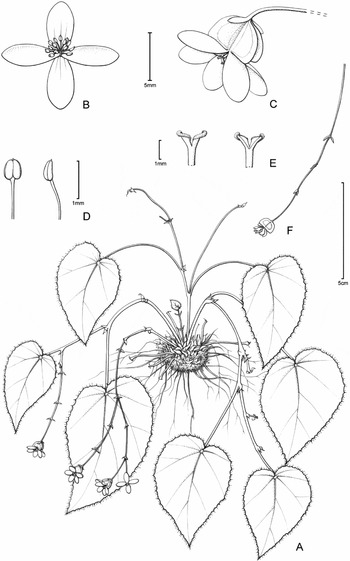
Begonia speculum Moonlight & Tebbitt. A, habit; B, male flower (front view); C, female flower (side view); D, stamen (front and side view); E, style (front and back view); F, branch of infructescence. Drawn from isotype P.W. Moonlight & A. Daza 158 (E).

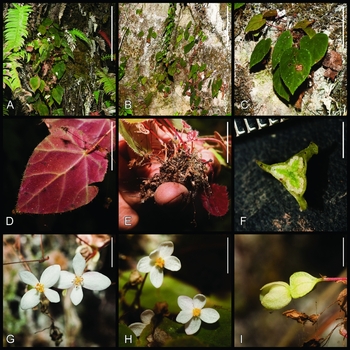
Begonia speculum Moonlight & Tebbitt. A and B, habitat (scale bar, 20 cm); C, habit (scale bar, 5 cm); D, leaf, abaxial surface (scale bar, 2.5 cm); E, tuber (scale bar, 2 cm); F, ovary, cross-section (scale bar, 3 mm); G, male flowers, front view (scale bar, 5 mm); H, female flowers, front view (scale bar, 10 mm); I, immature female flower, side view (scale bar, 5 mm). Photographs from type collection P.W. Moonlight & A. Daza 158.

Begonia speculum is most similar to B. lutea and B. cremnophila, sharing with both species its compact habit and subsymmetrical leaves but differing from both in having a true tuber (B. lutea and B. cremnophila have short, fleshy rhizomes), in its two- or three-locular ovaries (those of B. lutea and B. cremnophila are always three-locular) and in possessing bracteoles. Begonia speculum further shares its entire placentae with B. lutea but differs in its glabrous petioles, irregularly crenate leaf margins (those of B. lutea are irregularly biserrate) and white tepals (those of B. lutea are yellow). Begonia speculum can be further distinguished from B. cremnophila by its caulescent habit.
Caulescent, tuberous herb. Tuber subglobose, 1.5–2 × 1.5–3 cm. Stems 2–4 per tuber, erect, 10–90 × c.0.2 mm, unbranched, internodes 5–45 mm long, glabrous, pink to red. Stipules semipersistent, lanceolate, 1–4.5 × 1–2 mm, apex acute to mucronate, margin entire. Leaves 2–4, alternate, basifixed; petiole oriented c.20° from the direction of the main vein of blade, 8–70 mm long, glabrous, pink to red; blade subsymmetrical, ovate, 20–65 × 12–35 mm, succulent, apex acute, base shallowly cordate, basal lobes not overlapping, sinus 2–4 mm deep, margin irregularly crenate, ciliate, the hairs to 2 mm, red, upper surface glabrous, copper to dark green, lower surface glabrous, red, veins palmate, 5–7, secondary veins indistinct. Inflorescences 1–3, axillary, arising from axis of each leaf, erect, an asymmetrical dichasial cyme, with 1–4 branches, bearing up to 4 male flowers and up to 4 female flowers, usually protandrous but basal-most female flower often opening concurrently with the apical male flower; peduncle 15–55 mm long, glabrous; pedicels of male flowers 4–15 mm long, glabrous; pedicels of female flowers 10–20 mm long, glabrous; bracts persistent, elliptic to lanceolate, 2–4 × 1–1.5 mm, apex obtuse, margin entire, glabrous, pale green. Male flowers: tepals 4, spreading, white, outer 2 elliptic to obovate, 6–7 × 3–4 mm, apex obtuse, margin entire, glabrous, inner elliptic to oblanceolate, 4–6 × 2.5–3 mm, apex acute to obtuse, margin entire, glabrous; stamens 15–20, spreading, yellow, filaments 1–3 mm long, on a 0.5-mm column, anthers cuboid, 0.5–0.75 mm long, dehiscing by lateral slits, connectives projecting to 0.1 mm, symmetrically basifixed. Female flowers: bracteoles 2, positioned directly below the ovary, lanceolate, 1.5 × 0.5 mm, apex acute, margin entire, glabrous, light green to red; tepals persisting in fruit, 5, spreading, white, flushed light green, narrowly elliptic to obovate, equal, 5–6 × 3–5 mm, apex obtuse to rounded, margin entire, glabrous; ovary body ovoid, 3.5–6 × 3.5–6 mm, glabrous, light green, equally 3-winged, wings rounded-oblong, marginal, 0.5–1 mm tall; 2- or 3-locular, placentae entire, bearing ovules on both surfaces; styles 2 or 3, yellow, free to base, 2–3 mm long, 2-lobed, stigmatic papillae in a band around the lobes. Fruiting pedicel to 25 mm long. Fruit a capsule, body globose, to 6 × 6 mm, glabrous, drying brown, wings same shape as in ovary, expanding to 2.5 mm tall. Seeds not examined.
Phenology
Begonia speculum has been collected in flower and fruit in February, and in flower in early July.
Distribution
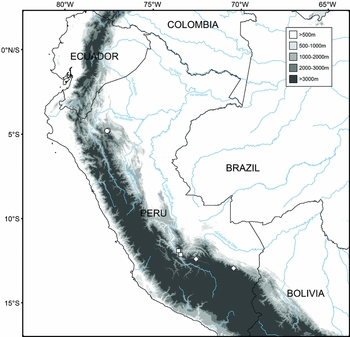
Begonia speculum is known only from the Peruvian region of San Martín (Rioja Province).
Habitat
Begonia speculum grows as a lithophytic herb on limestone in subtropical to montane forest at an altitude of 1335–1800 m. It typically grows on vertical rocks under a dense canopy, with its tuber covered in either moss or alkaline soil. Associated species include two undescribed and distantly related Begonia species (P.W. Moonlight & A. Daza 156 and 169). No hybrids between Begonia speculum and these species were observed.
IUCN conservation category
Begonia speculum is known only from two localities in Bosque de Protección de Alto Mayo (BPAM) in Rioja Province, Peru. The first is the type locality of the ‘kovachii orchid’, Phragmipedium kovachii J.T.Atwood, Dalström & Ric.Fernández (= Phragmipedium peruvianum Christenson). Visitors are only permitted to visit this site with a park guide, and the trail head is continually manned by armed guards. Although Begonia speculum could not be relocated at this site during fieldwork in February 2016, it was probably dormant rather than extirpated. The second site is an apparently stable population of about 1000 plants located on an outcrop of limestone immediately adjacent to the 5N highway. Although this site is within BPAM, a footpath was observed by the limestone outcrop leading to a small plantation or ‘chacre’. The vicinity of the road leaves this population vulnerable to anthropomorphic disturbance. We consider it likely that Begonia speculum will be found at other limestone outcrops within BPAM, such as the six other known localities of Phragmipedium peruvianum. However, the very small area of occupancy of Begonia speculum (<1 km2) will probably not increase significantly if similar-sized populations are discovered, and leaves it vulnerable to stochastic events. Accordingly, we assess Begonia speculum as Vulnerable (VU D2) according to IUCN criteria (2016).
Etymology
The epithet ‘speculum’ is derived from the Latin word for ‘mirror’ and emphasises the symmetry of the leaves and male flowers, and the occasional two-locular ovary and two styles of the female flowers of this species.
Additional specimens examined. Peru. Region San Martín, Prov. Rioja, Bosque de Protección de Alto Mayo (BPAM), 5°42′S, 77°44′W, 9 vii 2010, M. M. Mora & J. Pérez 883 (USM).
All plants observed at the type location during fieldwork in January 2016 possessed three-winged fruit and three-locular ovaries, whereas the paratype in USM has two-winged fruits and two-locular ovaries. The latter collection consists of a single plant, and it is unclear whether this character state is the norm among this population. Further fieldwork is necessary to determine the level of variation among populations of Begonia speculum.
Further colour photographs of the collection Moonlight & Daza 158 are available via the Begonia Resource Centre (Hughes et al., Reference Hughes, Moonlight, Jara-Muñoz, Tebbitt and Pullan2015–).
Begonia erythrothrix Tebbitt & Moonlight, sp. nov. § Ignota. – Type: PERU. Region Cuzco, Prov. La Convención, Distr. Echarati, E río Apurimac NE Pueblo Libre, up mountain of Anchihuay & Bellavista, south Cordillera Vilcabamba, 12°51′S, 73°30′W, 3 viii 1998, P. Nuñez, W. Nauray, R. de la Colina & S. Udvardy 23400 (holo CUZ; iso US, USM). Figs 3, 4.
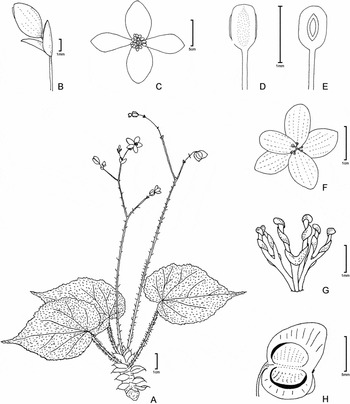
Begonia erythrothrix Tebbitt & Moonlight. A, habit; B, fully expanded male flower bud and associated bracts (side view); C, male flower (front view); D, stamen (front view); E, stamen (side view); F, female flower (front view); G, group of three styles and stigmas; H, mature dehiscent fruit. A, C–H, drawn from holotype P. Nuñez, W. Nauray, R. de la Colina & S. Udvardy 23400 (holo CUZ; iso US, USM); B, drawn from T. R. Dudley 10618 (US).

Distribution of Begonia speculum Moonlight & Tebbitt (circles), B. erythrothrix Tebbitt & Moonlight (squares) and B. thyrsoidea Irmsch. (diamonds). Shading indicates altitude.

Begonia erythrothrix Tebbitt & Moonlight is similar to B. thyrsoidea, differing by lacking an aerial stem and instead having a creeping rhizome (B. thyrsoidea has an aerial stem 15–30 cm long but lacks a rhizome), by its much shorter and thicker internodes (c.3 mm long and 1–8 mm diam. in B. erythrothrix versus 0.8–7.5 cm long and c.1 mm diam. in B. thyrsoidea), by its larger and more prominent stipules (3–10 × 2–3 mm in B. erythrothrix versus 1–5 × 0.75–2 mm in B. thyrsoidea), by its finely serrate leaf margin that lacks crenate lobes (B. thyrsoidea has leaf margins that are dentate and shortly crenately lobed), by its glandular-hispid pedicels (B. thyrsoidea has glabrous pedicels) and by its bright red flowers (the tepals of B. thyrsoidea are white with a pink flush on the outer surfaces of the outer pair).
Acaulescent, rhizomatous herb, leaves and inflorescences arising from apex of rhizome. Rhizome ≥ 40 × 1–8 mm. Stipules persistent, ovate, 0.3–1 × 0.2–0.4 cm, apex acute, aristate, terminal hair c.2 mm long, margin entire. Leaves 1–4, alternate, basifixed; petiole joining blade at an angle, 1.2–10.5 cm long, densely hispid; blade asymmetrical, ovate, 3–11 × 2–6 cm, apex acuminate, base cordate, basal lobes spreading, sinus 0.5–1 cm deep, margin serrate, teeth 0.5–1.5 mm long, teeth ending in red hairs, upper surface glabrous to sparsely pubescent, hairs simple, 2–2.5 mm long, lower surface sparsely to moderately pubescent, hairs 2–2.5 mm long, simple, upper surface yellowish green with reddish pink venation (Dudley), lower surface reddish purple maculate (Dudley), veins palmate, 6 or 7. Inflorescences 1–3, cymose, asymmetrical, bisexual, male flowers starting to open before female but eventually both open concurrently; peduncle 7.8–11.5 cm long, with a moderate covering of glandular hispid hairs; pedicels of male flowers 0.25–1.8 cm long, glabrous; pedicels of female flowers 0.6–1.8 cm long, glabrous; bracts tardily deciduous, ovate, c.3 × 1–2 mm, apex acute, terminating in a 0.5–1 mm long hair, margin entire, margin and both surfaces glabrous. Male tepals: 4, spreading, white, outer pair with a pink (Nuñez et al.) or red (Dudley) tinge, elliptic, 0.6–2 × 0.3–1 cm, apex obtuse, margin entire, glabrous; inner pair obovate, 0.6–2.2 × 0.3–1.2 cm, apex obtuse, margin entire, glabrous; stamens 15–30, attached along the length of a slender 2–2.75 mm tall column, filaments 1–2 mm long, anthers subglobose, 0.5–0.75 mm long, symmetrically basifixed, dehiscing via lateral slits along sides of locules, connective not projecting. Female flowers: bracteoles absent, tepals not persisting in fruit, tepals 5, spreading, white, outer 3 with a pink (Nuñez et al.) or red (Dudley) tinge, outermost 3 ovate to elliptic, 0.65–1.3 × 0.4–0.7 cm, apex subacute, margin entire, innermost 2 elliptic, 0.65–1.3 × 0.6–0.95 cm, apex obtuse, margin entire; ovary body broadly ellipsoid, 0.3–1 × 0.2–0.5 cm, glabrous, unequally 3-winged, longest wing subtriangular, apex obtuse, 0.2–0.7 cm tall, shorter 2 wings rounded and following contour of locules, apex indistinct, 0.1–0.4 cm tall; 3-locular, placentae not observed; styles 3, shortly fused at base, slender, 2.5–4 mm tall, bifid from ± half their height, branches erect, stigmatic papillae in a spiral band. Fruiting pedicels 1–2.2 cm long. Fruit a capsule, subnutant, body ± spherical, ovary body to 1 × 1 cm, glabrous, wings same shape and size as in mature ovary. Seeds not examined.
Phenology
Begonia erythrothrix has been collected in flower and fruit in early March and late June.
Distribution
Begonia erythrothrix is known from only two collections made c.29 km apart in La Convención Province (Cuzco Region) Peru.
Habitat
Begonia erythrothrix grows on steep cliff faces in cloud forest at an altitude of 1750–2445 m.
IUCN conservation category
We have not had the opportunity to observe this species in the wild. Accordingly, we assess Begonia erythrothrix as Data Deficient (DD) according to IUCN criteria (2016).
Etymology
The name ‘erythrothrix’ refers to the dense indumentum of red hispid hairs that covers the petioles and peduncles of this species.
Additional specimens examined. Peru. Dep. Cuzco, Prov. La Convención, Knox's cascade, c.2 km NW of camp 2½, 12°38′S, 73°38′W, 29 vi 1968, T. R. Dudley 10618 (US).
Begonia thyrsoidea Irmsch. § Ignota, Bot. Jahrb. Syst., 74: 610, 1949. – Type: Peru. Region Cuzco, Prov. Calca, Lares Valley between Calca and Pasto Grande, 11 iii 1929, A. Weberbauer 7927 (lecto B (barcode B 10 0186590); isolecto B (barcode B 10 0186591), BM, F, GH, NY, US here designated). Fig. 4.
Caulescent, tuberous herb. Tuber narrowly ellipsoid to subglobose, 1.5–3 cm diam., 0.5–1.1 cm tall. Stems 1–5 per tuber, sprawling, geniculate, c.1 mm diam., 15–30 cm long, unbranched or few-branched, internodes 0.8–7.5 cm long, sparsely pubescent to velutinous. Stipules persistent, ovate to lanceolate, 1–5 × 0.75–2 mm, apex acute, aristate, margin irregularly lacerate-ciliate. Leaves 3–7 per stem, alternate, basifixed; petiole oriented in same direction as the main vein of blade or joining blade at an angle, gradually becoming smaller from base of plant to the apex, 0.6–16 cm long, sparsely pubescent or velutinous; blade asymmetrical, lanceolate-ovate to ovate, 1.5–7 × 2–7 cm (gradually becoming smaller from base of plant to the apex), apex acute, base cordate, basal lobes not overlapping or overlapping at their bases, sinus 0.5–1.8 cm deep, margin shortly crenate lobed, 1–5 mm deep, lobes themselves dentate, teeth tipped with a short hair, rather thin, upper surface dark green with a sparse to moderate covering of minute reddish hairs, lower surface pale green with a burgundy tinge to burgundy throughout or sometimes lamina undersurface burgundy and veins pale green, sparsely to densely pubescent along the veins and moderately pubescent elsewhere, venation palmate-pinnate, 6–9. Inflorescences 1–6, axillary, asymmetrical cymes bearing 2 or 3 flowers, male flower opening first but eventually flowers of both sexes open concurrently; peduncle 3–7.5 cm long, glabrous to sparsely pubescent; pedicels of male flowers 0.6–2 cm long, glabrous; pedicels of female flowers 1–1.7 cm long, glabrous or with a few scattered microscopic glandular hairs; bracts persistent, ovate, oblong or narrowly obovate, 2–4 × 1–2 mm, apex acute, margin irregularly lacerate-ciliate. Male flowers: tepals 4, spreading, white, outer pair with a pink tinge on outer surfaces, obovate or almost elliptic, 5–9 × 3–4 mm, apex obtuse, margin entire, glabrous; inner pair elliptic or oblong, 3–7 × 2.5–4 mm, apex obtuse, margin entire, glabrous; stamens 15–20, attached to upper half of a slender 2–2.75 mm long column, filaments 0.5–1.5 mm long, anthers cuboid, c.0.75 mm long, dehiscing by slits on sides of locules, connectives not projecting, symmetrically basifixed. Female flowers: bracteoles absent; tepals not persisting in fruit, 5, spreading, white, outermost 3 pink-tinged or pink on outer surfaces, narrowly elliptic to narrowly obovate; innermost 2 obovate, subequal, 4–5.5 × 2–3 mm, apex obtuse, margin entire, glabrous; ovary body ellipsoid to obovoid-ellipsoid, 3–5 × 2–4 mm, green with a burgundy tinge, glabrous, unequally 3-winged, longest wing subtriangular, apical edge ± truncate, basal edge steeply sloping to base of ovary, apex acute or obtuse, 2.5–4.5 mm tall, shorter 2 wings following contour of body with a broad obtuse apex, c.0.5 mm tall; 3-locular, placentae bifid, bearing ovules on both surfaces; styles 3, shortly fused at base, slender, 2.5–3.5 mm long, bifid from a little above half their height, branches erect, stigmatic papillae in a spiral band. Fruiting pedicel 1.3–1.7 cm long. Fruit a capsule, subnutant, body almost spherical, to 7 × 6.5 mm, glabrous, largest wing ligulate, to 1 cm tall, shorter 2 wings same shape as in ovary, to 2 mm tall. Seeds ellipsoid, 321–417 × 179–217 µm; collar region occupying 1/3 of seed length; operculum nipple-shaped, 70–80 µm long; testa cells 3–4 along long axis of seeds; cuticle of collar and testa cells sparsely covered with very faint undulated striae and underlying pits visible, the striae of the collar cells 5–20 µm long.
Phenology
Begonia thyrsoidea has been collected in flower in January and March and in fruit in March.
Distribution
Begonia thyrsoidea is endemic to Peru, where it has been collected from the Cuzco Region (Calca Province) and the Puno Region (Carabaya Province).
Habitat
Begonia thyrsoidea typically grows in shady, humid situations, on vertical surfaces of large moss-covered rocks, within subtropical forest, at altitudes between 1240 and 1950 m.
IUCN conservation category
Begonia thyrsoidea has been collected on only two occasions in Peru, once in March 1929 from the Cuzco Region (Calca Province) and once in January 2015 in the Puno Region (Carabaya Province). Fieldwork during the January 2015 season failed to relocate the species at the type locality. Suitable habitat is still located in this general area, although there has been large-scale forest clearance associated with the cultivation of coffee in the Lares Valley since 1929, and it is possible that the species has been locally extirpated as a result. The rugged nature of this region and the constraint of only having 3 days to explore the Lares Valley meant that it was not possible to conduct a thorough search of the area, so it is possible that populations of this species still occur on some of the more inaccessible cliffs within this valley. In Puno's Carabaya Province, Begonia thyrsoidea was observed to be locally common, with several hundred plants occurring along an approximately 1.5-km stretch of forest margin. This site is not within a protected area and is close to a road and the San Gabon II Hydroelectric Substation, and so is potentially vulnerable to anthropomorphic disturbance. The species was newly located at a considerable distance (c.200 km) from its original collection site, but the area between these two sites was not thoroughly explored by us, so we assess Begonia thyrsoidea as Data Deficient (DD) according to IUCN criteria (2016). However, because Begonia thyrsoidea appears to occupy a precise microhabitat (shady, humid vertical moss-covered rocks), it probably has a distribution that is patchy and small in total area because of the limited occurrence of this precise kind of habitat. As a result, it probably falls within one of the threatened categories. Future fieldwork should target this species so that its IUCN status may be accurately assessed.
Additional specimens examined. Peru. Puno Region, Carabaya Province, San Gabon District, Between Ollachea and San Gabon, km 259 + 200, below the hydroelectric substation San Gabon II, 13°38′S, 70°27′W, 9 i 2015, M. C. Tebbitt & A. Daza 809 (E, MOL).
Begonia thyrsoidea Irmsch. is here newly lectotypified. In his original description of this species, Irmscher (Reference Irmscher1949) cites the collection Weberbauer 7927 located in Berlin (B) and Chicago (F); he does not, however, designate a holotype specimen. Our herbarium-based studies found that additional type material is also located in four other herbaria (BM, GH, NY and US) and that two sheets of the type collection are housed in the Berlin herbarium. We designate the Berlin sheet with the barcode number B 10 0186590 as the lectotype of Begonia thyrsoidea Irmsch. This sheet was chosen because it is annotated by Irmscher and consists of three almost complete plants (they lack their rootstocks but collectively possess flowers and fruit). The other specimen at B (barcode B 10 0186591) consists of just a few fragmentary parts, and there is no indication on this sheet that these fragmentary parts came from either the other Berlin specimen or the specimen in the Chicago Field Museum.
Colour photographs of the collection Tebbitt & Daza 809 have been published in Tebbitt (Reference Tebbitt2015) and are available via the Begonia Resource Centre (Hughes et al., Reference Hughes, Moonlight, Jara-Muñoz, Tebbitt and Pullan2015–).
Acknowledgements
We thank the curators of AAU, B, BKL, BM, BR, BRIT, C, CAS, CGE, COL, CPUN, CUZ, E, E-GL, F, G, GB, G-BOISS, G-DC, G-DEL, GH, GOET, HOXA, HUT, K, LIL, LPB, MEDEL, MO, MOL, MOL-WEB, NY, OXF, P, QCA, QCNE, QPLS, S, SEL, TEX, UC, US, USM, USZ, W and Z for loaning material or allowing us to work in their herbaria, and Adolfo Jara Muñoz for providing photographs of specimens housed at COAH. We thank the Ministario del Ambiente del Perú for granting us permission to conduct the fieldwork and collect specimens, and the University of Edinburgh Davis Expedition Fund, the James and Eve Bennett Trust and the American Begonia Society for funding the fieldwork. We also thank Claire Banks for providing the artwork of Begonia speculum, and the M.L. MacIntyre Begonia Trust for scholarship support for PM.