Introduction
Pesticide legislation in the European Union (EU), at the EU level and nationally, is generally considered the most comprehensive and stringent in the world, and this view was reinforced in 2010 with the launch of the “Thematic Strategy on the Sustainable Use of Pesticides” (https://eur-lex.europa.eu/legal-content/EN/TXT/?uri=LEGISSUM%3Al28178). This opinion was substantiated by a recent study revealing that 72 pesticides approved for outdoor agricultural use in the United States are banned or in the process of a complete phase-out in the EU and that pesticides banned in the EU accounted for more than 25% of agricultural pesticides used in the United States (Donley Reference Donley2019). The differences between the United States and Brazil and China were less pronounced, with 17 and 11 pesticides, respectively, banned or in the process of being banned in these two countries but still in use in the United States (Donley Reference Donley2019).
Pesticides are attracting a lot of public attention in the EU, and many nongovernmental organizations (NGOs) particularly target pesticide regulation. This trend is reinforced by the frequent media reports about findings of pesticide residues or their metabolites in groundwater, surface water, or food. Over time, the focus on pesticides in the public debate has influenced politicians and decision makers, which has been reflected in recent EU pesticide legislation. On the other hand, because of strict pesticide regulation, there is a widespread concern among farmers in the EU that effective control of weeds and other pests will become difficult in the future (Hillocks Reference Hillocks2012). To accommodate this situation, the EU has, among other initiatives, launched a number of research activities on alternative control measures and innovative cropping systems that can minimize pest occurrences and their impact on crop yield and quality (Lamichhane et al. Reference Lamichhane, Dachbrodt-Saaydeh, Kudsk and Messean2016). Recently, a project solely dedicated to integrated weed management was launched (https://www.iwmpraise.eu). Nonetheless, pesticide use in most EU member states has not been reduced (European Environment Agency 2018).
In this paper, a short introduction to the pesticide legislation in the EU, in particular, Regulation 1107/2009 (http://data.europa.eu/eli/reg/2009/1107/oj) and Directive 2009/128 (http://data.europa.eu/eli/dir/2009/128/2009-11-25), will be given and the consequences of the lower number of available herbicides for the agricultural and horticultural industry in the EU will be discussed. Following this overview, we will focus on the glyphosate controversy that arose just before the planned renewal of the approval of glyphosate in 2015. The discussions for and against glyphosate are still ongoing and will, for sure, intensify as we get closer to the expiration of the current glyphosate approval in 2022. Finally, we will summarize the outcome of the reports on the potential impacts of a glyphosate ban that was published recently in some EU member states as a response to the glyphosate controversy and highlight some of the challenges that EU farmers are facing should glyphosate be banned.
Pesticide Legislation in the EU
Pesticide regulation in the EU is based on Regulation 1107/2009, which provides the harmonized rules for approval of pesticide active ingredients, and Regulation 395/2006, which deals with maximum residue limits in food and feed. Directive 2009/118, the so-called Sustainable Use Directive (SUD), complements the two regulations. In this section the content, implementation, and impacts of Regulation 1107/2009 and the SUD will be discussed.
Regulation 1107/2009
In Regulation 1107/2009, the requirements for authorization of active ingredients are stipulated. Pesticide approval in the EU is a dual process. Approval of active ingredients is at the EU level, while authorization of commercial products containing approved active ingredients is the responsibility of the individual EU member states.
The active ingredient dossier submitted by the applicant is assessed by a rapporteur and co-rapporteur EU member state that submits a draft assessment report to the European Food Safety Agency (EFSA). To ensure consistency in the evaluation, a scientific peer review is conducted by EFSA. Finally, the European Commission (EC) conducts a risk management assessment, and, if endorsed by the Standing Committee of Plants, Animals, Food and Feed, approval will be granted, typically for 10 years.
Regulation 1107/2009 went into force in 2011, replacing Directive 91/414/EEC, and one of the main changes was that approval of active ingredients no longer is based on a risk assessment but on a hazard-based approach examining whether the active ingredient presents a hazard to human health and the environment. Hazard criteria are in place, for example, for compounds classified as category 1 and 2 CMRs (carcinogenic, mutagenic, and reprotoxic) and PBTs (persistent, bioaccumulative, and toxic for the environment) and for compounds classified as endocrine disruptors.
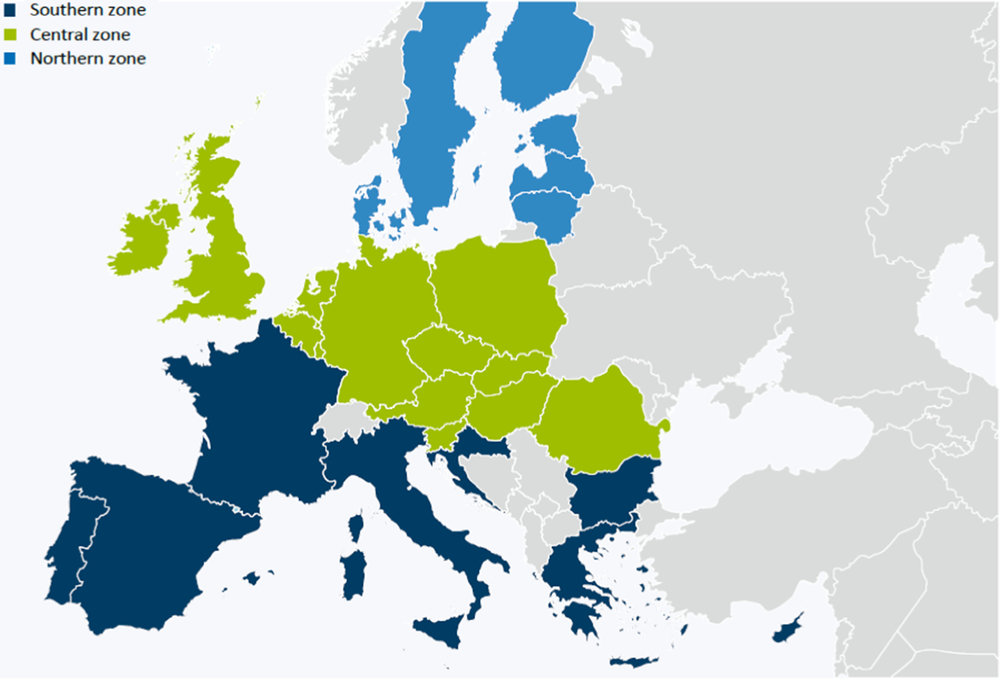
If an active ingredient is approved, authorizations of commercial pesticides containing the active ingredient can subsequently be granted by member states. Authorization of commercial pesticides is done as a zonal assessment (the EU is divided into northern, central, and southern administrative zones), wherein one country will do the assessment on behalf of the other countries in the zone (Figure 1). If approved by the zonal rapporteur, the pesticide subsequently can be authorized by other member states in the zone without further assessment.
European Union administration zones for authorization of commercial pesticides (EC 2018).

Another novel feature of Directive 1107/2009 was the implementation of the principle of substitution. A comparative assessment must be conducted for all uses of commercial products containing active substances with certain hazardous properties and a relatively higher risk of environmental and human toxicity, the so-called Candidates for Substitution (CfSs). Initially, the EU published a list of CfSs with 77 active ingredients. The purpose of the comparative assessment is to assess whether a nonchemical solution or a pesticide not containing a CfS can be substituted for a pesticide containing a CfS. Comparative assessment is intended to ensure that products containing CfSs are only authorized if there are no alternatives with a significantly lower risk to human health and the environment that can be used without agronomic or economic disadvantages. Because the availability of products and agricultural practices vary between countries, comparative assessments are conducted at the national level. So far, comparative assessments have resulted in very few substitutions. With Regulation 1107/2009, active ingredients are, figuratively speaking, divided into the “good” ones (those fulfilling the hazard criteria), the “bad” ones (those up for comparative assessment) and the “evil” ones (those not fulfilling the hazard criteria), with the first group rapidly decreasing in number.
Another important aspect, considering pesticide authorization in the EU, is the precautionary principle as a legal benchmark for decision making by authorities (Løkke and Christensen Reference Løkke and Christensen2008). The precautionary principle is applied widely in environmental policy in the EU, and the provisions of both Regulation 1107/2009 and the SUD are based on the precautionary principle, that is, EU countries cannot be prevented from applying this principle (Pelaez et al. Reference Pelaez, da Silva and Araújo2013). The precautionary principle allows authorities not to authorize a pesticide where there is scientific uncertainty as to the risks with regard to human and animal health or the environment. In the recent glyphosate controversy, the precautionary principle was frequently referred to by those not favoring renewal of glyphosate. A similar principle does not exist in the regulatory framework for pesticide authorization in the United States (Pelaez et al. Reference Pelaez, da Silva and Araújo2013).
Pesticide authorization in the EU is under constant scrutiny for not providing a sufficient level of human health and environmental protection. For example, Stehle and Schultz (Reference Stehle and Schultz2015) and Zubrod et al. (Reference Zubrod, Englert, Feckler and Koksharova2015) concluded that the EU risk assessment did not provide an adequate level of protection of aquatic ecosystems from insecticides and fungicides, respectively. Pesticide producers and farmers’ organizations, on the other hand, complain about the loss of active ingredients, the difficulties in obtaining approval of new active ingredients, and timelines that are exceeded for many products. The EU legislation on pesticides is currently being evaluated and an external study intended to support the evaluation was recently published (EC 2018). A number of topics are highlighted in the report, most of them addressing administrative issues. Of more agronomic relevance, the report concludes that the availability of pesticides for minor uses (minor crops or minor uses in major crops) is negatively affected by a lack of full implementation of Regulation 1107/2009 and alternative methods are not sufficiently evaluated and used as substitutes for pesticides.
Sustainable Use Directive
The purpose of the SUD is to regulate the use of pesticides, provide a framework to achieve sustainable pesticide use, and promote low-pesticide farming in the EU. The directive lays down a number of obligations for EU countries: for example, compulsory training for professional users, distributors, and advisors; raising public awareness of the risks of pesticide use; and taking specific measures to protect the aquatic environment and drinking water. Each EU country is obliged to develop a national action plan listing indicators and laying out timetables to achieve the aims of the SUD.
More specifically, the SUD highlighted the term “integrated pest management” (IPM), stating that as of January 1, 2011, all professional users of pesticides were obliged to follow the eight principles of IPM laid out in an appendix to the directive (Barzman et al. Reference Barzman, Bàrberi, Birch, Boonekamp, Dachbrodt-Saaydeh, Graf, Hommel, Jensen, Kiss, Kudsk, Lamichhane, Messéan, Moonen, Ratnadass and Ricci2015). Whereas the EU member states have fulfilled many of the other obligations, the implementation of IPM at the farm level has been highlighted several times as an area where the SUD has not met its aim. In several EU member states, steps have been taken to speed up and monitor the level of IPM implementation at the farm level.
Implications of the EU Pesticide Regulation on EU Farming
Strict regulation in the EU has removed a number of widely used pesticides from the market. Examples of herbicide active ingredients banned/withdrawn by the manufacturer or in the process of being banned in the EU, but still used in the United States, are alachlor, atrazine, dichlobenil, diquat, EPTC, glufosinate, paraquat, and most recently, desmedipham. It is expected that several other herbicide active ingredients will be banned following the ongoing reauthorization process. The number of herbicide active ingredients authorized in the EU in 2017 was 78, a slight increase compared with 2010 (European Environment Agency 2018). In major crops like small grain cereals, maize (Zea mays L.), oilseed rape or canola (Brassica napus L.), and potatoes (Solanum tuberosum L.), the loss of active ingredients has, so far, not had any severe implications for agricultural weed control, but with the recent decision to ban diquat in 2020, EU potato growers are facing a serious problem with no effective herbicides authorized to desiccate potato haulm. Nonetheless, with the loss of active ingredients, a reduction in the number of available modes of action has been observed, and that has made resistance management more difficult (Moss et al. Reference Moss, Ulber and den Hoed2019). In minor crops, including many vegetable and fruit crops, some weed species can no longer be controlled chemically due to the lack of effective herbicides, despite a strong focus within the EU on promoting solutions for minor crops via minor use authorizations (Lamichhane et al. Reference Lamichhane, Arendse, Dachbrodt-Saaydeh, Kudsk, Roman, van Bijsterveldt-Gels, Wick and Messéan2015).
Glyphosate Use and the Glyphosate Controversy
The recent controversy surrounding glyphosate in the EU has turned the spotlight on the political debate on pesticides in the EU. Here we will briefly discuss glyphosate’s history and use in the EU, summarize the recent controversy, and outline the potential consequences of a glyphosate ban for EU agriculture.
Glyphosate History and Use in the EU
Glyphosate was approved in 2002 for the first time at the EU level for a duration of 10 years under a directive replaced in 2011 by Regulation 1007/2009, but glyphosate had been on the market in most countries under national legislation since the 1970s. Glyphosate products are authorized for a wide variety of crop and non-crop uses. As there is no cultivation of genetically engineered (GE) glyphosate-resistant crops in the EU, in-crop use of glyphosate is restricted to perennial crops like pome fruits and vineyards and shielded interrow applications in row crops. The majority of glyphosate is used either pre-sowing/PRE or postharvest, for example, in stubble. There is also some use in mature crops shortly before harvest (preharvest use) to control perennial weeds and annual weeds that survived the use of selective herbicides and for crop desiccation, in particular in the northern parts of the EU, due to a more humid climate. This use was previously the focus of the public glyphosate debate. Many farmers also found it ethically unacceptable to treat crops a few days before harvest. Besides uses in crops, there are a number of authorized non-crop uses on railways, hard surfaces, and so on, but it is noteworthy that the aquatic use of glyphosate is authorized in very few EU countries. There are no statistics on the sales of individual active ingredients for the whole of the EU, only at member-state levels. In spite of the absence of GE glyphosate-resistant crops in the EU, glyphosate is the most widely used pesticide in many EU countries due to its unparalleled action on both annual and perennial weeds (Duke et al. Reference Duke, Powles and Sammons2018).
The Glyphosate Controversy
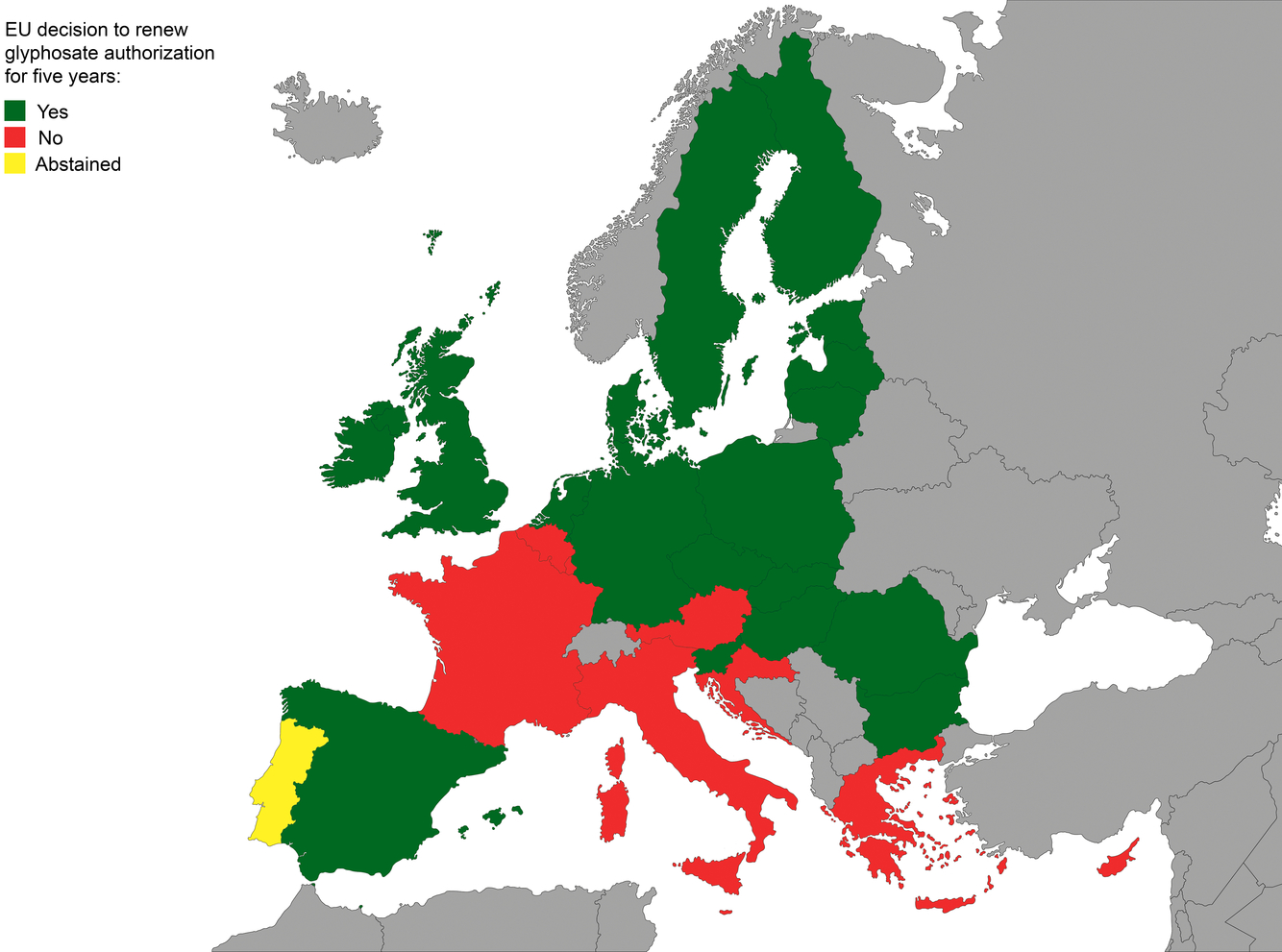
In 2010, the European Commission extended the approval of glyphosate until the end of 2015, and in the meantime, the German authorities, acting as the rapporteur member state, reviewed the documentation submitted by the glyphosate task force, a consortium of glyphosate manufacturers. The German authorities handed in their initial risk assessment (the “draft assessment report”) at the end of 2013, and EFSA initiated the peer review. One of the conclusions of the draft assessment report was that glyphosate was not carcinogenic. In March 2015, the International Agency for Research on Cancer (IARC) of the World Health Organization (WHO), in an assessment of glyphosate, concluded that the compound was “probably carcinogenic to humans.” This reopened the EU assessment of glyphosate, and the German authorities and EFSA were asked to consider IARC’s findings in their risk assessment. Meanwhile, the approval of glyphosate was extended to the end of June 2016 to allow time for this additional risk assessment. In November 2015, EFSA concluded that glyphosate was “unlikely to pose a carcinogenic hazard to humans,” but the agency did raise concerns about some of the substances used in some commercial glyphosate products such as polyethyloxylated tallow amine (POE-T) surfactants. In February 2016, the European Commission proposed, on the basis of EFSA’s conclusions, to renew the approval of glyphosate for 15 years; however, many member states in the Standing Committee of Plants, Animals, Food and Feed abstained from voting, and the proposal failed to gain support from a qualified majority of member states. Again, the approval of glyphosate was extended, this time to the end of 2017 to allow the European Chemical Agency (ECHA) to assess the potential carcinogenicity of glyphosate. In March 2017, ECHA, like EFSA, concluded that glyphosate could not be classified as a carcinogen. In the meantime, the European Commission banned the use of POE-T surfactants admixed with glyphosate. Meanwhile, NGOs like Greenpeace and Pesticide Action Network put more and more pressure on politicians and other policy decision makers not to renew glyphosate, and “Stop Glyphosate,” a “European citizen” initiative, collected more than a million signatures. Partly in view of these activities, the European Parliament called for phasing glyphosate out by December 2022. Finally, on December 12, 2017, just 19 days before the current approval expired, the European Commission renewed the approval of glyphosate, but only for 5 years. Voting revealed a clear distinction between the northern and southern EU countries, with the northern countries generally being in favor of renewing the approval of glyphosate and the southern EU countries being against renewal (Figure 2). A qualified majority was only reached because Germany changed its position from abstaining to a vote in favor of renewing the approval of glyphosate. Along with the approval, EU member states were asked to pay particular attention to the protection of groundwater, in particular with respect to non-crop uses, protection of operators and non-professional users, risk to terrestrial vertebrates and non-target terrestrial plants, risk to biodiversity via trophic interaction, and compliance of preharvest uses with good agricultural practices.
Results of the European Union (EU) vote in December 2017 for renewing the approval of glyphosate for 5 years until 2022.

It is noteworthy that several authorities outside the EU, including the Joint Meeting on Pesticide Residues of FAO and WHO as well as the U.S. EPA and the Australian, Canadian, and New Zealand pesticide authorities came to the same conclusions as EFSA and ECHA. In fact, the IARC report stands out as the only one concluding that glyphosate is a potential carcinogen. Several reasons explain the divergence in the assessment between the IARC and EFSA. For example, IARC only assessed reports published in scientific journals, while EFSA also considered confidential research done by the manufacturers, as the underlying concept of the pesticide authorization scheme is that the agrochemical companies have to prove that the active ingredient meets the hazard criteria. In addition, EFSA only assesses the active ingredient, in this case glyphosate, whereas IARC assessed reports on glyphosate and formulated commercial products.
As a follow-up to the glyphosate reapproval, many national pesticide authorities have restricted the use of glyphosate to comply with special conditions laid out in the approval. Particularly, home and garden use by non-professional users has been restricted in some countries, and in Denmark, preharvest use in crops intended for human consumption such as wheat (Triticum aestivum L.) for bread making and barley (Hordeum vulgare L.) for malting have been banned.
As glyphosate was only reapproved for 5 years, it will be up for assessment again in 2022. An application for reapproval is due in December 2019, to be followed by a full dossier in June 2020. The EU has decided not to appoint one member state as rapporteur but instead to appoint an Assessment Group on Glyphosate consisting of the authorities of France, Hungary, the Netherlands, and Sweden. The reason for this was that the workload was expected to be high. The group is supposed to submit its report in June 2021 for peer review by EFAS, and a decision is planned for the autumn of 2022.
Consequences of a Ban on Glyphosate
Recently a number of reports discussing the alternatives to glyphosate and analyzing the potential impacts of banning the use of glyphosate have been published. In the following sections, the conclusions of reports published in Germany, the United Kingdom, France, and Sweden will be summarized.
Germany
Glyphosate use in Germany is about 5 million kg yr−1 and constitutes approximately one-third of total herbicide use (P Zwerger, personal communication). Around 40% of the arable land is treated with glyphosate every year (Steinmann et al. Reference Steinmann, Wiese, Schulte, Koning, Theuvsen and Gerowitt2015; Wiese et al. Reference Wiese, Schulte, Theuvsen and Steinmann2018).
Germany was the first EU country to solicit a desk study on the potential consequences of a partial or total ban on the use of glyphosate. The report was not triggered by the current EU glyphosate controversy but by a prolonged national discussion about the potential adverse impacts of glyphosate, particularly on biodiversity (Steinmann Reference Steinmann2013). Restrictions on the use of glyphosate have been in place since 2014, limiting glyphosate use to two applications per year with a minimum interval of 90 days and a maximum application rate of 3.6 kg ha−1 per year. Furthermore, the preharvest use of glyphosate for the control of surviving weeds and desiccation of the crop is severely restricted and is only allowed as a spot treatment if the harvest of the crop is at risk. A survey revealed that in Germany, 60% of the glyphosate used in arable crops is used in the stubble, 34% is used pre-sowing, and 6% is used preharvest (Wiese et al. Reference Wiese, Schulte, Theuvsen and Steinmann2018).
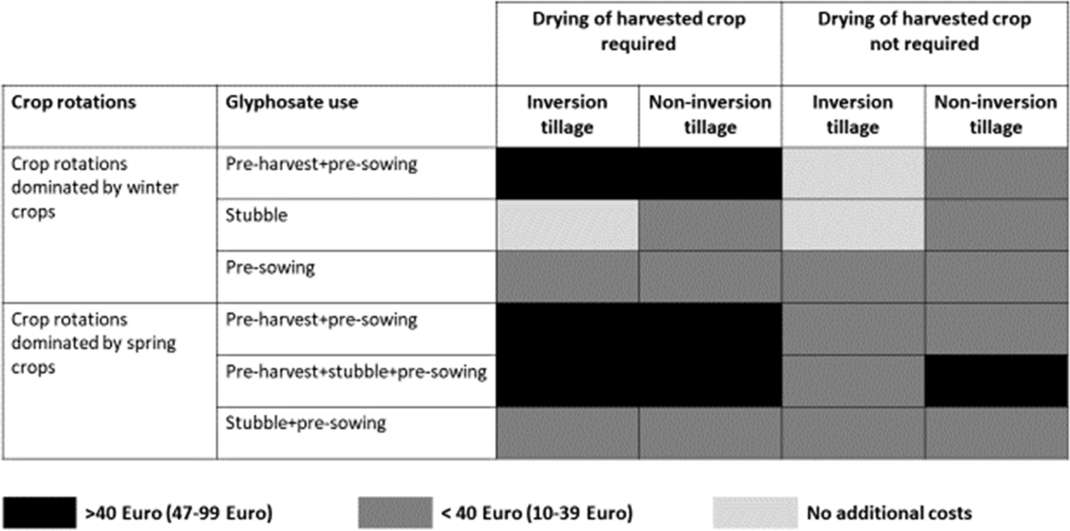
One study, conducted by the Federal Research Centre for Cultivated Plants (Julius Kühn Institute) was done by evaluating the economic effects of a ban of glyphosate for five common arable crop rotations dominated either by winter or summer crops. For each of the five crop rotations, three different scenarios were compared reflecting different uses and combination of uses of glyphosate (pre-sowing, preharvest, and stubble). In addition, for each of the 15 combinations of crop rotation and glyphosate use, plowing and a no-plowing (non-inversion tillage) scenarios were included along with scenarios in which drying of the harvested crop was required (corresponding to a wet harvest period) and not required (corresponding to a dry harvest period). For some of the scenarios, a yield decrease or increase was assumed. For example, the combination of non-inversion tillage and no glyphosate was assumed to lead to a 0% to 5% yield decrease, while the preharvest use of glyphosate was assumed to reduce yield reductions by 0% to 5%, that is, for each scenario minimum, mean, and maximum values were estimated. The full report on the study is only available in German (Kehlenbeck et al. Reference Kehlenbeck, Saltzmann, Schwarz, Zwerger, Nordmeyer, Rossberg, Karpinski, Strassemeyer, Golla and Freier2015), but a paper summarizing the outcome of the report is available in English (Kehlenbeck et al. Reference Kehlenbeck, Saltzmann, Schwarz, Zwerger and Nordmeyer2016).
The economic consequences of a glyphosate ban varied significantly between scenarios, with the highest losses recorded in years with a wet harvest period when drying of a harvested crop is necessary and on farms practicing non-inversion tillage. Additional costs of not having access to glyphosate varied from €0 to €100 ha−1 (US$0 to US$111 ha−1), equivalent to a loss to German farmers of 6% to 17% of the net margin for winter wheat at the time of the study. An overview of the outcome of the study, based on estimated mean values, is shown in Figure 3. As pointed out by the authors, a number of assumptions were made that could be questioned or that could change over time. For example, the study did not consider the long-term consequences of a lower level of control using mechanical control methods on perennial weeds like quackgrass [Elymus repens (L.) Gould]. Another point of uncertainty is that even if alternative measures are comparable to glyphosate from an efficacy and economic point of view, capacity in terms of hectares treated per hour may be lower, which could be an issue, particularly on larger farms. An increased risk of soil erosion from substituting mechanical weeding for glyphosate will be another issue on some farms. The study also showed that the assumptions made before embarking on an impact study can change, which may challenge the conclusions. In the scenarios with winter oilseed rape, diquat was considered an alternative for glyphosate for desiccation but, as pointed out earlier, diquat is now in the process of being banned in the EU from 2020, and therefore is no longer a viable alternative. Kehlenbeck et al. (Reference Kehlenbeck, Saltzmann, Schwarz, Zwerger, Nordmeyer, Rossberg, Karpinski, Strassemeyer, Golla and Freier2015) also evaluated the potential impact of a glyphosate ban on apple (Malus domestica L.) cultivation, as an example of a perennial crop, and found much more severe economic consequences than for arable crops.
Summary of results of the German study conducted by the Julius Kühn Institute (mean values) on the potential effects of a glyphosate ban in Germany. Modified from Kehlenbeck et al. (Reference Kehlenbeck, Saltzmann, Schwarz, Zwerger, Nordmeyer, Rossberg, Karpinski, Strassemeyer, Golla and Freier2015, Reference Kehlenbeck, Saltzmann, Schwarz, Zwerger and Nordmeyer2016).

Another desk study by researchers from Göttingen University evaluated the impact that a glyphosate ban would have on German arable farming (Schulte et al. Reference Schulte, Theuvsen, Wiese and Steinmann2016). In this study, the background information came from a survey comprising data from 2,026 farms and interviews with farm advisors, that is, in contrast to the study by Kehlenbeck et al. (Reference Kehlenbeck, Saltzmann, Schwarz, Zwerger, Nordmeyer, Rossberg, Karpinski, Strassemeyer, Golla and Freier2015, Reference Kehlenbeck, Saltzmann, Schwarz, Zwerger and Nordmeyer2016), data were available on the actual use pattern of glyphosate. Three crop rotations were included in the study, and for each crop rotation three scenarios were assessed: (1) farmers currently plowing and continuing to plow their land; (2) farmers practicing non-inversion tillage but changing to plowing following a glyphosate ban; and (3) farmers practicing non-inversion tillage and continuing to do so following a glyphosate ban. For each of these combinations, a best- and a worst-case scenario was assumed, considering yield loss, ease of harvest, drying of the harvested crop, and increased use of selective herbicides. Estimations were done for three regions: the northwestern, eastern, and southern parts of Germany.
The economic consequences of a glyphosate ban estimated by Schulte et al. (Reference Schulte, Theuvsen, Wiese and Steinmann2016) were in the same range as reported by Kehlenbeck et al. (Reference Kehlenbeck, Saltzmann, Schwarz, Zwerger, Nordmeyer, Rossberg, Karpinski, Strassemeyer, Golla and Freier2015, Reference Kehlenbeck, Saltzmann, Schwarz, Zwerger and Nordmeyer2016). For the plowing/plowing scenario, the average reduction in income varied from €27 to €38 ha−1 (US$30 to US$42 ha−1). For the non-inversion/plowing and non-inversion/non-inversion scenarios, the average costs were higher, varying from €56 to €91 (US$62 to US$101 ha−1) and €65 to €118 ha−1 (US$72 to US$131 ha−1). The economic losses corresponded to 6% to 39% of the net margin of the studied crop rotations. The loss of income was mainly associated with increased costs rather than reduced yields and tended to be less in eastern part of Germany, which was attributed to larger farm sizes and lower machinery costs.
United Kingdom
A study commissioned by the Crop Protection Association was conducted by Oxford Economics, a research firm specializing in economic research, and the Andersons Centre, a company providing business advice to the agricultural sector in the United Kingdom and Ireland (Anonymous 2017). Glyphosate use in the United Kingdom is around 2 million kg yr−1, constituting ca. 25% of the total herbicide use, and it was estimated that around 2.2 million hectares were treated in 2014 (Anonymous 2017).
The approach adopted for the UK study was somewhat different from the German studies. First, the current scenario (the “pre-ban” scenario) was described and analyzed, and then a “post-ban” scenario was created. The assumptions made in creating the post-ban scenario were that there is no chemical substitute for glyphosate, that is, plowing and mechanical cultivation will become more common and the use of selective herbicides will increase, but these alternatives will not prevent yield losses and lower-quality harvested crops. Eventually, a glyphosate ban will lead to changes in crop rotations with less winter wheat and winter oilseed canola, currently the most profitable crop in UK farming, and more spring cereal crops.
The study predicted a loss of £940 million yr−1 (US$1,136 million yr−1) loss for UK farmers, equivalent to a reduction in earnings of 13.9%, that is, within the range found in the German studies.
France
Glyphosate use in France is around 9 million kg yr−1 and constitutes around 25% of the total herbicide use. Following the discussions on glyphosate reauthorization, the French government asked the French National Institute for Agricultural Research to carry out a desk study outlining the current use of glyphosate, identifying possible alternatives to the current uses, considering the implications of replacing glyphosate, and proposing measures to promote the substitution for glyphosate (Reboud et al. Reference Reboud, Blanck, Aubertot, Jeuffroy, Munier-Jolain and Thiollet-Scholtus2017). Due to the very short time period allocated to the study, the economic consequences of banning glyphosate were not considered.
The analysis of glyphosate in France was largely based on the data collected by the DEPHY network, which represents more than 3,000 farms working closely together with local advisors with the objective of reducing pesticide use (Lapierre et al. Reference Lapierre, Sauquet and Julie2019). Among the DEPHY farms with arable crops, 59% used glyphosate regularly or occasionally. Glyphosate was primarily used pre-sowing or postharvest (70% of the treatments), whereas preharvest use was rare (0.1% of the treatments). Ninety percent of the treatments targeted annual weeds, while 10% were directed toward perennial weeds. Glyphosate use was most frequent and the highest doses were applied by farmers practicing no-till or conservation agriculture (100% of the farmers used glyphosate), and overall there was a clear inverse relationship between glyphosate use and tillage intensity. The report also provided data on glyphosate use in other cropping systems, but those results will not be discussed in this paper. Alternatives to glyphosate were primarily physical control methods, more intensive tillage, living mulches, and a higher use of selective herbicides used alone or in combination (Reboud et al. Reference Reboud, Blanck, Aubertot, Jeuffroy, Munier-Jolain and Thiollet-Scholtus2017).
The report listed cropping situations in which substitution for glyphosate will be challenging. For arable crops, these are farms practicing no-till/conservation agriculture, which was reflected in their intensive use of glyphosate, and farms growing certified seeds, where purity of the harvested crop is a key issue. Management of cover crops in row crops or following harvest of the main crop is another situation in which a glyphosate ban would be problematic. In perennial crops, glyphosate is difficult to substitute on steep slopes due to the practical problem of managing weeds mechanically on slopes and the increased risk of soil erosion. Finally, the report listed the research needs to meet the challenges posed by a ban on glyphosate in French agriculture.
Sweden
Sweden is the latest country to publish a report on the potential consequences of a glyphosate ban (Johansson et al. Reference Johansson, Johnson, Widén, Andersson, Manduric, Olofsson, Hallgren, Söderberg, Håkansson, Elmquist, Jansson, Åsman and Björkman2019). The work was solicited by the Swedish Agricultural Board with contributions from a range of national experts. In Sweden, glyphosate is the most widely used herbicide and constitutes ca. 28% of the total herbicide use. The two main uses of glyphosate are in stubble for controlling perennial weeds and in nonpermanent pastures for terminating growth and controlling perennial weeds. The objective of the report was to assess the agronomic, economic, and environmental impacts of a glyphosate ban. The costs of a glyphosate ban were estimated for five common arable and mixed farm types and for the three most important horticultural crops in Sweden: strawberry [Fragaria × ananassa (Weston) Duchesne ex Rozier], apple, and onion (Allium cepa L.).
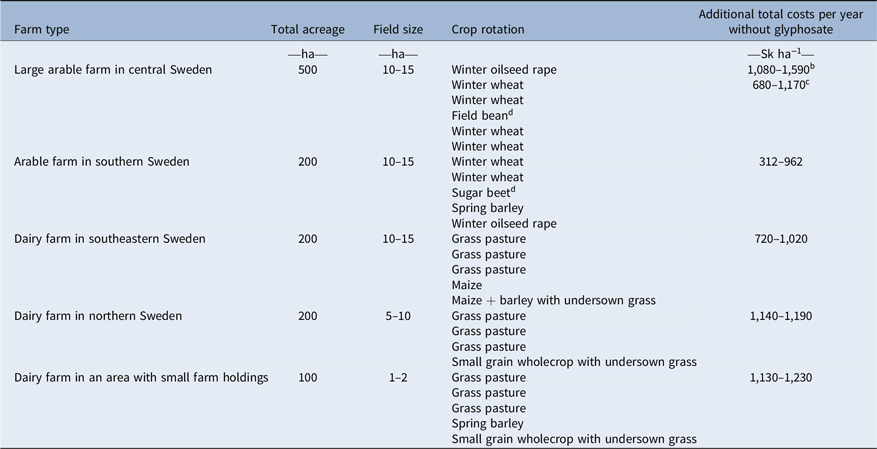
The analysis revealed that without access to glyphosate, farmers will have to increase the intensity of soil cultivation and the use of selective herbicides and, in some cases, change the crop rotation. Furthermore, yields of arable crops will be lower; on mixed farms, the loss of glyphosate for termination of pastures would result in the loss of one cut of grass in the last year of cultivation; and conservation agriculture would be difficult to practice. Economically, the losses varied between Sk 312 to 952 ha−1 (US$32 to US$99 ha−1) to Sk 1,080 to 1,590 ha−1 (US$112 to US$165 ha−1) depending on farm type (Table 1). For the agricultural sector as a whole, the costs were estimated to be between Sk 375 and 700 million yr−1 (US$39 and US$73 million yr−1), assuming a yield loss of 1%. For every percent increase in yield loss, the overall costs would increase by Sk 80 million to 160 million yr−1 (US$8 million to US$16 million yr−1). The corresponding figure for the horticultural sector was Sk 60 million yr−1 (US$6.2 million yr−1). Overall, the cost of a glyphosate ban corresponds to 5% to 8% reduction in income. As pointed out in some of the other studies, this assessment reflects the current situation but does not take into account how, for example, weed infestation will develop over time and how this will influence potential yield losses.
Summary of the outcome of the Swedish study on the potential effects of a glyphosate ban for five common arable and mixed farm types in Sweden.a

a Modified from Johansson et al. (Reference Johansson, Johnson, Widén, Andersson, Manduric, Olofsson, Hallgren, Söderberg, Håkansson, Elmquist, Jansson, Åsman and Björkman2019).
b Two of four years winter wheat is replaced by spring barley.
c One of four years winter wheat is replaced by spring barley.
d Field bean, Vicia faba L.; sugar beet, Beta vulgaris L.
In contrast to most of the other studies, the Swedish study also considered the environmental consequences of a glyphosate ban and concluded that nitrogen leaching would increase by 0% to 33% and glasshouse gas emissions by 15 to 20 kg CO2 ha−1 yr−1 due to increased tillage. Glyphosate runoff to surface water and leaching to groundwater would decrease, but the effect on biodiversity could not be assessed, as a number of factors affect biodiversity in the agricultural landscape. The overall impact on the macroeconomic scale would be minor, because the loss of income in the agricultural and horticultural sectors would partly be compensated by increased tax incomes on labor and gasoline.
General Points Emerging from the Country Studies
It is obvious from all the studies that it is more difficult to assess the impact of a ban on glyphosate than a ban on other pesticides. This is not only because glyphosate has so many different uses and is so widely used, but also because the efficacy of glyphosate against both annual and perennial weeds has permitted farmers to optimize their farming practices. For example, glyphosate has allowed farmers to reconsider their soil cultivation strategies, as seen in the United States and Argentina, where farmers very quickly shifted from conventional and reduced tillage to no tillage following the introduction of GE glyphosate-resistant crops (Duke and Powles Reference Duke and Powles2008). A similar trend has been observed in the EU, where the shift to no-tillage or conservation agriculture has been associated with an increased use of and dependency on glyphosate, as illustrated by the analysis of the DEPHY network of farmers in France (Reboud et al. Reference Reboud, Blanck, Aubertot, Jeuffroy, Munier-Jolain and Thiollet-Scholtus2017). Conservation agriculture has been promoted as a measure to reduce nitrogen losses and soil erosion but has often led to increased weed problems, in particular grass weeds (Melander et al. Reference Melander, Munier-Jolain, Charles, Wirth, Schwarz, van der Weide, Bonin, Jensen and Kudsk2013). Also, cover crops are promoted at both EU and national levels as a measure to improve sustainability of farming, but termination of cover crops depends very much on access to glyphosate. Under cooler conditions, cover crops not tolerating frost could be grown, but this is not an option under warmer conditions.
Another outcome of the studies is that they provide a snapshot of the situation. As pointed out in some of the studies, without glyphosate the weed flora may change, and perennial weeds in particular will become a bigger problem, as there are very few alternatives to glyphosate for the control of these weeds. Perennial weeds generally respond less to change in crop rotation than annual weeds, and in the present context, it is noteworthy that perennial weeds are one of the major pest issues in organic agriculture, particularly in the northern EU countries. Increasing problems with perennial weeds could have severe long-term impacts on farm productivity and the potential losses following a glyphosate ban. Mechanical weeding is the obvious alternative, but it is less effective and more labor intensive. Furthermore, soil cultivation could increase nutrient losses, as highlighted in the Swedish study, and soil erosion.
Another issue is that of herbicide resistance, which is only touched upon in the reports. Glyphosate used before crop sowing has been viewed as a tool for the management of acetolactate synthase–resistant and acetyl-CoA carboxylase–resistant weed species and still is, despite a few cases of glyphosate resistance in arable cropping (Collavo and Sattin Reference Collavo and Sattin2014; Davies et al. Reference Davies, Hull, Moss and Neve2019). With the expected reduction in the number of herbicides and modes of action on the market and an increased dependency on selective herbicides following a glyphosate ban, the problems with herbicide-resistant biotypes can be expected to increase, further affecting crop productivity, that is, the negative economic consequences could increase over time.
A glyphosate ban in the EU in December 2022 that would be effective 18 months later will have immediate significant economic consequences for EU farmers. Integrated weed management practices would need to be implemented combining cultural, nonchemical, and chemical methods. Because of the close relationship between crops and weeds, crop rotations will also need to be redesigned, that is, integrated crop management practices will have to be implemented by farmers rather than just integrated weed management. Hence, the necessary changes to current cropping practices are more far-reaching than would occur for a ban against any other herbicide, highlighting the dependence of farmers on glyphosate.
Acknowledgment
This research received no specific grant from any funding agency or the commercial or not-for-profit sectors. No conflicts of interest have been declared.