Wagner’s first trip to Paris was not a success. From September 1839 to April 1842, the composer lived in Paris with his wife Minna and their Newfoundland dog Robber, who ran away soon after they arrived. From the start, Wagner existed well beyond his means, to such an extent that he was constantly borrowing money from friends and family, requesting meals from near strangers and demanding credit from lenders. There is even evidence that Wagner spent time in prison due to unpaid debts.Footnote 1
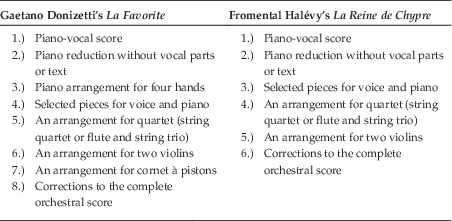
Hoping perhaps to become the next German to find fame and fortune in Paris, as Meyerbeer had with Robert le diable in 1831, Wagner struggled to gain the interest of librettists, theatre directors, fellow composers and even audience members in the French capital.Footnote 2 The one area in which Wagner found success while in Paris, however, was working for the German-born French music publisher Maurice Schlesinger as both a critic and an arranger of French operas, most notably Donizetti’s La Favorite (1840) and Halévy’s La Reine de Chypre (1841). For both of these grands opéras, Wagner arranged a substantial amount of material for a public who wanted to hear these works again and again in their homes as the operas continued to do well at the theatre box office. See Table 1 for a list of the many arrangements Wagner made of the two works.Footnote 3Footnote
Complete list of arrangements by Richard Wagner while in Paris (1839–1842) for the music publisher Maurice Schlesinger4

Although poverty may have forced Wagner to arrange these pieces while he lived in Paris,Footnote 5 there is no doubt his work as an arranger of popular French operas and salon pieces provided him the opportunity to study the compositional styles of the day and thus contributed to his vision as a revolutionary composer of dramatic music.
As evidenced in a letter to his benefactor, King Ludwig II of Bavaria, written some 25 years later in the idyllic surroundings of Lake Lucerne, Wagner confessed what the two and a half years in Paris meant to him:
Paris occupied so important a place in the development of my relations with the outside world that, whenever I think of such things, I invariably find myself remembering my experiences there … As the world now is, Paris forms the culminating point: all other cities are simply stations along the way. It is the heart of modern civilization, drawing in the blood before sending it out again to the limbs. When I decided to become a famous opera composer, my good angel sent me straight to that heart: I was at the source, and there I was able to grasp at once things, which at the wayside stations would perhaps have taken me a half a lifetime to learn.Footnote 6
I believe these ‘things’ that Wagner grasped while in Paris are partly found in the activity surrounding his arrangements of French opera premieres, most notably Halévy’s opera, La Reine de Chypre. Unlike Donizetti’s opera, which he thought was filled with ‘pernicious fireworks and intolerable prima-donna-flourishes’,Footnote 7 Wagner consistently praised the score of La Reine de Chypre, namely Halévy’s use of colourful instrumentation, strong motivic development and a simplified vocal expression. The German composer published two articles on the opera in the Dresdener Abend-Zeitung,Footnote 8 four articles in Schlesinger’s own Parisian journal, La Revue et Gazette musicale de Paris Footnote 9 and a short review in Schumann’s Neue Zeitschrift für Musik.Footnote 10 Beyond his admiration for the score,Footnote 11 I believe the young German composer was impressed with the subject matter itself: the redemption of a man in exile. This same dramatic theme is found in Wagner’s Der fliegende Holländer, a three-act work written while the composer was living in Paris. The opera is the first of his so-called ‘German Romantic operas’,Footnote 12 and not only contains the seeds of his revolutionary dramatic concept of Gesamtkunstwerk Footnote 13 but also bears witness to the nineteenth-century fascination with the world of the exile, a subject that would persist throughout Wagner’s life.Footnote 14
The Queen
La Reine de Chypre by Fromental Halévy premiered at the Paris Opéra on 22 December 1841. With a libretto by Jules-Henri Vernoy de Saint-Georges, the opera focuses on the rise to power of the Venetian noblewoman Catarina Cornaro (1454–1510). According to historical accounts,Footnote 15 after the negotiations of her father Andréa Cornaro and the Venetian Senate Council, Catarina was betrothed at the age of 14 to James II Lusignan of Cyprus. The marriage was confirmed by an elaborate ceremony in Nicosia four years later in 1472. Upon James’s death in 1473, a year after the marriage, Venetian rebels took possession of Catarina and her newborn son and attempted to force the teenage queen to hand over the throne to the Venetian Senate. Although Venetian herself, Catarina refused to bow to the wishes of the Venetian government and defended the independence of her newly adopted land and people by soliciting the help of the Ottoman Empire. After the death of her son in 1474, she ruled Cyprus as sole monarch for 15 years. She finally ceded her realm to Venice in 1489, retaining her royal title and an Italian estate in the Veneto region.
The addition Saint-Georges brings to the story is the invention of a French suitor, Gérard de Coucy, a knight in exile from France who abandons his search for glory in order to marry Catarina. As Gérard and Catarina exchange wedding vows (early in Act 1), Andréa bursts into the church and cancels the ceremony upon the orders of the Venetian Senate. The Senate’s commands thus set the drama into motion by introducing the conflict that Catarina and Gérard must conquer before they can marry. However, as we learn from the Notice historique published in the libretto, Catarina never marries Gérard, but remains true to Lusignan even after his death. Thus, the introduction of Gérard presents not only a chivalric romance that is destined to fail but also the sacrifice Catarina must make in order for the Cypriot people to gain their freedom.
In La Juive (1835), Halévy’s first work for the Paris Opéra, sacred pieces, drinking songs, romances, large choruses and massive religious processions are intermixed to create a larger-than-life view of Christian–Jewish relations in the early fifteenth century.Footnote 16La Reine de Chypre on the other hand presents a less varied approach to depicting the drama, by centring the listener’s attention on simple and direct vocal writing and the use of a recurring dissonant motive. The motive – a diminished seventh chord in a rapid tremolo with an ascending figure in the bass line – is presented in the score whenever the sinister plans of the Venetian Senate are referred to in the libretto. In Act 1, for example, we hear the motive for the first time in the orchestra when Mocénigo (a member of the Venetian senate) enters the stage and demands that Andréa stop the wedding (Ex. 1).Footnote 17
Referred to by Wagner as ‘notable for a certain void in the harmony’,Footnote 18 Halévy consistently places the motive in harmonic areas that reveal its dissonance – as in Ex. 1, where B major is suddenly proclaimed (bar 51) in the context of E-flat major by the strings; in this new harmonic context, the passage slowly progresses to a fully diminished seventh chord, E♯–G♯–B–D (bar 59),Footnote 19 while all along maintaining the tension with fast tremolo strings with fortepiano attacks on the downbeat – thus, highlighting the motive’s dramatic presence. In fact, the work’s 249-bar overture essentially presents a fantasy on the motive’s main rhythmic elements of a rising semiquaver (Ex. 2a); note especially the near verbatim use of the motive starting at bar 38 (Ex. 2b).
Halévy, La Reine de Chypre, Act 1, No. 3: Duo, bars 49–66.
Halévy, La Reine de Chypre, Overture, (a) bars 1–9 (b) bars 35-43.
Apart from its presence in the overture and the opening of Act 1, this same motive and its variants are heard in the finale to Act 1 when Andréa explains to Caterina that as her guardian it is his right (droit) to stop the wedding (Ex. 3a); the finale to Act 2, as Catarina sees the daggers of Mocénigo’s men who are ready to strike Gérard if he does not leave Venice (Example 3b); and in Act 5 Scene 4, as Catarina tells Gérard that she sacrificed her love for him in order to save his life (Ex. 3c). Thus, throughout the score, the ‘Venetian Senate’ motive is heard in places where the destiny of the couple is threatened, harmonically placed in areas removed from the surrounding tonal pallet. In the end, however, it is Catarina’s constant sacrifice of her own will that remains the lasting legacy in the opera, for we see that her actions not only bring about the independence of Cyprus from Venetian control but also the salvation of a man in exile.
The ‘Venetian Senate’ motive in Halévy, La Reine de Chypre, (a) Act 1, No. 6: Final, bars 151–158; (b) Act 2, No. 9: Duo Final, bars 141–151; (c) Act 5, No. 21: Duo, bars 174–183.
The Queen as Redeemer
We first learn of Gérard’s ‘wanderer’ status in Act 1 Scene 2, when he proclaims to Catarina on the eve of their wedding day: ‘Submitted to the laws of knighthood, I wandered through the world searching for honor! Fate has led my steps to thy country; instead of finding glory, here, I have found happiness’.Footnote 20 Gérard’s confession of his love is presented in a slow moving cavatina with string and woodwind accompaniment, thus highlighting the sincerity of his position as he places his hopes for redemption on Catarina, whose hand will allow him to return to France with honour owing to the sincerity of their love.Footnote 21 After a failed attempt in Act 2 to run away with Catarina, Gérard is forced to leave Venice and to continue his search for meaning and life fulfilment. Gérard now finds himself in Cyprus, strolling through the gardens of a casino in Nicosia. As he contemplates his misfortune, Mocénigo’s men attack him. Coming to Gérard’s aid is a fellow French knight, who happens to be James II Lusignan in disguise. After fighting off Mocénigo’s men, these two knights of France greet one another as friends and exchange stories of how each came to be so far from home. Halévy sets this important meeting between the two rivals for Catarina’s hand in an extended number that serves to close the act, the grand tenor duet, ‘Triste exilé sur la terre étrangère’ (Ex. 4).Footnote 22
Halévy, La Reine de Chypre, Act 3, No. 13: Duo Final, bars 198–228.
The duet, described by Wagner as ‘a precious pearl in the rich tiara of this score’,Footnote 23 reflects the sentiments of two men in ‘sad exile’ from their homeland who both look to Catarina for salvation. Lusignan, who was once a citizen of France, is bound by the Cypriot people to find a queen, while Gérard, also a son of France, remains in exile not only from France but from his true love, Catarina, who is about to marry another. All of these dramatic concerns are explicitly expressed without vocal flourishes or virtuosic display, accompanied by pizzicato strings with flute, oboe, B-flat clarinet, bassoons and E-flat horns. More importantly, however, Halévy sets this duet to a  $\raster="rg1"$
, Anda nte rhythm in a syllabic, ballad-like Bar Form of AAB, which not only serves to characterize the fifteenth-century historic setting but also creates a fraternal expression between the two men. Perhaps the use of this historic form is what immediately spoke to Wagner when he singled it out in his review, for he uses the same form in Der fliegende Holländer (more on this below).Footnote 24
Following their meeting in Act 4, Gérard is waiting outside the church in Nicosia, ready to kill the new husband of Catarina as soon as he appears (Gérard does not know that Catarina’s husband is now Lusignan). Although Gérard is captured before he can strike, he is later set free by the jailer after learning of the knight’s story. Gérard, a man in exile from France, Venice and now Cyprus, roams throughout the Mediterranean in search of a new destiny. This renewed search, which is brought to the fore owing to Catarina’s sacrifice (unknown to Gérard) to save his life and to marry another, leads Gérard to join the Knights of Rhodes. After a few years have passed, Gérard returns to Cyprus in Act 5 as an ambassador of the holy order to inform the king of the Venetian plot against him. As Gérard enters the throne room to notify the king, he sees Catarina and immediately questions his motives. Gérard’s newly found faith in his order and Catarina’s status as Queen of Cyprus are now in jeopardy as they begin to suffer under the weight of a rekindled love. However, just when they are about to give in to their passions, Mocénigo, the Venetian senator, arrives and accuses Gérard and Catarina of killing the king. Although weak from the poison, the king bursts into the room and defends Catarina’s honour by fighting side by side with Gérard against the approaching Venetian soldiers (earlier in the act, Lusignan admits to Catarina that he knew of her love for Gérard and praises her for her constancy in marriage and assures her that God will reward her).
When her new husband finally dies in her arms, Catarina boldly asks the people of Cyprus: ‘[People of Cyprus], will you swear revenge to the martyr of your independence’?Footnote 25 As the people cry for revenge, the queen takes hold of her son and presents him to the people, saying: ‘Well then, I trust to your loyalty the last hope of Lusignan’s race. You must vanquish or die for his banner, for his King, his God, his liberty’!Footnote 26 The final curtain falls as the people crowd around their queen, including Gérard, who is on bended knee, bearing the red cross of his holy militant order, with his hands clasped, devoutly looking up at his once love, as Cypriot banners wave on all sides of the stage (Fig. 1).Footnote 27
Eugène Delacroix, La Liberté guidant le peuple, 1830, 260cm x 325cm (Louvre Musée). Image obtained from Shutterstock.com.
Catarina, the daughter of a Venetian senator, has thus led her adopted people in a rebellion against the Venetians in order to provide a new social order, one that replaces the current system of deceit and murder with a common liberty founded upon Catarina’s self-sacrifice to marry Lusignan. As the opera ends, Catarina remains fixed on stage, like a ‘statue of liberty’ that calls the people to arms. Halévy shrouds this climactic moment with a large battery of instruments including woodwinds, strings, brass (with ophicleide and military trumpets or grandes trompettes in A-flat), crash cymbals, triangle, timpani, bass drum and side drum, all harmonized on a final plagal cadence as the full chorus proclaims the word ‘liberté’ (Ex. 5).
Halévy, La Reine de Chypre, Act 5, No. 28: Marche et Final, bars 101–107 (Paris: Maurice Schlesinger, 1842): 736.
Wagner was impressed with Halévy’s treatment of this final ensemble of the opera, remarking that ‘the most sublime number in all the score is the quartet … Here, more than anywhere else, Halévy’s talent shows itself in all its individuality; the grandiose is allied with the terrible, and an elegiac melancholy appears to spread a funeral veil above this solemn scene – a scene arranged moreover with that clearness, that simplicity, which marks great masters’.Footnote 28 The German composer’s praise for the final scene, as Catarina is beatified in the score and on stage suggests an understanding of the opera that highlights Wagner’s sensitivity to the inner world of the drama, namely the sacrifice that true love demands:
If I have rightly grasped the poetic trend of the libretto, the drama is founded on a conflict between human passions and Nature … In the thick of this deadly conflict stands the noble nature of Man, trusting to the twin stars that guide him here below, of Love and Faith, courageously fighting the infernal power, and albeit sacrificed yet conqueror; that is how we apprehend this admirable Lusignan. What a magnificent and poetical subject!Footnote 29
Wagner’s level of insight into Halévy’s work goes far beyond the subject matter in his review, however, for we perceive in his writings on the opera a rather nuanced discussion on the current state of French and German music for the stage and what is needed to redeem the fortunes of both. As we shall see, Wagner defines Halévy and his new opera as forming a kinship with his own desires for a fresh and sustainable brand of theatre, one that upholds dramatic unity and thus presents a stronger sense of artistic truth.
A New ‘Step Forward’
In reading Wagner’s critical commentary on Halévy’s grand opéra, one is struck by the high level of praise the German composer consistently places upon La Reine de Chypre and Halévy’s style in general.Footnote 30 As mentioned above, Wagner wrote several articles about the opera while in Paris. Completed on 31 December 1841 for the Dresden daily, the Dresdener Abend-Zeitung, and published the following month in two parts on 26 and 29 January 1842, his first review of the opera begins not as a review per se but as a judgment upon the current state of opera in Germany.
Wagner begins his review by accusing German opera directors – ‘earnest men in black suits and brown overcoats’Footnote 31 – who were at the premiere of La Reine de Chypre as usurpers of German culture owing to their embrace of foreign works rather than the German operas of the day (albeit the same can be said of Wagner who finds himself in Paris reviewing French operas). The reason for this, Wagner argues, is due to the simple fact that Germany lacks good librettos. Wagner then proceeds to instruct his German readers on what makes a good libretto:
The main thing is to have poetry inside you and your heart in the right place. Since you are forever reading books both new and old, you are bound one day to come on a story or event which completely grips you: you are unable to read on, because you suddenly see wonderful flesh-and-blood figures moving before your eyes, you feel their pulses throbbing, you hear their hymns of joy and their sorrowful complaints. Having come this far, what else can you possibly do but seize your pen and write down a glowing drama that must excite and shatter the emotions of every human being?Footnote 32
If, however, you do not have poetry within you to write a libretto, Wagner argues, then you can rely upon skill, ‘for skill is indispensable to craftsmen such as cobblers and harness-makers, and consequently to makers of librettos too’.Footnote 33 He then describes the action of La Reine de Chypre (in a not so complimentary tone) as an example of how ‘skill’ (not poetry) is used by Saint-Georges:
Break up a marriage here – let a lover elope with his sweetheart there – beat up a young cavalier – place a queen’s crown on the head of a senator’s daughter – and in the end throw the villain out of the window. Embellish all this with gold beakers containing poison, secret doors, concealed spies and other entertaining things of that sort – and in the twinkling of an eye you will have produced a libretto every bit as good as those for whose sake German composers waylay Parisian writers. Certainly you will produce one just as admirable as the text of La Reine de Chypre … Yet all the same it would never occur to anybody to call this libretto a work of art. Above all, the author has most decidedly shown himself to be devoid of the gift we call poetry: there is nothing in this work that suggests some higher spiritual idea; no inner impulse gripped him; no burning enthusiasm carried him away.Footnote 34
The contradiction between Wagner’s comments on the libretto in April 1842, published in a French journal as having a ‘poetical trend’, and here in December 1841 (directly after the premiere) published in a German daily as lacking ‘poetry’ is rather telling of an individual who was constantly torn between his high artistic ideals and the practical matter of entertaining the public. In fact, in the translator’s note in the English translation of the 24 April 1842 review, Ellis argues that in the handful of months that followed Wagner’s first introduction to La Reine de Chypre, he ‘would appear to have read into his impressions of the text a pretty large dose of his own idealism, owing to that more complete acquaintance with the music imposed by the necessity of studying it for the purpose of arrangements’.Footnote 35 Although it could be argued that the contradiction found in Wagner’s view of the libretto stems from a desire to appeal to the sentiments of his readers, be they German or French, Wagner is consistent in his praise of the music. Believing the score to be unique and dramatically convincing, Wagner argues that the ‘music is appropriate, full of feeling and in some places even impressive in effect. Gracefulness … is apparent in the many opportunities for song that the libretto so richly provides, and above all I was struck by a welcome tendency towards simplicity in the treatment as a whole’.Footnote 36 Wagner continues in this vein by arguing that what is new and novel in La Reine de Chypre is Halévy’s ‘historical’ conception of dramatic music, which ‘can in truth be regarded as a step forward rather than a step back, and what I might call its inherent historical tendency should provide a good basis to build further and to solve problems which have perhaps not yet even been posed’.Footnote 37
The ‘historic tendency’ that Wagner perceived in the music of La Reine de Chypre is a move towards a simple, direct form of expression in relaying the sentiments of the characters, rather than an ornate sense of ‘French luxury and pomp’.Footnote 38 Although Wagner was frustrated with Halévy’s reluctance to use a more ‘modern’ form of instrumentation (such as valve trumpets) in the opening acts, he found the final two acts to be more effective, where ‘[m]oments of great beauty are to be found in every number, and particular mention must be made of the last act, to which the composer as distinct from the librettist, has managed to impart a truly poetic flavour’.Footnote 39 Here, Wagner refers to the music of the final scene that imparts the feelings and sentiments of the dying king, Lusignan, in a simple declamatory manner and the dramatic situation that arises from his death, creating, in Wagner’s words, ‘a truly shattering effect’ (Ex. 6).Footnote 40 Thus, what Wagner appears to admire in La Reine de Chypre is Halévy’s desire to present not the external matters of time, place or even fashion, but the internal dramatic world of the characters, the so-called ‘poetic’ musical voice.
Fromental Halévy, La Reine de Chypre, Act 5, No. 23: Final, bars 58–73; Richard Wagner, Sämtliche Werke, XX.2C: Opernbearbeitungen, III: Fromental Halévy, ‘La Reine de Chypre’, ed. Egon Voss (Mainz: Schott Music, 2007): 408.
After Wagner was contracted in January 1842 by Schlesinger to compose arrangements of La Reine de Chypre, the reviews that appeared the following month in La Revue et Gazette musicale de Paris present in greater detail his thoughts about Halévy and what his ‘historic’ and ‘poetic’ style present for the future of music in France and in Germany.Footnote 41 Similar to the start of the review for the Dresden evening newspaper, Wagner begins his four-part article on La Reine de Chypre by attempting to define how one writes a ‘good’ opera. He starts, ‘To make a good opera, it not only needs a good poet and a good composer, but also a sympathetic accord between the talent of the one and that of the other’.Footnote 42 Wagner then asks the reader to ‘let one imagine, for example, that the poet and the composer are friends from childhood’, sharing the same thoughts when looking upon something with great ‘enthusiasm’. He concludes that it is the poet who first experiences the spark of creativity for a new opera subject, ‘but what weaves the charm of the ineffable around the poetic conception, what reconciles reality with the ideal – the task of seizing that belongs to the musician. The work elaborated by the talents of them both, in hours of calm reflection, might be justly called a perfect opera’.Footnote 43 The natural link and artistic affinity between composer and librettist are only ideals for Wagner, however, for he argues that it has nothing in common with the ‘Artistic Industry’ in Paris, which has established the royalty system (droits d’auteurs) in so far that certain alliances between librettists and composers hold the stage (for example, Scribe and Meyerbeer). According to Wagner, this system has created a poor model for others to follow and thus presents ‘nothing but mediocre works appearing under the aegis of an illustrious name’.Footnote 44 Therefore, one may conclude that ‘works conceived without enthusiasm, and elaborated in a spirit of blind routine, cannot kindle the public’. But from time to time, Wagner admits, it is sheer ‘luck for art’ that ‘this method of procedure gives birth to creations which delight the parterre, and moreover stand the scrutiny of a rigorous criticism’.Footnote 45 In this latter camp, Wagner places Halévy and La Reine de Chypre:
Halévy has twice been completely fortunate, and one can but admire the manner in which he has profited of this double favour to create two monumentsFootnote 46 that will mark the history of musical art. Certainly Halévy’s talent lacks neither grace nor freshness; nevertheless, through the predominance of passionate gravity in his character, it was upon our Grand Lyric stage that he was destined to develop all his force and volume. And it is worthy of remark, that in this respect, the talent of Halévy essentially differs from that of Auber and the generality of French composers, whose veritable home is decidedly the Opéra Comique.Footnote 47
The Opéra-Comique for Wagner is a place where music is presented with little to no dramatic weight or substance, only ‘obligatory cut of airs-de-danse, with its eight-bar period returning periodically, their cadences on the dominant or relative minor’.Footnote 48 He believes this institution and its music have kept the true talents of French composers at bay by convincing them to mimic the style of Auber, whose music presents a ‘stamp of nationality to the point of becoming monotonous’.Footnote 49 Halévy’s music, on the other hand, presents ‘the pathos of high Lyric Tragedy’, where ‘a general and independent character’ dominates and a so-called ‘dramatic type of melody’ comes forth.Footnote 50 Only then, Wagner argues, ‘is it possible for the musician to give his pictures a colouring whose elements are drawn from elsewhere than his epoch and the world in which he lives’.Footnote 51 Wagner, thus concludes his February article by stating:
Abruptly breaking with the system of Auber, Halévy boldly sprang out of the rut of conventional turns and rhythms, to enter the career of free, unlimited creation, recognising no other law than that of truth. Indeed it needed a very resolute confidence in his own strength and the resources of his talent, for a musician thus voluntarily to desert the beaten track, which could but lead him sooner and more surely to popularity; it needed high courage and dauntless faith in the power of truth; and to succeed in this adventurous attempt, it needed all the concentrated energy of Halévy’s talent.Footnote 52
This same line of thought continues in the 13 March article, where once again Wagner hails Halévy as the start of something new in France, distinct from ‘that race of pygmies, to whom Music appears to have revealed herself in no form save that of 3/8 time, of couplets and quadrilles’.Footnote 53 Owing to the artistic situation in France, Wagner instructs Halévy to turn his talents toward Germany for the full appreciation of his skills. Wagner even goes so far as to compare Halévy’s style to Beethoven in its ability to move German hearts, as he first witnessed in the score of La Juive. He thus concludes that Halévy presents a fresh path for German musicians, which can only serve to ‘vivify dramatic music once again in Germany’:
The passionate energy revealed in [Halévy’s] music, appeals most keenly to [German] musical faculties. This sympathetic tie has shown them how they may appear again in the province of Musical Drama – which they seemed to have completely abandoned – without renouncing their individuality, without offending the national genius, or effacing its character by imitation of a foreign mode. Things ripen slowly in Germany … Nevertheless in more than one work published recently it already is recognizable that a new era is dawning for the dramatic music of our neighbours. When the time shall have come we will show in what degree the influence exerted by Halévy has contributed thereto … The impulse given by Halévy coming from a talent which, though foreign, has an intimate affinity with the German spirit, will have results far more decisive [than Mendelssohn].Footnote 54
This is high praise for a French composer, indeed. Wagner is in fact stating in his review that Halévy’s compositional talents contain the spark to reignite German music drama. Perhaps it was upon hearing Halévy’s La Juive that Wagner decided to come to Paris in the first placeFootnote 55 in order to emulate the style of the French composer he found so engaging. Nevertheless, it is clear from the first two articles in La Revue et Gazette musicale de Paris that Wagner was profoundly impressed with Halévy’s music. One may argue that Wagner is simply presenting in the reviews an overt form of flattery for his own vision of opera, for which there is certainly evidence, or that he is presenting these ideas so that the public will purchase more of his arrangements of La Reine. But use of Halévy’s overall style and his latest dramatic work for the German composer’s own ends, is not supported by the consistent tone of praise and respect Wagner heaps upon the work in three different periodicals for three different audiences. There were certainly other works that Wagner viewed in Paris that he did not care for that would have served to highlight his talents, including Donizetti’s more successful opera La Favorite. Furthermore, one needs only to read a few of the several articles written by Wagner while in Paris that tell of his overall dissatisfaction with the music industry in France to discover how unique was his admiration for Halévy.Footnote 56
After taking on the task of articulating what sets Halévy apart from his French and German contemporaries, Wagner presents in his final two articles for La Revue et Gazette musicale de Paris (24 April and 1 May) the particularities within La Reine de Chypre that are fitting to this new compositional path. He breaks down each of the five acts and discusses how well Halévy succeeds with each vocal number and orchestral passage. Wagner thus concludes his review of Halévy’s new opera with no less than the same level of unqualified praise and admiration as found in his previously published reviews on the opera:
To cast one parting glance on the whole of La Reine de Chypre, to carefully sum up its salient qualities: we find its author still advancing on the road he struck-out in La Juive, for he pays more and more attention to simplifying his means … It is indeed a fine sight to see how Halévy, while purposely and palpably delimiting his means, has succeeded in obtaining so great a variety of effects; to say nothing of his having thereby made his ends more clear and intelligible. For the rest, the method employed by Halévy, and its indubitable influence on contemporary art, are too important to be merely touched in passing. We therefore reserve to ourselves the right of returning to this subject at some other time, and treating it with the study it deserves.Footnote 57
Artistic Kinship
The way ‘forward’, as represented by Halévy and argued for by Wagner, is made all the more striking by the German composer’s own stylistic advance from Rienzi, Der Letzte der Tribunen (1842), a five-act grand opéra,Footnote 58 to Der fliegende Holländer, a three-act romantische oper. Wagner made this point several times in his published writings and correspondence, nowhere more famously expressed than in the composer’s introduction to his Gesammelte Schriften Dichtungen:Footnote 59
As far as my knowledge, I can in the life of no other artist discover such a striking transformation, accomplished in so short a time, than here [between the composition of Rienzi and Der fliegende Holländer] … it turns out, the first of which was scarcely finished when the second one, too, was nearly complete. Certainly, owing to a kindred spirit both works did not escape the attention of examiners … [Suffice it to say,] that something significant took place within the author, perhaps a profound shock, certainly a violent reversal.Footnote 60
The libretto of The Dutchman was written by Wagner in Paris in May 1840; the orchestral score was completed in the fall of 1841.Footnote 61 Although it was originally conceived for Paris and then Berlin, the opera had its premiere in Dresden on 2 January 1843.Footnote 62 From the very start of Wagner’s work on the opera, he desired a ‘backward-looking’ style for The Dutchman rather than the modern panoramic display of history found in Rienzi. He even referred to The Dutchman as part of an older form of drama, a ‘dramatic ballad’, which would recall the Gothic works of a generation before with their mythic legendary figures, rich tonal texture, and folk-like Männerchöre.Footnote 63 By returning to an earlier, German-conceived dramatic style, Wagner was able to present a tightly knit opera that presented none of the sub-plots or sudden changes of fortune that are often found in French grand opéra (for example, note the many changes of fortune in La Reine de Chypre, namely the sudden break of the marriage between Gérard and Caterina in Act 1, as well as the miraculous appearance of a near-dead Lusignan to fight on the battlefield in Act 5). Although Wagner argued that his new ‘dramatic ballad’ was a return to an earlier style of opera, it still contained many of the modern elements of French grand opéra, including a large number of ‘tableaux vivants’ (for example, the choral-ensemble introduction on Donald’s ship in Act 1 and the choruses of Scottish and Dutch sailors in Act 3), the modern use of the brass (for example, off-stage brass, use of valve horns and natural horns, valve trumpets, trombones and ophicleide) and a mixture of Italian and French vocal forms (for example, extensive entrance arias or cavatinas, large choral numbers, scena, romance and ariosos).Footnote 64
Wagner departs from the elements in grand opéra (as listed above) precisely in his setting for the voice, where a more pronounced sense of declamatory writing is presented; for example, we see this stripped-down vocal style in the Helmsman’s song at the end of Act I (Ex. 7) and Senta’s ballad in Act 2 (Ex. 8). Here, in both of these examples from the 1841 orchestral score, the characters sing a highly syllabic setting of the text, which, as in the Halévy duet of Act 3 between Gérard and Lusignan (see Ex. 4), is in the context of a memory composed in simple bar form with an extended third section (the Abgesang). Similar to what Wagner pointed to in the score of La Reine de Chypre, the highly syllabic vocal writing emphasizes the drama and not the vocal display of the singer, so that, in Wagner’s words, ‘a general and independent character dominates’ and a so-called ‘dramatic type of melody’ comes forth.Footnote 65 In addition to the vocal writing, a consistent characterization of the dramatic legend is heard in the numerous appearances of the Dutchman motive and the persistent use of material from Senta’s Ballad aria, the theme that Wagner would cite as the musical origins of the entire work.Footnote 66 All this, of course, flies in the face of conventional wisdom in Paris, the capital of the so-called ‘artistic industry’ in Europe with its penchant for eclectic dramatic styles in order to present an opera for all.
Richard Wagner, Der fliegende Holländer, Act 1, No. 1: Introduction, bars 179–205; Richard Wagner, Sämtliche Werke, IV.1: Urfassung 1841, ed. Isolde Vetter (Mainz: Schott Music, 1983): 72–3.
Richard Wagner, Der fliegende Holländer, Act 2, No. 4: Ballade, bars 321–339; Richard Wagner, Sämtliche Werke, IV.1: Urfassung 1841, ed. Isolde Vetter (Mainz: Schott Music, 1983): 218–20.
Thus, what one reads into Wagner’s review articles on La Reine de Chypre is his affinity for a work that in part broke free from the mechanizations of the music industry in Paris (the music of Auber for example) and presents a singular vision for simplicity and organic unity through a more predominant use of declamatory writing for the voice, characteristic orchestration, and a consistent dramatic motive to highlight the main action.Footnote 67 Notwithstanding the fact that La Reine de Chypre still conformed to the genre of a five-act historic grand opéra, which Wagner of course rejected in favour of a one-act, later three-act drama for Der fliegende Holländer, the artistic kinship shared by the two works still lay in the dramatic emphasis in the score of the redemptive power of a woman’s love – the very subject of Wagner’s new artistic path.
An Exile in Paris
Wagner described the main narrative of Der fliegende Holländer in a letter written while in forced exile in Zurich in 1851:Footnote 68
For his temerity this Dutch seaman is condemned by the devil … to navigate the seas aimlessly throughout all eternity. Just as Ahasuerus, he yearns for an end of his sorrows through death. But this redemption withheld from the Wandering Jew, is put within reach of the Dutchman in the form of – a woman who will sacrifice herself for love. The longing for death drives him to seek out a woman. But that woman is no longer the domestic paragon Penelope, as courted by Ancient times by Odysseus; it is now the epitome of woman, woman as yet unmanifest, only longed-for, dimly intuited, an infinitely feminine being – let me just say it outright: the woman of the future.Footnote 69
In the opera, Wagner presents this ‘infinitely feminine being’ in such a musical style that one is made aware early in the score (Act 2 in her ballad aria) that there is something special and unique about Senta, the woman who redeems the Dutchman from endless wandering at the end of the opera by throwing herself into the sea (Ex. 9). Wagner even depicts her climactic end in a later revision of the opera in 1860 with cascading harps, rolling horns and strings, and ascending woodwinds in what Thomas Grey refers to as an extended plagal cadence on the ‘transfigured’ recollection of Senta’s ballad aria from Act 2, where she tells her female companions of the Dutchman legend.Footnote 70 Similar to what we see in Halévy’s La Reine De Chypre, the use of the plagal cadence at the end of the opera highlights the sacred in Senta’s sacrificial act, which one forgives only due to her unquestionable loyalty to the Dutchman (Ex. 10).Footnote 71 The changes made to the 1860 version notwithstanding, to return to the original 1841 score of Der fliegende Holländer, the final tableau of Wagner’s opera shares similarities with La Reine de Chypre in that the sacrificial acts of a woman are highlighted in order to redeem the fortunes of a man in exile (Fig. 2).
Richard Wagner, Der fliegende Holländer, Act 3, No. 8: Finale, bars 414–429; Richard Wagner, Sämtliche Werke, IV.2: Urfassung 1841, ed. Isolde Vetter (Mainz: Schott Music, 1983), 263–4.
Richard Wagner, Der fliegende Holländer, Act 3, No. 8: Finale, bars 423–437; Richard Wagner, Sämtliche Werke, IV.4: Fassung, 1842–1880, ed. Egon Voss (Mainz: Schott Music, 1986): 163–4.
Final scene of Der fliegende Holländer, Leipziger Illustrirte Zeitung, I, No. 15, 7 October 1843, 236.
Throughout Wagner scholarship, researchers have noted Wagner’s predilection for women of unwavering loyalty to serve as a redemptive force for the wandering hero, from Der fliegende Holländer to his final dramatic work Parsifal:
The first work of Wagner’s maturity, Der fliegende Holländer brings together several ingredients characteristic of the later works, notably the single-minded attention given to the mood and colour of the drama, and the themes of suffering by a Romantic outsider and of redemption by a faithful woman.Footnote 72
Wagner’s heroines in the music dramas (that is from The Flying Dutchman onwards) are the most obvious site on which the perpetual battle between conflicting claims of sensuality and spirituality takes place … In [Senta] the Dutchman has found the loving archetypal female he needed in order to be released from the curse that has kept him at sea … and in him, Senta has quite literally found the man of her perpetual and overheated longings and (day)dreams … Senta is therefore the first Wagnerian female expression of redemption; the redemption, that is, that the chosen female engineers in the interest of the male.Footnote 73
Perhaps it was in Wagner’s desperate state while in Paris that he perceived the need for a female partner who did not question his resolve, no matter where such determination might take their collective fortunes – for example, Paris in 1839 (Minna) or Zurich in 1849 (Cosima) – hence the continual appearance of the character type throughout his remaining operatic œuvre. As a letter collected in the Gesammelte Schriften und Dictungen suggests, however, it was because of his feelings of artistic alienation in Paris that Wagner’s desire to return to the people, language and culture of Germany arose in him:
It was the feeling of utter homelessness in Paris that awoke in me a longing for my German homeland. Yet this longing was not directed toward some old familiar thing that was to be regained; rather, its object was something new, as yet unknown, which I intuitively desired, but of which I only knew one thing for sure: that I would certainly never find it here in Paris. It was the longing of my Flying Dutchman for a woman … the redeeming woman whose features I held as yet only indistinctly, but which hovered before me only as the feminine element in general. And now this element expressed itself to me in terms of the homeland, that is to say, the sensation of being embraced by some intimately familiar community, although a community I did not truly know, but only longed for, as the realization of the idea of a ‘homeland’.Footnote 74
The reason for Wagner to change the ending of the opera in 1860 now becomes clear, for as mentioned above, Wagner imparts Senta with a ‘musical halo’ just as the curse of the Dutchman is broken. Furthermore, such an ending highlights the divine act of the ‘infinitely feminine being’ and reveals Wagner’s own desire for such a woman.Footnote 75
To conclude, more than just a convenient location for Wagner to compose in an older, ballad-inspired dramatic form Paris was the very place that allowed him to project himself into his own artistic creations, where the desires of his characters became his longings and their loves became his ideals. To be sure, this connection between art and life was centred on the young German composer’s desire for the artistic communities in France and Germany to respect and embrace his talents. Thus, starting in Paris, Wagner’s dramatic works begin to represent the composer’s socio-psychological needs and ideals as well as his artistic will to dominate the operatic stages of Europe. Wagner became familiar with La Reine de Chypre during this very time when he was reflecting upon his own artistic exile from Germany and the operatic world in general. Furthermore, Halévy’s opera presented to Wagner a musical work that embodied an operatic vision that Wagner believed would establish a ‘new step forward’ in dramatic unity. Wagner’s positive assessment of La Reine de Chypre as the future for dramatic music (in light of his negative opinion of popular French opera of the time) serves as evidence not only of the kinship this opera shares with Wagner’s new conception of the dramatic and psychological unity found in Der fliegende Holländer but also the artistic legacy of Halévy as presented in a work largely forgotten today.