Introduction
The taxonomical history of the genus Aporcella Andrássy, 2002 is relatively short, but interesting. Originally created to accommodate its type (and then only) species, Aporcella gibberocaudada from Chile, it was classified under the family Aporcelaimidae Heyns, 1965. Later, Andrássy (Reference Andrássy2009) transferred Aporcelaimellus parapapillatus Botha & Heyns, 1990 from South Africa to it. Again, Andrássy (Reference Andrássy2012) described the new species Aporcella magna from Chile too, and transferred Aporcelaimus pseudospiralis Botha & Heyns, 1990, also from South Africa, to Aporcella. Álvarez-Ortega et al. (Reference Álvarez-Ortega, Subbotin and Peña-Santiago2013) proposed a new concept for the genus, including the first molecular analysis of one of its species, Aporcella simplex (Thorne & Swanger, 1936) Álvarez-Ortega, Subbotin & Peña-Santiago, 2013, which resulted in a new approach to the evolutionary relationships of the group since it did not share a recent common ancestor with other aporcelaims. Two new members were subsequently added to the genus catalogue – namely, Aporcella charidemiensis Álvarez-Ortega & Peña-Santiago, 2016 from Spain, and Aporcella malekimilanii Naghavi, Niknam, Vazifeh & Peña-Santiago, 2019 from Iran. Molecular data of these two species confirmed previous results about the evolutionary relationships of the group.
This is the second contribution devoted to characterize Iranian Aporcella species after the previous one (Naghavi et al., Reference Naghavi, Niknam, Vazifeh and Peña-Santiago2019) dealing with the description of A. malekimilanii and Aporcella vitrinus (Thorne & Swanger, 1936) Álvarez-Ortega, Subbotin & Peña-Santiago, 2013. It pursues the study of two members of the genus, one new and one known, including their molecular analyses and a discussion of their evolutionary relationships.
Materials and methods
Soil sampling
Soil samples were taken from a depth of 5 to 30 cm in rhizosphere of fruit trees and common wheat in East Azarbaijan province, Iran, during 2015 to 2016. Nematodes were extracted from 500 cm3 of soil using the modified method of Brown & Boag (Reference Brown and Boag1988).
Processing and examination of nematodes
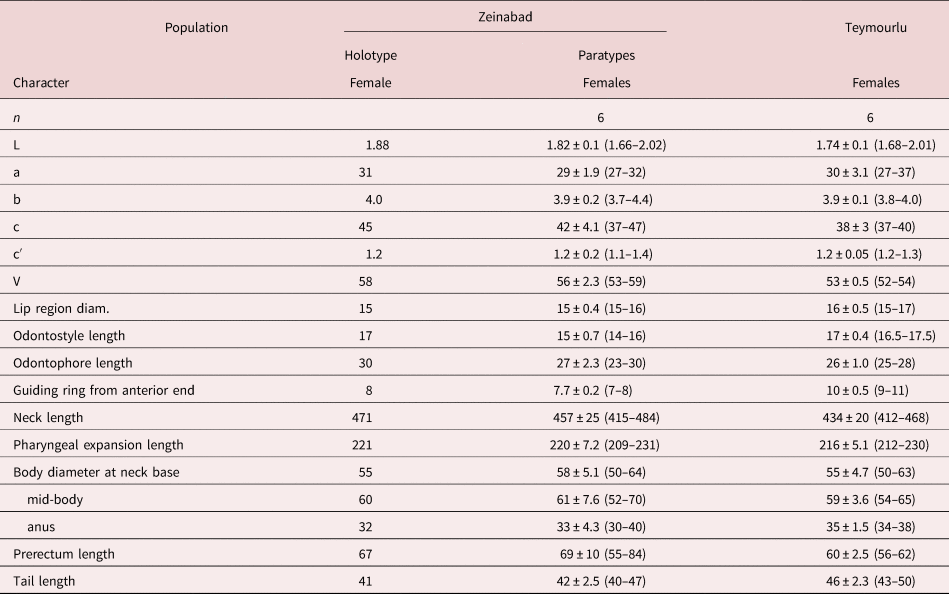
The extracted nematodes were relaxed and killed by heat, fixed and transferred to dehydrated glycerine according to De Grisse's (Reference De Grisse1969) method, and mounted on permanent glass slides for handling. The specimens were examined and measured with an Olympus BX41 light microscope, Olympus Corporation, Shinjuku, Tokyo, Japan equipped with differential interference contrast optics and a drawing tube attached to it. Morphometrics include Demanian indices and other usual ratios and measurements, the most important of which are presented in table 1. Microphotographs were taken using a DP50 digital camera, Olympus Corporation, Shinjuku, Tokyo, Japan attached to the same light microscope and edited by Adobe® Photoshop® software, www.ir-tci.org. Line drawings were prepared based on the digital images using CorelDRAW® software, version 12, www.designer.com.
Morphometrics of Aporcella talebii sp. n.

All measurements are in μm (except L in mm) and in the form: mean ± standard deviation (range).
L = body length; a = body length/maximum body diameter; b = body length/neck length; c = body length/tail length; c′ = tail length/body diameter at anus; V = distance vulva-anterior end × 100/body length.
Molecular identification
Nematode DNA was extracted from three to four individuals and polymerase chain reaction (PCR) assays were conducted as described by Archidona-Yuste et al. (Reference Archidona-Yuste, Navas-Cortés, Cantalapiedra-Navarrete, Palomares-Rius and Castillo2016). The D2–D3 segments were amplified using the D2A (5′-ACAAGTACCGTGAGGGAAAGTTG-3′) and D3B (5′-CGGAAGGAACCAGCTACTA-3′) primers (Nunn, Reference Nunn1992). PCR products were purified after amplification using a Thermo Scientific GeneJET Gel Extraction Kit (Fermentas), Carlsbad, California, USA according to the procedure recommended by the manufacturer, and used for sequencing in both direction by D2A and D3B primers.
The PCR cycle conditions were as follows: one cycle of 94°C for 2 min, followed by 35 cycles of 94°C for 30 s, annealing temperature of 55°C for 45 s, 72°C for 3 min and finally one cycle of 72°C for 10 min. The purified PCR products were sent for sequencing to the Bioneer Company in South Korea. The nematode sequences obtained in this study were deposited in the GenBank database under accession numbers MH727511 and MH727515 for Aporcella talebii sp. n. and MH727506, MH727512, MH727513 and MH727514 for A. simplex.
Phylogenetic analyses
D2–D3 segments, partial 28S ribosomal DNA (rDNA) of previously deposited Aporcelaimidae Heyns, 1965 representatives and some other nematodes belonging to closely related families were obtained from the GenBank database and used for phylogenetic reconstruction. Outgroup taxa for the dataset were chosen following early published studies (Álvarez-Ortega & Peña-Santiago, Reference Álvarez-Ortega and Peña-Santiago2016; Peña-Santiago & Varela, Reference Peña-Santiago and Varela2017). The newly obtained and previously published sequences were aligned using MEGA6 software (Tamura et al., Reference Tamura, Stecher, Peterson, Filipski and Kumar2013). Phylogenetic analysis of the sequences datasets were performed based on Bayesian inference (BI) using MrBayes 3.1.2, https://bioweb.psteur.fr/packages/pack@mrbayes@3.1.2. The best-fitted model of DNA evolution was obtained using MrModel test 2.3 (Nylander, Reference Nylander2004) with Akaike-supported model in conjunction with PAUP* version 4.0b10 (Swofford, Reference Swofford2003). BI analysis under a general time-reversible of invariant sites and gamma-shaped distribution (GTR + I + G) model for the D2–D3 expansion segment of the 28S rDNA gene was done. The BI analysis was run using four Metropolis-coupled Markov Monte Carlo for 1 × 10⁸ generation. Two runs were performed for each analysis. After discarding burn-in samples and evaluating convergence, the remaining samples were retained for further analysis. Posterior probabilities are given on the appropriate clade. The tree was visualized using Fig Tree version 1.4.2 and edited with Adobe Illustrator 19.0.9, http://tree.bio.ed.ac.uk/software/figtree/
Results
Aporcella talebii sp. n.
Material examined
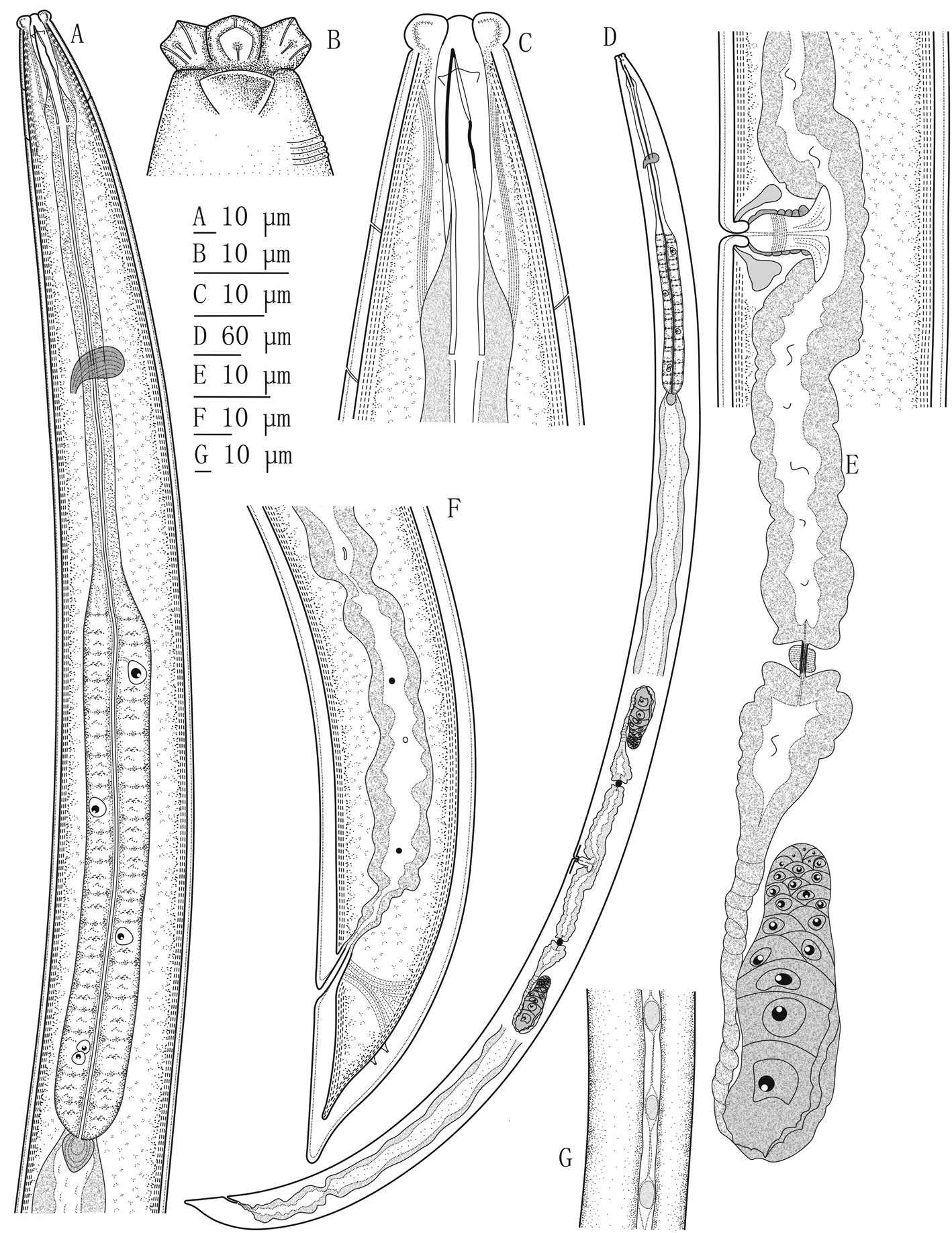
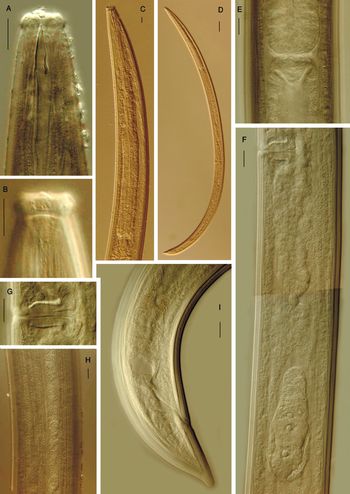
Twelve females from two locations, in a good state of preservation (figs 1 and 2).
Aporcella talebii sp. n.: (A) neck region; (B) amphidial pouch; (C) anterior end; (D) entire body; (E) posterior genital branch; (F) posterior body region; (G) lateral chord.

Aporcella talebii sp. n.: (A) anterior end; (B) amphidial pouch; (C) neck region; (D) entire body; (E) pharyngo–intestinal junction; (F) posterior genital branch; (G) vagina; (H) lateral chord; (I) posterior body region. Scale bars: (a–i) 10 μm; (d) 60 μm.

Measurements
The measurements are presented in table 1.
Description
Female. Moderately slender to slender (a = 27–37) nematodes of medium size, 1.66–2.02 mm long. Body cylindrical, tapering toward both ends but more so towards the posterior end as the tail is conical. Upon fixation, body curved ventrad, from an open to a closed C. Cuticle two-layered, 2–3 μm thick at anterior region, 3–5 μm in mid-body and 4.5–6.5 μm on tail; outer layer thin and with constant thickness throughout the body, with an apparently smooth surface; inner layer visibly thicker than the outer one, especially perceptible at caudal region. Lateral chord 8–10.5 μm broad at mid-body, occupying 14–17% of the corresponding body diameter, bearing glandular bodies throughout the body. One ventral and two dorsal body pores usually present at level of odontostyle, plus odontophore in some specimens. Lip region angular, offset from the adjacent body by a constriction, 3.0–3.5 times as wide as high and about one-third (28–34%) of body diameter at neck base; lips moderately separate, with protruding labial and cephalic papillae. Amphidial fovea cup-shaped, its opening 7.5–9 μm broad or 50–60% of lip region diameter. Odontostyle typical of the genus, strong, nearly equal in length (0.9–1.1 times) to lip region diameter, its aperture 9–11 μm or 62–68% of its total length. Odontophore rod-like, 1.4–1.8 times as long as the odontostyle. Guiding ring single, plicate, located at 7–11 μm from the anterior end. Nerve ring at 31–39% of neck length from anterior end. Pharynx entirely muscular, its anterior section gradually enlarging into the basal expansion that is 7.9–8.3 times longer than wide, 3.6–4.1 times longer than body diameter at neck base and occupies up to one half (46–50%) of the total neck length, with gland nuclei situated as follows: DN = 59–60; S1N1 = 68–70; S1N2 = 77–79; S2N = 88–91. Cardia hemispherical to conoid, 13–15 × 8.7–9.5 μm. Reproductive system didelphic–amphidelphic, with both branches equally and well developed, the anterior 287–369 μm or 16–22% of body length, the posterior one 276–387 μm or 16–21% of body length: ovaries comparatively small, in general not reaching the uterus–oviduct junction, anterior 78–109 μm and posterior 75–118 μm long, with oocytes arranged first in two or more rows, then in a single row in the maturation zone; oviduct 108–133 μm (anterior) and 98–137 μm (posterior), consisting of slender part and well-developed pars dilatata with visible lumen; sphincter present at oviduct–uterus junction; uterus a simple, tube-like structure 89–124 μm long or 1.6–2.0 times the corresponding body diameter long; vagina extending inwards 22–37 μm, reaching 38–47% of body diameter, consisting of pars proximalis 14–25 × 16–22 μm with somewhat sigmoid walls and surrounded by developed musculature, and pars distalis 4–9 μm long. Gland cells present on both sides of vagina. Vulva a transverse slit. Prerectum 1.3–2.8, rectum 0.7–1.4 times the anal-body diameter long. Tail conical with finely rounded terminus, ventrally nearly straight, dorsally first convex and then bearing a more or less conspicuous concavity, sometimes with subdigitate outline, inner cuticle continuous but not reaching the tail tip – thus, a short but perceptible terminal hyaline portion exists; caudal pores at about the middle of the tail, one nearly lateral, other subdorsal.
Male. Not found, and females do not contain sperm cells.
Molecular characterization
Two sequences of the D2–D3 28S rDNA gene comprising about 800 bp long from two specimens belonging to different populations were obtained and deposited at the GenBank (accession numbers MH727515 and MH727511). In pairwise-distance analysis, two sequences showed seven nucleotide differences and 99% similarity. .
Diagnosis and relationships
The new species is characterized by its 1.66–2.02-mm-long body, lip region offset by constriction and 15–17 μm broad, odontostyle 14–17.5 μm or 0.9–1.1 times the lip region diameter, neck 412–484 μm long, pharyngeal expansion 209–231 μm long or 46–50% of total neck length, female genital system didelphic–amphidelphic, uterus a simple tube 89–124 μm long or 1.6–2.0 times the corresponding body diameter long, vulva a somewhat posterior (V = 52–59) transverse slit, tail conical (40–50 μm, c = 37–47, c′ = 1.1–1.4) with a weak but perceptible dorsal concavity at the end and male absent.
Aporcella talebii sp. n. is very similar to A. malekimilanii Naghavi, Niknam, Vazifeh & Peña-Santiago, 2019, another Iranian, recently described species, from which it can be easily distinguished by its much shorter pharyngeal expansion (209–231 vs. 300–375 μm, 46–50 vs. 58–63% of total neck length) and, consequently, much more posterior position of pharyngeal gland nuclei (DN = 59–60 vs. 50–52; S1N1 = 68–70 vs. 59–61; S1N2 = 77–79 vs. 70–73; S2N = 88–91 vs. 81–86). In addition, it shows a generally smaller-sized body (1.6–2.0 vs. 1.9–2.7 mm long; neck 412–484 vs. 476–619 μm; prerectum 55–84 vs. 105–178 μm). The new species also resembles Aporcella capitulum (Shahina, Musarrat & Siddiqi, 2005) Álvarez-Ortega, Subbotin & Peña-Santiago, 2013 and Aporcella salsa (Andrássy, 2010) Álvarez-Ortega, Subbotin & Peña-Santiago, 2013. It differs from A. capitulum, only known from Pakistan, by its narrower lip region (15–17 vs. 17.5–20 μm), longer neck (412–484 vs. 356–402 μm), significantly different female tail shape (conical with a dorsal concavity vs. regularly convex conoid) and male absent (vs. as frequent as female). From A. salsa, a North American species, by its more slender body (a = 27–37 vs. 24–26), narrower lip region (15–17 vs. 19–20 μm), shorter odontostyle (14–17.5 vs. 18–19 μm), posteriorly located vulva (V = 52–59 vs. 46–52) and somewhat different tail shape (finely rounded vs. more rounded tip, presence vs. absence of a perceptible dorsal concavity and less vs. more developed terminal hyaline portion or lacuna).
Type locality and habitat
Iran, East Azarbaijan province, Sufiyan, Roodghat area, Zeinabad village (GPS coordinates: 38°18′00″N, 46°07′08″E, altitude 1540 m above sea level (a.s.l.)), from the rhizosphere of common wheat (Triticum aestivum L.).
Other locality and habitat
Iran, East Azarbaijan province, Osku, Teymourlu (GPS coordinates: 37°44′35″ N, 45°57′30″E, altitude 1456 m a.s.l.), from the rhizosphere of ‘Red Delicious’ apple (Malus domestica L.).
Type material
Female holotype female and two female paratypes deposited at the Nematode Collection of the Faculty of Agriculture, University of Tabriz, Tabriz, Iran. Four female paratypes with the Nematode Collection of the University of Jaén, Spain.
Etymology
The new species is named in honour of the late Dr Parviz Talebi Chaichi, Associate Professor of Insect Ecology, Department of Plant Protection, Faculty of Agriculture, University of Tabriz, Tabriz, Iran.
Aporcella simplex (Thorne & Swanger, 1936) Loof & Coomans, 1970
Material examined
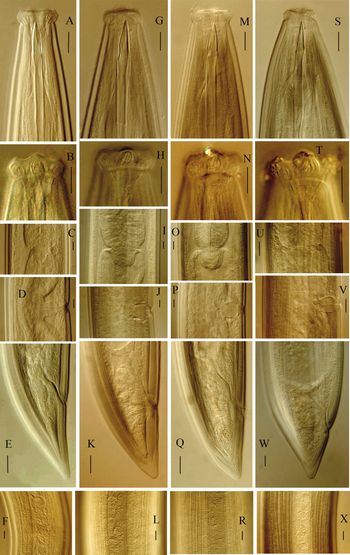
Twenty females from four locations, in a good state of preservation (fig. 3).
Aporcella simplex (Thorne & Swanger, 1936) Loof & Coomans, 1970 anterior end, amphidial pouch, vaginae, posterior body region and lateral chord of populations from (A–F) Azarbaijan Shahid Madani University Campus; (G–L) Sheikh Hassan; (M–R) Firooz Salar; and (S–X) Mamaghan, respectively. Scale bars: 10 μm.

Measurements
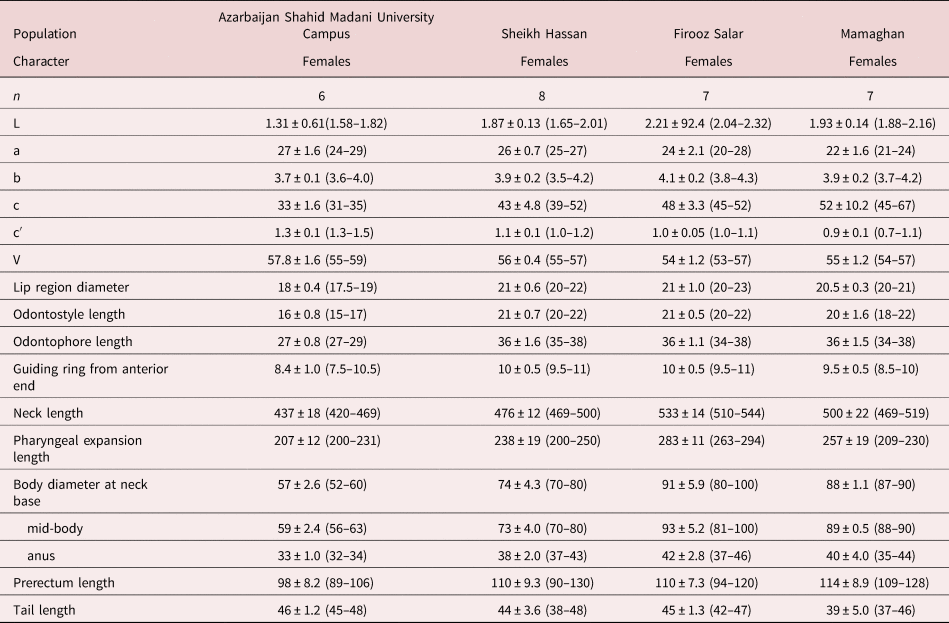
The measurements are presented in table 2.
Morphometrics of the Iranian populations of Aporcella simplex.

All measurements are in μm (except L in mm) and in the form: mean ± standard deviation (range).
L = body length; a = body length/maximum body diameter; b = body length/neck length; c = body length/tail length; c′ = tail length/body diameter at anus; V = distance vulva-anterior end × 100/body length.
Molecular characterization
Four sequences (MH751506, MH751512, MH751513 and MH751514) c. 800 bp long of D2–D3 expansion segments of the 28S rDNA gene were obtained from four specimens belonging to different populations. In pairwise distance analysis, the three sequences MH727512, MH727513 and MH727514 showed 100% similarity, with no inter-population variation. Nevertheless, the MH727506 sequence presented a 2 bp difference, with 99% similarity to the other sequences.
Distribution
Four populations of this species were collected in four Iranian places: (i) East Azarbaijan province, Tabriz, Sheikh Hassan village (GPS coordinates: 38°01′37″N, 46°06′30″E, altitude 1315 m a.s.l.), in the rhizosphere of silver berry (Elaeagnus angustifolia L.); (ii) Mamaghan region, Azarshahr (37°49′39″N, 45°58′17.2″E, altitude 1304 m a.s.l.), in the rhizosphere of walnut (Juglans regia L.); (iii) Azarbaijan, Tabriz, Shahid Madani University Campus (37°48′39″N, 45°56′00″E, altitude 1338 m a.s.l.), in the rhizosphere of white mulberry (Morus alba L.); and (iv) Azarshahr, Gugan, Firooz Salar (37°47′47″N, 45°56′10.2″E, altitude 1340 m a.s.l.), in the rhizosphere of silver berry (E. angustifolia).
Remarks
Some inter-population variations were noted in the Iranian specimens of A. simplex. Thus, females from Azarbaijan Shahid Madani University Campus show a narrower (17.5–19 vs. 20–23 μm) but more expanded lip region, a shorter odontostyle (15–17 vs. 18–22 μm) and odontophore (27–29 vs. 34–38 μm) and a comparatively longer tail (c = 31–35 vs. c = 39–67, c′ = 1.3–1.5 vs. c′ = 0.7–1.2) than those of other populations, and the Mamaghan population has a less convex and somewhat shorter tail. These intraspecific variations, together with those observed in the D2–D3 sequences, are probably due to the influence of environmental conditions. Nevertheless, all of them fit well those previously known in the populations from the USA and Spain (Álvarez-Ortega et al., Reference Álvarez-Ortega, Subbotin and Peña-Santiago2013), with very similar morphology and either totally coincident or widely overlapping morphometrics. The molecular analyses also confirm the identity of the Iranian specimens.
The finding of A. simplex in Iran is a remarkable biogeographical novelty, as it represents the first Asian record of the species, which significantly extends its spread since it was previously known to occur in Jamaica (Thorne & Swanger, Reference Thorne and Swanger1936; Andrássy, Reference Andrássy2001), the USA (Thorne & Swanger, Reference Thorne and Swanger1936; Loof & Coomans, Reference Loof and Coomans1970; Tjepkema et al., Reference Tjepkema, Ferris and Ferris1971; Baird & Bernard, Reference Baird and Bernard1984; Andrássy, Reference Andrássy2001; Álvarez-Ortega & Peña-Santiago, Reference Álvarez-Ortega and Peña-Santiago2010; Álvarez-Ortega et al., Reference Álvarez-Ortega, Subbotin and Peña-Santiago2013) and several European countries – namely, Austria (Zolda, Reference Zolda2002), Bulgaria (Ilieva et al., Reference Ilieva, Iliev and Georgieva2017), France (Loof & Coomans, Reference Loof and Coomans1970; Domowska, Reference Domowska2000; Andrássy, Reference Andrássy2001), Italy (Loof & Coomans, Reference Loof and Coomans1970; Andrássy, Reference Andrássy2001), the Netherlands (Loof & Coomans, Reference Loof and Coomans1970; Bongers, Reference Bongers1988; Andrássy, Reference Andrássy2001), Poland (Winizewska-Slipinska, Reference Winizewska-Slipinska1987), Spain (Álvarez-Ortega et al., Reference Álvarez-Ortega, Subbotin and Peña-Santiago2013) and ?Switzerland (Altherr, Reference Altherr1950, Reference Altherr1952). Thus, the species certainly is a typical representative of the Holarctic nematode fauna.
Notes on the phylogeny of Aporcella
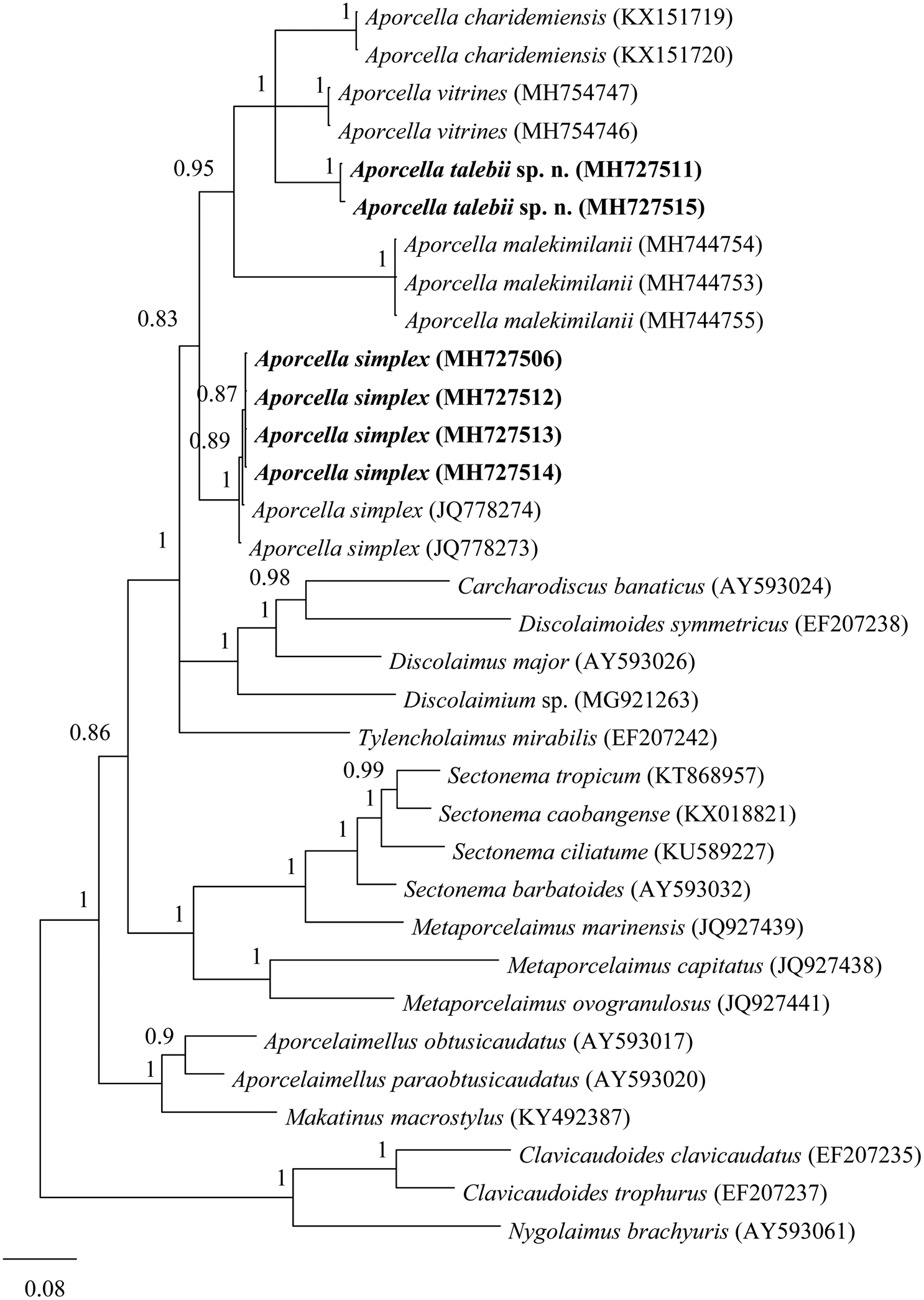
As derived from the molecular analyses, the evolutionary relationships of the two species herein studied with its congeners and other dorylaims are represented in the tree of fig. 4. All Aporcella sequences, 15 in total, form a recognizable clade, supporting (83%) the monophyly of the genus. The Aporcella clade is divided into two subclades, one (support 100%) corresponding to six A. simplex sequences, two Californian and four Iranian, another (95%) consisting of nine sequences of four (one Iberian and three Iranian) species. Regarding the external relationships of Aporcella, the same tree shows that it forms a highly supported (100%) clade with discolaims and tylencholaims, and that it does not share a (most) recent ancestor with other aporcelaims, which are separated in two subclades: Sectonema plus Metaporcelaimus on the one side, and Aporcelaimellus plus Makatinus on the other side. These results (once more) confirm the previous ones presented by several authors (Álvarez-Ortega et al., Reference Álvarez-Ortega, Subbotin and Peña-Santiago2013; Álvarez-Ortega & Peña-Santiago, Reference Álvarez-Ortega and Peña-Santiago2016; Naghavi et al., Reference Naghavi, Niknam, Vazifeh and Peña-Santiago2019) regarding the monophyly of Aporcella, its close relationships with other genera lacking a distinct pars refringens vaginae and the polyphyly of aporcelaims as traditionally conceived.
Bayesian inference tree from the known and newly sequenced Aporcella talebii sp. n. and A. simplex based on sequences of the 28S rDNA region. Posterior probability and bootstrap values exceeding 50% are given on appropriate clades. Scale bar shows the number of substitutions per site. Newly obtained sequences are in bold letters.

Financial support
This research received no specific grant from any funding agency, commercial or not-for-profit sectors.
Conflicts of interest
There is no conflicts of interest in this work.