INTRODUCTION
The holothuroids, commonly known as sea cucumbers, are characterized by pentamerous symmetry, which is often obscured by a more or less conspicuous bilateral symmetry. The body wall and other organs generally contain microscopic calcareous particles in greater or less abundance in a variety of different orientations and are, hence, important taxonomic characteristics (Miller & Pawson, Reference Miller and Pawson1984; Borrero-Pérez et al., Reference Borrero-Pérez, Benavides-Serrato and Diaz-Sanchez2012).
Holothuroids inhabit exclusively marine environments and are distributed from polar sea bottoms to tropical coral reefs, where they play several functional roles: as filter-feeders of the water column, sediment-feeders, bioturbators of soft substrates, and as the prey of mammals, birds, fishes, crustaceans, mollusks and other taxa (Bakus, Reference Bakus1973; Birkeland, Reference Birkeland1989; Francour, Reference Francour1997; Borrero-Pérez et al., Reference Borrero-Pérez, Benavides-Serrato and Diaz-Sanchez2012). The class Holothuroidea includes approximately 1400 species distributed across the orders Apodida, Aspidochirotida, Dactylochirotida, Dendrochirotida, Elasipodida and Molpadiida (Pawson, Reference Pawson2007). Regionally, the eastern Pacific harbours 174 species (Alvarado & Solís-Marín, Reference Alvarado and Solís-Marín2013), of which 38 species are specifically associated with coral reef environments (Sotelo-Casas & Rodríguez-Troncoso, Reference Sotelo-Casas, Rodríguez-Troncoso, Cifuentes-Lemús and Cupul-Magaña2014).
Coral communities of the eastern Pacific are characterized by a high richness of the orders Dendrochirotida and Aspidochirotida (Alvarado et al., Reference Alvarado, Solís-Marín and Ahearn2008, Reference Alvarado, Solís-Marín and Ahearn2010; Bastida-Zavala et al., Reference Bastida-Zavala, García-Madrigal, Rosas-Alquicira, López-Pérez, Benítez-Villalobos, Meraz-Hernando, Torres-Huerta, Montoya-Márquez and Barrientos-Luján2013; Ríos-Jara et al., Reference Ríos-Jara, Galvan-Villa, Rodriguez-Zaragoza, Lopez-Uriarte, Bastida-Izaguirre and Solis-Marin2013). The dendrochirotids are typically small and sedentary filter feeders that live in cryptic habitats (Birkeland, Reference Birkeland1989; Solís-Marín et al., Reference Solís-Marín, Arriaga-Ochoa, Laguarda-Figueras, Frontana-Uribe and Durán-González2009). They are normally present at low densities in tropical regions due to both a high level of predation and resource competition (Bakus, Reference Bakus1973; Birkeland, Reference Birkeland1989; Francour, Reference Francour1997). Contrastingly, members of the order Aspidochirotida are large suck-feeders that demonstrate high levels of activity and locomotion relative to the dendrochirotids (Solís-Marín et al., Reference Solís-Marín, Arriaga-Ochoa, Laguarda-Figueras, Frontana-Uribe and Durán-González2009); also they have become a commercially important group with a high vulnerability to human activities (Purcell et al., Reference Purcell, Samyn and Conand2012).
Islas Marietas National Park (IMNP) harbours an important coral community in the Central Mexican Pacific (CMP), with a diverse assemblage of holothurians that inhabit several types of substrates, from sandy bottoms to crevices, and on top of macroalgae and corals (Nepote-Gónzalez, Reference Nepote-Gónzalez1998; Cupul-Magaña et al., Reference Cupul-Magaña, Aranda, Medina-Rosas and Vizcaíno2000; Chávez-Dagostino et al., Reference Chávez-Dagostino, Nepote-González, Medina-Rosas and Solís-Marín2000). A total of 11 species have been reported for the area (Nepote-Gónzalez, Reference Nepote-Gónzalez1998; Solís-Marín & Laguarda-Figueras, Reference Solís-Marín and Laguarda-Figueras1999; CONANP, 2007); however, the richness has been underestimated, as the identification of holothurians in situ is difficult due to their sedentary habits, nocturnal activity and, in some cases, small size (Miller & Pawson, Reference Miller and Pawson1984; Birkeland, Reference Birkeland1989). As they represent a key group in the coral reef community, acknowledging the biodiversity of the holothuroids at IMNP would not only increase our understanding of this national protected area, but it could also fill a critical gap in the distribution of holothurians of the tropical eastern Pacific.
MATERIALS AND METHODS
Study area
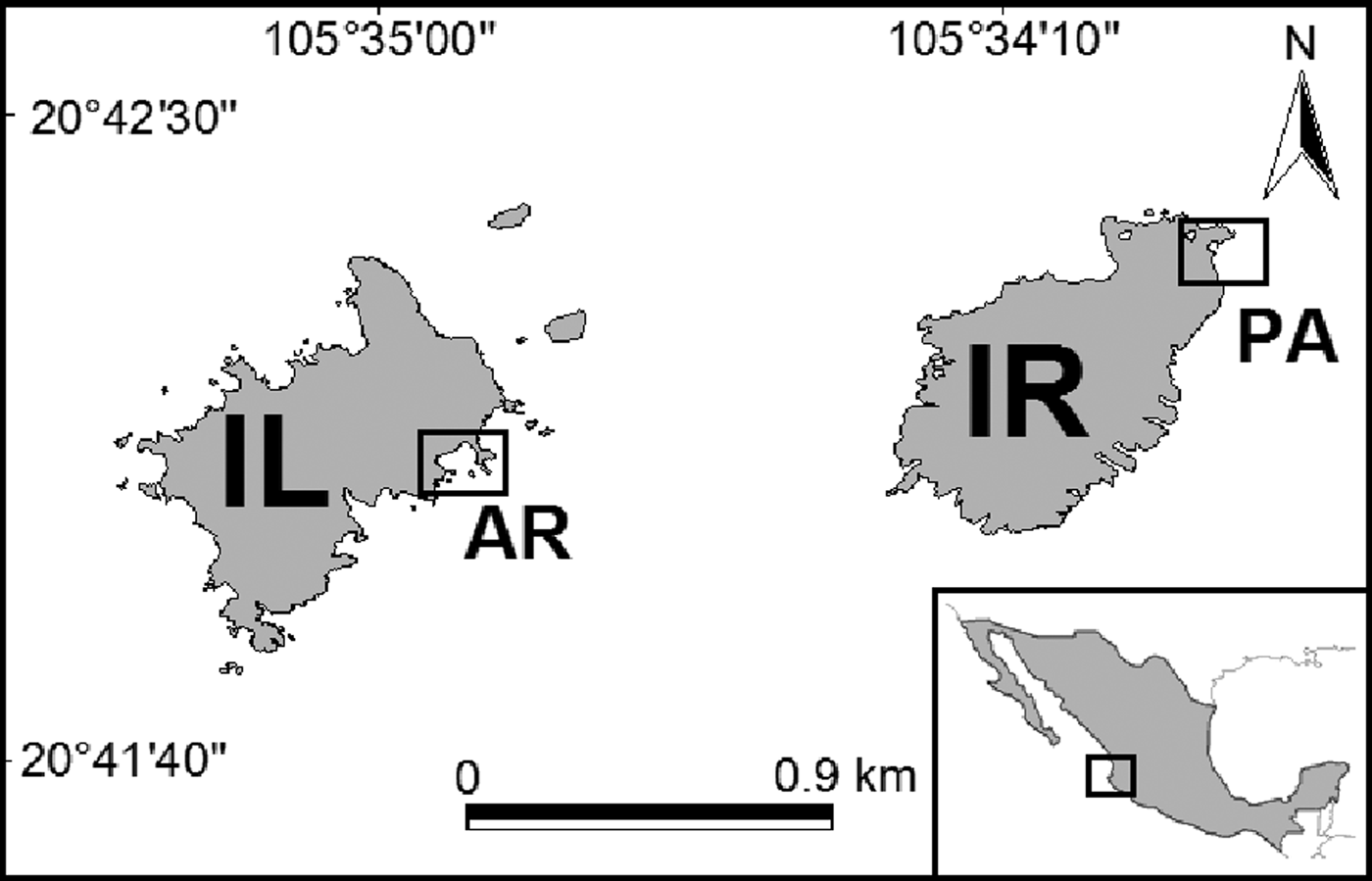
Sampling was conducted at IMNP (20°41′30″–20°42′30″N 105°35′30″–105°33′30″W) located in the CMP (Figure 1). This region is considered an oceanographic transition zone between two biogeographic provinces, the tropical eastern Pacific and the temperate northern Pacific (Pantoja et al., Reference Pantoja, Marinone, Pares-Sierra and Gomez-Valdivia2012). Therefore, the area is influenced by two oceanic currents: the California Current, which brings in cold waters between November and April, and the Costa Rica Current, which transports warm waters to the region between May and October. Furthermore, seasonal upwelling occurs between February and April (Lavín et al., Reference Lavín, Fiedler, Amador, Ballance, Färber-Lorda and Mestas-Nuñez2006; Pantoja et al., Reference Pantoja, Marinone, Pares-Sierra and Gomez-Valdivia2012). Collectively, the mean annual temperature is 26.4°C and ranges from 23 to 30°C. The average salinity is ~35 psu (CONANP, 2007).
Location of the study area: IL, Isla Larga; AR, Área de Restauración; IR, Isla Redonda; PA, Playa del Amor, Islas Marietas National Park, Nayarit, Mexico.

IMNP harbours one of the most important coral communities from the Mexican Pacific; the benthic structure is characterized by the presence of branching and massive corals, (Reyes-Bonilla et al., Reference Reyes-Bonilla, Carriquiry, Leyte-Morales and Cupul-Magaña2002) combined with rocky or sandy bottoms (CONANP, 2007); the former structures, in particular, provide favourable habitats for a high diversity of both vertebrates and invertebrates (Chávez-Dagostino et al., Reference Chávez-Dagostino, Nepote-González, Medina-Rosas and Solís-Marín2000; Cupul-Magaña et al., Reference Cupul-Magaña, Aranda, Medina-Rosas and Vizcaíno2000).
Sample collection and identification
Surveys were conducted via SCUBA diving at two sites in the IMNP: Playa del Amor (Isla Redonda) and Área de Restauración (Isla Larga), by visual censuses (25 × 4 m) in a depth range from 0 to 15 m (WWF, 2006). For taxonomic purposes only, few specimens (or only one) were collected; however ecological observations were recorded in situ during the surveys. The specimens were collected from a variety of substrata in or adjacent to the main coral frame structure (dead stony corals, rock and sand). The organisms obtained were placed individually in plastic bags in situ, transported to the laboratory, preserved in 70% ethanol and stored at room temperature until the time of taxonomic analysis.
In the laboratory, each specimen was photo-documented using an Olympus® digital camera. To extract the ossicles, small pieces of dorsal and ventral tissues from each specimen were placed in a Petri dish, submerged in 10% sodium hypochlorite solution for 10 min, and washed with fresh water in order to remove tissue and the sodium hypochlorite. The ossicles accumulated at the bottom of the Petri dish were observed under a compound microscope (LABO®). The specimens and spicules were photographed with a camera Canon EOS 7D®, and afterwards drew and digitalized with the software Adobe Photoshop CS v.8®. The species were identified following the taxonomic criteria described by Deichmann (Reference Deichmann1941, Reference Deichmann1958), Prieto Ríos (Reference Prieto Ríos2010) and Solís-Marín et al. (Reference Solís-Marín, Arriaga-Ochoa, Laguarda-Figueras, Frontana-Uribe and Durán-González2009). Finally, all species were validated with reference material from the Colección Nacional de Equinodermos “Dra. Ma. E. Caso” at the Instituto de Ciencias del Mar y Limnología (ICML), UNAM, Mexico.
SYSTEMATICS
Phylum ECHINODERMATA
Class HOLOTHUROIDEA
Order ASPIDOCHIROTIDA Grube, 1840
Family HOLOTHURIIDAE Burmeister, 1837
Genus Holothuria Linnaeus, 1767
Subgenus Halodeima Pearson, 1914
Holothuria (Halodeima) inornata Semper, 1868
MATERIAL EXAMINED
One specimen, deposited at the collection of the Laboratorio de Ecología Marina, Centro de Investigaciones Costeras, Departamento de Ciencias Biológicas, Centro Universitario de la Costa, Universidad de Guadalajara (Playa del Amor, 20°42′14.1″N 105°33′50.1″W).
COMPARATIVE MATERIAL
ICML-UNAM 5.12.0, one specimen, Isla de los Chivos, Mazatlán, Sinaloa, Mexico (23°10′46″N 106°24′42″W).
DESCRIPTION
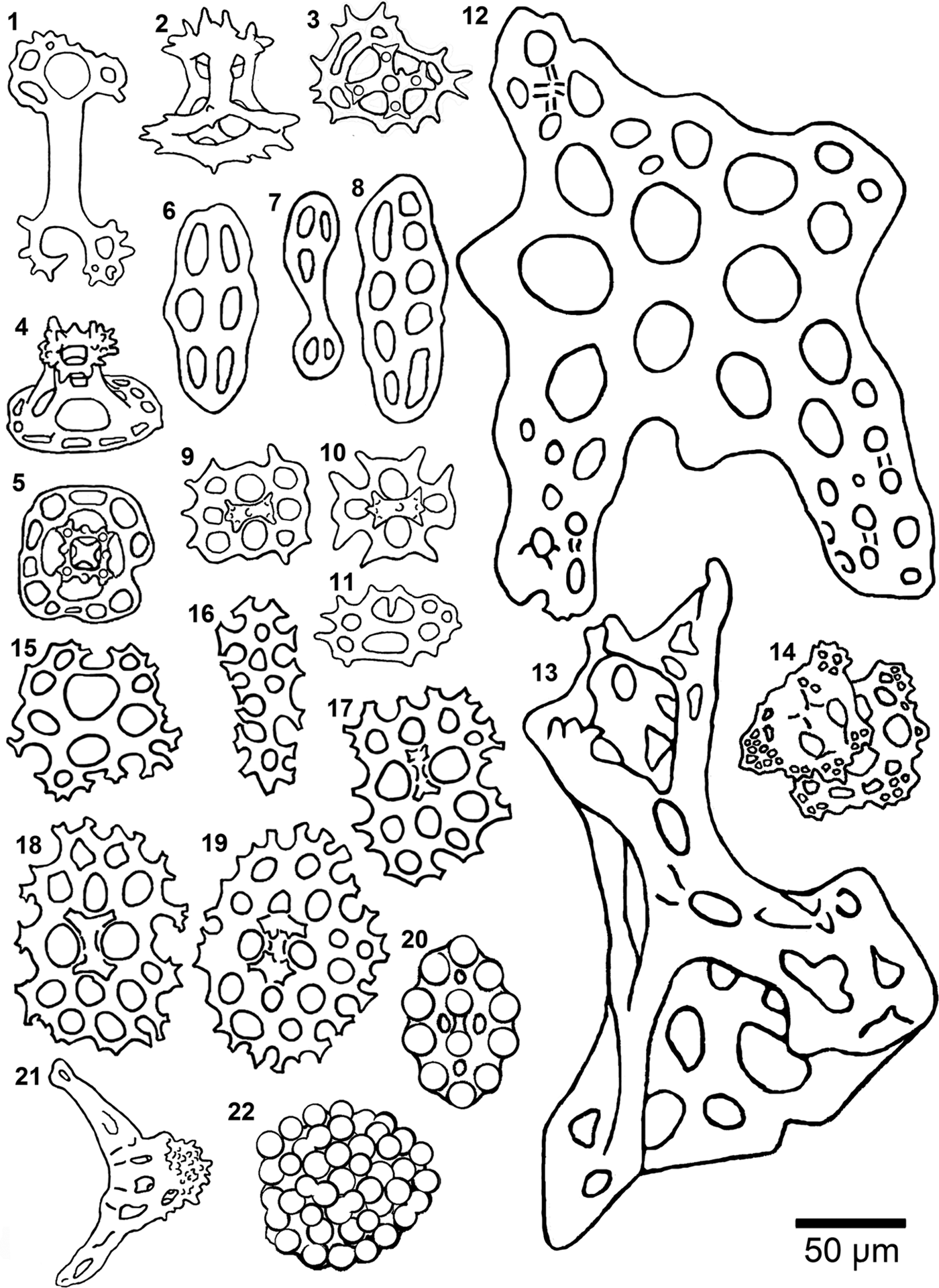
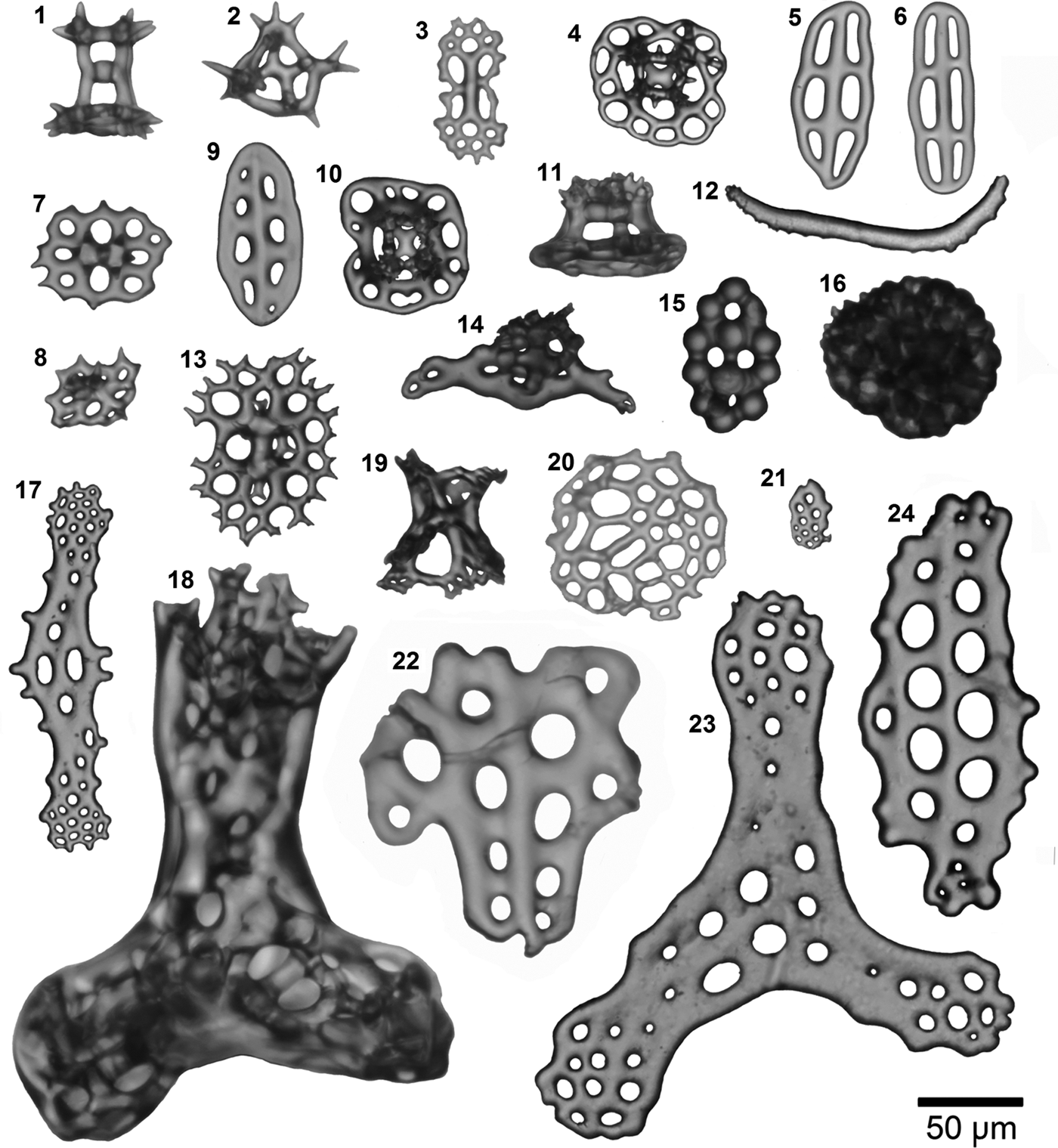
Large species (>200 mm) with 20 tentacles. Ventral feet cylindrical, not crowded; dorsally four to six rows of low warts, each carrying a small papillae with smaller, more or less cylindrical feet scattered between them (Figure 2G). Spicules with an external layer of tables with small or completely reduced disks, often with a few marginal spines; spire well developed, with one crossbeam and four erect and eight laterally projecting teeth. The tables often partly reduced, with either disk or teeth resorbed (Figure 3, pls. 2, 3 & Figure 4, pls. 1, 2). Supporting rods or plates from tube feet with perforated or branched ends (Figure 3, pl. 1 & Figure 4, pl. 3).
Specimens sampled at Islas Marietas National Park. (A) Neocucumis veleronis (Deichmann, Reference Deichmann1941); (B) Lissothuria ornata Verrill, 1867; (C) Pachythyone pseudolugubris Deichmann, Reference Deichmann1941; (D) Afrocucumis ovulum (Selenka, 1867); (E) Holothuria (Mertensiothuria) hilla Lesson, 1830; (F) Holothuria (Platyperona) difficilis Semper, 1868; (G) Holothuria (Halodeima) inornata Semper, 1868. Photographs from specimens A–D were taken from samples preserved in 70% ethanol, while those remaining were from live specimens.
Extracted spicules from specimens taken from Islas Marietas National Park. 1–3: Holothuria (Halodeima) inornata Semper, 1868; 1 = supporting rod from tube foot; 2–3 = tables from dorsal side. 4–8: Holothuria (Mertensiothuria) hilla Lesson, 1830; 4–5 = tables from dorsal body wall, 6–8 = different types of buttons from dorsal side. 9–11: Neocucumis veleronis (Deichmann, Reference Deichmann1941); 9–10 = tables with low spires from dorsal side, 11 = plate without spire from the dorsal side. 12–14: Lissothuria ornata Verrill, 1867; 12 = curved supporting plate from the dorsal side, 13 = tower-like body from the dorsal side, 14 = hourglass-shaped body from the dorsal side. 15–19: Afrocucumis ovulum (Selenka, 1867), 15 = plate without trace of spire, 16 = supporting plate from tube foot, 17–19 = plates with traces of spire. 20–22: Pachythyone pseudolugubris Deichmann, Reference Deichmann1941. 20 = knobbed button from the dorsal side, 21 = supporting tables from the dorsal tube feet, 22 = strongly knobbed, ovoid-shaped ossicles from the dorsal side.
1–3: Holothuria (Halodeima) inornata Semper, 1868; 1–2 = tables with spires from the dorsal side. 3 = plate from tube foot. 4–6: Holothuria (Mertensiothuria) hilla Lesson, 1830; 4 = table from dorsal body wall, 5–6 = buttons from the dorsal side. 7–8: Neocucumis veleronis (Deichmann, Reference Deichmann1941). Tables with low spires from the dorsal side. 9–12: Holothuria (Platyperona) difficilis Semper, 1868; 9 = button from dorsal tube feet, 10–11 = tables with spires from the dorsal side, 12 = rod from the tube feet. 13: Afrocucumis ovulum (Selenka, 1867). Plate with several spires. 14–16: Pachythyone pseudolugubris Deichmann, Reference Deichmann1941; 14 = supporting table from dorsal tube feet, 15 = knobbed button from dorsal side, 16 = strongly knobbed, ovoid-shaped ossicle from the dorsal side. 17–24: Lissothuria ornata Verrill, 1867; 17 = supporting plate from ventral feet, 18 = tower-like body from the dorsal side, 19 = hourglass-shaped body from the dorsal side, 20 = end plate from tube foot, 21 and 24 = perforated plates of the ventral sole, 22 = curved supporting plate from the dorsal side, 23 = perforated plate from the ventral sole.
REMARKS
The organism presents spicules similar to Holothuria kefersteini. However, both species in vivo present differences in their corporal coloration. Holothuria inornata have brownish bodies and are normally covered with sand. They also have black papillae, tentacles and podia, and a generally more corpulent appearance (Figure 2G). The bodies of Holothuria kefersteini are typically orange with dark green papillae, tentacles and podia; their bodies are typically free of sediments.
DISTRIBUTION
Mexico, Revillagigedo Islands, Guatemala, El Salvador, Costa Rica, Panama, Ecuador, Galapagos and Peru (Solís-Marín et al., Reference Solís-Marín, Arriaga-Ochoa, Laguarda-Figueras, Frontana-Uribe and Durán-González2009; Alvarado & Solís-Marín, Reference Alvarado and Solís-Marín2013).
ECOLOGY
The species was collected from a rubble-sandy bottom environment. Specimens were observed as isolated in crevices or between rocks, and their bodies were normally covered with mucus, sand and/or mud. This could serve as a camouflage mechanism or as protection against solar irradiance (Bonham & Held, Reference Bonham and Held1963).
Subgenus Mertensiothuria Deichmann, Reference Deichmann1958
Holothuria (Mertensiothuria) hilla Lesson, 1830
MATERIAL EXAMINED
One specimen, deposited at the collection of the Laboratorio de Ecología Marina, Centro de Investigaciones Costeras, Departamento de Ciencias Biológicas, Centro Universitario de la Costa, Universidad de Guadalajara (Área de Restauración 20°41′57″N 105°34′55.6″W).
COMPARATIVE MATERIAL
ICML-UNAM 5.26.31, two specimens, Conchas Chinas, Puerto Vallarta, Jalisco, México (20°34′58″N 105°17′59″W).
DESCRIPTION
Slender, spindle-shaped form, up to 200 mm long, though usually less than 150 mm. Ventral mouth surrounded by 20 small, yellowish tentacles, anus terminal. Ventral podia arranged in 3–4 rows in each ambulacra area. Dorsal papillae, large and conical, scattered in no particular order on the bivium. The coloration was greenish-brown with numerous orange spots, marking the base of the yellowish papillae (Figure 2E).
The spicules of the body wall were tables, with buttons of three or five pairs of holes (Figure 2, pls. 6–8 & Figure 3, pls. 5, 6). The podia and papillae spicules were similar to the body wall spicules. Tables had circular disk with ten to fourteen holes and tapering spires with few spines on the tips (Figure 2, pls. 4, 5 & Figure 3, pl. 4).
DISTRIBUTION
Mexico, Revillagigedo Islands, El Salvador, Costa Rica, Cocos Island, Panama, Colombia, Galapagos, Hawaii, Marianas Islands, Marshall Islands, French Polynesia, Palau, Samoa, Papua New Guinea, Australia, Micronesia, Guam, Kiribati, Fiji, Indonesia, Japan, Philippines, Thailand, Maldives and the Persian Gulf (Barraza, Reference Barraza2008; Solís-Marín et al., Reference Solís-Marín, Arriaga-Ochoa, Laguarda-Figueras, Frontana-Uribe and Durán-González2009, Alvarado & Solís-Marín, Reference Alvarado and Solís-Marín2013).
ECOLOGY
At the study area, this species was collected from a sandy bottom under a concrete artificial, semi-spherical structure, forming aggregations of over 15 individuals. This species is especially difficult to observe during diurnal visual surveys, possibly due to their nocturnal behaviour.
Subgenus Platyperona Rowe, 1969
Holothuria (Platyperona) difficilis Semper, 1868
MATERIAL EXAMINED
One specimen, deposited at the collection of the Laboratorio de Ecología Marina, Centro de Investigaciones Costeras, Departamento de Ciencias Biológicas, Centro Universitario de la Costa, Universidad de Guadalajara (Área de Restauración, 20°41′57″N 105°34′55.6″W).
COMPARATIVE MATERIAL
ICML-UNAM 5.25.11, two specimens, Isla San Gabriel, La Paz, Baja California Sur, México (24°33′N 110°22′W).
DESCRIPTION
Medium-sized, varying from 60 to 180 mm long. Ventral side well demarcated from the dorsal and usually dark brown (Figure 2F). Papillae scattered on the dorsal side without any evident arrangement. Pedicels arranged in three bands on the ventral side.
Spicules consist of tables, plates, rods and buttons. Tables are short and robust with about eight holes in the disk, often with smaller holes intercalated between them (Figure 4, pls. 10, 11). Disks of the tables are either round or squarish. Spires are short, with four rods and numerous teeth and spines on top. Buttons are broad ovals with three to five pairs of small holes. An apparent median longitudinal ridge is present in each button (Figure 4, pl. 9). Tentacles have curved rods with spinous ends (Figure 4, pl. 12).
REMARKS
At IMNP, the specimens were ≤100 mm in total length, with evidence of gonad present.
DISTRIBUTION
United States of America, Mexico, Revillagigedo Islands, Clipperton Island, Guatemala, El Salvador, Honduras, Nicaragua, Costa Rica, Cocos Island, Panama, Colombia, Cook Islands, Marshall Islands, Guam, Pitcairn Islands, French Polynesia, Australia, Kenya, North-western Africa (Deichmann, Reference Deichmann1958; Solís-Marín et al., Reference Solís-Marín, Arriaga-Ochoa, Laguarda-Figueras, Frontana-Uribe and Durán-González2009; Alvarado & Solís-Marín, Reference Alvarado and Solís-Marín2013).
ECOLOGY
Individuals were collected from sandy bottoms under rocks and coral rubble. At the moment of collection, the specimens discharged fine, white filaments known as Cuvierian tubules as a defence mechanism.
Order DENDROCHIROTIDA Grube, 1840
Family CUCUMARIIDAE Ludwig, 1894
Genus Neocucumis Deichmann, 1944
Neocucumis veleronis (Deichmann, Reference Deichmann1941)
MATERIAL EXAMINED
One specimen, deposited at the collection of the Laboratorio de Ecología Marina, Centro de Investigaciones Costeras, Departamento de Ciencias Biológicas, Centro Universitario de la Costa, Universidad de Guadalajara (Playa del Amor, 20°42′14.1″N 105°33′50.1″W).
COMPARATIVE MATERIAL
ICML-UNAM 5.40.4, three specimens, Playa Norte, Mazatlan, Sinaloa, Mexico (23°12′N 106°25′W).
DESCRIPTION
Medium size (~100 mm long) with body tapering toward both ends with numerous soft feet scattered over the inter-ambulacra. The oral and anal ends are arranged in a more orderly manner along the ambulacra. There are five large external pairs and five inner, smaller pairs closely appressed. Colour is mottled greyish, with orange and yellow marks on the tentacles (Figure 2A).
Spicules comprise a scattered layer of small tables, with oval to squarish disks, with about eight holes and dentate edges; spires are low, mostly with two pillars and often reduced to knobs (Figure 3, pls. 9, 10 & Figure 4, pls. 7, 8).
DISTRIBUTION
United States of America, Mexico, El Salvador, Nicaragua, Costa Rica, Panama, Ecuador, Peru and Chile (Solís-Marín et al., Reference Solís-Marín, Arriaga-Ochoa, Laguarda-Figueras, Frontana-Uribe and Durán-González2009; Alvarado & Solís-Marín, Reference Alvarado and Solís-Marín2013).
ECOLOGY
Specimens were found on soft bottoms (sand or mud), with their tentacles distended for catching particles in the water column. Upon contact, the individuals retracted their tentacles and actively dug through the sand to avoid capture.
Family PSOLIDAE Burmeister, 1837
Genus Lissothuria Verrill, 1867
Lissothuria ornata Verrill, 1867
MATERIAL EXAMINED
One specimen, deposited at the collection of the Laboratorio de Ecología Marina, Centro de Investigaciones Costeras, Departamento de Ciencias Biológicas, Centro Universitario de la Costa, Universidad de Guadalajara (collected from Área de Restauración, 20°41′57″N 105°34′55.6″W).
COMPARATIVE MATERIAL
ICML-UNAM 5.91.8, ten specimens, Isla Cocinas, Bahía Chamela, Jalisco, Mexico (19°32′42″N 105°06′32″W).
DESCRIPTION
Small size: length ~85 mm. Ventral side well demarcated from the dorsal one. Dorsal side completely covered by scales (Figure 2B). The anterior end, bearing the tentacles, rises considerably above the level of the dorsal side. The tentacles are highly branched, not large, and the subdivisions are contracted and form a rounded cluster on a stout pedunculated base. The dorsal skin is soft, but filled with calcareous ossicles.
The coloration from the specimen preserved in alcohol was light purple with a yellowish white ring around the mouth. The base on the tentacles is purple, with yellowish subdivisions (Figure 2B).
Spicules from the ventral sole are flat plates with scalloped edges (Figure 4, pls. 21, 24). Spicules of the dorsal side are complicated, lace-like, hourglass-shaped bodies (Figure 3, pl. 14 & Figure 4, pl. 19). There are also large towers-like bodies (Figure 3, pl. 13 & Figure 4, pl. 18) and curved perforated plates (3:12 and 4:22). Tube feet or present curved plates with four central holes and numerous marginal ones (Figure 4, pl. 17). Perforated plates present on the ventral sole (Figure 4, pl. 23).
DISTRIBUTION
Mexico, El Salvador, Nicaragua, Costa Rica, Cocos Island and Panama (Alvarado & Solís-Marín, Reference Alvarado and Solís-Marín2013).
ECOLOGY
This species is observed in hidden rock walls and under crevices of hard substrate exhibiting filter-feeding activity.
Family SCLERODACTYLIDAE Panning, 1949
Genus Afrocucumis Deichmann, 1944
Afrocucumis ovulum (Selenka, 1867)
MATERIAL EXAMINED
One specimen, deposited at the collection of the Laboratorio de Ecología Marina, Centro de Investigaciones Costeras, Departamento de Ciencias Biológicas, Centro Universitario de la Costa, Universidad de Guadalajara (Área de Restauración, 20°41′57″N 105°34′55.6″W).
COMPARATIVE MATERIAL
ICML-UNAM 5.37.1, one specimen, Playa Norte, Mazatlán, Sinaloa, México (23°13′N 106°26′W).
DESCRIPTION
Medium size (~100 mm) with soft, thick skin and numerous soft feet (Figure 2D). Tentacles: ten large external ones and ten inner ones that are much smaller and may be completely retracted into small pockets.
Spicules are characterized by a scattered layer of tables with irregular disks varying from cross-shaped to a more or less branching or laciniated plates (Figure 3, pls. 15–19 & Figure 4, pl. 13). Spires are almost always reduced to a few spines.
REMARKS
Specimens present an intense reddish-brown coloration in situ. After immersion in ethanol, the red-orange pigments were liberated.
DISTRIBUTION
Mexico, El Salvador, Panama and Peru (Alvarado & Solís-Marín, Reference Alvarado and Solís-Marín2013).
ECOLOGY
This species was collected from a small hole in a rocky substrate covered with turf algae and sand. The specimen had adopted a horseshoe form, with the mouth and anus presented upwards in the water column.
Genus Pachythyone Deichmann, Reference Deichmann1941
Pachythyone pseudolugubris Deichmann, Reference Deichmann1941
MATERIAL EXAMINED
One specimen, deposited at the collection of the Laboratorio de Ecología Marina, Centro de Investigaciones Costeras, Departamento de Ciencias Biológicas, Centro Universitario de la Costa, Universidad de Guadalajara (Área de Restauración, 20°41′57″N 105°34′55.6″W).
COMPARATIVE MATERIAL
ICML-UNAM 5.52.0, three specimens, Bahía San Felipe, Baja California, Mexico (31°00′N 114°84′W).
DESCRIPTION
Medium-sized (up to 50 mm long). Colour is mostly mottled brown (Figure 2C), though sometimes almost black; occasionally, a pale, faded specimen may be produced after alcohol preservation.
Spicules from the dorsal wall are four-holed knobbed buttons, rarely elongate and possess accessory holes in the ends (Figure 3, pl. 20 & Figure 4, pl. 15). Numerous curved, supporting tables with a low or absent spire are located in the ventral feet (Figure 3, pl. 21 & Figure 4, pl. 14). On the dorsal side, a number of spicules have well-developed complex spires, although rarely as large as those of Pachythyone lugubris. Spicules at the introvert with large tables of numerous holes and reduced spire. Strongly knobbed ovoid-shaped ossicles are present in the dorsal side (Figure 3, pl. 22 & Figure 4, pl. 16).
DISTRIBUTION
Mexico and Galapagos Islands (Solís-Marín et al., Reference Solís-Marín, Arriaga-Ochoa, Laguarda-Figueras, Frontana-Uribe and Durán-González2009).
ECOLOGY
The specimen was collected in the sand, under coral rubble.
CONCLUSION
These new records contribute towards an increase in knowledge of the biodiversity of holothuroids in the Mexican Pacific region. Previously, a total of 11 species were recorded, and within this data, the richness increased by 63.6%, enhancing the importance of IMNP as a Natural Protected Area, but most importantly, this characterizes the CMP region as a highly biodiverse coral community, representing organisms that are widely distributed throughout the eastern Pacific.
ACKNOWLEDGEMENTS
RCSC was supported by CONACyT (grant no. 291281). The funding from projects PROMEP 220265 to A.P. Rodríguez-Troncoso, and PIFI P/PIFI-2010-14MSU0010Z-10 to A.L. Cupul-Magaña was critical for the success of this work. The authors thank the authorities from the Islas Marietas National Park (CONANP) for assistance and use of facilities during the sampling periods. Thanks to V. Sotelo-Casas for photographing the spicules and A. Mayfield for proofreading the English.