Introduction
Third-wave variationist sociolinguistics investigates how social meaning interacts with language variation and change and how speakers express stances and construct personae through linguistic practices (Eckert Reference Eckert2012). In this line of research, the linguistic analysis focuses on style, which refers to ‘a socially meaningful clustering of features, within and across linguistic levels and modalities’ (Campbell-Kibler, Eckert, Mendoza-Denton, & Moore Reference Campbell-Kibler, Eckert;, Mendoza-Denton; and Moore2006). While the linguistic variable is often conceptualized as the carrier of social meaning, recent work reveals that different variants of the same variable are not necessarily associated with opposing meanings (Podesva Reference Podesva2006; Campbell-Kibler Reference Campbell-Kibler2011). Furthermore, the strength of social meaning is also shown to interact with the markedness of the linguistic conditions (Bender Reference Bender2000; Podesva, Reynolds, Callier, & Baptiste Reference Podesva, Reynolds;, Callier; and Baptiste2015). The current study adds to this emerging literature by showing that the social meanings associated with the same set of linguistic variants can differ qualitatively, depending on the adherence to the normative linguistic constraints.
A major finding of the third-wave literature is that linguistic and non-linguistic stylistic practices work in tandem in the process of constructing a persona style (Eckert Reference Eckert2008). While much of the existing work consists of ethnographic investigations on everyday linguistic practices (Mendoza-Denton Reference Mendoza-Denton2014; Drager Reference Drager2015, but see also Starr Reference Starr2015; Starr, Wang, & Go Reference Starr, Wang; and Go2020), the present study extends this literature by examining the multimodal stylization in high performance (Coupland Reference Coupland2007), which refers to marked occasions where ‘participants would readily acknowledge and classify as “performance” ’ (Bell & Gibson Reference Bell and Gibson2011:556). Specifically, we focus on popular music, a type of performance that puts on display a style initiated by an individual or a small group, and (actively) engages the audience in the interpretation and circulation of the style. The examination of the stylistic construction in popular music provides a window into the ways in which micro-level meaning-making processes can contribute to the macro-level changes in social meaning. While there is an emerging literature on sociolinguistics and popular music, it concentrates mainly on the interplay between the lyrics and phonetic variation. To further investigate stylistic construction as a multimodal process, we discuss the social meaning of phonetic variation against the sociocultural scheme created through the co-existing lyrical, musical, instrumental, and visual semiotic resources.
This study presents two cases of linguistic stylization in the singing and rap by Taiwanese singer Jay Chou. The first case is concerned with the ‘Chinese Flavor’ ballad, a style characterized by the extensive reference to traditional Chinese culture. The second one focuses on a hip-hop song where Chou's use of hypercorrected forms appears perceptibly and socially salient, even to non-linguists. We analyze two sets of linguistic variables imbued with rich social meanings in Mandarin-speaking communities: retroflex sibilants and r-colored vowels.
(1) Guoyu, Putonghua, and Mainland Mandarin: lao.shi ‘teacher’ [lɑu.ʂɹ̩]
Taiwan Mandarin: lao.shi ‘teacher’ [lɑu.ʃɹ̩] or [lɑu.sɹ̩]
(2) Guoyu, Putonghua, and Mainland Mandarin: er ‘two’ [ɚ]; hua.er ‘flower’ [xwaɹ]
Taiwan Mandarin: er ‘two’ [ɤ]; hua ‘flower’ [xwa] or [xwa.ɤ]
As shown in example (1), the retroflex sibilants in standard Mandarin varieties (Guoyu in Taiwan and Putonghua in the Chinese mainland) and in the idealized Mainland Mandarin are often realized as denti-alveolars or post-alveolars in Taiwan Mandarin, Chou's vernacular. Also, the rhotic or rhotacized vowels in standard and Mainland Mandarin are non-rhotic in Taiwan Mandarin (see example (2)). Quantitative analysis shows that in the Chinese Flavor ballads and the ‘hypercorrected’ hip-hop song, Chou adopts considerably more retroflex and rhotic variants than in his other ballad and hip-hop songs. Moreover, we argue that the linguistic stylizations are associated with contrasting social meanings in the two cases: in the former, the standard and Mainland Mandarin variants index a sense of tradition, whereas in the latter, the similar variants in the over-generalized linguistic contexts convey an unconventional stance. In the remainder of this section, we review the literature on social meaning, with a focus on how the social meaning-based approach can account for the existing findings on the use of language in high performance.
Social meaning and language variation
Distinct from works that foreground how social factors condition linguistic variation, the third-wave research explores how speakers position themselves into the social landscape through linguistic practices (Eckert Reference Eckert2012). Just as how speakers’ stances, personae, and identities vary and change, the relationship between social meaning and linguistic forms also exhibits flexibility. Silverstein's (Reference Silverstein, Basso and Selby1976, Reference Silverstein2003) framework of indexical order, for example, posits that the social meaning of linguistic features is not only a result of its semantic properties, but also how the forms have been ideologically construed among the speakers. Eckert (Reference Eckert2008) proposes the concept of an indexical field, which consists of the ideologically linked meaning potentials for the same linguistic variable. Any of the social meanings in the field can be activated ‘in the situated use of the variable’ (Eckert Reference Eckert2008:454).
Originally developed as a ‘heuristic device’ (Labov Reference Labov1978:1), the linguistic variable is often conceptualized as the carrier of social meaning (Eckert Reference Eckert2008; Campbell-Kibler Reference Campbell-Kibler2009). However, some recent work demands closer attention to the level of linguistic structure that can index distinct social meaning. Based on decades of research, Eckert & Labov (Reference Eckert and Labov2017:15) argue that social meanings are associated with concrete phonetic forms, or ‘changes in the range and frequency of allophones of a given phoneme’, rather than the structural relations between phonemes. In a matched-guise experiment on (ING), Campbell-Kibler (Reference Campbell-Kibler2011) found that the social meanings for individual variants can differ drastically, rather than simply occupying opposing ends of the same continuum. While the -in guises were rated as less formal and less gay-sounding, the -ing guises were perceived as more intelligent/educated, more articulate, and less student-like. Podesva (Reference Podesva2006) shows that the different phonetic realizations of the released coronal stop, a variant of the (-t/d) variation, are also socially meaningful. Longer and more intense bursts for the (-t/d) release could index a diva stance and prissiness.
In addition to these between-variant differences, the linguistic constraints of variation can also mediate social meaning (Bender Reference Bender2000; Podesva et al. Reference Podesva, Reynolds;, Callier; and Baptiste2015). Looking at the social perception of copula absence/presence in African American Vernacular English (AAVE), Bender (Reference Bender2000) argues that this feature carries stronger social meanings in more marked linguistic environments. Similarly, Podesva and colleagues (Reference Podesva, Reynolds;, Callier; and Baptiste2015) suggest that word-medial /t/ releases carry stronger social meanings than those in word-final positions in the social evaluation of politicians’ speech. These findings raise important questions regarding how social and linguistic structures interact in the mind (Campbell-Kibler Reference Campbell-Kibler2016). The current study contributes to this discussion by presenting a case wherein a speaker agentively follows and violates the normative linguistic conditioning to convey different social meanings.
Social meaning in high performance
Drawing on previous research on the linguistic practices in popular music, we have identified three generic sources through which stylistic meanings are constructed (Podesva Reference Podesva2008): the meaning of its stylistic components, the meaning as a distinction from existing styles, and the meaning that emerges in interaction.
According to Eckert (Reference Eckert2008), style is constructed through bricolage (Hebdige Reference Hebdige1979), a process of recombining elements from existing semiotic resources. The new style comes to be associated with the indexical meanings of its components. For instance, non-American musicians often adopt American English features in singing (Trudgill Reference Trudgill and Trudgill1983; Simpson Reference Simpson1999; Gibson Reference Gibson2010; Duncan Reference Duncan2017). Early analyses of this phenomenon (Trudgill Reference Trudgill and Trudgill1983; Simpson Reference Simpson1999) drew mainly on the ‘territorial-indexical’ (Coupland Reference Coupland2011:574) meaning, suggesting that in doing so, the musicians are modeling themselves after American singers (Trudgill Reference Trudgill and Trudgill1983). More recent work explores the sociocultural indices of such stylistic practices. As an American voice is often the default voice in which the English-language pop is experienced, the use of American English features effectively connects the performance to a well-established ‘mainstream pop’ style (Beal Reference Beal2009; Gibson Reference Gibson2010). Similarly, Guy & Cutler (Reference Guy and Cutler2011) show that during rapping, white hip-hoppers often shift away from their default speech style and adopt features from AAVE, and that this pattern also resonates in other works on rap music (Androutsopoulos & Scholz Reference Androutsopoulos and Scholz2003; Cutler Reference Cutler2015).
Another important source of stylistic meaning stems from its contrast with other styles. Or, in Irvine's words (Reference Irvine, Eckert and Rickford2001:22), styles are part of ‘a distinction, in which a style contrasts with other possible styles, and the social meaning signified by the style contrasts with other social meanings’. Coupland (Reference Coupland2007) also argues that high performance is marked by linguistic stylization, that is, the intentional use of styles that deviate from what is expected of the current situation. A case in point is Beal's (Reference Beal2009) study on the Arctic Monkeys, an indie band from Northern England. Their song Mardy Bum is characterized by the abundance of local linguistic variants and the absence of American English features, which constructs an anti-mainstream persona that is coherent with the band's rejection of conventional publicity. Another example would be multilingual songs, where different languages often index contrasting meanings (Lee Reference Lee2004; Westinen Reference Westinen2017).
Lastly, stylistic meaning also emerges from interactional moments; the variation in form can serve to construct interactional stances. In comparison with everyday linguistic practices, high performance has its own constraints and affordances (Coupland Reference Coupland2011) regarding the means of expression. Crucially, the construction of stylistic meaning in music is the result of the ‘particular interactions between vocal/linguistic and musical/instrumental/bodily/contextual parameters’ (Coupland Reference Coupland2011:575). Furthermore, as Irvine & Gal (Reference Irvine, Gal and Kroskrity2000) eloquently argue, the emergence of linguistic distinction involves the process of ‘fractal recursivity’, where oppositions at one level (e.g. race, nation) are mapped onto another level (e.g. language, dialect). Given the multimodal nature of music, it is essential to contextualize the linguistic analysis in relation to the stylistic constructions across modalities.
While sociolinguistic studies on popular music often explore the interplay between lyrical content and linguistic stylization, only a few have engaged with other semiotic modes (Coupland Reference Coupland2011; Stæhr & Madsen Reference Stæhr and Madsen2017; Helland Reference Helland2018). One exception is Coupland's (Reference Coupland2011) work on James Taylor's performance of Copperline, where he shows that the singer's facial expression, singing style, the acoustic guitar, and the use of regional lexicon all contribute to the nostalgic theme. Helland's (Reference Helland2018) analysis of a Japanese Chicana rapper also shows how she constructs a feminist hybrid identity through lyrics, musical style, and the cultural iconography in the music videos. In the current study, we contribute to this growing literature by examining linguistic stylization as well as stylization in lyrics, melody, musical instruments, and music videos.
Background
Mandarin varieties in Taiwan and beyond
Prior to the introduction of Mandarin in 1945, the dominant linguistic variety in Taiwan was Taiwanese, a subvariety of the Min Chinese dialect group (DeFrancis Reference DeFrancis1984). Both Min and Mandarin varieties of Chinese originated from Old Chinese, sharing a considerable number of cognates despite being mutually unintelligible due to the time depth. Currently, the only official language in Taiwan is Guoyu (lit. ‘national language’). Similar to Putonghua (lit. ‘common speech’), the official language of the Chinese mainland, the phonological basis for Guoyu is Beijing Mandarin (Y-H. Lin Reference Lin2007). However, Taiwan Mandarin, or the vernacular Mandarin variety in Taiwan, differs substantially from Beijing Mandarin in terms of phonology, lexicon, and syntax (Kubler Reference Kubler1985).
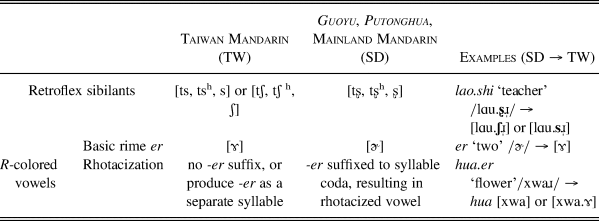
The geopolitical situation in Taiwan renders two sets of linguistic distinctions critical to discussing the social meaning of Taiwan Mandarin: Taiwan Mandarin vs. Guoyu, and Taiwan Mandarin vs. Mainland Mandarin (Baran Reference Baran2014; S. Chen Reference Chen2018; see Table 1).
Variants and examples for retroflex sibilants and r-colored vowels.

Following Spencer Chen (Reference Chen2018), we use the term Mainland Mandarin to refer to an imagined accent associated with mainlanders. While it is not supposed to represent any particular regional variety, many salient Mainland Mandarin features are found in Mandarin varieties spoken in northern China, as they serve as the basis for Putonghua. Within Taiwan, in comparison with Taiwan Mandarin, Guoyu indexes prestige, education, and socioeconomic status, as it is the prescribed standard. However, when compared against Mainland Mandarin, Taiwan Mandarin comes to index a territorial identity. In this context, the distinction between Guoyu and Putonghua is often erased (Irvine & Gal Reference Irvine, Gal and Kroskrity2000), and their contrast with Taiwan Mandarin becomes accentuated.
In the Chinese mainland, the label ‘Hong Kong–Taiwan accent’ became enregistered (Agha Reference Agha2003) from the 1980s, as the popular cultural products from the two regions dominated the mainland market. Despite distinct linguistic differences between the Mandarin varieties in Hong Kong and Taiwan, this well-known label unites the two, indicating a strong ideological contrast between the ‘mainland’ and the ‘Hong Kong–Taiwan’ accents. Zhang (Reference Zhang2018) shows that features associated with the ‘Hong Kong–Taiwan accent’ have been adopted by some mainlanders, creating what she calls ‘Cosmopolitan Mandarin’. The indexical meanings of Putonghua and Cosmopolitan Mandarin represent important social distinctions: the former indexes ‘national unity, social equality and egalitarianism’, whereas the latter indexes ‘being cultured and tasteful, stylishness and sophistication’ (Zhang Reference Zhang2018:137). As illustrated below, these ideological distinctions between different Mandarin varieties are often mapped onto the presence or absence of ‘r-like’ qualities in speech, be it an r-like production of a consonant (i.e. retroflexed sibilant) or an r-colored vowel (i.e. rhotic or rhotacized vowel).
The first set of features are the retroflex sibilants /tʂ, tʂʰ, ʂ/, which are phonemically contrastive with the denti-alveolar sibilants /ts, tsʰ, s/ in Putonghua, Guoyu, and Mainland Mandarin. In Taiwan Mandarin, the two sets of phonemes are often merged and the place of articulation for the merged category is alveolar or somewhere between dental and post-alveolar (Y-H. Lin Reference Lin2007; Brubaker Reference Brubaker2012; Baran Reference Baran2014). For instance, as shown in Table 1, lao.shi ‘teacher’ /lɑu.ʂɹ̩/ is produced as [lɑu.ʃɹ̩] or [lɑu.sɹ̩] in Taiwan Mandarin. This feature is a ‘stereotype’ (Labov Reference Labov1972) of Taiwan Mandarin and in the metalinguistic commentary, speakers often mention that Taiwan Mandarin lacks juanshe, or ‘tongue-curling’ sounds (S. Chen Reference Chen2018). As a recent lab-based study on Taiwan and Beijing Mandarin (Chang & Shih Reference Chang and Shih2015) suggests that the two varieties differ significantly only in the retroflex but not the alveolar sibilants, the current study limits the scope of analysis to Chou's production of the former. In Taiwan, full retroflexion indexes educatedness, as it is often the target of explicit instruction in elementary school (Kubler Reference Kubler1985). The prestige of full retroflexion has even led some speakers to hypercorrect denti-alveolar targets to retroflex-like productions in formal settings (Chung Reference Chung2006; Y-H. Lin Reference Lin2007). Nonetheless, consistent use, and over-use, of retroflex sounds can come across as pretentious or unnatural (Y-H. Lin Reference Lin2007; Brubaker Reference Brubaker2012). Full retroflexion is also closely associated with Mainland Mandarin in Taiwan (Baran Reference Baran2014; Su Reference Su2016; S. Chen Reference Chen2018).
Another set of features are what we refer to as r-colored vowels, which consist of the basic rime er and rhotacization. In spite of the different morphological processes involved, the two features exhibit similar dialectal differences regarding the presence/absence of rhotic vowels. In Guoyu, Putonghua, and Mainland Mandarin, the basic rime er is produced as a rhotacized mid central vowel; yet, in Taiwan Mandarin, the vowel is often not rhotacized. In addition, the diminutive suffix -er (written as 兒 in orthography) can also be attached to the syllable coda in Guoyu, Putonghua, and Mainland Mandarin, a process often known as rhotacization (Y-H. Lin Reference Lin2007). For instance, the word 花 hua [xwa] ‘flower’ becomes 花兒 hua.er [xwaɹ], in which the nuclear vowel is rhotacized. The distribution of rhotacization is lexically conditioned, making it difficult for non-native speakers to acquire. In Taiwan Mandarin, rhotacization is rare and even when it does occur, speakers often realize the -er suffix as a stand-alone syllable (see example in Table 1). As with the case of the retroflex sibilants, rhotacization is often cited by Taiwan Mandarin speakers to illustrate the distinction between their own speech and Mainland Mandarin (Su Reference Su2016; S. Chen Reference Chen2018).
Jay Chou and his musical styles
Born and raised in Taiwan, Zhou Jielun, or Jay Chou, has been a household name in Mandopop, or Mandarin pop music, since the inception of his career in the early 2000s. As a singer-songwriter, Chou is heavily involved in the creative process: he composes and produces all his songs, writes lyrics, and directs music videos (Di Genova Reference Di Genova2005). Similar to most Mandopop singers of his time (Moskowitz Reference Moskowitz2010), much of Chou's work belongs to the genre that we henceforth refer to as modern ballad. This genre is marked by melodies that are slow tempo and mellow, and by lyrics that depict the heartbreaks and unrequited love in contemporary life. However, of particular interest to the current study are two other musical styles, whose popularization in Mandopop is often credited to Chou.
Chou is acclaimed for ‘his proficiency in infusing Chinese elements into popular music’ (W-H. Lin Reference Lin, Fitzsimmons and Lent2013:207), and this particular style has come to be known as Zhongguofeng, or the ‘Chinese Flavor’ style. Here, reference to traditional Chinese culture surfaces in multiple semiotic channels, from the lyrical themes to the melodies and musical instruments, and to the settings and costumes in the music videos (Fung Reference Fung2008; Chow & de Kloet Reference Chow and de Kloet2010; W-H. Lin Reference Lin, Fitzsimmons and Lent2013; C. Lin Reference Lin, Tsai, Ho and Jian2019). Chou takes pride in his role as the creator of this style. In the song Hong mofang ‘popular imitation’, he writes ‘of my many styles, I love most the Chinese Flavor’. While he incorporates the Chinese Flavor style into different genres, Chou consistently produces Chinese Flavor ballads, releasing one such song in almost every album. Therefore, in the first case of the current study, we compare Chou's Chinese Flavor ballad and modern ballad to shed light on the linguistic stylization of the former.
Aside from pioneering the Chinese Flavor style, Chou is also recognized for introducing rap into mainstream Mandopop. His hip-hop songs are characterized by rapping in the verse and singing in the chorus, contrasting with his ballads, which consist mostly of singing, with only occasional rapping in the bridge. As is the case with some other rap music outside the US (Androutsopoulos & Scholz Reference Androutsopoulos and Scholz2003), Chou's work is generally not concerned with the life in ‘the streets’ (Alim Reference Alim2002). Instead, his hip-hop songs cover a broad variety of topics, from social issues, such as domestic violence and generation gap, to the exotic lives of ninjas and Sherlock Holmes. This thematic diversity is accompanied by the sampling of musical materials from other cultural traditions. The second case in the study focuses on Chou's hip-hop song, Wo De Dipan ‘My territory’, whose phonetic patterning diverges considerably from the norm in this genre.
Besides his extensive stylistic repertoire in music, Chou also stands out in the Mandopop scene for his ‘relaxed enunciation’ in singing. This folk perception results partially from two types of phonetic lenitions: the deletion of initial consonants and the production of voiceless consonants as [+voiced]. It should be noted that the presence of the lenited variants are likely results of linguistic stylization, rather than indication of idiosyncratic phonological knowledge, as their occurrence is limited. In fact, in our quantitative analysis, we show that the majority of Chou's phonetic production is still typical of Taiwan Mandarin, but he does style-shift to index context-specific social meanings.
Methodology
As discussed in the introduction, stylization often involves deviation from the norm in a given situation (Coupland Reference Coupland2007). Therefore, to identify the linguistic stylizations that characterize Chinese Flavor ballads and the hip-hop song, Wo De Dipan, we compared the production of retroflex sibilants and r-colored vowels in these two cases with the norms in Chou's ballads and hip-hop songs, respectively. Chinese Flavor ballads were defined as those with titles that reference elements of traditional Chinese culture, such as literature, calligraphy, and craftwork. Nine songs were selected from eight of Chou's albums, with one modern ballad and one hip-hop song serving as the controls. Specifically, we chose the modern ballad with the most similar tempo to the selected Chinese Flavor and the first hip-hop song in each albumFootnote 1 (see the appendix for the list of songs).
Since the three retroflex sibilants have shared geographical distribution and social meaning, only the retroflex fricative /ʂ/ was analyzed for the Chinese Flavor ballad and the two control groups. For Wo De Dipan, all retroflex sibilants were coded, because the song contains a metrical structure that highlights this group of phones in particular. The lyrics in the first verse rhyme with the syllable structure of sibilant + [ɹ̩] and in most cases the sibilants are retroflex. The selected sibilant tokens (/ʂ/: N = 742, /tʂʰ/: N = 13, /tʂ/: N = 42) and all basic rime er (N = 38) were impressionistically coded. The ballads were coded by the two authors independently, with an inter-coder agreement of over 90%. All inconsistencies were resolved through discussion. The hip-hop songs and Wo De Dipan were then coded by the first author. Seven /ʂ/ tokens could not be accurately categorized due to loud background tracks and were thus excluded. Additionally, we observed eighteen instances of rhotacization, where the -er suffix was attached to the syllable coda.
Aside from the linguistic analysis, we also discuss the stylistic construction in different semiotic channels, including general themes, imageries in the lyrics, melody composition, musical instruments, as well as the setting, costumes, and the script style of subtitles in the music videos.
Tongue-curling sounds: A sense of tradition
Linguistic stylization in the Chinese Flavor ballad
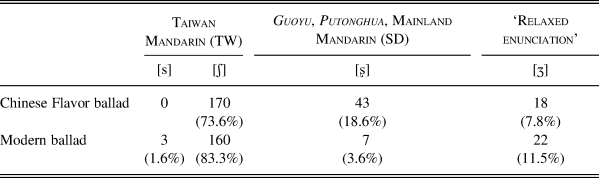
In both the Chinese Flavor ballad and the modern ballad, as shown in Table 2, the majority of /ʂ/ is realized as the postalveolar [ʃ], the common variant in Taiwan Mandarin (henceforth TW). The other TW variant [s] also surfaced, but with much lower frequency. This is unsurprising, given that it is more stigmatized due to possible confusion with the phoneme /s/. Additionally, in each style, approximately 10% of the tokens are realized as [ʒ], the voiced counterpart for [ʃ], a ‘relaxed enunciation’ that typifies Chou's mumbling singing style.
Distribution of TW, SD, and ‘relaxed enunciation’ variants for /ʂ/ in the Chinese Flavor and the modern ballad.

The major difference between the two styles lies in the frequency of [ʂ], the variant associated with Guoyu, Putonghua, and Mainland Mandarin (henceforth SD): it accounts for 18.6% of all tokens in the Chinese Flavor but only 3.6% in the modern ballad. To determine the statistical significance of this difference, logistic mixed-effect modeling was conducted using the lme4 package (Bates, Mächler, Bolker, & Walker Reference Bates, Mächler, Bolker and Walker2015) in R (R Core Team 2018). Given that [ʒ] shows comparable distribution across both styles, it was excluded from the analysisFootnote 2. The dependent variable was thus the SD vs. TW realization of /ʂ/. The analysis began with a full model with the predictors of style (Chinese Flavor, modern), release year (continuous), stanza (verse, chorus), and following vowel (rounded, unrounded), as well as by-song and by-character random intercepts. A step-down model comparison based on likelihood ratio tests was conducted to determine the best-fit model. All categorical predictors were contrast-coded.
The best-fit model contained two predictors, style and following vowel (see Table 3). The style effect confirms our observation: Chou is more likely to use the SD variant in the Chinese Flavor ballad. Regarding the following vowel, the retroflex sibilants before rounded vowels are less likely to be realized as an SD variant. Note that Chang & Shih's (Reference Chang and Shih2015) acoustic study found that the roundness of following vowel affects /ʂ/ in Beijing and Taiwan Mandarin in different ways. In Beijing Mandarin, /ʂ/ is realized fronter before the rounded vowel, whereas in Taiwan Mandarin, /ʂ/ is backer in the rounded vowel context. It seems, then, that Chou's variation in the retroflex sibilant patterns more like the Beijing Mandarin norm. However, 60% of all SD variants occur on the syllable ‘shi’ [ʂɹ̩], which happens to be the stereotypical linguistic context in folk perception. That is, lay speakers are more likely to refer to the retroflex sibilants as ‘the initials in zhi, chi, shi’ rather than in ‘zha, cha, sha’ or ‘zhu, chu, shu’. Thus, it is also possible that the stereotypical linguistic context is more readily available for linguistic stylization (cf. Walker Reference Walker2019 for stereotypicality and topic-based variation). Lastly, the fact that release year is not a significant predictor suggests that even as Chou became more involved with the mainland market over the years, he has not shown an overall shift to a more SD-like pattern, which further supports our contention that his adoption of SD variants in the Chinese Flavor ballad is the outcome of linguistic stylization.
Model coefficients for best-fit model for /ʂ/ in the Chinese Flavor ballad and the modern ballad.

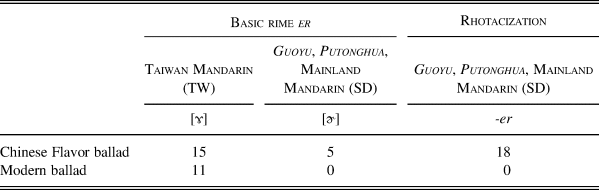
Table 4 shows the variation in the r-colored vowels in the two ballad styles. For the basic rime er, the SD variant is only present in the Chinese Flavor ballad. With regard to rhotacization, all instances (N = 18) occur in a highly stylized bridge of the Chinese Flavor ballad, Faruxue (髮如雪) ‘hair like snow’. Unlike the rest of the song, in this stanza, Chou sings in a falsetto voice, reminiscent of the Xiao Sheng ‘young male’ style in Peking opera. However, it should be noted that sixteen instances of -er are suffixed to the discourse particle la, which also happens to be a homophone for the common non-lexical vocable in singing. Thus, it can be tricky as to whether such production should be considered linguistically meaningful. The other two instances of rhotacization occur on the initial syllable of the word 馬尾 ma.wei [ma.wei] ‘ponytail’. Even though the diminutive -er is sometimes attached to 馬 ma ‘horse’ in literary texts, -er is often produced as a separate syllable and it also does not function as an infix. This particular instance of mis-application may be accidental, as the lexical constraints for rhotacization can be quite complex for an out-group speaker like Chou. In sum, r-colored vowels occur exclusively in the Chinese Flavor ballads.
Distribution of TW and SD variants for the basic rime er and rhotacization in the Chinese Flavor and the modern ballad. For rhotacization, the absence of SD indicates that Chou is following the TW norm.

Multimodal construction of Chinese Flavor
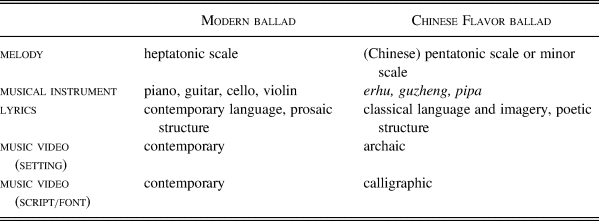
Table 5 shows a comparison between Chou's modern ballad and his Chinese Flavor ballad with regard to melody, musical instruments, lyrics, as well as the setting and script choice in the music videos. While the modern ballads are often composed in the western heptatonic scale and accompanied by western musical instruments, the Chinese Flavor ballads are written in the pentatonic or minor scale that is typical of Chinese folk music, and are accompanied by traditional Chinese instruments, such as erhu, guzheng, and pipa.
A multimodal comparison between Chou's modern ballad and Chinese Flavor ballad.

Language also plays an important role in the construction of the traditional essence of the Chinese Flavor ballad. Rather than constructing a straightforward, first-person narrative, as Mandopop songs often do, the lyrics in the Chinese Flavor ballad allude to the protagonist's state of mind through common imageries in classical Chinese poetry (W-H. Lin Reference Lin, Fitzsimmons and Lent2013). This lyrical style is illustrated in excerpt (3), which is taken from ‘East wind breaks’, one of Chou's most famous Chinese Flavor ballads. Within just four lines, there exist several imageries alluding to the central theme of loneliness and sorrow. The lamp (line 1) and candlelight (line 4) index melancholy, and the full moon (line 3), a common symbol of reunion, reminds the protagonist of their loneliness. In accordance with the lyrics, the music videos of the Chinese Flavor ballads are reminiscent of period dramas. The videos often feature two lovers dressed in traditional costumes in an archaic setting, interluded with singing scenes of Chou, the narrator of their melancholic love story.
(3) The first four lines from Dongfeng Po (東風破) ‘East wind breaks’ (translated by the authors)


In addition to the storyline, another stylistic practice in the music videos lies in the selection of scripts, or font style, for the subtitle display. Of the seventeen ballads examined in the linguistic analysis, the subtitles for all modern ballads are displayed in the Mingti font, the default typeface in contemporary Taiwan. In contrast, the lyrics in the musical videos for the Chinese Flavor ballads are displayed in the lishu or xingkai typeface, both of which are strongly associated with China's traditional calligraphic culture. Figure 1 illustrates how these three scripts—Mingti, Lishu, and Xingkai—would appear, using the song title, Dongfeng Po. In short, across multiple semiotic channels, the modern ballads and the Chinese Flavor ballads exhibit contrastive stylistic practices: the former uses resources that resonate with the daily experiences of the contemporary audience, whereas the latter incorporates elements that index a sense of tradition.
Illustration of Mingti, Lishu, and Xingkai scripts with the song title, Dongfeng Po.

Tongue-curling sounds and traditional Chinese culture
The quantitative analysis shows that in the Chinese Flavor ballads, Chou deviates from his vernacular style and uses more retroflex sibilants and r-colored vowels. This pattern prompts the question of how Chou's use of curled-tongue sounds is related to the traditional essence that characterizes the Chinese Flavor ballads.
Following previous third-wave variationist research (Eckert Reference Eckert2008; Podesva Reference Podesva2008), we interpret this local meaning in relation to the sociocultural indices of these linguistic variables in Taiwan and other Mandarin-speaking communities. These r-colored sounds, especially the retroflex sibilants, enjoy high prestige in Taiwanese society, as they are often explicitly discussed in Chinese classes. Furthermore, as stereotypical features of the imagined Mainland Mandarin, they also index the mainland.
But how is prestige or mainland-like quality then connected to traditional Chinese culture? We posit two paths through which such indexical links could be formed. In a broader sense, the major cultural elements that constitute the Chinese Flavor ballads—including the imagery in the lyrics, the pentatonic scale in composition, the traditional musical instruments, and the calligraphic scripts—all originated in the mainland. Therefore, the adoption of Mainland Mandarin-like pronunciations can serve to index this common origin. Looking more closely at the local context, Taiwan speakers likely experience the explicit instruction of tongue-curling pronunciations and the learning of traditional Chinese literature and poetry in guowen (lit. ‘national language’) classes. This particular curriculum design may have led speakers to link the use of the prescribed Guoyu forms with being steeped in knowledge of traditional Chinese culture. Nevertheless, the presence of these paths only provides the meaning potential of ‘tradition’. It is the co-existing multimodal stylistic practices that serve to activate this meaning in the context of the Chinese Flavor ballad.
Tongue-curling sounds: Undoing the convention
In 2004, Chou released Wo De Dipan (我的地盤) ‘My territory’ as the commercial song for donggan didai ‘mobile zone’, a sub-brand of China Mobile, which targets young customers (Fung Reference Fung2008). Not only does the lyrical theme—the celebration of individuality—resonate well with the younger generation, but the playful linguistic performance also renders the song all the more memorable. Excerpt (4), for example, demonstrates how even non-linguists noticed that Chou deviates from his usual style in this song. In this section, we compare Chou's production in Wo De Dipan with his other hip-hop works to illustrate its unconventional status.
(4) A review on Wo De Dipan from sina.com.cn (2004)
Wo De Dipan is the most hilarious song of this album. Jay Chou imitates the pronunciation of Beijing Mandarin on purpose, but he goes overboard and rhotacizes words that shouldn't be rhotacized. Also, for the phrase, shi bu shi ‘yes or no’, he curls his tongue to imitate Beijing Mandarin, which sounds quite funny.
Linguistic stylization in Wo De Dipan
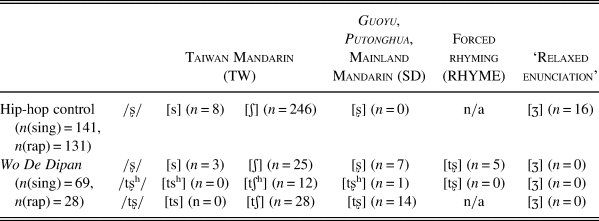
As shown in Table 6, in the eight control hip-hop songs examined, TW variants constitute the majority of all tokens and the rest (N = 16) are realized as [ʒ], the ‘relaxed enunciation’ variant. In other words, Chou tends to stick to his vernacular form in this style. However, in Wo De Dipan, the percentage of SD variants reaches a whopping 22.7%. Furthermore, not only are the SD variants more frequent, but they are also densely packed in the first verse. As shown in the phonetic annotation (lines 9–23 in excerpt (5) below), the initial consonant of the last syllable in every line is realized as a retroflex sibilant. Additionally, several tokens in this position are produced as [tʂ] regardless of the target phonemes (e.g. kao.shi ‘test’ /kʰɑu.ʂɹ̩/ as [kʰɑu.tʂɹ̩] in line 15). These cases are listed under the column, Forced rhyming (RHYME), in Table 6. The presence of forced rhyming and the exceptionally high rates of SD variants suggest that the strong retroflexion in this stanza is the product of linguistic stylization.
Distribution of TW, SD and RHYME variants for retroflex sibilants in the hip-hop control group and in Wo De Dipan.

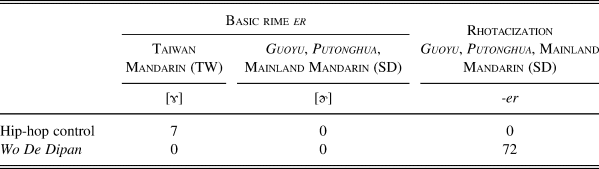
Similarly, the extensive rhotacization in Wo De Dipan serves to enforce rhyming in the chorus. As is bolded in lines 1–8, the last syllable in every line is rhotacized. Chou's profuse use of rhotacization deviates from his typical style in hip hop (see Table 7), where r-colored vowels are absent altogether. Furthermore, the rhotacization rule is deliberately applied beyond the normative constraint in any existing Mandarin variety. With the exception of 這兒, zher ‘here’ (lines 1 and 5), none of the rhotacized words are the conventional targets for rhotacization in Mandarin. Such excessive over-generalization of the rhotacization rule does not go unnoticed. In fact, more than a decade after its release, a recent popular science article on the (mis)use of rhotacization among southern Mandarin speakers still cites the chorus of this song as a vivid example of this sociolinguistic phenomenon (X. Chen Reference Chen2018).
(5) Selected lyrics from Wo De Dipan with annotation for retroflex sibilants and rhotacization (translated by the authors). SD variants are bolded and RHYME variants are bolded and italicized.

Distribution of TW and SD variants for basic rime er and rhotacization in the hip-hop control group and Wo De Dipan. For rhotacization, the absence of SD indicates that Chou is following the TW norm.

Multimodal construction of an unconventional stance
In contrast to the case with the Chinese Flavor ballad, where elements indexing traditional Chinese culture are combined to immerse the audience in an ancient setting, in Wo De Dipan, such elements are introduced as points of contrast in a song about contemporary life. As is indicated multiple times in the lyrics (lines 20–21, 26–27 of excerpt (5)), the protagonist is a youngster who works hard to practice Monkey Kung Fu, a type of Chinese martial arts, when his peers are occupied with more modern pastimes, such as playing online games. Correspondingly, in the music video, Chou plays the role of a Chinese-opera major in college. During the chorus, he performs hip-hop dance in a yellow costume that resembles those worn by Monkey Kung Fu practitioners. In addition, classic moves of Monkey Kong Fu are infused into the dance as well. Musically, a melody written in the pentatonic scale and played with the bamboo flute accompanies the chorus, which stands in stark contrast to the otherwise modern composition. Challenging the assumption that traditional cultural elements are associated with convention and formality, the recontextualization of these semiotic resources into hip-hop creates the locally relevant meaning of originality and individuality. Such unconventional stylistic practices accord well with the central theme of the song.
Overgeneralization and an unconventional stance
In Wo De Dipan, Chou deviates from his typical linguistic style in hip-hop songs and uses an abundance of rhotacization and sibilant retroflexion. Crucially, Chou overgeneralizes the production of SD variants, exceeding the normative lexical constraints in Guoyu, Putonghua, and Mainland Mandarin. Such hypercorrection and overuse of the prescribed standard also contradicts the widespread impression that Chou has unclear enunciation in singing—instead of leniting the initial consonants (e.g. /ʂ/ as [ʒ]) as he sometimes does, here, he produces the retroflex sibilants with fortition (e.g. /ʂ/ as [tʂ]). It is through these divergences from the lexical norms in everyday language use and the deviation from his typical stylistic practices that Chou constructs an unconventional and innovative stance that is coherent with the lyrical theme and the non-linguistic stylizations.
Discussion and conclusion
The current study presents two cases of linguistic stylization in Taiwanese singer Jay Chou's singing and rap, focusing on the production of retroflex sibilants and r-colored vowels. The first case involves the Chinese Flavor ballad, a musical style characterized by extensive reference to traditional Chinese culture, and the second case focuses on a hip-hop song where Chou shows extensive hypercorrection.
Taking into consideration the broader social meaning of the variants and the semiotic constructions in the lyrics, melody, musical instruments, and music videos, we argue that the use of the same sets of linguistic features in the two cases index different locally relevant social meanings. To illustrate these differences, in Figure 2, we present an indexical field for [ʂ] and rhotacization, the two features that exhibit the greatest extent of variation. In this field, the three linguistic conditions are listed at the top, followed by the corresponding variants and social meanings. The social meanings activated in the current study are bolded. The left-most column shows the variants for Taiwan Mandarin, which are associated with Mandopop sung by Taiwanese singers and are prevalent in Chou's modern ballad and hip-hop songs. Variants that conform to the linguistic constraints of standard and Mainland Mandarin are listed in the middle column, which index a sense of tradition in the Chinese Flavor ballad. The right-most column lists the hypercorrected forms, which serve to construct an unconventional stance. In the remainder of this section, we discuss how the findings of the current study demonstrate that the meaning-making process is distinction-driven, context-dependent, and multidimensional, and that social meaning interacts with language-internal constraints.
Indexical field of different linguistic conditions for retroflex sibilant [ʂ] and rhotacization (bold = locally relevant meaning).

As illustrated in Table 5, Chou's Chinese Flavor style is considered innovative because semiotic resources that index traditional Chinese culture are not typically featured in Mandopop. Similarly, the use of SD variants comes to index the meaning of ‘tradition’ in this style, partially due to its deviation from the norm of Mandopop in Taiwan as well as the norm of Chou's modern ballad. For instance, had someone who typically sings in Mainland Mandarin performed the song with similar rates of SD variants, the meaning of ‘tradition’ might not appear as notable. The perspective of viewing meaning-making as distinction-driven is even more pivotal to understanding the social meaning of the hypercorrected variants. Since they do not resemble any existing Mandarin varieties, the social meaning necessarily emerges from their relation to the prescribed standard and the imagined mainland speech. Furthermore, the hypercorrection also comes to index an unconventional stance through its contrast with Chou's typical hypocorrection (i.e. ‘relaxed enunciation’). In sum, the linguistic stylization in the two cases illustrate that it is important to analyze meaning-making as a system of distinctions (Irvine Reference Irvine, Eckert and Rickford2001) rather than as a composite of singular events.
The findings in the current study further suggest that the strength and quality of social meaning is subject to the distribution and phonetic qualities of the variants as well as the adherence to normative linguistic constraints. As discussed in the introduction, several previous studies demonstrate that the strength of social meaning for phonetic variation can interact with the markedness of the linguistic conditions (Bender Reference Bender2000; Podesva et al. Reference Podesva, Reynolds;, Callier; and Baptiste2015) and the phonetic qualities of the variants (Podesva Reference Podesva2006). Eckert & Labov's (Reference Eckert and Labov2017:13) recent article also suggests that intensification of social meaning for a phonetic variable can be achieved through ‘increased frequency of use’ and ‘phonetic intensification’.
The current study, especially the case with Wo De Dipan, provides an interesting addition to this emerging line of research. Relative to the Chinese Flavor ballad, Chou shows greater use of the tongue-curling sounds, and adopts phonetically strengthened variants. More importantly, the rules of retroflexion and rhotacization are applied to lexical items beyond the normative constraints in standard and Mainland Mandarin. It is through these agentive efforts of distributional and phonetic intensification, as well as the intentional violation of the normative constraints, that Chou constructs a persona that embraces an unconventional stance. Even though stylized language use tends to be ‘emphatic and hyperbolic’ (Coupland Reference Coupland2007:154), the results of this study suggest that further research could pay closer attention to the relationship between social meaning and language-internal constraints in everyday communication.
The growing ethnographic studies in third-wave variationist sociolinguistics have demonstrated that stylistic practices in language are necessarily part and parcel of a broader meaning-making process (Eckert Reference Eckert2008). Findings in the current study corroborate this argument from the perspective of high performance: in both cases examined, we observe parallelisms between linguistic and non-linguistic stylizations. Regarding the Chinese Flavor ballad, in both the linguistic and non-linguistic modes, there exist distinct shifts away from the default style in Mandopop, as represented by the modern ballad. More importantly, resources that index ‘Chineseness’ are incorporated into the songs in a holistic manner to create an authentic experience of ‘traveling back in time’. In terms of the non-linguistic modes, it is common for all characteristics listed under the Chinese Flavor ballad column in Table 5 to be present in a single song. Linguistically, Chou's use of the SD variant for [ʂ] is not constrained by release year or by the type of stanza (chorus, verse), suggesting that this stylistic practice permeates his Chinese Flavor ballads.
In contrast, in Wo De Dipan, the stylization involving similar semiotic resources is much more concentrated. The use of strong retroflexion and rhotacization occurs predominantly in the rhyming positions. Furthermore, all instances of rhotacization appear only in the chorus, and almost 60% of the SD and RHYME variants for the retroflex sibilants are in the first verse. The particular placements of these variants serve to reinforce the presence of the ‘r-like’ quality, thus intensifying their contrast with the TW-like production in the rest of the song. Looking at the non-linguistic modes, in the music video, the scenes of Chou performing in the Monkey Kung Fu inspired costume appear repeatedly and solely during the chorus, while the rest of the video is dedicated to depicting an ordinary college life. It is also during the chorus that the melody composed in the pentatonic scale shows up.
In short, these parallelisms in the degree and manner of stylization between the linguistic and non-linguistic modes demonstrate that the meaning-making process is indeed multimodal and context-dependent. These findings call for more future sociolinguistic work on style to explore the interplay between linguistic practices and semiotic constructions in other modes. This perspective is particularly crucial for the analysis of linguistic variation in high performance. As suggested by Irvine & Gal (Reference Irvine, Gal and Kroskrity2000:37), speakers ‘construct ideological representations of linguistic differences’ through ‘fractal recursivity’: the projection of oppositions salient at one level onto another level. In the context of high performance, it is then possible that the perceived distinctions in the co-existing, non-linguistic modes (e.g. western vs. folk Chinese melody) can affect how the audience makes sense of linguistic variation. Thus, the interplay between stylization across different semiotic channels can be a valuable first step towards the dissemination of new social meanings associated with well-established linguistic variables.
Appendix: Jay Chou Discography
Chinese Flavor ballads
(2003). 東風破 ‘East wind breaks’. On 葉惠美 ‘Yeh Hui-mei’. Taiwan: Alfa Music.
(2005). 髮如雪 ‘Hair like snow’. On 十一月的肖邦 ‘November's Chopin’. Taiwan: Alfa Music.
(2006). 千里之外 ‘Faraway’. On 依然范特西 ‘Still fantasy’. Taiwan: Alfa Music.
(2006). 菊花台 ‘Chrysanthemum terrace’. On 依然范特西 ‘Still fantasy’. Taiwan: Alfa Music.
(2007). 青花瓷 ‘Blue and white porcelain’. On 我很忙 ‘On the run!’. Taiwan: JVR Music.
(2008). 蘭亭序 ‘Orchid Pavilion’. On 魔杰座 ‘Capricorn’. Taiwan: JVR Music.
(2010). 煙花易冷 ‘Fireworks cool easily’. On 跨時代 ‘The era’. Taiwan: JVR Music.
(2012). 紅塵客棧 ‘Mundane inn’. On 十二新作 ‘Opus 12’. Taiwan: JVR Music.
(2014). 天涯過客 ‘Passer-by’. On 哎喲,不錯哦 ‘Aiyo, not bad’. Taiwan: JVR Music.
Modern ballads
(2003). 晴天 ‘Sunny day’. 葉惠美 ‘Yeh Hui-mei’’. Taiwan: Alfa Music.
(2005). 楓 ‘Maple leaf’. 十一月的肖邦 ‘November's Chopin’. Taiwan: Alfa Music.
(2006). 退後 ‘Retreat’. On 依然范特西 ‘Still fantasy’. Taiwan: Alfa Music.
(2007). 我不配 ‘I'm not worthy’. On 我很忙 ‘On the run!’. Taiwan: JVR Music.
(2008). 說好的幸福呢 ‘Promised happiness’. On 魔杰座 ‘Capricorn’. Taiwan: JVR Music.
(2010). 說了再見 ‘Said goodbye’. On 跨時代 ‘The era’. Taiwan: JVR Music.
(2012). 明明就 ‘Obviously’. On 十二新作 ‘Opus 12’. Taiwan: JVR Music.
(2014). 算什麼男人 ‘What kind of man’. On 哎喲,不錯哦 ‘Aiyo, not bad’. Taiwan: JVR Music.
Hip hop
(2003). 以父之名 ‘In the name of the father’. 葉惠美 ‘Yeh Hui-mei’’. Taiwan: Alfa Music.
(2005). 夜曲 ‘Nocturne’. 十一月的肖邦 ‘November's Chopin’. Taiwan: Alfa Music.
(2006). 聽媽媽的話 ‘Listen to mom’. On 依然范特西 ‘Still fantasy’. Taiwan: Alfa Music.
(2007). 無雙 ‘Incomparable’. On 我很忙 ‘On the run!’. Taiwan: JVR Music.
(2008). 龍戰騎士 ‘Dragon rider’. On 魔杰座 ‘Capricorn’. Taiwan: JVR Music.
(2010). 跨時代 ‘The era’. On 跨時代 ‘The era’. Taiwan: JVR Music.
(2012). 四季列車 ‘Four seasons train’. On 十二新作 ‘Opus 12’. Taiwan: JVR Music.
(2014). 竊愛 ‘Stolen love’. On 哎喲,不錯哦 ‘Aiyo, not bad’. Taiwan: JVR Music.