1. Introduction
The High German Consonant Shift (henceforth HGCS) is a sound change whereby Pre-Old High German ⁺/p/, ⁺/t/, and ⁺/k/ shifted to the corresponding Old High German affricates [pf], [ts], and [kx].Footnote 1 Compare the bolded segments in the High German words in (1) with the Low German equivalents. Note that orthographic <z> represents phonetic [ts] and <kh> represents [kx].

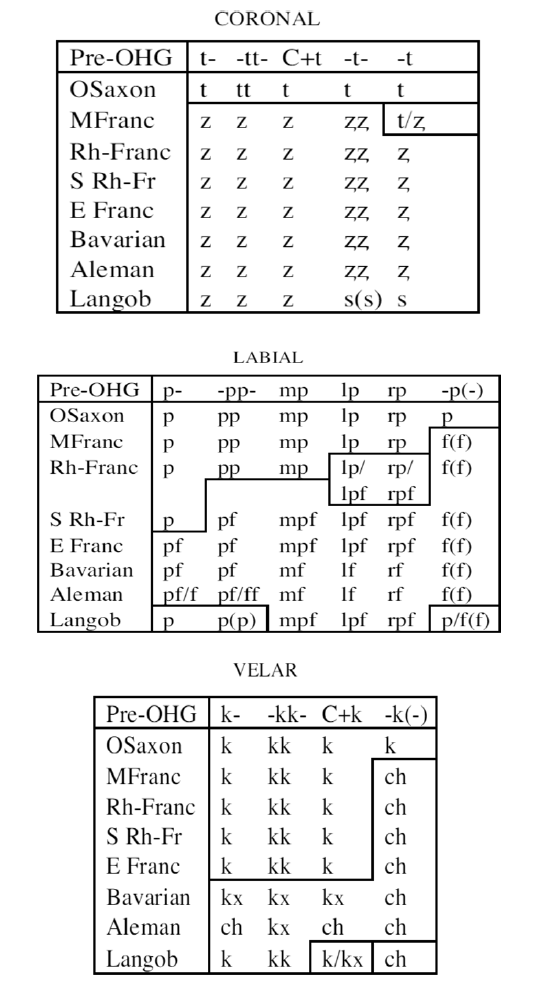
However, not all dialects of Old High German adopted all of the affricates. The Upper German dialects of Bavarian and Alemannic are the only ones to shift ⁺/k/ to [kx]. ⁺/p/ shifted to [pf] in Upper German and East Franconian, as well as in South Rhine Franconian and Rhine Franconian non-word-initially. The affricate [ts] from ⁺/t/ shifted in virtually all dialects. This uneven distribution of the shift to affricates across the German dialects is what is referred to in the literature as the HGCS asymmetries.
In their work on the shift, Davis, Iverson, & Salmons (Reference Davis, Iverson and Salmons1999, Iverson & Salmons Reference Iverson and Salmons2006, Davis Reference Davis2008) attribute the shift asymmetries to markedness. The general claim in the literature (see, for example, de Lacy Reference De Lacy2006) is that dorsal segments (e.g. /k/) are most marked, labial segments (e.g. /p/) are slightly less marked, coronal segments (e.g. /t/) are relatively unmarked, and glottal segments (e.g. /h/) are least marked. The markedness of these different places of articulation appears to align perfectly with the shifting of affricates in the HGCS: the most marked dorsal segment /k/ shifted least, only in Upper German dialects; the slightly less marked labial segment /p/ shifted in more dialects, but still shows vacillation; and the relatively unmarked coronal /t/ shifted in virtually all dialects. Thus, Davis, Iverson, and Salmons point out that there is a tidy correlation between place of articulation markedness and the extent of the shift and they attribute the shift asymmetries to markedness.
Davis, Iverson, and Salmons note in later work that their interpretation of the HGCS is consistent with the principles of Evolutionary Phonology (Blevins Reference Blevins2004), although their analysis was not originally conducted in this framework. This model espouses that synchronic grammars are the result of the phonologization of phonetic sound change. Importantly, it also explicitly rejects markedness, both synchronically and diachronically. While recognizing that markedness is absent from Evolutionary Phonology, Davis, Iverson, and Salmons nevertheless maintain that markedness played a role in the shift. But since a notion of markedness is absent in this framework, explaining the shift asymmetry in this way is incompatible with the tenets of the theory.
A clear challenge is whether or not it is possible to bring Davis, Iverson, and Salmons’ analysis of the shift into consonance with Evolutionary Phonology and similar approaches where markedness plays no role (cited below). If it can be shown that the shift asymmetries arise via pathways that are permissible under Evolutionary Phonology, that is, via phonetic and perceptual data, then the analysis of the HGCS can be brought into full conformity with this model. This article provides such data and proposes that there is no need to refer to markedness in accounting for the shift asymmetries. Data from phonetic and perceptual studies provide evidence that there are properties of ⁺/t/ that contributed to its shifting in virtually all dialects, while ⁺/k/ and ⁺/p/ possess properties that contributed to their lack of shifting in many dialects. In this way, the present article intends to build upon the analyses put forth by Iverson & Salmons (Reference Iverson and Salmons2006) and Davis (Reference Davis2008) by sketching an alternative to the role of markedness in the shift.
The stance towards markedness espoused in this article is in line with that proposed by Haspelmath (Reference Haspelmath2006). He argues that the notion of markedness should be dispensed with in phonology, because there is no widely accepted definition for what markedness is and therefore has been used to account for a broad range of phenomena. Rather than attempt to ascribe all these phenomena to “markedness,” “simple everyday concepts should be expressed by simple everyday words” (Haspelmath Reference Haspelmath2006:63). This reasoning is adopted in the present treatment of the HGCS asymmetries: this phenomenon should be accounted for by measurable and observable data, rather than appealing to the abstract notion of markedness. Although it adopts the Evolutionary Phonology framework, the proposed analysis is consistent with approaches that replace or inform markedness and other phonological phenomena with phonetic data, such as Kingston & Diehl Reference Kingston and Diehl1994, Kubozono Reference Kubozono1995, Steriade Reference Steriade1999, Reference Steriade, Hume and Johnson2001, Hayes & Steriade Reference Hayes, Steriade, Hayes, Kirchner and Steriade2004, Hume Reference Hume2004, Haspelmath Reference Haspelmath2006, Martins Reference Martins and Samuels2017, and especially with those that emphasize the role of such data in diachronic changes, such as Ohala Reference Ohala and Jones1993, Ohala & Busà Reference Ohala and Busà1995, Blevins Reference Blevins, Raimy and Cairns2008, Garrett & Johnson Reference Garrett, Johnson and Yu2013, Harrington et al. Reference Harrington, Kleber, Reubold, Schiel, Stevens, Katz and Assmann2019, among many others.
The remainder of the article is organized as follows. Section 2 lays down some theoretical foundations. Markedness is introduced and discussed, as well as the Evolutionary Phonology framework. Section 3 provides the facts of the HGCS and describes the shift asymmetries. Section 4 recapitulates Iverson, Davis, and Salmons’ interpretation of the HGCS, including their account of the shift asymmetries. The alternative analysis that I propose is presented in section 5 and I conclude and offer avenues for further research in section 6.
2. Markedness and Evolutionary Phonology
This section presents two theories that are relevant to our discussion of the HGCS asymmetries. Section 2.1 introduces and discusses markedness. Section 2.2 introduces and discusses the Evolutionary Phonology framework.
2.1 Markedness
Markedness refers to the observation that “certain structures are often avoided while others are generated; the avoided structures are called ‘marked’ while the generated ones are ‘unmarked’” (de Lacy Reference De Lacy2006:1). Under this definition of markedness, the typical claim made in the literature is that dorsals are the most marked place of articulation, labials are slightly less marked, coronals are relatively unmarked, and glottals are most unmarked (Lombardi Reference Lombardi2002, de Lacy Reference De Lacy2006). Scholars have come to this conclusion by investigating which segments are the targets or undergoers of a number of processes, including epenthesis, neutralization, and assimilation. The relative markedness of these places of articulation can be represented as in (2), where the ‘<’ symbol means ‘less marked than’.

For example, in her discussion of coronal epenthesis and markedness, Lombardi (Reference Lombardi2002:229) provides the data in (3) from Cupeño, an extinct Uto-Aztecan language formerly spoken in southern California.

What is interesting for markedness purposes is that the epenthetic segment is a glottal stop and not some other segment. The fact that a consonant at the glottal place of articulation, as opposed to one at the dorsal, labial, or coronal place of articulation, is chosen by the grammar as the epenthetic segment is an indication that the glottal place of articulation is unmarked. Examples such as those in (3) are often claimed to illustrate markedness effects.
However, not all scholars accept markedness (Hale & Reis Reference Hale and Reiss2000, Gurevich Reference Gurevich2001, Hume Reference Hume2004, Haspelmath Reference Haspelmath2006, Martins Reference Martins and Samuels2017, Odden Reference Odden and Samuels2017, among many others). Given the many apparent exceptions to markedness effects and the variety of solutions proposed to account for these exceptions, these scholars claim that markedness must not exist. At best, it is a cross-linguistic tendency, but certainly not a language universal that is hard-wired into every grammar. One such scholar is Juliette Blevins, whose approach is examined and adopted in the following section.
2.2 Evolutionary Phonology
Building upon the work of Ohala (Reference Ohala and Jones1993, Reference Ohala, Kiritani, Hirose and Fujisaki1997) and others, who emphasize the role of phonetics and perception in sound change, Blevins (Reference Blevins2004) introduces and elaborates a theory of phonology known as Evolutionary Phonology (EP). According to Blevins (Reference Blevins2004:237), the “Central Premise of Evolutionary Phonology [is that … ] Principled diachronic explanations for sound patterns have priority over competing synchronic explanations unless independent evidence demonstrates, beyond reasonable doubt, that a synchronic account is warranted.” That is, sound patterns in a synchronic grammar, such as voicing alternations, arise and are accounted for via diachronic changes. Sound change emerges from phonetic factors, such as misperception or reanalyzing acoustically ambiguous surface forms. Such misperceptions can arise in fast, colloquial speech, when speakers give less attention to how they speak. Blevins and Ohala refer to this type of speech as “hypoarticulation.” This stands in contrast to “hyperarticulation,” that is, slow and careful speech, as might be heard in a public speech. Under this model, there are three sources of sound change: Change, Chance, and Choice. These are described and illustrated in (4), where S stands for speaker and L for listener.

As demonstrated by these examples, sound change arises in this model via misperception and reanalysis of underlying forms. It is important to note that just because a listener misperceives a word does not guarantee that a sound change will be triggered. As Ohala (Reference Ohala and Jones1993) notes, such misperceptions merely create the possibility for sound change, but they are not obligated to trigger a change.
A final, crucial tenet of Evolutionary Phonology is its explicit rejection of markedness: “there is no clear role for markedness within synchronic phonology. Absolute universals and universal tendencies in sound patterns emerge from general pathways of language change, and have no independent status in the grammar” (Blevins Reference Blevins2004:20). Since this model relies primarily on misperception in speech transmission, it is not necessary to talk of segments being marked or unmarked relative to each other. Instead, it can be observed that certain segments are more likely than others to be misperceived and reanalyzed as a different segment in a particular context. Since human beings share the same linguistic faculty, as well as the same auditory, visual, and mental faculties, it can be assumed that similar types of misperceptions will arise cross-linguistically, which is why the same or very similar types of diachronic changes and synchronic alternations can be observed across a wide variety of unrelated languages.
3. The High German Consonant Shift
The HGCS is a sound change that is assumed to have begun in the sixth century in Upper German dialects, that is, in modern-day Switzerland, Austria, and the Baden Württemberg and Bavaria regions in Germany, and spread northFootnote 2 to other German dialects until approximately 800 CE (Braune Reference Braune2004:82ff., Paul Reference Paul, Klein, Solms and Wegera2007:117ff.). The change consisted in shifting the Pre-Old High German voiceless stops ⁺/p/, ⁺/t/, and ⁺/k/ to homorganic affricates ⁺/pf/, ⁺/ts/, and ⁺/kx/ in initial position and to geminate fricatives ⁺/ff/, ⁺/ȥȥ/, and ⁺/xx/ post-vocalically (the ‘ȥ’ symbol represents a spirantized ⁺/t/, which was an s-like sound distinct from the inherited ⁺/s/). According to much work done by Iverson, Davis, and Salmons (Davis & Iverson Reference Davis and Iverson1995, Davis, Iverson, & Salmons Reference Davis, Iverson and Salmons1999, Davis Reference Davis2005, Reference Davis2008, Iverson & Salmons Reference Iverson and Salmons2006), the shift initially affected ⁺/p t k/ only after a short vowel. Rather than an immediate shift from singleton ⁺/p t k/ to geminate fricative ⁺/ff ȥȥ xx/ in this position, they propose that these stops first shifted to affricates. These affricates were then realized as geminate fricatives in this position (5a i, ii, iv, v, vii, and viii),Footnote 3 but not before the affricates were generalized to other positions in the word, namely, after long vowels, after sonorant consonants (5b), and word-initially (5c). The geminate fricatives also occurred after a long vowel. Words with long tonic vowels either shortened the vowel, as in slaffan (thus producing the form provided in 5a), or degeminated the fricative, as in slāfan. Both of these forms of ‘sleep’ are attested in Old High German. Word-final geminate fricatives were reduced to singletons (compare skif vs. slaffan, hwaz vs. ezzan, and ih vs. mahhōn in 5a iii, vi, and ix). In addition to singleton ⁺/p t k/, geminate affricates arose from geminate ⁺/pp tt kk/, namely, ⁺/ppf, tts, kkx/, which were subsequently reduced to singleton affricates ⁺/pf ts kx/ (5d). The shift was blocked when ⁺/p t k/ followed the voiceless fricatives ⁺/s f x/ (5e, where ‘h’ represents ⁺/x/) and when ⁺/t/ preceded ⁺/r/ in the consonant cluster ⁺/tr/ (5f). Blocking of the shift in these clusters is not dealt with in this article. Interested readers are directed to the literature cited above. The data in (5) drawn from Braune (Reference Braune2004:84ff.) are illustrative of these changes. Interpretation of these facts and the cause of the shift are dealt with in the following section.

While the affricates that arose postvocalically from singleton ⁺/p/ ⁺/t/ ⁺/k/ were realized as geminate fricatives in virtually all dialects, only in certain dialects were the affricates generalized to other positions. In Upper German dialects, namely, Bavarian and Alemannic, all three affricates occur in word-initial position. None of the other dialects exhibit the velar affricate ⁺/kx/ in this position, although Langobardic exhibits vacillation between the velar affricate and velar stop after a consonant. ⁺/p/ shifted to the labial affricate ⁺/pf/ in Upper German, as well as in East Franconian in word-initial position. It shifted in all environments except word-initially in South Rhine Franconian, but only after a vowel in Rhine Franconian, with some vacillation after the liquids ⁺/l/ and ⁺/r/. Langobardic exhibits this affricate after a liquid or ⁺/m/. The coronal affricate ⁺/ts/ from Pre-Old High German ⁺/t/ occurs in virtually all dialects, except for some vacillation in Middle Franconian, which borders on the Low German area where the shift did not occur at all. Recall from section 1 that this uneven distribution of the shifted affricates across Upper and Central German dialects is referred to in the literature as shift asymmetry. In other words, ⁺/t/ > ⁺/ts/ in all dialects, ⁺/p/ > ⁺/pf/ in some dialects, and ⁺/k/ > ⁺/kx/ in Upper German only. The asymmetry is shown in table 1, taken from Davis Reference Davis2008:199 (ultimately adapted from Sonderegger Reference Sonderegger1974:159).Footnote 4
Extent of the HGCS

4. Interpretation of the High German Consonant Shift
Since the present analysis maintains Reference Davis, Iverson and SalmonsDavis, Iverson, and Salmons’ explanation of the HGCS, it is recapitulated here. I highlight the fact that their analysis of the shift is in consonance with the principles of Evolutionary Phonology (a fact which these scholars recognize), even before this framework had been fully developed in Blevins (Reference Blevins2004). It is also noted that markedness plays a significant role in their interpretation of the shift asymmetries. The facts regarding the triggers of the shift are presented in section 4.1. The idea that the asymmetry of affricates in the German dialects is due to markedness is discussed and rejected in section 4.2.
4.1 The triggers of the shift and the formation of the affricates
As far back as Braune (Reference Braune2004:90ff.), scholars proposed that the trigger of the shift lay in the aspiration of the segments ⁺/ph th kh/. However, it was not clear what the connection was between aspiration and the development of affricates. Davis & Iverson (Reference Davis and Iverson1995) argued that the trigger for the shift was a joint effort between Prokosch’s Law and the Head Law. Prokosch’s Law states that stressed syllables must be bimoraic (Prokosch Reference Prokosch1939/2009). The Head Law states that singleton consonants with low sonority (high consonantal strength, in Murray and Vennemann’s words) are the most preferred syllable onsets (Murray & Vennemann Reference Murray and Vennemann1983, Davis & Iverson Reference Davis and Iverson1995:116). Thus, in a word like pre-Old High German ⁺ó.p h an, where ‘.’ represents a syllable boundary, the stressed syllable only contains one mora, violating Prokosch’s Law. This violation is what triggers the repair that ultimately leads to the changes seen in the HGCS. The repair strategy employed is what Davis and Iverson call “segmentalization,” or factoring out, of aspiration from these stops: Pre-Old High German [ph th kh] → [ph th kh]. According to these scholars, there is no phonetic difference between, for example, p h and ph. (6) gives their representation of this change, where aspiration is expressed by the feature [spread glottis].

After segmentalization occurred, the structure became ⁺op.han. Since the ⁺/p/ was now in the coda of the first syllable (and coda consonants in Old High German were moraic), Prokosch’s Law was satisfied. Next, progressive place assimilation occurred: the ⁺/h/ inherited the place feature of the preceding consonant. Davis and Iverson’s representation of this change is shown in (7).

The assimilation shown in (7) produced a fricative homorganic to the stop. Thus, assimilation gives rise, in this example, to the affricate [pf]. In like manner, [th] > [th] > [ts] and [kh] > [kh] > [kx]. The account thus far explains why affricates arose in Old High German after a short vowel. From this point, the process generalized and affected the voiceless aspirated stops in word-final and word-initial positions, for example, ⁺kop > kopf and ⁺pund > pfund, and subsequently generalized to voiceless aspirated stops after a long vowel. Although Prokosch’s Law was already satisfied in syllables with long vowels because such vowels were bimoraic, the voiceless aspirated stops were treated like those after a short vowel, that is, they underwent segmentalization and assimilation. In other words, although the restructuring began with ⁺/p t k/ after a short vowel, their treatment in this position generalized to all contexts in which these sounds occurred, consequently producing affricates in all positions.
Note how the analysis up to this point fits squarely into the principles of Evolutionary Phonology. A reanalysis occurred in which aspiration was reinterpreted as a phonological element—this is an example of Chance (4ii). The point at which that element subsequently underwent assimilation and affricates emerged exhibits the mechanism of Change (4i) (Iverson & Salmons Reference Iverson and Salmons2006). The explanation for the appearance of the geminate fricatives postvocalically, which obtained in virtually all dialects, is similarly phonetically motivated, as expected under the model of Evolutionary Phonology. Davis & Iverson (Reference Davis and Iverson1995:115) “correlate … the spirantization of the stop portion of the affricate with the phonetic probability that the ‘tension’ (or closure duration) of stops was weaker in postvocalic position than elsewhere, i.e., word-initially and after consonants.” In other words, the [p] in ⁺opfan weakened to a fricative [f] postvocalically, yielding the geminate form offan, because stops are conducive to weakening in this position. As they point out, this is a phonetic tendency, and is not something that is phonological or otherwise motivated by the grammar. The weakening of the affricates to geminate fricatives could involve either Change or Choice (4iii)—in the former case, the listener misperceives the affricate as a geminate fricative, in the latter the affricate and fricative pronunciations exist simultaneously as variants and the form with the fricative wins out. In the context after a long vowel, there were two possible outcomes. Because the stressed vowel was already bimoraic, either the geminate fricative was reduced to a singleton or the stressed vowel was shortened. Both outcomes are attested for the verb ‘sleep’: slāfan with degemination and retention of the long vowel and slaffan with vowel shortening and retention of the geminate. In both cases, bimoraicity is preserved. In final position, the geminate fricative was reduced to a singleton, for example, ⁺ūp > ⁺ūpf > ⁺ūff > ūf ‘up’. The full process exhibiting the shift of ⁺/ph th kh/ is as follows (Davis & Iverson Reference Davis and Iverson1995:115): ⁺op h an > ⁺ophan > ⁺opfan > offan ‘open’; ⁺et h an > ⁺ethan > ⁺etʒan > eʒʒan ‘eat’; ⁺mak h ōn > ⁺makhōn > ⁺makxōn > maxxōn ‘make’.
4.2 Shift asymmetry via markedness
Up to this point, I maintain the analysis proposed by Davis & Iverson (Reference Davis and Iverson1995). The HGCS was triggered in postvocalic position by pressures from Prokosch’s Law and the Head Law. The consequent restructuring led to phonetically motivated sound change, as predicted by Evolutionary Phonology. Iverson & Salmons (Reference Iverson and Salmons2006) and Davis (Reference Davis2008) recognize that their earlier analyses of the HGCS are consistent with Blevins’ mechanisms of Change, Chance, and Choice. For example, Iverson & Salmons (Reference Iverson and Salmons2006:64) claim that:
Change probably played a determinative role in the affrication of aspirated stops in the unfolding of the Second Sound Shift …, as stop+/h/ pronunciations, as in pre-OHG + óp.han came to be misperceived as stop+fricative (+op.fan or +op.ϕan). The fricative perception effect was even more likely in /t/+/h/ clusters, where the more confined release of the alveolar stop results in greater acoustic turbulence to leave the probable impression that a voiceless fricative had been produced, hence changing the perception from /t/+/h/ to /t/+/s/.
Davis (Reference Davis2008:233) also appeals to the mechanisms of Evolutionary Phonology. In the uneven shift of ⁺/p/, as shown in table 1, he claims that Choice played a crucial role. Given the variant phonetic signals (i.e. [ph pf p]) that could be associated with the aspirated stop [ph], different dialects “chose” different forms as the best exemplar. In East Franconian, the affricated allophone [pf] is “chosen” as the best exemplar, while in South Rhine Franconian it is not. Davis also notes that this could be due to dialect contact: since the East Franconian area borders on the Upper German area, where the shift of ⁺/p/ → [pf] is complete, the East Franconian speakers were influenced by the Upper German speakers in their “choice” of [pf] as the best exemplar for the aspirated stop.
While making these connections to Evolutionary Phonology is a strength of their analyses, the scholars referred to above retain the notion of markedness to explain the shift asymmetries. For example, Iverson & Salmons (Reference Iverson and Salmons2006:48) adopt the representations given in (8), which are based on proposals in Avery & Rice (Reference Avery and Rice1989) and Rice (Reference Rice1994).

These representations show that dorsals (velars in their terminology) have the most structure: they possess a place node, a peripheral node, and the feature dorsal. Labials have slightly less structure, possessing the place node and peripheral node. Coronals have the least structure, possessing only the place node. The representations are intended to capture markedness generalizations, namely that dorsals are more marked than labials, and labials more than coronals. Dorsals have the most structure, which means they are the most resistant to any kind of change. Since coronals have the least amount of structure, they are most susceptible to change. Iverson and Salmons show that these representations can account for the facts of the shift asymmetries: “the Second Sound Shift affected /t/ more broadly and with greater regularity in post-consonantal and word-initial positions than it did /p/, and /p/ more than /k/, because this ranking mirrors the markedness of these stops relative to each other. That is, a stop’s resistance to the Second Sound Shift correlates directly with the complexity of its representation” (Iverson & Salmons Reference Iverson and Salmons2006:49–50).
I reject the idea that the asymmetry of the shift is due to markedness effects. Instead, an alternative analysis for the asymmetry, rooted in the phonetic properties of the stops /p t k/, is proposed in the following section.
5. Perceptual prominence and acoustic similarity—an alternative approach
Many scholars endeavor to ground sound change in phonetic and perceptual phenomena (for example, Ohala Reference Ohala and Jones1993, Ohala & Busà Reference Ohala and Busà1995, Lindblom et al. Reference Lindblom, Guion, Hura, Moon and Willerman1995, Blevins Reference Blevins, Raimy and Cairns2008, Beddor Reference Beddor2009, Solé Reference Solé, Solé and Recasens2012, Garrett & Johnson Reference Garrett, Johnson and Yu2013, Lehnert-LeHouillier Reference Lehnert-LeHouillier and Yu2013, Beddor et al. Reference Beddor, Coetzee, Styler, McGowan and Boland2018, Harrington et al. Reference Harrington, Kleber, Reubold, Schiel, Stevens, Katz and Assmann2019, Carignan et al. Reference Carignan, Stefano Coretta, Jonathan Harrington, Joseph, Kunay and Voit2021). Although the specific mechanisms of change are debated, such scholars argue that perception and production are primary factors in sound change. Blevins’ (Reference Blevins2004) Evolutionary Phonology framework incorporates this idea directly into a model of phonological change. It is built around the idea that sound change occurs in the “transmission channel” between the speaker and the listener, that is, in the perception and production of speech (Ohala Reference Ohala and Jones1993:262). This section provides evidence in the form of perceptual prominence and acoustic similarity that can account for the HGCS asymmetries. Section 5.1 introduces the notion of perceptual prominence and attributes the shift asymmetries to this phenomenon. Section 5.2 presents evidence regarding acoustic similarity, which I claim was an additional factor that prevented ⁺/k/ from shifting in most dialects. The implications of the analysis in sections 5.1 and 5.2 for the origin of the shift and unshifted forms are discussed in section 5.3.
5.1 Perceptual prominence as the cause of the HGCS asymmetries
In her discussion of how sound changes spread areally, Blevins (Reference Blevins and Hickey2017:99) states that “establishment of a phonetic prototype requires phonetic saliency: the more salient the phonetic pattern, the more likely it will spread areally … perceptual saliency is critical to sound pattern diffusion.” This idea provides a starting point with which to investigate an alternative pathway to asymmetry: if /p t k/ vary in their perceptual saliency, then the asymmetry in their shifts can be attributed to this fact. With this in mind, the expectation is that /t/ should be the most perceptually salient, and so it shifted most in the HGCS, and that /k/ should be the least perceptually salient, and so it shifted least. It is shown that this prediction is borne out for /t/, while the facts regarding /k/ and /p/ are less clear.
But what is perceptual saliency? Blevins (Reference Blevins and Hickey2017) herself does not give a formal definition, but such definitions can be found in the literature on phonetics. Wright (Reference Wright, Hayes, Kirchner and Steriade2004:47) defines perceptual saliency as follows: “change (modulation) along an acoustic dimension, such as frequency or amplitude, will result in increased salience of the cues in the portion of the signal where the change occurs.” Furthermore, he defines a “cue” as “information in the acoustic signal that allows the listener to apprehend the existence of a phonological contrast” (Wright Reference Wright, Hayes, Kirchner and Steriade2004:36). So, one example of a dimension that contributes to a segment’s perceptual saliency is frequency. Acoustically speaking, if a segment is higher in terms of its frequency in hertz (Hz), then it is louder and more perceptually salient. However, because the term “salience” is used in several subdomains of linguistics to address various phenomena across these domains (see Boswijk & Coler Reference Boswijk and Coler.2020), that term is avoided here. Instead, I use the term perceptual prominence in the remainder of this article. Perceptual prominence is correlated with frequency (the higher the frequency, the greater the prominence) and confusability (the greater the likelihood of being misperceived as a different segment, the less prominent it is).
Studies have shown that [t] has high frequency and low confusability, relative to [p] and [k]. Winitz et al. (Reference Winitz, Scheib and Reeds1972) investigated the bursts (the explosion of air at the release of a stop consonant) of [p t k] in initial and final position. They recorded two speakers reading aloud eighteen sentences with instances of [p t k] throughout the sentences. The sentences they used are given in (9). The underlined words are the targets of the study.

The participants of the study performed two tasks. In the first task, they listened to the stimulus twice and then marked down on a sheet which sound they heard, that is, either p, t, or k. The second task involved two procedures. In the first procedure, the consonant varied and the vowel remained the same, for example, top, cop, pop. In the second procedure, the vowel varied and the consonant remained the same, for example, keep, cop, coop. The results showed that speakers correctly identified [t] most, then [p], and [k] least (Winitz et al. Reference Winitz, Scheib and Reeds1972:1311–1312). Correct identification of [t] is attributed to its high frequency (Winitz et al. Reference Winitz, Scheib and Reeds1972:1315). On average, the frequency of [t] was 4495 Hz, which was significantly higher than [k] and [p], whose average frequencies were 2325 Hz and 2121 Hz, respectively. Similar results were obtained by Halle et al. (Reference Halle, Hughes and Radley1957), who investigated the acoustic cues differentiating [p t k b d g].
Winitz et al. note, however, that the surrounding vowels also affect the rate of correct responses. For example, [t] is most correctly identified when the high vowel [i] follows, and [p] is often confused for [t] in this context. The reason for this is the “high-energy concentration” of the front vowel [i]. Furthermore, they note that [k] is fairly often mistaken for either [t] or [p]. If the vowel is front [i], it is mistaken for [t]; if the vowel is back [u], it is mistaken for [p]. Delogu et al. (Reference Delogu, Paoloni, Ridolfi and Vagges1995) obtained similar results. They note that [ki] is confused for [ti] in 50 percent of instances, but the reverse, [ti] being confused for [ki], never occurs in their data. This confusion asymmetry emerges because [t] and [k] have similar formants (Fischer-Jørgensen Reference Fischer-Jørgensen1954). However, [k] has an “extra,” non-robust feature that distinguishes it from [t]. Speakers are more likely to misinterpret this feature of [k] (which makes it sound like [t]), rather than add this feature to [t] (which would make it sound like [k]) (Plauché et al. Reference Plauché, Delogu and Ohala1997). Plauché et al. (Reference Plauché, Delogu and Ohala1997) point out that such confusions mirror historical sound changes, such as the change from [ki] to [tʃi]. They conclude that their findings support “the claim that sound changes can result from speaker misperceptions and suggest that diachronic sound changes can be explored in the laboratory” (Plauché et al. Reference Plauché, Delogu and Ohala1997:2190). Chang et al. (Reference Chang, Plauché, Ohala, Hume and Johnson2001) discuss such confusions in relation to markedness. They carry out two experiments which show that, when properly manipulated, [ti] can be perceived as [ki] and vice versa. The results demonstrate that there are acoustic explanations for why [ki] more often shifts to [ti], for which reason the notion of markedness can be dispensed with in accounting for such changes. Further, the phonetic approach explains why this change occurs in the environment of [i], whereas markedness cannot account for this fact.
A study similar to Winitz et al.’s was performed by Miller & Nicely (Reference Miller and Nicely1955), who tested a wider variety of consonants besides just [p t k]. Their results support those found by Winitz et al. When comparing the voiceless stops [p t k] to the voiced ones [b d g], Miller & Nicely (Reference Miller and Nicely1955:347) concluded that “the plosive part of the voiceless stops is relatively intense, however, so that the high-frequency noise of middle |t| distinguishes it from the low-frequency noise of front |p| and back |k|. The distinction between |p| and |k| is slightly harder to hear because it seems to depend upon hearing the aspirated transition into the second vowel resonance.” That [t] has a high-frequency noise which distinguishes it from [p] and [k] is additional evidence which corroborates the results obtained by Winitz et al. (Reference Winitz, Scheib and Reeds1972). That [k] is often confused for [t] and [p] and that it has a lower frequency than [t] suggests that [k] lacks perceptual prominence.
In investigating the shift of the stops ⁺/p t k/ to the affricates ⁺/pf ts kx/, the frequency of the homorganic fricatives should also be considered. If [s] has a higher perceptibility than [f] and [f] higher than [x], this would provide further evidence for the extent of the shift as shown in table 1, namely, ⁺/t/ shifted most (or was more readily generalized), then ⁺/p/, and ⁺/k/ least because of the intensity of the fricative portion of the resulting affricate. In other words, reinterpreting the segmentalized ⁺/h/ as a fricative that is homorganic to the stop (i.e., ⁺/f s x/) influenced the asymmetries because of the perceptibility of that homorganic fricative. If the perceptibility of the fricatives also plays a role, it is predicted that ⁺/ts/ occurs most widely because both [t] and [s] are highly perceptible, while ⁺/kx/ occurs least because both [k] and [x] are not.
Strevens (Reference Strevens1960) investigated the noise of fricatives to determine how they are distinguished from one another. The fricatives included in his study were /Φ θ f χ s x ʃ h ç/. The results showed that three groups emerged: front /Φ θ f/, mid /s ʃ ç/, and back /x χ h/. The front group is characterized by a peak of energy at 2000 cps (Hz) or lower; the mid group by a frequency between 6000 and 8000 cps (Hz); and the back group by a frequency between 400 and 7500 cps (Hz). Strevens concludes that the mid group has the most intensity, whose segments have a higher average frequency, and the front group has the lowest intensity of the three groups because of the overall weak frequency of the segments in this group. The intensity of the back group shows great variation, with frequencies as low as 400 Hz and as high as 7500 Hz, which places this group in the middle of the three with moderate intensity. Behrens & Blumstein (Reference Behrens and Blumstein1988) came to similar conclusions in their study, which found that [s] had a significantly higher frication noise than [f] (the study did not examine [x]).
The high frequency of the fricative [s] combined with the high frequency of the stop [t] suggests that the affricate [ts] has a high frequency. Indeed, it has been shown for German that the affricate [ts] has a peak frequency between 6500 and 7500 Hz (Zygis et al. Reference Zygis, Recasens, Espinosa, Susanne Fuchs, Mooshammer and Zygis2010). Each component of the affricate, the stop and the fricative, contributes to its overall perceptibility. Given these facts, it is no surprise that ⁺/t/ shifted most in the HGCS, because its initial state ⁺/t/ and final state ⁺/ts/ are both highly perceptually prominent, relative to ⁺/p/, ⁺/pf/, ⁺/k/, and ⁺/kx/. Furthermore, the generalization to word-initial position, in which ⁺/ts/ occurs in all dialects (see table 1), can also be accounted for via phonetic properties. Studies have shown that word-initial consonants have greater acoustic distinctiveness than final ones (Miller & Nicely Reference Miller and Nicely1955, Winitz et al. Reference Winitz, Scheib and Reeds1972, Redford & Diehl Reference Redford and Diehl1999). Redford & Diehl (Reference Redford and Diehl1999) show that initial consonants are longer and louder, while final consonants are more often confused than initial ones. Thus, ⁺/ts/ generalized to word-initial position because, coupled with its inherent prominence, consonants in this position are more easily produced and perceived.
However, the frication noise of [f] and [x] does not match the asymmetries shown in table 1. Their frequencies overlap, with [x] ranging between 1200 and 7500 Hz and [f] between 1500 and 7500 Hz (Strevens Reference Strevens1960), which appears to make them equally (non)prominent. This is, however, consistent with the crosslinguistic facts, in which labial and velar affricates are rare: “the preferred place of articulation of affricates appears to be the palatoalveolar region, and the second most frequently exploited place is the anterior coronal area. The other places of articulation where affricates are attested are considerably less frequent, as reflected by the number of languages with labial, velar, or uvular affricates” (Berns Reference Berns2014:379). According to Berns (Reference Berns2014), the top ten most common affricates in UPSID (UCLA Phoneme Segment Inventory Database), which lists the phoneme inventories of 451 languages, are found at the coronal place of articulation. Because both [k] and [p] and their fricative counterparts [x] and [f] have low noise, one might expect that the extent of ⁺/kx/ and ⁺/pf/ shifting should be more or less equal. However, as shown in table 1, ⁺/p/ shifted in more dialects than ⁺/k/. It could be that their acoustic difference is in fact phonetically negligible and the greater shifting of ⁺/p/ has more to do with the mechanism of Choice or Chance. Another possibility is that ⁺/k/ did in fact shift more than ⁺/p/, but was later reduced in most dialects. Such an approach is maintained by Goblirsch (Reference Goblirsch2005, Reference Goblirsch2008, Reference Goblirsch2015), who claims that the affricate ⁺/kx/ emerged throughout the High German area and to an extent the Middle German area, but in most of these dialects the change was reversed due to phonetics. His work suggests that Germanic ⁺/t/ and ⁺/k/ are more susceptible to changes than ⁺/p/. This approach might align better with the phonetic studies cited here, which typically attribute a slightly greater level of noise to [k] than [p]. Furthermore, Goblirsch’s analysis challenges the approach to the HGCS adopted here, that of Iverson, Davis, and Salmons, and by extension challenges markedness, since velar ⁺/k/ under his analysis is more likely to undergo change than labial ⁺/p/. In any case, there is ample phonetic evidence for the shifting of ⁺/t/ in all dialects and lack of shifting in ⁺/k/ and ⁺/p/. A tentative solution to the problem of why ⁺/p/ shifted more than ⁺/k/ is addressed in the following section.
The data in the studies cited here deal only with singleton [p t k] and not geminate [pp tt kk]. Although I have been unable to find studies showing it, I predict that the coronal geminate stop [tt] is more prominent than the geminate labial or velar stop. If a singleton [t] is prominent, then it is likely that a geminate [tt], which differs from [t] only in duration, but not articulation, is also prominent; by extension then, if [t] is more prominent than [k], then [tt] is likely to be more prominent than [kk]. That is, it is unlikely that [kk] is more prominent than [tt], while [t] is more prominent than [k]. This would mean that geminate ⁺/tt/ should have shifted more than geminate ⁺/pp/ and geminate ⁺/kk/, and this is in fact the case (Davis Reference Davis2008:200).
Overall, the results of perceptual and phonetic studies suggest that the shifting of ⁺/t/ in virtually all dialects can be correlated with its perceptual prominence. The lack of shifting of ⁺/k/ and ⁺/p/ is due to their low frequency and confusability. Because Evolutionary Phonology seeks to establish phonetic motivations for sound change, the results presented here are in consonance with this theory.
5.2 Acoustic similarity—a phonetic factor that inhibited the shift of /k/
In the previous section, it was shown that there are phonetic reasons why ⁺/t/ shifted most in the HGCS. However, the data were less clear regarding the asymmetry of ⁺/p/ and ⁺/k/. It is argued in this section that ⁺/k/ shifted less than ⁺/p/ because of the acoustic similarity between [x], [h], and [kx]. The acoustic similarity of [k], [x], and [kx] has been discussed by many scholars. Davis (Reference Davis2008:232) remarks that the “high aspiration of k h - along the k h -/kx- isogloss between Franconian and Alemannic varieties is noted by Schirmunski (Reference Schirmunski1962:298), as is the difficulty in differentiating the two sequences acoustically.” Regarding the segment /k/, Bohnenberger (Reference Bohnenberger1900:235) writes that “Der Explosivlaut wird an der Grenze so stark aspiriert gesprochen, dass man scharf hinhören muss und oft einer Reihe von Proben bedarf, um ihn von Affricata und Spirans zu unterscheiden.”Footnote 5 Kümmel (Reference Kümmel2007:31) also mentions this problem, noting that “Eine echtvelare Affrikata [kx] wird … möglicherweise als einfache Aspirata gehört und beschrieben … Diese Affrikata variiert allerdings sicherlich mit aspirierten Lautungen (die ja ihrerseits nicht selten leicht affriziert sind), wie auch der alleinstehende Frikativ selbst zum reinen Glottal werden kann.”Footnote 6, Footnote 7 There is therefore a wide amount of variation concerning dorsal segments in these dialects: aspirated [kh], affricate [kx], a lightly affricated /k/ ([kx]), and fricatives [x] and [h]. Bloomfield (Reference Bloomfield1938) considers kh a shifted consonant equivalent to kx in the sense that they are both sequences of stop + fricative. Such an approach is consistent with the analysis of the HGCS adopted in section 4, which espouses a stage where aspiration is segmentalized. Bloomfield’s analysis suggests that the difficulty in distinguishing these sounds lies in the similarity between [h] and [x]. Goblirsch (Reference Goblirsch2008:50) similarly claims that “kh may be seen as a preliminary stage in the affrication of Gmc. k, but may not be distinguished clearly from kx.” Thus, there is general agreement that [kx] and [kh] are phonetically very similar, which ultimately lies in the acoustic similarity of the fricatives [x] and [h].
Studies have shown that [x] and [h] are difficult to distinguish. For example, Babel & Johnson (Reference Babel and Johnson2010) investigated the perception of voiceless fricatives by speakers of English and Dutch. The fricatives examined were /f h s ʃ θ x/. They found that [x] and [h] are perceived to be very acoustically similar. The high acoustic similarity of h/x was only matched by the pair f/θ. The rest of the pairs (f/h, f/s, f/ʃ, f/x, h/ʃ, h/θ, s/ʃ, s/θ, s/x, ʃ/θ, ʃ/x, θ/x) were significantly less similar. The surrounding vowels affected perceptual similarity. When the pairs in question occurred in the high front environment i_i, f/θ was perceived to be more similar than h/x. When the environment was high back u_u, h/x was perceived to be more similar than f/θ. The results for h/x were consistent across both English and Dutch speakers, suggesting that native language contrasts did not influence the perception of acoustic similarity of this pair. Importantly, [x] and [h] were shown to be more similar to each other than [s] and [h] are. On a scale of 1 to 5, where 1 is very similar and 5 is very different, the pair h/s ranked 4 and the x/h pair ranked approximately 1.5. These rankings hold for the u_u environment. In the i_i environment, h/x ranked a little less than 3 and s/h ranked 4. Generalized across environments, the acoustic similarity of h/x ranked 2 and h/s ranked 4. In other words, [h] and [x] are harder to distinguish than [h] and [s]. Thus, in assimilating ⁺/h/ to ⁺/t/ and ⁺/k/ in the HGCS, the ⁺/h/ → ⁺/s/ assimilation is easier to perceive than the ⁺/h/ → ⁺/x/ one, because those segments are less acoustically similar. Likewise, the ⁺/h/ → ⁺/x/ assimilation is more difficult to perceive because these segments are acoustically similar. The resulting affricate ⁺/kx/ was thus perceptually difficult to distinguish from ⁺/kh/, evidence of which still exists today. This perceptual difficulty is the reason that phonologization of the affricate did not occur. Because of these perceptual facts, ⁺/ts/ was more easily perceived from its predecessor ⁺/th/ during the HGCS, another factor contributing to its broader diffusion through dialects, while ⁺/kx/ was less easily perceived as distinct from its predecessor ⁺/kh/. Consequently, ⁺/kx/ emerged in fewer dialects than ⁺/ts/.
Given that there is variation and ambiguity in modern German dialects among the dorsal segments, I assume that it is possible that such variation and ambiguity also existed at the time of the HGCS. If this is the case, then the reason that ⁺/k/ did not shift in many dialects is because the speakers faced with the newly emerged affricate [kx] could not perceive the difference acoustically between [kh] and [kx]. In other words, the variation seen in modern dialects is an unbroken line of variation going all the way back to the time of the shift, which is ultimately rooted in phonetics and perception. The mechanism of Choice could have also played a role: given the several phonetic signals associated with a single form, some speakers “chose” the affricate [kx], while others did not, perhaps even among speakers of the same dialect. A similar line of reasoning is adopted by Davis (Reference Davis2008:233) to explain why East Franconian adopted [pf] in initial position while South Rhine Franconian did not. It is likely that this mechanism interacted with the perceptual problems discussed here to produce the pattern for ⁺/kx/ shown in table 1.
5.3 Unshifted forms and mono- vs. polygenesis
The perceptual prominence analysis described in the previous two sections raises questions regarding other aspects of the shift, namely unshifted ⁺/t/ in the Rhineland and the origin of the shift. Can the perceptual prominence analysis described above tell us anything about lack of shifting in dialects that have shifted consonants? Does it contribute to the debate on mono- vs. polygenesis? These questions are addressed in this section. It is concluded that the prominence analysis is compatible with both mono- and polygenetic accounts of the origin of the shift, while it tells us little about the non-shifting of ⁺/t/ in Rhineland dialects.
There are words with unshifted ⁺/t/ in Central German dialects such as Ripuarian, Moselle Franconian, and Hessian (Lerchner Reference Lerchner1971, Venema Reference Venema1997). Examples are shown in (10). The majority of examples include unshifted ⁺/t/ in initial position (a–g), but there are also examples of unshifted ⁺/t/ in gemination (h–j), postconsonantal position (k–l), and postvocalic position (m–n). From left to right, the first and fourth columns are the words as listed by Venema (Reference Venema1997), the second and fifth columns present the pronunciation as provided by Venema, and the third and sixth columns provide the gloss.

These data are interesting because ⁺/t/ should have shifted in all these positions—[ts] or [s] is expected depending on ⁺/t/’s position in the word. It might appear, given the proposed analysis, that such forms are counterexamples to the perceptual prominence approach, because ⁺/t/, despite its prominence, did not shift in these words. However, these examples can be accommodated by the present analysis in the following way. The fact that ⁺/t/ is perceptually prominent does not guarantee or compel it to undergo any kind of change.Footnote 12 The change began when German speakers reanalyzed the aspiration of the voiceless stops as a segment ⁺/h/ (“segmentalization”). This reanalysis did not privilege ⁺/t/ or ⁺/p/ or ⁺/k/— it affected each of these segments equally. However, the subsequent development of these stops as a result of the reanalysis was affected by their inherent articulation and phonetic properties. Since [t] and [s] have a higher prominence than [p], [f], [k], and [x], [ts] was more readily analyzed as an affricate than the other segments. In a phonetically based model like EP, the fact that not all possible forms underwent the widespread change of ⁺/t/ → ⁺/ts/ is not surprising. Such forms can be accounted for via the mechanism of Choice. For Choice to occur, multiple possibilities for analyzing the segments in question must be possible. As the analysis in section 4 has shown, this was indeed possible—in the process of segmentalization and subsequent assimilation, the ⁺[th]could be perceived as such or as an affricated ⁺[ts]. By way of Choice, most of the German dialects perceived ⁺[th] as ⁺[ts], but in the unshifted dialects it was not. The same reasoning can be applied to the unshifted forms in (10). Alternatively, the lack of shifting in the examples in (10) could be a result of dialect contact or lexical diffusion. For example, most of the unshifted forms documented in Lerchner (Reference Lerchner1971) and Venema (Reference Venema1997) are from Central dialects that border on Low, non-shifting ones and are thus caught between dialects that have shifted forms and ones that do not. Being flanked on either side by dialects with shifted and unshifted forms provides fertile ground for either triggering the Choice mechanism or for lexical influences or a mix of both. It is not surprising then that such dialects exhibit a mixture of shifted and unshifted forms.
One possible way to address the lack of ⁺/t/ shifting in these dialects is to examine which vowels appear in shifted vs. unshifted forms. Previous studies have suggested that ⁺/t/ shifted more readily before the front vowel ⁺/i/, while [k] is often confused for [t] in that environment. In that case, ⁺/t/ could have shifted more because it occurred more frequently before the vowel ⁺/i/, which was an environment conducive to shifting. While such a hypothesis is consistent with the principles of EP, an examination of data with unshifted ⁺/t/ in the Rhineland (Venema Reference Venema1997) does not suggest any preference in terms of vowel place. Of the approximately thirty lexical items presented with unshifted ⁺/t/ in initial position, eighteen of them have front vowels, for example tällewällen [tęləwęlə] ‘quarrel, contend’, täunen [tø̄nə] ‘show, appear’, tieren [tīrə] ‘become, be of a certain kind’, and twelve of them have back vowels, for example Tack [tɑk] ‘branch, bough’, Tudder [tudər] ‘mud, thick muck’, torren [torrə] ‘hit and thereby dent’ (Venema Reference Venema1997:114ff.). The expectation is that there should be fewer unshifted forms before front vowels and more unshifted forms before back vowels. Likewise, the examples of unshifted ⁺/t/ in non-initial position (see (10h–n)) do not display any pattern with respect to quality of vowel and (non)shifting. Such facts suggest that these data are inconclusive with regards to vowel place and shifting of ⁺/t/. Nevertheless, this is a very small sampling of data that should not be taken to represent a broader generalization without further investigation. As Iverson & Salmons (Reference Iverson and Salmons2006:60) point out, citing Venema’s work, lexical items are subject to much variability, due to dialect borrowing and social factors, and so these data must be treated with extreme caution. While there is evidence that suggests ⁺/t/ and ⁺/k/ shifted more readily before front vowels, unshifted forms appear to tell us little about this phenomenon. However, a fuller examination of a larger data set of shifted and unshifted ⁺/p t k/ and their surrounding vowels is a desideratum of future work.
The problem of unshifted forms also raises the question of mono- vs. polygenesis, an issue which the present analysis has not directly commented on. The monogenetic hypothesis was mentioned at the beginning of section 3: according to this hypothesis, the HGCS started in one dialect and spread to other dialects. The polygenetic hypothesis instead proposes that the HGCS was autochthonous, with the shift having its origin independently in different dialects. The present analysis is compatible with either approach—the important aspect of the proposed analysis is that the shift and its asymmetries, whether mono- or polygenetic, be phonetically motivated. Under a monogenetic approach, the shift starts in Alemannic and Bavarian varieties of German. In these varieties, ⁺/t p k/ shift to the corresponding affricates ⁺/ts pf kx/. Then, the affricates spread north to other dialects. The extent of affricate diffusion is correlated with their perceptual prominence: ⁺/ts/ is most widely adopted because it is most prominent and ⁺/kx/ is least widely adopted because it is least prominent. Under a polygenetic approach, the shift is undertaken by individual dialects. Rather than diffusion due to perceptual prominence, individual dialects choose (via Choice in EP, or possibly Chance) the affricated allophone as the best exemplar of the ambiguous signal— this is the type of approach Davis (Reference Davis2008) proposes. Since ⁺/ts/ is the most prominent of the affricates in question, it is adopted by most dialects, while ⁺/kx/’s lack of prominence leads to minimal adoption across dialects. Because the German dialects are closely related, it is possible that they developed independently but in a similar fashion (Davis Reference Davis2008) or that due to contact/proximity between dialect areas a perceptually prominent sound shift had one dialect of origin that innovated forms which then diffused over other dialect areas. The present approach does not provide evidence in favor of one of these hypotheses over the other, though research into sound change actuation (see footnote 11) might shed light on this question.
6. Conclusion and Further Study
Recent work on the HGCS has attributed the uneven distribution of the affricates ⁺/pf ts kx/ to markedness. The present study has shown that the shift asymmetries can be accounted for without reference to markedness; instead, an alternative analysis is possible where the asymmetries arise on account of the phonetic properties of these segments and listeners’ perceptions of them. The advantage of accounting for the shift asymmetries via phonetic and perceptual data is that such an approach is consistent with the phonetically based origins of the shift as proposed by Davis & Iverson (Reference Davis and Iverson1995) and subsequent work. To that end, the present analysis is complementary to the analysis of the shift developed by these scholars.
The present approach to diachronic sound change has broader implications for markedness. Although this analysis rejects markedness in the HGCS, it does not ipso facto reject markedness across the board. It leaves the possibility open that markedness only operates in synchronic grammars, while diachronic change is not constrained by markedness. This possibility meshes well with EP. Blevins (Reference Blevins2004:82) states that the phonetic approach of EP only applies diachronically, while synchronically the language remains unaffected. This in turn is compatible with de Lacy’s approach, where markedness can only be explored via synchronic alternations and diachrony is thus excluded from discussion. In other words, the two approaches appear to complement one another, EP accounting for diachrony via phonetically motivated phonology, de Lacy’s approach accounting for synchrony. Since language change does not happen instantaneously, but spreads through a population of speakers over time, it is possible that perceptual prominence and markedness constantly interact. As Ohala (Reference Ohala and Jones1993) and Blevins (Reference Blevins2004) point out, just because a change can happen, does not mean that it will happen. For our purposes, simply because [t] is phonetically more prominent relative to [p] and [k] does not automatically mean that some sound change must occur. However, if a sound change were to occur (which it did), [t] should be preferentially affected because of its prominence (and it was). On the view that markedness only operates synchronically, but not diachronically, the point at which markedness effects operate could be understood as occurring once the mechanisms of Change, Chance, and Choice have created new phonological segments. After the shifted segments are no longer perceived as phonetic variants or speech errors, in other words, they have been phonologized, only then do markedness effects take into account these new segments. That is, markedness could be viewed as a “stabilizing” of the grammar, streamlining the variations that have arisen via Change, Chance, and Choice. The interaction between diachronic EP and synchronic markedness is an avenue for further study. Alternatively, the results of the present analysis are also compatible with the view of Haspelmath (Reference Haspelmath2006), who advises that markedness be rejected altogether. In rejecting markedness, the shift asymmetries, and other phenomena, are accounted for by referring directly to perceptual and phonetic data. For example, rather than assert “t shifts most in the HGCS because this segment is unmarked,” it is asserted that “t shifts most in the HGCS because this segment has high frequency and low confusability.” In this way, traditional markedness effects become more explanatory.
Other avenues for further study were briefly noted throughout the article, but they are recapitulated here. Some scholars, including both those working on the HGCS and those who are not, have noted that the environment in which [p t k] occur affects their perception, and this could have also affected the extent of the shifting of these segments. This fact is not surprising in Evolutionary Phonology, but is in fact expected. Further study should be given to the environments in which ⁺/p t k/ occurred in the HGCS. Are there any correlations between segment environment and extent of shift? Are certain vowels more likely to induce or inhibit shifting? Was ⁺/k/ more often in environments that inhibited shifting? Was ⁺/t/ in ones that induced it? These data would need to be cross-referenced with the appropriate acoustic and phonetic studies to make connections between environment and extent of shift, and then further checked against perceptual studies. Another avenue of further study is to obtain perceptual studies performed particularly with native German speakers. The observant reader will have noticed that the perceptual studies cited here were primarily carried out for English. While English and German are very closely related languages, it should not be taken for granted that the studies will yield the same results. Some studies have suggested that speakers of different languages perceive the same segments differently (Kochetov & So Reference Kochetov and So2005), so the German data would be vital to any future study. Particularly interesting would be studies performed with speakers from those dialects that have variation between the aspirated voiceless velar stop, the velar affricate, and the “lightly affricated” stop. Finally, integrating the data from dialects exhibiting this variation is crucial to any future study as well.