INTRODUCTION
Monstrilloids are protelean parasitic copepods infesting benthic polychaetes and molluscs as larvae; recently, they have been recorded also in sponges (Huys et al., Reference Huys, Llewellyn-Hughes, Conroy-Dalton, Olson, Spinks and Johnston2007). The free-living adult stage is present in the water column and mature individuals are collected frequently by plankton nets in marine coastal and reef environments (Davis, Reference Davis, Steidinger and Walker1984; Suárez-Morales, Reference Suárez-Morales2001b). Taxonomically, monstrilloid copepods represent one of the most intriguing groups among the Copepoda; their phylogenetic links remained unclear for a long time (Huys & Boxshall, Reference Huys and Boxshall1991); more recently, Huys et al. (Reference Huys, Llewellyn-Hughes, Conroy-Dalton, Olson, Spinks and Johnston2007) explored this aspect and placed the monstrilloids as sister group to the caligiform fish parasites. Aside from the rareness of the specimens and the shallowness of most of the earliest species descriptions, there are complex nomenclatural and taxonomic problems related to the definition of the genera of Monstrilloida (Grygier, Reference Grygier1994a; Suárez-Morales & Gasca, Reference Suárez-Morales and Gasca2004; M. Grygier, in litt.). Upgraded, detailed morphological descriptions of new species, and also of type and other old specimens, are needed in order to conduct a reliable taxonomic revision of this group (Grygier, Reference Grygier1994a; Suárez-Morales, Reference Suárez-Morales2000, Reference Suárez-Morales2001a, Reference Suárez-Morales2006; Suárez-Morales & Ivanenko, Reference Suárez-Morales and Ivanenko2004).
From a series of surface zooplankton samples obtained in the coastal area of Miami, Florida, several specimens of Monstrilloida were collected and examined. These specimens included several adult females of an undescribed species of Cymbasoma and a single adult male of Cymbasoma quadridens Davis, Reference Davis1947. The latter species has not been recorded since its original description, and the type specimen, deposited as a permanent slide in the National Museum of Natural History, Washington, DC, was deemed unusable together with other type specimens of taxa described by C.C. Davis in the late 1940s (Suárez-Morales et al., Reference Suárez-Morales, Bello-Smith and Palma2006; personal observations). This species is redescribed herein based on this male specimen collected near the type locality in Biscayne Bay, Florida. Both species of Cymbasoma are described following the upgraded standards and nomenclature set by Grygier & Ohtsuka (Reference Grygier and Ohtsuka1995). Taxonomic comments and comparisons are made for both species based on the available information.
MATERIALS AND METHODS
Samples of zooplankton were taken using a standard plankton net fixed to a pole of the main dock at the Rosenstiel School of Marine and Atmospheric Science in Miami; this facility is located on Virginia Key, Biscayne Bay, Florida. Collections were made twice a week between June and July, 2006. Monstrilloid copepods were sorted from the samples and fixed and preserved in 70% alcohol. In order to facilitate the observation process, the specimens were transferred to a freshly prepared solution of glycerol (70%) in ethanol, and then into pure glycerine with a drop of methylene blue for several hours. This process of mild staining allowed all the structures, particularly those on the cuticular surface, to become clearer under the light microscope. Drawings were prepared using a camera lucida at different magnifications. After the morphological examination and handling, the specimens were placed again in ethanol with drops of glycerine, thus allowing the methylene blue to fade from the tissues. Specimens were deposited in the collection of zooplankton of El Colegio de la Frontera Sur (ECO-CHZ) and in the National Museum of Natural History, Smithsonian Institution, Washington, DC, USA.
SYSTEMATICS
Type material
Holotype: adult female, ethanol-preserved, undissected. Plankton sample, Miami, Florida (25°44′47.8′′N 80°10′40.6′′W). Specimen collected 23 June 2006, deposited in collection of zooplankton of El Colegio de la Frontera Sur (ECO-CHZ-03467).
Paratypes: seven adult females, same date and site (ECO-CH-Z-03648). Two adult females, undissected, ethanol-preserved, same date and site, deposited in the National Museum of Natural History, Smithsonian Institution, Washington, DC, USA (USNM-1110019).
Description of adult female
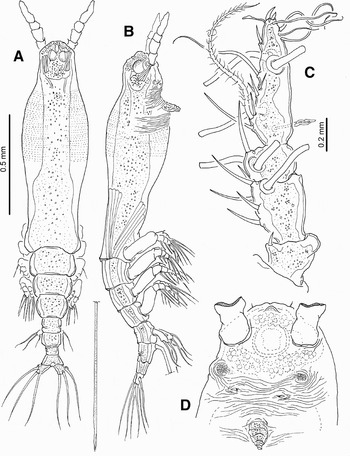
Total body length: 1.76–1.81 mm (average 1.77, N = 10) measured from anterior end of cephalic somite to posterior margin of anal somite. Holotype 1.79 mm. Cephalothorax incorporating first pedigerous somite straight, relatively long, accounting for 63.4% of total body length (Figure 1A & B). Forehead rounded, protuberant in dorsal view, with small field of rounded cuticular processes on anteriormost dorsal ventral surface visible in lateral view; pattern becoming fainter posteriorly (Figure 1A & B); with pair of short sensillae between antennular bases (Figure 1D). Ventral surface of head with low, rounded, convex, chitinized protuberance between bases of antennules, visible in ventral view (Figure 1D). One pair of well developed nipple-like cuticular processes on ventral surface between antennule bases and oral papilla, both processes surrounded and connected by field of transverse ridges; additional pair of cuticular processes posterior to nipple-like ones, surrounded by same field of cuticular ridges. Oral papilla moderately protuberant, located close to anteriormost part of body, midventrally 0.25 of way back along cephalothorax (Figure 1B). Nauplius eye present, well developed, ocelli relatively large, pigmented, rounded, lateral cups separated by less than half cup diameter. Ventral cup present, relatively large, visible in ventral view (Figure 1D).
Cymbasoma davisi sp. nov. Adult female holotype from Miami, Florida. (A) Habitus, dorsal view; (B) habitus, lateral view showing length of ovigerous spine; (C) right antennule, dorsal view; and (D) cephalic area showing ventral surface with cuticular processes.

Antennules relatively short, slightly shorter than 16% of total body length, and about 25% of length of cephalothorax. Antennule length 0.32 mm; 0.33 mm on average in paratypes. As usual in female monstrilloids, antennules four-segmented, intersegmental divisions well-defined. Last antennular segment longest, representing 48.7% of total length of antennule; ratio of lengths of segments (proximal–distal): 13.3:24.7:13.3:48.7 = 100. Armature with 0,I; 1,V; 2,I; 8,VIII setae (Roman numerals) and spines (Arabic numerals) (Figure 1B) plus two aesthetascs, both on last segment, one on proximal ventral surface, one terminal. Following pattern described by Grygier & Ohtsuka (Reference Grygier and Ohtsuka1995) for monstrilloid antennular armature, setae and spines on first (1), second (2d1–2, 2v1–3, IId), and third (3, IIIv, IIId) segments complete. Fourth segment with 4v1–3, IVv, IVd, 4d1, Vm, Vd, Vv, 5, 61, 62, 4aes, 6aes, b1–5; missing: b6. Setae b1–3 branched distally.
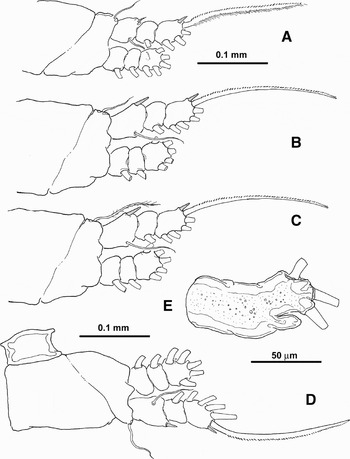
Incorporated first pedigerous somite and succeeding three free pedigerous somites each bearing pair of biramous swimming legs (Figure 2A–D). Intercoxal sclerite of legs 1–4 rectangular, naked. Basis with diagonal division articulating it with large, rectangular coxa. Lateral hair-like setae usual on basis of legs 1–4 of the Monstrilloida present on all legs; basipodal seta on third leg longer and thicker than in the other swimming legs (three times longer in leg 3 than in leg 1) (Figure 2D). Natatory leg setae all lightly and biserially plumose (setules not illustrated). Endopodites and exopodites of legs 1–4 triarticulated. Third exopodal segment with outermost terminal spiniform seta relatively short, 0.2–0.25 times the length of bearing segment. Spiniform terminal setae of same segment armed with small spinules along outer margin; inner margin with short setules on leg 1 only (Figure 2A–D). Armature of swimming legs:
Fifth legs one-segmented, fused medially. Each leg represented by two lobes, outer lobe cylindrical, relatively elongated, armed with three long, plumose seta, all sub-equal in length and width, innermost slightly shorter, about 55% as long as other two setae. Fifth leg setae reaching posterior margin of genital double somite. Relatively short inner lobe, mostly fused to main outer lobe, arising from its distal half to one-third of latter and not reaching its distal end (Figure 2E).
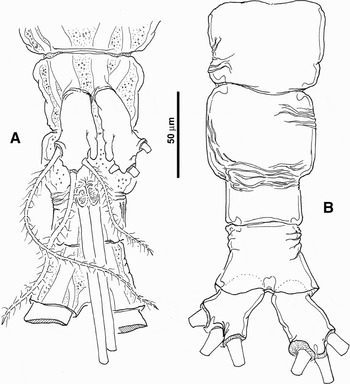
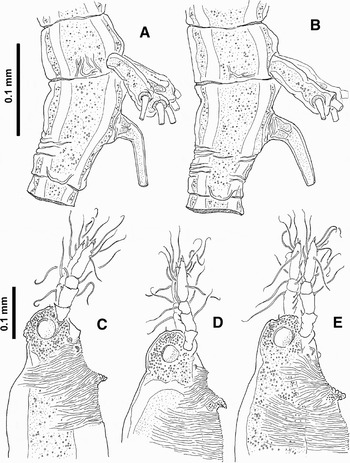
Urosome consisting of fifth pedigerous somite, genital double somite, and one free abdominal somite. Urosome, excluding furcal rami, accounting for 15% of total body length. Ratio of lengths of urosomites (proximal–distal): 31.5:39.2:29.3 = 100. Second to fourth pedigers accounting for 21% of total length in dorsal view. Genital double somite with expanded anterior half; lateral margins straight (Figures 1A & 3B). Dorsal surface of genital double somite with transverse cuticular ridges separating anterior and posterior parts of somite (Figure 3B); these running around somite and reaching ventral surface in different patterns (Figure 4A & B). Additional dorsal ridges near left lateral margin and on anterior right lateral margin (Figure 3B). Ventral anterior surface of genital double somite with rounded protuberance visible in lateral view. Posterior margin of somite with pair of rounded lateral processes (arrowed in Figure 4A & B). Medial ventral part of genital double somite bearing relatively long (0.95 mm), basally separated ovigerous spines (Figure 3A), mostly slender but slightly swollen at distal end; spines representing about 52% of total body length, reaching well beyond distal end of caudal setae. Anal somite relatively long, with moderately divergent lateral margins and with notch in middle of outer margins marked by array of transverse striae on lateral surface (Figure 3B). Caudal rami subrectangular, about 1.5 times as long as wide, divergent, bearing three setae arranged as two outer and one inner (Figure 3B); inner caudal seta slightly longer than remaining two.
Cymbasoma davisi sp. nov. Adult female holotype from Miami, Florida. (A) First swimming leg; (B) second swimming leg; (C) third swimming leg; (D) fourth swimming leg; and (E) fifth leg showing distally arising inner lobe and outer lobe. Most swimming setae cut short, including those on fifth leg.

Cymbasoma davisi sp. nov. Adult female holotype from Miami, Florida. (A) Urosome, including fifth pedigerous, genital, and anal somites, showing fifth legs with complete setae, ventral view; and (B) same, dorsal view, showing cuticular ornamentation.

Cymbasoma davisi sp. nov. Adult female from Miami, Florida. (A) Fifth pedigerous somite with fifth legs and genital somite, lateral view; (B) variant form of same, showing different cuticular ornamentation and much less pronounced anterior ventral process of genital somite; (C) first variant form of head shape and striations, paratype specimen, lateral view; (D) second variant form, paratype specimen, lateral view; and (E) main form, lateral view.

Male
Unknown.
Etymology
The species is warmly dedicated to Dr Charles C. Davis in recognition of his contributions to the taxonomy and biology of the Monstrilloida and his exceptional career in the study of the plankton.
Remarks
The specimens examined showed at least two subtle variations from the main pattern described for the holotype. These involve the shape of the head in lateral view (Figure 4C–E). In the first and second patterns (Figure 4C & D), the dorsal and preoral ventral sinuses are more pronounced and the striae coverage is different both on the dorsal and ventral surfaces. The third type does not have notably pronounced sinuses and the anterior ventral protuberance is absent (Figure 4E). The pattern found in the holotype is similar to the first and second ones, in which the ventral sinus is slightly more pronounced (Figure 1B).
This species is assigned to the genus Cymbasoma on the basis of the caudal rami armed having three setae and the presence of three urosomites (fifth pedigerous, genital double and anal). By following the key published by Isaac (Reference Isaac1975), this species would be identified as Cymbasoma rigidum owing to its fifth leg with a naked inner lobe and an outer lobe with three setae. Based on Suárez-Morales' (2006) analysis of the morphological variability of the many records attributed to this species worldwide, C. rigidum appears to comprise an assemblage of different species. This is principally due to the poor definition of the original C. rigidum, described by Thompson (Reference Thompson1888) from a specimen caught off the Canary Islands. The most recently described member of this complex is C. germanicum Timm, Reference Timm1896, previously synonymized by Sars (Reference Sars1921), but reinstated as a valid species based on several morphological details, including the structure of the fifth legs (Suárez-Morales, Reference Suárez-Morales2006). The new species shares many important characters with C. rigidum and with C. germanicum and is thus deemed another member of this complex.
The anterior half of the genital double somite is globose in C. germanicum, or has the swollen condition shown in other accounts of C. rigidum (Scott, Reference Scott1904; Sars, Reference Sars1921; Sekiguchi, Reference Sekiguchi1982). In the new species, the lateral margins of this compound somite are straight, thus different from the pattern found in all other known species related to C. rigidum.
Antennular setal elements 2v1,3 are long and well-developed. This is a character shared only by C. germanicum but not any other illustrated record of C. rigidum (see Table 1) and is added to the set of characters useful in separating this species.
The swimming legs described by Suárez-Morales (Reference Suárez-Morales2006) for C. germanicum show the usual pattern of armature and setation known for monstrilloids; the armature and proportion are equal in it and the present species. In the first swimming leg of C. germanicum the inner spine on the first exopod is noticeably thicker and stiffer than in the other legs; this is not the case in any specimen of C. davisi. Most importantly, the two knob-like postero-lateral processes on the genital double somite, considered by Suárez-Morales (Reference Suárez-Morales2006) as a character exclusive to C. germanicum, are also present in the new species.
The morphology of the fifth legs was considered by Suárez-Morales (Reference Suárez-Morales2006) as being one of the most important features used in the taxonomic identification and characterization of members of this presumed species complex. An analysis of the structural variations of the fifth legs of specimens that have been attributed to C. rigidum by different authors showed at least three distinct patterns involving differences in the development and length of the inner lobe. The new species seems to be among the members of the intermediate pattern but with some differences: the inner lobe rises very far distally (always more than half and up to two-thirds) along the ramus and it is short, not reaching the distal end of the outer lobe. In C. germanicus, the inner lobe arises much more proximally on the ramus margin and is clearly longer than in C. davisi. The size and shape of the inner lobe has been used recently to separate species in other species complexes, mainly in the C. longispinosum group (see Grygier, Reference Grygier1994b; Suárez-Morales & Escamilla, Reference Suárez-Morales and Escamilla1997; Suárez-Morales & Palomares, Reference Suárez-Morales and Palomares1999), but more comparative data are needed in order to determine the value of this character alone in this species complex. Another variable character of the fifth legs is the relative length of the inner terminal seta of the outer lobe; it can be nearly as long as the other setae, as in C. germanicum (Timm, Reference Timm1896) and in reports of C. rigidum by Bourne (Reference Bourne1890) and Scott (Reference Scott1904). A relatively short inner seta, about half the length of the other two setae, is present in C. davisi and also in specimens of C. rigidum reported by Sars (Reference Sars1921), Wilson (Reference Wilson1932), Sekiguchi (Reference Sekiguchi1982) and Bernier et al. (Reference Bernier, Klassen and Locke2002).
The antennules of C. germanicum (Thompson, Reference Thompson1888; Suárez-Morales, Reference Suárez-Morales2006) are relatively longer (27% of total length) than in C. davisi (16%), the latter being within the range of most C. rigidum depicted in the literature (14–18%).
Material examined
One adult male, undissected, ethanol-preserved. Plankton collection, Miami, Florida (25°44′47.8′′N 80°10′40.6′′W). Specimen collected 23 June, 2006, deposited in collection of zooplankton of El Colegio de la Frontera Sur (ECO-CHZ-03469). Holotype adult male, permanent slide mounted in Canada balsam, deposited in the National Museum of Natural History, Washington, DC (USNM-84196).
Type locality
Off Chicken Key in Biscayne Bay, Florida (25°37′14.7″N 80°17′13.8″W) (Davis, Reference Davis1947). New locality: Virginia Key in Biscayne Bay, Florida.
Description of adult male
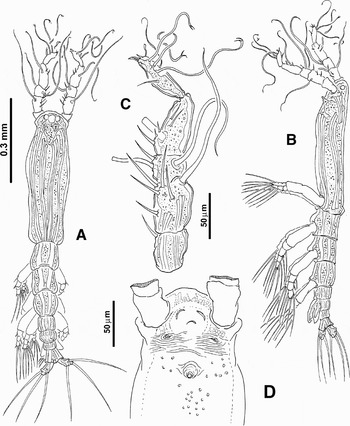
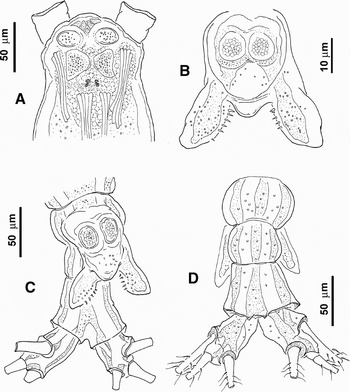
Body length of adult male specimen: 0.9 mm, measured in dorsal view from anterior end of cephalothorax to posterior edge of anal somite, caudal rami excluded. Cephalothorax incorporating first pedigerous somite representing about 52% of total body length (Figure 5A & B); body slender. Oral papilla slightly protuberant, located at about 0.13 of way back along ventral surface of cephalothorax (Figure 5B). Anteriormost cephalic region relatively broad near insertion of antennular bases. Middle part of cephalothorax slightly expanded but gradually tapering posteriorly. Ocelli present, pigment cups relatively small, separated by distance of about one half of ocellar diameter, poorly developed, almost unpigmented, rounded in dorsal view (Figure 1A). Cephalic region slightly protuberant in dorsal view. Ventrally, anterior cephalic surface with pair of elongated, semicircular scars with denticulate borders between antennular bases; two pairs of chitinized, nipple-like cuticular processes between oral papilla and antennule bases. Nipple-like processes showing whorl-like stucture, surrounded by field of transverse ridges. Vesicle-like structures scattered on ventral surface near oral papilla. In dorsal view, cephalic region with bean-shaped, paired cuticular processes (darker structures in Figure 7A).
Cymbasoma quadridens Davis, Reference Davis1947. Adult male from Miami, Florida. (A) Habitus, dorsal view; (B) habitus, lateral view; (C) geniculate right antennule, dorsal view and (D) ventral surface of cephalic area with cuticular processes.

Antennules moderately long, with five segments; antennular length 0.25 mm, representing close to 30% of total body length, and ~57% as long as cephalothorax. Length ratio of antennular segments starting from proximalmost: 17.4: 21.2:13.6:25.1: 22.7 = 100 (Figure 5C). Fifth segment geniculate. Segments armed with 0-I; 1-V; 2-I; 1-V; 5-II + aes setae (in Arabic numerals), spines (in Roman numerals), and aesthetascs (aes). Distal antennular segment with three sub-equal, distally dichotomously branched setae aligned near outer distal end (Figure 5C). In terms of the basic setal nomenclature of Grygier & Ohtsuka (Reference Grygier and Ohtsuka1995) for female monstrilloid copepod antennules and the generalized male armature presented by Huys et al. (Reference Huys, Llewellyn-Hughes, Conroy-Dalton, Olson, Spinks and Johnston2007), elements in first (1), second (2d1,2, 2v1–3, IId), and third (3, IIIv, IIId) segments complete. In fourth segment elements 4v1–3, 4d1,2, and IVv present, IVd is missing on both antennules. On the fifth segment only elements b1–3, b5, b6, 61, 62, and 6aes identified.
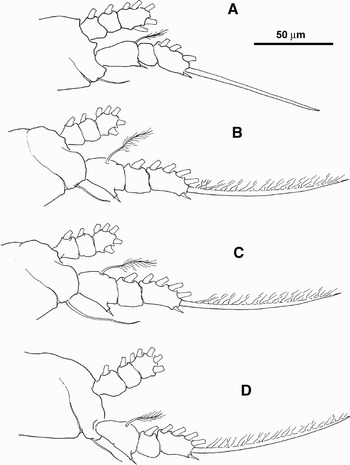
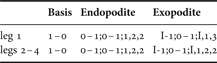
First pedigerous thoracic somite incorporated into cephalothorax. This and succeeding three pedigers each bearing well developed swimming legs, all with 3-segmented endopods and exopods and with same armament pattern, except for leg 1 exopod with one fewer seta on distal segment (Figure 6A). Legs 2–4 slightly larger than leg 1; exopods longer than endopods in all cases. Coxa of each pair unarmed, joined by subrectangular intercoxal sclerite. Basis separated from coxa by diagonal articulation in swimming legs 1–4. Outer margin of basis of swimming legs 1, 2 and 4 with small, thin seta, that on leg 3 are about two times longer and thicker than in other legs. Outer distal corner of first exopodal segments of legs 1–4 each with notably short, spinelike, straight seta about 0.12 times as long as bearing segment; on legs 2–4, spine inserted on protuberant basal process (arrowed in Figure 6B–D). All natatory setae lightly and biserially plumose except for seta on outer distal corner of third exopodal segments of legs 2–4, these being lightly plumose along inner side (not in leg 1, Figure 6A), outer margin naked.
Armament formula of swimming legs as:
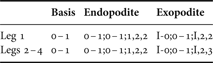
Fifth leg absent. Succeeding somite (genital somite) globose in dorsal view; with genital complex, represented by strong, ventrally protruding genital apparatus of about same length (slightly smaller) as three postgenital somites together (see Figures 1B & 7C). Apparatus nearly cylindrical at base, with two divergent arms rising from distal one-third of appendage (Figure 7B & C). In lateral view, entire shaft curved downwards; in ventral view, tips of arm broad ending in rounded terminal margins. Base of arms with rounded process protruding ventrally; arms bearing set of 5–6 inner spines (Figure 7B). Surface with scattered vesicle-like cuticular structures.
Cymbasoma quadridens Davis, Reference Davis1947. Adult male from Miami, Florida. (A) First swimming leg with naked terminal exopodal spiniform seta; (B) second swimming leg; (C) third swimming leg and (D) fourth swimming leg.

Cymbasoma quadridens Davis, Reference Davis1947. Adult male from Miami, Florida. (A) Cephalic area showing paired cuticular processes (darker), dorsal view; (B) genital lappets with spiniform processes along inner surface, ventral view; (C) urosome including genital lappets, ventral view; and (D) urosome, dorsal view.

As usual in male Cymbasoma, urosome consisting of four somites: fifth pedigerous somite, genital somite (with genital complex/apparatus), and two free somites. In dorsal view, anal somite longest; ratio of lengths of genital somite and two succeeding free somites: 30.6:30.8:38.6(=100).
Furcal rami subrectangular, about 1.75 times longer than wide. Caudal rami with three biserially setulated setae (Figure 7D). All caudal setae sub-equal in length and thickness.
Remarks
Cymbasoma quadridens was described by Davis (Reference Davis1947) based on a single male. The specimen collected off Miami and examined herein is assigned to this species on account of it having all the characters mentioned and depicted by Davis (Reference Davis1947). These include the body size (1.14 mm in the type specimen, 0.9 mm in our specimen), cephalothorax/urosome shape and proportions, and a relatively large anal somite, but mainly the structure of the genital complex. Davis (Reference Davis1947) depicted a general view of the antennule armature outlining most of the elements and emphasizing the length of some of them (i.e. elements IId, IIIv and IIId). The complete set of antennular elements found in this species is presented herein; it is noteworthy to mention Davis' depiction and description of the setae on the terminal segment (b-setae) as branched; this was not so evident in the Virginia Key specimen, in which these setae are dichotomous only distally (see Figure 5C). This character could not be checked in the holotype specimen. Another set of characters not mentioned in the original description and not observable in the type specimen is the ornamentation of the cephalic area, which is described herein. The position of the oral papilla shows a slight difference; it is 0.28 of the way back along the cephalothorax in the original description, and about half that distance in the Virginia Key specimen.
Davis (Reference Davis1947) presented a figure of the fourth swimming leg only. He depicted the short, slender outer spine of the first exopodal segment and the unusual basal process, with a sinus, on which this spine is inserted. These characters were observed also in the Miami specimen. The armature and structure of all legs are presented in this work. The genital complex in the original description is identical in most respects to that observed in the Miami specimen; however, the ornamentation of the inner margin of the lappets was described by Davis (Reference Davis1947) as having four inner teeth that were depicted as cuticular, unsocketed processes. A closer look at these structures showed that these are in fact spine-like, socketed processes, not merely expansions of the cuticle. Furthermore, in the Miami specimen, each margin is armed with more than four spines; adjacent to these structures we found clusters of cuticular papillae on both the dorsal and ventral surface of the genital lappets.
The type locality of Gymbasoma quadridens is off Chicken Key, in Biscayne Bay; the site is about 13 km from our sampling site in Virginia Key. The holotype specimen deposited in the National Museum of Natural History in Washington, DC is mounted in Canada balsam and the specimen is almost completely invisible, apparently partially dissolved in this mounting medium. Only parts of the body and some of the thickest setae are faintly outlined even using different microscopy techniques such as phase contrast and Nomarsky differential interference contrast. The original description, based on a single specimen suggests that M. quadridens is a rare species; hence, it is fortunate that another individual of this small species was recovered from our samples. To permanently and objectively clarify the taxonomic status of this species in the context of the ongoing revisionary study of the monstrilloid copepods, it might be desirable to name the new specimen as the neotype of C. quadridens, but this is not possible at present because the holotype is still extant (International Code of Zoological Nomenclature, Article 75.1). A request must first be made to the International Commission on Zoological Nomenclature to set aside the current, nearly useless name-bearing type (Article 75.5).
ACKNOWLEDGEMENTS
Valuable literature was obtained from the Wilson Copepod Library (National Museum of Natural History), managed by Chad Walter. Rosa Ma. Hernández-Flores deposited and catalogued the specimens in the collection of ECOSUR. Special thanks to Mark J. Grygier for positive and relevant comments on earlier versions of this contribution.