Introduction
Performing clinical behavioural research in areas with an emerging evidence base presents a number of unique challenges. Often, the available evidence is varied or at low level, and typical methods (e.g. randomised control trials) are unable to be applied (Turner-Stokes, Reference Turner-Stokes2008). Further, when translating behavioural-intervention research findings to real-world clinical situations, their application to everyday clinical practice may be limited by contextual constraints (Douglas, Campbell & Hinckley, Reference Douglas, Campbell and Hinckley2015). This article presents a methodology and framework that can be used to maximise small groups of evidence from differing research fields in behavioural clinical research to develop an evidence-based treatment protocol for clinical practice. It recognises the importance of using both qualitative and quantitative findings (Onwuegbuzie & Leech, Reference Onwuegbuzie and Leech2005) and combines these to develop a novel, contextually relevant intervention that is based on all available evidence. This has occurred within the specific clinical context of early acquired brain injury (ABI) rehabilitation by speech–language pathologists (SLPs) for cognitive-communication reading comprehension (CCRC) deficits.
Changes to communication skills, including reading comprehension, can occur following ABI. Reading comprehension changes that occur at a text or ‘discourse’ level following ABI are typically a feature of a cognitive-communication disorder (CCD) (MacDonald & Wiseman-Hakes, Reference MacDonald and Wiseman-Hakes2010; Togher et al., Reference Togher, Wiseman-Hakes, Douglas, Stergiou-Kita, Ponsford, Teasell and Turkstra2014). The incidence of CCD following ABI has been reported as 80%–100% (MacDonald & Wiseman-Hakes, Reference MacDonald and Wiseman-Hakes2010; Togher et al., Reference Togher, Wiseman-Hakes, Douglas, Stergiou-Kita, Ponsford, Teasell and Turkstra2014); however, the incidence of CCRC deficits following ABI is unknown. While discourse-level reading comprehension deficits have been reported to occur following aphasia (Mayer & Murray, Reference Mayer and Murray2002), aphasia-related reading deficits typically occur at a phoneme/grapheme, word or sentence level (Kiran & Sandberg, Reference Kiran, Sandberg, Peach and Shapiro2012). Discourse-level reading comprehension deficits related to CCD typically occur with intact word and at sentence-level processing; these reading changes are not considered ‘aphasic’ in nature.
A range of skills are required to enable reading comprehension, including intact visual and perceptual skills (Ciuffreda, Han, Kapoor & Ficarra, Reference Ciuffreda, Han, Kapoor and Ficarra2006; Pollock et al., Reference Pollock, Hazelton, Henderson, Angilley, Dhillon, Langhorne and Shahani2011), sentence processing and word comprehension (Kiran & Sandberg, Reference Kiran, Sandberg, Peach and Shapiro2012), discourse-level comprehension skills (Holliday, Hamilton, Luthra, Oddy & Weekes, Reference Holliday, Hamilton, Luthra, Oddy and Weekes2005) and cognitive processes including attention, memory and executive skills (Butterfuss & Kendeou, Reference Butterfuss and Kendeou2018; Ferstl, Guthke & von Cramon, Reference Ferstl, Guthke and von Cramon2002; Sohlberg, McLaughlin, Pavese, Heidrich & Posner, Reference Sohlberg, McLaughlin, Pavese, Heidrich and Posner2000), metacognition and self-awareness (Baker, Reference Baker1989). A direct relationship is suggested between impaired cognitive skills and reading comprehension deficits following ABI (Griffiths, Sohlberg, Kirk, Fickas, & Biancarosa, Reference Griffiths, Sohlberg, Kirk, Fickas and Biancarosa2015). Cognitive processes following ABI associated with reading comprehension deficits include attention (Sohlberg, Griffiths & Fickas, Reference Sohlberg, Griffiths and Fickas2014; Sohlberg et al., Reference Sohlberg, McLaughlin, Pavese, Heidrich and Posner2000), working memory (Griffiths et al., Reference Griffiths, Sohlberg, Kirk, Fickas and Biancarosa2015; Schmitter-Edgecombe & Bales, Reference Schmitter-Edgecombe and Bales2005; Sohlberg et al., Reference Sohlberg, Griffiths and Fickas2014), speed of language processing (Sohlberg, Griffiths & Fickas, Reference Sohlberg, Griffiths and Fickas2015), verbal learning (Sohlberg et al., Reference Sohlberg, Griffiths and Fickas2014) and executive processes (Ferstl et al., Reference Ferstl, Guthke and von Cramon2002; Schmitter-Edgecombe & Bales, Reference Schmitter-Edgecombe and Bales2005). As such, CCRC deficits typically occur following changes to the cognitive and complex communication skills that facilitate reading (Ferstl et al., Reference Ferstl, Guthke and von Cramon2002; Griffiths et al., Reference Griffiths, Sohlberg, Kirk, Fickas and Biancarosa2015; Schmitter-Edgecombe & Bales, Reference Schmitter-Edgecombe and Bales2005; Sohlberg et al., Reference Sohlberg, McLaughlin, Pavese, Heidrich and Posner2000, Reference Sohlberg, Griffiths and Fickas2014, Reference Sohlberg, Griffiths and Fickas2015). For example, when an adult with ABI attempts to read discourse-level information early in recovery, attentional difficulties may disrupt information processing of written text (e.g. impacting encoding, storage and/or retrieval), which disrupts the construction of an accurate situational model and impacts overall comprehension (Kintsch & van Dijk, Reference Kintsch and van Dijk1978; Sohlberg & Turkstra, Reference Sohlberg and Turkstra2011; Sohlberg et al., Reference Sohlberg, Griffiths and Fickas2014).
Reading comprehension changes occur across all levels of function as described in the International classification of functioning, disability and health (ICF) model (World Health Organization, 2001), from impairment to participation (Griffiths, Reference Griffiths2012), with changes to CCRC skills identified in both early (<6 months post ABI) and chronic ABI populations. Features of impairment-level CCRC deficits early in recovery include reductions in vocabulary/written word knowledge (Kaplan, Reference Kaplan1990), reduced comprehension of literal texts at a paragraph level and above (Hinchliffe, Murdoch & Chenery, Reference Hinchliffe, Murdoch and Chenery1998; Kaplan, Reference Kaplan1990) and impaired complex, inferential reading comprehension (Kaplan, Reference Kaplan1990). In chronic populations, difficulties with these skills continue, including reduced vocabulary and reduced paraphrase comprehension (Sohlberg et al., Reference Sohlberg, Griffiths and Fickas2014), reduced comprehension of discourse-level text (Ferstl et al., Reference Ferstl, Guthke and von Cramon2002; Schmitter-Edgecombe & Bales, Reference Schmitter-Edgecombe and Bales2005; Sohlberg et al., Reference Sohlberg, Griffiths and Fickas2015) and reduced complex comprehension, including text coherence (Ferstl et al., Reference Ferstl, Guthke and von Cramon2002), inferential reading and gist memory (Holliday et al., Reference Holliday, Hamilton, Luthra, Oddy and Weekes2005). Adults with ABI tend to have more difficulties with inferential comprehension than literal/verbatim comprehension (Sohlberg et al., Reference Sohlberg, Griffiths and Fickas2014).
These impairment level changes to reading comprehension impact individuals’ function, activity and participation. Changes to cognition impact reading processes and ability, which impacts the success of reading for a specific purpose (i.e. reading activity) and ultimately influences global participation (Griffiths, Reference Griffiths2012). These changes to activity and participation occur across all recovery time points, from early in recovery to long-term post-injury. Specific limitations and restrictions have been associated with CCRC deficits, in the areas of participation during rehabilitation (Malec, Smigielski, DePompolo & Thompson, Reference Malec, Smigielski, DePompolo and Thompson1993), independence within the home and community (Jacobs, Reference Jacobs1988), participation in leisure activities and return to study/work (Laatsch & Guay, Reference Laatsch and Guay2005), participation in vocation and education (Griffiths, Reference Griffiths2012) and tertiary education performance (Sohlberg et al., Reference Sohlberg, Griffiths and Fickas2015). As the goal of SLP interventions following brain injury is to maximise independent function for participation in daily living (American Speech-Language-Hearing Association, 2020), providing rehabilitation of CCRC deficits, regardless of time post-injury is supported. As CCRC deficits are present from early post-injury, providing early rehabilitation for CCRC deficits may maximise participation and function during early recovery and positively influence future participation and function.
Rehabilitation and management of CCRC deficits are typically provided by SLPs and occur across the rehabilitation continuum, from early post-injury (Blake, Frymark & Venedictov, Reference Blake, Frymark and Venedictov2013; Coelho, DeRuyter & Stein, Reference Coelho, DeRuyter and Stein1996; Watter, Copley & Finch, Reference Watter, Copley and Finch2016) to later in recovery (Griffiths et al., Reference Griffiths, Sohlberg, Kirk, Fickas and Biancarosa2015; Harvey & Hux, Reference Harvey and Hux2015; Sohlberg et al., Reference Sohlberg, Griffiths and Fickas2014). However, the evidence base for managing CCRC deficits is predominantly from chronic populations (MacDonald, Reference MacDonald2017; Watter, Copley & Finch, Reference Watter, Copley and Finch2017). In a recent systematic review of discourse-level reading comprehension interventions following ABI, only 3 of 23 identified papers investigated clients in early rehabilitation (i.e. <6 months post onset) (Watter et al., Reference Watter, Copley and Finch2017). Identified CCRC interventions included strategy-based interventions (Griffiths et al., Reference Griffiths, Sohlberg, Kirk, Fickas and Biancarosa2015; Sohlberg et al., Reference Sohlberg, Griffiths and Fickas2014), cognitive interventions with a reading focus (Laatsch & Guay, Reference Laatsch and Guay2005) and the use of compensatory devices (e.g. text-to-speech) (Harvey & Hux, Reference Harvey and Hux2015). MacDonald reports there is evidence to support the interventions of oral reading, compensatory and metacognitive strategy interventions, organisational training and gist reasoning training for CCRC deficits (MacDonald, Reference MacDonald2017).
Strategy use is a common rehabilitation intervention for adults with ABI (Cicerone et al., Reference Cicerone, Langenbahn, Braden, Malec, Kalmar, Fraas and Ashman2011), including those with CCRC deficits (Watter et al., Reference Watter, Copley and Finch2017). Deliberate strategy use can aid reading comprehension by helping to compensate for the cognitive impairments that impact reading processes (Sohlberg & Turkstra, Reference Sohlberg and Turkstra2011). The use of strategy-based interventions for CCRC deficits has been supported in previous reviews (MacDonald, Reference MacDonald2017; Watter et al., Reference Watter, Copley and Finch2017). Recent research into managing CCRC deficits has focused on adults undertaking post-secondary education and the use of strategy-based interventions in a chronic population. This includes investigating the cognitive and reading comprehension skills of adults with ABI and traumatic brain injury (TBI) (Sohlberg et al., Reference Sohlberg, Griffiths and Fickas2015); the effectiveness of computer-delivered reading strategies (Griffiths et al., Reference Griffiths, Sohlberg, Kirk, Fickas and Biancarosa2015; Sohlberg et al., Reference Sohlberg, Griffiths and Fickas2014) and developing new tools to assess reading comprehension and identify strategy use during reading (Kucheria, Sohlberg, Prideaux & Fickas, Reference Kucheria, Sohlberg, Prideaux and Fickas2019; Kucheria, Sohlberg, Yoon, Fickas & Prideaux, Reference Kucheria, Sohlberg, Yoon, Fickas and Prideaux2018). While the CCRC evidence base grows for those with chronic deficits, it continues to be limited for those early post-injury, and the application of the above interventions to early recovery is unknown.
The need for early rehabilitation of CCRC deficits has previously been recognised. Adults with ABI may require functional reading skills on discharge from hospital to enable return to previous roles, including running the house, returning to work, engaging in social networks (Watter et al., Reference Watter, Copley and Finch2016) and to participate in meaningful activities that involve reading, including leisure and social pursuits (Cocks, Pritchard, Cornish, Johnson & Cruice, Reference Cocks, Pritchard, Cornish, Johnson and Cruice2013). Maximising reading skills early in recovery may increase success and participation in these activities and in life roles, increasing independence in the home and community, reducing the amount of support required post-discharge and increasing the levels of social participation which may in turn impact the quality of life.
Further, CCRC deficits can impact participation in rehabilitation (Malec et al., Reference Malec, Smigielski, DePompolo and Thompson1993; Ryan, Sautter, Capps, Meneese & Barth, Reference Ryan, Sautter, Capps, Meneese and Barth1992), including participation and success in more complex rehabilitation (e.g. vocational rehabilitation) (Ryan et al., Reference Ryan, Sautter, Capps, Meneese and Barth1992). If aspects of a rehabilitation programme require comprehension of written information, then the person’s ability to fully comprehend and participate in that aspect of rehabilitation may be compromised (Malec et al., Reference Malec, Smigielski, DePompolo and Thompson1993). This may result in reduced rehabilitation progress and client outcomes. Accessing specialised, early ABI rehabilitation is considered ‘best practice’ (Australasian Faculty of Rehabilitation Medicine, 2011; Royal College of Physicians and British Society of Rehabilitation Medicine, 2003). This rehabilitation maximises recovery and long-term gains and is effective and cost-efficient for adults with ABI of working age (Turner-Stokes, Reference Turner-Stokes2008; Turner-Stokes, Nair, Sedki, Disler & Wade, Reference Turner-Stokes, Nair, Sedki, Disler and Wade2005; Turner-Stokes, Williams, Bill, Bassett & Sephton, Reference Turner-Stokes, Williams, Bill, Bassett and Sephton2016). However, if reading deficits interfere with rehabilitation participation, then client outcomes may be negatively impacted if reading is not addressed early in recovery. Therefore, providing early rehabilitation for CCRC deficits may maximise rehabilitation participation and gains, addressing best practice recommendations for adults with ABI.
During the period of early recovery and early rehabilitation (i.e. first 6 months post-injury), health services typically provide maximum intensity rehabilitation (Christensen et al., Reference Christensen, Colella, Inness, Hebert, Monette, Bayley and Green2008). This includes rehabilitation for cognitive deficits (Beaulieu et al., Reference Beaulieu, Dijkers, Barrett, Horn, Guiffrida, Timpson and Hammond2015; Rabinowitz & Levin, Reference Rabinowitz and Levin2014) and the cognitive processes associated with CCRC deficits. The recovery of cognitive functions is also accelerated during the first 5 months post-injury (Christensen et al., Reference Christensen, Colella, Inness, Hebert, Monette, Bayley and Green2008). Therefore, providing rehabilitation for CCRC deficits early in recovery takes advantage of the accelerated recovery of cognitive processes, the spontaneous recovery period and a period of increased rehabilitation intensity. This may maximise recovery and gains for these individuals and may enhance the rehabilitation potential for people with ABI and their future participation and clinical outcomes both in hospital and at home/in the community.
SLPs provide management and interventions for CCRC deficits in early ABI rehabilitation (Blake et al., Reference Blake, Frymark and Venedictov2013; Coelho et al., Reference Coelho, DeRuyter and Stein1996; Watter et al., Reference Watter, Copley and Finch2016), with evidence of improved CCRC skills overall (Blake et al., Reference Blake, Frymark and Venedictov2013; Coelho et al., Reference Coelho, DeRuyter and Stein1996). Yet the priority of providing CCRC rehabilitation is unknown. SLPs within specialised sub-acute brain injury rehabilitation units in Australia reported providing highest intensity services to clients with dysphagia and severe communication disorders (Watter, Addis, Copley & Finch, Reference Watter, Addis, Copley and Finch2014b). Australian SLPs also identified that sub-acute rehabilitation for CCRC deficits may not be prioritised for all clients, given concomitant swallowing or CCDs (e.g. auditory–verbal and social communication skills) (Watter et al., Reference Watter, Copley and Finch2016). Reduced rehabilitation of CCRC skills in early recovery has also been demonstrated in a recent multi-site study, which reported on ‘common’ SLP interventions in sub-acute rehabilitation for TBI (Beaulieu et al., Reference Beaulieu, Dijkers, Barrett, Horn, Guiffrida, Timpson and Hammond2015). Reading/writing skills (including paragraph, multiple paragraph, functional and advanced reading) were not reported as ‘common’ SLP interventions during early rehabilitation (Beaulieu et al., Reference Beaulieu, Dijkers, Barrett, Horn, Guiffrida, Timpson and Hammond2015). It is possible that clients’ reading comprehension needs are not being adequately prioritised or addressed early in recovery, which may negatively impact rehabilitation outcomes and individuals’ function and participation. There has been limited research in this area to guide clinicians to provide evidence-based interventions for the early rehabilitation of CCRC deficits, with clinicians relying on findings from the chronic evidence base.
Providing evidence-based practice (EBP) is the cornerstone of delivering quality healthcare. The principles of EBP are used in clinical decision-making as part of regular practice by allied health clinicians, including SLPs (American Speech-Language-Hearing Association, 2005). Being an evidence-based practitioner involves integrating multiple types of information to inform decision-making in clinical practice, including research evidence, clinical experience, utilising client and consumer preferences and information on context (Hoffman, Bennett & Del Mar, Reference MacDonald2017). These have been described as the ‘external’ research evidence, evidence ‘internal’ to clinical practice, evidence regarding the preferences of an informed client (Dollaghan, Reference Dollaghan2007) and ‘context’ (Hoffman et al., Reference Hoffman, Bennett and Del Mar2017). Clinical guidelines, practice recommendations and position statements from professional bodies also inform clinicians when delivering ‘best practice’ services. Within clinical practice, treatment selection, timing of interventions, service delivery methods and treatment intensity are considered alongside the context of the workplace and clinical service. However, a lack of research in specific areas, poor generalisation of research to clinical practice or specific settings, and workplace and contextual factors have been identified as barriers to clinicians in providing EBP (O’Connor & Pettigrew, Reference O’Connor and Pettigrew2009; Reilly, Reference Reilly2004).
In the areas of ABI rehabilitation, a significant body of evidence exists to support early specialist multi-disciplinary rehabilitation (Turner-Stokes, Reference Turner-Stokes2008; Turner-Stokes et al., Reference Turner-Stokes, Nair, Sedki, Disler and Wade2005, Reference Turner-Stokes, Williams, Bill, Bassett and Sephton2016) including systematic reviews and evaluations, with access to early rehabilitation considered best practice for adults with ABI (Australasian Faculty of Rehabilitation Medicine, 2011; Royal College of Physicians and British Society of Rehabilitation Medicine, 2003). However, studies typically investigate the process and overall outcomes of rehabilitation, not specific interventions provided during rehabilitation (Turner-Stokes et al., Reference Turner-Stokes, Nair, Sedki, Disler and Wade2005). Similarly, a lack of published research has been identified regarding specific CCRC interventions and their effectiveness during early, sub-acute ABI rehabilitation (Watter et al., Reference Watter, Copley and Finch2016, Reference Watter, Copley and Finch2017).
Conducting ABI rehabilitation research presents a number of challenges, including heterogeneity of the population, resources required for system-level interventions, ethical concerns with treatment selection, participant withdrawal and the impact of real-life clinical practice on treatment design (Turner-Stokes et al., Reference Turner-Stokes, Nair, Sedki, Disler and Wade2005). During early rehabilitation, other clinical factors may also impact ABI research, including medical stability, spontaneous recovery, service-level decisions (e.g. length of stay) and timing of interventions (Hall & Cope, Reference Hall and Cope1995). Subsequently, research that also investigates practice-based evidence (alongside EBP) has been recommended (Turner-Stokes et al., Reference Turner-Stokes, Nair, Sedki, Disler and Wade2005). Practice-based evidence investigates specific clinical practice (e.g. clinical rehabilitation interventions) alongside client characteristics, deficits and outcomes (Beaulieu et al., Reference Beaulieu, Dijkers, Barrett, Horn, Guiffrida, Timpson and Hammond2015) to provide detailed information on rehabilitation activities. Early interventions and outcomes for adults with brain injury in sub-acute rehabilitation have recently been investigated in a practice-based evidence study; the categories for SLP interventions investigated included cognitive and communication domains (Beaulieu et al., Reference Beaulieu, Dijkers, Barrett, Horn, Guiffrida, Timpson and Hammond2015). Specific SLP interventions were not detailed; however, these studies are a positive step towards building the evidence-base for early SLP rehabilitation practice for cognitive-communication.
While the evidence supports early rehabilitation for adults with ABI and interventions for chronic CCRC deficits, there is little formal evidence to guide SLPs in managing CCRC deficits early in recovery. When attempting to provide evidence-based services for adults with CCRC deficits in early rehabilitation, SLPs face a challenging task. They must relate published evidence for interventions from a chronic, stable population to early rehabilitation; utilise clinical and professional guidelines; use clinical judgment, practitioner-based knowledge and ‘expert opinion’; and consider client preferences, all within the context of their clinical service.
Objectives
This study aims to apply a newly designed novel methodology to develop and describe a context-specific intervention and service delivery model for CCRC deficits that is evidence based and can be delivered by SLPs in sub-acute and early ABI rehabilitation (<6 months post-injury) as part of regular service delivery. The study was developed within an Australian rehabilitation context. The principles and frameworks that guide multi-disciplinary service provision in specialist sub-acute ABI rehabilitation centres in Australia have previously been presented (Watter et al., Reference Watter, Copley and Finch2016). To summarise, Australian SLPs provide early, sub-acute rehabilitation for adults with ABI and TBI within specialised brain injury rehabilitation centres, broader rehabilitation services and generalist health settings. Australian ABI rehabilitation facilities operate under the Australasian Faculty of Rehabilitation Medicine’s Standards (2011), where services are provided in line with the World Health Organization’s ICF framework (World Health Organization, 2001). As such, findings from an Australian healthcare context should translate to other healthcare settings and contexts.
Considerations When Developing an Evidence-Based Clinical Intervention and Service Delivery Model: Using a Pragmatic Clinical Framework
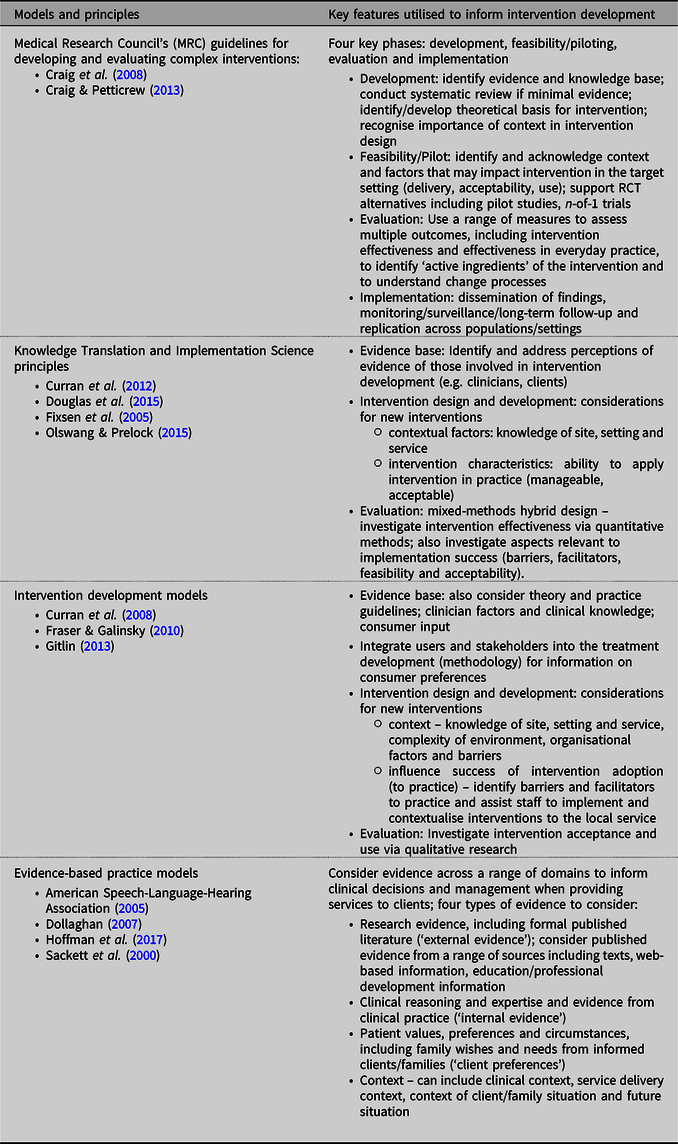
A number of models and principles informed the development of the CCRC intervention and service delivery model and intervention design. These models were broadly congruent and shared a number of key themes and factors; an emergent multi-phase mixed-methods design (Creswell, Klassen, Plano Clark & Smith, Reference Creswell, Klassen, Plano Clark and Smith2011) allowed for the combination of methodologies.
The Medical Research Council’s (MRC) guidelines for developing and evaluating complex interventions (Craig & Petticrew, Reference Craig and Petticrew2013; Craig et al., Reference Craig, Dieppe, Macintyre, Michie, Nazareth and Petticrew2008) were utilised alongside knowledge translation and implementation science principles (Curran, Bauer, Mittman, Pyne & Stetler, Reference Curran, Bauer, Mittman, Pyne and Stetler2012; Douglas et al., Reference Douglas, Campbell and Hinckley2015; Fixsen, Naoom, Blase, Friedman & Wallace, Reference Fixsen, Naoom, Blase, Friedman and Wallace2005; Olswang & Prelock, Reference Olswang and Prelock2015), intervention development models (Curran, Mukherjee, Allee & Owen, Reference Curran, Mukherjee, Allee and Owen2008; Fraser & Galinsky, Reference Fraser and Galinsky2010; Gitlin, Reference Gitlin2013) and EBP models and principles that guide clinical practice (American Speech-Language-Hearing Association, 2005; Dollaghan, Reference Dollaghan2007; Hoffman et al., Reference Hoffman, Bennett and Del Mar2017; Sackett, Straus, Richardson, Rosenberg & Haynes, Reference Sackett, Straus, Richardson, Rosenberg and Haynes2000).
Steps one, two and three of the MRC framework have been applied to this study. This includes development of the complex intervention, planning to pilot the new intervention via contextually designed n-of-1 trials and planning evaluation of the intervention involving a range of outcomes and measures. Step four (implementation) has not been fully executed and is an identified future direction.
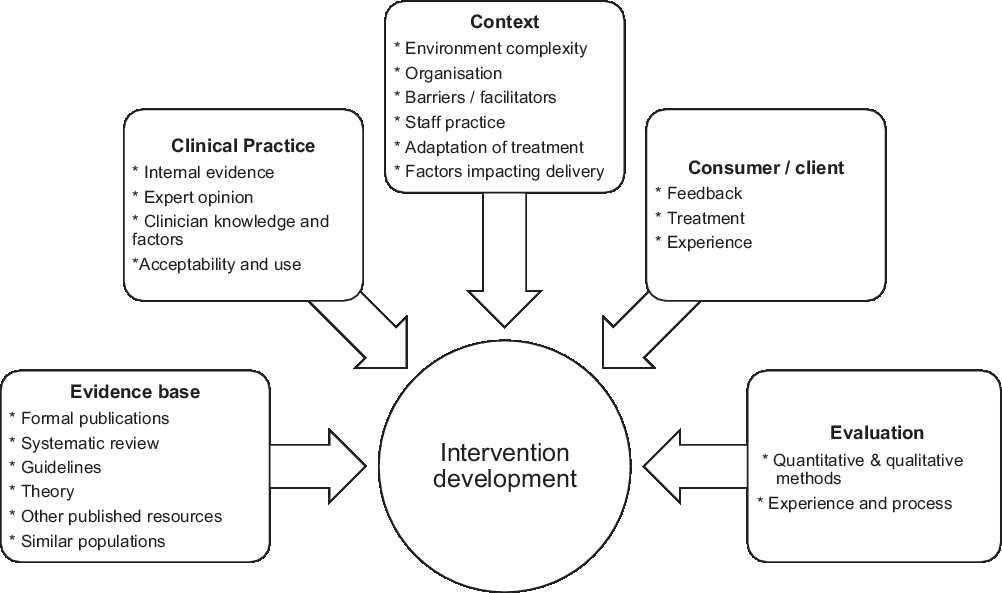
From these models and frameworks, five key factors were identified that informed the treatment design: evidence base (including theoretical constructs), clinical practice, consumer and client factors, contextual factors and evaluation. These have been combined to form a pragmatic clinical framework, which is summarised in Fig. 1, and detailed below. These key features are also summarised in Appendix 1.
Clinical frameworks influencing intervention development: A pragmatic clinical framework.

When developing a new intervention, a range of information should be considered (American Speech-Language-Hearing Association, 2005;Craig & Petticrew, Reference Craig and Petticrew2013; Craig et al., Reference Craig, Dieppe, Macintyre, Michie, Nazareth and Petticrew2008; Curran et al., 2008, Reference Curran, Bauer, Mittman, Pyne and Stetler2012; Dollaghan, Reference Dollaghan2007; Douglas et al., Reference Douglas, Campbell and Hinckley2015; Fixsen et al., Reference Fixsen, Naoom, Blase, Friedman and Wallace2005; Fraser & Galinsky, Reference Fraser and Galinsky2010; Gitlin, Reference Gitlin2013; Olswang & Prelock, Reference Olswang and Prelock2015; Sackett et al., Reference Sackett, Straus, Richardson, Rosenberg and Haynes2000). The MRC recommends identifying the evidence and knowledge base, performing a systematic review of the literature if there is little evidence (Craig et al., Reference Craig, Dieppe, Macintyre, Michie, Nazareth and Petticrew2008) and identifying or developing the theoretical basis for the intervention (Craig & Petticrew, Reference Craig and Petticrew2013). In addition to utilising formal evidence from the literature (Dollaghan, Reference Dollaghan2007; Hoffman et al., Reference Hoffman, Bennett and Del Mar2017; Sackett et al., Reference Sackett, Straus, Richardson, Rosenberg and Haynes2000), published evidence from a range of sources should be considered, including texts, web-based information, education/professional development information (American Speech-Language-Hearing Association, 2005) and theory and practice guidelines (Gitlin, Reference Gitlin2013). The evidence base for similar interventions from related populations may also be useful to consider (MacDonald & Wiseman-Hakes, Reference MacDonald and Wiseman-Hakes2010).
Evidence ‘internal’ to clinical practice (Dollaghan, Reference Dollaghan2007; Sackett et al., Reference Sackett, Straus, Richardson, Rosenberg and Haynes2000), alongside clinician factors and clinical knowledge (Gitlin, Reference Gitlin2013; Hoffman et al., Reference Hoffman, Bennett and Del Mar2017), should also be used to inform the development of new interventions. Input from consumers should be sought (Dollaghan, Reference Dollaghan2007; Gitlin, Reference Gitlin2013; Hoffman et al., Reference Hoffman, Bennett and Del Mar2017; Sackett et al., Reference Sackett, Straus, Richardson, Rosenberg and Haynes2000) to identify needs and perspectives. Integrating users and stakeholders into study methodology and treatment development (Gitlin, Reference Gitlin2013) can aid in providing information on consumer preferences. The perceptions of evidence for those involved (e.g. clinicians, clients) should also be identified and addressed in treatment development (Douglas et al., Reference Douglas, Campbell and Hinckley2015).
Contextual factors (Hoffman et al., Reference Hoffman, Bennett and Del Mar2017) should be considered in the design and development of a new implementation intervention (Curran et al., Reference Curran, Mukherjee, Allee and Owen2008; Olswang & Prelock, Reference Olswang and Prelock2015). These include knowledge of the site, setting and service for future implementation (Douglas et al., Reference Douglas, Campbell and Hinckley2015; Fixsen et al., Reference Fixsen, Naoom, Blase, Friedman and Wallace2005; Gitlin, Reference Gitlin2013), complexity of the practice environment and organisational factors and barriers (Gitlin, Reference Gitlin2013). Specific intervention characteristics, including the ability to apply the intervention in practice (i.e. being manageable and acceptable) should also be considered (Douglas et al., Reference Douglas, Campbell and Hinckley2015). Identifying barriers and facilitators to practice and assisting staff to implement and contextualise interventions to their local service influence the likelihood of interventions being successfully adopted (Curran et al., Reference Curran, Mukherjee, Allee and Owen2008).
Evaluating the feasibility of a potential intervention requires knowledge and acknowledgement of the context, including factors impacting delivery, acceptability and use of the intervention in the target setting (Craig et al., Reference Craig, Dieppe, Macintyre, Michie, Nazareth and Petticrew2008). Investigating the intervention’s acceptance and use via qualitative research is recommended (Gitlin, Reference Gitlin2013). Curran and colleagues (Reference Curran, Bauer, Mittman, Pyne and Stetler2012) support the use of a mixed-methods hybrid design to investigate the effectiveness of interventions via quantitative methods, plus investigating aspects relevant to implementation success (e.g. barriers, facilitators, feasibility and acceptability).
The translation of the pragmatic clinical framework to the target population (SLP management of sub-acute CCRC deficits) is detailed in the Methods section.
Methods
This study has ethical clearance from the University of Queensland Medical Research Ethics Committee (# 2013000489; #2014000755) and the Metro South Human Research Ethics Committee (HREC/11/QPAH/533; HREC/13/QPAH/094). The Criteria for Reporting the Development and Evaluation of Complex Interventions in healthcare: revised guidelines (CReDICI 2) have been applied to this study (Mohler, Kopke & Meyer, Reference Möhler, Kopke and Meyer2015); specifically, all four steps in the first stage, which relate to the development of a complex healthcare intervention.
A mixed-methods approach using an emergent multi-phase mixed-methods design (Creswell et al., Reference Creswell, Klassen, Plano Clark and Smith2011) allowed for the translation of factors identified from the pragmatic clinical framework to the target population (SLP management of sub-acute and early CCRC deficits). This process is described in detail in the procedure below and summarised here to aid the reader. The evidence base for discourse-level reading comprehension deficits following ABI needed to be identified, which involved conducting a systematic review (Watter et al., Reference Watter, Copley and Finch2017), identifying other sources of published evidence and investigating the evidence from other populations for discourse-level reading comprehension deficits. Clinical guidelines and practice recommendations for SLP service provision for ABI and CCD rehabilitation were also reviewed. The clinical practice of sub-acute SLPs for CCRC management and service delivery was investigated (Watter et al., Reference Watter, Copley and Finch2016), and contextual factors including practice patterns and service delivery of SLPs in specific brain injury sub-acute rehabilitation facilities were identified (Watter, Addis, Copley & Finch, Reference Watter, Addis, Copley and Finch2014a; Watter et al., Reference Watter, Addis, Copley and Finch2014b). Consumer preferences for sub-acute rehabilitation of CCRC deficits were also sought. Lastly, when developing the intervention, the theoretical constructs that underpin the intervention were explored, and future evaluation measures were considered.
Procedure
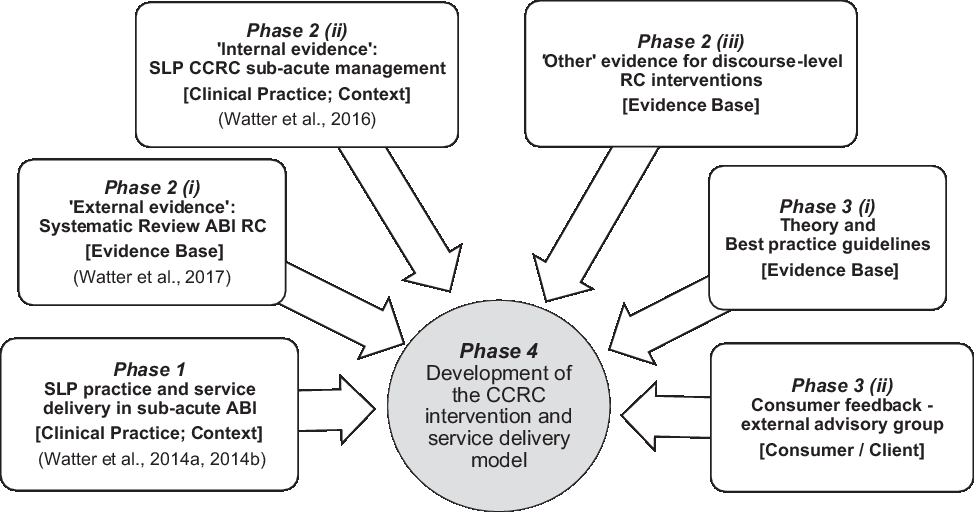
The emergent multi-phase mixed-methods design (Creswell et al., Reference Creswell, Klassen, Plano Clark and Smith2011) allowed for multiple phases of activity; each phase was separate and possessed its own methodology. Earlier phases of the study informed and guided the following phases, and qualitative information informed the development of quantitative interventions (Creswell et al., Reference Creswell, Klassen, Plano Clark and Smith2011). Within the study, three phases of research activity led to the development of a CCRC intervention and service delivery model for SLPs in sub-acute brain injury rehabilitation (phase four of this study). These phases are described below. A fifth and future phase involved implementing the developed intervention and service delivery model with adults with ABI and CCRC deficits during early rehabilitation (Watter, Copley & Finch, Reference Watter, Copley and Finch2020). These phases are presented alongside the clinical framework factors in Fig. 2.
Developing the CCRC intervention and service delivery model.
ABI: acquired brain injury; CCRC: cognitive-communication reading comprehension; RC: reading comprehension; SLP: speech–language pathology.

Study phases
Phase 1: SLP service delivery and practice in sub-acute ABI rehabilitation – identifying clinical practice and context
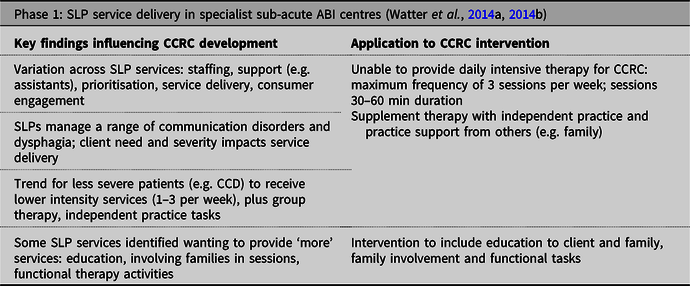
The clinical practice and service delivery methods of SLPs working in specialised sub-acute brain injury rehabilitation centres across Australia were investigated (Watter et al., Reference Watter, Addis, Copley and Finch2014a, 2014b) to provide information on ‘context’ and clinical practice (Hoffman et al., Reference Hoffman, Bennett and Del Mar2017). The areas investigated involved staffing, prioritisation, intervention, frequency, mode, education provision and family/consumer involvement (Watter et al., Reference Watter, Addis, Copley and Finch2014a, 2014b). The key findings from phase one that influenced the development of the CCRC intervention are presented in the Results section (see Table 1).
Phase 1 Findings used in CCRC Development

ABI, acquired brain injury; CCD, cognitive-communication disorder; CCRC, cognitive-communication reading comprehension; SLP, speech–language pathologist.
Phase 2: Identifying the evidence base
The evidence base for CCRC interventions following ABI was investigated in this phase. The ‘external’ research evidence and ‘internal’ clinical practice evidence (Dollaghan, Reference Dollaghan2007) for CCRC sub-acute interventions were investigated via (i) a systematic review (Watter et al., Reference Watter, Copley and Finch2017), (ii) investigation of SLP clinical practice (Watter et al., Reference Watter, Copley and Finch2016) and (iii) identification of ‘other’ research evidence for discourse-level reading interventions from related populations and research fields via a literature review.
-
(i) Systematic review findings (Watter et al., Reference Watter, Copley and Finch2017): A systematic review of the literature was conducted and reported according to PRISMA guidelines (Moher, Liberati, Tetzlaff, Altman & Group, Reference Moher, Liberati, Tetzlaff, Altman and Group2009) and logged with PROSPERO (http://www.crd.york.ac.uk/PROSPERO) to identify the evidence for discourse-level reading comprehension interventions following ABI (Watter et al., Reference Watter, Copley and Finch2017). Twenty-three papers were identified for review, with six different groups of interventions. This study also identified intervention outcomes, assessment methods, intervention features including treatment duration, trends and future directions for CCRC research.
-
(ii) Clinical practice findings (Watter et al., Reference Watter, Copley and Finch2016): The clinical practice of Australian SLPs and how they provided sub-acute CCRC rehabilitation for adults with ABI was investigated via an online national survey (Watter et al., Reference Watter, Copley and Finch2016). The mixed-methods study identified SLP service delivery for CCRC in sub-acute rehabilitation, including assessment practices, intervention frequency and types of interventions provided (including impairment and functional/participation-level intervention activities and reading strategy interventions).
-
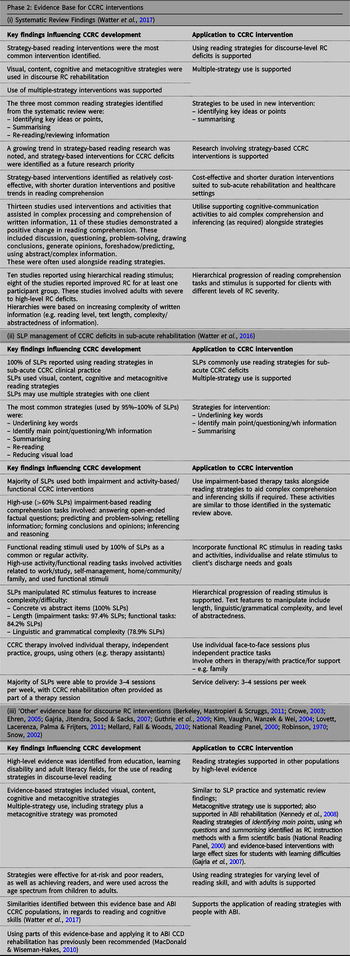
(iii) ‘Other’ discourse-level reading comprehension evidence: The evidence base for other discourse-level reading comprehension interventions was investigated via a literature review and involved research and literature from the fields of education, learning disability and adult literacy. This literature base was large and included government reports, systematic reviews and meta-analyses. It provided high levels of evidence for a range of strategy-based reading interventions, with key papers referenced in the Results section (see Table 2).
Phase 2 Findings Used in CCRC Development

ABI, acquired brain injury; CCD, cognitive-communication disorder; CCRC, cognitive-communication reading comprehension; RC, reading comprehension; SLP, speech–language pathologist.
The key findings from phase two that influenced the development of the CCRC intervention are presented in the Results section (see Table 2).
Phase 3: Theory, practice guidelines and consumer feedback
Additional information was investigated to inform the intervention development, regarding (i) theory, (ii) practice guidelines and (iii) information from consumers.
-
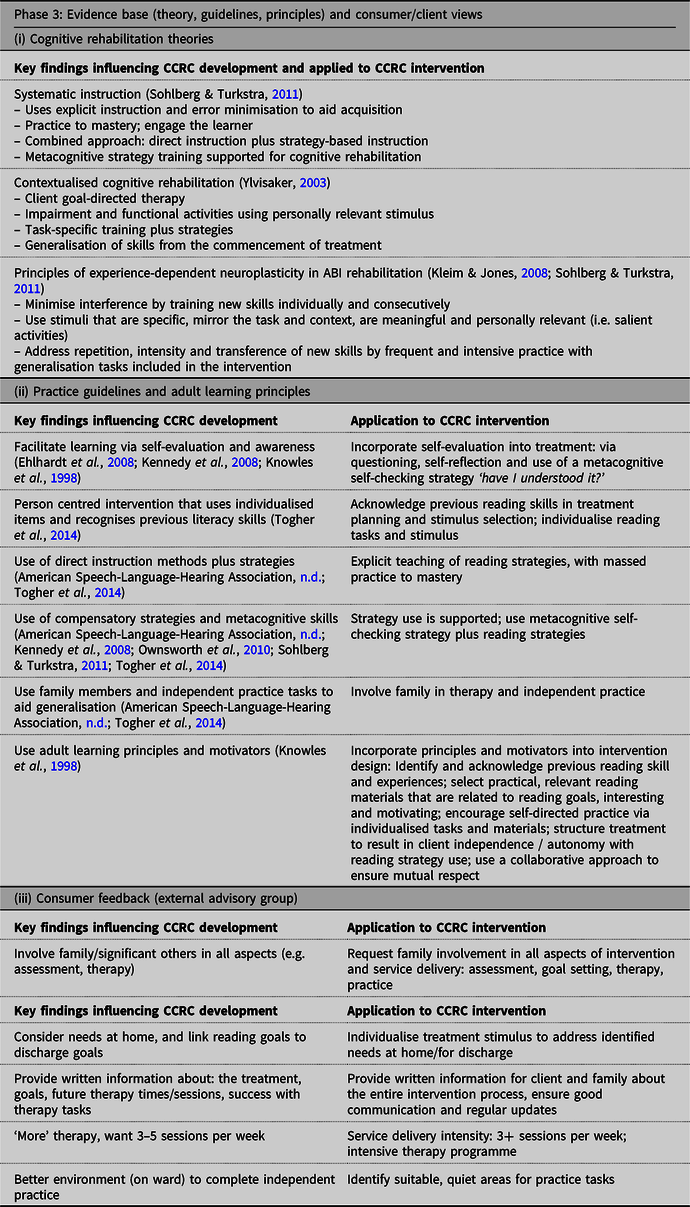
(i) Theory: The broad construct of cognitive rehabilitation theory underpins the development of the CCRC intervention and service delivery model. Specific theories influencing treatment development included systematic instructional theory (Sohlberg & Turkstra, Reference Sohlberg and Turkstra2011), contextual cognitive rehabilitation paradigms (Ylvisaker, Reference Ylvisaker2003) and neuroplasticity (Kleim & Jones, Reference Kleim and Jones2008). These theories are congruent with recommendations contained in the practice guidelines and learning principles detailed below. As it is beyond the scope of this paper to explain these theories in-depth, readers are referred to the specific papers referenced for further information. The specific concepts of these rehabilitation theories that influenced the treatment and service delivery design are outlined in the Results section (see Table 3).
-
(ii) Practice guidelines: Recommendations on SLP practice in brain injury (American Speech-Language-Hearing Association, n.d.), guidelines for the management of CCDs (Togher et al., Reference Togher, Wiseman-Hakes, Douglas, Stergiou-Kita, Ponsford, Teasell and Turkstra2014) and for ABI rehabilitation of cognitive and executive skills (Ehlhardt et al., Reference Ehlhardt, Sohlberg, Kennedy, Coelho, Ylvisaker, Turkstra and Yorkston2008; Kennedy et al., Reference Kennedy, Coelho, Turkstra, Ylvisaker, Moore Sohlberg, Yorkston and Kan2008; Ownsworth, Quinn, Fleming, Kendall & Shum, Reference Ownsworth, Quinn, Fleming, Kendall and Shum2010; Sohlberg & Turkstra, Reference Sohlberg and Turkstra2011) were reviewed to inform the CCRC intervention. Key adult learning principles and motivators (Knowles, Holton & Swanson, Reference Knowles, Holton and Swanson1998) were also reviewed and applied to the development of the intervention (see Results, Table 3).
-
(iii) Consumer feedback: Consumer and client views were investigated via a consumer advisory group, with feedback from the group incorporated into the development of the new CCRC intervention. The group comprised four consumers – an adult with ABI and their partner and two experienced ABI SLP clinicians. The group met twice to provide information and feedback on this study; communication with the group occurred via email and telephone.
Phase 3 Findings used in CCRC Development

ABI, acquired brain injury; CCRC, cognitive-communication reading comprehension.
Prior to the meetings, the information to be discussed was emailed to the group. The information provided was written for a lay audience, and phone support was offered to the consumer with ABI and their family member prior to the meetings to go through the information. During the meetings, communication strategies were used to maximise the participation of the consumer with ABI. These included the use of written and verbal information, repetition of information, rephrasing, summarising the discussion and giving increased time for discussion and responses.
In the first meeting, the group provided feedback and information on their perspectives of participating in sub-acute ABI rehabilitation, barriers and facilitators to rehabilitation, CCRC interventions, involvement of family in therapy and the overall study design. In the second meeting, the group provided feedback on the newly developed CCRC intervention and service delivery model.
The key findings from phase 3 that influenced the development of the CCRC intervention are presented in the Results section (see Table 3).
Phase 4: Intervention development
Findings from phases 1–3 were combined to form an intervention and service delivery model for sub-acute SLP management of CCRC deficits that was evidence based and able to be delivered under current clinical service models and caseload constraints (see Fig. 2). The resulting CCRC intervention and service delivery model are presented in the Results section, with the components described according to the Rehabilitation Treatment Specification System (Hart et al., Reference Hart, Dijkers, Whyte, Turkstra, Zanca, Packel and Chen2019; Turkstra, Norman, Whyte, Dijkers & Hart, Reference Turkstra, Norman, Whyte, Dijkers and Hart2016; Van Stan et al., Reference Van Stan, Dijkers, Whyte, Hart, Turkstra, Zanca and Chen2019), see Appendix 2.
Results
Developing the CCRC intervention (phases 1–3)
Key findings from phases 1–3 that influenced the development of the CCRC intervention are presented in Tables 1–3.
Developing the CCRC intervention (phase 4)
The methodology was successfully applied to develop a new CCRC intervention that aims to improve discourse-level reading comprehension for texts of increasing complexity and length, using a service delivery model and treatment schedule that can be implemented by SLP clinicians as part of their rehabilitation practice in early or sub-acute rehabilitation (i.e. <6 months post onset).
Description of the CCRC intervention components
The intervention is a multiple-strategy reading intervention. It uses content, visual and metacognitive strategies: identifying key points/wh strategy (strategy identifying who, what, where, when, why and how); summarising information; underlining/highlighting key information and self-checking – asking ‘Have I understood it?’.
The intervention involves three hierarchical reading levels: basic functional reading, longer factual reading, and inferential reading, with hierarchical progression of reading complexity and text length between levels. Stimulus materials are personalised, address functional tasks and activities for the home and community and relate to client goals.
Treatment process
Level 1: Basic, functional reading comprehension
Strategies are taught individually and sequentially commencing with identifying key ideas/identifying wh information, underlining, summarising and lastly self-checking. Strategies are taught via direct, explicit instruction and practiced on basic factual reading materials, with massed practice occurring in 1:1 sessions and via independent practice tasks. Each strategy is practiced to emerging mastery and client confidence with the strategy. Fading cues, client self-reflection and self-rating of confidence, massed practice in therapy activities and independent practice tasks and talk-aloud procedures when applying the strategies are used to aid strategy acquisition, future mastery and generalisation. Once all strategies have been learned and practiced, and comprehension accuracy for basic factual reading stimulus is high (≈80%), and the intervention progresses onto the next level of reading (i.e. longer, factual reading).
Level 2: Longer, factual reading comprehension
This stage of the intervention aims to increase participants’ independence and confidence in strategy application, for longer factual information. The clinician continues to use fading cues, client self-reflection and self-rating, and massed practice to aid accurate strategy application and mastery. Additional self-cues (e.g. written prompts, internal rehearsal) can be utilised as required. Progression to level 3 occurs when reading comprehension accuracy is ≈80% for the stimulus, and increased independence, accuracy and confidence with strategy application are demonstrated.
Level 3: Inferential reading comprehension
The final stage of the intervention involves inferential reading of complex, lengthy text. Ideally, the client will be generalising strategy use and require minimal prompts and cues to accurately apply the strategies. If specific difficulties in inferencing are identified, cognitive-communication strategies and activities that promote complex processing, problem-solving, reasoning and comprehension will be utilised during the intervention (e.g. discussion, how and why questions, identifying themes and argument structures).
Service delivery model
The intervention will be provided via 1:1 sessions with an SLP, use independent practice tasks and involve family members where possible. The proposed intervention dosage is 3–4 sessions per week, over 4–6 weeks.
Participant characteristics
The intervention is designed for clients with CCRC deficits at a paragraph level or above, who have: functional pre-morbid literacy skills; functional visual and visual processing skills; the ability to learn and apply strategies and modify their behaviour; access to a longer period of intensive, early rehabilitation and use English as a primary means for communication or vocation. Exclusion criteria include a diagnosis of aphasia, an active psychiatric illness, severe cognitive impairment or a post-traumatic amnestic state impacting their ability to participate in the rehabilitation program.
Intervention description via the rehabilitation treatment specification system
The Rehabilitation Treatment Specification System (Hart et al., Reference Hart, Dijkers, Whyte, Turkstra, Zanca, Packel and Chen2019; Turkstra et al., Reference Turkstra, Norman, Whyte, Dijkers and Hart2016; Van Stan et al., Reference Van Stan, Dijkers, Whyte, Hart, Turkstra, Zanca and Chen2019) has been applied to further describe and categorise the components of the intervention and service delivery model, and aid specificity of reporting. This involved identifying the intervention targets, active ingredients, dosage, group and relevant treatment theory. This is presented in Appendix 2.
Outcome measures
Both core and supplemental outcome measures are planned as part of the intervention evaluation. Core outcome measures will be used to identify changes in reading comprehension across different levels of text and involve both formal and informal measures of reading comprehension. Formal assessment of discourse-level reading comprehension occurs pre-/post-intervention and at follow-up (3+ months) to objectively identify and monitor changes to reading comprehension skills. The Gray Oral Reading Test (Wiederholt & Bryant, Reference Wiederholt and Bryant2012) was chosen as it assesses reading skills from primary to tertiary-level readers and accommodates short time frames for test/retest; other assessments used in this population include the Nelson Denny Reading Test (Brown, Fishco & Hanna, Reference Brown, Fishco and Hanna1993) and the Discourse Comprehension Test (Brookshire & Nicholas, Reference Brookshire and Nicholas1997). Informal comprehension assessment occurs continuously during the intervention, with the dual purpose of identifying clients’ performance on therapy stimuli tasks (i.e. percentage correct on comprehension questions) and identifying amount of support required to apply strategies (i.e. level of strategy mastery). Outcome measures have been designed specifically for the n-of-1 pilot study (multiple-baseline single-case experimental design), which involve the use of ‘probe’ reading comprehension assessments at each level of the reading intervention. Supplemental outcome measures include formal assessment of CCD function across the ICF via the Australian Therapy Outcome Measures for Speech Pathology (Perry & Skeat, Reference Perry and Skeat2004); a measure of reading comprehension activity from the Rehabilitation Institute of Chicago’s Functional Assessment Scale (Heinemann, Reference Heinemann1993); and self-perceived overall communicative functioning through the Latrobe Communication Questionnaire (Douglas, O’Flaherty & Snow, Reference Douglas, O’Flaherty and Snow2000).
Discussion
This study has utilised a novel approach to identify and develop contextually relevant evidence by combining qualitative and quantitative data with information from clinical frameworks. This pragmatic approach has resulted in the development of an intervention that is evidence based (utilising available evidence) and designed for a specific early rehabilitation context. Given the emerging nature of the evidence for CCRC interventions, multiple models and systems have been utilised to guide intervention development directly facilitated by the methodology.
A multiple-strategy intervention was developed. Multiple-strategy-based CCRC interventions have only been investigated in chronic ABI populations; however, their use in early ABI rehabilitation is supported. Findings from phase 2 of this study identified that strategy use for CCRC deficits during sub-acute rehabilitation is high (100% SLPs) and is clinically higher than reported in the literature (Watter et al., Reference Watter, Copley and Finch2016). Strategy-based interventions are regularly provided in ABI rehabilitation, and reading-strategy interventions have been reported in the literature for over 30 years (Watter et al., Reference Watter, Copley and Finch2017). The developed intervention and service delivery model may be suitable for clients with specific CCRC goals for discharge, who have the ability to learn and apply strategies and moderate their own behaviour and have access to a longer period of early rehabilitation (e.g. 4–6 weeks).
The intervention has a focus on deliberate strategy instruction and strategy acquisition to mastery, across increasingly difficult levels of text. Within the systematic review (Watter et al., Reference Watter, Copley and Finch2017), non-significant gains in reading comprehension were reported in four of the five solely strategy-based studies identified. The study where reading comprehension gains were not identified for people with ABI occurred over a sole session and did not explicitly focus on strategy learning and acquisition/mastery (Sohlberg et al., Reference Sohlberg, Griffiths and Fickas2014). The paper’s authors identified the lack of systematic training of strategies as a potential factor impacting performance and reading comprehension; other studies have also highlighted the need and importance of systematic strategy instruction for CCRC rehabilitation (Griffiths et al., Reference Griffiths, Sohlberg, Kirk, Fickas and Biancarosa2015). As such, the use of explicit strategy instruction (for acquisition to mastery) is supported. Massed practice of strategies to mastery should provide the best chance of generalisation and future (post-hospital) use, as compared with only providing education or limited practice for strategies. It is anticipated that the final level of reading in this treatment may require increased time and practice for inferencing skills.
It is hypothesised that this intervention will also be applicable to different CCRC severities and presentations during early rehabilitation. Strategy-based interventions have been used with chronic individuals with significant (i.e. paragraph level) reading deficits to mild, high-level CCRC deficits (i.e. inferencing deficits, difficulties with university-level reading); reading stimuli have ranged from functional phrase reading to chapter-level reading of academic texts (Watter et al., Reference Watter, Copley and Finch2017). In applying this intervention, clients with more severe CCRC deficits (e.g. reading comprehension at a primary school level) or more severe cognitive deficits may benefit from the use of errorless learning in strategy teaching and may not progress to lengthy or more complex texts. Clients with higher level CCRC deficits (e.g. difficulties with complex, lengthy text) may progress quicker through the reading hierarchy or may not require progression through all three levels of the intervention. These clients should still learn strategies on a simpler level of reading before applying them to more complex materials, to reduce the overall cognitive load for the task. Providing specific intervention details via the Rehabilitation Treatment Specification System (Hart et al., Reference Hart, Dijkers, Whyte, Turkstra, Zanca, Packel and Chen2019; Turkstra et al., Reference Turkstra, Norman, Whyte, Dijkers and Hart2016; Van Stan et al., Reference Van Stan, Dijkers, Whyte, Hart, Turkstra, Zanca and Chen2019) may aid in increasing the applicability of this intervention outside of early rehabilitation. This intervention may also translate outside of Australian rehabilitation contexts to countries where rehabilitation is provided according to similar rehabilitation structures and principles, including longer periods of early rehabilitation. This is an identified future direction of this study.
This methodological approach may be useful in other clinical areas with varied levels of evidence and contextual constraints, and in areas where typical quantitative research paradigms are difficult to implement. Utilising data gathered from clinicians and consumers regarding treatment and context for intervention development increases the likelihood of translation from theory to clinical practice. A limitation of this study is the small number of consumers and stakeholders involved. Additional or different feedback may have been gained if more consumers had been included in the study. Currently, consumer feedback on participation and experience with the developed intervention is not available; however, this is included in a future phase of this study. A limitation of this methodology is its novel approach; its actual translation and application to other contexts of populations are unknown.
Conclusions
The MRC’s guidelines for developing and evaluating complex interventions, plus principles from knowledge translation and implementation science, have been applied alongside the best available evidence in a pragmatic clinical framework to develop an intervention and service delivery model for sub-acute CCRC deficits, for a specific, contextualised clinical setting (i.e. Australian sub-acute ABI rehabilitation). This method may be applied in other clinical areas with varied levels of evidence and contextual constraints and in areas where typical quantitative research paradigms are difficult to implement.
The next step of this research is to investigate the treatment during early rehabilitation via a series of experimental single-case (n-of-1) studies with consumer feedback and interviews (Watter, Copley & Finch, Reference Watter, Copley and Finch2020). Following this, step four of the MRC’s guidelines (Craig & Petticrew, Reference Craig and Petticrew2013) (implementation) can commence, via disseminating intervention findings, conducting longer monitoring and conducting future research to replicate findings across populations and settings. Future directions also include formally evaluating the subsequent implementation of the complex intervention by applying stages 2 (feasibility and piloting) and 3 (evaluation) of the CReDICI 2 guidelines (Mohler et al., Reference Möhler, Kopke and Meyer2015); and implementing the intervention outside the context of Australian rehabilitation services.
Financial support
This work was supported by the Queensland Registration Board Legacy Research Grant (administered by Speech Pathology Australia, 2014/2015).
Conflict of interest
None.
Ethical standards
The authors assert that all procedures contributing to this work comply with the ethical standards of the relevant national and institutional committees on human experimentation and with the Helsinki Declaration of 1975, as revised in 2008.
Appendix 1: Key Models and Principles Underpinning the Pragmatic Clinical Framework

Appendix 2: Applying the Rehabilitation Treatment Specification System (Van Stan et al., Reference Van Stan, Dijkers, Whyte, Hart, Turkstra, Zanca and Chen2019) to the CCRC Intervention and Service Delivery Model

Key: ABI: acquired brain injury; CCRC: cognitive-communication reading comprehension; RC: reading comprehension; Tx: therapy