Jules Massenet's 1884 opera Manon ends with tragedy: Manon Lescaut, condemned to be deported to America, dies in the arms of the Chevalier des Grieux, at the end of an emotional duet between the two lovers. In Puccini's 1893 operatic adaptation of the novel, the pair arrives overseas, but Manon dies of exposure after the lovers have subsequently fled New Orleans territory. As she is dying, she sings farewell to her love; des Grieux, overcome by sadness, falls unconscious beside her. In When a Man Loves, the 1927 Warner Bros. film adaptation of the same story, Manon (Dolores Costello) and des Grieux (John Barrymore) manage to escape from the ship taking them to America, where they are both prisoners, just before reaching land. On a lifeboat, they embrace. The film's music echoes their happiness with a triumphant return of the score's love theme, rejoicing in their future in an America that promises, as the intertitle suggests, “freedom—and everlasting love.”Footnote 1
Of the three aforementioned adaptations of Abbé Prévost's 1731 novel, the ending to When a Man Loves comes across today as a distinctively Hollywood modification of the story: anti-operatic, even comedic in its convoluted happy ending, reinforced by the swelling Romanticism of the accompanying musical theme.Footnote 2 However, the film's composer—American composer-conductor Henry Kimball Hadley (1871–1937)—might have argued that the three versions were, at least musically, all part of the same cultural register, and that his score for the cinematic adaptation was as much serious art as either of the operas. When a Man Loves premiered on the cusp of an era of technological change in the film industry—the year 1927 is often considered a watershed moment for the arrival of synchronized sound in America—and Hadley aimed to demonstrate that the medium of sound cinema had as much to offer “serious” composers as that of opera.
This study examines Henry Hadley as an unlikely first: the first American concert composer to write an original score for a synchronized sound film. Warner Bros. had just introduced Vitaphone, its new sound synchronization technology, and Hadley took advantage of the technology's novelty to reevaluate how American concert composers would view film music. Hadley came from a school of neo-Romantic American composers that today is typically considered compositionally conservative. Yet he embraced film composition and sound film technology enthusiastically.Footnote 3 Hadley saw film's potential for art music composers, which linked him to a longstanding discourse on film music and cultural uplift that had existed within the industry since the early days of cinema. But his advocacy of film composition was also distinct because it came at a pivotal moment of technological change for cinema. Hadley's participation as both a conductor and a composer for the Warner Bros. early Vitaphone films reveals an encounter between media and genres in early twentieth-century America that complicates common notions of the boundaries between experimental and conservative, as well as highbrow and lowbrow musical and cultural practices.
Hadley as Conservative
Born in Somerville, Massachusetts, Hadley studied composition with George Chadwick at the New England Conservatory before completing his music education in Europe, with Eusebius Mandyczewski in Vienna and Ludwig Thuille in Munich.Footnote 4 He began his career as a conductor in Europe (1904–09) and went on to serve as music director and conductor of the Seattle Symphony (1909–11) and the San Francisco Symphony (1911–15), and as associate conductor of the New York Philharmonic. From 1929 to 1932 he was conductor of the Manhattan Symphony Orchestra, where he showed commitment to programming works by American composers. He was a guest conductor for a number of national and international orchestras, and in the summer of 1927 he toured Argentina, becoming the first North American to lead an orchestra in South America.Footnote 5 He was also a prolific composer: he wrote five symphonies, six operas, and several tone poems, as well as countless songs, all firmly rooted in late-romantic European musical idioms.
Hadley was a champion of American music. In 1933, he helped establish the National Association for American Composers and Conductors and the following year founded the Berkshire Music Festival; he also demonstrated an interest in cultivating a national school of composition. Yet he most often championed the music of older, more established American composers who favored Austro-Germanic compositional styles.Footnote 6 His own compositions also reflected these stylistic preferences. As a result of his position within the mainstream musical establishment, Hadley's compositions and programming choices are viewed by scholars today as resistant to the radical changes taking place as American musical modernism began to flourish.Footnote 7 The particular set of values within American classical music culture he represented have been undervalued, attracting little scholarly attention to date.Footnote 8
Hadley was nevertheless a prominent and respected figure during his lifetime. Pauline Arnoux MacArthur wrote in Musical America in 1921 that Hadley was “to-day probably our leading American composer”; Viola Brothers Shore of The Musical Observer stated in 1922 that “Henry Hadley is often referred to as America's foremost composer,” adding that he “has to his credit a truly remarkable volume of successful works in addition to his splendid record and achievements as a conductor.”Footnote 9 With the growth of commercial radio Hadley became well known to audiences through broadcasts of his concerts in the 1930s.Footnote 10 He aimed to make classical music accessible to new audiences, and saw new technology—radio, and ultimately, sound film—as a means to this end.
Hadley Conducts the Vitaphone Premiere
In many respects, Hadley's involvement in the popular medium of film might seem unexpected. But his interest in new media and accessibility motivated him to cross over into film twice in 1926, just as developments in synchronized sound film technology were becoming commercially viable. In both cases he worked at Warner Bros. Although inventors had been experimenting with synchronizing sound and image since the early days of cinema—Thomas Edison's film laboratory tried to synchronize film and phonographs as early as 1906—substantial change arrived in the 1920s with a postwar increase in electrical research.Footnote 11 Warner Bros., together with Western Electric, was the first film production company to introduce a commercially viable sound synchronization technology to the public. They named their technology Vitaphone, a neologism meaning “living sound.”Footnote 12
In 1926, the trade journal Film Daily announced that Warner Bros. had a “New Musical Device,” a recording machine that could provide musical accompaniment and captured performances to movie houses across the world.Footnote 13 Vitaphone recorded a soundtrack on a shellac disc that was mechanically linked to the projector, to be played back in sync with the projected film. The soundtrack could be recorded simultaneously with the image, or added later in post-synchronization.Footnote 14 Warner Bros. used Vitaphone technology to standardize the musical accompaniment for films by replacing live musicians and providing high quality musical accompaniment to movie theaters across the country. As such, Vitaphone was initially marketed to film distributors and the public as an extension of existing film music practices, with synchronized sound allowing for more control and systematization of music by directors and producers.Footnote 15
Overseeing musical production was Vitaphone's Music Director Herman Heller, a friend and colleague of Hadley's when the two lived in San Francisco in the 1910s. An Austrian émigré who arrived in America in 1898, Heller was trained as a classical violinist, and played in the San Francisco Symphony from 1911 to 1913, during Hadley's tenure as conductor.Footnote 16 Heller became the conductor of the motion picture California Theatre Orchestra, where he founded an immensely popular Sunday morning concert series in 1919.Footnote 17 In 1925 Warner Bros. hired him as Musical Director-in-Chief of Vitaphone, and he was placed in charge of activities at the Manhattan Opera House studios in New York. He supervised Vitaphone recording, frequently conducted the Vitaphone Symphony Orchestra, and occasionally compiled scores for Vitaphone films.
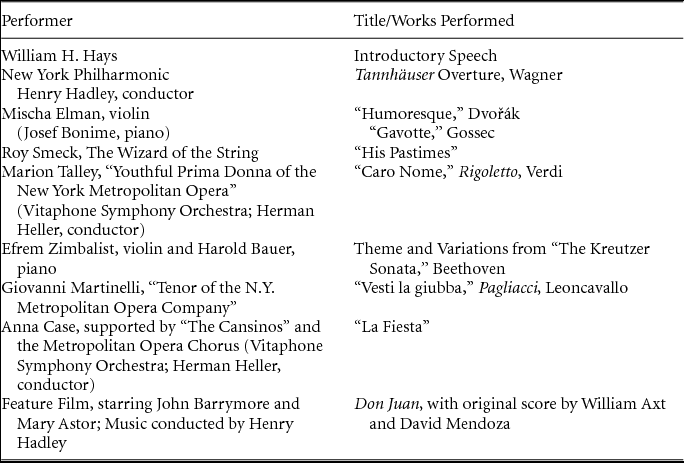
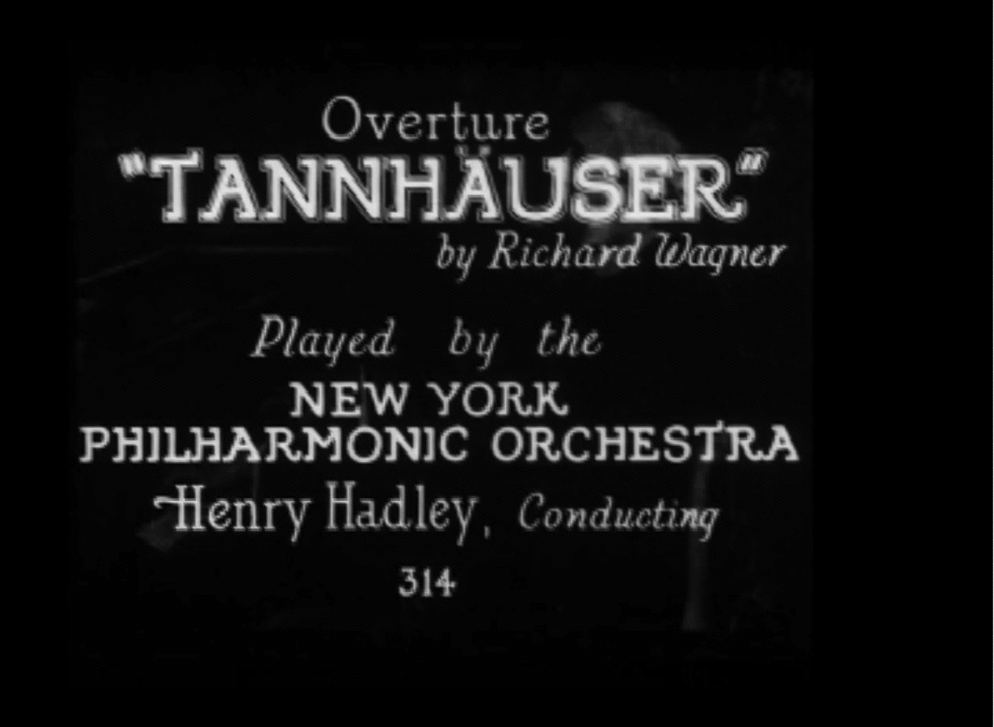
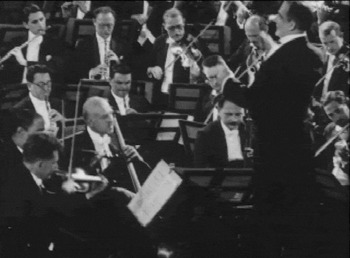
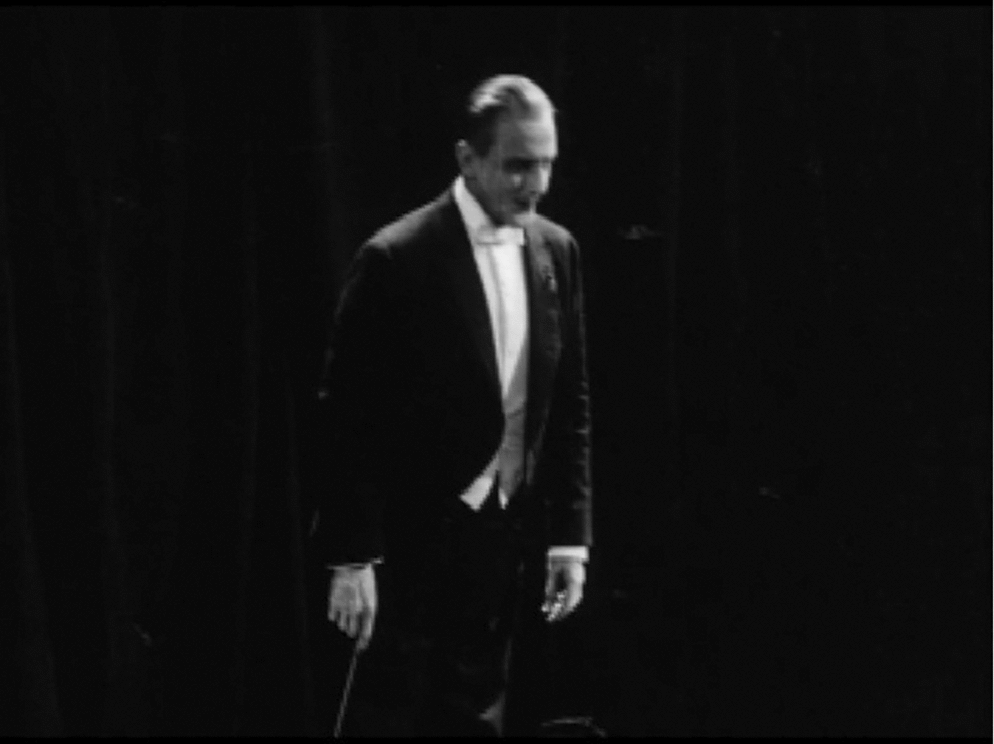
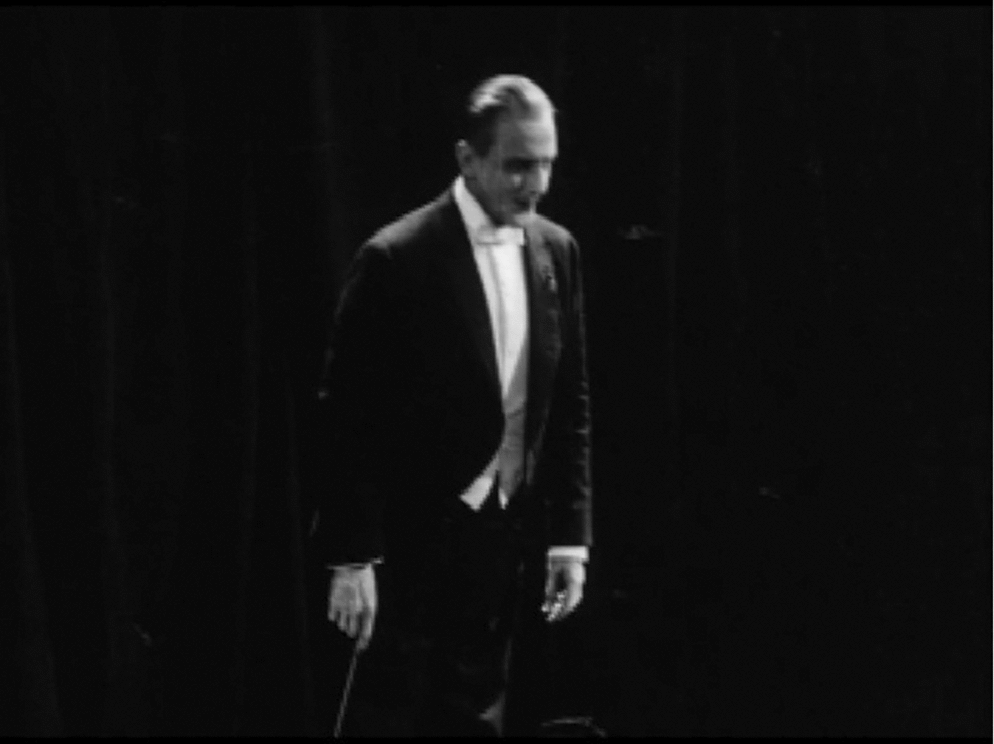
Vitaphone's public premiere on 6 August 1926 was also Hadley's film debut. The evening's entertainment began with several one-reel short films, mainly consisting of filmed performances of prominent classical musicians (see Table 1). Will Hays, President of the Motion Picture Producers & Distributors of America, introduced the program with a public address recorded on film, praising the possibilities of the new technology. There followed a short film of the New York Philharmonic playing the Tannhäuser Overture, conducted by none other than assistant conductor Henry Hadley (Figures 1–3). The film was the public's first introduction to Vitaphone's musical capabilities. Later that evening, the feature film, Don Juan (1926), a costume drama starring John Barrymore, was presented with a synchronized score, compiled by well-known silent film composers William Axt and David Mendoza, and also recorded by Hadley and the Philharmonic.Footnote 18 In his role as conductor, Hadley was an important presence in the public's introduction to Vitaphone, making him a crucial figure in presenting the technology's possibilities as well as establishing its relationship to classical music.
The First Vitaphone Program (6 August 1926)

Opening credits for Tannhäuser Overture for Vitaphone premiere, 6 August 1926. “Overture Tannhäuser,” Don Juan, DVD, dir. Alan Crosland (1926; Burbank, CA: Warner Bros. Entertainment Co., 2011).

Henry Hadley conducts the New York Philharmonic playing Tannhäuser Overture for Vitaphone premiere, 6 August 1926. “Overture Tannhäuser,” Don Juan, DVD, dir. Alan Crosland (1926; Burbank, CA: Warner Bros. Entertainment Co., 2011).

Henry Hadley bows after conducting the New York Philharmonic playing Tannhäuser Overture for Vitaphone premiere, 6 August 1926. “Overture Tannhäuser,” Don Juan, DVD, dir. Alan Crosland (1926; Burbank, CA: Warner Bros. Entertainment Co., 2011).
The classical works performed at the August 1926 event functioned not only to elevate Vitaphone's artistic (or cultural) status through its association with concert music, but also to educate audiences unfamiliar with the new sound medium. Here, Hadley's role as a conductor of classical music aided in these broader efforts. Early Vitaphone publicity and programming self-consciously drew connections between sound film and great art, attempting to negotiate sound film's position in the cultural hierarchy through its connection with certain kinds of highbrow musical forms, namely opera and symphonic music.Footnote 19 In his speech at the Vitaphone premiere, Will Hays declared: “In the presentation of these pictures, music plays an invaluable part. The motion picture too is a most potent factor in the development of a national appreciation of good music. That service will now be extended, as the Vitaphone shall carry symphony orchestrations to the town halls of the hamlets.”Footnote 20 In addition to Hays's speech and the New York Philharmonic's performance of the Tannhäuser Overture, nearly all of the short films were performances by classical musicians (see Table 1). By following Hays's address with Hadley and the New York Philharmonic, Warner Bros. clearly linked sound film technology with what Hays characterized as “good music.”
Hays's rhetoric grew out of a well-established discourse about music's ability to contribute to the cultural uplift of silent cinema, which in turn stemmed from the belief that the right music could create more educated and cultured audiences. Since the first years of cinema, its potential for uplift was frequently linked with music's role in the film-going experience. Early nickelodeons were thought to provide cheap entertainment for immigrant and working-class populations; but as the industry aimed to capture the middle class constituency it sought to “clean up” the movies, as cinema's potential for cultural uplift was seen as central to its acceptance as a medium. Rooted in both idealistic and commercial concerns, uplift became a motivating factor in a number of changes in the medium, in film spectatorship, and in the kinds of films being made, beginning in the 1910s.Footnote 21 Uplift could be accomplished through different kinds of subject matter—adaptations from novels or from the “legitimate” theater were particularly appropriate—as well as through the kind of music played in the movie theater.Footnote 22 With the increased prevalence of the multi-reel “feature film” in the teens, many theaters converted from pianos to small orchestras.Footnote 23 Some companies hired composers to write or arrange music for their more prestigious films.Footnote 24 Filmmakers and film musicians drew heavily from opera, in part because of its perceived highbrow status.Footnote 25 Indeed, a number of films were themselves adaptations of operas, featuring condensed versions of the original scores. As Rick Altman notes, such films not only added “substantially to cinema's prestige, but musical scores for opera and operetta films had the benefit of being virtually ready-made.”Footnote 26
By the 1920s, big picture palaces in urban centers devoted significant resources to maintaining full symphony orchestras, large organs, and extensive musical staffs. Exhibitors and theater managers followed in the footsteps of figures such as Samuel Lionel (“Roxy”) Rothapfel, Hugo Riesenfeld, and Erno Rapée, who each played a prominent role in increasing the prevalence of “serious” music for cinema.Footnote 27 Classical music was ubiquitous in picture palaces, used as accompaniment and featured in overtures and entr’actes. The quality of movie music, however, varied widely. Although deluxe theaters could devote significant resources to music, small theaters often had to rely on the cheaper, and much-maligned, small-town pianist. Furthermore, local theater musicians sometimes took interpretive liberties with their accompaniment, which could even result in mocking or changing the meaning of a film. From early on, these variable film music practices were, as Tim Anderson argued, “positioned as nuisances that needed to be eradicated,” and the industry sought to take interpretive control out of the hands of theater musicians.Footnote 28 This was part of the motivation for standardizing musical accompaniment through sound synchronization technology.
Despite the efforts of moviemakers and musicians, cinema remained the perennial example of “low” or “mass” entertainment throughout the early twentieth century. David Savran has shown how playwrights and critics in the 1920s seeking to legitimize a new form of literary theater as an “elite cultural practice” enforced a strict cultural hierarchy that would separate serious theater from more popular forms.Footnote 29 Critics constructed “ostensibly universal principles of culture,” setting the terms to distinguish between “legitimate art” and commercial forms, and defining themselves against the motion picture industry to establish an elite audience.Footnote 30 Although the cultural boundaries of these forms were indistinct, flexible, and always in flux, the fact that cinema continued to remake itself around the notion of uplift indicates a persistent anxiety surrounding its cultural status. Enough anxiety remained that Warner Bros. could claim to “revolutionize” cinema by offering the highest quality music to the entire country through Vitaphone.Footnote 31
Vitaphone was also part of a larger trend in public discourse surrounding new mass media beginning with the invention of the phonograph, part of what Mark Katz calls “an abiding technological utopianism in late-nineteenth- and early-twentieth-century American thought.”Footnote 32 Advocates of the phonograph frequently highlighted the technology's potential to widely disseminate classical music, thus educating a public who did not all have access to “fine” music. The phonograph became crucial in a movement to elevate American musical life in the early 1900s as a public educator and means of musical progress. The 1920s saw a proliferation of this kind of idealistic thinking in public discourse around new media: according to Steve Wurtzler, sound media were “often hyperbolically hailed as the technological fulfillment of utopian goals such as universal uplift and the fulfillment of democracy.”Footnote 33 Opera and classical music, as emblems of uplift, thus came to be used to legitimize new sound technologies.Footnote 34 Vitaphone was one in a long line of technologies whose creators attempted legitimization by highlighting its multifaceted associations with classical music. From within the complex relationship of cinema and technology—and music's role in the reception of both—Hadley provided Warner Bros. with an opportunity to resituate cinema within the cultural hierarchy as “high art.”
Hadley Composes for Film
Hadley's second involvement in sound film was in the role of composer. The score he conducted for Don Juan and the scores for most other early Vitaphone features were compiled by experienced silent film composers, and consisted of pastiches of preexisting melodies alongside some original themes. Hugo Riesenfeld, the well-known conductor of the orchestras at the Rivoli, Rialto, and Criterion theaters, compiled a score for the fourth Vitaphone feature film, Old San Francisco (1927). Vitaphone music director Herman Heller compiled the music for The Better ’Ole (1926) and The First Auto (1927), by following Axt, Mendoza, and Riesenfeld's styles as models.Footnote 35 But for the third Vitaphone feature, When a Man Loves, Warner Bros. turned to Hadley with a unique request: a commission for a specially composed original score.
During the silent era, specially composed film scores became a method for the film industry to begin to standardize and systematize musical practices. Instead of leaving the musical decisions in the hands of local musicians, who would either improvise or prepare their own accompaniment for films, directors and producers created and distributed scores to go with a specific film. Some special scores began to appear in America in the 1910s, as the film industry pushed for better film music; yet these scores were exceptions, created for films that were billed as high-end pictures. It was even rarer to have a completely original score—most special scores were arrangements of preexisting melodies with some original themes—especially one composed by an established concert composer rather than a film or theater arranger. Only a week before the release of When a Man Loves, a Film Daily reporter wrote that film music could not yet be a viable outlet of new composition for serious composers. The reviewer, however, expressed some optimism:
Do motion pictures offer a new field for composers? . . . [T]he field is too limited, at least at present, to insure [sic] a promising outlet. Is it unreasonable to suppose that some day this great industry will see special compositions by famous composers to accompany splendid screen presentations? We think not.Footnote 36
Original film scores by concert composers, at least in the United States, were practically unthinkable.Footnote 37
Hadley's commission by Warner Bros., then, was an unusual request, rooted in the same ideals as the Vitaphone's premiere performances. His embrace of Vitaphone could help establish sound film composition as a viable genre for “serious” composers to reach much larger audiences. Furthermore, his high-art associations could confer legitimacy upon the new technology, whose cultural worth or relationship to other media had not yet been established. When a Man Loves, a costume drama adapted from a literary source with a history of operatic adaptations, would have been an appropriate vehicle for music of the same cultural register; Hadley's commitment to accessibility and his stature as a musical luminary made him a logical person for the task.
Hadley himself expressed what he saw as the high-art possibilities offered by sound film composition. A Boston Herald article from 7 November 1926 reported that “Mr. Hadley is enthusiastic about the future of Vitaphone which he thinks will develop into a powerful influence for advancing interest in good music.”Footnote 38 Hadley later wrote about his first encounter with Vitaphone, noting that Herman Heller, the violinist who had introduced him to the technology, described it as “a mechanical device which would some day revolutionize the motion picture world, and which would at once raise it to the realm of serious art.”Footnote 39 Heller's comments apparently prompted Hadley's interest in sound film and encouraged his advocacy of film composition during this crucial juncture in its technological transformation.Footnote 40 He moreover emphasized the connection between When a Man Loves and art music, encouraging others to see its merits by comparing film to opera:
Much more opportunity is given the composer than in writing an opera, because in the moving picture the action changes constantly, whereas when one is given a text to set to music, he is bound to give more sustained and lengthier episodes to each singer. . . . I believe that Wagner would have found the cinema a great inspiration. . . . I have written six operas and music in every form for voices and orchestra, but I cannot remember ever composing music to any theme which gave me such delight from beginning to end as “Manon,” the most beautiful of photo-plays.Footnote 41
For Hadley, accepting the commission was likely a financial as well as artistic decision. He was paid a handsome sum for his commission: $5000, half of his annual salary as conductor for the San Francisco Symphony, and worth approximately $67,000 today.Footnote 42 Film moreover generated greater exposure to his music and did not require repeated performances, as would have been the case with one of his operas or symphonies. It is even possible that the idea for the commission originated with Hadley: through Heller, Hadley may have learned of the lucrative possibilities of film composition and suggested to his friend that Warner Bros. contract with him for an original score. Hadley was a shrewd negotiator on his own behalf (reflected in his frequent self-promotion of his own compositions), and seems to have embraced both the financial and artistic possibilities of Vitaphone.
For Warner Bros., Hadley's involvement allowed them to capitalize on his fame and prestige. Pragmatic reasons may also have prompted their request for an original score over a compiled one. A letter to Hadley dated 23 August 1926 from Abel Thomas, the secretary of the Vitaphone Corporation (controlled by Warner Bros.), articulated the company's intention for an original score:
Warner Bros. Pictures, Inc., have produced a motion picture starring John Barrymore and based upon “Manon Lescaut”, which we have undertaken to score on the Vitaphone. We desire you to compose the music and to arrange it in synchronism with the picture.
It is contemplated that most, if not all, of the music will be original. If, however, you desire to include some themes of other composers which are in the public domain and not subject to copyright restrictions, we have no objections. Our Mr. Herman Heller will cooperate with you in every respect. When the composition is finished it will be orchestrated for a full symphony orchestra and in this also we will expect to receive your assistance and cooperation, as well as when the music is recorded. . . . The copyright of the music will be ours and. . .[w]e will, of course, have the performing rights for the music throughout the world.Footnote 43
Requesting a completely original score recorded with a new technological apparatus helped elevate the film's cultural status. But it also might have been cheaper for Vitaphone to pay a one-time fee of $5000 for Hadley's score than to buy rights to preexisting music. Musical scores, which had been the responsibility of individual movie theaters, were now controlled by the production company, whereby licensing requests for distribution of the score could be expensive.Footnote 44 Sound film further complicated the process of paying for rights—music reproduced on a device was susceptible to different copyright rules than live performance, and copyright costs could be prohibitively expensive—and Thomas's comment about public domain suggests this may have been a motivating factor. At the very least, Hadley's original score drastically simplified the amount of paperwork required, and Warner Bros. was granted exclusive copyright.
Hadley's Score for When a Man Loves
In his score, Hadley attempted to mediate high art aspirations within the existing conventions of film composition. In his notes on the process, he shared his approach to writing original music to accompany preexisting images:
I went to my studio and wrote down themes for de Griex [sic], Manon, and many pages of music to express the character of the scenes I had witnessed. Afterwards I went to the projection room to meet and consult with the experts in regard to the fitting of my themes to the screen episodes and their synchronization. . . . On playing over the music, we found that the themes seemed not only appropriate for the characters for which they were concerned, but fitted the pattern quite accurately. We then got down to actual technical details, timing by the second, every phrase, by using a stopwatch and deciding the actual tempo for each section or scene.Footnote 45
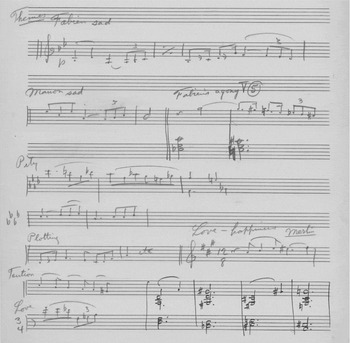
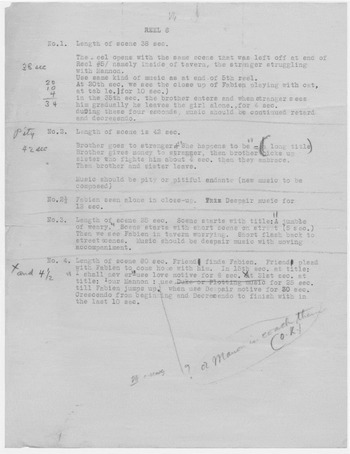
Despite Hadley's claim of unfamiliarity with film-scoring practices, he followed the structural and stylistic practices of silent film composers of the 1920s. Sketches demonstrate, for example, that he wrote original themes before limiting himself to the time constraints of the scenes, picking musical ideas that were to repeat, as well as emotions that needed amplifying. Some themes are labeled with descriptions of characters, actions, or emotions, such as “Love Theme,” “Storm Music,” “Humiliation,” “Friend's Music,” “Plotting,” “The King,” and “Fight on Ship” (see Figure 4). But in his notes on the film, used for reference while composing, Hadley broke each scene down meticulously by shot length and timing. In the same manner that silent film composers and compilers often completed their scores, he wrote and adjusted the musical cues, moods, and themes accordingly (see Figure 5).
Several original themes for When a Man Loves. Sketches, “When a Man Loves,” Henry Hadley Papers, JPB 83–2 No. 306. New York Public Library. Performing Arts Division.

Notes and timings for individual scenes for When a Man Loves. Sketches, “When a Man Loves,” Henry Hadley Papers, JPB 83–2 No. 306. New York Public Library. Performing Arts Division.

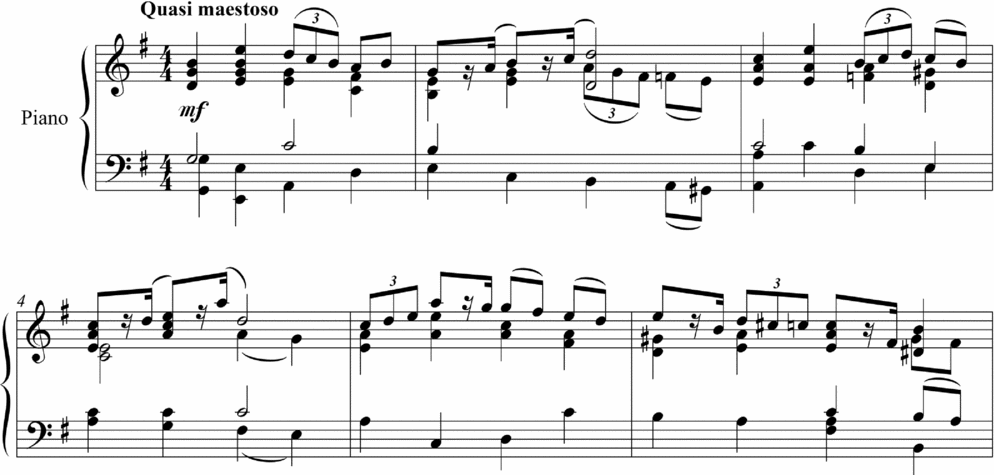
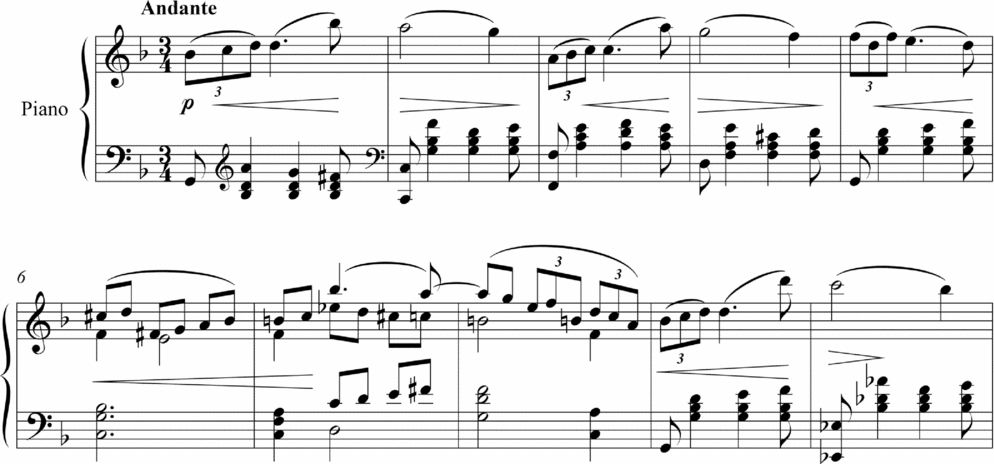
Hadley's score began with the “Manon Minuet,” to be played before the screening, and which, much like a traditional opera overture, introduced a number of the main themes that would appear later in the music.Footnote 46 The overture set the tone for an evening of high-class musical entertainment, which would continue once the film began. It also provided Hadley a chance to compose a completely extractable musical work, a tone poem that could be performed in a concert hall.Footnote 47 The film score itself is typical of Hadley's compositional approach, in its late-Romantic lyrical style and rich orchestration, though with some themes reminiscent of Baroque dances to contribute to the film's eighteenth-century setting. Stylistic unity comes from Hadley's use of recurring themes, varied in orchestration, tempo, or key to fit the dramatic character of each scene (three of the most prominent themes in the score can be found in Examples 1–3).
Henry Hadley, When a Man Loves score, Des Grieux's Theme, cue 7.

Henry Hadley, When a Man Loves score, Manon's Theme, cue 10.

Henry Hadley, When a Man Loves score, Love Theme, cue 31.

Although the film score consisted of original music, it conformed stylistically with 1920s scoring practices. It comprises 115 different cues, most of which repeat a handful of recurring themes that represent different characters or moods.Footnote 48 Alongside his original music, Hadley also incorporated a few preexisting themes into his score. For example, when Fabien des Grieux stops in a tavern during his search for Manon, the accompaniment alternates between Jacques Arcadelt's “Margot Labourez les Vignes” and the French folk song, “En passant par la Lorraine,” both of which provided a folk-like French flavor appropriate for the scene. This approach aligns his score more closely with other early Vitaphone compiled scores by Axt and Mendoza, Riesenfeld, and Heller, who also used familiar preexisting melodies to establish settings. Hadley also borrowed from the Act 3 Finale of his 1912 opera The Atonement of Pan.Footnote 49 (The only adaptation Hadley made from opera to film was to omit the opera's original chorus, assigning the vocal parts to the horns instead.) His self-borrowing not only provided a compositional shortcut, perhaps for the sake of expediency given the time constraints of the commission, but also reinforced the connection Hadley felt existed between cinema and opera, effectively putting them on the same aesthetic plane.
Although the score's musical structure and style were typical of silent films of the period, the new Vitaphone technology provided the opportunity for experimentation with the different components of the soundtrack. Sound effects were recorded simultaneously with the music. These included knocking at a door, the sounds of a sword fight, and a ship's bell; but most prominent were the storm effects, layered on top of Hadley's storm music. Such strategies were typical of those performed live in movie theaters at the time. But they were also part of Hadley's holistic approach to the soundtrack. In his orchestral copy of the score, Hadley notates “Wind Machine” numerous times, revealing his concerns about integrating sound effects with the music during the storm scenes.Footnote 50 Hadley also included vocal music performed nondiegetically, when Manon visits Fabien at the cathedral. Here, a chorus sings an a cappella hymn to the text “Ave Regina” with an original melody composed by Hadley. The effect establishes the cathedral setting. Although vocal music was not new to film per se—accompaniment for silent films did occasionally feature live singingFootnote 51—it was the first time recorded vocal music was incorporated into a Vitaphone feature film's score, and it would not occur again until The Jazz Singer (1927).Footnote 52
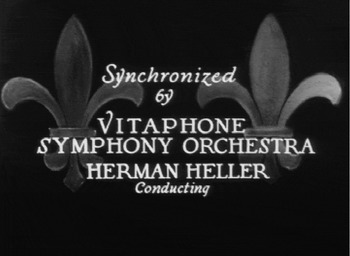
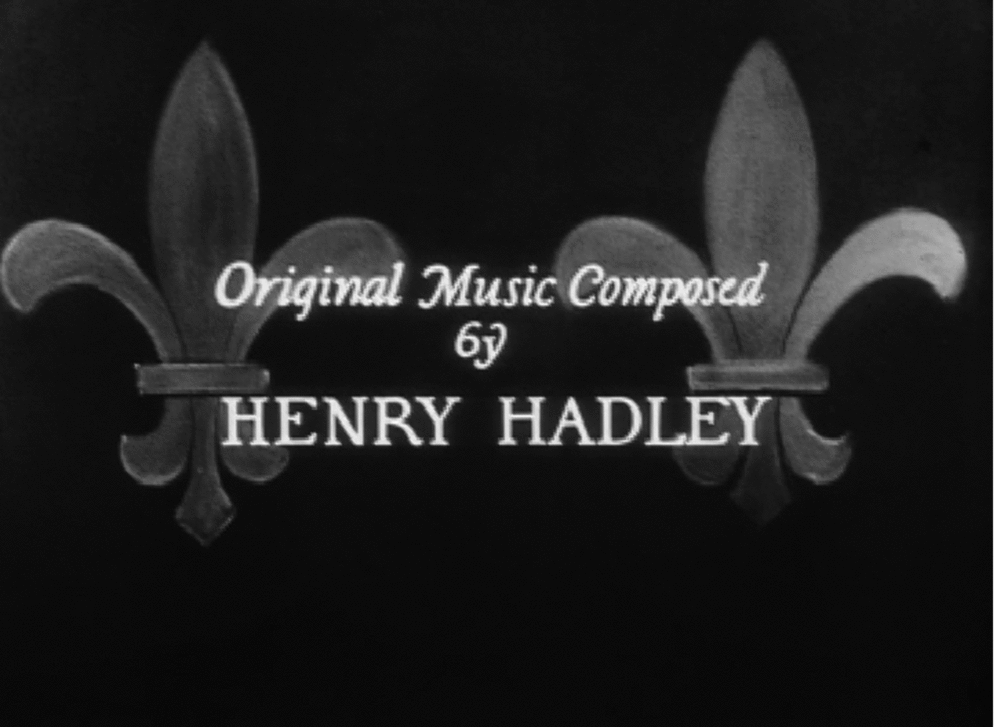
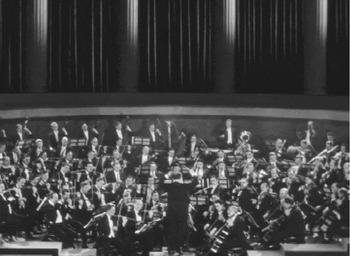
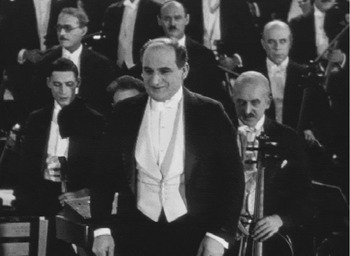
It is at the end of the film, however, where the most remarkable moment of technological reflexivity occurs. As the film comes to a close, after a title that reads “Original music composed by Henry Hadley, Synchronized by Vitaphone Symphony Orchestra, Herman Heller Conducting,” the music continues and the image cuts to a shot of the orchestra playing, with Heller conducting, as they finish playing their final note. The orchestra stops, Heller bows, and the image fades out (Figures 6–9). Mordaunt Hall of the New York Times commented on the surprise of this moment in his review from February 1927:
End credits, When a Man Loves, DVD, dir. Alan Crosland (1927; Burbank, CA: Warner Bros. Entertainment Co., 2009).

End credits, When a Man Loves, DVD, dir. Alan Crosland (1927; Burbank, CA: Warner Bros. Entertainment Co., 2009).

Vitaphone Symphony Orchestra at the end of When a Man Loves, DVD, dir. Alan Crosland (1927; Burbank, CA: Warner Bros. Entertainment Co., 2009).

Vitaphone Symphony Orchestra Conductor Herman Heller bows at the end of When a Man Loves, DVD, dir. Alan Crosland (1927; Burbank, CA: Warner Bros. Entertainment Co., 2009).

‘When a Man Loves,’ was accompanied with a Vitaphone reproduction of an orchestra. . . . This orchestra effect was so good that there were many in the audience who forgot until the last moment that there were no musicians in the pit. They were reminded of the absence of the orchestra when the body of musicians was depicted on the screen, and then the spectators were moved to applaud.Footnote 53
The visual coda emphasized Hadley's involvement, making even more explicit the connections between technology and “high art” within the film itself. This kind of reflexivity occurred frequently in the Vitaphone shorts, when performers would bow or address the audience directly,Footnote 54 but the fade-out of When a Man Loves was possibly the only such occurrence to date in a feature film. It reminded the audience one final time that not only did they see a great film, but they also heard a great musical score, a coherent symphonic work. It also served as a reminder that the high quality music was played not by live performers but by musicians displaced in time and space, played back and amplified electronically. Vitaphone's unique technological abilities were again equated with high quality musical performance.Footnote 55
Conclusion: Hadley as Experimentalist
At the time of When a Man Loves, Vitaphone playback technology was only available in a handful of theaters across the country.Footnote 56 Therefore, in many instances the film was likely distributed without Hadley's music (in which case the final scene was most likely excised). And despite the film's emphasis on Hadley's original score, When a Man Loves did not revolutionize the film industry. In fact, Hadley's efforts were all but ignored in the trade press reviews. Roy Chartier in Billboard wrote that Hadley's original score “is never impressive but serves the purpose well enough,”Footnote 57 and reviews of When a Man Loves in Film Daily, Motion Picture News, and Variety did not even mention the music.Footnote 58 The film's music, however, did receive attention and acclaim from classical music critics, provoking excitement over what many saw as a new outlet for classical music. Josephine Vila complimented Hadley's original score in The Musical Courier, writing that Warner Bros.
had the enterprise to arrange with Henry Hadley to furnish an original score for the new John Barrymore film, When a Man Loves. This score, which has the Vitaphone accompaniment of a symphony orchestra throughout the picture, is a scholarly and ambitious effort and worthy of anything that Mr. Hadley has composed in the past. The composer says that he went about his work with enthusiasm, which is apparent to one closely following the score. This score has been praised by some of the most competent critics of music in the country, and the encomiums given Mr. Hadley for his Manon Minuet must be extremely gratifying to him.Footnote 59
She also connected Hadley's involvement with Vitaphone to the company's larger goals of musical uplift: “There is no questioning the fact that in a musical way Vitaphone is one of the most tremendous things tending toward the uplift of the masses in the country at the present time. Its power in educating all the people musically is enormous.”Footnote 60 W. J. Henderson of the New York Sun proposed that Hadley's endeavor was a useful model for future composers, and praised its execution:
This department of THE SUN has on several occasions expressed the opinion that American composers would find a good field for the exercise of their talents in the moving picture. Mr. Hadley's admirable achievement ought to encourage other trials along the same line . . . Mr. Hadley has succeeded in creating new themes of excellent delineative and even emotional character entirely his own. He has even given us a new “Manon” minuet, quite as charming as those of his predecessors. His descriptive, or, as some call it, scenic, music is felicitous all the time and in style, color and movement perfectly in keeping with the action on the screen. The orchestration is uncommonly clever in its adaptation of instrumental effects to incidents.Footnote 61
The fact that Hadley was enthusiastic about technology inspired reviewers to praise the direction they thought he was taking new music. The Metronome, for instance, called him “one of the most far-sighted of musicians,” describing “a new field for his genius, in creating motion picture music.”Footnote 62 Classical music critics, rather than the film industry, responded enthusiastically to his participation with Warner Bros., hoping that other composers might follow his example.
Even if he did not substantially alter filmmaking practices or American concertgoers’ attitudes toward cinema, Hadley, as the first American “crossover” art composer to write a sound film score, consecrated sound film in the American classical music establishment. Hadley's interest in film music was part of a longer story surrounding classical music and new media, but the arrival of Vitaphone nevertheless offered an opportunity to rearticulate classical music's relationship to mass media. At a crucial juncture in cinema's development, Hadley contributed to the discourse on film's role in cultural uplift and democratization of classical music.Footnote 63 Moreover, while Hadley's musical world seems distinct from that of movie houses, these two seemingly separate musical realms were aesthetically close. Indeed, film music of the period often sounds a lot like Hadley, and Hadley's compositions, in many ways, sound a lot like film music.
Hadley's experience with film also reveals an encounter between media that opens up questions about the distinction between conservatism and newness or “freshness” in composition, as they are typically understood in the context of American musical modernism. Whereas his compositional style was by no means considered avant-garde, he was forward-looking, even experimental, in his approach to media. Operating at the intersection between tradition and innovation, between “high” culture and mass culture, between live and mediated music, Hadley's legacy complicates our typical understanding of musical innovators. In his embrace of technology, a signature of American modernism, Hadley was part of the musical cutting edge.Footnote 64 The example of Hadley's involvement with new technologies helps us reconsider the parameters through which we normally distinguish “experimental” and “conservative” musical practices, reconfiguring the definitions to include not only musical proclivities but also different contexts and modes through which they circulate.