

INTRODUCTIONFootnote 1
Set in the Aegean sea, the island of Crete witnessed the rise of the first writing traditions on European soil: a ‘Hieroglyphic’ tradition (Cretan Hieroglyphic, hereafter CH) and a ‘Linear’ tradition (comprising Linear A and Linear B, hereafter LA and LB).Footnote 2 These scripts received their names by Sir Arthur Evans upon discovery during the excavations at the palatial centre of Knossos in the beginning of the twentieth century.Footnote 3 CH was named after Egyptian Hieroglyphic for its ‘pictographic’ character somewhat recalling, in Evans's view, the shapes of hieroglyphs. By contrast, the other script – more ‘linear’ in appearance – was generally referred to as ‘linear script’, further subdivided into script of ‘Class A’ and script of ‘Class B’ to reflect a chronological separation (Evans Reference Evans1895; Reference Evans1909). Over time, these latter ‘Classes’ came to be defined, classified and referred to as ‘Linear A’ and ‘Linear B’ in the scholarship.
LB was deciphered as Greek by Michael Ventris in 1952,Footnote 4 whereas both LA and CH still remain undeciphered. CH and LA are understood to represent pristine scripts on Crete, as these are likely to be indigenous creations originated by stimulus diffusion.Footnote 5 However, an aura of mystery still surrounds these scripts: their genetic relationship, as well as the language(s) notated, are still unclear and represent a highly debated topic.Footnote 6 LA, more linear in character if compared to CH, is supposed to be either derivative from CH or a parallel system (see esp. Karnava Reference Karnava2007; Anastasiadou Reference Anastasiadou2016; Perna Reference Perna, Nakassis, Gulizio and James2014; Petrakis Reference Petrakis2014; Reference Petrakis and Steele2017; Schoep Reference Schoep, Davis and Laffineur2020). The evidence itself is quite controversial and does not help to settle the issue. With respect to chronology, the earliest attestations of CH (Middle Minoan [MM] IB seals) predate the earliest recognisable LA inscriptions (MM IIA–B). However, both scripts do show a period of overlap in their use (MM II–III), so much so that in the Knossos ‘Hieroglyphic Deposit’ and the Mallia ‘Dépôt Hiéroglyphique’ a number of documents defy a clear-cut classification as either CH or LA (‘dubitanda’; Petrakis Reference Petrakis2014). Moreover, the geographical distribution of their respective attestations is selective: CH is at home in the north and east of Crete, while LA is understood to be a north-central Cretan phenomenon, and became more widespread after CH ceased to be used (MM IA–B).
On purely graphic grounds, some signs are found in both CH and LA,Footnote 7 and further identifications may be put forward (as will be argued in the present work). However, a good number of signs are found only in one system or the other. This circumstance may raise the following question: are these ‘shared’ signs to be taken as continuations of the same sign shapes or as parallel developments? This is one of the still debated issues that this research attempts to shed light on. A graphic analysis of the respective sign repertories of CH and LA aimed at re-analysing and re-assessing the degree of shared sign shapes between the two scripts may in fact throw light on the level of graphic relatedness of one script to the other. As such, this research may have significant implications on our understanding of the genetic relations between these two scripts. The focus of this paper will therefore be on what is here called ‘imagery’: the set of visual motifs which were selected and adapted to be incorporated into the script to become ‘script-signs’. Hence, this paper explores the dynamic interplay between the dimensions of visual and iconographic imagery and script.
THE ‘IMAGERY’ FRAMEWORK
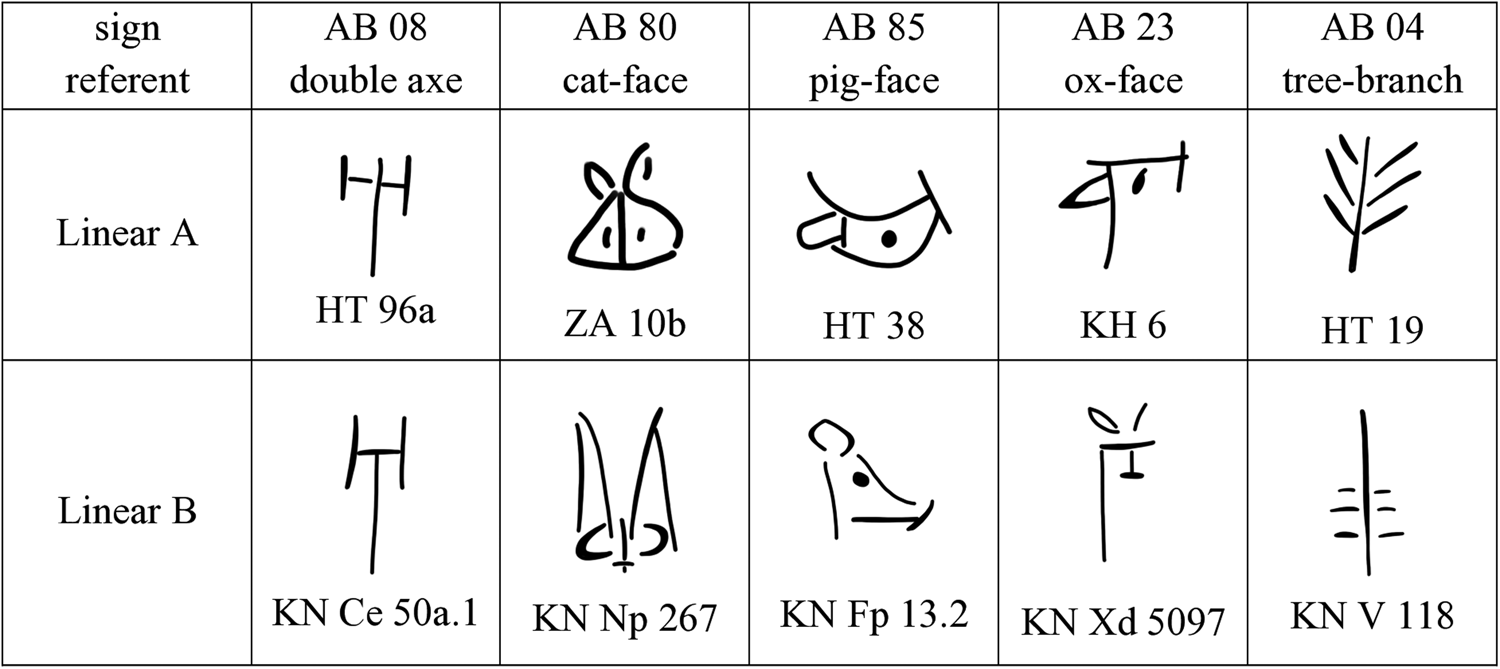
Both the Hieroglyphic and Linear scripts show a number of signs which are taken as ‘pictographic’ in character, as representing real-world referents (e.g. animals, parts of the human body, plants, vessels, tools).Footnote 8 These are more easily identifiable in the Hieroglyphic script for its characteristic iconic nature (e.g. CH 005 is an ‘eye’, CH 008-009 are ‘hands’, CH 010 is a ‘leg’, CH 025-030 are different types of tree-branches, etc.; examples in Fig. 1).Footnote 9 However, identifications can also be made in the Linear tradition, although these may not necessarily be as straightforward to the untrained eye at first glance. By way of example, AB 08/a is understood to be the stylised depiction of a double axe, AB 80/ma is the stylised representation of a cat-face (known as ‘cat-mask’ in the literature), AB 85/au the stylisation of a pig-face (as this sign is also used as the logogram for ‘pig’), AB 23/mu the stylisation of an ox-face (as this sign is also used as the logogram for ‘ox’), AB 04/te a tree-branch, etc. (examples in Fig. 2; more detailed discussion of processes of sign creation below).Footnote 10
Examples of ‘hieroglyphic’ signs representing stylisations of real-world referents.

Examples of ‘Linear’ signs representing stylisations of real-world referents.

Thanks to the decipherment of LB as an early form of Greek, we are now able to allocate phonetic values to a good many syllabic signs comprising the Linear tradition. If, on the one hand, we stand on firm grounds with respect to LB (only some 15 signs are without secure phonetic transcription, i.e. the so-called ‘undeciphered’ signs; most recently Judson Reference Judson2020), on the other hand phonetic values are only speculatively and approximately allocated to LA signs. This is done by retrospectively applying to LA homomorphic signs the phonetic values we have reconstructed for their LB counterparts.Footnote 11 When referring to signs in this paper, for ease of reference the following nomenclature will be used: prefix (e.g. A, AB, B), classification number (e.g. 01), reconstructed phonetic value if available (e.g. pu). Being aware of the issues surrounding the phonetic reconstruction methodology, the choice of adding phonetic values in addition to classification numbers to homomorphic AB signs may appear problematic to some extent. In fact, given that we still lack precise knowledge of the phonemic and phonetic repertory of the Minoan language, there is the possibility that the current approach may not be fitting. However, it is believed that the nomenclature chosen may help readers more promptly and easily identify the signs mentioned within the Linear tradition.
As a proviso, it needs stressing that this research is not strictly concerned with speculations about the phonetic values to be associated to signs (most of the time difficult to prove incontrovertibly), although some values may be speculatively suggested, context permitting. Rather, this study looks into the underlying ‘cognitive’ processes which may be thought to have been at work upon developing a script and the sources it may have drawn on. To this end, this section presents and discusses an interpretative framework to investigate the context of the visual and iconographic imagery of Bronze Age Crete.
Landscapes and mindscapes
Imagery is all around us, and visuality plays a considerable role in shaping our perception of the world. Visual motifs can be taken and elaborated from the images and objects we are exposed to in our daily life: fixing these images as iconographic representations and making them recurrent is the first step towards establishing a common visual culture. Within a theoretical framework, we could define ‘land-scapes’ as an objective reality, and by opposition ‘mind-scapes’ as their subjective counterpart, once transposed and mediated by human perception. Hence, a ‘visual landscape’ refers to the naturalistic as well as anthropic background that characterises a geographical setting (or location).Footnote 12 When the community living in (and surrounded by) such a setting subsumes elements of the external world taken as meaningful and turns them into recurrent iconographic motifs, the visual landscape takes on cultural meaning, becoming ‘cultural landscape’, inasmuch as modified by and meaningful to the culture which lives in it.Footnote 13 By representing the visual and cultural background a given community is exposed to, these landscapes present themselves as the source of the ‘visual imagery’ of the community living in that specific geographical and natural setting. This ‘imagery’ is then reflected on the artistic and material culture production (e.g. frescoes, pottery decoration, architecture).
Such landscapes and mindscapes, once identified, are therefore likely to have played a role in developing the graphic component of a writing system, i.e. the script. In fact, script too is to be understood as part of the material culture production of a given community.Footnote 14 As such it is both embedded in and informed by the (icono)graphic context and material culture production of the said community. Hence, the framework proposed here presents itself as a lens through which we can understand the process of re-interpretation of ‘landscapes’ into ‘mindscapes’ and the iconographic transfer of the motifs thus created into the sphere of material culture production.
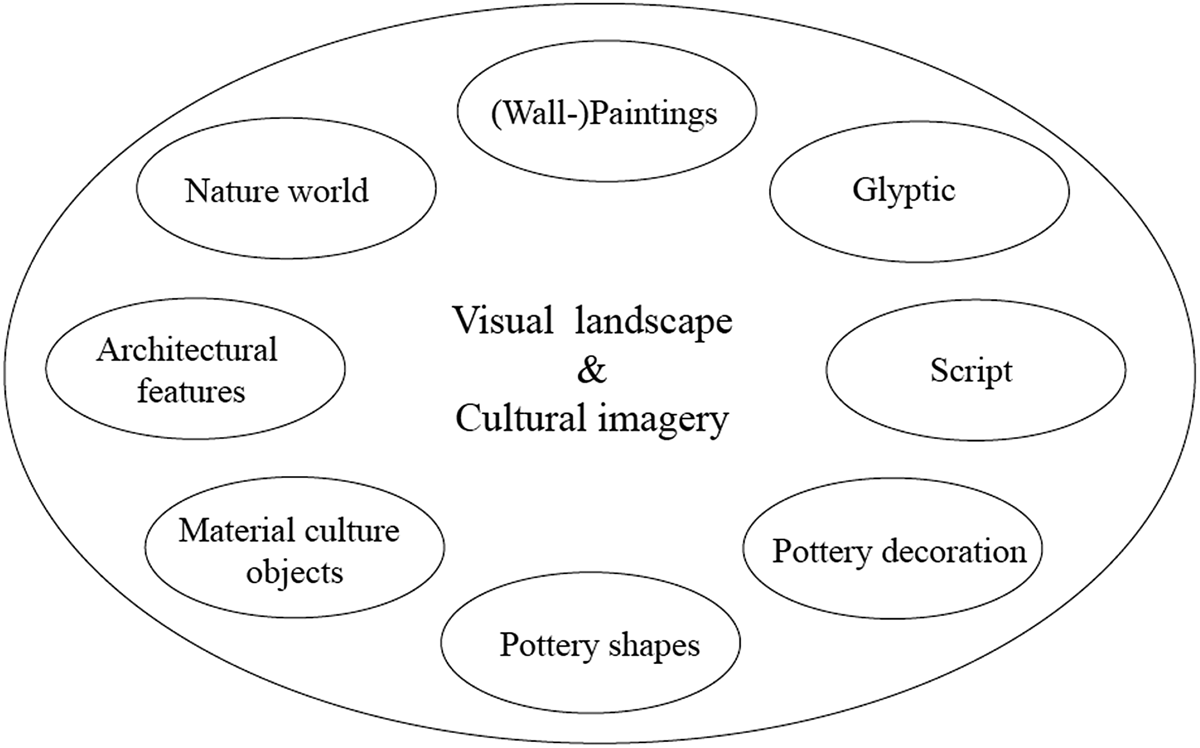
Those elements of the cultural landscape taken as meaningful and turned into recurrent motifs, which may be referred to as ‘iconographic motifs’, may be considered the ‘iconographic substratum’ most areas of the material culture production drew on.Footnote 15 As such, this substratum feeds into the ‘cultural imagery’ of a given community. Motifs can be found displayed on different media (e.g. pottery decoration, glyptic, wall-paintings, etc.) in a fluid and dynamic interchange, with different areas influencing one another (see Fig. 3). Motifs could be borrowed either directly from the iconographic substratum or indirectly via the mediation of other material production areas,Footnote 16 resulting in ‘fluidity’ of iconographic boundaries (fluidity of visual representations) and ‘transformation’ of motifs across different areas.
Visual landscape and cultural imagery model: the ‘iconographic substratum’.

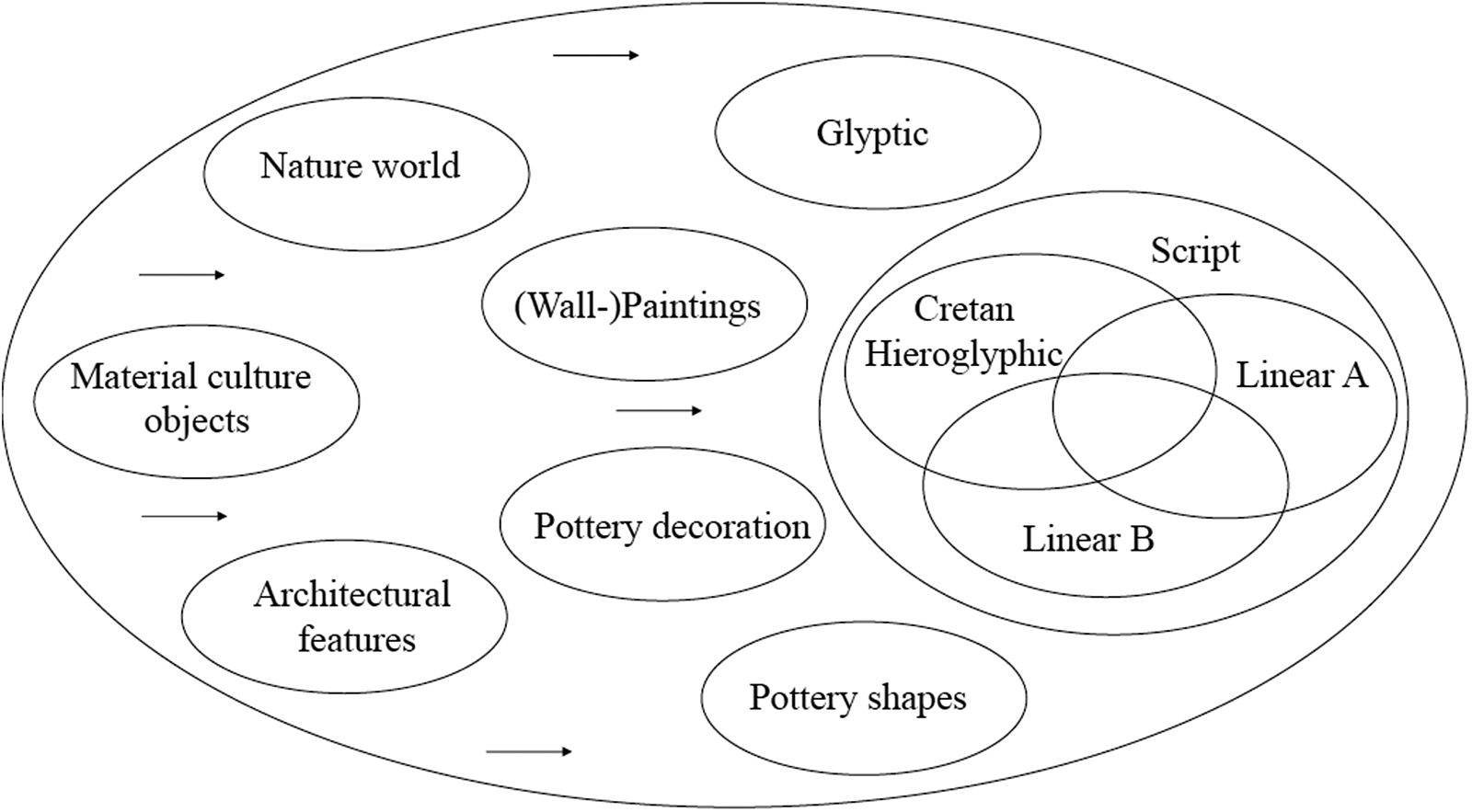
Despite the dynamic interchange of motifs across media, a trend is nevertheless observable as to the direction of motif transferral from the substratum onto other media, as exemplified in Fig. 4. It is possible to identify such direction based on the level of stylisation a given motif shows if attested on multiple media. Script(s) would appear to be located at the end of such a reconstructable chain: as will be discussed below, it would appear that script could draw directly on the substratum (first level: natural world, material culture object, architectural features) or indirectly via attestations of iconographic motifs already subsumed as such and displayed on other media (second level: glyptic, wall-paintings, pottery decoration). By way of example, let us take signs AB 27/re and AB 80/ma. The former has recently been argued to represent the stylisation of a flax plant (Nosch and Ulanowska Reference Nosch, Ulanowska, Boyes, Steele and Elvira Astoreca2021), implying that the sign originated from a referent easily and commonly found in the natural landscape which also played a major role in textile production. Hence, this is a clear example of first level motif transferral (natural world to script).Footnote 17 The latter is the cat-mask sign, which we find already codified as such in the glyptic repertory alongside a full-body cat motif (see esp. Jasink Reference Jasink2009, 31, 46, 140; Civitillo Reference Civitillo2007): this is therefore to be taken as an example of second level motif transferral (natural world to glyptic, glyptic to script).
Proximity analysis of motif transferral within the visual landscape and motif selection in the writing context.

The recurrence of the same
A good many motifs and patterns thereof are recurrent and displayed on different media and can be thought of as a common (icono)graphic repertory. The main method used to study Aegean ‘artistic production’ has so far been through ‘iconography’ (esp. Morgan Reference Morgan, Pascal and Poursat1985; Reference Morgan1988; Crowley Reference Crowley1992; Laffineur and Crowley Reference Laffineur and Crowley1992; see also Younger Reference Younger1988; Weilhartner Reference Weilhartner, Touchais, Laffineur and Rougemont2014). However, both terms – ‘art’ and ‘iconography’ – are problematic to say the least. First, the term ‘art’ is deeply connotedFootnote 18 and somewhat restrictive as well as misleading if applied to contexts that are not modern ones. Moreover, the very definition of ‘art’ and ‘artistic production’ may well have changed over time (especially over centuries and across cultures). Second, ‘iconography’ is an equally restrictive term as not all images can be straightforwardly reduced to either icons or symbols. Notwithstanding this, the iconographical method is still a useful lens through which we can analyse the representational production of the Bronze Age: ‘the icon has been proposed as the compositional imperative in Aegean representational art with important mnemonic functions’ (Malafouris Reference Malafouris, Renfrew, Boyd and Morley2015, 306, emphasis in original). However, in an attempt at taking into account the broader visual landscape and the cultural imagery that originates from it, the term ‘image’ may prove less connoted than ‘icon’ with respect to those instances that do not allow for a straightforward classification into either category.
In traditional scholarship, ‘styles’ have been identified for analysing and discussing the artistic production of the Bronze Age Aegean, and especially Minoan Crete.Footnote 19 These representational trends are found displayed in the whole material culture production of a given period (especially pottery decoration, wall painting, glyptic). Given that script is also taken as part of the material culture production of a given community, and script itself is at the same time material culture but also visual image, we may wonder whether the same trends that we see at play in the whole material culture production of a given period could also be detected on the side of script.Footnote 20 In other words, is it possible to find (icono)graphic counterparts of the most widespread motifs also in the script appearing as script-signs? If we posit an osmotic relationship between material culture production (especially the traditionally called ‘artistic production’) and script – and thus we take them just as two different manifestations of representational production – the boundary between these two categories is dismantled, encouraging the adoption of a more fluid approach to the analysis of their respective features. If this interpretation holds good, we should be able to identify script-signs that can be linked to widespread motifs in vogue at a given period. This would also allow us, albeit tentatively, to trace the (relative) chronological development and introduction of signs into a script, on supposing not all signs were created in one single timespan.
The role of glyptic: from seals to script
If we now zoom into the origin of writing in the Aegean context, and more precisely on Crete, which witnessed the emergence of CH and LA (and most likely also LB; see Salgarella Reference Salgarella2020, esp. 371–80), it has been convincingly argued that script is likely to have originated from (icono)graphic motifs displayed on seals (Yule Reference Yule1980, 229–30; Sbonias Reference Sbonias1995, 74–121; Webb and Weingarten Reference Webb, Weingarten, Cadogan, Iacovou, Kopaka and Whitley2012, 93; Flouda Reference Flouda2013, 148; Ferrara Reference Ferrara2015, 43; Civitillo Reference Civitillo2016, 166, 169–70; Ferrara and Jasink Reference Ferrara, Jasink, Jasink, Weingarten and Ferrara2017; Decorte Reference Decorte, Ferrara and Valério2018a). Glyptic, therefore, is understood to have played a major role in bearing and shaping some of the motifs that would then be incorporated into the script as script-signs.Footnote 21
The earliest expressions of what has been defined as an ‘early glyptic vocabulary’ (Decorte Reference Decorte, Ferrara and Valério2018a, 39; Reference Decorte2018b, 356) can be detected already as early as the Pre-Palatial period, with an incremental introduction of symbolic motifs over time (‘glyptic take off’; Webb and Weingarten Reference Webb, Weingarten, Cadogan, Iacovou, Kopaka and Whitley2012, 93). This resulted in the creation of a ‘shared symbolic culture’ (Sbonias Reference Sbonias and Müller2010; Civitillo Reference Civitillo2016, 166, 169–70), which formed a fertile arena for the development of a ‘visual language’ (Schoep Reference Schoep, Jasink, Weingarten and Ferrara2017), slowly giving rise to ‘literacy through iconicity’ (Ferrara and Jasink Reference Ferrara, Jasink, Jasink, Weingarten and Ferrara2017, 51). However, it has been suggested that writing ‘does not necessarily need to be the end result of an evolutionary process stemming from seal iconography’ (Ferrara Reference Ferrara2015, 43). Seal iconography may have functioned as a trigger for the creation of writing, but writing itself may be thought of as a punctual event and the two contexts (glyptic and writing) as parallel (Ferrara Reference Ferrara2015, 43). On a similar line of thinking, it has also been argued (Schoep Reference Schoep, Davis and Laffineur2020, 52) that ‘the development of writing on Crete cannot be modelled as a single invention but is better understood as a sequence of step-like inventions’ and that the inspiration for such inventions is likely to be found in the experimentation with writing we witness in Early Minoan (EM) III–MM IA sealstones (i.e. Arkhanes Script group and ‘white pieces’ stylistic group; Schoep Reference Schoep, Davis and Laffineur2020, 49).
Within this backdrop, we may well wonder: why seals? Why did seals represent the preferential medium as well as carrier of that specific set of motifs that were at some point turned into script-signs? If the reconstruction outlined above holds good, it ensues that in the Aegean context the main reason behind (as well as trigger of) the development of writing was symbolic in nature (seals iconography), and not purely economic stricto sensu (for the bookkeeping of palatial administrations). Seals can be taken as falling into the category of ‘powerful objects’ (in keeping with the definition set out by Robb Reference Robb2017), displaying some of the most meaningful and thus influential motifs and symbols of the culture which created and made use of such objects. Hence seals, as objects of both personal display and administrative significance as well as identity and status markers, may have proven the most suitable and ideologically legitimate place to look at for the creation of script-signs. By drawing on the glyptic repertory (with its more or less codified icons and symbols), script is therefore legitimised in its role, becoming itself a ‘powerful object’. In turn, its constitutive units, i.e. signs, become ‘powerful images’, inasmuch as they are associated with the cultural background of seals and sealing practices that first produced and made use of them.
Moreover, the very nature of this medium (the seal) may have contributed to the dissemination and codification of a set of recurrent images. On the one side, the small size of this medium may have made motifs easier to reproduce in their constitutive traits, especially if compared to more detailed representations appearing on other media (e.g. bigger size frescoes). On the other side, the circulation of seals may have helped to embed into the ‘visual culture’ – and therefore standardise – the set of motifs they bore. As such, seal circulation, in addition to the practice of seal use, may also have played a role in the codification of particular motifs. In this respect, it is also worth pointing out that the geographical distribution of those seals whose iconographic repertory shows most affinities and similarities with the CH signary (e.g. Mallia Steatite Group, Mallia Workshop Subgroup, Hieroglyphic Deposit Group) coincides, for the most part, although not exclusively, with the area of development of CH (i.e. eastern Crete).Footnote 22
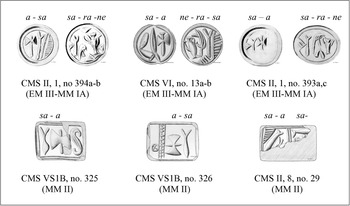
Seals, therefore, may have acted as the leading source in providing ‘powerful images’ to be turned into script-signs. As an example of image transferral from seals to script we can take the referent ‘fish’. Fish belongs in the natural world and is an important resource, especially for an island, where sea and seascapes play a major role. It comes with no surprise that the referent ‘fish’ became a motif, especially in the ‘marine style’, with wide attestations: on pottery (e.g. ‘dolphin rhyton’ from Pseira, Late Minoan [LM] IB), frescoes (e.g. ‘dolphin fresco’ at Knossos, LM I), engraved seals (two dolphins in CMS VI, no. 182, MM III, Palaiokastro, Crete).Footnote 23 We understand that at some point this referent came to be incorporated into the script as a script-sign, since its shape is recognisable as part of the ‘Arkhanes formula’ (Fig. 5,Footnote 24 second and third signs in the sequence).Footnote 25
Examples of seals showing the ‘Arkhanes formula’.

This ‘formula’ is inscribed on a number of seals (MM IA/B) discovered at the site of Arkhanes, and is speculatively read as a-sa-sa-ra-me/ne.Footnote 26 The stylised shape of the ‘fish’ (or perhaps a dolphin?) took on phonetic meaning, becoming a script-sign: this sign is continued from the ‘Arkhanes formula’ and CH (CH 019), down to LA and LB (AB 31/sa). This is the reason why the formula is usually given a phonetic reading in the scholarship. However, this method is not unproblematic, given that we currently lack an in-depth appreciation of the phonological repertory of CH and the extent to which it may be legitimate to read assumed CH-LA-LB homomorphic signs with the same phonetic values we have reconstructed for LB.Footnote 27
As a last remark in this section, over time other (icono)graphic media than seals are also likely to have played a role and have cast an influence on the successive development of sign forms within a fluid and osmotic relationship between graphic representations (as on wall-paintings and pottery decoration, just to name a couple).
Before embarking on the next section, a note needs adding in relation to chronology. In this paper, seals evidence is primarily used for comparative purposes (for the reasons mentioned above), but at times representations of referents on other media are also shown where relevant. With respect to seals, stylistic dating is used (as given in CMS), as this is the earliest chronological context we can reconstruct.Footnote 28 As to script-signs, the majority of CH documents date to MM II–III, with only one potsherd (Pomadère Reference Pomadère2009, 636) and a few seals (Yule Reference Yule1980) having been argued to go back to as early as MM IB.Footnote 29 The great majority of the extant LA administrative documents (chosen as an epigraphic dataset for this study) are loosely dated to LM I, with the earliest attestations stretching back to MM II.Footnote 30 Thus, most of the signs appearing in this paper are attested on documents belonging in either LM II–III (for CH) or LM I (for LA), if not otherwise specified. In places, LB evidence is also given in the figures for comparative purposes: the examples chosen are all from Knossos, which preserves the earliest datable evidence.Footnote 31 This chronological framework shall form the basis for our discussion of sign formation and introduction over time.
FROM IMAGE TO SIGN
Processes of sign creation
On investigating the procedures by which graphic units (signs) were allocated phonetic values, we know that in LA a process referred to as the ‘acrophonic principle’ appears to have operated. According to this principle, a sign is read with the phonetic value of the first syllable of the word the sign represents. By way of example, sign AB 30 is the stylised depiction of a tree-branch with leaves, and it functions both as syllabogram and logogram. As logogram, it stands for the commodity ‘fig’ (in both LA and LB); as syllabogram, it is read with the syllabic value /ni/, which has been demonstrated to be the acrophonic abbreviation of the Minoan word νικύλεον /nikyleon/ ‘fig’ (Neumann Reference Neumann1962). The shape of AB 30/ni is in fact reminiscent of a branch with fig-tree leaves (see Weilhartner Reference Weilhartner, Touchais, Laffineur and Rougemont2014, 299–300, pl. LXXXVa,j1; Reference Weilhartner, Weilhartner and Ruppenstein2015, 256, fig. 1), hence pointing to the commodity ‘fig’ and at the same time phonetically standing for the first syllable of the word for ‘fig’.
The acrophonic principle, however, is only applicable to iconic signs, inasmuch as representing referents in the real world which can clearly be referred to with a specific word. Lacking an accurate understanding of the vocabulary of the Minoan language, at present it is quite challenging for us to evaluate the extent to which this process was used. In addition to this process, we may also have examples of signs whose phonetic values may be understood to have originated from onomatopoeic sounds (‘onomatopoeic principle’): e.g. /ma/, /mu/, /au/. AB 80/ma depicts a cat face and its phonetic reading /ma/ is likely to imitate a cat's sound (to ‘miaow’).Footnote 32 AB 23/mu is used as logogram for ‘cow/ox’ in both LA and LB and in LB is read as /mu/, arguably imitating the mooing of such an animal. AB 85/au is the logogram for ‘pig’ in both scripts and its value /au/ may likewise be taken as onomatopoeic.
But what if a sign does not fall into either of these two categories? In such instances, one of the processes that is here argued to have been at play is what the present author proposes to call ‘analogic principle’. On this principle, signs are associated by analogy because of a shared characteristic (illustrated in what follows). This can be thought of as a complementary principle devised to increase the number of signs which do not have a straightforward phonetic connection to a referent. As such, this could be taken as a mnemonic device, as well as mnemo-technical procedure, to create and remember groups of signs in association. As will be shown in the following sections, there appears to have been a pattern in the application of either principles in order to create script-signs: if a given referent gives rise to one sign only, then the phonetic value of the sign originates by acrophonic principle (i.e. the sign is read with the first syllable of the referent-word it stands for); whereas, if a given referent gives rise to two signs, then the analogic principle operates, whereby the phonetic values of the two graphically related signs are indeed different but have something in common that allows one to put them in association.
This ‘something’ would appear to be the vocalic value. In fact, signs originating from the same graphic referent (shown in different poses/orientations) happen to share the same vocalic sound: this circumstance would suggest a vowel-driven process of creation and systematisation of signs.Footnote 33
These principles – ‘acrophonic’ and ‘analogic’ – may be just two of the procedures used to create script-signs, as other methods may also have been employed, although not identified yet. In my view, this is an avenue worth exploring further, and is being tested in this paper. In order to illustrate the above theoretical outline, in what follows some examples (illustrative as a case-study, but potentially not exhaustive) will be given of signs that can be taken as having originated by way of either acrophony or analogy. In some cases, a possible explanation of the phonetic value associated to signs by way of acrophony may be put forward, although such suggestions remain speculative for the time being, in the absence of any further probative evidence.
One referent, one sign: ‘acrophonic principle’
AB 06/na
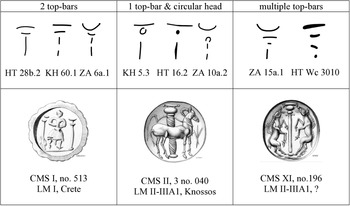
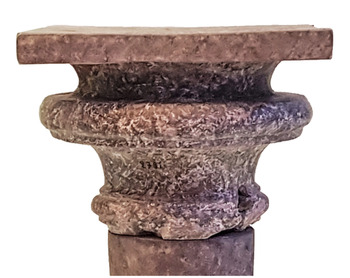
Sign AB 06 (read with the value /na/ in LB) is reminiscent of a column, with its shape looking like a stylisation of such a referent. The column is a prominent motif in palatial architecture as well as artistic representations. It may therefore be taken as part of the ‘cultural landscape’, inasmuch as it is conspicuously visible not only as a physical architectural feature (e.g. the ‘Grand Staircase’ at Knossos),Footnote 34 but also as a compositional element depicted on frescoes (e.g. the ‘Grandstand Fresco’ at Knossos showing a columnar construction with horns of consecration) and carved on seals (Figs 6 and 7; Macdonald and Zanon Reference Macdonald, Zanon, Baldacci and Caloi2018, 291, fig. 6). It has been argued that columns represent loci of epiphany, and when depicted in isolation, columns can be taken as ‘abbreviated sanctuaries’ functioning as ‘sacred markers’ (Marinatos Reference Marinatos1993, 180).
Variants of AB 06/na in LA and representations of referent ‘column’ on seals.

Serpentine capital from Zakros (LM IB).

In the wake of such an interpretation, a connection with the alphabetic Greek word ναός /naos/ ‘temple, house of a god, sanctuary’ comes to mind. No secure Indo-European etymology has been so far advanced for this word, which may be supposed to be of Pre-Greek origin (see Beekes Reference Beekes2010, s.v.). The suggestion may be put forward, although speculative for the time being, that the phonetic value /na/ associated with sign AB 06 (as reconstructed for LB) may have originated by way of acrophony from a word which may have survived as ναός /naos/ in alphabetic Greek. At this point two possibilities open up in relation to the original meaning of ναός /naos/: either (i) the word did stand for ‘shrine’ in the substratum language of Bronze Age Crete and the same meaning was carried into the Iron Age or (ii) the word originally meant ‘column’ and by way of semantic shift (metonymic process pars pro toto) it came to mean ‘shrine/temple’ by the time of alphabetic Greek (in a fashion similar to the development of Mycenaean Greek a-mo meaning ‘chariot wheel’ to alphabetic Greek ἅρμα /harma/ meaning ‘chariot’).
A final remark is worth adding with respect to the historical development of AB 06/na in its graphic shape. On purely graphic grounds, this sign shape does not seem to be present in CH.Footnote 35 As such, it is likely to be taken as a new introduction in LA, then continued into LB. In LA AB 06/na is already attested in early contexts (MM IIB–IIIB),Footnote 36 with the most representative examples occurring on LM I evidence (as in Fig. 6). For the purposes of the present discussion, it needs stressing that the lack of a Linear graphic parallel in CH (be it real or awaiting identification) does not imply concomitant absence in the CH system of the phonetic value associated to the Linear sign (in this case /na/), since another CH sign (probably not shared with the Linear tradition) may well have fulfilled that function.
Now, let us take into account that: (i) the column is an architectural feature that became pivotal and conspicuous in the context of monumental palatial architecture, thus becoming highly visible in the ‘cultural landscape’; (ii) by consequence, this element started to gain popularity on representational media (especially seals);Footnote 37 (iii) the glyptic (icono)graphic repertory with its more or less codified motifs has been demonstrated to have acted as the main source for the creation of script-signs (see below). On these grounds, it may be argued that this element got incorporated into the script as a script-sign at a moment when the ‘column’ as a motif started to take on ideological significance (although visually already there in the cultural imagery from early on).
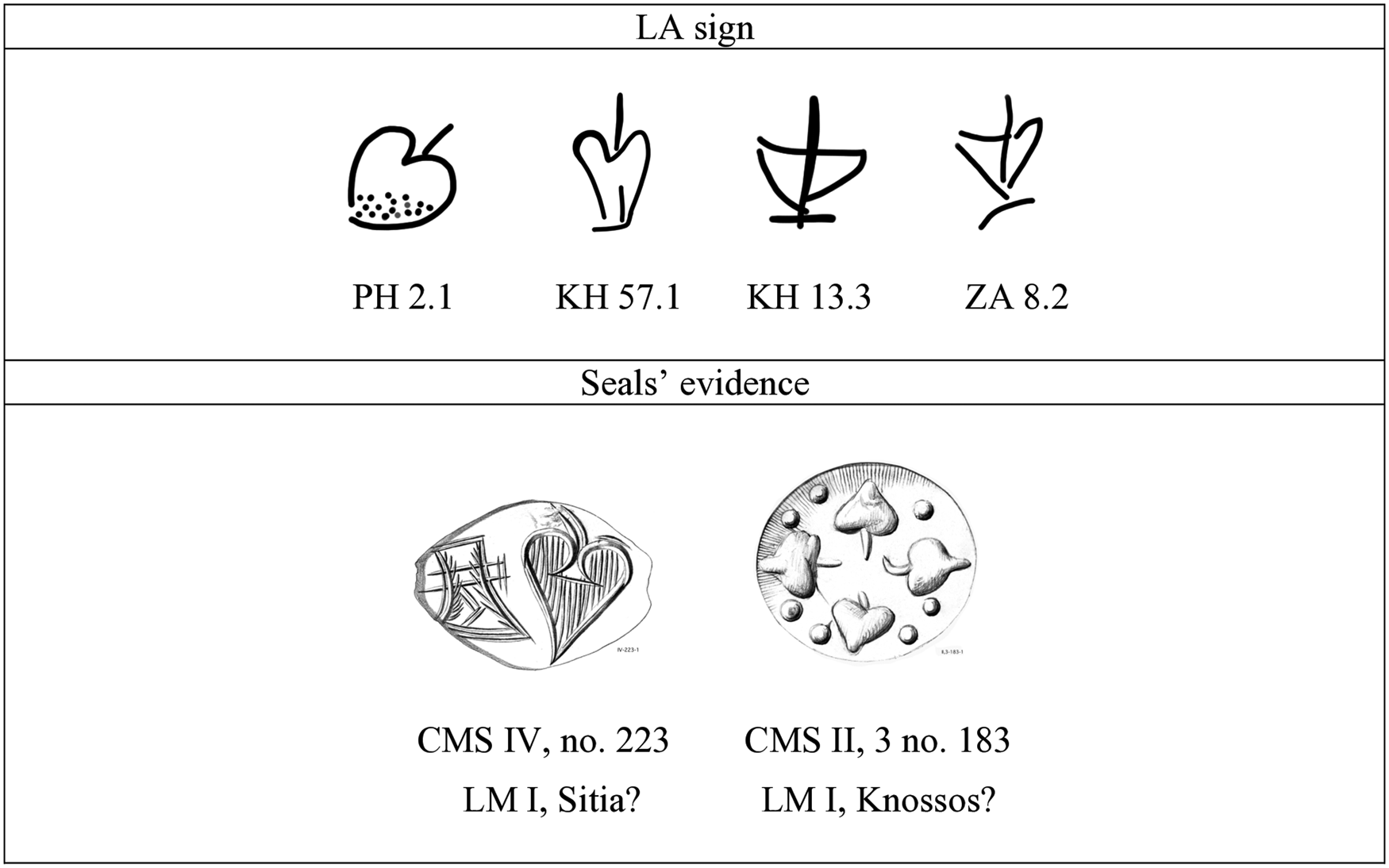
AB 69/tu
It may come with no surprise that AB 69 (read as /tu/ in LB) is most arguably the depiction of a leaf, as is easily recognisable at first glance (Fig. 8).Footnote 38 Not only does this shape occur on seals (examples above), it is also a common naturalistic motif occurring on other representational media such as frescoes and pottery decoration (especially as part of the ‘naturalistic style’). In these latter contexts, the motif is usually referred to as ‘ivy leaf’. However, it has been argued (Cerceau Reference Cerceau, Darcque and Poursat1985) that the plant in question is more likely to be Smilax aspera than ivy. In fact, Smilax aspera is more widespread and common on Crete compared to ivy, and also the shape of its leaves is more akin to the AB sign than the shape of the ivy leaf.
Variants of AB 69/tu in LA and representations of ‘ivy leaf’ motif on seals.

The interpretation of the motif as ivy leaf (or more generally, ‘foliate motif’), be it correct or not, brings to mind the alphabetic Greek word θύρσος /thyrsos/ ‘thyrsus’. This term does not have a clear-cut etymology. Although it has been argued to be connected to Luwian tuwarsa ‘vine shoot’ (Beekes Reference Beekes2010, 566; Chantraine Reference Chantraine1968, 447), such an interpretation has been rejected by a number of scholars on linguistic grounds (Weeden Reference Weeden, Mouton, Rutherford and Yakubovich2013, 77; Yakubovich Reference Yakubovich2010, 147). As a result, to date there is no reconstructable secure etymology for this word, nor has a possible connection with the Indo-European family been successfully demonstrated. According to Mycenaean Greek spelling conventions, the sound we usually see written as <υ> (Greek upsilon) in alphabetic Greek would be transcribed with a sign of the u-series in LB (e.g. see on PY Ta 722.1 po-ru-po-de, interpreted as connected to πολύπους /polypous/ ‘octopus’). Moreover, given that in LB there is no distinction between voiced, voiceless and aspirated stops, alphabetic Greek <θ> /th/ would be rendered with a sign of the t-series. As a result, the alphabetic Greek spelling <θυ> would appear as tu in Mycenaean Greek, which is compatible with the phonetic value reconstructable for AB 69 (at least as it is reconstructed for LB).
Hence, the possibility may be entertained that the phonetic value /tu/ associated with AB 69 may have originated by way of acrophony from a word related to θύρσος (if not actually this term itself). Since, at present, no secure identification of the referent as either ivy leaf or other plant can be unquestionably proved, the exact meaning of this word still defies us. Notwithstanding this, the suggestion put forward as to the origin of such a sign is worth considering for the purposes of this discussion. As a final remark, it needs stressing that, also in this case, this sign shape is not attested as part of the script in CH (although it does appear as a motif on seals, e.g. on CMS IV, no. 223), and is therefore likely to be taken as a new graphic introduction in LA, then continued into LB.
AB 59/ta
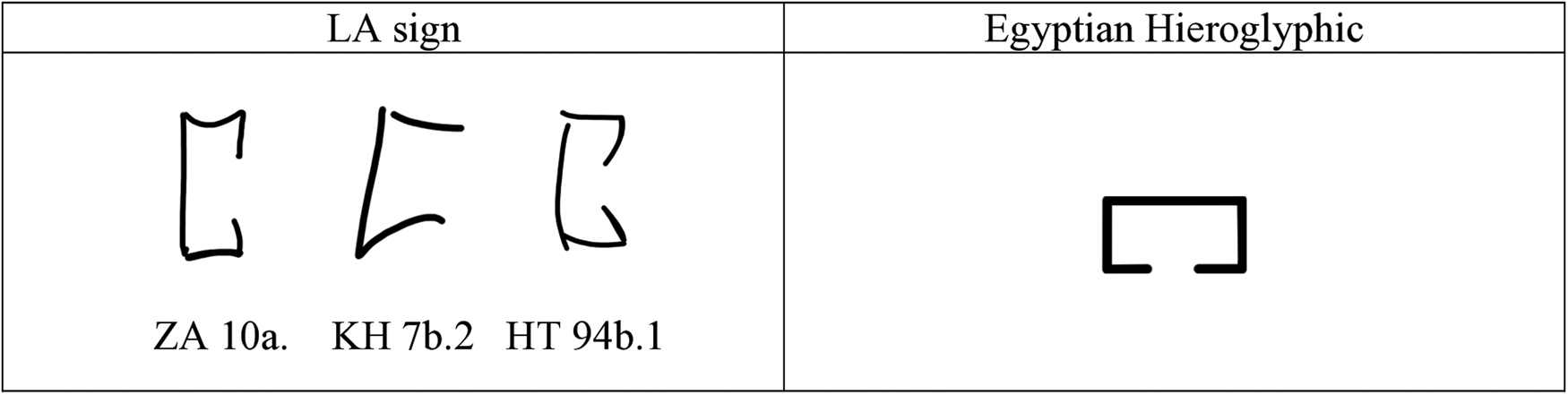
Sign AB 59 (read with the phonetic value /ta/ in LB) is continued from LA to LB, but its shape is not attested in the CH graphic repertory (nor is it on seals).Footnote 39 This sign, showing a very simple rectangular shape with an opening on the right-hand side, bears some resemblance to, and is reminiscent of, Egyptian Hieroglyphic sign pr (Gardiner's sign O1; see Fig. 9). The Egyptian Hieroglyphic sign is understood to represent a floor plan of a walled building with an open doorway, and has the meaning ‘house’. It may be tempting to draw a parallel between these two signs, in the wake of the theory that writing in the Aegean may be taken as an autonomous creation originated by stimulus diffusion from other contexts where writing already existed and had been in use, primarily Egypt and the Levant (esp. Ferrara Reference Ferrara2015; Decorte Reference Decorte, Ferrara and Valério2018a, 36–42). Given that we do have positive evidence for contacts between Egypt and the Aegean, especially Crete, in the Bronze Age (see esp. Davies and Schofield Reference Davies and Schofield1995; Betancourt Reference Betancourt, C and Shelmerdine2008), it may not be too far-fetched to suppose that the shapes of some signs may betray Egyptian influence (e.g. AB 48/nwa, AB 51/du; and especially so for CH signs).
Variants of AB 59/ta in LA and Egyptian Hieroglyphic sign O1.

Within this backdrop, the alphabetic Greek term θάλαμος /thalamos/ ‘thalamus’ comes to mind, whose etymology is to date unknown, and it has been suggested to be a loanword (Chantraine Reference Chantraine1968, s.v.). As mentioned earlier, given that alphabetic Greek <θ> /th/ would be rendered with a sign of the t-series in LB, the spelling of <θα> in LB would have resulted in ta. This is consistent with the phonetic value reconstructed for AB 59. Thus, the possibility may be entertained that the shape of the sign representing a floor plan and therefore standing for ‘house’ might have been borrowed from Egyptian with its theoretical function, but read with the lexeme of the borrower (hence, without keeping a value somewhat comparable to that of the sign of the lender). In alphabetic Greek, the term thalamus refers to an inner room or chamber, or more generally an inner part of the house, and hence the theoretical constitutive nucleus of a house (Chantraine Reference Chantraine1968, s.v.). Although not uncontrovertibly provable, this hypothesis is nevertheless worth putting forward, arguably providing another example of a sign only attested in LA and LB which could have originated by way of acrophony.
AB 81/ku
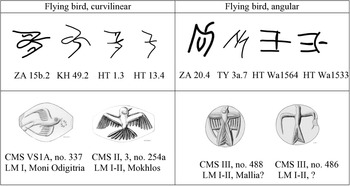
There is little doubt that sign AB 81 is the depiction of a flying bird, as can easily be inferred from its more realistic renditions (especially in LA).Footnote 40 This sign is attested in both LA and LB, read with the phonetic value /ku/ in LB.Footnote 41 This graphic shape is not attested in the CH sign repertory (although CH hapax #236 is very similar), but it does occur on seals as a motif. In LA and LB, sign AB 81 is drawn in two main variants: one more realistic and curvilinear, the other more stylised and angular (Fig. 10). Interestingly, the graphic sources (or ‘templates’) behind both variants can be found in the glyptic repertory (as exemplified in Fig. 10), likewise showing the flying bird motif both in a realistic representation and a stylised one.
Variants of AB 81/ku in LA and seals’ evidence.

The identification of the bird species depicted on seals, however, is rather challenging, even provided that the motif depicts the same referent.Footnote 42 In keeping with the examples discussed in the previous paragraphs, it is tempting to explain the phonetic value /ku/ associated with this graphic rendering of the referent as having originated by way of acrophony from a word standing for ‘bird’ in the Minoan language. In this respect, the alphabetic Greek word κύκνος /kyknos/ ‘swan’ comes to mind, which may suit the context nicely. Unfortunately, in this case the root of the Greek word has been reconstructed as Indo-European, which makes the proposed parallel untenable (Beekes Reference Beekes2010, s.v.; Chantraine Reference Chantraine1968, s.v.).
However, there may be another appealing argument that can explain the association of the phonetic value /ku/ with a sign whose graphic shape is the rendition of a bird: the value /ku/ may be taken as onomatopoeic, imitating as well as recalling the sound made by a specific category of birds, namely seagulls. The call of seagulls is, in fact, remarkably similar to such a syllable (/ku/), if one ever attempted at writing it down. This interpretation is even more compelling on considering that coastal environments are quite a common feature on Crete. As mentioned earlier in this paper, in LA we already have examples of signs whose phonetic values are understood to have been onomatopoeic (ma, mu, au). Hence, there may be reason to argue for counting the ‘onomatopoeic principle’ as one of the processes used for the creation of script-signs.
AB 26/ru
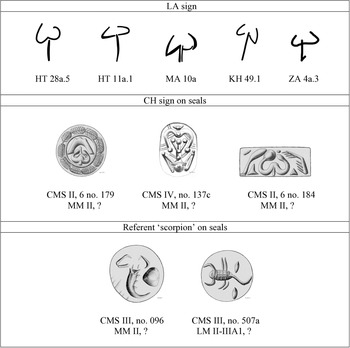
The shape of sign AB 26 (read with the phonetic value /ru/ in LB) appears to have been continued from CH 092.Footnote 43 At a closer analysis of the glyptic repertory, it can be noted that the shape of the sign, as it appears on seals, is reasonably close to the way in which the referent ‘scorpion’ is carved on the same support (Fig. 11).Footnote 44 It may not be implausible to argue for a derivation of the script-sign from such a referent, once duly stylised.Footnote 45 In fact, the main traits characterising the scorpion on seals are the two converging semicircular top arms and the straight body. These elements, that can be taken as minimal necessary requirements for the correct identification of the referent, are indeed shown in all instances, whereas the lateral arms may be omitted as a result of simplification (in CH these may still be seen in some instances, but are absent in the AB sign).Footnote 46 A very stylised shape, showing the two abovementioned constitutive traits, with just a hint at the lateral arms, is already present as such on seals (see e.g. CMS III, no. 96 in Fig. 11).
Variants of AB 26/ru in LA and seals’ evidence.

It is true that the scorpion as a motif is not very popular in ‘artistic’ representations, but it is so as a referent with an arguable ideological/symbolic connotation.Footnote 47 It has been suggested (Banou and Davis Reference Banou, Davis, Alram-Stern, Blakolmer, Deger-Jalkotzy, Laffineur and Weilhartner2016) that the symbol of the scorpion may have been of good auspice to sailors, for it represented the constellation later called Orion, whose rise in the sky marked the start of the sailing season. Bronze figurines of scorpions have been found in the peak sanctuary at Ayios Yeoryios Sto Vouno (Kythera), suggesting such an interpretation.
Moreover, from a naturalistic point of view, the scorpion is a common animal on Crete, attested in at least three different species (Tsantilis Reference Tsantilis2015, 173–5). Since the sign repertory of CH, as well as that of LA (and later on LB), does show a number of signs representing small invertebratesFootnote 48 (e.g. CH 020 = ‘bee’; CH 021 = ‘moth’?; Evans Reference Evans1909, no. 85 = ‘spider’;Footnote 49 AB 39/pi and perhaps AB 45/de look like stylised moths, especially in LA), it may not be too far-fetched to assume that the scorpion too (an arachnid), both as referent and motif, got incorporated into the script as a script-sign. Even more so on reckoning its arguable symbolic value. Also in this case, the possibility may be entertained that the Minoan word for scorpion started with the syllable /ru/, with the acrophonic principle at play. If this were the case, we may want to draw the attention to an alphabetic Greek word with unknown etymology which may be a good candidate: this is λύρα /lyra/ ‘lyre’. According to LB spelling rules, the syllable <λυ> /ly/ would have been written ru. The etymology of this term is obscure, and it has been proposed to be a loanword (Chantraine Reference Chantraine1968, s.v.). Although speculatively, we may reconstruct a process whereby the stylised shape of the scorpion overlapped with that of the musical instrument ‘lyre’ (some examples are still extant, e.g. on display at the Archaeological Museum of Heraklion) due to shape similarity (some sort of ‘iconographic merging’), resulting in the term over time coming to take on a different meaning by way of semantic shift (from scorpion to lyre).
AB 50/pu
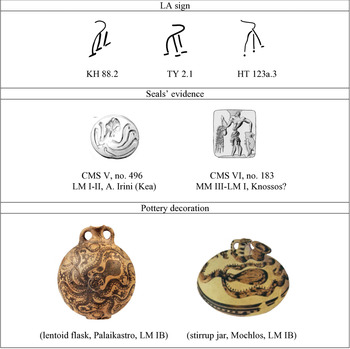
Another sign would appear to show a connection with the animal kingdom. This is AB 50 (read with the value /pu/ in LB), which shows a shape compatible with the representations of octopuses on other media (especially seals and pottery; Fig. 12).Footnote 50 This sign shape is not part of the CH sign repertory. However, also in this case, it does appear on seals, and it became a prominent motif in the Neo-Palatial ‘marine style’. Moreover, AB 50/pu makes its first appearance on LA evidence belonging in LM I (although this may be due to chances of preservation), as it is not attested in earlier contexts.Footnote 51 Given these circumstances, we may argue for this referent (as well as motif) to have entered the realm of writing as script-sign at a period later than the creation of CH, and within a context in which seascapes functioned as a prominent source of inspiration for the material culture production. This reasoning may give us a relative chronology (as an absolute one is of course unfeasible) for the creation and inclusion of script-signs in the history of development of the ‘Linear signary’.
Variants of AB 50/pu in LA and representations of referent ‘octopus’.

Moreover, in the proposed scenario, the incorporation of the referent/motif ‘octopus’ into the script follows a trajectory similar to the reconstructed development of AB 06/na discussed earlier: a newly introduced sign (without a CH graphic parallel), which drew on a motif already present on seals (or, more broadly speaking, quite prominent in the ‘visual landscape’). We may want to add a final note on the possible interpretation of the sign in linguistic terms: given that this referent gave rise to only one sign, it may be legitimate to suppose that its phonetic value originated by way of acrophony. Hence, it may not be too far-fetched to assume that the word for octopus (although not known, at least not yet) may have started with the syllable /pu/ in the Minoan language.
A 301
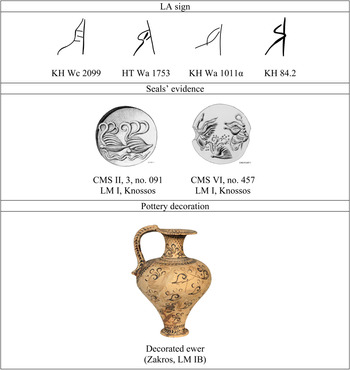
LA-only sign A 301 (unknown phonetic value) also seems to have been incorporated into the script under the influence of seascapes iconography. In fact, at a closer analysis, we can notice that the constitutive traits of this sign are compatible with those of the referent/motif ‘nautilus’, as attested both on seals and pottery (examples in Fig. 13).Footnote 52 These traits are: a straight ‘back’, a semicircular ‘body shell’ and protruding tentacle(s), resulting in an R-shape. However, appearing reasonably stylised in LA, the sign shows all these traits, and at times little horizontal strokes are also added to the body (as on KH Wc 2099, Wa 1753 in Fig. 13), arguably more closely to imitate the grooves characterising the shell of the real referent.
Variants of A 301 in LA and representations of referent ‘nautilus’.

The motif ‘nautilus’ became quite popular in the ‘marine style’, but attestations are also found in the glyptic repertory. As such, the trajectory reconstructable for this motif to become a script-sign is somewhat comparable to that delineated above for AB 50/pu. In fact, A 301 also makes its first appearance on LA evidence belonging in LM I, and is not attested in earlier contexts (although this may be due to chances of preservation). However, unlike AB 50/pu, A 301 may have a graphic parallel in CH. Two hieroglyphic signs show a comparable shape (Fig. 14): CH 087 (more stylised) and CH 046 (more pictorial).Footnote 53 If so, this motif may have already been incorporated into the script in CH, and then transmitted onto LA (unless we suppose a parallel development).
Examples of CH 046 and CH 087.

AB 24/ne
Another parallel is here put forward, involving a sign that originated from the depiction of a material culture object, namely a spouted pot: this is sign AB 24 (read with the phonetic value /ne/ in LB) (Fig. 15).Footnote 54 This sign appears to have quite a long history, given that the same shape is also attested in CH (CH 052).Footnote 55 The shape is drawn rather realistically in CH, where the constitutive elements of a pot are clearly recognisable (handle, spout, round body). In LA this sign comes in two variants: a realistic one (apparently continuing the CH shape) and a stylised version (so much so that at times, especially in the evidence from Haghia Triada, the sign is reduced to three horizontal strokes crossing the vertical stem). Of these, only the realistic variant (duly stylised) was continued in LB (Salgarella Reference Salgarella2019; Reference Salgarella2020, esp. 366).
Variants of AB 24/ne in LA and LB, and CH 052.

On considering that the sign is a realistic depiction of a spouted pot and is read with the syllabic value /ne/, could we entertain the possibility that a term starting with /ne/ was used to identify such an object in Bronze Age Crete, and thus the associated phonetic value originated by way of acrophony? In this respect, a rather appealing candidate comes to mind: this is alphabetic Greek word νέκταρ /nektar/ ‘nectar’, ‘drink of the gods’. This term does not have an ascertained etymology (Beekes Reference Beekes2010, s.v.; Chantraine Reference Chantraine1968, s.v.), and it is unclear whether νέκταρ is to be taken as of Indo-European origin, as a term belonging to the Pre-Greek substratum or even a loanword.Footnote 56 The speculative assumption that a term existed in the language of Crete starting with the syllable /ne/ (or an approximation thereof) with the general meaning of ‘perfume’, ‘unguent’ or ‘precious liquid’, or referring to the name of the container itself, is therefore rather appealing, although not unquestionably provable for the time being.
AB 61/o
Finally, the last parallel involves sign AB 61.Footnote 57 This sign is read with the phonetic value /o/ in LB, but its LA phonetic interpretation is doubtful.Footnote 58 Although this linear sign already appears considerably stylised in outline, and detecting its possible referent proves a rather challenging task,Footnote 59 there seems to be reason to argue that it may have been continued from (or have a parallel in) CH: this is CH 013.Footnote 60 This CH sign is generally known as ‘calf's head’, being interpreted as the representation of such a referent. Since it is frequently attested in CH (occurring on both administrative documents and seals), it has been argued that this sign is likely to be a much used syllable (Jasink Reference Jasink2009, 66). Hence, such a pattern of attestations of CH 013 is not incompatible with it representing a vowel (as it is in LB).
However, the most compelling argument to equate the Linear and the Hieroglyphic signs is their graphic appearance, in particular the presence in both signs of the constitutive traits of the calf's head (Fig. 16).Footnote 61 It can be noted that the traits that are always taken as essential (and as such never disregarded) are: the top ear, the eye and the muzzle/nose (these latter two may be mutually exclusive in some linear instances). Sometimes one or two additional short horns are also added (e.g. in CH: #065, #57.b, #304; in LA: PH 2.2, HT 6a.4). Moreover, the curvilinear shape of the head (showing a concavity near the ear) is well respected in the Linear sign, although more stylised.
Variants of AB 61/o in LA, and CH 013.

If such an interpretation holds good, we may have here evidence of a sign, representing a calf's head, continued from CH down to LA and LB with an increasing degree of stylisation. Moreover, the graphic interpretation of AB 61 as ‘calf's head’ could explain the many attestations of such a sign occurring in isolation (arguably performing a logographic/ideographic function) on a good number of LA roundels. As a last remark, it is worth bearing in mind that the referent ‘calf's head’ can be taken as falling into the broader category of ‘cattle’, which evidence suggests was used as a source to create signs (see e.g. AB 23/mu also functioning as logogram for ox ‘BOS’). This circumstance proves of interest in the following discussion.
One referent, two signs: ‘analogic principle’
AB 05/to and A 306/wo ?
Another two signs fall into the category ‘cattle’, as arguably representing an ox-head depicted in different orientations. The referent is easily detectable as such in CH: CH 011 represents an ox-head in frontal view,Footnote 62 whereas CH 012 represents an ox-head in profile (Fig. 17).
CH evidence: CH 011 and CH 012.

This circumstance would suggest that different spatial orientations of one and the same referent played a role in the creation of script-signs, especially if we reckon that, as argued above, glyptic evidence is likely to have been the privileged and preferential source drawn on for the creation of script-signs. Moreover, this would imply that different orientations of the same referents may have proven a productive arena to ‘multiply’ somewhat (already symbolically and cognitively) related signs.
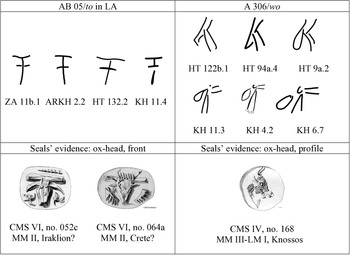
Interestingly, at a closer analysis, it can be observed that the two different orientations of the same referent clearly detectable in the CH signs are also present in LA (and LB), although more stylised (Fig. 18): these are AB 05/to (frontal view) and A 306/wo? (profile).Footnote 63 This interpretation is further borne out by evidence of individual attestations of such a referent on seals (Fig. 18). There we can see that the referent's graphic shape shows quite markedly the essential traits characterising script-signs: e.g. on CMS VI, no. 052c and no. 064a, we can see straight horizontal traits for horns and ears, matching the stylised shape of the ‘Linear’ sign AB 05/to.
Variants of AB 05/to and A 306/wo? in LA, and seals’ evidence.

If this reconstruction holds true, it may not come as a surprise that the phonetic values allocated to the linear signs fall into the vocalic o-series. As argued above with respect to AB 61/o, referents falling into the category ‘cattle’ could have been grouped (cognitively speaking as well as by analogy) under the o-series for easier memorisation of their phonetic value. In this way, it would have been easier to remember ‘clusters’ of graphically related referents/signs sharing one same common feature: in this case, the vocalic sound /o/. That this principle, here called ‘analogic principle’, may have been a reality is further confirmed by the following doublets of signs.
AB 04/te and AB 09/se
The analogic principle appears to have been at work also for the creation of a couple of signs that in LB, and arguably LA, fall into the vocalic e-series: these are AB 04/te and AB 09/se.Footnote 64 In this case, the referent in question is a ‘tree branch’ (or reed): in AB 04/te the branch is straight, whereas in AB 09/se the branch is bent (Fig. 19).Footnote 65 Also in this case, the two orientations of the same referent are present in CH as script-signs, namely CH 025 (straight branch) and CH 026 (bent branch) (Fig. 20).
Variants of AB 04/te and AB 09/se in LA, and seals' evidence.

CH evidence: CH 025 and CH 026.

If we look at seals’ evidence, the straight-branch variant is attested quite often as a motif (and it does occur as a motif also in other representational media, most remarkably frescoes and pottery decoration), while the bent branch version is less recurrent. However, the most compelling piece of evidence corroborating the hypothesis that AB 09/se does represent (and derives from) a bent tree branch are the attestations of the sign on the LA tablet PH 2 (i.e. 2.1, 2.4; the only two attestations of this sign in the LA evidence from Phaistos). There the sign is more pictorially drawn, clearly betraying its graphic origin. Hence, also in this case it would appear that different orientations of the same referent found their way into the script to become script-signs and were clustered together not only graphically, but also phonetically by being put into the same vocalic series (in this case the e-series).
As a last remark, a final observation is worth making in relation to AB 04/te, in the light of this sign graphically representing a tree-branch. In Mycenaean Greek, we have the attestation of the term te-u-ta-ra-ko-ro (on PY An 424.1), arguably reconstructable as /teuthragros/ (*τευθραγρος) ‘collector of orchils’.Footnote 66 This term is understood to be a compound, whose first element is connected to alphabetic Greek τεύθριον /teuthrion/. The precise meaning of the term τεύθριον in unclear, and it is taken as a general designation of a not clearly identified plant (Chantraine Reference Chantraine1968, s.v. ‘nom de plantes’; Beekes Reference Beekes2010, s.v. ‘tree-germander’). In fact, this term does not have an ascertained etymology and no attempt to explain the word in Indo-European terms appears convincing, a circumstance which may point to a Pre-Greek origin.Footnote 67 Hence, the possibility may be entertained that the value /te/ given to AB 04 may have originated by way of acrophony from a term starting with such a syllable, a potential candidate being τεύθριον.Footnote 68
AB 01/da and AB 60/ra
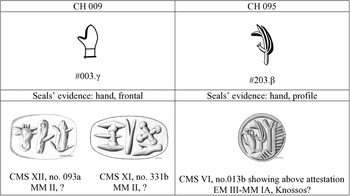
Another telling example showing the analogic principle at play involves the referent ‘hand’. Such a referent comes in two orientations, frontal view and profile, both on seals and – not surprisingly – also in the realm of script as script-signs. In CH there are two ‘hand’ signs showing said orientations: CH 009 depicts a hand in frontal view (‘glove’ variant), while CH 095 shows a hand in profile (Fig. 21). On CH seals’ evidence, we can already observe a process towards stylisation of the referent ‘hand’ in its frontal view orientation, with the thumb becoming an oblique trait and the wrist and fingers being reduced to a vertical trait (e.g. in Fig. 21: middle sign on CMS XII, no. 093a, and bottom right-hand corner sign on CMS XI, no. 331b).
CH 009 and CH 095, and seals’ evidence.

Turning now to the ‘Linear’ signary, at a closer analysis we can notice that LA also presents a similar pattern. There are two LA signs (also continued onto LB) that are likely to be taken as the stylisation of the referent ‘hand’ in the aforementioned orientations.Footnote 69 The signs under discussion are: AB 01/da, here argued to be the extreme stylisation of a hand in frontal view (reduced to this from the ‘glove’ variant), and AB 60/ra, the stylisation of a hand in profile (Fig. 22).Footnote 70
Variants of AB 01/da and AB 60/ra in LA.

The compelling clue giving as proof that the Linear sign AB 01/da does derive from the stylisation of such a referent in frontal view comes from the very attestations of this linear sign in LA: all attestations (except a very small number) show the lateral trait as oblique and not perpendicular to the vertical trait,Footnote 71 thus recalling the original inclination of the thumb. By contrast, in LB the sign always shows a perfectly orthogonal disposition of its two constitutive traits, pointing to a later stage of systematisation of the script where the original derivation of this script-sign was, as it were, forgotten (and the disposition of traits perceived as irrelevant).
As for AB 60/ra, the connection between the Linear sign and the referent ‘hand in profile’ is borne out by the occurrence of such a sign in the so-called ‘Arkhanes formula’ (attested on sealstones bearing the ‘Arkhanes Script’; see most recently Decorte Reference Decorte2018b). The formula reads a-sa-sa-ra-ne, at times clearly showing the fourth sign of the sequence (ra) as a stylised hand in profile.Footnote 72 The fact that this formula also happens to occur in a number of votive LA inscriptions (esp. Godart Reference Godart, Betancourt, Karageorghis, Laffineur and Niemeier1999; Schoep Reference Schoep2006, 45; Jasink Reference Jasink2009, 69–71; Decorte Reference Decorte2018b), although with the spelling a-sa-sa-ra-me, makes it legitimate to link such representations of the sign readable as ra in the Arkhanes formula with the LA sign occurring in the corresponding position, i.e. AB 60/ra. Although on seals the graphic resemblance is not straightforward at first glance, we can detect already some of the traits characterising the Linear sign. By way of example, let us take attestation #203.β given in Fig. 21: this shows a curved lateral thumb that can be paralleled with the (slightly more elaborate) lateral curl of AB 60/ra, and the closed-up fingers were reduced to a vertical line in the Linear sign.
AB 03/pa and B 15/mo
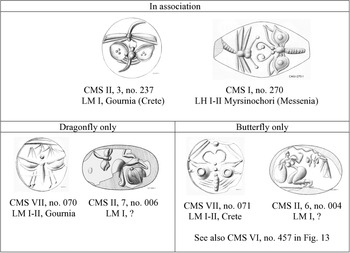
One more example is worth discussing in this context, as it shows the transferral of representational motifs attested on seals into script as script-signs. These are the ‘butterfly’ and the ‘dragonfly’ motifs, which could be grouped under the general label of ‘bug flies’. Remarkably, not only do these motifs appear on their own in the glyptic repertory,Footnote 73 but they may also occur together on the same seal (and signet-rings, e.g. the Arkhanes golden ring), suggesting that such motifs did have some kind of cognitive (and symbolic) association (Fig. 23). A case can be made for such motifs having been transposed into script as script-signs, once duly stylised. It is here argued these are linear sign AB 03/pa (dragonfly) and LB-only sign B 15/mo (butterfly) (Fig. 24).Footnote 74
Dragonfly and butterfly motifs.

Variants of AB 03/pa in LA and B 15/mo in LB.

Both signs show, as well as maintain, the constitutive traits necessary for the correct identification of the given referents in a stylised form. As to AB 03/pa, the two horizontal strokes crossing the vertical stem would represent the wings of the dragonfly (also note the idiosyncratic variant on HT 115a.4 and PH 7a.1 in Fig. 24, which would seem to show also part of the round upper body of the dragonfly). Instead, B 15/mo would be the stylisation of a butterfly in profile: the three lateral strokes (at times ‘embellished’ with further little orthogonal traits) represent a stylised wing, while the vertical trait ending with a curl outlines the body of the butterfly ending with curved antennae (as visible on seals).
Both AB 03/pa and B 15/mo appear to be new introductions in the Linear Script, as these graphic shapes are not present in the CH signary.Footnote 75 Moreover, it is noteworthy that B 15/mo is a new introduction in LB.Footnote 76 It would appear that, when the necessity arose to create new signs, it was the glyptic repertory that was looked back at as a legitimate source to draw on (as it had been before). Moreover, the process seems to have operated of selecting motifs already found in association on seals by looking for ‘couplets’ to generate new script-signs. In this way, the graphic (and arguably symbolic, as well as cognitive) association of motifs chosen to become script-signs was maintained. However, it would appear that by the time of LB only the idea of graphic associations survived (along with the fact that couplets of motifs on seals would provide a graphic source), but the ‘phonetic’ association was lost. In fact, in this case the LB sign (butterfly) belongs to the o-series, not to the a-series which AB 03/pa belongs to.
CONCLUSIONS
By examining the visual backdrop within which Cretan writing traditions blossomed, emphasis has been placed on the role played by the material world – natural as well as human-made surroundings (‘mindscapes’ and ‘cultural imagery’) – for the creation of script-signs. In particular, this paper has presented evidence showing that a good number of script-signs belonging to both the Hieroglyphic and Linear traditions of Crete are the stylisation (more or less marked) of iconographic elements and motifs – which we could call ‘artistic’, by applying Robb's (Reference Robb2017) ‘art plus disclaimer’ – recurrent in the material culture production of Bronze Age Crete. It has been demonstrated that more signs than generally assumed can be linked to a clear graphic source. Hence, such signs are unlikely to be taken as creations e nihilo. Rather, they are transpositions into script of ‘images’ or ‘motifs’ (duly stylised) already embedded and available in the contemporary visual culture.
Moreover, it has been shown that in most cases the very same ‘image’ or ‘motif’ can be found transposed as script-sign in both CH and LA (often also continued onto LB), which is indicative of a significant level of graphic similarity (as well as continuity) between these two writing systems, to a higher extent than so far envisaged. This circumstance may suggest that CH and LA be taken as derivative from one another (with LA showing higher stylisation of the same referents), and not necessarily two entirely parallel systems, at least for what we see on graphic grounds.
Two processes of sign creation (among the many conceivable and perhaps yet to be detected) are argued to have operated: the ‘acrophonic principle’ (already known in the scholarship) and what has here been defined as the ‘analogic principle’. Further to the discussion of their workings as exposed above, it is now possible to draw some conclusions by comparing the contexts in which either of the two processes was chosen for use (whether consciously or unconsciously). The two following patterns can be observed:
(i) If a sign originated by way of acrophony (for as far as we can reconstruct), this is often an AB sign, that is to say a sign newly introduced in the Linear writing tradition (without a parallel in CH). When this happens, the graphic source behind the newly introduced sign can be found in the glyptic repertory (e.g. AB 06/na ‘column’).
(ii) If signs originated by way of analogy, such signs happen to be shared between CH and the Linear scripts. In other words, AB signs are a continuation of CH ones, whose graphic sources are detectable on seals as joined motifs.
These considerations would corroborate the theory, already proposed by scholars (see above), that glyptic iconography played a major role in the process of script creation. The examples illustrated in this paper lend further support to glyptic having acted as the cradle of script-signs, with seals perceived as among the most legitimate sources to draw on in their role of ‘powerful objects’ (see above). It would appear that the basic method observed to create script-signs remained the same throughout time (for both primary creation and later introductions): primarily from seals to script. In consequence, this research supports the theory that Aegean scripts originated within a symbolic, more precisely glyptic, context, and the drive for their creation may not necessarily have been stricto sensu economic (for accounting purposes).
As final remark, we may wish to push this argument a step further for future consideration. Although the glyptic repertory is argued to have played a major role in the process of script formation, there is not necessarily a need to take this trajectory as all-encompassing. In other words, we need not have to always assume directionality of influence (seals to script). Going back to the theoretical framework outlined above and by taking a broader angle, the ‘visual’ and ‘cultural’ landscapes may have functioned themselves as the main source of inspiration for common motifs that manifested themselves on different media without necessarily presupposing directionality of influence.
The close correspondence of motifs we witness at times on different media may also have resulted from their drawing directly from a common source (the ‘visual’ and ‘cultural’ landscapes), with referents having been ‘filtered’ and ‘interpreted’ similarly in different representational contexts in a dynamic interplay. For this hypothesis to be evaluated, a further critical comparative analysis of motifs on any media (including script) is necessary in order to understand the peculiarities and influences of graphic relations within the whole realm of a ‘visual culture’, set in time and space. This approach has been tested in this paper, and it is hoped that it shall deserve further critical attention.
ACKNOWLEDGEMENTS
I am most grateful to Dr Yannis Galanakis, Dr Torsten Meissner and Prof. John Bennet for their insightful comments at earlier stages of this work. I should also like to thank the two anonymous reviewers for providing extensive and productive feedback. Last but not least, I shall extend my thanks to the editors of the Annual, Prof. Peter Liddel and Prof. John Bennet, for their support and editorial assistance.