

Introduction
Even though internally displaced persons (IDPs) are citizens of their own country, they frequently face prejudice and social exclusion. They do not have equal access to social services in many nations. Since 2014, the lack of appropriate access to social assistance has put persons fleeing violence and human rights violations in confrontation with the State in Ukraine. The country’s judicial system, being in a state of reformation and having an absence of an adequate legal framework, is obliged to assume a large share of responsibility in protecting the rights of this group of people. The issue of access to justice for IDPs remains relevant. The problem is that people cannot apply to the court for objective reasons in an armed conflict. These explanations could include the defendant’s active military operations within its borders, a lack of financial resources to cover the court costs or the absence of laws governing judicial protection.
Cardona-Fox (Reference Cardona-Fox2020) conducted a comparative study of the state of affairs in Europe concerning IDPs impacted by conflict or other unfavourable circumstances. Most European nations that have gone through internal displacement are post-socialist nations with comparable histories, developmental stages and ethnic conflicts. In response to this phenomenon, Europe developed a variety of treaties governing the legal status of IDPs. Since the Second World War, IDP registers have been maintained, which track people’s movements, their health status, mental and physical wellbeing, the economic consequences of displacement for the local population, and the country’s politics in general. Based on fundamental human rights, social security includes basic human needs like food, housing and medical care. Social support is necessary for everyone who finds themselves in adverse living circumstances at any point in their lives, not just older people, children or members of vulnerable populations. One of these situations is the forced departure from a permanent domicile for security reasons. In the event of violations of these rights, justice should act as a guarantor of their protection and should not contradict human rights in general (Gutterman 2022).
The phenomenon of citizen mobility inside Yugoslavia emerged due to the violence that ensued there following the dissolution of the Soviet Union. To address the protection of this demographic group, the European Commission, the Council of Europe, the European Court of Human Rights (ECHR) and the Organization for Security and Co-operation in Europe approved the “Guiding Principles on Internal Displacement” (United Nations Office for the Coordination of Humanitarian Affairs 2004). As a result, Europe implemented a strategy to protect IDPs. The war made an impact on the stability and security of the entire society. Motte-Baumvol, Mont’Alverne, and Braga Guimarães (Reference Motte-Baumvol, Mont’Alverne and Guimarães2022) examined the dynamics of European decisions in light of the events occurring in Ukraine. In 2001, the Council of the European Union in Ukraine adopted Council Directive 2001/55/EC,Footnote 1 which deals with “minimum standards for giving temporary protection in the event of a mass influx of displaced persons and on measures promoting a balance of efforts between Member States in receiving such persons and bearing the consequences thereof”. Following the outbreak of a full-scale invasion of Ukraine, the European Union made a decision confirming the existence of a huge exodus of people from the country and granting nationals of that country exceptional temporary protection, including social security.Footnote 2
Bulakh (Reference Bulakh2020) looked at how social protections for IDPs differ from those for refugees. In particular, it was established that refugee status is protected internationally by the Convention Relating to the Status of RefugeesFootnote 3 at the national level. In particular, the Law of Ukraine No. 1706-VIIFootnote 4 governs the status of IDPs in that country, while the “Recommendation of the Committee of Ministers of the Council of Europe (2006)6 to Member States on Internally Displaced Persons” (Ombudsman of Ukraine 2006) is merely meant to serve as a recommendation. The author concentrated on the issue of providing social guarantees to displaced persons from the State and their interaction.
Fuley (Reference Fuley2023) examined the issues of citizens’ access to justice in disputes where the defendant is a State authority and which are considered in courts of administrative jurisdiction in various instances. The conclusion drawn from analysing cases from the Supreme Court’s Cassation Administrative Court about war, veterans and IDPs is that administrative court rulings should prioritize the individual and their rights. The ruling in the case of Caesar and Others v. Ukraine by the ECHR was examined by Krakhmalova (Reference Krakhmalova2020). The ruling raises issues with citizens’ access to justice during times of war and the suspension of social payments.Footnote 5 The person found themselves in a country without access to the essential social and judicial agencies, but the court found no breach of Article 34 of the European Convention on Human Rights.Footnote 6 Because of this discrimination, it becomes necessary to examine how IDPs are faring in terms of defending their legal rights and receiving judicial protection during a military war. The study’s goal is to look into how courts use the practice of judicial protection of IDPs while they are challenging judgments made by State agencies about social issues.
Materials and Methods
For a deep and comprehensive study of the subject, studies published in international journals and collections on social security and protecting IDP rights, including in court, were reviewed. In court, the analogous method was used to compare the practice of implementing both domestic and international laws to protect the rights of individuals relocating inside the country. A comparison of IDP and refugee status is provided. Using the classification method, the characteristic features of general and special legal guarantees, features of social security, and the mechanism of judicial protection of IDPs in Ukraine are identified in cases of violation of their rights by subjects of power. Using the formal-legal method, an evaluation was conducted of the application of international humanitarian law regulations that govern the legal status of displaced people, such as the European Convention on Human Rights,Footnote 7 the “Guiding Principles on Internal Displacement” (United Nations Office for the Coordination of Humanitarian Affairs 2004), the “Recommendation of the Committee of Ministers of the Council of Europe (2006)6 to Member States on Internally Displaced Persons” (Ombudsman of Ukraine 2006), and the legal acts of Ukraine responsible for ensuring human rights, in particular IDPs, in the social sphere, such as the Constitution of Ukraine,Footnote 8 Law of Ukraine No. 1706-VIIFootnote 9 and Law of Ukraine No. 1788-XII.Footnote 10
The analysis aids in tracking the development of the legal protections for citizens forced to abandon their place of employment or permanent residence, or remain in Ukraine, as well as the dynamics of court decisions about the social protection of IDPs by internal legislative acts, such as the Code of Administrative Proceedings of Ukraine No. 2747-IV,Footnote 11 Law of Ukraine No. 1402-VIII,Footnote 12 regulating Law of Ukraine No. 389-VIII,Footnote 13 Law of Ukraine No. 3674-VIFootnote 14 and Draft Law on Amendments to Article 5 of the Law of Ukraine “On Court Fee” regarding Exemption from Payment of Court Fee for Internally Displaced Persons.Footnote 15 The primary inadequacies in the judicial process and the system of access to justice are emphasized. The study analyses the judicial practice of applying the norms of the current legislation by the Fifth, Seventh and Eighth Administrative Courts of Appeal in cases involving IDPs. The main problematic issues that force IDPs to apply to the court were identified through deduction to achieve this goal. Using the systematization method, we became acquainted with the bylaws of Ukraine that directly regulate the mechanism of access to IDP services, namely Resolution of the Cabinet of Ministers of Ukraine No. 509 (2014), Resolution of the Cabinet of Ministers of Ukraine No. 365 (2016), Resolution of the Cabinet of Ministers of Ukraine No. 505 (2014) and Resolution of the Cabinet of Ministers of Ukraine No. 637 (2014), and the main shortcomings in the system of access to social services, access to justice and the implementation of judicial proceedings are highlighted.
Results
Since the beginning of the war, special legislative acts and bylaws aimed at the social protection of IDPs have been in effect in Ukraine. However, it was identified that only a regulatory framework cannot ensure the fundamental rights of IDPs guaranteed by the Constitution of Ukraine and the norms of international law since the practice of application often does not coincide with the declared norms.
“Guiding Principles on Internal Displacement” (United Nations Office for the Coordination of Humanitarian Affairs 2004) has become a central document defining the responsibility of governments to ensure the protection of IDPs. However, not all States support this principle due to circumstances or lack of political will. This was the reason for the formation of the “Responsibility to Protect” (R2P) movement, the concept of which was the supervision of the international community over States’ compliance with their obligations to their citizens. R2P’s primary goal is to guarantee the implementation of national laws that include provisions for defending the rights of IDPs (Hammond Reference Hammond2021). The war on the territory of Ukraine caused a massive movement of people to safer places in Ukraine, which has no analogues since the Second World War. As a result, an increase in constitutional human rights and freedoms violations was recorded. The protracted conflict exacerbated the nation’s economic predicament and worsened the material and social circumstances of all citizens, especially IDPs (International Crisis Group 2022). Military actions have also escalated the issue of citizens’ external migration. International law, however, protected those who fled the nation during a period when national legislation restricted IDPs’ access to justice, medical care and social protection (Mikheieva, Sereda, and Kuzemska Reference Mikheieva, Sereda, Kuzemska, Madlovics and Magyar2023). However, similar problems arise in persons exercising rights with refugee and IDP statuses, so they need to be addressed similarly. They manifest themselves as restrictions on social and economic rights, access to social protection and justice. These problems are often political, social or economic. Internally, IDPs are citizens who have the same rights as other non-displaced citizens, but due to the imperfection of the mechanisms underlying the social protection of IDPs, they are not able to use them. The State must incorporate IDPs into all of its programmes since it was founded on the idea that every member of society should have a respectable life (Meral and Both Reference Meral and Both2021):
-
• national social programmes (which also include meeting the needs of IDPs);
-
• initiatives are created to address the needs of both citizens and IDPs (e.g. financial grants for building and upkeep, grants for social involvement);
-
• programmes aimed at meeting the specific needs of IDPs (programmes that do not apply to other citizens in society).
According to international norms, a nation’s degree of social sphere development is the primary barometer for guaranteeing that its residents’ rights and freedoms are properly implemented. Constitutional liberties and rights require sufficient safeguarding. Thanks to the administrative court system, everyone in Ukraine can file an appeal with the court against judgments that infringe upon their liberties and rights. The primary safeguard for preserving rights in court is the Constitution of Ukraine,Footnote 16 the nation’s basic law. The Code of Administrative Processes of Ukraine No. 2747-IVFootnote 17 governs the legal process in administrative courts. It states that anyone who believes State authorities have violated their rights, freedoms or legitimate interests may apply for protection with the administrative court. Administrative courts are described as a way to defend the rights, liberties, and interests of people and legal entities in public law relations in Law of Ukraine No. 1402-VIII (2016).Footnote 18 A person has the right to apply to an international judicial authority, such as the ECHR, if they are unhappy with the rulings of national courts (Fedorenko Reference Fedorenko2019). Administrative courts shall function independently of the legislative and executive arms of government, base their decisions solely on the legislation and the Code of Administrative Procedure of Ukraine, and follow the precedent set by the ECHR. Unresolved problems in the system of administrative proceedings, corruption and improper implementation of court decisions have led to the population’s dissatisfaction with the court’s conclusions.
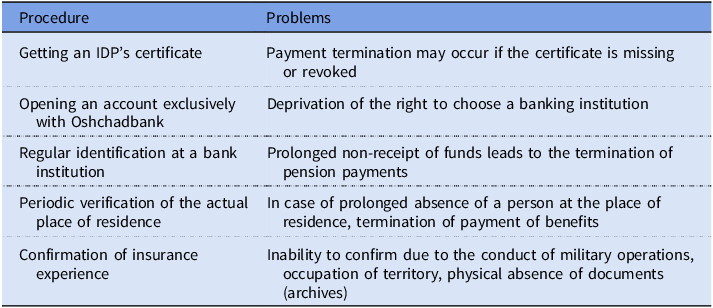
States are required by international law to ensure that a person can apply to a court – threats to the lives of judges and parties involved in a case hamper court access during martial law. The Law of Ukraine No. 389-VIII,Footnote 19 which was passed in 2015, states that courts’ authority should not be abolished under martial law. This means a person can file a statement of claim or complaint at any time. The individual’s right to unrestricted access to justice would be violated by using specific processes for filing court applications. Applying procedural laws that cannot impair the right of access to the courts and their consideration has been made clear by the ECHR’s experience. Remote and electronic justice was introduced in Ukraine during the war period to ensure continuous access of individuals to the judicial system. This can be demonstrated by emailing a statement of claim along with any supporting documentation or using a video conference to attend court. Such innovations have reduced financial costs and substantially saved time, which is an important argument for implementing them (Ostrovsky et al. Reference Ostrovsky, Turlakova, Obushenko, Skorobogatova and Borysocheva2023). A special feature of access to social and pension payments for IDPs is that to receive such payments, they must go through many bureaucratic procedures (Table 1).
The most common problems of IDPs

Source: Compiled by the authors based on Group of Influence and Donbas SOS (2018).
In the course of protecting their rights and liberties, IDPs suffer because of biased judgments made by the authorities or because of their inaction. Applying to court is the most effective way to protect one’s rights. However, access to the court is often restricted due to the need to pay a court fee in cases involving protecting the rights of IDPs. As of today, the Verkhovna Rada (Ukraine Parliament) has registered a Draft Law on Amendments to Article 5 of the Law of Ukraine “On Court Fee” regarding Exemption from Payment of Court Fee for Internally Displaced Persons.Footnote 20 Benefits contained in the current version of the Law of Ukraine No. 3674-VI (2012)Footnote 21 do not fully provide simplified access to justice. The issue of exemption of IDPs from paying the court fee has been repeatedly raised and discussed, but the proposed draft laws were not implemented.
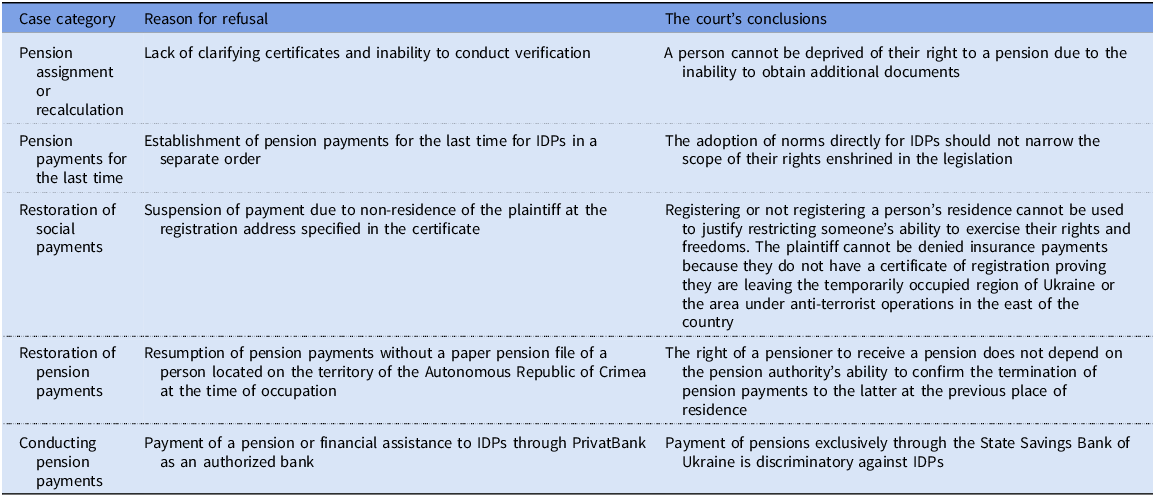
According to the United Nations Office for the Coordination of Humanitarian Affairs (2004), IDPs are full members of society and enjoy all the rights and freedoms provided for citizens. Through an examination of the Unified State Register of court rulings, it has been determined that since the Russian Federation invaded on a large scale, there have been more instances involving disagreements over social protection and IDP pensions – specifically, rulings made by courts in matters that fall under the purview of the Fifth, Seventh and Eighth Administrative Courts of Appeal (Table 2).
Categories of IDP cases

Source: Compiled by the authors based on Resolution on behalf of Ukraine of the Seventh Administrative Court of Appeal, Case No. 560/5444/22 (2022), Resolution on behalf of Ukraine of the Seventh Administrative Court of Appeal, Case No. 560/19594/21 (2022), Resolution on behalf of Ukraine of the Seventh Administrative Court of Appeal, Case No. 120/1206/19-a (2019), Resolution on behalf of Ukraine of the Fifth Administrative Court of Appeal, Case No. 420/1137/19 (2019), Resolution on behalf of Ukraine of the Fifth Administrative Court of Appeal, Case No. 420/14598/22 (2023), Resolution on behalf of Ukraine of the Seventh Administrative Court of Appeal, Case No. 600/114/23-a (2023), Resolution on behalf of Ukraine of the Eighth Administrative Court of Appeal, Case No. 380/18125/23 (2024), Resolution on behalf of Ukraine of the Eighth Administrative Court of Appeal, Case No. 297/1675/22 (2023) and Unified State Register of Court Decisions (Ukraine Government 2024).
As can be seen from these court decisions, judicial practice is aimed at supporting IDPs. Nonetheless, other conflicting court rulings cast doubt on the legitimacy of documents produced in areas that Ukraine does not control.Footnote 22 There are several criteria for ways to protect rights in the system of administrative proceedings. Objective criteria for judicial review include legal norms, judicial practice and decisions of higher courts. Thus, the discretionary powers of courts are limited to the position of higher courts, and the so-called judicial practice is created in a certain category of cases. Subjective methods should include the direct position of judges. The only things that decide how the case would proceed in such a scenario are the rule of law, the judge’s independence and their impartiality. The primary markers of upholding the rule of law in administrative proceedings are a judge’s discretionary powers and how judicial protection is selected (Gorbalinskyi Reference Gorbalinskyi2023).
Changes have been made in recent years to the Code of Administrative Proceedings of Ukraine No. 2747-IV;Footnote 23 in particular, simplified proceedings allowed for streamlining the consideration of administrative cases. In general, the legislative regulation of the administrative process corresponds to the positions of the ECHR, but there are problematic aspects in applying simplified claim proceedings (Shcherbanyuk Reference Shcherbanyuk2020). An important element in the social security system of IDPs is the appointment and payment of pensions. Since the creation of financial resources for the Fund of Ukraine depends on the economy’s state and the gross domestic product amount, the Pension Fund’s financial situation affects the nation’s general living level. All seniors in Ukraine now have a low standard of living due to the pension fund’s imbalanced budget. Finding reserves during a conflict is crucial to ensuring the pension system’s financial viability and providing for pension beneficiaries’ fundamental needs (Horbunova et al. Reference Horbunova, Kartseva, Pedchenko and Ostapenko2018).
Better legislation safeguarding the public’s social and pension rights and an enhanced administrative judicial system are urgently needed in Ukraine, which is currently under martial law. In such circumstances, society needs to determine the status of IDPs and improve the mechanisms for ensuring them. Simplifying procedural steps can guarantee that people have access to the court and that their claims are effective. The dynamics of judicial processes and the practice of the ECHR require amendments to the current legislation, taking into account international experience.
Discussion
The State and civil society must ensure that the rights of IDPs comply with international standards to determine their status. People’s movement usually occurs during adverse events that threaten life. In this context, IDPs are frequently contrasted with refugees or those in need of temporary protection. These concepts differ, but those forced to move need the same social protection.
Brück et al. (Reference Brück, Cuesta, De Hoop, Gentilini and Peterman2019) considered social protection in the context of sustainable development of countries. A developed social sphere indicates the economy’s stability as a whole. As a result, social protection enhances livelihoods, contributes to the decline of poverty and inequality, and advances national development. Every year, the international community expands the scope of influence in the social sphere by implementing new programmes and international cooperation. These measures should include all segments of the population, including IDPs. As part of the agreement adopted at the World Humanitarian Summit (2016), social protection of the population was recognized as one of the fundamental human rights and a commitment was made to strengthen local and regional social protection systems to overcome poverty and social inequality. Agreeing with the authors, a developed social sphere is the prerogative of developed democratic countries. A balanced economy, in turn, provides an opportunity to improve social standards for certain categories of citizens and the majority of the population.
According to international law, the rights and freedoms of the person play a major role in the evolution of modern society. The effective operation of the legal system guarantees the protection of these rights. Even in a martial law situation, courts still must carry out justice. The Human Rights Union, a Helsinki-based public organization in Ukraine, is responsible for implementing the US Agency for International Development’s “New Justice” programme. Correa, Muddell, and Roccatello (Reference Correa, Muddell and Roccatello2021) looked into this process. The programme aims to eliminate corruption in Ukraine by establishing a justice system based on the rule of law. Within the programme’s framework, activities were launched on the work of courts during the armed conflict. It aims to raise public awareness of trials, advocacy participation and transitional justice during conflict. One may disagree with the authors since the programme only determines the direction of State policy on access to justice. However, notably, participation in the programmes is important for civil society, as it means international recognition of Ukraine as a democratic State. In this context, the innovations that are being implemented must be not only declarative but also find their practical implementation in life.
Socher (Reference Socher2023) explored an alternative to legal empowerment through international legal cooperation that goes beyond the traditional approach to justice. The main idea behind this concept is to build citizens’ confidence by expanding their access to the justice system. These days, the rule of law and giving State structures priority in court proceedings are prevalent in practically all judicial systems. On the other hand, the new alternative strategy prioritizes human rights regarding trial participation and access to justice. The international community aims to develop new approaches to improving access and trust in the justice system, especially in conflict situations. The author focused on the international legal framework, which allows for creating a new idea based on the analysis of the examples of Palestine, Ukraine and Pakistan by the German Ministry of Foreign Affairs. Such conclusions should be disputed since access to justice can be viewed from a legislative framework and a transparent administrative system’s standpoint. Unless these elements exist, people cannot trust the court’s ruling or apply to protect their rights.
The United Nations Development Programme (UNDP) works with many countries to reduce poverty, prevent crises and address their consequences in the national development system. In UNDP (2004), the place of a fair trial in the institution of a democratic society and the direct link between democracy, social protection of citizens and access to justice were determined. Thus, it is believed that access to justice is a basic human right to prevent poverty, especially during conflict. In times of crisis, legal systems often fail to cope with society’s challenges, encountering shortcomings in legislation and legal systems, lack of legal assistance, legal illiteracy of the population, formality of judicial procedures and unavailability of justice due to a large court fee. Often, people avoid lawsuits because they consider them useless in achieving a goal. Agreeing with such initiatives, it can be added that abuse of power, corruption and the lack of responsibility of the courts lead to people’s distrust of the national judicial system. Confidence in the impartiality of their rulings is a crucial sign for a rise in the number of people seeking the court to defend their rights.
Using the example of European countries, Bridgen, Meyer, and Davison (Reference Bridgen, Meyer and Davison2023) showed how displaced persons could be disadvantaged in pension provision due to the lack of proper legislation since social insurance plays a fundamental role in the assignment of pensions. It is worth agreeing with this conclusion since the practice of insurance legislation, which serves as the basis for pension provision, is positive for every citizen. However, in conditions of instability and military operations and occupation, people are often deprived of the opportunity to obtain insurance experience for objective reasons. Many new groups of persons needing social protection arise due to war.
Robinson (Reference Robinson2021) raised the issue of making payments to former military personnel with mental illnesses. Due to armed wars in the Balkan States, veterans with mental illnesses required specialized care as well as financial recompense. However, due to the reduction in social insurance, meeting the needs of these communities has become unsatisfactory. The authors believe the lack of provisions governing these issues violates fundamental human rights. Each State must provide adequate social protection to all citizens, regardless of their social status. This is especially true for socially vulnerable people who cannot create favourable living conditions for reasons beyond their control.
De Ninno (Reference De Ninno2021) raised the issue of pension provision for civilians after the Second World War in Italy. In the researcher’s opinion, there was a practice during and after the war in which attention was paid to the injured military personnel, and quite little attention was paid to helping the affected civilian population. Social rights were not protected by legislation, and there was no political will to put it into effect; therefore, citizens went to the courts for their protection. Despite the negative practice, court decisions influenced the adoption of pension reform in Italy. It is worth agreeing with the author because, unfortunately, implementing reforms in any system often requires a push in the form of adverse events. The economic and social crisis that accompanies war makes providing adequate social protection to needy people impossible. Therefore, the task of each State is to find a reserve to ensure proper pension provision for individuals.
Turner et al. (Reference Turner, Rajnes, Hughes and Maher2020) investigated how war in different countries affected pension payments and the pension insurance system in general. In particular, the entire pension provision and financing of such payments were revised, which later had an impact on the formation of new pension mechanisms, such as non-State pension insurance and funded pensions. Agreeing with these conclusions, it should be noted that to ensure proper financing of pension payments and the appointment of pensions, it is necessary to fill the Pension Fund, which is impossible without sufficient functioning of the economy. However, during a war, production always declines, negatively affecting other areas of life.
The breakdown of the Ukrainian pension system was caused by the vast number of people eligible to receive pensions under the country’s current laws and the dearth of funding to support them. Currently, the only level of required pension provision in the nation operates. Implementing a funded system is an urgent need for the nation to undergo reform. The volume of judicial rulings regarding IDP pension provisions suggests that the pension laws need to be changed.
Conclusions
There are still many unanswered questions regarding the defence of the liberties and rights of IDPs today. This is because there is a dearth of experience in administering the law in this area, and the status of IDPs is ambiguous. The most significant is that the rules are declarative because there is no working mechanism to put them into practice. On the surface alone, legislative regulations cannot effectively address problems regarding the social security of IDPs.
The execution of programmes for displaced people’s protection, their funding, the openness of State agencies’ operations, and the access mechanisms to these services are the main factors influencing how well IDP issues are resolved. An important point is the system’s function in protecting the rights of IDPs, in particular, directly through citizens’ appeals to the judicial system. There are many problems in this context, as such individuals often do not have the opportunity to go to court for objective or subjective reasons. National and international law guarantees every citizen’s right to obtain justice. Examining administrative and organizational issues revealed the necessity of reviewing them in light of a military confrontation. It is a matter of principle within the universal human rights framework to know whose rights should be safeguarded during war.
When utilizing judicial practice, administrative courts should only act by the rule of law, be led by the laws, and, if the laws are inadequate or lacking, by the legal analogy. This is because administrative procedures have specific purposes and objectives. Effective access to the court refers to the ability to appeal against illegal actions or omissions in practice and receive real support from the court. The role of the judge in the administrative process remains important since, when making decisions, the judge embodies the principle of discretionary protection of violated rights. The social problems of IDPs are multifaceted and cannot be traced only based on judicial practice. However, the patterns of court rulings in this class of cases suggest that the matter remains open-ended and serves as a yardstick for amending already enacted laws.
Acknowledgements
The author of this study extends gratitude to the Researchers at Risk Fellowship of the British Academy, the Institute of Advanced Study of the University of Warwick and the Politics and International Studies Department of the University of Warwick for their support in undertaking this research.
Competing interests
No potential competing interests were reported by the author.
Olena Miliienko is a Visiting Associate Professor at the Department of Politics and International Studies, University of Warwick, Coventry, UK. Her research now focuses on administrative courts and procedures, protection of IDP rights and freedoms, and pension and benefits legislation.