INTRODUCTION
Beaked whales of the family Ziphiidae are among the least understood of cetaceans. They are rarely seen and difficult to identify at sea because of their pelagic distribution, deep-diving capacity, low surfacing profile and apparent low density. Some species are only known from stranded individuals and new species are still being described (Dalebout et al., Reference Dalebout, Mead, Baker, Baker and Van Helden2002, Reference Dalebout, Scott Baker, Steel, Thompson, Robertson, Chivers, Perrin, Goonatilake, Charles Anderson, Mead, Potter, Thompson, Jupiter and Yamada2014). General papers summarizing known beaked whale distribution data (MacLeod et al., Reference MacLeod, Perrin, Pitman, Barlow, Ballance, D'Amico, Gerrodette, Joyce, Mullin, Palka and Waring2006), reproductive data (Mead, Reference Mead1984) and molecular taxonomy (Dalebout et al., Reference Dalebout, Baker, Mead, Cockcroft and Yamada2004) have been published. These studies are primarily based on stranded specimens with very few live sightings. The beaked whale genus Mesoplodon (family Ziphiidae) is the most speciose in the order Cetacea with 14 species currently recognized. Skull morphology is the definitive morphological feature differentiating the skeletons of beaked whales (Dalebout et al., Reference Dalebout, Steel and Baker2008, Reference Dalebout, Scott Baker, Steel, Thompson, Robertson, Chivers, Perrin, Goonatilake, Charles Anderson, Mead, Potter, Thompson, Jupiter and Yamada2014). Despite this large gaps in our knowledge about this family still exist.
Strandings contribute greatly to our knowledge about Ziphiidae and in some cases provide all that is known about a species (e.g. Andrew's beaked whale Mesoplodon bowdoini (Baker, Reference Baker2001), the spade-toothed beaked whale M. traversii (Van Helden et al., Reference Van Helden, Baker, Dalebout, Reyes, Van Waerebeek and Baker2002; MacLeod et al., Reference MacLeod, Perrin, Pitman, Barlow, Ballance, D'Amico, Gerrodette, Joyce, Mullin, Palka and Waring2006; Thompson et al., Reference Thompson, Baker, Helden, Patel, Millar and Constantine2012)). Inferences about distribution can be made based on the location of stranded species; however, it is important to consider that ocean currents and winds may transport carcasses or incapacitated animals and so result in an inaccurate picture of distribution (MacLeod et al., Reference MacLeod, Perrin, Pitman, Barlow, Ballance, D'Amico, Gerrodette, Joyce, Mullin, Palka and Waring2006). A recent study by Pyenson (Reference Pyenson2011) has demonstrated that cetacean stranding records can accurately reflect patterns of species diversity and relative abundance in living communities, particularly for coastlines 2000–15000 km in length.
Mainland Western Australia (WA) has a coastline that extends 12889 km (excluding islands) from the cold temperate waters (15–20°C) of 35 degrees latitude in the south to the warm tropical water temperatures (25–32°C) of 14 degrees latitude in the north. Many beaked whale species have distributions that are latitudinal, and linked to ocean temperatures. The potential for strandings is great given the vastness of the coastline.
Australia has a long history of cetacean strandings which have been the subject of several reviews (Guiler, Reference Guiler1978; McManus et al., Reference McManus, Wapstra, Guiler, Munday and Obendorf1984; Baker, Reference Baker1990; Kemper & Ling, Reference Kemper and Ling1991; Bryden et al., Reference Bryden, Marsh and Shaunessy1998; Kemper et al., Reference Kemper, Flaherty, Gibbs, Hill, Long and Byard2005; Groom & Coughran, Reference Groom and Coughran2012). Beaked whale strandings have been reported for all Australian states and territories: Northern Territory, Queensland, New South Wales, Victoria, South Australia and Tasmania (Australian Government 1999–2011). Strap-toothed (Warneke, Reference Warneke1963; Dixon, Reference Dixon1980; Guiler, Reference Guiler1984; Kemper et al., Reference Kemper, Flaherty, Gibbs, Hill, Long and Byard2005), Gray's and Cuvier's are the species most commonly reported in eastern and southern Australia (Guiler, Reference Guiler1978; McManus et al., Reference McManus, Wapstra, Guiler, Munday and Obendorf1984; Augee et al., Reference Augee, Nicol, Croome and Augee1988; Australian Government 1999–2011; Chatto & Warneke, Reference Chatto and Warneke2000; Kemper et al., Reference Kemper, Flaherty, Gibbs, Hill, Long and Byard2005). Other species such as True's and Shepherd's beaked whales have only been reported infrequently in Australia (Dixon et al., Reference Dixon, Frigo and Moyle1994) and globally (MacLeod et al., Reference MacLeod, Perrin, Pitman, Barlow, Ballance, D'Amico, Gerrodette, Joyce, Mullin, Palka and Waring2006).
This paper summarizes strandings of beaked whales that have occurred along the WA coast from the first specimen records in the Western Australian Museum, Perth (WAM) in 1940, to 2010.
MATERIALS AND METHODS
Records of Ziphiidae were extracted from the WA Cetacean Stranding Database. Reports of stranded, entangled or otherwise injured cetaceans along the WA coast are routinely made to the Department of Parks and Wildlife (DPaW). These reports are investigated and records with sufficient detail and certainty of species identification are entered into the database. The certainty of records are ranked 1–4 with 1 the highest level of certainty where a species identification was confirmed by analysis of genetics or skull morphology. A score of 2 or 3 indicates, photographs and/or expert opinion and a score of 4 an uncorroborated report by a member of the public or a DPaW officer in attendance at the stranding and no photographs available. The DPaW is the custodian of this database and data quality control has been maintained by single officer (D.K.C.) since it was created in 1982. The database contains 844 records of cetaceans up to 2010 of which 47 are of Ziphiidae.
For an event to be included in the WA Cetacean Stranding Database it must have required some involvement by the DPaW (e.g. rescue attempt and carcass disposal) and so does not contain incidental sighting records from beaches or oceans or reports made by the community without validation by the database custodian (D.K.C.). Beaked whales are notorious for being difficult to identify to species. Only records with certainty of species identification through genetic testing, dental characteristics, morphology, expert opinion or a combination of these have been included in analyses.
To obtain a more comprehensive dataset, specimen records in the WAM were also included in analyses. Where multiple specimens were collected from a mass stranding event, these were considered a single record for the purposes of this study. Also, duplicate records, that is, records in the WA Cetacean Stranding Database and with a specimen in the WAM, were identified and amalgamated. As at 2010 the WAM housed 44 specimens of Ziphiidae which represents 27 additional records for this study. The combined dataset for this study comprised 74 records of Ziphiidae (Appendix).
Mass stranding events were defined as single events involving two or more individuals, with the exception of mother and calf pairs that were considered a single event. It was difficult to decide if an event was a mass stranding or separate unrelated individual strandings if there was significant spatial (e.g. 20 km) and/or temporal spread, i.e. multiple days, between individuals stranding. Examples of such incidents in Australia have occurred for Gray's beaked whale in 1989 and 1991, and for the purpose of this study, they have been considered two mass strandings (see Appendix for more details on these events).
RESULTS
Species diversity
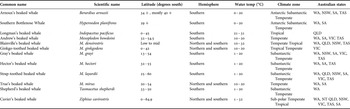
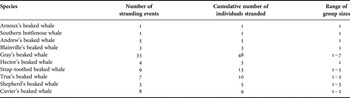
A total of 10 species of Ziphiidae were recorded along the coast of WA (Table 1). The majority of Ziphiidae records for WA have been documented in the last 20 years; this is likely to be a reflection of increased human habitation over time as well as improved community awareness, communication and reporting avenues. However, species rarely recorded continue to be reported infrequently while more common species (e.g. Gray's beaked whale) are reported stranded most frequently (Table 2).
General distribution characteristics of Ziphiidae have been recorded in Western Australia. Data sourced from: Flower, Reference Flower1882; Longman, Reference Longman1926; Warneke, Reference Warneke1963; McCann & Talbot, Reference McCann and Talbot1964; Guiler, Reference Guiler1967, Reference Guiler1978, Reference Guiler1984; Dixon, Reference Dixon1980; Tidemann, Reference Tidemann1980; McManus et al., Reference McManus, Wapstra, Guiler, Munday and Obendorf1984; Augee et al., Reference Augee, Nicol, Croome and Augee1988; Mead, Reference Mead, Ridgway and Harrison1989; Kemper & Ling, Reference Kemper and Ling1991; Dixon et al., Reference Dixon, Frigo and Moyle1994; Bannister et al., Reference Bannister, Kemper and Warneke1996; Australian Government 1999–2011; Chatto & Warneke, Reference Chatto and Warneke2000; Kemper et al., Reference Kemper, Flaherty, Gibbs, Hill, Long and Byard2005; Palazzo, Reference Palazzo2005; MacLeod et al., Reference MacLeod, Perrin, Pitman, Barlow, Ballance, D'Amico, Gerrodette, Joyce, Mullin, Palka and Waring2006.

Temp., temperature; WA, Western Australia; NSW, New South Wales; SA, South Australia; TAS, Tasmania; QLD, Queensland; VIC, Victoria; NT, Northern Territory.
Summary of Ziphiidae stranding events for Western Australia.

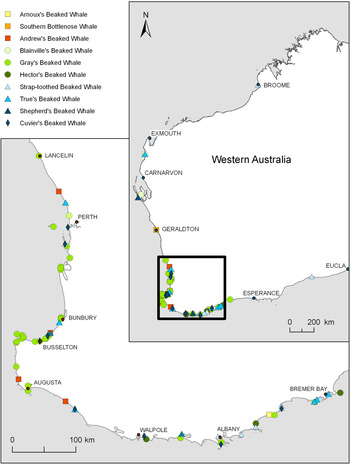
The records presented in this paper are the first records of Arnoux's, strap-toothed, Blainville's and True's beaked whales (MacLeod et al., Reference MacLeod, Perrin, Pitman, Barlow, Ballance, D'Amico, Gerrodette, Joyce, Mullin, Palka and Waring2006) in WA (Figure 1). Additional details are contained in the following species summaries and in the Appendix.
Distribution of records of stranded Ziphiidae from Western Australia.

Species summaries
ARNOUX'S BEAKED WHALE BERARDIUS ARNUXII (DUVERNOY, 1851)
Arnoux's beaked whale is known only from a few stranding events in Tasmania and South Australia (Guiler, Reference Guiler1978; Kemper et al., Reference Kemper, Flaherty, Gibbs, Hill, Long and Byard2005) and predominantly in New Zealand (Baker, Reference Baker1990; Bannister et al., Reference Bannister, Kemper and Warneke1996). A single record of an Arnoux's beaked whale has been documented from Cape Riche on the south coast of WA (Appendix; record 1). The skull and mandibles (with two teeth in place) of this specimen are lodged with the WAM (WAM specimen number M29335). The northern limit of this species is not well known throughout its southern hemisphere range but it is generally known from latitudes south of approximately 40 degrees (MacLeod et al., Reference MacLeod, Perrin, Pitman, Barlow, Ballance, D'Amico, Gerrodette, Joyce, Mullin, Palka and Waring2006) (Figure 1). This record is the closest to the equator that this species has been reported (–34.6953S 118.5931E) (Figure 1). There is some evidence to suggest that Arnoux's beaked whale moves inshore during summer months in Australia (Ross, Reference Ross2006) and this is supported by this stranding occurring in February.
SOUTHERN BOTTLENOSE WHALE HYPEROODON PLANIFRONS (FLOWER, 1882)
The southern bottlenose whale is known in Australia from 13 records (Dixon et al., Reference Dixon, Frigo and Moyle1994; Kemper et al., Reference Kemper, Flaherty, Gibbs, Hill, Long and Byard2005), two of which are from WA (Dixon et al., Reference Dixon, Frigo and Moyle1994). A single undated skull specimen for this species is lodged with the WAM with very little associated information. The specimen was collected somewhere in the vicinity of Geraldton. The species was originally described in 1882 from a damaged skull in the British Museum collected from Lewis Island in the Dampier Archipelago off the WA coast (Flower, 1882). That specimen represents the most northerly record for the species at 20.6 degrees south (MacLeod et al., Reference MacLeod, Perrin, Pitman, Barlow, Ballance, D'Amico, Gerrodette, Joyce, Mullin, Palka and Waring2006). The species rarely strands but numerous at-sea sightings have been made particularly between 57 and 70 degrees south (MacLeod et al., Reference MacLeod, Perrin, Pitman, Barlow, Ballance, D'Amico, Gerrodette, Joyce, Mullin, Palka and Waring2006) (Figure 1) making it possibly the most abundant whale in Antarctic waters (Kasamatsu & Joyce, Reference Kasamatsu and Joyce1995).
ANDREW'S BEAKED WHALE MESOPLODON BOWDOINI (ANDREWS, 1908)
Andrew's beaked whale does not commonly strand (Bannister et al., Reference Bannister, Kemper and Warneke1996) and was known from only 35 specimens in 2001 (Baker, Reference Baker2001). The species has been recorded in South Australia (Kemper et al., Reference Kemper, Flaherty, Gibbs, Hill, Long and Byard2005) and Tasmania (Guiler, Reference Guiler1978). The first record of Andrew's beaked whale in Australian waters was from Bunbury in WA in 1944 (Glauert, Reference Glauert1947). Four additional records have since been documented and each is supported by specimens in the WAM. These records occur between Lancelin and Hopetoun in the south-west of WA (Figure 1).
BLAINVILLE'S BEAKED WHALE MESOPLODON DENSIROSTRIS (BLAINVILLE, 1817)
Blainville's beaked whale is the most widely distributed Mesoplodon species according to MacLeod et al. (Reference MacLeod, Perrin, Pitman, Barlow, Ballance, D'Amico, Gerrodette, Joyce, Mullin, Palka and Waring2006) and strands frequently in South Africa (Bannister et al., Reference Bannister, Kemper and Warneke1996). This species is reported stranding in Tasmania, Australia (Guiler, Reference Guiler1978). The records from WA cover a large length of coastline and reflect the broad ocean temperature range that is tolerated by this species. There are three records from WA: Perth, Shark Bay and Coral Bay at latitudes 31.9, 26.1 and 23.1 degrees south respectively (Figure 1).
GRAY'S BEAKED WHALE MESOPLODON GRAYI (VON HAAST, 1876)
Gray's beaked whale is the most commonly recorded species of beaked whale in WA waters with 33 records (44.5% of records) (Table 2). It is the second most commonly stranded ziphiid in Australia (after the strap-toothed beaked whale) (Guiler, Reference Guiler1978; McManus et al., Reference McManus, Wapstra, Guiler, Munday and Obendorf1984; Augee et al., Reference Augee, Nicol, Croome and Augee1988; Kemper et al., Reference Kemper, Flaherty, Gibbs, Hill, Long and Byard2005) and also commonly strands in New Zealand (Bannister et al., Reference Bannister, Kemper and Warneke1996; Baker, Reference Baker1999; Thompson et al., Reference Thompson, Millar, Baker, Dalebout, Steel, van Helden and Constantine2013). Gray's beaked whale was first recorded in WA in 1940 from Bunbury (Glauert, Reference Glauert1947). The records in WA range in latitude from 31.0 to 35.1 degrees south and occur between Lancelin in the north and Hopetoun along the south coast with the majority (10 records) around Busselton and Cape Naturaliste (Figure 1). Bannister et al. (Reference Bannister, Kemper and Warneke1996) suggest Gray's beaked whales are approximately 4.5 m in length at maturity and because 15 stranded Gray's beaked whales, where a length had been recorded, were shorter than this it can be inferred that immature Gray's beaked whale strand frequently in WA. The presence of immature whales suggests that breeding may occur in waters off the coast of WA; however, the lengths of the immature whales suggest they were not neonates (all >2.64 m).
HECTOR'S BEAKED WHALE MESOPLODON HECTORI (GRAY, 1871)
Hector's beaked whale is rarely recorded in the southern hemisphere with only a few strandings known from South America (Zerbini & Secchi, Reference Zerbini and Secchi2001), South Africa (Ross, Reference Ross1984), (Mead, Reference Mead1981, Reference Mead, Ridgway and Harrison1989), and Australia (MacLeod et al., Reference MacLeod, Perrin, Pitman, Barlow, Ballance, D'Amico, Gerrodette, Joyce, Mullin, Palka and Waring2006). In Australia this species has been reported stranded in Tasmania (Guiler, Reference Guiler1967, Reference Guiler1978) and South Australia (Kemper et al., Reference Kemper, Flaherty, Gibbs, Hill, Long and Byard2005). With as few as 25 published records (MacLeod et al., Reference MacLeod, Perrin, Pitman, Barlow, Ballance, D'Amico, Gerrodette, Joyce, Mullin, Palka and Waring2006), the three records from WA reported in this study are significant contributions to overall knowledge about this species. Records range from latitudes 34.4 to 35.0 degrees south and all occur along the south coast between Doubtful Islands near Bremer Bay and Walpole (Figure 1). One of the records is supported by a specimen in the WAM. A skin sample of a second specimen of this species is held by the WAM that was taken from a living Hector's beaked whale that swam close to shore at Safety Bay but did not strand (Gales et al., Reference Gales, Dalebout and Bannister2002).
STRAP-TOOTHED BEAKED WHALE MESOPLODON LAYARDII (GRAY, 1865)
Strap-toothed beaked whales are found only in the southern hemisphere and they are the most commonly stranded ziphiid in Australia (Warneke, Reference Warneke1963; Guiler, Reference Guiler1978, Reference Guiler1984; Dixon, Reference Dixon1980; McManus et al., Reference McManus, Wapstra, Guiler, Munday and Obendorf1984; Augee et al., Reference Augee, Nicol, Croome and Augee1988; Bannister et al., Reference Bannister, Kemper and Warneke1996); however, there are fewer stranding events in WA than in other southern states of Australia (Bannister et al., Reference Bannister, Kemper and Warneke1996; Kemper et al., Reference Kemper, Flaherty, Gibbs, Hill, Long and Byard2005). There are nine records of strandings for this species in WA. The WA records range in latitude from 17.9 to 35.0 degrees south (Figure 1). The record at 17.9 degrees south is from Cable Beach, Broome and is the most northerly record for the species in WA.
TRUE'S BEAKED WHALE MESOPLODON MIRUS (TRUE, 1913)
True's beaked whale has a very patchy known distribution spanning both hemispheres with most records in the southern hemisphere from South Africa (Bannister et al., Reference Bannister, Kemper and Warneke1996; MacLeod et al., Reference MacLeod, Perrin, Pitman, Barlow, Ballance, D'Amico, Gerrodette, Joyce, Mullin, Palka and Waring2006) where the species was first recorded in the southern hemisphere in 1959 (McCann & Talbot, Reference McCann and Talbot1964; Bannister et al., Reference Bannister, Kemper and Warneke1996; MacLeod et al., Reference MacLeod, Perrin, Pitman, Barlow, Ballance, D'Amico, Gerrodette, Joyce, Mullin, Palka and Waring2006). The seven records reported here for WA span latitudes 23.1 to 34.5 degrees south (Figure 1). The records consist of four individual strandings, two cow and calf pairs and an adult/sub-adult mass stranding. Two of the individual strandings were calves (i.e. less than 3.5 m in length). The presence of calves in these strandings suggests that breeding may occur in waters off the coast of WA.
SHEPHERD'S BEAKED WHALE TASMACETUS SHEPHERDI (OLIVER, 1937)
In 2006 Shepherd's beaked whale was known mostly from New Zealand with 42 stranding records and five unconfirmed live sightings (MacLeod et al., Reference MacLeod, Perrin, Pitman, Barlow, Ballance, D'Amico, Gerrodette, Joyce, Mullin, Palka and Waring2006). The furthest north this species has been reported is 26.3 degrees south (Shark Bay) (Holyoake et al., Reference Holyoake, Holley, Spencer, Salgado-Kent, Coughran and Bejder2013). This record confirms its distribution in Western Australian waters and at warmer latitudes than previously recorded (Kemper et al., Reference Kemper, Flaherty, Gibbs, Hill, Long and Byard2005). Two other WA strandings for this species have been recorded further south at 35.0 and 33.5 degrees within the known latitudinal/global range for the species (Figure 1).
CUVIER'S BEAKED WHALE ZIPHIUS CAVIROSTRIS (CUVIER, 1823)
Cuvier's beaked whale is the most widely distributed beaked whale with the known global distribution spanning 0–64.9 degrees latitude (Guiler, Reference Guiler1978; McManus et al., Reference McManus, Wapstra, Guiler, Munday and Obendorf1984; Augee et al., Reference Augee, Nicol, Croome and Augee1988; Chatto & Warneke, Reference Chatto and Warneke2000; Kemper et al., Reference Kemper, Flaherty, Gibbs, Hill, Long and Byard2005; MacLeod et al., Reference MacLeod, Perrin, Pitman, Barlow, Ballance, D'Amico, Gerrodette, Joyce, Mullin, Palka and Waring2006) (Figure 1). There are eight records for this species in WA, all from strandings on the south-west coast of WA between Perth and Cape Riche (west of Bremer Bay).
Key geographical region and seasonality
The previous species summaries have commented on the general distribution and frequency of strandings in relation to other locations in the world. Of particular note are records of True's and Gray's beaked whale adults accompanied by calves that are stranded. This suggests that calving occurs in WA waters but requires further investigation. Beaked whale strandings peaked in summer (December to February) in WA. This is predominantly due to the large proportion of Gray's beaked whale that stranded over this period (Appendix).
Mass strandings
Some species were reported in mass strandings more often than others, e.g. strap-toothed and Gray's beaked whales. Others, such as Andrew's, Blainville's and Hector's beaked whales, have only ever been recorded as single strandings (Table 2). The largest mass stranding in WA to date was of seven Gray's beaked whales that stranded near Busselton in 2003 (Appendix). Of those stranded, three died and four were returned to sea. The three females that died were necropsied and confirmed pregnant.
Cause of stranding
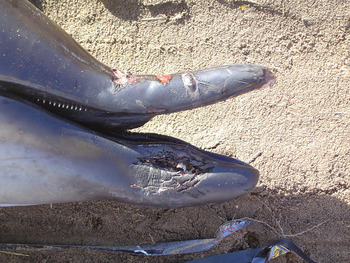
For the majority of records the cause of stranding or death could not be determined from external examination and not all specimens were necropsied. There were six beaked whales observed with rostrum/mandible injuries. These strandings occurred between 1989 and 2009 (Appendix) and involved one Blainville's (Record 9), four Gray's (records 22, 28, 34 and 38) and one Shepherd's (record 64). The injuries were pre-mortem in at least four of the six events. Of those that could be aged based on length (N = 5), all were immature (2.6–3.4 m) and presumably feeding would have been difficult due to the rostral injury. An example of a rostral injury is illustrated in Figure 2. This photograph is included to show the nature and severity of the injury, and for comparative purposes for other studies.
Gray's beaked whale, Mesoplodon grayi, with rostrum injury that live stranded and died at Warnbro Sound in January 2009 (record 38) (photograph by D.K. Coughran).

DISCUSSION
Species diversity
Western Australia has the most diverse cetacean fauna of all Australian states with at least 37 species known/reported of which ten are beaked whales (Bannister et al., Reference Bannister, Kemper and Warneke1996; Groom & Coughran, Reference Groom and Coughran2012). This demonstrates high beaked whale diversity in this area given 21 species are currently recognized worldwide and six of those are considered restricted to the northern hemisphere (MacLeod et al., Reference MacLeod, Perrin, Pitman, Barlow, Ballance, D'Amico, Gerrodette, Joyce, Mullin, Palka and Waring2006). The assemblage of Ziphiidae found in WA is similar to New Zealand (Dalebout et al., Reference Dalebout, Baker, Mead, Cockcroft and Yamada2004; MacLeod et al., Reference MacLeod, Perrin, Pitman, Barlow, Ballance, D'Amico, Gerrodette, Joyce, Mullin, Palka and Waring2006).
The list of beaked whale species known to occur in WA is considered comprehensive with the newest record (Shepherd's beaked whale) of Ziphiidae last added more than a decade ago in 1995 (Appendix). Most beaked whales are difficult to detect and identify at sea due to low surfacing profile and apparent preference for deep water and so stranding records are the only useful method for determining distribution (Maldini et al., Reference Maldini, Mazzuca and Atkinson2005; Pyenson, Reference Pyenson2011).
Additional Ziphiidae species that are known from strandings in New Zealand but have not been recorded for Australia include spade-toothed beaked whale Mesoplodon traversii and pygmy beaked whale, Mesoplodon peruvianus (MacLeod et al., Reference MacLeod, Perrin, Pitman, Barlow, Ballance, D'Amico, Gerrodette, Joyce, Mullin, Palka and Waring2006) whereas ginkgo-toothed beaked whale Mesoplodon ginkgodens (Tidemann, Reference Tidemann1980; Mead, Reference Mead, Ridgway and Harrison1989) and Longman's beaked whale Indopacetus pacifius are known from eastern Australia (Longman, Reference Longman1926; Dalebout et al., Reference Dalebout, Ross, Baker, Anderson, Best, Cockcroft, Hinsz, Peddemors and Pitman2003; MacLeod et al., Reference MacLeod, Perrin, Pitman, Barlow, Ballance, D'Amico, Gerrodette, Joyce, Mullin, Palka and Waring2006) but have not yet been recorded in WA. Spade-toothed beaked whales may potentially strand in the south of WA whereas the others are possibilities for the north of WA. Ocean currents bringing unusually warm or cool waters may result in ‘vagrant’ specimens. This is thought to be the reason for ginkgo-toothed beaked whales stranding along the east coast of Australia (Baker & Van Helden, Reference Baker and Van Helden1999).
Key geographical region and seasonality
Beaked whales prefer shelf-edge and canyon habitats (Waring et al., Reference Waring, Hamazaki, Sheehan, Wood and Baker2001; Hooker et al., Reference Hooker, Whitehead and Gowans2002). Studies of both strandings and at-sea sightings of Cuvier's beaked whale in the Mediterranean have shown certain areas are more favourable (Podesta et al., Reference Podesta, D'Amico, Pavan, Grougas, Komnenou and Portunato2006; Gannier, Reference Gannier2011) with strandings of Cuvier's beaked whale being associated with steep bathymetry (Podesta et al., Reference Podesta, D'Amico, Pavan, Grougas, Komnenou and Portunato2006; Cozzi et al., Reference Cozzi, Panin, Butti, Podesta and Zotti2010). Undersea canyons are known to be present off the south coast and Perth regions of WA (Harris et al., Reference Harris, Heap, Passlow, Shaffi, Fellow, Porter-Smith, Buchanan and Daniell2003) which correlates well with the location of Cuvier's beaked whale strandings. The presence and habitat use for Cuvier's beaked whale and other species, such as Gray's beaked whale in these areas could be confirmed through targeted surveys at sea.
Blainville's beaked whale appears to be rarer in WA waters than elsewhere in Australia and New Zealand. The paucity of records of beaked whales in the north of WA, particularly Blainville's beaked whale, may be attributed to the lower observer effort along this remote coastline, large tides washing carcasses back out to sea and faster decomposition in heat and humidity. The lack of coastal deep water may also be a factor.
Seasonality of beaked whale strandings differs around the world. For example, there was no seasonality pattern to the strandings of Cuvier's beaked whale in the Mediterranean Sea (Podesta et al., Reference Podesta, D'Amico, Pavan, Grougas, Komnenou and Portunato2006) whereas on the coasts of the United Kingdom and Ireland, Cuvier's beaked whale strands more often in January to February and in June to July (MacLeod et al., Reference MacLeod, Pierce and Begona Santos2004). In South Australia and New Zealand, seasonality of strap-toothed beaked whale strandings is evident (Kemper & Ling, Reference Kemper and Ling1991; Thompson et al., Reference Thompson, Millar, Baker, Dalebout, Steel, van Helden and Constantine2013). Gray's beaked whale strandings peak in warmer months (austral summer and autumn) in New Zealand (Thompson et al., Reference Thompson, Millar, Baker, Dalebout, Steel, van Helden and Constantine2013) and we have observed a similar trend in summer in Western Australia. The reasons for seasonality of strandings are uncertain but it may be related to ocean currents, water temperature (Evans et al., Reference Evans, Thresher, Warneke, Bradshaw, Pook, Thiele and Hindell2005) and food availability or possibly the breeding biology of the species coming closer to shore to calve. There is little known about True's beaked whale but most WA strandings of this species involve calves suggesting calving may occur in WA waters. Similarly, almost half the stranded Gray's beaked whales were immature. WA waters should be investigated as a possible key region for True's and Gray's beaked whales in the southern hemisphere.
In WA, Gray's and strap-toothed beaked whale strandings occur seasonally, with the majority occurring in the summer and autumn months between December and April. The summer months are when the coastal waters are least affected by the warm, southerly flowing Leeuwin Current that brings warm water to the south. It is also when the Cape Current which brings cool water north around the south-west corner of WA is at its strongest (Pearce & Pattiaratchi, Reference Pearce and Pattiaratchi1999). The interaction of these currents in summer may result in cooler water temperatures (Pearce & Pattiaratchi, Reference Pearce and Pattiaratchi1999) more similar to the subantarctic and temperate waters where Gray's and strap-toothed beaked whales are known to occur (MacLeod et al., Reference MacLeod, Perrin, Pitman, Barlow, Ballance, D'Amico, Gerrodette, Joyce, Mullin, Palka and Waring2006). The peak in strandings in summer coincides with high usage of coastal areas by people at the same time but is not thought to be an artefact of reporting as some locations are remote and the seasonal trend in strandings is still apparent. A similar seasonal trend has been reported in New Zealand for these species (Thompson et al., Reference Thompson, Millar, Baker, Dalebout, Steel, van Helden and Constantine2013).
Mass strandings
Toothed whales more commonly mass strand than baleen whales (Geraci & St Aubin, Reference Geraci and St Aubin1977; Mignucci-Giannoni et al., Reference Mignucci-Giannoni, Toyos-González, Pérez-Padilla, Rodríguez-López and Overing2000; Nemiroff et al., Reference Nemiroff, Wimmer, Daoust and McAlpine2010; Dolman et al., Reference Dolman, Evans, Notarbartolo-di-Sciara and Frisch2011; Tyack et al., Reference Tyack, Zimmer, Moretti, Southall, Claridge, Durban, Clark, D'Amico, DiMarzio, Jarvis, McCarthy, Morrissey, Ward and Boyd2011; Aurioles-Gamboa et al., Reference Aurioles-Gamboa, Rodríguez-Pérez, Sánchez-Velasco and Lavín2013). This is likely a result of the social structure of these species where cohesive long-term pods are formed of extended family, e.g. long finned pilot whales (Globicephala melas) (Amos et al., Reference Amos, Schlötterer and Tautz1993) and sperm whales (Physeter macrocephalus) (Lettevall et al., Reference Lettevall, Richter, Jaquet, Slooten, Dawson, Whitehead, Christal and Howard2002). Sociality of beaked whales is poorly known (Gowans et al., Reference Gowans, Whitehead and Hooker2001) but a level of social structure can be inferred from strandings as well as from at-sea sightings (Cox et al., Reference Cox, Ragen, Read, Vos, Baird, Balcomb, Barlow, Caldwell, Cranford, Crum, D'Amico, D'Spain, Fernandez, Finneran, Gentry, Gerth, Gulland, Hilderbrand, Houser, Hullar, Jepson, Ketten, MacLeod, Miller, Moore, Mountain, Palka, Ponganis, Rommel, Rowles, Taylor, Tyack, Wartzok, Gisiner, Meads and Benner2006). The largest mass stranding of Gray's beaked whales (25) was reported for the Chatham Islands in the 19th Century (Von Haast, Reference Von Haast1876). Only Gray's and strap-toothed beaked whales have mass stranded in WA in groups of more than three. The majority of strandings have been individuals.
Causes of stranding
In WA, more beaked whales have been reported to live strand and subsequently die rather than beach-cast dead, than any other group of cetacean (Groom & Coughran, Reference Groom and Coughran2012). In these cases the cause of death is usually complications associated with the physical stresses of stranding (Stroud & Roffe, Reference Stroud and Roffe1979; Kirkwood et al., Reference Kirkwood, Bennett, Jepson, Kuiken, Simpson and Baker1997; Kemper et al., Reference Kemper, Flaherty, Gibbs, Hill, Long and Byard2005). The cause of stranding is of greater interest than cause of death but remains largely unknown. Where the cause of stranding has been investigated elsewhere, research has focused on anthropogenic factors such as acoustic disturbance from sonar (Frantzis, Reference Frantzis1998; Zimmer et al., Reference Zimmer, Johnson, Madsen and Tyack2005; Cox et al., Reference Cox, Ragen, Read, Vos, Baird, Balcomb, Barlow, Caldwell, Cranford, Crum, D'Amico, D'Spain, Fernandez, Finneran, Gentry, Gerth, Gulland, Hilderbrand, Houser, Hullar, Jepson, Ketten, MacLeod, Miller, Moore, Mountain, Palka, Ponganis, Rommel, Rowles, Taylor, Tyack, Wartzok, Gisiner, Meads and Benner2006; D'Amico et al., Reference D'Amico, Gisiner, Ketten, Hammock, Johnson, Tyack and Mead2009), fisheries interactions (Carretta et al., Reference Carretta, Barlow and Enriquez2008) or vessel collisions (Carrillo & Ritter, Reference Carrillo and Ritter2010) and to a lesser extent environmental factors such as climatic events (Evans et al., Reference Evans, Thresher, Warneke, Bradshaw, Pook, Thiele and Hindell2005) or disease (Fernández et al., Reference Fernández, Vela, Andrada, Herraez, Díaz-Delgado, Domínguez and Arbelo2011). Few studies comprehensively report the cause of death in cetacean strandings (Stroud & Roffe, Reference Stroud and Roffe1979; Kirkwood et al., Reference Kirkwood, Bennett, Jepson, Kuiken, Simpson and Baker1997; Kemper et al., Reference Kemper, Flaherty, Gibbs, Hill, Long and Byard2005).
Rostral injuries have been reported in multiple species of beaked whales including northern bottlenose whale (Hardy, Reference Hardy2005), Cuvier's (Ketten, Reference Ketten2005) and Blainville's (Flom et al., Reference Flom, Brown and Schonewald1980; Jepson et al., Reference Jepson, Deaville, Patterson, Pocknell, Ross, Baker, Howie, Reid, Colloff and Cunningham2005) beaked whales from strandings around the world. In this study we report six occurrences of injuries to the mandible and/or rostrum. Potential causes of these injuries include boat strike (Carrillo & Ritter, Reference Carrillo and Ritter2010), fisheries entanglement (Carretta et al., Reference Carretta, Barlow and Enriquez2008), or aggressive inter or intra-specific interactions (Oremland et al., Reference Oremland, Allen, Clapham, Moore, Potter and Mead2010). Many studies of beaked whales have noted evidence of aggressive intra-specific interactions based on dentition (Hardy, Reference Hardy2005; Dalebout et al., Reference Dalebout, Steel and Baker2008), presence of tooth rake marks (Heyning, Reference Heyning1984; MacLeod et al., Reference MacLeod, Perrin, Pitman, Barlow, Ballance, D'Amico, Gerrodette, Joyce, Mullin, Palka and Waring2006; Dalebout et al., Reference Dalebout, Steel and Baker2008) and reinforced rostrums (Heyning, Reference Heyning1984; Kasamatsu & Joyce, Reference Kasamatsu and Joyce1995; MacLeod, Reference MacLeod2002). The dense bone structure of the rostrum and head area are diagnostic features of beaked whales but this only develops as the animal ages (Heyning, Reference Heyning1984; MacLeod, Reference MacLeod2002). The head density is thought to assist their deep diving habits to protect them during male to male aggression (MacLeod, Reference MacLeod2002; Cozzi et al., Reference Cozzi, Panin, Butti, Podesta and Zotti2010). The beaked whales with rostrum injuries may have been too young for their bones to have been reinforced and therefore were more susceptible to injury. The derivation of these injuries from conspecific behavioural interactions or anthropogenic interactions should be investigated in future, as the latter may have implications for management.
Management and research implications
Given the paucity of knowledge and lack of records about many beaked whale species each stranding event should be utilized to obtain as much information as possible on species identification, age, gender, group size, relatedness of individuals and diet. Dalebout et al. (Reference Dalebout, Baker, Mead, Cockcroft and Yamada2004) recommend that the collection of genetic data be routine for all beaked whale strandings. The cause of death should also be investigated through post-mortem examination by an experienced veterinarian or pathologist
The records presented in this study highlight the importance of recording marine fauna stranding events and have contributed to the limited knowledge about this taxonomic group. Understanding the context and use of habitat in Western Australian waters would be useful and could be supported by surveys at sea. The undersea canyons along the south coast and the Perth Canyon are obvious starting points to investigate the presence and habitat use by beaked whales. Understanding habitat use and why strandings occur could improve the management response at these events.
ACKNOWLEDGEMENTS
The authors thank the numerous volunteers and staff of the Department of Parks and Wildlife for collecting information on stranding events and contributing to the valuable dataset utilized for this study. Claire Stevenson from the Western Australian Museum kindly extracted museum records of Ziphiidae for this study. Peter Mawson provided advice on an earlier version of the manuscript. This project was funded through the Australian Marine Mammal Centre of the Australian Antarctic Division as part of a programme to develop an Australian National Marine Mammal database.
APPENDIX
Records of Ziphiidae in Western Australia
The certainty of records are ranked 1–4 with 1 the highest level of certainty where a species identification was confirmed by analysis of genetics or skull morphology. A score of 2 or 3 indicates skull morphology, photographs and/or expert opinion and a score of 4 an uncorroborated report by a member of the public or Department of Parks and Wildlife (DPaW) officer in attendance at the stranding but no photographs available.
Coordinates stated in datum WGS 84.