Externalizing manifestations refer to a diverse set of aggressive, antisocial, and potentially destructive behaviors directed towards the external environment and intended to reflect on internal negativity (Campbell, Shaw, & Gilliom, Reference Campbell, Shaw and Gilliom2000; Eisenberg et al., Reference Eisenberg, Cumberland, Spinrad, Fabes, Shepard, Reiser and Guthrie2001; Liu, Reference Liu2004). The construct of externalizing behavior (EB) ranges in severity from nonclinical to clinical, underlining the individuals’ negative emotional state associated with behaviors of opposition, aggression, hyperactivity, or impulsivity. These behaviors tend to increase during adolescence and then decline from late adolescence to adulthood (Petersen, Bates, Dodge, Lansford, & Pettit, Reference Petersen, Bates, Dodge, Lansford and Pettit2015), and may signal risk for the emergence of conduct, antisocial, attention-deficit/ hyperactivity disorders, as well as disorders related to substance dependency and abuse (Kendler, Prescott, Myers, & Neale, Reference Kendler, Prescott, Myers and Neale2003; Krueger et al., Reference Krueger, Hicks, Patrick, Carlson, Iacono and McGue2009; Krueger, Markon, Patrick, Benning, & Kramer, Reference Krueger, Markon, Patrick, Benning and Kramer2007; Loeber, Burke, Lahey, Winters, & Zera, Reference Loeber, Burke, Lahey, Winters and Zera2000). Moreover, due to their disruptive patterns, especially within the youths’ environment (e.g., teachers, parents), the presence of EB constitutes one of the most common reasons for referral to mental health services (Sobel, Roberts, Rayfield, Barnard, & Rapoff, Reference Sobel, Roberts, Rayfield, Barnard and Rapoff2001).
EBs could be seen as a heterogeneous construct. As such, they are considered to represent an ongoing movement away from specific disorders to a transdiagnostic construct and imply the notion that specific behaviors tend to cluster together and so should be investigated together (Krueger & Tackett, Reference Krueger, Tackett, Beauchaine and Hinshaw2015). Not surprisingly, there is extensive research on identifying the underlying mechanisms or associated factors that could potentially improve our understanding of these phenomena. One relevant neuropsychological mechanism underlying EBs relates to altered executive functions. These functions, which range across the ability to monitor information, regulate a response, or inhibit or manage impulsive reactions, are necessary to adapt behavior in social situations (Barkley, Reference Barkley1997), have been associated with EBs not only during early development but also during adolescence (Eisenberg, Spinrad, & Eggum, Reference Eisenberg, Spinrad and Eggum2010 for review). Indeed, one of the most relevant developmental periods to study EBs is adolescence, as it is a developmental period characterized by significant biological, physiological, and psychosocial changes (Blakemore, Reference Blakemore2012; Steinberg & Morris, Reference Steinberg and Morris2001). These changes impose increasing demands on executive functions such as monitoring and regulation of new information, especially in relation to social context (for a developmental review see Murphy, Brewer, Catmur, & Bird, Reference Murphy, Brewer, Catmur and Bird2017). Furthermore, adolescence is characterized not only by an increase in the emotional and cognitive demands needed for adaptive functioning, but also by an increase in risk-taking behaviors, some of which are constitutive of the EB construct. In parallel, the adolescent brain undergoes profound structural and functional neural changes (Burnett, Bird, Moll, Frith, & Blakemore, Reference Burnett, Bird, Moll, Frith and Blakemore2009; Li, Zucker, Kragel, Covington, & LaBar, Reference Li, Zucker, Kragel, Covington and LaBar2017; Mills et al., Reference Mills, Goddings, Herting, Meuwese, Blakemore, Crone and Tamnes2016; Tamnes et al., Reference Tamnes, Herting, Goddings, Meuwese, Blakemore, Dahl and Mills2017), and some of the brain systems that undergo significant development during adolescence have been found to relate to these behavioral changes. Specifically, having a less mature prefrontal cortex and the imbalance of this less mature region with more mature limbic and subcortical structures have been associated with EBs (Casey & Jones, Reference Casey and Jones2010).
Adolescence is also a period when severe psychopathologies (e.g., depression, anxiety, psychosis, substance use disorders, eating disorders) first manifest (Kessler et al., Reference Kessler, Berglund, Demler, Jin, Merikangas and Walters2005; Paus, Keshavan, & Giedd, Reference Paus, Keshavan and Giedd2008), perhaps as a consequence of adaptive regulation or maturation of structural brain circuits interacting with other environmental or biological risk factors (Masten & Cicchetti, Reference Masten and Cicchetti2010). Examining associations between structural brain maturation and manifestations of EB during adolescence has the potential to inform our understanding of typical development as well as contributing to the identification of risk or resilience mechanisms underlying mental health.
Structural brain maturation and EB during adolescence
Structural magnetic resonance imaging (MRI) studies examining adolescents who report significant maladaptive EBs (e.g., conduct, oppositional, attention-deficit/hyperactivity, and antisocial disorders) have found atypical indices of cortical thickness and volume in prefrontal areas such as the superior frontal cortex, orbitofrontal cortex (OFC), dorsolateral prefrontal cortex (dl-PFC), and anterior cingulate cortex (ACC) (Fahim et al., Reference Fahim, He, Yoon, Chen, Evans and Pérusse2011; Fernández-Jaén et al., Reference Fernández-Jaén, López-Martín, Albert, Fernández-Mayoralas, Fernández-Perrone, Tapia and Calleja-Pérez2014; Freitag et al., Reference Freitag, Konrad, Stadler, De Brito, Popma, Herpertz and Fairchild2018; Noordermeer et al., Reference Noordermeer, Luman, Greven, Veroude, Faraone, Hartman and Oosterlaan2017; Puiu et al., Reference Puiu, Wudarczyk, Goerlich, Votinov, Herpertz-Dahlmann, Turetsky and Konrad2018; Raschle, Menks, Fehlbaum, Tshomba, & Stadler, Reference Raschle, Menks, Fehlbaum, Tshomba and Stadler2015). These brain areas contribute to structural and functional networks involved in inhibitory control, executive control, and salience processing, which ultimately sustain the regulation of affect and behavior (Botvinick & Braver, Reference Botvinick and Braver2015; Pessoa, Reference Pessoa2009).
Moreover, atypical volume and thickness of the insular cortex and reduced volume of the amygdala have been reported in clinical groups experiencing externalizing symptoms (Fairchild et al., Reference Fairchild, Hagan, Walsh, Passamonti, Calder and Goodyer2013, Reference Fairchild, Toschi, Hagan, Goodyer, Calder and Passamonti2015; Hyatt, Haney-Caron, & Stevens, Reference Hyatt, Haney-Caron and Stevens2012; Lopez-Larson, King, Terry, McGlade, & Yurgelun-Todd, Reference Lopez-Larson, King, Terry, McGlade and Yurgelun-Todd2012; Noordermeer, Luman, & Oosterlaan, Reference Noordermeer, Luman and Oosterlaan2016; Raschle et al., Reference Raschle, Menks, Fehlbaum, Tshomba and Stadler2015; Sterzer, Stadler, Poustka, & Kleinschmidt, Reference Sterzer, Stadler, Poustka and Kleinschmidt2007; Wallace et al., Reference Wallace, White, Robustelli, Sinclair, Hwang, Martin and Blair2014). For example, female adolescents diagnosed with conduct disorder (N = 22, age range 14–20) showed reduced volume in the bilateral anterior insula and in the right amygdala compared with a community control group (Fairchild et al., Reference Fairchild, Hagan, Walsh, Passamonti, Calder and Goodyer2013). In addition, examination of the effect of sex showed that the insular reduction was present only in female but not in male adolescents (Fairchild et al., Reference Fairchild, Hagan, Walsh, Passamonti, Calder and Goodyer2013). However, a similar volumetric reduction in the bilateral anterior insula and left amygdala was shown in 12 male adolescents when compared with controls (Sterzer et al., Reference Sterzer, Stadler, Poustka and Kleinschmidt2007), suggesting comparable effects in relation to both male and female adolescents. These links with the insular cortex are important, considering that the insular cortex receives afferent information on the internal states of the body, is involved in affect regulation, and is identified as a salience hub of information and interoception processing (Craig, Reference Craig2002; Uddin, Reference Uddin2015). As such, the insula, as well as the prefrontal cortex and amygdala volume, may be involved in a reduced or altered threshold for affective regulation, resulting in EB expression.
However, while results from these studies have informed our knowledge about the neural underpinnings of clinical conditions entailing EB, our understanding about the underlying psychological processes that sustain these behaviors is confounded by factors that are specific to clinical populations (i.e., effects of medication, social rupture and isolation linked to psychopathology, substance use effects, comorbidity, etc.). Moreover, with the ongoing shift in psychological research from categorical diagnosis toward continuous or spectral dimensions (Krueger et al., Reference Krueger, Kotov, Watson, Forbes, Eaton, Ruggero and Zimmermann2018), focusing on individuals from the community may offer complementary information to the characterization of the key dimensions of psychopathology (Zald & Lahey, Reference Zald and Lahey2017).
In this vein, a few structural MRI studies have reported on EB as a general construct in community adolescents, with most studies observing an association with prefrontal brain morphology (Bos et al., Reference Bos, Wierenga, Blankenstein, Schreuders, Tamnes and Crone2018; Brumback et al., Reference Brumback, Worley, Nguyen-Louie, Squeglia, Jacobus and Tapert2016; Ducharme et al., Reference Ducharme, Hudziak, Botteron, Albaugh, Nguyen, Karama and Evans2012; Oostermeijer et al., Reference Oostermeijer, Whittle, Suo, Allen, Simmons, Vijayakumar and Popma2016). These findings have been interpreted in relation to the role played by the prefrontal areas in inhibitory control. For example, using a prospective longitudinal design following healthy adolescents (N = 265; age 12–14) for 13 years and focusing on regions of interest (ROIs) including the prefrontal areas and the insula, Brumback et al. (Reference Brumback, Worley, Nguyen-Louie, Squeglia, Jacobus and Tapert2016) reported that reduced cortical thickness of the inferior frontal gyrus predicted more EB. Similarly, using a whole-brain analysis as well as an ROI approach, Ameis et al. (Reference Ameis, Ducharme, Albaugh, Hudziak, Botteron, Lepage and Karama2014) observed that in community children and adolescents (N = 297, age 6–18) EB is associated with reduced cortical thickness in the left OFC, right cingulate, and medial temporal cortex. In addition, although no correlation between amygdala volume and EBs has been found, an interaction between left OFC thickness and amygdala volume has been reported. Individuals with lower EBs presented a positive correlation between amygdala volume and left OFC thickness, which was not present in those with more severe EBs (Ameis et al., Reference Ameis, Ducharme, Albaugh, Hudziak, Botteron, Lepage and Karama2014). Furthermore, a longitudinal study of community children, adolescents, and young adults (N = 271, age 8–25), which showed three different trajectories of engagement in antisocial behaviors (desisting, intermediate, and stable low), reported an interaction between antisocial behavior trajectory and cortical thickness in the dl-PFC, ACC, and insula. Specifically, individuals with a desisting trajectory showed reduced cortical thinning of these areas (with reduced thinning of the insula not surviving statistical correction) compared with the other two groups (Oostermeijer et al., Reference Oostermeijer, Whittle, Suo, Allen, Simmons, Vijayakumar and Popma2016).
While there are more prominent findings in relation to frontal areas, findings on the association between EBs and the insular cortex are less consistent and warrant further investigation. This inconsistency may be attributed first to the functional and structural architecture of the insula. The posterior insula has been associated with low-level somatosensory information from the spinothalamic system and is considered the primary somatovisceral cortex. The anterior part shows greater connectivity with the frontal lobe and is involved in higher level cognitive regulation and affective processing (Craig, Reference Craig2002, Reference Craig2009, Reference Craig2011; Cauda et al., Reference Cauda, Costa, Torta, Sacco, D'Agata, Duca and Vercelli2012, Reference Cauda, D'Agata, Sacco, Duca, Geminiani and Vercelli2011; Chang, Yarkoni, Khaw, & Sanfey, Reference Chang, Yarkoni, Khaw and Sanfey2013; Simmons et al., Reference Simmons, Avery, Barcalow, Bodurka, Drevets and Bellgowan2013; Uddin, Nomi, Hébert-Seropian, Ghaziri, & Boucher, Reference Uddin, Nomi, Hébert-Seropian, Ghaziri and Boucher2017). However, despite this subdivision, most studies do not specifically examine or report on the specific contributions of different part of the insula, which would potentially resolve some of the inconsistencies in the available literature.
Second, given that EB is a general construct encompassing several related but substantially different behaviors, such as rule breaking and aggression (as operationalized in the Youth/Adult Self-Report questionnaires; Achenbach, Reference Achenbach1991; Achenbach & Rescorla, Reference Achenbach and Rescorla2003), further exploration within these subdomains might reveal specific associations with the different parts of the insula. A previous study on functional resting state reported that different intrinsic connectivity networks within the insular cortex relate to different externalizing subdomains (Abram et al., Reference Abram, Wisner, Grazioplene, Krueger, MacDonald and DeYoung2015). These should be taken into account when trying to illuminate the neural basis of EBs.
The present study
In the present study, we aimed to explore the cortical thickness and surface area of ROIs in the frontal cortex, insular cortex, and amygdala and their associations with EB. We also aimed to examine different parts of the insula and EB subscales to inform our understanding of the underlying mechanism contributing to EB. Based on previously reported associations between EB and frontal brain areas, we hypothesized that in a sample of community adolescents, high EB would be associated with thinner cortex of the dl-PFC, OFC, and ACC, as well as with reduced cortical thickness of the insula and reduced volume of the amygdala. Regarding the relations between the parts of the insula and EBs subscales, we hypothesized that higher levels of aggression, referring to physical violence or relational hostility, would be negatively associated with the cortical thickness of the anterior insula. In addition, rule-breaking behaviors, including drug use, impulsivity, and oppositionality, would be associated with the posterior insula.
We examined these relations first in a cross-sectional design, and then prospectively, to examine whether morphological measurements of structural brain areas at baseline would predict changes in EB 1 year later. Our expectations on these longitudinal analyses followed our general hypothesis on thinner cortex being associated with increased EB; specifically, that the cortical thickness of the key areas (dl-PFC, medial PFC, ACC, insula, and amygdala) would be associated with no reduction or increase in EB after 1 year, identifying these areas as neurobiological markers.
Methods
Participants
A total of 102 community adolescents (49 female and 53 male adolescents) were recruited through written advertisements and by word of mouth in local schools and youth community centers in Geneva, Switzerland. Inclusion criteria were age 12–19 years, enrolment in age-appropriate school curricula, and absence of past or current psychiatric treatment and/or neurological conditions as assessed by a self-report demographic questionnaire. The descriptive statistics for the different variables included in our analysis are presented in Table 1. Individuals were included in an ongoing longitudinal study on factors contributing to adolescent mental health, which comprised multiple time points over a 5-year period. For the purpose of this study we were interested in two time points: Time 1 (baseline), the first time adolescents participated in the study, and Time 2, after an interval of 1 year, measuring change in EB. The longitudinal analysis comprised a subsample of 62 adolescents (Table 1), as some of the participants did not come back for a second assessment during this timeframe (61% retention rate; mean time interval = 12.84 months, SD = 0.10, range = 11–15 months). Participants received financial compensation and written consent was obtained from them or from their parents (if they were under 18), under protocols approved by the local ethical commission (Commission Centrale d’éthique de la Recherche des Hôpitaux Universitaires de Genève).
Participants’ characteristics

Note. * t tests for independent samples showed a significant difference between the dropout (n = 40) and retained (n = 62) groups in this variable (p = .003).
Instruments
Externalizing and internalizing behaviors
To evaluate participants’ externalizing and internalizing behaviors, we used the Youth Self-Report (YSR; for individuals aged 11–17; Achenbach, Reference Achenbach1991) and its adult equivalent, the Adult Self-Report (ASR; for individuals above 17 years; Achenbach & Rescorla, Reference Achenbach and Rescorla2003) questionnaires. Both questionnaires are designed to assess behavioral problems in the past 6 months and consist of a 3-point scale (0 = not true to 2 = very true). The ASR/YSR is divided into subscales that can be combined to form two separate problem scales: externalizing (i.e., aggression and rule breaking) and internalizing (i.e., anxiety/depression, social withdrawal, and somatic complaints) (Cronbach α: Externalizing Time 1 ASR = .94; YSR = .85; Externalizing Time 2 ASR = .93; YSR = .82; Internalizing Time 1 ASR = .88; YSR = .82).
Cognitive functioning
To control for cognitive functioning, we used the French version of the Block and Vocabulary Design subtests of the Wechsler Intelligence Scale for Children, fourth edition (WISC; Wechsler, Reference Wechsler2003). For participants over the age of 18 (Time 1, n = 11; Time 2, n = 20), the Wechsler Adult Intelligence Scale, third edition (WAIS-III; Wechsler, Reference Wechsler1997) was used. The two scaled scores were averaged to one score. The block design subtest measures abstract visual information processing and visual problem solving, while the vocabulary subtest measures word knowledge, language development, and concept understanding.
Image acquisition and pre-processing
Anatomical imaging data were acquired on a 3T Siemens Trio scanner in two different sites located in Geneva (n = 58, 44, respectively). The T1-weighted sequence was identical in both sites and collected with a three-dimensional (3D) volumetric dimension using the following parameters: TR = 2,500 ms, TE = 3 ms, flip angle = 8°, acquisition matrix = 256 × 256, field of view = 22 cm, slice thickness = 1.1 mm, 192 slices.
MRI pre-processing
To obtain an accurate 3D cortical model, images were processed using FreeSurfer software version 6.0 (http://surfer.nmr.mgh.harvard.edu). Processing steps were conducted following the FreeSurfer pipeline for fully automated preparation of images, including resampling of the surface into cubic voxels, skull stripping, intensity normalization, white matter segmentation, surface atlas registration, surface extraction, and gyrus labeling. After preprocessing, each participant was registered to the spherical atlas fsaverage in FreeSurfer. Cortical thickness was measured as the shortest distance between the two surfaces, and was computed at each vertex of both hemispheres. The cortex was subdivided into 68 parcels based on the Desikan–Killiany (DK) cortical atlas (Desikan et al., Reference Desikan, Ségonne, Fischl, Quinn, Dickerson, Blacker and Killiany2006) provided in FreeSsurfer. ENIGMA's quality assurance protocol was performed and included visual checks of the cortical segmentations (http://enigma.usc.edu/protocols/imaging-protocols; Stein et al., Reference Stein, Medland, Vasquez, Hibar, Senstad and Winkler2012). Histograms of the values of all regions were computed for visual inspection.
Areas from the DK atlas were combined to a specific set of ROIs, separately for each hemisphere (Supplementary Table 1). ROIs (e.g., OFC, ACC, inferior, superior and middle frontal cortex, amygdala and insula) were selected based on previous reports on the involvement of frontal areas in the externalizing spectrum. We also did a separate analysis with the posterior and anterior parts of the insula using the Destrieux atlas (Destrieux, Fischl, Dale, & Halgren, Reference Destrieux, Fischl, Dale and Halgren2010). The anterior part included the short insular gyrus and the posterior part included the long insular gyrus and the central insula sulcus, which, due to their small size, were grouped in this atlas as a single region (Destrieux et al., Reference Destrieux, Fischl, Dale and Halgren2010).
Statistical data analysis
Multiple regression
Multiple regression was conducted to examine whether the cortical thickness or surface are of ROIs was associated with EB. ROIs were set as independent variables and sex, age, MRI scanner, cognitive functioning score, internalizing symptoms, and mean individual hemispheric cortical thickness as covariates. This was done for each hemisphere separately. To account for the effects of age or sex, interactions between sex/age and the cortical thickness/surface area of the ROIs were entered separately into the models. Results were corrected for multiple comparisons using a 5% false discovery rate (FDR), based on the sequential Benjamini–Hochberg FDR correction algorithm (Benjamini & Hochberg, Reference Benjamini and Hochberg1995).
Because certain variables of interest (i.e., rule breaking, and aggression subscales of the ASR/YSR) violated the assumption of normality, we used Spearman partial correlation tests. Partial correlation analyses were conducted between ROIs and ASR/YSR subscale scores. Again, age, sex, location of MRI scanner, ASR/YSR internalizing behaviors score and WISC/WAIS-IV cognitive functioning score used as covariates. This was done for each hemisphere separately. Results were corrected for multiple comparisons using a 5% FDR. Analysis was done using Matlab.
For the prospective prediction of EB 1 year later (Time 2), we did a regression analysis using the score of change in EB (EB Time 2–EB Time 1) as the dependent variable. ROIs were entered as independent variables and EB Time 1, age, sex, MRI scanner, score on cognitive functioning, and internalizing symptoms as covariates. Results were again corrected for multiple comparisons using a 5% FDR. Given that there is an ongoing debate on controlling for hemispheric cortical thickness (Vijayakumar, Mills, Alexander-Bloch, Tamnes, & Whittle, Reference Vijayakumar, Mills, Alexander-Bloch, Tamnes and Whittle2018), we repeated our analysis controlling for hemispheric cortical thickness. There were no differences in terms of significant effects (see Supplementary Tables 2 and 4).
Results
Cross-sectional: descriptive analysis
EB was correlated with internalizing behaviors (r = .41, p < .001) but not with age (r = −.02, p = .78). A univariate analysis of variance (ANOVA) revealed that male and female participants did not significantly differ on EB (male M = 56.11, SD = 9.79; female M = 56.06, SD = 9.06, p = .97). A correlation matrix between the ROIs is presented in Supplementary Table 1.
Cortical thickness
Multiple regression
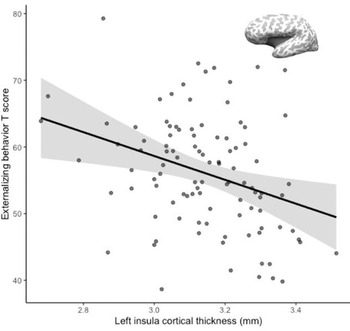
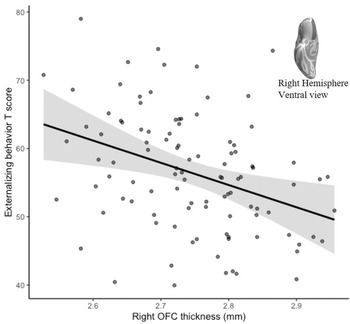
To examine whether the cortical thickness of ROIs was associated with EB, we conducted a regression analysis with all the ROIs as independent variables and sex, age, MRI scanner, cognitive functioning score, and internalizing symptoms as covariates (F (11,90) = 3.18, p = .001, Adjusted R2 = .189). Results were corrected for multiple comparisons using a 5% FDR. The cortical thickness of the left insula was negatively associated with EB (β = –.30, p = .03; FDR corrected; Figure 1; Table 2), indicating that high EBs are associated with thinner cortex of the left insula. However, there was no specific relation with any of the left anterior or posterior insula. In addition, when doing the same regression analysis with the right ROIs (F (11,90) = 2.84, p = .001, Adjusted R2 = .17), the right OFC emerged as a significant predictor, such that high EBs were associated with thinner cortex (Figure 2, Table 2).
Association between cortical thickness of the left insula and externalizing behavior, controlling for sex, age, magnetic resonance imaging (MRI) scanner, cognitive functioning score and internalizing symptoms (β = –.30, p = .03; false discovery rate (FDR) corrected). The points are the calculated residuals based on the regression model.

Association between cortical thickness of the right orbitofrontal cortex (OFC) and externalizing behavior, controlling for sex, age, magnetic resonance imaging (MRI) scanner, cognitive functioning score and internalizing symptoms (β = –.34, p = .03; false discovery rate (FDR) corrected). The points are the calculated residuals based on the regression mode.

Effects of cortical thickness of left and right regions of interest at Time 1 on externalizing behavior

Note. MRI = magnetic resonance imaging, ACC = anterior cingulate cortex, Inf = inferior, Sup = superior, Mid = middle, OFC = orbitofrontal cortex.
* p FDR corrected < .05
** p FDR corrected < .01
We also examined whether these ROIs interacted with age or sex by using separate regression models and predicting EB, but there were no significant effects (Supplementary Figure 1).
Subscales of the externalizing dimension
To further examine the relation between EB and cortical thickness, we conducted partial cross-sectional correlation analysis between ROIs and the subscales of the externalizing dimension (i.e., aggression and rule breaking). The cross-sectional analysis showed that a high score on the rule-breaking subscale was negatively correlated with the cortical thickness of the left insula (r = –.34, p = .003, FDR corrected). In addition, a high score on the aggression score was negatively correlated with the cortical thickness of the left insula (r = –.29, p = .02, FDR corrected). Furthermore, performing the same analysis with the different parts of the insular cortex revealed that the rule-breaking dimension was negatively associated with both parts, but both reached only trend-like significance (posterior r = –.25, p = .07; r = –.23, p = .07, FDR corrected). The aggression dimension was negatively associated with both parts, with only the anterior part reaching significance (posterior: r = –.21, p = .12; anterior: r = –.30, p = .02). No other result reached significance.
Longitudinal analysis
There was no significant difference in EBs and internalizing behaviors between the subsample that returned to complete the follow-up assessment (n = 62) and those who did not (n = 40). However, these groups differed in the rule-breaking subscale, suggesting that those who remained in the study scored slightly higher on these items at Time 1 (see Table 1). No significant differences between male and female participants were found at Time 2, and no significant difference was observed between EB at Time 1 (M = 57.1, SD = 8.84) and at Time 2 (M = 56.7, SD = 8.38).
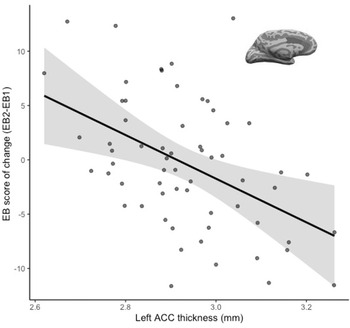
Next, to examine whether the cortical thickness of ROIs predicted the change in EB after 1 year (EB Time 2–EB Time 1), we conducted a regression analysis, with all the ROIs as independent variables and sex, age, MRI scanner, cognitive functioning score, and internalizing symptoms as covariates (F(12,47) = 5.79, p = .00006, Adjusted R 2 = .48). Results were corrected for multiple comparisons using a 5% FDR. The cortical thickness of the left ACC was negatively associated with the change in EB (β = –.39, p = .02; FDR corrected; Figure 3), suggesting that individuals with a thinner left ACC at Time 1 showed no reduction or even an increase in EB from Time 1 to Time 2. In addition, the left inferior frontal cortex was negatively correlated with the EB change score; however, this result did not survive statistical correction (Table 3). No other result reached significance. In addition, the interactions between ACC and age and between ACC and sex did not reach significance (Supplementary Figure 2).
Association between cortical thickness of the anterior cingulate cortex (ACC) and score of change in externalizing behavior (EB2-EB1), controlling for sex, age, magnetic resonance imaging (MRI) scanner, cognitive functioning score and internalizing and externalizing symptoms at Time 1(β = –.39, p = .02; false discovery rate (FDR) corrected). The points are the calculated residuals based on the regression model.

Effects of cortical thickness of left/right regions of interest at Time 1 on the score of change in externalizing behavior after 1 year

Note. CT = cortical thickness, ACC = anterior cingulate cortex, Inf = inferior, Sup = superior, Mid = middle, OFC = orbitofrontal cortex.
* p FDR corrected < .05
Subscales of the externalizing dimension
To further examine the relation between EB and cortical thickness, we used again partial correlation analysis but with the EB subscales. This analysis revealed that thinner ACC at Time 1 was associated with less change in aggression score 1 year later (β = –.38, p = .02, FDR corrected). The change in rule breaking was also negatively associated with ACC cortical thickness, but this was not significant (β = –.22, p = .10). No other effect was found.
Surface area
We repeated all of the analyses with the volume of the ROIs as the independent variable, but no significant effect survived statistical corrections in any of the analyses. Note that in these analyses we also included the volume of the amygdala as a ROI (Supplementary Table 4).
Discussion
In the present study, we examined both cross-sectionally and longitudinally (1 year) the relation between EB and the cortical thickness of targeted brain areas in a community sample of adolescents. The analyses yielded four main findings. First, the cortical thickness of the left insula correlated negatively with EB, supporting our hypothesis that higher EB scores would be associated with thinner cortex of the insula. Second, the cortical thickness of the right OFC was negatively associated with higher EB scores. Third, examination of the aggression and rule-breaking subscales that encompass EB revealed specific associations with the different parts of the insular cortex. High scores on the aggression subscale were associated with the left anterior part, while scores on the rule-breaking subscale were negatively associated with both parts; however, the latter reached only trend-like significance. Fourth, prospective analyses showed an association between the cortical thickness of the left ACC and change in EB score, such that adolescents who had a thinner ACC at baseline showed less reduction, or even increases, in EB at 1-year follow-up.
The specific relation we observed between the left insula and EB is consistent with previous reports of structural abnormalities of the insular cortex in adolescents with psychopathology within the externalizing spectrum (Fairchild et al., Reference Fairchild, Hagan, Walsh, Passamonti, Calder and Goodyer2013, Reference Fairchild, Toschi, Hagan, Goodyer, Calder and Passamonti2015; Hyatt et al., Reference Hyatt, Haney-Caron and Stevens2012; Lopez-Larson et al., Reference Lopez-Larson, King, Terry, McGlade and Yurgelun-Todd2012; Raschle et al., Reference Raschle, Menks, Fehlbaum, Tshomba and Stadler2015; Sterzer et al., Reference Sterzer, Stadler, Poustka and Kleinschmidt2007). A meta-analysis examining conduct and oppositional disorders identified reduced grey matter volume in the left amygdala, bilateral insula (with a larger cluster on the left side), and left medial/superior frontal gyrus (Noordermeer et al., Reference Noordermeer, Luman and Oosterlaan2016). In addition, activation likelihood estimation meta-analysis of eight structural neuroimaging studies on aggressive behavior identified the left insula as well as other brain areas, such as the cingulate cortex, right dl-PFC, and amygdala, as clusters of significant convergence between studies (Raschle et al., Reference Raschle, Menks, Fehlbaum, Tshomba and Stadler2015). However, unlike previous findings (Fairchild et al., Reference Fairchild, Hagan, Walsh, Passamonti, Calder and Goodyer2013, Reference Fairchild, Toschi, Hagan, Goodyer, Calder and Passamonti2015), we did not find an interaction with sex. We also did not find any effect with the surface area of any of the regions examined.
The associations within the left hemisphere are consistent with findings from a meta-analysis of functional neuroimaging literature on emotions—that left prefrontal activation (including the left anterior insula) is associated with experiencing or perceiving angry emotion (Lindquist, Wager, Kober, Bliss-Moreau, & Feldman Barrett, Reference Lindquist, Wager, Kober, Bliss-Moreau and Feldman Barrett2012). Relatedly, insular lesions were associated with reduced arousal sensitivity and low interoceptive accuracy (Terasawa, Kurosaki, Ibata, Moriguchi, & Umeda, Reference Terasawa, Kurosaki, Ibata, Moriguchi and Umeda2015), which could have a direct impact on behavior (Goodkind, Sturm et al., Reference Goodkind, Sturm, Ascher, Shdo, Miller, Rankin and Levenson2015). In relation to EBs, and in particular its aggression component, and using the term of interoception processing, which pertains to a moment-by-moment sense of signals originating from within the body and is considered to underlie emotions and mental states (Craig, Reference Craig2002; Lange & James, Reference Lange and James1922; Khalsa et al., Reference Khalsa, Adolphs, Cameron, Critchley, Davenport, Feinstein and Meuret2018), it might be that atypical cortical thickness of the insula may hinder the ability to detect one's own internal or external valence (e.g., anger). This assumed disrupted interoception processing may lead to more difficulties in regulating emotions effectively, engaging with affect learning, and undertaking decision making (Murphy et al., Reference Murphy, Brewer, Catmur and Bird2017), favoring maladaptive or disruptive strategies during emotion-laden social interactions. Longitudinal functional studies measuring EB and interoception abilities should be performed to test this hypothesis.
Further examination of different parts of the insula in relation to the externalizing subscales revealed more specific associations. Aggression was negatively associated with the cortical thickness of the anterior insula, and rule breaking with both the anterior and posterior insula. These insular parts are morphologically and functionally different (Cauda et al., Reference Cauda, Costa, Torta, Sacco, D'Agata, Duca and Vercelli2012; Nieuwenhuys, Reference Nieuwenhuys2012; Uddin et al., Reference Uddin, Nomi, Hébert-Seropian, Ghaziri and Boucher2017). For example, atypical anterior insula structure might affect the integration and regulation of internal information with cognitive and motivational information (Craig, Reference Craig2011; Gu, Hof, Friston, & Fan, Reference Gu, Hof, Friston and Fan2013), resulting in aggressive behavior. Atypical posterior parts, which are more involved in the processing of actual sensory experience (Craig, Reference Craig2002, Reference Craig2011), might affect risk decision and risk assessment, leading to rule-breaking behaviors. Relatedly, separate network coherence within the insular cortex in resting states has been associated with externalizing domains in community participants. Specifically, the posterior part has been associated with general disinhibition and substance abuse, whereas the anterior part–ACC network–has been associated with general disinhibition (Abram et al., Reference Abram, Wisner, Grazioplene, Krueger, MacDonald and DeYoung2015).
The finding that cortical thickness of the OFC is negatively associated with EB score is supported by previous findings on structural reductions in the right OFC in relation to the EB spectrum (Yang & Raine, Reference Yang and Raine2009). In addition, early-acquired OFC damage has been associated with elevated impulsivity, aggression, and attentional deficits (Eslinger, Flaherty-Craig, & Benton, Reference Eslinger, Flaherty-Craig and Benton2004). This structural impairment in OFC thickness is associated with emotional deficits and effective information processing (Yang & Raine, Reference Yang and Raine2009), perhaps through altered structural connectivity with the limbic system (Ameis et al., Reference Ameis, Ducharme, Albaugh, Hudziak, Botteron, Lepage and Karama2014), which might lead to the poor decision making or unadaptive behavior that characterizes EB.
The finding that thinner ACC at baseline predicted less reduction in EB 1 year later supports previous findings on reduced structural and functional activity in the ACC in children with externalizing disorders (Budhiraja et al., Reference Budhiraja, Savic, Lindner, Jokinen, Tiihonen and Hodgins2017; Ducharme et al., Reference Ducharme, Hudziak, Botteron, Albaugh, Nguyen, Karama and Evans2012, Reference Ducharme, Hudziak, Botteron, Ganjavi, Lepage and Collins2011; Gavita, Capris, Bolno, & David, Reference Gavita, Capris, Bolno and David2012). The volume of the left ACC at baseline has been shown to predict alcohol-related problems at 4-year follow-up. More specifically, smaller volumes at age 12 were associated with more problems at age 16 (Cheetham et al., Reference Cheetham, Allen, Whittle, Simmons, Yücel and Lubman2014). Given that a decrease in cortical thickness typically occurs during adolescence (Mills et al., Reference Mills, Goddings, Herting, Meuwese, Blakemore, Crone and Tamnes2016; Tamnes et al., Reference Tamnes, Herting, Goddings, Meuwese, Blakemore, Dahl and Mills2017; Vijayakumar et al., Reference Vijayakumar, Allen, Youssef, Dennison, Yücel, Simmons and Whittle2016), it is possible that our finding could be explained in terms of an earlier decline that signals a potential risk marker. Relatedly, typical thinning of the left ACC has been associated with increased reductions in aggression and increases in effortful control at 4-year follow-up (Vijayakumar et al., Reference Vijayakumar, Whittle, Dennison, Yücel, Simmons and Allen2014). In addition, the ACC is involved in error monitoring, decision making, behavioral adjustment, and emotion regulation (Bush, Luu, & Posner, Reference Bush, Luu and Posner2000; Margulies et al., Reference Margulies, Kelly, Uddin, Biswal, Castellanos and Milham2007; Posner, Rothbart, Sheese, & Tang, Reference Posner, Rothbart, Sheese and Tang2007; van Veen, Cohen, Botvinick, Stenger, & Carter, Reference van Veen, Cohen, Botvinick, Stenger and Carter2001), functions that have been suggested to affect the behavioral pattern of EB (Goldstein et al., Reference Goldstein, Craig, Bechara, Garavan, Childress, Paulus and Volkow2009; Hoffmann, Wascher, & Falkenstein, Reference Hoffmann, Wascher and Falkenstein2012; Patrick, Durbin, & Moser, Reference Patrick, Durbin and Moser2012).
The association of the left ACC with change in EB from Time 1 (baseline) to Time 2, and not with EB at baseline, could be due to the participants’ age and the small sample size. Developmental studies have shown that cortical maturation of prefrontal areas reaches its peak later in adolescence than the sensory and limbic brain areas (Casey, Jones, & Hare, Reference Casey, Jones and Hare2008; Mills, Lalonde, Clasen, Giedd, & Blakemore, Reference Mills, Lalonde, Clasen, Giedd and Blakemore2014). As such, it might be the case that only the older adolescents in our group showed these relations, but the age range and group size of our sample prevented us from examining this hypothesis and perhaps masked this cross-sectional effect.
Certain limitations of the study should be acknowledged. First, the modest sample size and cross-sectional nature of the cortical measures limit any interpretation on causality. Given that the brain continues to develop throughout adolescence, a longitudinal study with more than two time points would allow further examinations of the interactions between brain development and behavior. Moreover, this study relied on a self-report measure of EBs only and did not use a multi-informant assessment approach (e.g., parent or teacher reports). Although previous meta-analyses have shown that informants’ reports about observed behaviors as in the EBs construct correspond with self-reports more than reports on internalizing behaviors (De Los Reyes et al., Reference De Los Reyes, Augenstein, Wang, Thomas, Drabick, Burgers and Rabinowitz2015), future studies should still take teacher/parents’ reports into account. In addition, the rather large age range and the moderately small group size limit the ability to make interferences about EBs in different stages of adolescences. Future studies focusing on more limited age groups or including more participants within each age group are warranted. In addition, in this study we did not assess behavioral measures of interoception and hence could only speculate on the association between EBs and interoception. Previous studies that examined brain development and interoception in adolescents with substance use disorder reported a significant difference in the neural activation of the insular cortex but no differences in behavioral assessments of interoception compared with a control group (Berk et al., Reference Berk, Stewart, May, Wiers, Davenport, Paulus and Tapert2015; Migliorini, Stewart, May, Tapert, & Paulus, Reference Migliorini, Stewart, May, Tapert and Paulus2013).
Despite these limitations, this is, to our knowledge, the first study that explores the different structural parts of the insular cortex in relation to subtypes of EBs in a community sample. These results, while requiring further support from longitudinal investigations, add to the knowledge base regarding individual differences in the expression of behavioral problems in adolescence. Furthermore, they provide a combined cross-sectional and longitudinal perspective, allowing the dynamic examination of associations between cortical thickness and EB during a key developmental period. To conclude, our findings may contribute to transdiagnostic approaches aiming to identify neurobiological substrates or behavioral mechanisms that are shared across different psychopathologies (Goodkind, Eickhoff et al., Reference Goodkind, Eickhoff, Oathes, Jiang, Chang, Jones-Hagata and Etkin2015). At least to some extent, atypical cortical structures that are involved in interoception processing contribute to the onset and maintenance of maladaptive behaviors even in community adolescents.
Supplementary material
The supplementary material for this article can be found at https://doi.org/10.1017/S0954579420000619
Financial support
This work was supported by the Prix Marina Picasso, Fondation AEMD (MD), the “Schweizerischer Nationalfonds zur Förderung der Wissenschaftlichen Forschung” (MD, Grant Number 100019_159440) and the Israeli Science Foundation (MT, grant number 51/16).
Conflicts of interest
None.