


Review of literature
Bullying is a specific phenomenon leading to victimisation, which has attracted the interest of school communities and researchers in the last decades due to its high prevalence all over the world, and the numerous detrimental, long-lasting effects it has on physical and mental wellbeing, on social relationships, and on the overall school functioning (e.g., Li et al., Reference Li, Chen and Li2020; Organisation for Economic Co-operation and Development [OECD], 2017; Reijntjes et al., Reference Reijntjes, Kamphuis, Prinzie and Telch2010). According to the prevailing definition, school bullying refers to forms of repetitive harmful conduct aimed at a student’s physical, emotional, social or other types of harm (Gladden et al., Reference Gladden, Vivolo-Kantor, Hamburger and Lumpkin2014; Olweus, Reference Olweus2013). Thus, a student is exposed to unwanted aggressive behaviours that are intended, repeated or highly likely to be repeated, while there is also an imbalance of power between the student who has been victimised and the perpetrator or group of perpetrators. Usually, students suffer this kind of aggressive behaviour in front of other people, known as bystanders, who play multiple key roles depending on their motivational sets (Gairín Sallán et al., Reference Gairín Sallán, Armengol Asparó and Silva García2013; Olweus & Limber, Reference Olweus and Limber2010). Under these circumstances, it is difficult for the student subjected to victimisation to defend him/herself effectively, and thus, bullying victimisation is being established.
While this definition was first conceived for the school context, it was subsequently adopted by researchers who studied the family context. For example, Menesini et al. (Reference Menesini, Camodeca and Nocentini2010) argued that many types of siblings’ aggressive behaviours present conceptual similarities to core principles of bullying, namely, to form intentionality, persistency and imbalance of power. Wolke et al. (Reference Wolke, Tippett and Dantchev2015) defined sibling bullying in congruence with peer bullying, while they excluded occasional aggressive acts, sibling rivalry and extreme criminal acts. In this context, many negative parental behaviours can also be classified as bullying, as long as the criteria for this specific form of aggression are being met (e.g., deLara, Reference deLara2020).
In the course of personal development, students who engage in bullying may shift interchangeably between several roles (Espelage et al., Reference Espelage, Rao, Craven, Bauman, Cross and Walker2012). However, changing roles depend on several epidemiological (e.g., sex), psychological (e.g., externalising behaviours) and contextual variables (e.g., cyberbullying); therefore, the direction of these role shifts can be hard to predict (Eden et al., Reference Eden, Heiman and Olenik-Shemesh2014; Foshee et al., Reference Foshee, Benefield, McNaughton Reyes, Eastman, Vivolo-Kantor, Basile, Ennett and Faris2016; Marsh et al., Reference Marsh, Morin, Parker and Kaur2014). Yet, most studies report a general tendency of ‘victims’ becoming ‘bullies’, termed ‘bully-victims’ (Lazuras et al., Reference Lazuras, Barkoukis and Tsorbatzoudis2017; Montero-Carretero et al., Reference Montero-Carretero, Barbado and Cervelló2020). It is worth noting that ‘victims’, ‘bullies’, ‘bully-victims’ and ‘bystanders’ present distinct psychological profiles (Seixas et al., Reference Seixas, Coelho and Nicolas-Fischer2013).
A large body of literature shows how students’ core psychological constructs can be affected by exposure to bullying behaviours (e.g., Leeuwis et al., Reference Leeuwis, Koot, Creemers and Van Lier2015) and how these constructs influence new behaviours. For example, some empirical findings shed light on the victim’s role by identifying alienation and avoidance behaviours, which actually weaken victims even further (Reijntjes et al., Reference Reijntjes, Kamphuis, Prinzie and Telch2010; Smith et al., Reference Smith, Talamelli, Cowie, Naylor and Chauhan2004). Youths who have been subjected to victimisation and youths representing bully-victims are prone to internalisation problems, cognitive appraisal issues, reactive aggression, deficient social competence and low peer status (Hubbard et al., Reference Hubbard, Smithmyer, Ramsden, Parker, Flanagan, Dearing, Relyea and Simons2002). Most young people who have been the object of victimisation tend to internalise the problem of bullying by expressing guilt, embarrassment, anxiety, depression, self-harm and somatisation (Smith et al., Reference Smith, Talamelli, Cowie, Naylor and Chauhan2004). To continue, young people who have been victimised may resort to nonadaptive behaviours, such as struggling for security or attention at all costs (Fox & Boulton, Reference Fox and Boulton2005). Presumably, young people who have experienced victimisation have to cope with conflicts among their psychological needs, especially with those involving autonomy and relatedness, and this is more apparent if they live in environments exhibiting lack of support, conditional regard, excessive control and introjections (Fousiani et al., Reference Fousiani, Dimitropoulou, Michaelides and Van Petegem2016). A frustrated need for competence may also be a part of such conflicts, or at least restrain young people who have been subjected to victimisation from standing up to bullying. Research has found that children and adolescents confronted with challenges like learning difficulties, weight stigma, neurodevelopmental disabilities and low socioeconomic status have an increased probability of being bullied (Andreou et al., Reference Andreou, Didaskalou and Vlachou2013; Juvonen et al., Reference Juvonen, Lessard, Schacter and Suchilt2017; Tippett & Wolke, Reference Tippett and Wolke2014; Törn et al., Reference Törn, Pettersson, Lichtenstein, Anckarsäter, Lundström, Hellner Gumpert, Larsson, Kollberg, Långström and Halldner2015). Thus, when involved in bullying victimisation, children and adolescents may regulate their behaviour each time in several ways. For instance, it has been observed that adolescents with autonomy-supportive parents who satisfy their children’s psychological needs build and maintain good relations with people around them, and neither endanger their real self by engaging in cyberbullying, nor sacrifice their own needs to gain approval (Fousiani et al., Reference Fousiani, Dimitropoulou, Michaelides and Van Petegem2016; Lereya et al., Reference Lereya, Samara and Wolke2013; Ryan et al., Reference Ryan, Deci, Vansteenkiste and Cicchetti2016). It has been established that teachers who establish an autonomy-oriented and needs-supportive classroom environmentFootnote 1 can reduce incidents of bullying (Hein et al., Reference Hein, Koka and Hagger2015; Jang et al., Reference Jang, Reeve, Cheon and Song2020; Montero-Carretero et al., Reference Montero-Carretero, Barbado and Cervelló2020).
These findings highlight the importance of the basic psychological needs theory (BPNT), which represents one of the six mini-integral theories composing self-determination theory (SDT; see Ryan & Deci, Reference Ryan, Deci, John, Robins and Pervin2008). In accordance with SDT, humans have innate growth forces, that are manifested through a complex and self-organised conglomerate of psychological entities. Basic psychological needs (PBNs) comprise an overarching function, as they tend to unify all the psychological entities proposed by SDT (e.g., Brenning et al., Reference Brenning, Soenens, Vansteenkiste, De Clercq and Antrop2021; Soenens et al., Reference Soenens, Vansteenkiste, Van Petegem, Beyers, Ryan, Soenens, Vansteenkiste and Van Petegem2018; Vansteenkiste et al., Reference Vansteenkiste, Ryan and Soenens2020). Currently, BPNT recognises three basic human psychological needs, namely autonomy (the need to feel a causal agent who acts in accordance to his/her integrated self), competence (the need to experience mastery in whatever he/she does), and relatedness (the need to bond with other humans in a mutual way). In particular, the satisfaction of these innate human needs by socials contexts is considered necessary for personal growth, wellbeing and integrity (Ryan & Deci, Reference Ryan and Deci2017).
While focusing on the relationships between BPNs and bullying, BPNT predicts that engaging in bullying is connected to thwarted relationships and frustrated BPNs (Legate et al., Reference Legate, DeHaan, Weinstein and Ryan2013). Thus, forms of aggression, bullying, stigmatisation, rejection and victimisation may constitute antecedents as well as consequences of thwarted BPNs (Menéndez Santurio et al., Reference Menéndez Santurio, Fernández-Río, Cecchini Estrada and González-Víllora2020; Ryan & Deci, Reference Ryan and Deci2017). That is, human psychological needs are not only experiential nutrients for growth, wellness and integrity, but they also involve dynamic and striving functions, significantly affecting behaviour (Chen et al., Reference Chen, Vansteenkiste, Beyers, Boone, Deci, Van der Kaap-Deeder, Duriez, Lens, Matos, Mouratidis, Ryan, Sheldon, Soenens, Van Petegem and Verstuyf2015). In particular, frustrated BPNs are connected to dysfunctional behavioural patterns (Costa et al., Reference Costa, Ntoumanis and Bartholomew2015), which is expected in bullying behaviour and bullying victimisation. More specifically, defensiveness in conjunction with introjects and sensitivities may lead to a lack of clear action plans against bullying (Ryan et al., Reference Ryan, Deci, Vansteenkiste and Cicchetti2016). An emerging body of longitudinal research has delivered further evidence about the direct effects of BPNs on prosocial and antisocial behaviours (e.g., Tian et al., Reference Tian, Zhang and Huebner2018). However, at the present time, most of the research conducted on the striving functions of BPNs refers to their mediation between bullying and other factors, such as empathy, trait self-determination, and teaching or parenting styles (e.g., Fousiani et al., Reference Fousiani, Dimitropoulou, Michaelides and Van Petegem2016; Hein et al., Reference Hein, Koka and Hagger2015; Montero-Carretero et al., Reference Montero-Carretero, Barbado and Cervelló2020). Besides, most studies assess broad internalising and externalising behaviours rather than examining the specific behaviours around bullying (e.g., Brenning et al., Reference Brenning, Soenens, Vansteenkiste, De Clercq and Antrop2021).
In this outline, BPNT maintains that people who have been subjected to victimisation may have experienced significant need frustration prior to bullying emergence that rendered them susceptible to victimisation, as they prefer to be alienated and defensive in their daily social interactions (Hodgins et al., Reference Hodgins, Weibust, Weinstein, Shiffman, Miller, Coombs and Adair2010). This assumption originates from a BPNT’s point of view that humans indeed strive for needs satisfaction, but they may develop maladaptive motivational sets after experiencing continuous needs frustration (Ryan & Deci, Reference Ryan and Deci2017). In sum, BPNs demonstrate several consequences at the cognitive, affective and behavioural levels, as they interact decisively with other psychological constructs (Montero-Carretero et al., Reference Montero-Carretero, Barbado and Cervelló2020). Hence, BPNs can be viewed as precursors of self-determined motivations.
In terms of the BPNT, human innate needs are interconnected across contexts (Ryan & Deci, Reference Ryan and Deci2017), and in the present case, across home and school. However, a direct proof for the association between BPNs in school and at home is missing, since empirical research on BPNs in different life domains regarding the same persons (within subject designs) are infrequent (Tian et al., Reference Tian, Zhang and Huebner2018). Several studies have delivered evidence about negative parental styles being related to needs frustration, which in turn is connected to school adaptation problems and to a diminished psychosocial functioning (Ahmad et al., Reference Ahmad, Vansteenkiste and Soenens2013; Filippello et al., Reference Filippello, Sorrenti, Buzzai and Costa2015; Moltafet et al., Reference Moltafet, Sadati Firoozabadi and Pour-Raisi2018; Rohinsa et al., Reference Rohinsa, Djunaidi, Cahyadi and Iskandar2020). Even so, caution is required about establishing causal links between early BPNs, frustration and subsequent functioning, because students may benefit from other life domains too, such as the school environment (Pomerantz et al., Reference Pomerantz, Cheung, Qin and Ryan2019).
As to the role of the home, high prevalence rates of sibling bullying support the idea that perpetration and victimisation begin in family life (Wolke et al., Reference Wolke, Tippett and Dantchev2015). Findings suggest that siblings engaged in persistent conflicts and bullying victimisation are at increased risk of becoming peer victims (Faith et al., Reference Faith, Elledge, Newgent and Cavell2015; Foody et al., Reference Foody, Samara and O’Higgins Norman2020). Bullying victimisation in more than one field has been observed to have multiple implications for a vast array of mental and social health indicators, both for children and adolescents (e.g., Wolke et al., Reference Wolke, Tippett and Dantchev2015). Additionally, early suboptimal family functioning and need-thwarting parenting styles relate to the emergence of both internalising and externalising problems (Fousiani et al., Reference Fousiani, Dimitropoulou, Michaelides and Van Petegem2016; Rigby, Reference Rigby2013; Vansteenkiste et al., Reference Vansteenkiste, Ryan and Soenens2020). In particular, needs frustration at home may lead to anger, hostility, aggression and antisocial behaviours in preadolescents (Kader & Roman, Reference Kader and Roman2018). Later, intimidating behaviours in school may increase when parents are unwilling to show any interest in their child’s school and social life (e.g., Fosco et al., Reference Fosco, Stormshak, Dishion and Winter2012; Papanikolaou et al., Reference Papanikolaou, Chatzikosma and Koutra2011). Taken altogether, family seems to be a key regulator for engaging in school bullying, as it poses the social context where early models of close relationships are formed (La Guardia et al., Reference La Guardia, Ryan, Couchman and Deci2000; Tsamparli & Halios, Reference Tsamparli and Halios2019).
The present study
According to the literature gaps pinpointed, the main objective of the present empirical effort is to investigate the relationships of BPNs, bullying and bullying victimisation in two contexts, namely in school and at home, using a theory-driven structural equation model (SEM). More specifically, BPNs are examined as perceived in relationships with specific groups of persons, because bullying is conceived as a phenomenon that affects relationships (see also Rodkin et al., Reference Rodkin, Espelage and Hanish2015).
According to the literature review, four hypotheses were formulated. The first one is that bullying victimisation may lead to bullying behaviour in each context (see paths 9 and 10 in Figure 1, which depicts the proposed SEM). Second, BPNs demonstrate a direct negative effect on both bullying and victimisation behaviours within each context (paths 1, 2, 6 and 7). Third, relationships at home, which in our study comprise BPNs, bullying behaviours and bullying victimisation among family/home members are expected to predict the corresponding assessed relationships at school (paths 5, 8 and 11). Finally, further cross-contextual influences are possible, while extending to the family’s dominant role. In this case, BPNs at home may negatively influence bullying behaviours and bullying victimisation in school (paths 3 and 4).
Proposed path model.
Note: Paths are numbered; signs in brackets show positive [+] or negative [-] expected influences.

Method
Participants
For the purpose of the present study, a large and diverse sample was incorporated that included upper elementary (5th and 6th grade), junior high school and senior high school students, covering modal ages from 11 to 16 years. An effort was made to develop a well-balanced sample with regard to the characteristics of the region. A nonrandom sampling method — that is, convenience sampling — was used by approaching school units. Participants were students from the prefecture of Thessaloniki, a region of about 1,110,000 residents. The major part of the population is allocated into city clusters. The European Union classifies it as an intermediate region; yet, under the new typology it is classified as more urban, compared to the old typology (Regional Statistics Team, 2013). To calculate the sample size over an a priori chi-square based power analysis concerning goodness of fit, the 3.1.9.7 edition of the G*Power software was used (Faul et al., Reference Faul, Erdfelder, Buchner and Lang2020; Faul et al., Reference Faul, Erdfelder, Lang and Buchner2007). Upon a .01 alpha error probability, a power of .95, a medium effect size (.03) and 21 degrees of freedom (see measures section), the required total sample size resulted in 439 participants (cf. Yang & Kim, Reference Yang and Kim2017). More students than the suggested number were recruited due to the anticipated nonresponse. Eventually, 532 students of mean age 13.18 (SD = 1.88) participated in the present study; specifically, 265 boys and 267 girls. Most students (58.3%) lived in the city centre and city clusters, while the remainder (41.7%) were from rural areas of varying density. Data were collected at the beginning of the school year, three months after it had started.
Measures
Demographic characteristics
Sex, age and schools’ geographical region (i.e., the origin of schools, urban or rural) were recorded for each student. In addition, data were collected on the student population of each education district and school, separately for each sex and education level. Specifically, each district’s student population represents the sum of students of each education district and education level. These data were used to calculate inverse probability of selection, which was to be used to support path analyses and balance unequal probabilities of student selection.
BPNs in relationships
The tool used to assess students’ BPNs was the Basic Psychological Needs in Relationships questionnaire (La Guardia et al., Reference La Guardia, Ryan, Couchman and Deci2000), which focuses on close social relationships and refers to the satisfaction and frustration of the needs for autonomy, competence and relatedness. With regard to school, the introductory sentence ‘When I am with my teachers and classmates …’ was used to underline student relationships in the classroom and the organised school activities; with respect to family, the sentence ‘When I’m with my family members …’ was introduced, putting an emphasis on family life. Students responded on a 7-point questionnaire scale. The questionnaire was translated and back-translated (e.g., Fountoulakis et al., Reference Fountoulakis, Papadopoulou, Kleanthous, Papadopoulou, Bizeli, Nimatoudis, Iacovides and Kaprinis2006). Wording was simplified; the expression ‘closeness and intimacy’ was rendered into ‘emotional warmth’, while the word ‘distance’ was interpreted as ‘coldness’. An example question for assessing relatedness satisfaction was: ‘When I’m with …, I feel loved and cared about’. An example item of competence satisfaction was ‘When I’m with …, I feel very capable and effective’, whereas an example question of autonomy satisfaction was ‘When I’m with …, I feel free to be who I am’. BPNs have been successfully tested in Greek before (e.g., Mouratidis et al., Reference Mouratidis, Barkoukis and Tsorbatzoudis2015). Each of the two BPNs in the Relationships questionnaire comprise nine items. For assessing the two life domains, the items are 18 in total. There are three items for each BPN. Three items, one per PBN for each context, measure needs frustration and need recoding before computing the scale average. High values represent high satisfaction combined with low frustration. BPNs in relationships were then calculated for each context, representing the average of all three BPNs. Basic psychometric properties are reported in the results section. The presentation of any invariance result is beyond the scope of the present paper.
Bullying behaviour and bullying victimisation
For the purposes of the present study, behaviours around bullying and victimisation were assessed by means of four general single-item measures in total covering: (a) victimisation through family members or relatives who consistently live at home and are considered family (e.g., ‘How often did a family/home member harassed you over the past two months?’; Dantchev & Wolke, Reference Dantchev and Wolke2019); (b) victimisation through classmates or peers (e.g., ‘How often did a kid or a group of kids harassed you over the past two months?’; Kyriakides et al., Reference Kyriakides, Kaloyirou and Lindsay2006); (c) bullying towards family/home members (e.g., ‘How often did you harass a family/home member over the past two months?’; Dantchev & Wolke, Reference Dantchev and Wolke2019); and (d) bullying towards classmates or peers (e.g., ‘How often did you — alone or with others — harass a kid or a group of kids over the past two months?’; Kyriakides et al., Reference Kyriakides, Kaloyirou and Lindsay2006). There was no limitation to the items’ formulation concerning location or means — that is, in person or by electronic means — of bullying victimisation (Lazuras et al., Reference Lazuras, Barkoukis and Tsorbatzoudis2017). The students answered by describing their experience during the last two months on a 5-point frequency scale (1 = never, 2 = only once or twice, 3 = 2 or 3 times a month, 4 = once a week, and 5 = several times a week). We opted for general single-items to measure bullying victimisation and perpetration because: (a) they are suitable for assessing the frequency of occurrence (Bear et al., Reference Bear, Mantz, Glutting, Yang and Boyer2015); (b) they have viable psychometric properties (e.g., good concurrent validity and strong correlations with peer ratings; Olweus, Reference Olweus2013; Shaw et al., Reference Shaw, Dooley, Cross, Zubrick and Waters2013); (c) they can reduce age and sex biases observed in the various forms of bullying (Olweus, Reference Olweus, Jimmerson, Swearer and Espelage2010); and (d) Greek students are familiar with bullying issues due to actions of the Ministry of Education (Artinopoulou, et al., Reference Artinopoulou, Babalis and Nikolopoulos2016; see also procedure section). However, it is important to underline that using single items in bullying research has both advantages and disadvantages (for an extensive discussion see Catone et al., Reference Catone, Signoriello, Pisano, Siciliano, Russo, Marotta, Carotenuto, Broome, Gritti, Senese and Pascotto2019).
Procedure
After the purpose of the questionnaire was explained to the students, reference was made to the definition of bullying and the forms of bullying victimisation (Vaillancourt et al., Reference Vaillancourt, Trinh, McDougall, Duku, Cunningham, Cunningham, Hymel and Short2010). Then, the concept of the dominant verb used in Greek was highlighted (cf. Kyriakides et al., Reference Kyriakides, Kaloyirou and Lindsay2006). It is the verb enohlo (back translation in English: harass), which, in this context, means ‘I deliberately make someone feel uncomfortable or uneasy, that is, I cause feelings of distress, discomfort, sadness, or discontentment’. Students were given the opportunity to ask for clarification about this.
Ethics
The study was conducted in agreement with the ethical standards of research with human subjects of the University of Macedonia. The research protocol was approved by the school district authority and informed consent was obtained from the parents of each subject, after the purpose of the protocol was explained to them. In any case, schools and students were free to decide whether they would participate.
Statistical analyses
In addition to basic analyses such as descriptive statistics and correlations (SPSS, cf. IBM Corp., 2011), the structural validity of the questionnaires was checked by means of confirmatory factor analyses (LISREL, Jöreskog & Sörbom, Reference Jöreskog and Sörbom2017). First, all ordinal and continuous variables were normalised. Then, those cases considered as multivariate outliers (N = 32) in any of the measurements were removed from the original sample of the 564 children and adolescents. Factor values, which are latent variables, were calculated through LISREL software (LISREL returns z-standardised values according to the confirmed structural models). For example, the sum of the basic psychological needs in each domain was calculated after it was posed as a second-order factor. Subsequent path analytical models were tested on the basis of these calculated factors. In LISREL analyses, the robust maximum likelihood (RML) method and completely standardised solutions were used (Jöreskog et al., Reference Jöreskog, Olsson and Wallentin2016). RML method represents an attempt to handle multivariate non-normality. Complex survey design, that is, weighting values with the inverse probability of student selection, was needed only as an auxiliary method to confirm factor models in the district subgroups of the sample. The criteria for evaluating fit indices were derived from Schermelleh-Engel et al. (Reference Schermelleh-Engel, Moosbrugger and Müller2003).
Results
As far as the quality of instruments is concerned, data showed a good fit to the basic psychological needs in relationships model, both for the family (chi-square value based on degrees of freedom, χ2(19) = 25.49, chi-square value’s statistical significance level, p = .15, chi-square value to degrees of freedom ratio, χ2/df = 1.37, normed fit index (NFI) = .98, non-normed fit index (NNFI) = .99, comparative fit index (CFI) = 1.00, standardised root mean square residual (SRMR) = .02, root mean square error of approximation (RMSEA) = .03, RMSEA’s 90% confidence interval (90% CI [.0, .05]); and for the school domains, χ2(21) = 32.43, p = .05, χ2/df = 1.54, NFI = .98, NNFI = .99, CFI = .99, SRMR = .02, RMSEA = .03, 90% CI [.0, .06]. In both family and school, the multivariate normality of the data could not be secured, χ2 = 4313.01, p < .001, and χ2 = 511.05, p < .001 respectively. Factor loadings varied from .34 to .83 for the family domain and from .32 to .86 for the school domain. Low factor loadings belonged to the frustration items. In both analysed domains, cross-correlations among the primary items were weak to moderate; LISREL did not make any suggestions for adding error covariance among variables, implying independence of errors. Internal consistencies were good (Cronbach’s alpha was .80 for the family context and .83 for the school context).
According to all the chi-square tests performed, students were quite evenly distributed in the sample with regard to sex, age group and school’s region. Table 1 illustrates the bivariate correlations among the z-standardised values of the variables used in the path model. A moderate positive statistically significant correlation occurred between the two BPNs in relationships stemming from school and home. The same phenomenon was observed in the correlation between bullying behaviour and bullying victimisation within the home context. A low positive statistically significant correlation was found between bullying behaviour across the two investigated contexts. Most of the remaining correlations, although statistically significant, were classified as negligible.
Descriptive statistics and z-order correlations among the variables used in the path model

Note: M, mean; SD, standard deviation; Family/School BPNs, BPNs in relationships in the family and at school respectively; Victimisation in/at family/school, Bullying victimisation in the family and at school respectively; Bullying in/at family/school, Bullying behaviour in the family and at school respectively.
*p < .05, **p < .01.
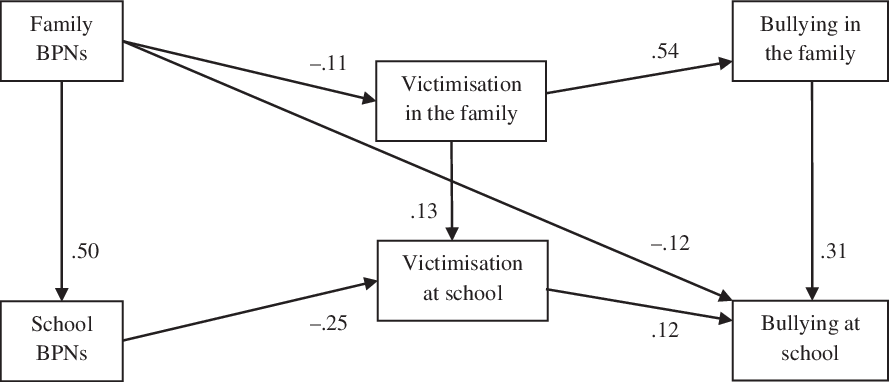
Figure 2 depicts the modified path model, which held a good data fit, χ2(7) = 7.17, p = .42, χ2/df = 1.02, NFI = .99, NNFI = 1.00, CFI = 1.00, SRMR = .03, RMSEA = .01, 90% CI [.0, .05]. All parameters, as well as direct and indirect paths, were statistically significant at the .01 level. That said, statistically significant indirect paths were revealed that signify an influence of BPNs at home on bullying at home and victimisation in school. The multivariate normality of the data could not be secured (χ2 = 899.01, p < .001). The modified model contained fewer paths than the proposed model; absent paths were not statistically significant and thus they did not participate in the statistical analysis. Still, the confirmed model provides sufficient evidence for the influence of the family domain, which was reflected in the case of the BPNs in relationships, bullying behaviour and bulling victimisation. In addition, it was found that bullying victimisation is a precursor for bullying behaviour within each social context. BPNs in relationships were able to directly predict bullying victimisation, but not bullying behaviour. Only BPNs in family relationships showed a statistically significant path to perpetrator behaviours in school.
Modified path model.
Note: Only statistically significant paths are shown. All direct and indirect paths were statistically significant at the .01 level.

Discussion
The present study focused on the perpetration and victimisation elements of bullying and tried to elucidate how the striving functions of BPNs in relationships work within this phenomenon in two distinct social contexts concurrently, namely in school and at home. Certain gaps in the literature were addressed via the objectives of the present study. The first and the second hypotheses relied on a solid literature basis and have been frequently examined in previous studies. The third and the fourth hypotheses were not extensively examined in the past.
The first hypothesis (bullying victimisation may lead to bullying behaviour) was confirmed for both contexts (Duggins et al., Reference Duggins, Kuperminc, Henrich, Smalls-Glover and Perilla2016; Montero-Carretero et al., Reference Montero-Carretero, Barbado and Cervelló2020). There is previous evidence suggesting that domestic victimisation may open the way to intimidating behaviours within the family (Desir & Karatekin, Reference Desir and Karatekin2018). Thus, according to these findings, families that are screened positively for domestic violence should receive early secondary prevention initiatives. However, in the present study it was not possible to assess whether bullying and victimisation stemmed from adults or siblings. For the first hypothesis, there was no previous indication for meaningful paths between bullying victimisation from one context to bullying behaviour of another context, nor did the data support such a path. In the same way, bullying behaviour from one context could not influence bullying victimisation in another context.
The second hypothesis (BPNs have a direct effect on both perpetration and victimisation behaviours in each context) was partially confirmed for both contexts; that is, only the paths from BPNs to bullying victimisation were verified. So, the BPNs’ immediate striving functions (Tian et al., Reference Tian, Zhang and Huebner2018) could be validated only for the victimisation part. Additionally, BPNs in relationships at home affected perpetration behaviours at home only indirectly. As a consequence, results support prior research establishing the importance of BPNs in forging daily relationships (e.g., Jang et al., Reference Jang, Reeve, Cheon and Song2020; Montero-Carretero et al., Reference Montero-Carretero, Barbado and Cervelló2020). In fact, human beings are proactive, meaning that they build anticipatory beliefs, while they process new social experiences (Ryan & Deci, Reference Ryan and Deci2017). More specifically, thwarted BPNs can reduce the possibility of children and adolescents to adaptively cope with bullying. However, statistical results (i.e., small loadings) illustrated the need for a further psychological construct that (a) would be influenced by the BPNs and (b) could reveal the proximate causes of bullying victimisation. BPNs could not prognosticate perpetrating behaviours in a direct way within each context. According to BPNT (Ryan & Deci, Reference Ryan and Deci2017) aggressive reactions may be generated due to frustrated BPNs. A possible reason for not establishing this link is that in our study, BPNs in relationships encapsulated satisfaction and frustration in one measure. Moreover, the analogy of satisfaction and frustration items was 3 to 1. Another plausible explanation may be that perpetrating behaviour is controlled by personality factors too (Del Rey et al., Reference Del Rey, Casas, Ortega-Ruiz, Schultze-Krumbholz, Scheithauer, Smith, Thompson, Barkoukis, Tsorbatzoudis, Brighi, Guarini, Pyżalski and Plichta2015).
Regarding the third hypothesis, BPNs in relationships, bullying behaviours and bullying victimisation among home members had strong influences on the equivalent relationship variables at school (e.g., Wolke et al., Reference Wolke, Tippett and Dantchev2015). In the case of BPNs, family shapes early patterns of internalising prosocial and other positive values, as well as of adopting mutuality in satisfying psychological needs, while children adopt such patterns in other life domains (Ryan & Deci, Reference Ryan and Deci2017). As far as victimisation is concerned, exposure to parents’ violence can be held responsible for the connection between family and school, signifying that early poor relationship and behavioural models can make children vulnerable to peer bullying (Espelage et al., Reference Espelage, Rao, Craven, Bauman, Cross and Walker2012). In the case of perpetration, exposure to violence by any family member underlines that early socialisation processes at home may determine intimidation in the school domain (Low & Espelage, Reference Low and Espelage2013). Briefly, the results are conforming to studies suggesting that family may be predominant over other social contexts in shaping basic relationship styles even in late childhood and early adolescence (Rigby, Reference Rigby2013; Tsamparli & Halios, Reference Tsamparli and Halios2019).
As to the fourth hypothesis (further specific cross-contextual influences are possible), only a significant path from BPNs in home relationships to bullying behaviours at school was proven, showing that accumulated family conflicts combined with frustrated psychological needs at home may lead to aggressive behaviour at school (Kader & Roman, Reference Kader and Roman2018; Menéndez Santurio et al., Reference Menéndez Santurio, Fernández-Río, Cecchini Estrada and González-Víllora2020). The fact that BPNs at home could not directly predict school victimisation denotes that in this particular case, the influence of the family fades out due to the role of BPNs at school (cf. Chen et al., Reference Chen, Wang, Chen and Huang2021; Duggins et al., Reference Duggins, Kuperminc, Henrich, Smalls-Glover and Perilla2016). According to these findings, although the context of home is very influential, there is also some distinctiveness between the two social contexts studied.
The present study has some limitations regarding the exclusive use of self-report questionnaires, its cross-sectional design, and its monocultural nature. Likewise, only single-items for assessing bullying and victimisation were used in this study, while multi-item scales could have provided greater measurement quality. In future research, it is imperative that a longitudinal research design be used in order to establish the dynamic impact of basic psychological needs on bullying behaviours and bullying victimisation. In addition, it will be useful to assess children’s pre-existing conditions, such as learning difficulties, disabilities and mental health risks. Also, improved scales for assessing basic psychological needs in relationships may be used. Although the basic psychometric properties of the questionnaires were good for the modal ages from 11 to 16 years, the implementation of full questionnaires, as well as the use of peer, sibling and other people’s reports may increase the psychometric properties of the models.
Moreover, future research may include further measures of both aggression and victimisation types (e.g., Hubbard et al., Reference Hubbard, Smithmyer, Ramsden, Parker, Flanagan, Dearing, Relyea and Simons2002; Seixas et al., Reference Seixas, Coelho and Nicolas-Fischer2013) in order to elucidate the complex and reciprocal nature of daily relationships between people who bully others and people who have been subjected to victimisation. In this respect, variables directly reflecting daily social interactions and/or expectations, such as information processing patterns and help-seeking (e.g., Matuschka et al., Reference Matuschka, Scott, Campbell, Lawrence, Zubrick, Bartlett and Thomas2021; Ziv et al., Reference Ziv, Leibovich and Shechtman2013), could be appropriate for addressing the question of proximate causation.
Educational implications
Significant and theory-conform paths — both direct and indirect — found in the present study emphasise that BPNs satisfaction and/or frustration play an important role in the phenomenon of bullying. Furthermore, they indicate that nurturing BPNs in close relationships formed in school and at home is indispensible for diminishing bullying victimisation. Hence, psychological support delivered to students struggling with victimisation should be improved for both the school and the family contexts by challenging frustration and promoting satisfaction with reference to BPNs. Youths who have suffered bullying should be supported not only in the area of their basic psychological needs, but also in further elements of SDT, such as goal contents, self-regulations, introjects and integrative processing of past identities (Goodboy et al., Reference Goodboy, Martin and Goldman2015; Ryan & Deci, Reference Ryan and Deci2017). To conclude, findings of the present study may significantly contribute to designing effective school prevention and intervention efforts. More specifically, intervention programs exceeding the school context, thus involving families too, are expected to be quite effective (Della Cioppa et al., Reference Della Cioppa, O’Neil and Craig2015; Lester et al., Reference Lester, Pearce, Waters, Barnes, Beatty and Cross2017; Pennell et al., Reference Pennell, Campbell and Tangen2020). At this point, it is necessary to highlight that our approach focuses on supporting the psychological growth and flourishing of the youths who have been victimised. Thus, besides telling an adult and receiving protection (Cantone et al., Reference Cantone, Piras, Vellante, Preti, Daníelsdóttir, D’Aloja, Lesinskiene, Angermeyer, Carta and Bhugra2015), youths who have been the object of victimisation are in need of psychological support and counselling (Vansteenkiste et al., Reference Vansteenkiste, Ryan and Soenens2020). In accordance with these arguments, antibullying guidelines for teachers and parents need to be reformed correspondingly. A final course of action could be that school counsellors and teachers are trained accordingly.