Instruction
Syncope is defined as a transient loss of consciousness and postural tone, with spontaneous recovery, but without neurologic sequelae.Reference Brignole and Hamdan 1 – Reference Chen, Zhang and Ingrid 3 Data showed that about 15% of children and adolescents experienced syncope at least once in their first 18 years of life.Reference Lai, Chen and Lin 4 It was shown that the neurally mediated syncope was the main reason for syncope in children, including vasovagal syncope and postural orthostatic tachycardia syndrome, etc.Reference Chen, Wang and Wang 5 , Reference Liao, Chen and Liu 6 The head-up tilt test was widely recognised as the “quasi-gold standard” for diagnosing vasovagal syncope and postural orthostatic tachycardia syndrome.Reference Chen, Zhang and Ingrid 3 , Reference Chen, Yang and Wang 7 There has been much discussion about the optimal angle choice for head-up tilt test. Baron-Esquivias et alReference Baron-Esquivias, Pedrote and Cayuela 8 found that the incidence of head-up tilt test-induced syncope would change at different tilt angles. Sheldon et alReference Sheldon and Koshman 9 concluded that compared with 60° tilt angle, there was a higher positive diagnostic rate at the 80° tilt angle. Haemodynamics should change with the tilt angles. As the tilt angle was increased, the fingertip oxygen saturation was decreased, but the fingertip blood pressure increased.Reference Rosales-Velderrain, Cardno and Mateus 10 Another study showed that patients younger than 25 years had syncope or pre-syncope within 22 minutes in the head-up tilt test, and the incidence of syncope was proportionately increased with the duration of head-up tilt test time in patients over 25 years.Reference Sheldon, Sexton and Koshman 11 Therefore, with a promise of a higher positive diagnostic rate, achieving the lowest psychological stress at increasing tilt angles was particularly important for children and young people. In this study, 176 patients with unexplained syncope randomly underwent the head-up tilt test at tilt angles of 60°, 70° and 80° to study the positive response rates, correlate the time to a positive response, and analyse the degree of psychological fear/stress and different tilt angles.
Subjects and methods
Subjects
A total of 174 children, including 76 boys and 98 girls, aged from 4 to 18 years (mean 11.3±2.8 years old), were admitted to the department of Pediatrics, Peking University First Hospital from April, 2008 to March, 2013. Children underwent the head-up tilt test if there was no clear reason for their syncope after a detailed history, physical examination, electrocardiogram, 24-hour ambulatory electrocardiogram, echocardiography, electroencephalogram and blood chemistries.Reference Zhang, Zhu and Wang 12 , Reference Zhang, Du and Wang 13
Methods
Head-up tilt test
The head-up tilt test was performed in a quiet, softly lit, temperature-controlled room. Drugs that could influence normal autonomic nervous system activity were avoided for ≥3 days before the test. The heart rate and blood pressure were monitored with Dash 2000 Multi-Lead Physiological Monitor (General Electric, New York, New York, United States of America) continuously. The heart rate and blood pressure were recorded until a positive response appeared or the until the conclusion of the 45-minute test.Reference Zhang, Li and Ochs 14
The positive criteria of postural orthostatic tachycardia syndromeReference Freeman, Wieling and Axelrod 15 , 16
The response was considered to be positive when heart rate increased by over 30 beats/minute or the maximum heart rate >120 beats/minute, and the patients had at least one of the following symptoms during the tilt standing, dizziness or fainting, chest tightness, headache, palpitations, blurred vision, fatigue or syncope.
The positive criteria of vasovagal syncope. During the tilt standing, the response was considered to be positive if patients exhibited syncope or presyncope with one of the following: (1) their blood pressure was decreased: systolic blood pressure ≤80 mmHg or diastolic blood pressure ≤50 mmHg or mean blood pressure decreased ≥25%; (2) the heart rate was decreased: 4–6 years <75 beats/minute, 7–8 years old <65 beats/minute, and older than 8 years <60 beats/minute; (3) sinus rhythm was replaced by a junctional escape rhythm; or (4) a transient second-degree atrioventricular block or up to 3 seconds of asystole appeared.
The evaluation of psychological fear of the children
Wong–Baker face scale was used for the subjective assessment of pain or emotion.Reference Cravero, Fanciullo and Mchugo 17 The scale presents six different facial expressions – from the smile to the sad cry – from left to right, which are labelled 0–5 points, which means comfortable, generally comfortable, minimally uncomfortable, slightly uncomfortable, severely uncomfortable and extremely uncomfortable, respectively. Owing to the fact that it is intuitive, it can be used in patients with expressive speech problems.Reference Garra, Singer and Taira 18 Tomlinson et al found that children preferred the Wong–Baker faces when compared with other pain assessment scales.Reference Tomlinson, von Baeyer and Stinson 19 The scale is also suitable for the study of children with psychological fear.Reference Cravero, Fanciullo and Mchugo 17 In this study, six facial expressions indicated the degrees of psychological fear progressively. At the end of the head-up tilt test, children were asked to select a suitable facial expression to indicate the degree of psychological fear during tilt standing.
The positive response appearance time
The positive response appearance time was recorded during the tilt position according to the definition as mentioned above.
Statistical analysis
SPSS 17.0 software was used for the data analysis. Data were analysed with variance. Enumeration data were analysed with the χ2 test; ranked data were analysed with the Kruskal–Wallis test. Correlation analysis was done between the psychological fear and the tilt angles. A value of p<0.05 was considered statistically significant. The Kolmogorov–Smirnov test was used for the analysis of pairwise comparisons, and a value of p<0.05 was considered statistically significant.
Results
The basic information and haemodynamics
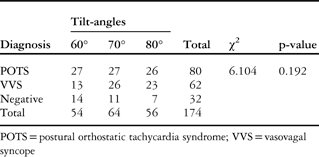
There were no statistical differences in age, height, weight and haemodynamic parameters among children at different angles of head-up tilt test (p>0.05, Table 1). There was no significant difference in the diagnostic rates in vasovagal syncope and postural orthostatic tachycardia syndrome cases among different tilt angles (χ2=6.104, p=0.192, Table 2).
Basic data and haemodynamic parameters ( ).

DBP=diastolic blood pressure; F=female; HR=heart rate; M=male; SBP=systolic blood pressure
Comparison of positive diagnosis rates at different tilt angles.

POTS=postural orthostatic tachycardia syndrome; VVS=vasovagal syncope
Correlation between the tilt angle and the level of psychological fear
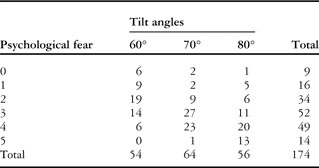
There was a significant difference in the psychological fear at different tilt angles measured using the Kruskal–Wallis test (χ2=36.398, p<0.01). The psychological fear between two tilt angles showed that it was lowest under 60° tilt angles (p<0.01). A positive rank correlation was found between psychological fear and the degree of tilt angle (rs=0.445, p<0.01) (Table 3, Fig 1).
Degree of psychological fear among different tilt angles. Degree of psychological fear: 0: comfortable; 1: generally comfortable; 2: minimally uncomfortable; 3: slightly uncomfortable; 4: severely uncomfortable; 5: extremely uncomfortable. A positive rank correlation was found between psychological fear and the degree of tilt angle.

Degree of psychological fear among different tilt angles (number).

Positive response appearance time at different tilt angles
There were no statistical differences of positive response appearance time in vasovagal syncope and postural orthostatic tachycardia syndrome at different tilt angles of head-up tilt test (p>0.05). The positive response appearance time for vasovagal syncope was 15.1±14.0 minutes at 60º, 19.1±13.2 minutes at 70º and 16.4±13.8 minutes at 80º, respectively. The positive response appearance time for postural orthostatic tachycardia syndrome was 4.3±3.5 minutes at 60º, 4.0±3.1 minutes at 70º and 3.3±3.2 minutes at 80º, respectively (Fig 2).
Positive response appearance time at different tilt angles. The positive response appearance time for VVS was 15.1±14.0 minutes at 60º, 19.1±13.2 minutes at 70º and 16.4±13.8 minutes at 80º. The positive response appearance time for POTS was 4.3±3.5 minutes at 60º, 4.0±3.1 minutes at 70º, and 3.3±3.2 minutes at 80º. There were no significant differences in the time for the appearance of a positive response. POTS=postural orthostatic tachycardia syndrome; VVS=vasovagal syncope.

Discussion
The head-up tilt test, at present, is widely recognised as a clinically useful diagnostic tool for assessing susceptibility to vasovagal fainting, in patients with unexplained syncope. This also allows reproduction of the patient’s spontaneous symptoms in a safe environment, under medical control.Reference Lai, Chen and Lin 4 , Reference Kikushima, Kobayashi and Nakagawa 20 The head-up tilt test is relatively safe. Some rare life-threatening ventricular arrhythmias have been described, but most of the cases occurred with isoproterenol provocation and in the presence of ischaemic heart disease or sick sinus syndrome.Reference Blanc 21 The literature confirmed that the head-up tilt test was a safe and reliable diagnostic tool, which could be utilised in most of the age groups.Reference Wang, Li and Wu 22
In addition to the positive diagnostic rate, a safety tilt angle was particularly important for children and young people. However, there has not been a definitive guideline regarding the optimal tilt angle of head-up tilt test yet. Forleo et al suggested that under the 60° tilt angle, there was a low sensitivity but a high specificity.Reference Forleo, Guida and Iacoviello 23 Voice found that induction of syncope in patients susceptible to neurally mediated syncope was similar to 60° and 80° head-up tilt test.Reference Voice, Lurie and Sakaguchi 24 Lewis showed the specificity >85% might be obtained by performing the tilt test at 60° or 70° for no longer than 10 minutes.Reference Lewis, Zlotocha and Henke 25 Zaidi et al indicated that increasing the tilt angle beyond 60° conferred no additional orthostatic stress and might not affect the sensitivity and specificity of the head-up tilt test, as was previously thought.Reference Zaidi, Benitez and Gaydecki 26 Our previous study analysed the positive rates at different tilt angles in only 18 cases, but the number of the study subjects was very small, limiting its significance. In this study, we found that there were no statistical differences in the positive diagnostic rates on postural orthostatic tachycardia syndrome and vasovagal syncope, but children would get the smallest psychological fear at 60° and there was a positive correlation between the tilt angle and psychological fear. Therefore, we recommended a tilt angle of 60° for the head-up tilt test in children.
We recommended 45 minutes as a suitable duration of the head-up tilt test. On the basis of a study of more than 100 patients, DuplyakovReference Duplyakov, Golovina and Sysuenkova 27 showed that the results of a head-up tilt test could be predicted within the first 5 minutes, by utilising a variability analysis of the heart rate. Some scholars have recommended a minimal time of 25 minutes for a head-up tilt test, and the time could be shortened to 15 minutes if administering sublingual nitroglycerin.Reference Liu, Fang and Liu 28 Khurana et alReference Khurana and Nicholas 29 indicated that tilt duration was a more important variable than tilt angle, and that the duration of the tilt should depend on the suspected cause of orthostatic intolerance. In this study, no statistical difference in positive response appearance time was found among different tilt angles in postural orthostatic tachycardia syndrome and vasovagal syncope. The positive response appearance time was 15.1±14.0 minutes at 60° for children with vasovagal syncope. Stretching the time by 2 SD (2×14.0=28), about 95% of the patients could be covered. Therefore, we recommended that the time of head-up tilt test be 45 minutes for vasovagal syncope. The positive response appearance time was 4.3±3.5 minutes at 60° for children with postural orthostatic tachycardia syndrome. Using the same paradigm, we recommended a head-up tilt test duration of 12 minutes for postural orthostatic tachycardia syndrome, by which about 95% of the patients could be covered.
Acknowledgements
None.
Financial Support
The work was supported by grants from the National Twelfth Five-Year Plan for Science & Technology Support [2012BAI03B03].
Conflicts of Interest
None.
Ethical Standards
The authors assert that all procedures contributing to this work comply with the ethical standards of the relevant national guidelines on human experimentation and with the Helsinki Declaration on 1975, as revised in 2008, and has been approved by Peking University First Hospital Ethical Committee. All procedures contributing to this work comply with the ethical standards of the relevant national guide.