Decades ago, interest groups were central to the study of American government, and group-based theories guided scholarly thinking about the whole of American politics (Truman Reference Truman1951; Schattschneider Reference Schattschneider1960; Lowi Reference Lowi1969). Yet their premier status was not to last. The Downsian revolution transformed political science during the 1970s and 1980s, reframing politics in terms of politicians, voters, and the electoral connection—and pushing interest groups toward the periphery (Downs Reference Downs1957; Hacker and Pierson Reference Hacker and Pierson2014).
Today a counter-revolution is brewing, fomented by agenda-setting articles recently appearing in Perspectives on Politics. At the forefront are Hacker and Pierson (Reference Hacker and Pierson2014), who argue that policy-seeking interest groups are the driving force behind the policy process. Also at the forefront are Bawn et al. (Reference Bawn, Cohen, Karol, Masket, Noel and Zaller2012), who argue that American political parties are coalitions of interest groups, and that parties cater to groups by choosing policies in the “electoral blind spot” of voters too ill-informed to know their own interests are not being served. Gilens and Page (Reference Gilens and Page2014) add support for these arguments, finding that the preferences of organized groups and economic elites, not average citizens, are the strongest predictors of policy outcomes.
This is not to say that interest groups have gone unstudied. The literature on the subject is fairly large (Baumgartner et al. Reference Baumgartner, Berry, Hojnacki, Kimball and Leech2009; Hojnacki et al. Reference Hojnacki, Kimball, Baumgartner, Berry and Leech2012), and interest groups play prominent roles in research on agendas and public policy—emerging, notably, from Baumgartner and Jones’s (Reference Baumgartner and Jones2009) theory of punctuated equilibria and Sabatier’s (Reference Sabatier1988) theory of advocacy coalitions. That said, Hacker and Pierson are quite right to throw down the gauntlet. For decades, interest groups have not been at the center of the field’s theory and research, and they must be if American politics is to be well understood.
We attempt to move that agenda forward. We do so by exploring an aspect of group influence that has received little systematic attention in the modern study of interest groups: the role that groups play on the inside of government as official or quasi-official participants in the making of bureaucratic decisions.Footnote 1
The modern interest group literature has invested heavily in studies of how groups attempt to influence government from the outside through lobbying and campaign contributions (see Hojnacki et al. Reference Hojnacki, Kimball, Baumgartner, Berry and Leech2012). It has also devoted attention to capture, iron triangles, and subsystem arrangements in which interest groups have ongoing, mutually beneficial relationships with agencies and legislators as political allies (Baumgartner and Jones Reference Baumgartner and Jones2009; Carpenter and Moss Reference Carpenter and Moss2014). But even these latter studies, while recognizing the favored status of interest groups within policy subsystems, do not specifically explore the roles that groups can play inside the bureaucracy as regular participants in bureaucratic decision-making. Little is systematically known, as a result, about how bureaucratic governance structures are designed to incorporate them, how group involvement varies across policies and bureaucratic venues, and what the policy consequences are.Footnote 2
The challenges facing researchers are formidable. Scholars who study campaign contributions and lobbying have access to large existing datasets, but any effort to study groups as inside actors requires the laborious collection and coding of entirely novel data. For a comprehensive program of quantitative research, moreover, this would need to be done across agencies; and different agencies have different decision processes, make different kinds of policy decisions, and empower different interest groups. To complicate matters further, basic information about agency decision-making can be elusive because so much of it takes place in the bureaucratic shadows, shielded from public view. Finally, even if these hurdles can be overcome, there remain endogeneity concerns. Agency design, including the degree of interest group involvement, is a product of politics; and the factors that shape it may well be correlated with policy outcomes of interest.
These challenges of design, data collection, measurement, and causal inference are daunting. But if a fuller understanding is to be gained of how interest groups shape American politics and policy, their insider roles need to be made sustained subjects of theory and research, however difficult the obstacles. Ours is an exploratory effort to encourage new work along these lines.
Our substantive focus is on public-sector pension funds, which are attractive targets of study for several reasons. First, pension policy is an arena in which a key economic interest has typically been granted a direct policymaking role on the relevant governing structures—pension boards—inside state bureaucracies. Most state statutes set aside positions on their pension boards for public employees (the systems’ beneficiaries) and thus, in practice, for the interest groups that represent them. Second, pension boards across states all make roughly the same kinds of funding decisions, and those decisions are inherently quantitative in nature and comparable across plans and years.Footnote 3 By focusing on public pensions, then, and the bureaucratic structures by which they are governed, we can develop quantitative measures of both interest group involvement and bureaucratic decisions.
Public pensions are also crucial matters of public policy and fundamental to every state government as well as many local governments. Their economic significance is staggering: they collect, invest, and distribute astronomical sums of public money, and with assets of about $4 trillion they represent the largest pool of investment capital in the country. They are also the main source of retirement security for millions of state and local government employees. Today, moreover, many pension programs are seriously underfunded—pressuring government budgets, crowding out public services, and burdening future generations. Indeed, these fiscal consequences are so severe that the underfunding of public employees’ pensions and other retirement benefits looms as one of the great policy challenges of the modern era (DiSalvo Reference DiSalvo2015a; Kiewiet and McCubbins Reference Kiewiet and McCubbins2014; DiSalvo and Kucik Reference DiSalvo and Kucik2017).
We argue here that the underfunding problem is aggravated by the way public pension funds are governed. A common perspective within the broader pensions literature is that, with state politicians and their board appointees vulnerable to political influences, granting public employees official decision roles helps to promote responsible fiscal behavior and full funding—because their own retirement benefits are on the line (Hess Reference Hess2005; Stalebrink Reference Stalebrink2014; Vermeer, Styles, and Patton Reference Vermeer, Styles and Patton2010). We set out a theory that offers a very different perspective, suggesting that employee representatives actually have incentives to favor policies that undermine the fiscal well-being of their own pension funds—and that politicians and their appointees, while indeed vulnerable to political influences and prone to irresponsible behavior, have a mix of incentives that incline them to act more responsibly by comparison. The official role of “interest groups on the inside,” then—a presumed check on the misbehavior of politicians—makes the underfunding problem worse, not better.
The challenges of carrying out a definitive test of the effects of these insider employee representatives are formidable, as we said, so we present our empirical analysis as suggestive and exploratory. We carry out a study of 109 state-operated pension funds from 2001 to 2014—focusing on the composition of their governing boards, key types of decisions, and board member effects on decisional outcomes. The findings suggest, as theory leads us to expect, that the official involvement of employee insiders works to undermine the fiscal integrity of state pension systems, and that politicians and their appointees are relatively more inclined to protect it. We go on to present two prominent case studies of pension politics in California and Rhode Island that illustrate and support these findings.
This analysis is not conclusive, but it begins to shed new light on the governance of America’s public pension funds, their susceptibility to insider group influence, and the problem of underfunding. More generally, our hope is that, by highlighting the role of interest groups in bureaucratic governance structures, we can encourage further studies of interest groups on the inside—and underline the value of bringing interest groups back to center stage in the field of American politics.
Background
Public pensions began to gain traction during the Progressive Era as part of the emerging American welfare state. By 1960, all but eleven states had adopted pension plans for their own employees, and by the mid-1970s every one of them had. Local governments moved in the same direction, although many local plans have been consolidated at the state level. Today, most state and local workers are covered by pension funds controlled by their states (Clark, Craig, and Sabelhaus Reference Clark, Craig and Sabelhaus2011).
Over the decades, public pensions have grown more generous and costly. As this occurred, governments routinely claimed that the contributions to their pension funds, augmented by investment returns, were sufficient to cover the promised benefits. All was supposedly good—until the Great Recession and research by financial economists revealed that it wasn’t (Novy-Marx and Rauh Reference Novy-Marx and Rauh2009). Indeed, research showed that these pension plans had been chronically underfunded for a long time.
Many states were faced with fiscal crises, and pension reform quickly topped their political agendas. The ensuing wave of reform, however, hasn’t come close to providing full funding. State policymakers have typically done just enough to avoid calamity in the present, leaving the core fiscal problems unresolved (Kiewiet and McCubbins Reference Kiewiet and McCubbins2014).
Theory
The formula for financial integrity is straightforward: the promised benefits must be covered by contributions and investment returns sufficient to pay for them. Yet the states often don’t do what they need to do (Novy-Marx and Rauh Reference Novy-Marx and Rauh2009). In explaining their funding problems, officials tend to point to hard economic times, down stock markets, and other short-term problems. But the real problems are endemic, arising from the way pension systems are governed and the incentives of those who govern them.
All but a few states follow the same basic model: they delegate authority to multi-member boards. The legislature and the governor are ultimately in charge, but in practice they mainly use their authority to set benefit levels (Anzia and Moe Reference Anzia and Moe2017), and sometimes contribution levels. Almost all other decisions are left to the pension boards.
The composition of these governance structures is set in statute. The typical board consists of five to fifteen trustees, some (e.g., state treasurers) participating ex-officio and the rest representing various constituencies: active public workers, retired public workers, government employers (school districts, counties), and the public. Ex-officio trustees are on the board automatically. Others are either appointed (typically by the governor) or elected; and if elected—the norm for employee trustees but not others—they are chosen solely by the constituencies they represent.
Political scientists have not studied these governance structures, but there is a small scholarly literature on the topic. One of its themes is that pension boards respond to political pressures—to favor certain financial advisers, to invest in local projects, to avoid ideologically verboten industries (tobacco, oil)—that divert them from responsible management. A second theme is that the key culprits are public officials and their board appointees, whose incentives are to be responsive to such political influences—and that the employee representatives, in contrast, have incentives to protect the boards’ fiscal integrity and ensure that their own retirement funds are properly managed. As Hess (2005, 199) puts it, “member-elected trustees have strong incentives to perform their board-related duties, while politically affiliated trustees have incentives to shirk and act opportunistically” (see also Stalebrink Reference Stalebrink2014; Vermeer, Styles, and Patton Reference Vermeer, Styles and Patton2010; Romano Reference Romano1995).
This literature is a useful foray into uncharted territory, but its analysis of incentives is off the mark. The place to start is with a touchstone of political economy with profound relevance for the politics of pensions: namely, that pensions lend themselves to “fiscal illusion” (Buchanan and Wagner Reference Buchanan and Wagner.1977), which politicians can employ to great advantage. As we explain in an earlier article (Anzia and Moe Reference Anzia and Moe2017), politicians can gain support of public workers and their unions by offering generous pension benefits—and they can gain further, with voters at large, by not requiring governments to make the high annual contributions necessary to fully fund those benefits. This way, they keep current government costs artificially low; they keep voters in the electoral blind spot, unaware of the true cost burden; and they make generous pension packages seem eminently affordable. The true costs will eventually come due. But this won’t happen for decades, when other politicians and taxpayers are responsible for the bill. In the meantime, the public money “saved” can support other government services, limit taxes, or balance budgets. For all these reasons, politicians have incentives to be fiscally irresponsible in their approach to pensions. We expect these same incentives to be transmitted to board members who are appointed by politicians.Footnote 4
Another basic feature of pension politics is that public workers and their unions have incentives to support the chronic underfunding of their own pensions. Due to state statutes, constitutions, and judicial decisions, pensions promised by state politicians are backed by strong legal protections almost everywhere; and public workers thus know they will eventually get what they are promised even if their pension plans are currently underfunded.Footnote 5 Indeed, because full funding on a regular schedule would be tremendously costly for state (and local) budgets—crowding out other services, forcing higher taxes, making the true costs of pensions painfully transparent to citizens—public workers and their unions have incentives to prefer that their pension plans be underfunded. Underfunding enables the fiscal illusion that pension benefits are much less expensive than they really are. If public workers and their unions want increasingly generous benefits in future years, they need to convince the public that these benefits are not costly to provide. At the same time, underfunding keeps employee contributions to their own pension funds at low levels; and by keeping contributions by their employers down, they are freeing up public money for other government services, keeping public workers employed—and providing funds for their own salaries and raises.
Thus, because the typical pension board is made up of public officials, appointees of public officials, and members elected by employees (with unions playing a big role, as we will discuss), it follows that all the key players typically have incentives to be fiscally irresponsible in their management of pension funds. Yet there is a partial corrective built into the system: politicians have electoral connections to taxpayers and citizens at large (e.g., Dahl Reference Dahl1961; Denzau and Munger Reference Denzau and Munger1986; Arnold Reference Arnold1992). This gives politicians incentives to steer clear of the fiscal crises and abject mismanagement that can lead to negative media and the movement of policy out of the voters’ blind spot. And in times of trouble, it gives them incentives to favor reforms that—with full funding so politically painful—would at least improve things enough to move policies back into the voters’ blind spot again.
These good-government incentives are stronger for some politicians than others. They are likely to be greatest for governors, who are typically the focus of public accountability on important policy matters, including pensions, and who—whether Democrat or Republican—are expected to “do something” to promote fiscal responsibility when things go bad. Even when governors are in their final terms, moreover, their concerns about their legacies and their reputations as strong leaders give them incentives to right the ship.Footnote 6 The same is true for other elected executives (such as state treasurers or comptrollers), and these good-government incentives should be transferred to political appointees as well. For state legislators, by contrast, such incentives are likely to be weak. Their small constituencies and large numbers tend to ensure that they are not held individually accountable for state-level policy outcomes; and they have reason to be much more responsive to special interests (including public-sector unions).
A deep dive into pension politics would reveal all sorts of additional complexities, from the machinations of financial advisors to the self-interested biases of actuaries to political pressures for (un)deserving targets of investment. But the basics we’ve just discussed lie at the core of the politics of pensions, and they provide a theoretical perspective that is simple, clear, and useful in guiding our expectations.
They suggest that it is a mistake to portray politicians and political appointees as the key source of fiscal irresponsibility in public pension systems, to portray elected employee trustees as champions of fiscal integrity, and to argue that pension boards will be better run when public workers have a greater role in governance. All these players have incentives to govern irresponsibly—and public workers, in particular, stand to benefit considerably when their own pensions are underfunded. To the extent that fiscal integrity has advocates—in a relative sense—we should expect to find them among the executive politicians and their appointees, whose incentives to behave irresponsibly are moderated by countervailing incentives to promote good government.
Employee Representatives and Unions
If public workers were atomized, they would have little basis for asserting their interests on pension boards. Pension policy is so arcane that most would be uninformed about how board decisions affect them. They would also be poorly informed about board elections and candidates, for these tend to be low-visibility, low-turnout elections that involve incredibly technical issues.
But public employees are not atomized. They have organized interest groups to represent them. Most notable are the state (and local) affiliates of the nation’s major public-sector unions: AFSCME, the SEIU, the National Education Association, the American Federation of Teachers, the International Association of Fire Fighters, and others. Throughout the nation, even in much of the “nonunion” South, these unions are typically large, well funded, and politically active (Disalvo Reference DiSalvo2015a). Most states also have retiree associations that organize retired public workers and are often affiliated or allied with unions.
These employee interest groups care intensely about their states’ pension funds, which are not only valuable to members but also of major consequence for state spending, taxing, services, investments—and jobs. They therefore have strong incentives to be well informed about pension policy, get involved in board elections, and provide elected board members with advice to shape their decisions. No one has studied these board elections, and there is little publicly available information about them. But based on information that does exist (refer to the online appendix), it appears that public-sector unions and retiree associations are indeed quite involved. They commonly endorse board candidates, donate money, and orchestrate voting. Also, boards with elected employee trustees often feature members with leadership experience in public-sector unions or retiree associations. And these same organizations monitor and often participate in board meetings, and have clear positions on issues. From board elections right through to board decision-making, then, the evidence suggests that employee interest groups work to ensure that pension boards represent employee interests.
The Mechanics of Public Pension Contributions
Politicians—legislators, governors—usually reserve for themselves the right to make decisions about pension benefits: these are opportunities to claim credit. Decisions that affect contributions—and thus costs—are typically delegated to pension boards. Accordingly, these are the decisions we will focus on here. We discuss what the key contributions decisions are and how they relate to the underfunding problem.
Pension liabilities are supposed to be prefunded, with governments and employees setting aside sufficient funds each year to pay for the future pension benefits employees have earned. To that end, the boards calculate the “actuarially required contribution,” or ARC. These calculations involve assumptions about the discount rate, mortality rates, salary growth, inflation, and more—assumptions that are uncertain, can be manipulated, and greatly affect the calculation of the ARC.
Of these, the most consequential is the discount rate. To see why, consider a payment of $100 million due in twenty years. What is its cost in today’s dollars? If we use an 8% annual interest rate to discount that future liability, the answer is $21 million. But if we use a 4% discount rate, it is $46 million—which means that much larger current contributions are required. The higher the discount rate, the lower the estimate of future pension liabilities and the less governments and employees must contribute for “full funding.”Footnote 7
Today, experts point to too-high discount rates as a major cause of underfunding. State pension boards typically set the discount rate equal to their expected rate of return on investments, which might seem to make sense. If they know they will need $100 million in twenty years, and they plan to make 8% on investments, then that 8% rate should presumably determine how much they must invest today to meet the $100 million target. But this approach ignores the risk that their investments will earn less than 8%, perhaps a lot less. Should that happen, they will still be required to pay the $100 million when it comes due.
Because of this risk, most finance economists agree that the discount rates typically used by public pension plans, roughly 8%, are way too high, and that fiscal integrity requires much lower rates closer to 4 or 5%. Such a shift would automatically entail dramatically higher annual contributions—and lots of political pain. State boards have chosen not to go that route. They have continued to embrace too-high discount rates, and thus to keep contributions too low and to chronically underfund their pension plans.
Decisions to underfund do not end there. Once the ARC is calculated, based on the discount rate and other actuarial assumptions, there is no guarantee that governments will actually pay the “required” annual amounts into their pension funds. Frequently, they pay only a fraction of the ARC—even though the ARC has already been manipulated to be artificially low.
Who decides what percentage of the ARC governments will actually pay? That decision is sometimes the prerogative of the board, or it can involve the legislature. In some plans, for example, the board decides what will be contributed, but the legislature must approve the contribution rate, or must appropriate funds, or may cap contributions. In a few other plans, the contribution rate is determined by a statute specifying that a fixed percentage of payroll be contributed year after year. We need to account for this variation in our analysis. For the moment, though, we simply point out that purposely not meeting the ARC requirements is another major channel through which policymakers can actively underfund pensions.
In our analysis, therefore, we will focus on decisions about the discount rate and decisions about how much of the ARC gets paid. Our goal is to assess whether government employees and their unions are associated with less responsible funding policies than the political trustees, as we have argued.
Data on Pension Boards
To assemble our dataset, we started with the 2015 Public Plans Database (PPD) from Boston College’s Center for Retirement Research, which compiles statistics from the financial reports of 114 state-operated pension plans. We then used LexisNexis Academic, state legislatures’ websites, and pension plans’ websites to locate the statutes specifying how their boards are composed and how members are to be selected. Using the statutes in place for each plan from 2001 to 2014, we coded each trustee as being one of five types.
Statutes typically designate positions for government employees, but they can be selected in different ways. Many are chosen by elections in which only public workers can vote, or by union bargaining units. Others are appointed by state politicians, usually governors. We expect that trustees chosen by employees will be the most reliable representatives of their interests; employee trustees appointed by state politicians may have loyalty to those politicians, or perhaps have political ambitions. We therefore create two employee trustee variables: the percentage of board members who are employee trustees chosen by employees (% Elected employees), and the percentage who are employee trustees appointed by politicians (% Appointed employees).
There are three additional categories. First, most plans reserve positions for state government officers, such as the governor or treasurer. We create a variable, then, equal to the percentage of trustees who are such ex-officio members. Second, some plans assign positions to representatives of government employers; almost all of these are appointed by state officials, usually the governor. This is our next variable: the percentage of board members who are employer trustees appointed by politicians. Finally, some statutes create positions for private citizens, taxpayers, or people with financial expertise; still others do not provide criteria for certain trustees. Nearly all such trustees are appointed by state officials, usually the governor. Our final variable groups these miscellaneous trustees together: the percentage of board members who are either private citizen or other trustees.Footnote 8
Of the 114 plans, 5 are not governed by a board of trustees, so our dataset tracks the composition of 109 boards from 2001 to 2014. We begin by looking at the overall share of employee trustees on the boards: we add together % Elected employees and % Appointed employees and present the distribution of that combined variable for all 1,526 plan-years in our dataset. Refer to the top left of figure 1. Strikingly, this variable is zero for only 84 observations; 103 of the 109 plans reserve positions for public workers. Also, employee trustees typically have a large share of the seats: for boards that have them, the median share is 50%. Thus, it is common for a key interest group to be in a position of policymaking authority.
State pension board composition

We next examine the two categories of employee trustees separately: the top-right panel of figure 1 shows the distribution of % Elected employees, and the middle-left panel shows % Appointed employees. Clearly, it is more common for employee trustees to be elected by employees rather than appointed by politicians. In all, 1,023 plan-years feature at least some elected employees, compared to only 648 plan-years with appointed employees. In our analysis, we keep these variables separate, expecting that elected employee trustees act more reliably in employees’ interests.
The distributions of the remaining board composition variables are shown in the final three plots of figure 1. In the middle-right plot, we can see that 71% of the board-year observations have at least one ex-officio member, but they rarely make up a large percentage of the board. On the bottom-left, we show that most boards do not have any employer trustees, and that when they are present they are usually a small contingent. Finally, the bottom-right shows that two-thirds of the boards reserve a small share of seats for private citizens or other trustees.
Overall, our data reveal that there is considerable variation in board composition across plans—and also that elected employee trustees usually have a large presence. We also find, however, that there is far less variation in board composition within plans over time. Over this 14-year period, 81 of the 109 plans had no changes to their share of elected employee trustees, and in the remaining 28 nearly all changes were small. Therefore, most variation we explore is variation across plans.
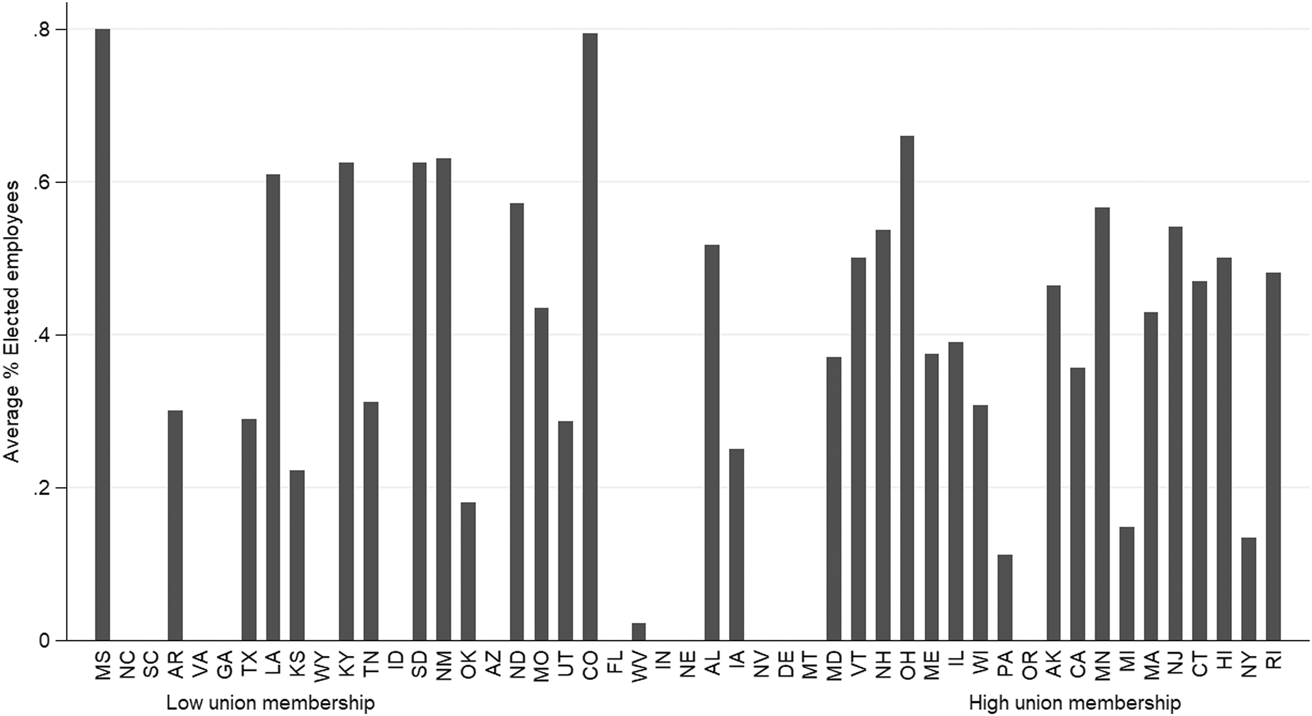
Moreover, the data show that boards with high shares of employee trustees are found throughout the country, even in states with relatively weak unions. In figure 2, we sort the states from lowest (Mississippi) to highest (Rhode Island) on public-sector union membership, and plot the average of % Elected employees in each state.Footnote 9 The figure shows that even weak-union states like Mississippi and Louisiana have boards with high shares of employee trustees. Moreover, some states with stronger unions, such as Oregon and Michigan, have boards with little or no elected employee representation. Therefore, pension boards with high employee representation are not limited to states known for having a pro-worker or pro-union culture.
Union membership and percent Elected employees

Government Employees and Public Pension Funding
We next consider whether public employee strength is associated with key pension funding decisions. Our first dependent variable is the discount rate. While plans rarely make major changes to their discount rates from year to year, there is meaningful variation in the rates used by these 109 plans over the fourteen years in our study: according to the PPD, they feature discount rates ranging from 0.055 to 0.09. In the analysis, we are testing our argument that government employees have greater incentive than the other political actors to keep discount rates high—and thereby keep required contributions low.
We also analyze the fraction of the ARC contributed each year, again using data from the PPD. In our dataset, the median value of this variable is 1, or 100% of the ARC. Occasionally, it is greater than 1. But in 43% of the observations it is less than 1, meaning that governments contributed less than what was officially required. Our goal is to test whether public employees influence this decision in the direction of less responsible funding—and thus toward a lower fraction of the ARC being paid—more so than the other trustees.
To model these dependent variables, we use OLS with standard errors clustered by pension board, regressing both the discount rate and the fraction of the ARC paid on the board composition variables. Because the five composition variables are fractions that sum to 1, we set % Ex-officio as the excluded category. This means the estimated coefficient for each board composition variable can be interpreted as the association between the dependent variable and an increase in the share of that type of trustee, while decreasing the share of ex-officio members by the same amount and holding constant the shares of the other three kinds of trustees.
While our focus is on the employee trustee variables, we also need to consider public-sector unions. When unions are strong, we expect them to influence decision-making in a few ways. First, as we have discussed, they can try to ensure that the “right” kinds of employee trustees are selected for the boards, and then try to inform their policy decisions. But the unions can also try to influence the selection and decisions of the other decision-makers: ex-officio trustees, political appointee trustees, and even the legislature. Therefore, when public-sector unions are strong, pension funding policy overall should be more aligned with government employees’ interests. In our models, then, we include the public-sector union membership variable we introduced earlier.
We also need to consider whether economic conditions or fiscal stress affect policymakers’ decisions. Certain scholars argue that pension administrators make less responsible decisions when fiscal conditions are poor (Mitchell and Smith Reference Mitchell and Smith1994; Stalebrink Reference Stalebrink2014). For that to hold, however, policymakers would have to be more responsible during times of low fiscal stress—and examples abound of governments taking “pension holidays” (lowering contributions) during good economic times. Thus, the impact of fiscal stress is an open question. To allow for its relevance, we include year fixed effects, which account for year-to-year variation in national economic conditions, including stock market returns, and the percentage change in state general revenue from the previous year, which accounts for variation in fiscal pressure from state to state and within states over time.
Empirical Results
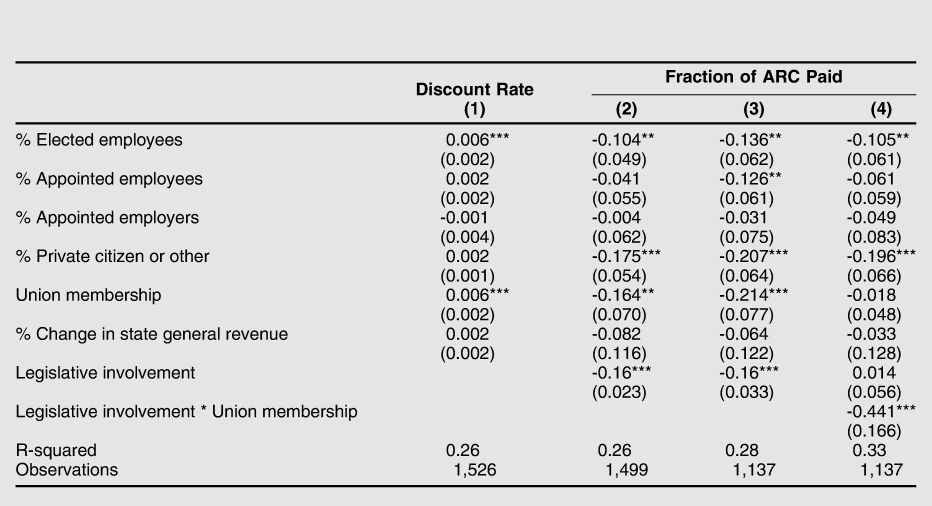
In column 1 of table 1, we present the results of the discount rate model. The coefficient on % Elected employees is positive, indicating that the elected employee trustees are associated with less responsible decisions than the ex-officio members. Specifically, compared to boards with no elected employee trustees, boards that are two-thirds elected employee trustees have discount rates that are an average of 0.42 percentage points higher. This is a substantively large effect, equal to a full standard deviation.
Government employees and public pension funding

Notes: Standard errors clustered by pension board in parentheses. The excluded board composition variable is % Ex-officio. All models include year fixed effects. Hypothesis tests are two-tailed. *p<0.1; **p<0.05; ***p<0.01.
Next, we consider whether any of the political appointee trustees have the same positive association with discount rates. Turning first to the politically-appointed employee trustees, our expectation (explained earlier) is that these trustees should be weaker representatives of workers’ interests. Consistent with that expectation, the coefficient on % Appointed employees is statistically insignificant, and an F-test rejects the hypothesis that it is equal to the coefficient on % Elected employees. Thus, in contrast to the trustees chosen by employees, increasing the share of politically-appointed employee trustees (and decreasing the share of ex-officio members) has no relationship with discount rates. The results also show that increasing the share of non-employee political appointees makes no clear difference to discount rates: the coefficients on % Appointed employers and % Private citizen or other are both statistically insignificant.
We also find no clear relationship between discount rates and fiscal stress. The year fixed effects (not presented) show that discount rates have gradually lowered over time, and the coefficient of state revenue growth is statistically insignificant. Neither pattern supports the hypothesis that fiscal stress makes administrators more likely to keep discount rates high.
Public-sector union membership, however, has a significant positive association with discount rates, suggesting that strong public-sector unions push boards toward less responsible actuarial assumptions. On average, boards in states like Rhode Island, with 77% union membership, adopt discount rates that are 0.38 percentage points higher than boards in states like Mississippi, with 8% union membership. This means that government employees not only influence discount rates by having their own representatives on the boards, but they also exert political pressure through their unions—resulting in higher discount rates.Footnote 10
Even with the actuarial assumptions built into the ARC, policymakers still often contribute a fraction of the officially required amount. This, then, is the variable we model next: the fraction of the ARC paid. If plans with greater employee representation are more dependable in paying the full ARC, then perhaps that helps make up for their rosier actuarial assumptions.
We use the same general approach as before, with two modifications. First, we exclude cases in which the dependent variable takes on extreme values. Occasionally, the fraction of the ARC paid exceeds 1 by a large amount. In researching all observations in which this fraction is greater than 1.5, we found that most either had contributions set by statute or involved special payments to the pension fund—for example, payments using proceeds of pension obligation bonds. In columns 2–4 of table 1, therefore, we drop 24 plan-year observations in which the fraction of the ARC paid is greater than 1.5.Footnote 11
Second, we account for the fact that decisions about contributions often involve the state legislature (which is not the case for the discount rate). In some cases, the contribution rate is set by statute, usually specifying that contributions will be a fixed percentage of payroll year after year. In others, the board sets the contribution rate, but then the legislature is involved in some way: it has to approve the rate, it has to appropriate funds to make the contribution, or it puts a limit on contributions.Footnote 12 We expect that when the legislature is involved, the result will likely be less responsible funding decisions, because legislators (compared to executives) have narrow constituencies and are more susceptible to interest group pressure.
In our ARC analysis, we use three different approaches to account for legislative involvement. Our first approach includes an indicator, Legislative involvement, equal to one if the legislature plays any role in the decision about what gets contributed. Our second approach includes Legislative involvement but drops 378 cases in which the contribution rate is set by statute, both because the board is not a decision-maker in those cases and because the ARC is not even the target amount. Finally, our third approach tests for an interaction between legislative involvement and public-sector union membership. In our discount rate analysis, this additional step was not necessary because discount rate decisions are virtually always made by the board—and so the relationship between union membership and discount rates could reasonably be interpreted as union influence on the board of trustees. For the fraction of the ARC paid, however, unions could influence the board or they could influence the legislature. We might also expect any effect of legislative involvement to depend on union membership, because legislators are probably more responsive to unions in states where they are strong. Allowing for an interaction of union membership and legislative involvement lets us evaluate these possibilities.
We begin with our first approach in column 2 of table 1. Does the evidence suggest that government employees are associated with more reliable payment of the ARC? The answer is no. Instead, we find that increasing the share of elected employee trustees is associated with a lower fraction of the ARC paid. Specifically, increasing their share on the board from 0 to two-thirds is associated with a seven point decrease in the percentage of the ARC paid. Thus, not only are employee trustees associated with more distorted ARCs (because of higher discount rates), but they are also associated with paying a lower percentage of those more distorted ARCs.Footnote 13
We also estimate a statistically significant negative coefficient on public-sector union membership. The results show that a shift from a low-union state like Mississippi to a high-union state like Rhode Island is associated with an 11 point drop in the percentage of the ARC paid. Therefore, when public-sector unions are strong, the result is less responsible funding of public workers’ pensions.
As in the discount rate model, we find that increasing the share of politically-appointed employee trustees has no significant relationship with the fraction of the ARC paid. We also estimate an insignificant coefficient on the share of appointed employer trustees. Together, these results suggest that the appointed employee and employer trustees behave similarly to the ex-officio members in their decisions on contributions. One surprising finding is the negative coefficient on % Private citizen or other. We did not expect this relationship, nor do we have a good explanation for it. Because this category combines a few different types of trustees—private citizens, taxpayer representatives, and trustees for whom the statutes provide no criteria—it is difficult to say why it has a negative impact. However, we did not find a similar relationship in the discount rate model, which leads us to question whether this association is meaningful.
Once again, it does not appear that policymakers in fiscally stressed states are more likely to underfund their pensions. Moreover, the negative coefficient on Legislative involvement shows that when the legislature gets involved, the fraction of the ARC paid is lower. On average, plans that involve the legislature in decisions about contributions pay 16 percentage points less of the ARC.
In column 3, we drop the cases where contribution rates are set by statute, and our main findings get stronger. The negative coefficient on % Elected employees grows to -0.136. Here, we also estimate a negative association between the fraction of the ARC paid and the share of appointed employee trustees, similar in magnitude to that of % Elected employees. Also, the negative coefficient on Union membership is larger than in column 2. We also continue to find negative coefficients on the share of private citizen and other trustees and legislative involvement. As expected, then, our results become clearer when we limit the analysis to cases where the board is involved and the ARC is a target used for deciding on contributions. When public workers are more involved, the result appears to be a lower fraction of the ARC paid.
Does the effect of legislative involvement vary with union strength? And do the negative coefficients on union strength in columns 2 and 3 represent union influence on the board, on the legislature, or both? The LOWESS plots in figure 3 provide preliminary answers. There, we plot the fraction of the ARC paid against public-sector union membership, separately for plan-years with no legislative involvement (on the left) and for plan-years with legislative involvement (on the right).Footnote 14 Three patterns emerge. First, when it is only the board that decides, union strength has no relationship with the fraction of the ARC paid. Second, when the legislature is involved, there is a negative relationship between union membership and the fraction of the ARC paid. Third, comparing the two graphs, we can see that in states where union membership is low, there is no clear effect of legislative involvement on the fraction of the ARC paid. Thus, legislative involvement is only associated with a lower fraction of the ARC paid in stronger-union states.
Union membership and fraction of the ARC paid, by legislative involvement

In column 4 of table 1, we test these patterns by adding an interaction of Legislative involvement and Union membership to our model from column 3. The coefficient on Union membership is insignificant, showing that stronger unions are not associated with a lower fraction of the ARC paid when legislatures are not involved. Thus, when it is entirely up to the board to decide, unions have their influence at the assumption-setting stage: they push the boards to adopt discount rates that keep ARCs artificially low. However, almost half the plan-years in column 4 do involve the legislature. And when the legislature is involved, union strength has a strong negative association with the fraction of the ARC paid: shifting from a weak-union state like Mississippi to a strong-union state like Rhode Island is associated with a 31 point decrease in the percentage of the ARC paid. Moreover, in weak-union states, having the legislature involved does not appear to affect the fraction of the ARC paid. But it does in strong-union states like Rhode Island, where shifting from board-only decision-making to legislative involvement is associated with a 32 point drop in the percentage of the ARC paid.Footnote 15
We have covered a great deal of ground here, dealing with two technical dependent variables, each with their own complexities. But the overall thrust of our analysis is clear. It shows that increasing the share of government employees on pension boards—especially those chosen by government employees themselves—is associated with higher discount rates and a lower fraction of the ARC paid. And when public-sector unions are strong, the result again is higher discount rates and lower-than-required contributions. The general pattern, then, is that greater involvement of government employees is associated with less responsible pension funding decisions.
Political Parties and the Scope of Conflict
To provide a more complete account, we want to consider whether there are other political variables that might affect these decisions. The most obvious candidate is political party. At first glance, it would seem that Democrats and Republicans should approach pensions differently: it is a labor issue as well as an issue of government taxing and spending, both of which usually divide the major parties (Jochim and Jones Reference Jochim and Jones.2012), plus the Democrats are the unions’ political allies and the Republicans aren’t. But when it comes to standing up for the fiscal integrity of public pension systems—and thus paying the much-higher costs that such integrity would entail—politicians of both parties (and unions too) have incentives to back away from full funding, to free up money for other priorities, and to push political pain into the future. Thus, there is no clear theoretical basis for expecting one party to be the champion of full funding, or for expecting Republicans to behave differently than Democrats.
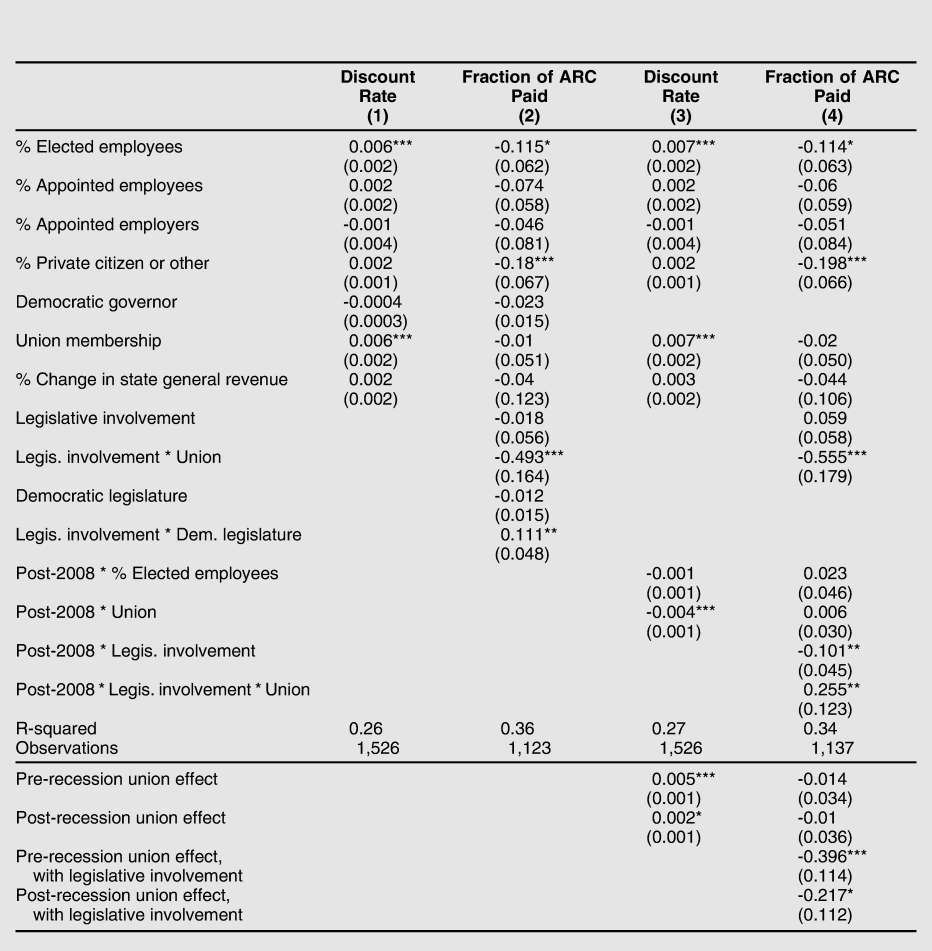
Even so, in table 2, we test whether ex-officio members who are Democrats, and various political appointee trustees who are appointed by Democrats, make different decisions than Republicans and their appointees do. We start in column 1 (the discount rate model) by adding an indicator for whether the governor in each state and year is a Democrat—a reasonable approach given that ex-officio trustees are usually members of the governor’s party and that the governor is usually the one who appoints the political appointee trustees. All of our earlier findings are substantively the same. But more importantly for our purposes here, we estimate a statistically insignificant coefficient on Democratic governor. Therefore, discount rate decisions made by boards operating under Democratic governors are not significantly different than those operating under Republicans.
Political parties and expansion in the scope of conflict

Notes: Standard errors clustered by pension board in parentheses. All models include year fixed effects. Hypothesis tests are two-tailed. *p<0.1; **p<0.05; ***p<0.01.
We use a similar approach to explore whether Democrats are associated with a higher (or lower) fraction of the ARC paid. In column 2 of table 2, we add three new binary indicators to the model from column 4 of table 1. The first is Democratic governor, which again tests whether ex-officio members and political appointees of one party are associated with different decisions than those of the other party. But as before we have to account for possible legislative involvement at this stage, and because our goal here is to test for party differences, we want to test whether the effect of legislative involvement depends on the party of the legislature. We therefore add Democratic legislature, which equals 1 if the Democrats have majorities in both chambers of the legislature, as well as its interaction with Legislative involvement. The estimates reveal no consistent pattern in the relationship between political party and the fraction of the ARC paid. The coefficient on Democratic governor is negative (p=0.12), but the coefficient on the interaction of Legislative involvement and Democratic legislature is positive.Footnote 16 All we can say, then, is that no clear pattern of partisanship emerges. And there is good reason to expect as much. Democrats have incentives to underfund, and so do Republicans.
One final question is whether the politics of pension funding changed with the onset of the Great Recession, which triggered an expansion of the scope of conflict on the pension issue. The funds suffered staggering investment losses, voters were suddenly flooded with information about public pensions, new interest groups became active on the issue, and there was much pressure for governments to “do something” to address the fiscal crisis (Anzia and Moe Reference Anzia and Moe2017).
How might these developments have affected the politics of pension funding? One possibility is that the increased public scrutiny made it harder for policymakers to continue making irresponsible decisions. For example, many reformers, think tanks, and good government groups began to criticize plans’ rosy actuarial assumptions, which presumably made it more difficult for policymakers to keep their high discount rates. If so, the influence of government employees and public-sector unions may have weakened with the onset of the recession. They continued to hold positions on the board and still had clout in many states, but perhaps they had less ability to keep discount rates high and contributions low.Footnote 17
To investigate this, we return to our discount rate model and test whether the coefficients on % Elected employees and Union membership decrease in the post-2008 period. We do this by interacting both variables with Post-2008, which equals 1 for years later than 2008 and 0 otherwise. The results are presented in column 3 of table 2. Consistent with our expectations, the coefficient on Union membership is positive, and the coefficient on the interaction of Post-2008 and Union membership is negative. The latter coefficient indicates that the positive association between union membership and the discount rate got smaller after 2008. At the bottom of column 3, we use the model estimates to calculate the effect of shifting from a weak-union state (8%) to a strong-union state (77%), first for years before the recession (“Pre-recession union effect), then for years after the recession (“Post-recession union effect”). We find that before the recession, the shift from a weak to a strong union state was associated with an increase in the discount rate of 0.5 percentage points. After the recession, the effect was only 0.2 percentage points—significantly smaller than before the recession. However, we also find that the interaction of Post-2008 and % Elected employees is statistically insignificant. This suggests that even after the recession, the share of elected employee trustees on the board maintained the same positive relationship with the discount rate.
There is a plausible reason for these mixed findings that is worth considering. After the onset of the Great Recession, public-sector unions were operating in a more hostile political environment, one in which they had to contend with newly activated opposition groups and reformers, and governments were under pressure to “do something” to address the fiscal crisis. Elected employee trustees, by contrast, may have remained insulated from much of this. They were elected solely by government employees, and once they were sitting in inside positions of policymaking authority, they could simply make decisions with an eye to that constituency alone. Perhaps it makes sense, then, that the relationship between discount rates and elected employee trustees did not change with the onset of the Great Recession—because their political environment on the inside had not changed much.
We next explore whether these same patterns hold for the model of the fraction of the ARC paid. First, we interact % Elected employees with Post-2008, as in the discount rate model. In addition, because in table 1 we found that union membership only has a negative relationship with the fraction of the ARC paid when the legislature is involved, here we want to test whether that negative relationship became weaker after 2008. We do that by including a triple interaction of Post-2008, legislative involvement, and union strength (and all component interactions).
The model estimates are shown in column 4 of table 2. At the bottom of the table, we again use the estimates to calculate the effect of a shift from a low-union state to a high-union state both before and after 2008, this time also calculating separate effects for cases with and without legislative involvement. As we found in our earlier models, we find that when the legislature is not involved, union membership has no clear relationship with the fraction of the ARC paid—and that did not change after the recession. When the legislature is involved, however, we find that before the recession, plans in strong-union states paid an average of 40 percentage points less of the ARC than plans in weak-union states. Moreover, after 2008, there was still a gap between plans in strong- and weak-union states, but that gap had shrunk to a significantly smaller 22 points. This is consistent with the idea that strong unions were successful in pressuring legislatures to keep contributions low before the recession, but that after the recession, their ability to do so was weakened.
Just as in the discount rate model, however, we find that the coefficient on the interaction between Post-2008 and % Elected employees is statistically insignificant. Thus, it seems that the ability of elected employee trustees to keep contributions low did not weaken with the onset of the Great Recession. This is in line with the idea—which we offer as a plausible suggestion—that when interest groups secure positions of direct policymaking authority, and thus have power on the inside, they may well be somewhat protected from pressures that emerge from the outside.
Alternative Explanations
The analysis thus far helps advance the study of interest groups on the inside: we measure and compare the decisions of 109 different agencies, we measure the degree of insider interest group involvement in those agencies, and we assess whether that involvement is associated with outcomes in an important area of public policy. As we discussed earlier, however, even with these solutions to various measurement challenges, endogeneity concerns remain: perhaps some unobserved characteristic of states or plans accounts for both the extent of employee representation on their boards and their boards’ funding decisions.
Could it be, for example, that pro-worker or pro-union states employ different systems of governance (giving employees greater representation) than states that are less favorable toward workers, and that their policies are also more aligned with employees’ interests? In the first place, we have already shown that boards with high employee representation are not confined to states with strong unions; they are found throughout the country, even in the South. Moreover, such an account must still explain why greater employee representation is associated with less responsible pension funding decisions.Footnote 18
Still, we cannot entirely rule out the possibility that some unobserved feature of these pension plans explains the association between employee representation and board decisions.
To get a better handle on causality, we would like to be able to estimate the effects of compositional changes within these boards over time, but as we explained earlier, our data are limited in this regard. Few of these plans saw changes to their share of elected employees during this 14-year period, and for the twenty-eight plans that did, most changes were very small—so small that we question whether they should even be expected to result in noticeable shifts in board decision-making. On the board of the Ohio Public Employee Retirement System, for example, the elected employee share decreased from 67% to 64%. Only nine plans changed their elected employee share by more than 10 percentage points, and a mere three changed it by more than 15 points. With such little variation within plans, it is not surprising that when we add plan fixed effects to the models from table 1, none of the coefficients on board composition variables are statistically significant.Footnote 19
Because of the limitations of our quantitative dataset, we also collected qualitative data on how these boards make key funding decisions. We started by identifying all 114 cases in which a plan’s discount rate changed. Then we attempted to collect the minutes of the board meetings that resulted in those changes, and we searched for media accounts of the debates surrounding the decisions. Our goals were to find out, as our theory suggests, whether elected employee trustees tend to support higher discount rates than the other trustees, and also whether the impetus for reform usually comes from governors’ appointees and ex-officio members.
We learned, however, that meeting minutes very rarely provide information about the positions of individual trustees—because they almost never specify what individual trustees said or how they voted. Media accounts, by contrast, were extremely useful—but also exceedingly rare. Decisions made by pension boards almost always take place in the bureaucratic shadows with no media coverage at all. For researchers, finding any information about how the boards make funding decisions proves to be a challenge.
We were fortunate, then, to be able to learn something about the individual trustees’ positions in eleven cases of board-made reform. For some of the cases we do not have much: just a contested vote on the discount rate, along with an indication of how individual trustees voted. For a few, however, the media did cover their debates and decisions, and in those cases, we have a much better sense of why individual trustees took the positions they did. Tellingly, the evidence across these 11 cases weighs heavily in favor of our theory: elected employee trustees do tend to favor higher discount rates and more modest reductions, and the trustees who favor lower discount rates and larger reductions tend to be ex-officio trustees and political appointees.Footnote 20 In what follows, we illustrate these patterns by looking closely at the two cases for which we were able to gather the most information, aided by media reports: Rhode Island and California (specifically, CalPERS).
Rhode Island
Rhode Island stands out for having adopted, in 2011, “perhaps the boldest pension reform of the last decade” (Finley Reference Finley2012). In prior years, the state’s chronically underfunded pension system was ranked among the worst in the country (Pew 2012). State contributions had grown from 5.6% of payroll in 2002 to 23% in 2011 and were projected to be 35% in 2013. The number of retired employees drawing pensions exceeded the number of active employees paying in. The funding ratio in 2010 was a miserable 54.3%, and even that was too optimistic due to the high 8.25% discount rate—which inflated the funding ratio, kept contributions artificially low, and made the system seem more affordable than it really was (Raimondo Reference Raimondo2011).
Then along came Gina Raimondo, a Democratic candidate for General Treasurer in the 2010 election who took dead aim at the state’s pension problems. “Where many public sector union leaders and other opponents of pension reform were blaming the stock-market crash for pension funding problems, Raimondo argued that the state had long been overpromising on its pension benefits while depending on unreasonably high [discount rates] to create the illusion that unfunded liabilities were lower than they were in reality” (Randazzo Reference Randazzo2014).
She won with 60% of the vote and proceeded to push for pension reforms so comprehensive they made her nationally famous. Her critical first step, as ex-officio member and chair of the state’s pension board, was to push the board to lower the discount rate from 8.25% to 7.5%. The latter was still too high for full funding (Smith Reference Smith2011), but even this three-quarter-point shift had huge consequences. The fund’s liabilities were now recalculated to be $6.8 billion, an increase of 45% from the original $4.7 billion; and the state had to increase contributions by $300 million annually (Raimondo Reference Raimondo2011; Randazzo Reference Randazzo2014).
The board’s vote showcased the battle lines: all the ex-officio and political appointees on the 15-member board voted “yes,” but six of the seven employee representatives voted “no.” The labor members worried that the discount-rate reduction would drastically increase costs, distress the public, and put pressure on benefits. The executive director of the National Education Association suggested alternatives, such as re-amortizing the unfunded liability over a longer period—which would have stretched out the payments and minimized current pain, but done nothing to improve the system’s fiscal integrity (Gregg and Stanton Reference Gregg and Stanton2011).
Raimondo went on to campaign for a far-reaching legislative reform, giving talks at more than 50 civic gatherings, arguing that reform was about “math, not politics,” and enlisting the support of the new Republican governor, Lincoln Chafee—who had run in opposition to pension reform and been supported by public-sector unions (DiSalvo Reference DiSalvo2015b). Now responsible for Rhode Island’s fiscal well-being, he had been converted.
The campaign succeeded despite “ferocious opposition from labor” (Washington Post Reference Washington2014; see also DiSalvo Reference DiSalvo2015b). In October of 2011 Raimondo and Chafee, Democrat and Republican, joined hands to introduce legislation that would become the Rhode Island Retirement Security Act, prescribing major structural reforms—suspending cost of living adjustments, raising the retirement age, and shifting to a hybrid defined-benefit/defined-contribution plan—that put the system on more secure financial footing (Finley Reference Finley2012). Yet even this breakthrough—widely hailed as a model for the nation—wasn’t enough for full funding. The discount rate remained too high, and the huge unfunded liabilities were amortized over twenty-five years to minimize current contributions. To do more, however, would have entailed more pain than even Raimondo could endorse.
In this nationally prominent case of pension reform, then, the political dynamic conforms to our theoretical expectations. The impetus for reform came from the executive leadership of General Treasurer and board chair Gina Raimondo, who—with support from the ex-officio and appointee members of the board, plus the governor—succeeded in getting Rhode Island to take politically difficult steps that markedly improved the system’s finances without entirely resolving its underlying problems. Her opponents were the public-sector unions and elected employee representatives, who resisted reforms designed to improve and protect the fiscal integrity of their own pensions.
California
When Jerry Brown became governor of California in 2011, the state’s pension funds—led by CalPERS, the nation’s largest—were in crisis. His predecessor, Republican Arnold Schwarzenegger, had struggled to correct matters. Undaunted, Brown made it his mission to get the state’s heavily Democratic legislature to embrace reform. His original 12 point proposal, which included a bold provision like Raimondo’s for a hybrid of traditional and 401(k)-type plans, was whittled down by legislators—faced with unions described as “livid” and “outraged” (CBS Los Angeles 2012)—to yield a much more modest reform, passed in 2012, that raised the retirement age and reduced benefits for new workers (Slosson and Christie Reference Slosson and Christie2012). It solved less than 10% of the long-term funding problem (Nation Reference Nation2011).
With the legislative path so difficult, Brown shifted focus to the CalPERS board itself, and to its discount rate. In late 2015, CalPERS staff recognized the fiscal need to lower its rate from 7.5% to 6.5%, but labor members favored a highly unusual plan to make the adjustments in increments over a period of 25 to 30 years. Governor Brown wanted a much quicker reduction, and so did the political appointees and ex-officio trustees on the board. “Bill Slaton, a Brown appointee, urged CalPERS to move more aggressively to reduce the fund’s ‘discount rate’” (Kasler Reference Kasler2015). Said Richard Gilligan, ex-officio from the state Department of Human Resources, “We’re just kicking the can down the road” by embracing the go-slow approach. He proposed an immediate rate reduction to 6.5% (Myers Reference Myers2015).
But kick it down the road they did. As the Sacramento Bee observed, the discount rate is
a sensitive political issue for CalPERS. Moving too quickly to lower the fund’s expected returns would mean imposing higher contributions on member agencies . . . (and) the faster the contributions go up, the more the political pressure builds for change in the pension system. Several members of the CalPERS board, which tends to tilt toward labor interests, said the go-slow approach is better (Kasler, Reference Kasler2015).
Labor won out, and CalPERS decided to reduce its discount rate over a 20-year time frame. Brown’s reaction was “an angry one . . . His criticism hinted at a larger struggle, a political tug of war between Brown and public employee unions” (Myers Reference Myers2015).
Time went on, but the pension problem didn’t go away. CalPERS was just 68% funded. Its investments had earned a paltry 0.61% in 2015–2016 and 2.4% in 2014–2015. Its financial consultant warned it to expect a painful decade, with annual investment returns of 6.2% (Kasler Reference Kasler2016a, Reference Kasler2016b). In late 2016, Governor Brown insisted again on a quick drop in the discount rate, and he was backed up by Gilligan and other board allies (Kasler Reference Kasler2016a).
But as the Los Angeles Times reported, “CalPERS members who come from the ranks of labor balked . . . ‘I’m a little confused at the panic and expediency you guys are selling us right now,’ said board member Theresa Taylor [of the SEIU]. ‘I think that we need to step back and breathe’” (Myers Reference Myers2016). Along with Taylor, “other union representatives also raised objections, both to the speed at which the rate would be lowered and the assumed need to lower it” (Rose-Smith Reference Rose-Smith and Imogen2016).
This stand-off led to a back-room deal with labor that was quickly ratified by the full CalPERS board—in a unanimous vote that masked the underlying conflict. It called for lowering the discount rate from 7.5% to 7% (not 6.5%) over three years, and phasing in these incremental changes over eight years for government agencies as they make higher contributions. Brown and his ex-officio and appointee allies on the board thereby made progress in protecting the fiscal integrity of the system. But they didn’t get nearly the reform they had sought, due to union resistance (Borenstein Reference Borenstein2017). Even if they had won this fight, the more responsible 6.5% discount rate, quickly adopted, still wouldn’t have allowed the system (absent very good luck in the market) to climb out of the deep hole in which it finds itself (see, e.g., Nation Reference Nation2017; Mendel Reference Mendel2018).
California and Rhode Island are different states with different pension systems, but their political dynamics have been similar in key respects and consistent with our theory and quantitative evidence. In both states, (1) public employees and their unions opposed efforts to bolster the system’s fiscal integrity; and (2) the champions of reform were government officials and their ex-officio and appointee allies on the boards, who showed themselves to be better guardians of fiscal integrity than the beneficiaries—although the reforms they pursued, even in a time of serious financial trouble, still fell short of what was needed for full funding.
Conclusion
In the field of American politics, a much-needed movement is underway to bring interest groups back to the center of theory and research. Our study of interest groups on the inside aims to further that agenda.
A focus on state pension boards is especially instructive. These boards are bureaucratic governance structures of great significance, controlling trillions of dollars with vast consequences for governments, public workers, and society as a whole. They are typically designed, by law, to incorporate interest groups on the inside by giving official governance roles to the pension systems’ employee-beneficiaries, and thereby, in practice, to the interest groups that represent them. The research challenges are daunting. But this is important ground well worth exploring, and ours is an effort to make headway that others might build upon.
The underfunding of public-sector pensions is among the most serious problems facing America’s state governments, and our argument is that these problems are largely built-in, due their governance structures. There are good theoretical reasons for believing that all the key actors in pension governance arrangements—politicians, their appointees, and public employees and their organizations—have incentives to behave irresponsibly. But some more than others.
Pension policy is tailor-made for fiscal illusion, and politicians have incentives to take advantage of that: promising public-sector workers generous benefits, pushing costs into the distant future, and giving voters and taxpayers the impression—with policies falling in their electoral blind spot—that pension systems are much more affordable than they really are. The politicians’ appointees should have incentives to go along with such policies. For public workers and their unions—the supposed guardians of their own system—chronic underfunding is smart politics. Their pension benefits are legally protected, whether properly funded or not, and underfunding, by promoting the fiscal illusion that benefits are inexpensive and affordable, works to their advantage. In addition, underfunding frees up current-period operating budgets to pay for the salaries, hiring, and spending that employees and their unions seek.
The saving grace is not that the system’s beneficiaries will step up to protect its fiscal integrity, but rather that executive politicians—due to their electoral connection to voters and their accountability for outcomes—have countervailing incentives to avoid fiscal crises and abject mismanagement. We can’t expect them to be champions of good government. But we can expect them to be more concerned about it than public workers and their unions are, and to be the proponents of reform—if anyone is—during troubled times.
Our empirical analysis of 109 state-run pension plans is not definitive, and it cannot put endogeneity concerns to rest. But the findings are revealing and consistent with this line of theoretical thinking. They suggest that, in the important board decisions explored here—regarding the discount rate and the percentage of the ARC paid—elected employee representatives are consistently less fiscally responsible than the ex-officio politicians and political appointees, as we would expect. Our case studies of Rhode Island and California point to exactly the same political dynamic in these two prominent cases, showing that when these states’ pension systems faced serious fiscal trouble, the impetus for reform came from governors, ex-officio board members, and appointees—and was opposed by elected employee representatives and public-sector unions.
Clearly, public pension boards are a topic of genuine importance to policy and governance, and much remains to be learned about their politics. Among other things, researchers need to explore how self-governance came to be part of their formal design, and what political efforts have been made to change that. It would also be revealing to take a deeper look at the countervailing incentives of politicians and their appointees in order to get a better calibrated sense of how strong the tugs in each direction are, and what might be done via structural reform to promote stronger incentives for fiscal integrity. It would also be helpful to explore the role of financial experts, both on and off the boards, and of the experts who make up the boards’ professional staffs: actors who are indispensable to proper management but also have career and material interests that may cause them to veer from fiscal integrity.
The study of pension boards is important in its own right. We target it here, however, because it is one understudied means of “bringing interest groups back in”—with attention to their official roles in shaping bureaucratic policies from the inside as regular participants. These insider roles are hardly restricted to pensions. Across government as a whole, they can take a variety of forms, from public employees inside state pension funds to ranchers inside the Bureau of Land Management to veterans inside the Department of Veterans Affairs to the countless private participants on advisory commissions (who may do much more than advising) scattered throughout federal, state, and local bureaucracies and across policy realms. In all cases, moreover, there are likely to be governance structures at work in the shaping of public policy—structures that vary in design, provisions for self-governance, official authority, and diversity of interests.
There is much here to study and, given the lack of research, much that remains unknown. We have already seen that these insider roles appear to be of genuine consequence in the realm of public-sector pensions, and that the specific design of their governance structures appears to matter for policy outcomes. The challenge going forward is to determine how group involvement and the associated decision structures vary across government; how much influence groups are exercising in these bureaucratically opaque ways; how that influence might be affected by the design of governance structures; and what it all means for our broader understanding of how interest groups shape American politics.
Supplementary Materials
Appendix
To view supplementary material for this article, please visit https://doi.org/10.1017/S1537592718003468