

1. Introduction
Xepapadeas (Reference Xepapadeas2012: 315) raises four questions that the symposium on Sustainability and the Measurement of Wealth was seeking to answer:
(1) How can we measure the wealth of nations?
(2) How can we know whether or not the actions of present generations will undermine the wellbeing of future generations?
(3) How can we tell if the development of a country is sustainable or not?
(4) How can we assess whether the natural and environmental resources of a country are being used in a way that will provide fair benefits across the same or future generations?
The central paper of the symposium, by Arrow et al. (Reference Arrow, Dasgupta, Goulder, Mumford and Oleson2012) (ADGMO, for short), has at least three salient features:
(1) The authors seek to provide a comprehensive measure of wealth for an economy, involving all assets that contribute to social value.
(2) The authors wish to provide a criterion of sustainability of the economy.
(3) The authors focus the analysis on paths of the economy that are not optimal.
Admitting non-optimality, which obviously besets humanity in any endeavour, is a giant step taken in this and the earlier presentations of the authors' theory of green welfare accounting. ADGMO also express formally a measure of wealth that is comprehensive in the sense that it includes all non-ephemeral inputs to human wellbeing and is consistently defined in terms of the expression of social value.
A shortfall of their approach is that a consistent criterion for sustainability is not provided. This shortfall is related to the measure of social value. ADGMO's criterion is non-declining discounted-utilitarian welfare at the given, reference point in time. Discounted-utilitarian welfare has been strongly criticized in the economics of sustainability and is not required in order to define a consistent, current criterion.
The alternative proposed herein is non-declining maximin value. This concept is defined and justified in the discussion below. The change has theoretic and practical consequences. Since what can be sustained by an economy is expressed directly by the maximin objective, non-decreasing of the maximin value is a criterion for sustainability. It can be applied to a non-optimal economy and requires the comprehensive measurement of assets. Moreover, since the discounted-utilitarian value is not used, attention is drawn away from the use of observed, market prices. Market prices are a step removed from the discounted-utilitarian shadow prices, which in turn are not shadow prices for sustainability.
2. Discounted-utilitarian welfare
The papers of the symposium all utilize discounted-utilitarian social welfare, which has been a basis for studying various issues in dynamic economics. Let the vector of consumption goods at time s (i.e., the fully comprehensive vector of flows of services from which consumers benefit at s, even flows not mediated in markets) be represented by C(s). Let utility at s be represented by U(C(s)) and be discounted over time at a constant rate δ ≥ 0. ADGMO define intergenerational wellbeing at time t to be
 $$V\lpar t\rpar \equiv \int_t^{\infty} U\lpar C\lpar s\rpar \rpar e^{-\delta \lpar s-t\rpar }ds\comma \;$$
and economic development as being sustained at time t if
 $${dV\lpar t\rpar \over dt} \ge 0.$$
There is a strong resemblance between discounted-utilitarian welfare accounting with δ > 0 and traditional, financial accounting. The resemblance is clear in the work of several authors, including earlier versions of ADGMO's paper (e.g., Dasgupta and Mäler, Reference Dasgupta, Mäler, Layard and Glaister1994, Reference Dasgupta and Mäler2000; Arrow et al., Reference Arrow, Dasgupta and Mäler2003). ADGMO analyze the accounting for capital goods, which are comprehensively defined to include the vector K(t) of all assets that contribute to value V(t) as well as time t itself. Accounting for capital is accomplished by differentiating the function  $\tilde{V}\lpar K\lpar t\rpar \comma \; t\rpar $, the value of which is equal to the value of the functional V(t) because the capital goods generate the consumption possibilities:
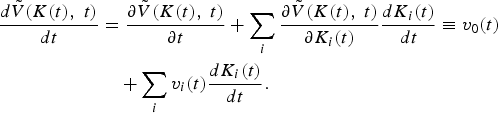 $$\eqalign{{d\tilde{V}\lpar K\lpar t\rpar \comma \; t\rpar \over dt} &= {\partial \tilde{V}\lpar K\lpar t\rpar \comma \; t\rpar \over \partial t} + \sum_i {\partial \tilde{V}\lpar K\lpar t\rpar \comma \; t\rpar \over \partial K_i \lpar t\rpar } {dK_i \lpar t\rpar \over dt} \equiv v_0 \lpar t\rpar \cr &\quad + \sum_i v_i \lpar t\rpar {dK_i \lpar t\rpar \over dt}.}$$
The shadow values of capital,  $v_{i} \lpar t\rpar = \partial \tilde{V}/\partial K_{i} \lpar t\rpar $, are written as v i (t) in equation (3) to stress that they pertain to the function
 $\tilde{V}\lpar K\lpar t\rpar \comma \; t\rpar $. The economy's wealth at t is defined to be
 $$W\lpar t\rpar = v_0\lpar t\rpar t + \sum v_i \lpar t\rpar K_i \lpar t\rpar.$$
Using relations (1)–(4), ADGMO answer the symposium's first question, for any economy, optimal or non-optimal. Their method of green accounting is an idealized extension of the national accounts that incorporates all non-priced assets, especially environmental assets. It would be hard to overstate the importance of this work, which aims to quantify the role of non-priced assets, especially the environment, in the prevailing political economy, which Dasgupta and Mäler call the resource-allocation mechanism.
The main divergences from financial accounting are:
(1) that prices are equal to shadow values rather than market prices;
(2) that capital is defined to include all assets, not just those mediated in markets;
(3) that time is included if there are exogenous factors that affect value.
There is a good deal of nuance in the relation of question 1 to questions 2–4. ADGMO (Reference Arrow, Dasgupta, Goulder, Mumford and Oleson2012: 321) ‘follow an approach that is closely guided by welfare economic theory’, a theory that is useful for studying national wealth. Questions 2–4, however, are posed in terms of a different concern, sustaining the society. Even though several concepts of sustainability have been proposed by other researchers, definitions (1) and (2) are not specifically justified. In a famous paper, Chichilnisky (Reference Chichilnisky1996) considers equation (1) to express a dictatorship of the present and not intergenerational equity, the term used by Solow (Reference Solow1974) to introduce the notion of sustainability to economics. The welfare integral in equation (1) is present, not intergenerational, wellbeing: the present perceives an increment of wellbeing from utility enjoyed in the future, weighted using the level of δ. Each future generation has its own welfare integral.
ADGMO (Reference Arrow, Dasgupta, Goulder, Mumford and Oleson2012: 325–326) realize that criterion (2), too, is limited to the present. It
do[es] not determine whether comprehensive wealth in a particular economy can be maintained or whether vital forms of natural capital have been so depleted that it is not possible for the economy to enjoy sustainable development in the future. For example, it could be that, even though an economy experiences sustainable development for a period of time, it is incapable of enjoying it indefinitely owing to scarcity of resources or limited substitution possibilities among capital assets or because the scale of the economy is too large.
These potential sources of non-sustainability are precisely those raised by sceptics of mainstream economics. Smulders (Reference Smulders2012: 370) notes that ‘the paper is about measuring whether the dynamic per capita welfare potential (wealth) of a country is sustained over a short period. … The short horizon makes the link with sustainability in the traditional meaning somewhat weak’. Elsewhere, Solow (Reference Solow1993) states: ‘If sustainability means anything more than a vague emotional commitment, it must require that something be preserved for the very long run.’
One might say that definition (2) is a criterion for short-term growth. Scholars in all other disciplines that study sustainability suspect that unmindful short-term growth is the cause of unsustainability. The suspicions are confirmed by a well-known example by Asheim (Reference Asheim1994). Condition (2) does not distinguish between mindful and unmindful short-term growth.
Moreover, the analysis maintains two conflicting sets of values. One is discounted-utilitarian welfare. The other is growing welfare in the short run. If V(t) is a full expression of the value of a society with a non-optimal resource-allocation mechanism, the economic problem for the generation at time t is to increase the current value with the given capital stocks rather than to maintain its current level over the next instant. The analysis, although normative, cannot prescribe what to do if welfare is not being maintained.
ADGMO (Reference Arrow, Dasgupta, Goulder, Mumford and Oleson2012: 326) remark that ‘[i]t can even be that along an optimum path (i.e., a path that maximizes V), V(t) declines for a period and then increases thereafter’. Since measurement is the aim, this remark raises some practical questions.
• Is the lowest projected level of welfare not sustained by the economy?
• If a country is over-consuming its resource base and technological capacity but decides to reduce consumption over time, is it unsustainable when the decision is made?
• If an economy's welfare fluctuates about a constant or rising trend, is it unsustainable in the downturns and sustainable in the upturns? The five countries that are subjects of ADGMO's empirical analysis are subject to fluctuations.
• Are all economies unsustainable because of a short-term crisis such as a Great Recession?
Because of the conflict of values, condition (2) is neither a necessary nor a sufficient condition for sustainability.
• It is not sufficient because it is not a condition for the very long run.
• It is not necessary because a sustainable society can suffer a short-term drop in welfare.
The problems, theoretical and empirical, with the measures proposed can be further understood in terms of a dichotomy in the symposium. ADGMO, as well as Kirk Hamilton (Reference Hamilton2012) of the World Bank, stress the comprehensiveness of capital assets. The other commentators emphasize a prime concern in economics, ‘to get the prices right’. While comprehensiveness is vital, the value of an asset in the present context is a quantity times a price. In empirical work, the cognate analyses of ADGMO and the World Bank use market prices, adjusted by a cost-benefit analysis founded on market realizations. It is unlikely that market prices, adjusted or not, are representative of the (relative) shadow values of equation (3).
Indeed, a small change in the choice of the discount rate affects the relative shadow prices of all capital and consumption goods in varying proportions. Currently, the level of the discount rate is subject to strong controversy. Necessary conditions for a constant, positive rate given by Koopmans (Reference Koopmans1960) are extremely strong.
Smulders (Reference Smulders2012: 369–370) considers the shadow prices to be the Achilles heel of the analysis, not transparent, hypothetical. The shadow prices are also the weakness in the link to sustainability.
3. Maximin value
It is important to be able to devise a criterion of sustainability that uses current, as opposed to projected, values. What is required is a welfare functional for which the current measure is also a long-term measure. Asheim (Reference Asheim2007) shows that an indicator with the form of equation (3) is a representation of the current change in the level of a wide class of possible measures of wellbeing. Each representation utilizes the shadow prices appropriate to the given measure.
A change in the value functional can yield a valid indicator of sustainability that takes future generations into account in a way that does not discount their aspirations. The key step is to define what it means to sustain an economy or a society and what is sustainable. What level of wellbeing is or can be guaranteed to all generations, starting from the present?
Definition 1
On a given path of an economy, what is sustained is the minimum (strictly, infimum) level of wellbeing attained on the path over the indefinite future.
An alternative concept of wellbeing has been used frequently in economic discussions of sustainability.
Definition 2
Well-being is current utility.
Given the concept of wellbeing, sustainability can be defined in an economic sense.
Definition 3
What is sustainable is the maximized value of the sustained level of utility over all feasible paths.
Definitions (1)–(3) underlie the maximin solution,  $\max \mathop{\min}\limits_{s\ge t} u_{s}$, first applied to dynamic problems in economics by Solow (Reference Solow1974) and further studied by Hartwick (Reference Hartwick1977). In these definitions, all generations are treated equally. The dynamic or intergenerational aspect of the problem, the concern for future generations, is expressed in the comparison of wellbeing over all future times. It is inconsistent to try to introduce a further dynamic consideration such as discounting into the criterion (Pezzey and Toman, Reference Pezzey, Toman, Tietenberg and Folmer2002).
For a so-called regular maximin problem, the solution exhibits constant utility throughout the program and the level of utility obeys Hartwick's net-investment rule. Let the maximin level of utility be denoted by u*. It is a function of the comprehensive capital stock K(t)and of time t:
 $$M\lpar K\lpar t\rpar \comma \; t\rpar = u^{\ast}.$$
Differentiation of equation (5) yields that
 $$\sum {\partial M\lpar K\lpar t\rpar \comma \; t\rpar \over \partial K_i} {dK_i\lpar t\rpar \over dt} + {\partial M\lpar K\lpar t\rpar \comma \; t\rpar \over \partial t} = {du^{\ast} \over dt} = 0\colon$$
The sum of the values of the changes in all capital stocks, including time, evaluated at maximin shadow prices ∂M/∂K i and ∂M/∂t, is equal to zero. Equation (6) is a generalization of Hartwick's rule to take into account exogenous drift in the economy. It is defined at time t and does not depend on the actions of future generations, who are free to choose to follow or not to follow the sustainable path.
Solow (Reference Solow2012: 354) doubts that time should appear as a form of capital stock in ADGMO's analysis. In the maximin model, the implication of the effects of time may be easier to accept: the value of net investments at maximin prices can be lower if ∂M/∂t is positive and must be higher if it is negative:
 $$\sum {\partial M \lpar K\lpar t\rpar \comma \; t\rpar \over \partial K_i} {dK_i\lpar t\rpar \over dt} = - {\partial M\lpar K\lpar t\rpar \comma \; t\rpar \over \partial t}.$$
In a regular program utility remains constant. In a non-regular maximin program the level of utility may increase but never decreases (Cairns and Martinet, Reference Cairns and Martinet2012; Martinet and Doyen, Reference Martinet and Doyen2011).
4. Sustainable Development
An important objection is that pursuing a maximin objective may entrench poverty rather than allow for (sustained) development. What can be sustained is not necessarily stationary but may improve. Sustained development can be defined as follows.
Definition 4
Sustained development consists of not impairing and possibly improving the ability of society to sustain its level of wellbeing.
Even if an economy is not optimal, at any time a maximin solution can be obtained as a function of the levels of its capital stocks and from the solution maximin shadow prices can be derived. That is to say, given the capital stocks (comprehensively defined) there is a potential maximin path having a set of shadow prices which, in conjunction with the change in comprehensively defined assets, can be used to measure the change in what can be sustained (Cairns and Martinet, Reference Cairns and Martinet2012). The criterion for sustained development is that
 $${dM\lpar K\lpar t\rpar \comma \; t\rpar \over dt} = \sum {\partial M\lpar K\lpar t\rpar \comma \; t\rpar \over \partial K_i} {dK_i\lpar t\rpar \over dt} + {\partial M\lpar K\lpar t\rpar \comma \; t\rpar \over \partial t} \ge 0.$$
Criterion (8) looks like criterion (2) as expanded in equation (3). Criterion (8), however, is the criterion for long-term, sustained development, and not for short-term growth as evaluated by criterion (2). The net comprehensive investments, dK i (t)/dt, are evaluated at maximin shadow prices, ∂M(K(t), t)/∂K i (t). The problem is not simply one of improving through cost-benefit analysis the empirical estimates of the shadow prices  $v_{i} \lpar t\rpar = \partial \tilde{V}\lpar K\lpar t\rpar \comma \; t\rpar /\partial K_{i} \lpar t\rpar $ that pertain to discounted-utilitarian welfare. The problem is more fundamental, involving a different economic objective.
There are two significant divergences of ADGMO's and the World Bank's empirical results from a reliable indicator of sustainable development. First, for both optimal and non-optimal paths, there is a theoretical divergence of the discounted-utilitarian measure in equation (3) from the maximin criterion in equation (8). That the two do not have the same relative shadow prices is clear from the optimal solutions, both of which are Pareto optima: under the usual convexity conditions the maximin solution can be decentralized to a competitive equilibrium and then the maximin problem can be re-expressed as a ‘generalized present value’ (GPV) problem (Withagen and Asheim, Reference Withagen and Asheim1998; Pezzey and Toman, Reference Pezzey, Toman, Tietenberg and Folmer2002). Except in a steady state, for maximin the GPV does not have a constant discount rate δ.
Second is the role of non-optimality. Maximin value is the measure of what can be sustained, given the capital stocks. With maximin, preserving wellbeing is inherent in the criterion itself. Since they are maximal, the maximin value and the prices do not depend on the non-optimal resource-allocation mechanism or on the choices made by the society. They are current prices applicable to both optimal and non-optimal paths. The solution indicates what an economy can sustain, even if it is not sustaining that level. The maximin prices are applied to the realization of the changes in the capital stocks to indicate whether what is sustainable has increased or decreased.
Calculating the shadow prices for the discounted-utilitarian formulation requires first specifying the resource-allocation mechanism and the utility discount rate δ. Even though market prices are determined by the prevailing, sub-optimal resource-allocation mechanism, controversy about the discount rate cautions one from proposing that market outcomes, even extended by cost-benefit analysis to include non-marketed goods, provide valid shadow prices.
The empirical results of ADGMO and the World Bank are valuable contributions. Their analyses apply to short-term growth, however. Economic analysis has confirmed that the pursuit of short-term growth may be inimical to long-term sustainability.
Presently it is no more possible to find the maximin prices for a complicated, modern economy than the discounted-utilitarian prices. The fundamental research agenda on sustainability is to determine how to estimate the maximin prices. Because the idea of economic sustainability is difficult, the task will be difficult, will require new insights and possibly will be long. It is not yet time to do empirical work.
A good start at understanding the shadow prices, using a generalization of maximin that can serve to deal with non-optimal economies and possible variations in the resource-allocation mechanism, may be provided by viability analysis (Martinet and Doyen, Reference Martinet and Doyen2011). Viability theory takes into account the evolution of stocks and their contributions in the short and long runs.
5. Conclusion
ADGMO and the World Bank have done a service by insisting that accounting for assets, as well as consumption flows, should be comprehensive. They have pointed the way toward improving the national accounts at market prices for certain purposes. In their estimation they substitute market-based prices for the shadow prices, thereby accounting for the realized outcome of a non-optimal resource-allocation mechanism rather than for an optimal outcome.
Their theoretical formulation does not, however, permit one to address sustainability. To do so, one should study the shadow prices of criterion (8), which are different from those of criterion (3), which in turn are different from the prices used in practice in green or comprehensive national accounting. Armed with the right quantities as sought by ADGMO, the analyst studying sustainability must also seek the right prices.


