

1. INTRODUCTION
Detailed knowledge of the structure of highly ionized atoms is essential for plasma spectroscopy. In the case of X-ray spectroscopy, most of atomic data currently used are produced using some of the simplest techniques. However, in a confrontation of plasma transport models with experiment and in spectral analysis, it is important to know the uncertainty in the collisional-radioactive coefficients. It is well-known, for example, that di-electronic recombination shifts equilibrium ionization balance fraction curves to higher temperature. This is most pronounced for the ions with one or two electrons outside the closed shells. It is also these ion fractions that show most markedly the effect of finite density reduction of the collisional radiative coefficients. This cannot be ignored for moderately ionized systems in plasmas with N e ≥ 1010 cm−3.
Highly ionized atoms have several properties that differ from those of neutral and few times ionized atoms. For example, there are large magnetic effects that cause the “fine structure” splitting to exceed the electrostatic structure separation. The allowed electric dipole transitions encounter strong competition from forbidden transitions. The transition rates for the forbidden decays scale with higher powers of Z than those of dipole transitions. The effects of quantum electrodynamics also scale with high powers of Z. Theoretical description of such effects involves the use of relativistic quantum mechanics and an accurate treatment of electron-electron correlation effects.
Collision between low energy electrons and atoms, molecules, or their ions are characterized by the formation of resonances and are often dominated by resonance mechanisms. Frequently, knowledge of the parameters defining the resonances participating in the process is sufficient to provide insight into details of the collisions. Referring to electron scattering Li-like ions, as an example, the contribution of di-electronic recombination process on gain of X-ray lasers with Li-like Al ions is mainly due to the capture of free electrons by ions in 1s 22s and 1s 22p configurations, producing autoionizing Be-like levels, which emit a photon to give bound levels of 1s 22snl and 1s 22pnl configurations. The most probably ways involve the autoionizing levels 1s 22pnl 1,3L'J' and 1s 23pnl 1,3L'J' (with initial ion 1s 22s) and 1s 23dnl 1,3L'J' (with initial ion 1s 22p) (Stancalie et al., Reference Stancalie, Sureau, Klisnick, Moller, Guennou and Berete1995). They can be characterized, respectively, by the core transitions 2s–2p, 2s–3p, and 2p–3d. A major contribution to the cross-section involves the intermediate formation of doubly excited states of beryllium ions. The theoretical prediction of this process therefore depends on accurate information about the resonant states.
This article pays particular attention to the calculation of atomic structure and scattering observable for Li-like ions, 1s 2nl configuration. A number of methods for atomic structure and electron-ion scattering calculations have been developed, which are able to provide atomic data for different spectroscopic applications. These methods vary in complexity and accuracy of the results in such way that one must decide between promptly available and highly accurate data to fulfill current spectroscopic needs.
In addition, this article shall address the role of laser induced degenerate state (LIDS) phenomenon on the behavior of resonance states of type 1s 22pns(1P 0), n = 9–12, and respectively, n = 5–12 in Al X and C3+. The work refers to particular situation when an electron colliding Li-like ion, is captured in the doubly excited state 1s 22pn's(1P 0), belonging to Be-like ion. This state can decay by photon emission to an excited Rydberg state of type 1s 22sns (1S) or can autoionize. These two states are studied throughout the resonant Rydberg series in a region where the autoionization and radiative rates are comparable in size. To this aim, it is analyzed the situation when these two excited Rydberg states are coupled by an intense, monochromatic, monomode, linearly polarized laser field.
This article is structured as follows. In Section 2, a short description of the well-known atomic structure calculation methods is given along with comparison between theoretical results and experimental data. In Section 3, the scattering calculation methods are reviewed. Electronic excitation and recombination cross-sections are needed for a variety of applications and their calculation places more emphasis on the accurate representation of target electron wave functions than the study of other processes. Calculations of the collision strengths are computationally demanding because of the dense Rydberg resonance structure below the highest target threshold. The low-temperature effective collision strength will be sensitive to the resonance structure. In this section are presented, comparatively, rate coefficients for electron impact excitation of Li-like Al ion as output from different theoretical approaches. In Section 4, special attention is paid to autoionization. Results are presented comparatively, from the ab initio non-perturbative and the perturbative treatment of this process. Conclusions will be outlined in Section 5.
2. ATOMIC STRUCTURE CALCULATION
The atomic structure problem is concerned with the computation of energy levels and rates of spontaneous transition among levels of the same ion (A—value) and from autoionizing levels of one ion to levels of the next ionized species (autoionization rates). There are several techniques used in atomic structure calculations: (1) model potential, (2) Hartree-Fock theory and method, (3) semiempirical methods, (4) perturbation methods, and (5) the R-matrix method in the close-coupling formalism.
Li-like ions are good systems for testing model potentials since, by having a single valence electron, their analysis leads to a single equation for the one-electron wave function. The solution of the Schrödinger equation based on this potential has been discussed by Bates and Damgaard (Sobelman et al., Reference Sobelman, Vainshtein, Yukov and Toennies1981, and references herein). A generally applicable potential is the modified Thomas-Fermi potential. This potential is implemented in the computer program superstructure (Eisner et al., Reference Eissner, Jones and Nussbaumer1974), which uses a scaled Thomas-Fermi-Dirac-Amadi potential. The scaling parameter is different for each angular momentum l. These parameters are iterated to give a minimum energy of a term or a group of terms. It should be noted that this method does not take into account correlation effects properly. Optimum Thomas-Fermi potential is obtained by minimizing the sum of the term energies. In contrast to the local central-field potentials, the Hartree-Fock methods (Pratt, Reference Pratt1956) entails the computation of the one-electron orbital in the non-local potential (direct and exchange) generated from electronic orbitals in a self-consistent manner using the variational principle. The accuracy of the wave function can be found by varying the valence orbitals while keeping the orbitals for the core fixed. This approximation has been developed to include electronic configurations interactions like in the multi-configuration Hartree-Fock (MCHF) (Froese Ficher, Reference Froese Fischer1969) or in the superposition of configurations method (Hibbert, Reference Hibbert1975).
The R-matrix method is the most accurate technique and takes into account additional effects that may contribute to atomic quantities, like configuration interactions and relativistic effects. The R-matrix formalism has been highly successful in describing a wide range of atomic and molecular scattering problems. The compilation volume by Burke and Berrington (Reference Burke and Berrington1993), provide both a general review of the R-matrix method as applied to atomic and molecular collision processes and a very extensive bibliography. In the simplest version of this approach, the collision is considered separately according to whether the projectile is inside or external to the charge cloud of the target. The solutions obtained in each of these regions are related by the R-matrix that corresponds to the inverse of the logarithmic derivative of the wave function on the boundary of the two regions. This R-matrix is the basic solution of the electron scattering problem as it allows one to determine the atomic structure of the (N + 1) system, the collision strengths, and photo-ionization cross sections. The total (N + 1)-electron wave function representing the electron-ion collision can be expanded in terms of R-matrix basis functions in the internal region in the form

Here  is the channel functions formed by coupling the spin and the angular momenta of the scattered electron to the multi-configuration target wave functions, which form eigenstates of the total angular momentum L and total spin S. u j is the continuum basis functions that are non-zero on the boundary of the internal region. χ j is the (N + 1)-electron quadratically integrable functions constructed from the same bound orbitals as target wave function. Finally, a ijk and b jk are the coefficients that are determined by diagonalizing the total Hamiltonian of the (N + 1)-electron system in the basis defined by Eq. (1). The target wave functions and the (N + 1)-electron quadratically integrable functions employed in Eq. (1) are constructed with a common set of one-electron spin-orbital functions. The radial part of each orbital is a sum of the Slater-type functions:

The internal region solution is obtained using the R-matrix II program package. In the external region, the asymptotic program STGF is used for the solution of the set of coupled differential equations.
In our previously works (Stancalie et al., Reference Stancalie, Burke and Sureau1999, Reference Stancalie, Pais, Totolici and Mihailescu2007; Stancalie, Reference Stancalie2000; Stancalie & Pais, Reference Stancalie and Pais2006), the superposition of configurations method and the model potential, respectively, have been used for different applications.
In the present article, we have carried out atomic structure calculations on the use of the semi-empirical method and the Cowan's code. Cowan (Reference Cowan, Sharp and Simmons1981) summarized the progresses made in the analyses of atomic spectra with these methods. Semiempirical methods compute the atomic structure of ions solving simplified forms of the Hartree-Fock equations. One of the first examples of this approach is the Hartree-Fock-Slater scheme, which consists in replacing the two-electron non-local exchange terms of the Hamiltonian by the statistical potential function:
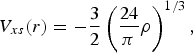
where ρ is the local electron density ρ(r) of the atom. Cowan modified the Hartree-Fock-Slater approach to write the total potential of the ion as:

where V e is the potential energy for the density ρ-ρi of electrons, where i and V xs are exchange terms in the form

where k 1 and k 2 are constants, ρ′ is the electron density less the densities of the electron i and of the electron with which it is paired, and

for suitable k and r 0. This definition for the atomic potential is mostly empirically motivated and requires preconceived wave functions with which to construct the electron density functions ρ and ρ′. Once these functions are created and the atomic structure equations are solved in an iterative fashion. Then the accuracy of the results is assessed upon the agreement between obtained energy levels and oscillator strengths with a given sample of experimental values. The method has the advantage of being quite efficient, but it requires a lot of care in the construction of the initial electron density distribution. Further, it is difficult to estimate the accuracy of any given calculation except by the observed agreement of a limited sample of data with experimental values.
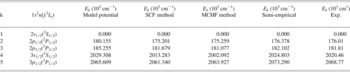
In Table 1 are presented comparatively, energy values (cm−1 units), calculated relative to the ground, for the lowest states belonging to Al10+. These are to be compared with the available experimental data (Kelly, Reference Kelly1987).
Calculated energies (in 103 cm−1 units) for the lowest states of type 1s2nlj(2Lj) in Al10+ relative to the ground state. Results as output from the model potential, SCF, MCHF, and semi-empirical, methods are compared with experimental data (Exp.)

3. SCATTERING CALCULATION
In considering the scattering calculation, it is customary to think of the residual ion as the “target” or “core” with N electrons and the incoming/outgoing (electron impact/photo-ionization) as “free” electron. Thus, the wave functions of the (N + 1)-electron system can be expanded in terms of products of wave functions of the core and those of the electron. The resulting equations have to be solved for every value of the energy (k 2) and of the total angular momentum (L) of the (N + 1)-electron system. This last condition motivates the so-called partial wave's expansion in which all states of definite angular momentum of the free electron are considered separately. Furthermore, the calculated collision strength is divided into partial waves as:

Collision strengths, phase shifts, and cross-sections may be obtained directly from the scattering K-matrices. We have applied this technique and an initial calculation using LS coupling with FARM (Burke & Noble, Reference Burke and Noble1995)—a flexible asymptotic R-matrix package—has been performed (Stancalie & Pais, Reference Stancalie and Pais2006), for solving the electron- scattering Li-like Al ion problem, in the external region of configuration space, where exchange effects may be neglected. The package uses a combination of R-matrix propagation techniques to ensure optimum stability and efficiency in integrating the coupled Schrödinger equations.
At lower impact energies, it is very difficult to compare the different theoretical results as the most sophisticated R-matrix results have large resonance structures below many of excitation thresholds. The effect of these resonances can be seen best by comparing excitation rates that are obtained by integrating the collision strength over a Maxwellian distribution of electron energies. The excitation rate coefficient for a transition from level i to level f at a temperature T e is given by:

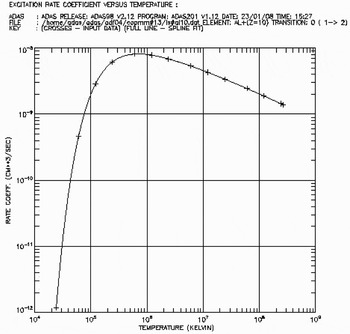
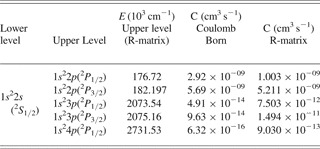
where g i = (2J i + 1) is the statistical weight of the lower level i, ΔE = E f − E i is the excitation energy, ΩE(I → f) is the collision strength, k is the Boltzmann constant, and E is the electron impact energy. In Figure 1, are plotted the rate coefficients (in cm3 s−1) versus electron temperature (in eV), for electron impact excitation of 2s − 2p1/3 transition in Al10+. The collision strengths have been calculated using the R-matrix code incorporated in atomic data and analysis structure (ADAS) package programs. Selected results for 100 eV are compared in Table 2 with those obtained from the Coulomb Born approximation (Sobelman, Reference Sobelman and Toennies1992). In this last case, the coupling between different target states is approximated by its asymptotic form at a large distance. This approximation is good for highly charged ions and transitions not affected by channel coupling and large partial waves.
Rate coefficient (cm3s−1) for electron impact excitation of 1s 22s − 1s 22p 1/3 transition in Al10+ plotted versus electron temperature (in Kelvin units).

The electron-impact excitation rate coefficient (in cm s−1 units) in Al10+, at electron temperature of 100 eV. The upper levels energy relative to the ground is also indicated. The comparison refers to the Coulomb Born approximation and the R-matrix calculation results. (a−b reads a × 10−b)

Sobelman et al. (Reference Sobelman, Vainshtein, Yukov and Toennies1981) suggested an approximate formula to obtain near threshold collision strengths for optically allowed transitions. The formula is based on the Kramers approximation and the Gaunt factor:
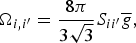
here S i,i′ is the line strength, which relates to the absorption oscillator strength and g¯ is the mean Gaunt factor. In the present article, we make use of perturbation theory and method (Poirier & Semoune, Reference Poirier and Semoune1998), to evaluate the effective oscillator strength averaged over continuum and Gaunt factors, in the particular case of complex atoms with two electrons outside a closed shell. The method accounts for the general properties of the Coulomb Green's function together with its available compact integral representations, and discrete state expansions. The principle behind the theory is to use Sturmian representation of the Coulomb Green's function and the non-penetration hypothesis, assuming that, configuration mixing arising from perturbation by interaction is a small effect as long as the two wave functions are spatially separated. The advantage is that Sturmian term respects the same radial equation as bound-hydrogenic wave function.
The model refers to an atomic system, with the net charge of the core Z, and with two electrons outside the closed shell, the outer “Rydberg electron” labeled 1, being more excited than the inner electron, referred to as the “valence electron” and labeled 2. The other electrons, γ, are named core electrons. For example, Ba-like W18+ has configuration [Xe] 6s 2, Sr-like W36+ has [Kr]5s 2, Hf-like W2+ has [Xe] 4f 145d 26s 2, etc. These configurations can be written as [Xe] n 2l 2j 2n 1l 1, for Ba-like and in a similar form for the others. The quasi-continuum spectra are simulated in “a single configuration description” assuming that, the Rydberg electron evolves from a bound hydrogenic state (n 1l 1) to a continuum state (ɛl) while, the valence electron falls from the excited ionic state (n 2l 2j 2) to a lower state (n 0l 0j 0).
The valence electron strongly interacts with the core. Hence the spin-orbit effect for this electron dominates all other interactions. The electronic repulsion 1/r 12 is generally stronger than spin-orbit effects for the Rydberg electron. Based on the Heisenberg approximation for helium, the “bound” Rydberg state, [γ]n 2l 2j 2n 1l 1, has been written as zero-order solution for the eigenvalue equation, in the coordinate-space representation.
The “excited” Rydberg state of the atomic system, [γ]n 0l 0j 0nsl s, has been described in the Coulomb formalism accounting for the general properties of the Coulomb Green Function (CGF) and its Sturmian representation. In this case, the resolvent, G(Ω), of the non-relativistic Hamiltonian, H C = H 0 + V, with H 0 = p 02/2 + U(r 0) + p s2/2 − 1/r s, and V = 1/r 0s − 1/r s, is a solution of the operator equation (Ω − H C) G(Ω) = 1, where Ω is a complex energy variable, and G is the CGF. Then, the potential V can be treated as perturbation thus that, the dipole matrix elements between “bound” and “excited” Rydberg states, [γ]n 2l 2j 2n 1l 1 → [γ]n 0l 0j 0n sl s, in intermediate coupling, can be written as the product of two mono-electronic matrix elements. Thus, the summation on the outer-electron principal quantum number can be performed exactly. The radial components of the Coulomb Sturmian functions are solutions of the equation:

where the parameter x, Re x > 0, is kept fixed and n is a positive integer. Besides a normalization constant, the radial Sturmian functions have a structure similar to those of bound-state hydrogenic functions:  , where
 are Laguerre polynomials and the normalization factor reads:
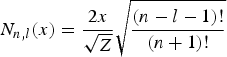 . The expansion of G l over the Sturmian basis reads explicitly:
 . The dipole matrix elements
 , between Sturmian and/or hydrogenic radial components are always reducible to a combination of hypergeometric polynomials, which can be computed to within any chosen accuracy. Starting from the relation:

where
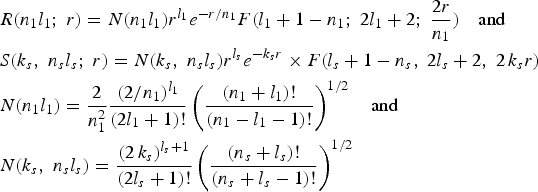
The dipole matrix element is:
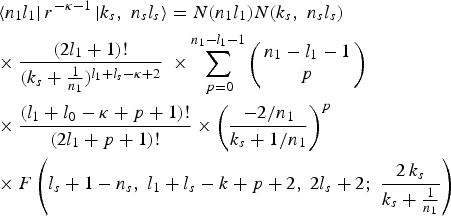
where  is the binomial coefficient =
 and a n is the Pochhammmer symbol = 1 if n = 0 and a(a + 1)…(a + n − 1) for positive integer n. If m > n the second term is absent and the first sum ranges from p = n to m.
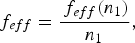
The effective oscillator strength averaged over continuous spectrum can be defined as:
where
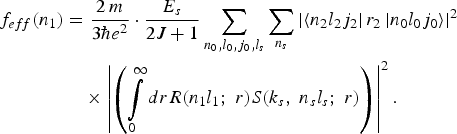
In Eq. (13), the sum runs over the complete (discrete + continuous) set of eigenstates of H C. The “averaged excitation energy,” E s, is given by: E s = E n 2l 2j 2 − E n 0l 0j 0 − 1/2n 12 = −k s2/2, with E n 2l 2j 2 and E n 0l 0j 0 threshold energies. The R(n 1l 1; r) and S(k s, n sl s; r) are hydrogenic and Sturmian radial components of the wave functions with respect to the valence (n 1l 1) and continuum electron (n sl s), respectively, m and e are the electron mass and charge, respectively, and J is the total angular momentum of the initial state. Finally, the Gaunt, G, factors for ionization of level n 1 has been evaluated as: 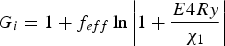 , where E is the collision energy, χ1 is the ionization energy of level 1, χ1 = Ry/n 12, and Ry = 13.6 eV.
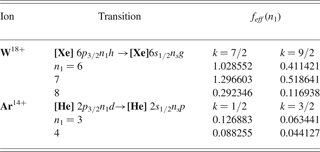
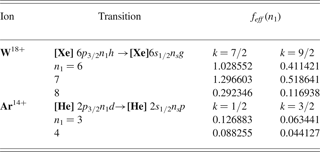
In intermediate coupling, f eff (n 1) depends on k but not on J, since the whole Hamiltonian is independent of the Rydberg-electron spin. The effective oscillator strengths averaged over continuum for Be-like Ar and Ba-like W, ions, in dipole approximation, are given in Table 3. The calculation refers to continuum states with n s ranges from n 1 to 15. The accuracy of the numerical calculation depends on the accuracy of the parent ion energy calculation and on the performed infinite, but discrete, sum over n s of term involving the overlap integral between hydrogenic and Sturmian functions. The last one has been controlled in a self-consistent manner on the basis of the partial sum rules of the averaged oscillator strengths. These rules are fulfilled only in the case when the photon frequency equals to the difference of the eigenvalue of the approximate Hamiltonian to the wave functions used in the calculation, (E s), is substituted in the oscillator strengths, f eff(n 1). The parent energies have been evaluated combining quantum defect theory and R-matrix method (QDT/R-matrix) (Stancalie, Reference Stancalie2005a) for C2+ and Al9+ ions, and from the Cowan's code for Ba-like W ion.
The effective oscillator strengths, feff(n1), averaged over continuum for Be-like Ar and Ba-like W, ions, in dipole approximation. Continuum quantum number ns range from n1 to 15
4. AUTOIONIZATION
4.1. Ab Initio Non-Perturbative Calculation of Laser-Induced Degeneracies Involving Autoionizing States in Li-Like Ions
Doubly excited states (resonances) offer a very suitable laser frequency regime within which to undertake investigative calculations that has already attracted interest. These resonance regions have been studied in the context of multiphoton transitions. There have been several theoretical methods introduced to describe multiphoton processes in atoms (Knight et al., Reference Knight, Lauder and Dalton1990; Cyr et al., Reference Cyr, Latinne and Burke1997; Kylstra et al., Reference Kylstra, Paspalakis and Knight1998; Kylstra & Joichain, Reference Kylstra and Joichain1998; Fearnside, Reference Fearniside1998; Paspalakis et al., Reference Paspalakalis, Kylstra and Knight2000). Of these calculations, only those employing the R-matrix Floquet (RME) method couple the field to the ion non-perturbatively, and only those of Latinne et al. (Reference Latinne, Klistra, Dörr, Purvis, Terao-Dunsheath, Joichain, Burke and Noble1995) and Cyr et al. (Reference Cyr, Latinne and Burke1997), explicitly investigated the laser-induced modification of doubly excited states, that is to say, the interplay of LIDS. Specifically, the frequency and the intensity of the light field can be adjusted such that the energy and the width of the dressed ground state coincide with the energy and width of a dressed autoionizing state.
The LIDS phenomenon has been studied (Stancalie, Reference Stancalie2005a, Reference Stancalie2005b) for transitions of type 1s 22sns – 1s 22pn's, Δn = n − n’ = 0 (n, n' = 9 − 12) in Al X and Δn = n − n' = 0, 2 (n, n' = 5 − 12) in C3+. The laser dresses the autoionizing state, the quasi-bound state, and the projectile electron. Following the RMF theory (Burke et al., Reference Burke, Francken and Joichain1991) and code, at resonance, this dressing is dominated by the resonant coupling between these states so that the influence of the remaining states can be ignored. With this assumption, the problem is reduced to a model space consisting of a ground state of atom |g〉 (or some excited bound state of atom), an autoionizing state |a〉 and a continuum |∈〉. Results are analyzed with two state model of Latinne et al. (Reference Latinne, Klistra, Dörr, Purvis, Terao-Dunsheath, Joichain, Burke and Noble1995), which reproduces the behavior of the Floquet states, showing that the coupling via the continuum is more important than the direct dipole coupling between states. The laser is used to strongly couple the autoionizing state to excited Rydberg state and operates in restricted frequency, ω = ΔE (core transition energy in the parent ion) intervals. In the limit of low field intensities, the width of the quasi-bound state is much smaller than the width of the autoionizing state and this particular value of the electron energy takes E ≅ E g + ω, with E g being the position of the ground state.
Floquet theory calculates quasi-stationary solution of time dependent Schrodinger equation for a monochromatic field equation. In the RMF approach, the time-dependent wave function is written in a Floquet-Fourier form, so that the time-dependent Schrödinger equation is transformed into a time-independent eigenvalue equation, in which atom-field coupling is treated in a fully non-perturbative manner. This implies that all the resonant couplings, as well as non-resonant and high-order laser-induced couplings, are fully accounted for. The principle behind the theory is to divide configuration space into two regions, an internal and an external region. The internal region is defined by a sphere of radius a, centered upon the nucleus of the ion, within which the full (N + 1)-electron problem is solved; that is, correlation and exchange effects are fully accounted for within this region of space where the charge distribution of the target ion is considered to be confined. The rest of configuration space is regarded as the external region. Here both exchange and correlation effects between the target atom and the outgoing photoelectron can be neglected. The latter electron now interacts with the residual atom through a long-range potential, expressed in a multipole expansion, in addition to the applied laser field. Since the RMF approach is a non-perturbative approach, the electric field, oscillating with laser frequency ω, is included ab-initio in the Hamiltonian. The time-dependent Schrödinger equation is solved by expanding the wave function as a Floquet-Fourier series. This yields a block structure of the Hamiltonian, each block corresponding to the absorption or emission of a specific number of photons. In the inner region, all angular symmetries with the correct parity and up to some suitably chosen maximum total angular momentum are present within each Floquet block. By diagonalizing the Hamiltonian matrix in the inner region in length gauge, the R-matrix at the boundary of the box (radius a) is obtained. This matrix transformed from the length to the velocity gauge, is propagated over the outer region to a radius a', where the long-range interactions are small. This transformation concerns only the outgoing photoelectron (the (N + 1)th) since the residual target electrons are not present in this region of configuration space. At this radius, the R-matrix is matched with an asymptotic expansion of the wave function yielding the complex quasi-energy and autoionizing rates, E, and Γ, of the system as a complex quasi-energy E F = E − iΓ/2.
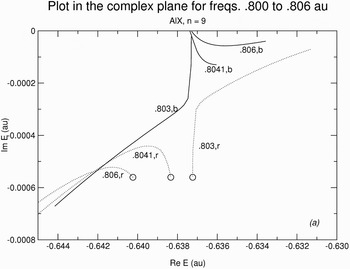
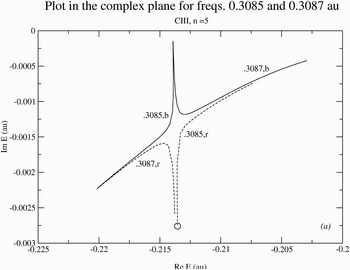
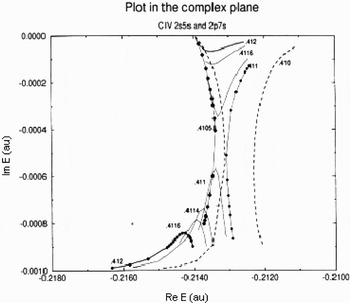
The two-state model shows that the zero-field position of the autoionizing state changes with ω, being scaled at the complex energy −ω + E a − iΓa/2. The corresponding detuning is defined as d = E a − E g − ω. For fixed values of the field intensity and frequency, the two quasi-energies become equal, giving rise to laser-induced degenerate states. In Figures 2–4 are shown, respectively, trajectories in the complex plane of the complex energies belonging to the 1s 22s9s(1S) − 1s 22p9s(1P 0) states in Al X, 1s 22s5s(1S) − 1s 22p5s(1P 0) states, and 1s 22s5s(1S) − 1s 22p7s(1P 0) states in C3+, respectively. In these figures, b and r label the trajectories of the quasi-bound and resonant states of type 1s 22sns(1S e) and 1s 22pns(1P 0). Detuning is indicated next to the curves in atomic units. For each frequency, there are two curves, one connected adiabatically with the quasi-bound state, the other with the autoionizing state. The corresponding curves have the same line type (solid or dashed) and are labeled by the frequency. Big circles denote the zero-field position of the autoionizing state. For transition with n = 9 (Fig. 2), the resulting complex energies are given for a few fixed values of the frequency, from 0.800 to 0.806 atomic units(au), and intensity up to 1 × 10¹⁴ W/cm−2. The corresponding detuning is 0.8029 au. Figure 3 gives the motion of the complex energies in the complex plane for 1s 22s5s(1S) and 1s 22p5s(1P 0) states in C2+. The intensity was varied from 0 to 1 × 10¹³ W/cm−2 (the intensity steps are of 5 × 10¹⁰ W/cm−2). For C2+, the inner region boundary radius was taken as 10a 0. At this radius, using 30 continuum radial functions per channel moves the energy state 1s 22s5s(1S e) at -0.21394 au relative to 2S e ionization threshold. The real energy of the autoionizing state 1s 22p5s(1P 0) is situated at 0.09496 au relative to 2P 0 ionization threshold. In Figure 4, the LIDS position is shown for transition with Δn = 2 in C2+. The trajectories of the complex energies of the 1s 22s5s(1S) and 1s 22p7s(1P 0) states are plotted in the complex plane, as a function of field intensity and frequency. For intermediate detuning, two structures are visible, about which the curves of the bound state and of the autoionizing state exchange their role. The atomic units are used and the energy scale is chosen such that ground-state energy is set to zero.
The motion in the complex plane of the complex energies belonging to 1s 22s9s(1S) (denoted by “b”) and 1s 22p9s(1P 0) (denoted by “r”), states in AlX as a function of frequency and field intensity. Corresponding curves have the same line type (solid or dashed) and are labeled by the frequency from 0.800 to 0.810 atomic units. Field intensity varied between 0.0 and 1 × 10¹⁴ W/cm2 and is indicated next to the curves. Zero-field position of the autoionizing state is denoted by big circles. The energy scale is chosen such that E g = 0.

Trajectories of the complex energies of 1s 22s5s(1S e), 1s 22p5s(1P 0) states in C2+, for frequencies 0.3085 and 0.3087 atomic units. The laser intensity is varied from 0.0 to 1 × 10¹³ W/cm2.

Trajectories of the complex energies of 1s 22s5s(1S e) and 1s 22p7s(1P 0) states as function of field intensity and frequency. For each frequency, there are two curves, one connected adiabatically to the “bound” and the other to the autoionizing state. The intensity is varied from 0.0 to 5 × 10¹³ Wcm−2. The small dots give intensity in steps of 5 × 10¹¹ Wcm−2. At very small detunings (e.g., ω = 412), the curve connected to the autoionizing state increases in width with intensity, while the bound state is “trapped” closed to the real axis. For intermediate detunings, two structures are visible, about which the curves of the ‘bound’ states and of the autoionizing state exchange their roles. The atomic units are used and the energy scale is chosen such that ground states energy is set to zero.

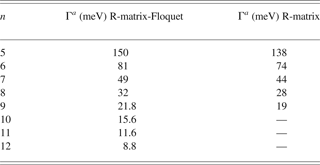
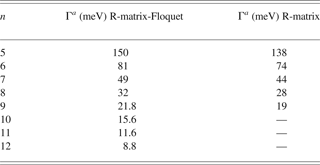
The results demonstrate that the motion of the trajectories in the complex plane shows different features of the coupled states. In all these figures, there is a critical point at the center of each of these two structures, at which the two complex energies are exactly degenerate such that LIDS occurs. Closed to the LIDS position, the LIDS frequency for fixed intensity can be predicted as complex trajectories with a real part avoided crossing and an imaginary part crossing switch to having a real part crossing and an imaginary part avoided crossing as ω passes through the LIDS frequency. For frequencies near the LIDS frequency, the real part of the energy is nearly constant for low intensities up to the LIDS intensity, but the imaginary part changes rapidly converging together at the LIDS position. Beyond LIDS, the real and imaginary parts both diverge from each other. Considering our simple two-state model for C2+, the values of E g and E a agree well with the opacity calculation. Table 4 gives comparison between the autoionization probability, Γa (meV), calculated for C3+, with this simple model and those reported by more sophisticated numerical method (Berington et al., 1998).
Comparison between calculated width, Γa, in meV units (meV), belonging to 1s 22pns(1P0) autoionizing states, 5 ≤ n ≤12, in C3+. Results refer to the R-matrix Floquet theory and code and its extension to LIDS method, and the R-matrix calculation by Berrington et al. (Reference Berrington, Pelan and Quigley1998)
4.2. First-Order Perturbative Calculation in a Single-Configuration Approach
While an R-matrix-Floquet analysis was then successfully applied, one can discuss theoretical description of the process in a perturbative framework. The basic formalism using Coulomb Green's function in its analytical form has been described in Section 3. It can be applied with exact summation on the outer-electron principal quantum number. The procedure has been suggested by Poirier (Reference Poirier1994), Poirier and Semanoune (1998) and used for alkaline-earth-metal atoms. The principle behind the theory is to include second-order effects in autoionization-width computation using the Sturmian representation of the Coulomb Green's function after multipolar expansion of the interaction. The autoionization probability up to second order is given by the Fermi golden rule:
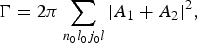
where (keeping notation given in Section 3) the first order amplitude reads:
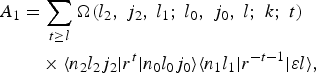
and
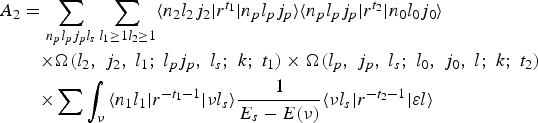
In Eq. (16), Ω is the angular factor in jk coupling, the infinite sum is over the quantum numbers of both electrons in a perturbing state n pl pj pυls and the sum over the principal quantum numbers of the perturbing states (n p, υ) includes the discrete and continuous parts of the spectrum. In this equation 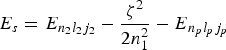 , where E n pl pj p are the parent-ion energies, and ζ is the charge experienced by the outer electron whose energy is purely hydrogenic at zero order of the perturbation expansion.
In atomic or molecular physics, it is customary the use of sum rules to handle the matrix elements that appear in many computations (Biedenharn & Rose, Reference Biedenharn and Rose1953; Biedenharn, Reference Biedenharn1955). These formulae are particularly well suited for the study of autoionization of large-angular momentum doubly excited Rydberg states. In Biedenharn's notation, the matrix element for bound-free transition is given by:
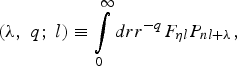
where F ηl is a continuum wave function of energy 1/2η 2 and angular momentum l and where P nl+λ is a discrete wave function of energy —1/2n 2 and angular momentum l + λ. The basic recursion relation for the radial matrix elements contains only radial integrals with q − λ of a given parity. This relation allows the multipole (λ − 1, q + 1; l + 1) to be expressed using multipoles of the two preceding orders.
In order to compute the autoionization width for 1s 22pns(1P 0), Rydberg states, n = 9–12 in Al10+ the starting point is the set of recursion relations on Coulomb non-relativistic wave functions:
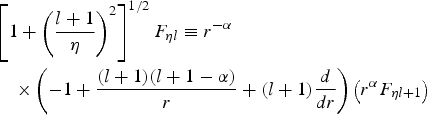

with α, β arbitrary numbers chosen such that q + α+ β =0. Introducing these recursion relation in the matrix element difference will lead to a term proportional to the electric multipole (λ − 1, q + 1; l + 1) and terms involving derivatives that are recast in symmetric and antisymmetric expressions. The basic relation has been obtained by Poirier (Reference Poirier1990) and contains only radial integrals with q − λ of a given parity:
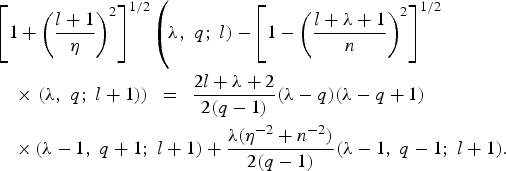
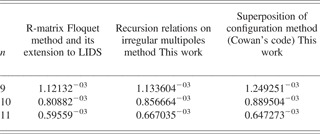
Once dipolar matrix elements have been analytically computed and once quadrupole elements have been computed from recursion property with l decreasing from n − 2 to 2, matrix elements of higher order can be derived from simple recursion relations. In Table 5, are presented results for the autoionization width of 1s 22pns(1P 0) states in Al X, n = 9–11, as output from the RMF code, Cowan's code and from perturbative calculation.
Comparative results for the autoionization widths (in atomic units) of Rydberg states of type 1s 22pns(1P0), n = 9–11, in Al 10+. (a−b reads a × 10−b)

5. CONCLUSION
In this article, a number of methods for atomic structure and electron-ion scattering calculations have been reviewed. Additionally, we have carried out semi-empirical and perturbative calculation to output values for the Gaunt factor, effective oscillator strengths, and autoionization rates. The simplest techniques developed in this article, of recursion relations on irregular electric multipoles, to describe excited Rydberg states, and the Coulomb Born approximation for electron –impact excitation rates, are particularly well suited for plasma when the evaluation of the ionic effective charge is requested. The single-electron description can be regarded in reasonable agreement with previously reported results. The approximation becomes more and more reliable as l increases and exchange effects are taken into account.
The article gives results from the non-perturbative treatment of laser induced degrade states. The motion of the complex energies in the complex plane as a function of the field intensity for different frequencies and atomic parameters gives complementary information on the role of LIDS on resonances obtained by laser. It is shown that the rate of ionization of the “ground” excited Rydberg state will first increase with intensity and then exhibit a typical “stabilization,” namely a decrease of the ionization rate with increasing intensity. The most interesting is the critical region where a crossing (or an avoiding crossing) of trajectories occurs. The consequences of the one-photon LIDS as “trapping” of population at some non-zero field intensity and possible population transfer from the excited to autoionizing state in Li-like ions are under investigation. The effect of one-photon transition, that couples the autoionizing state to the degenerate continuum state via the stimulated emission and subsequent absorption of a photon, on the resonance profile is studied as a function of the laser field intensity for particular case of Be-like Al and C ions. This type of process, implicitly included in the R-matrix Floquet calculation, contributes, to some degree, to the overall behavior of the resonance profiles. In the present case, the laser induced degenerate state phenomenon plays the most dominant role and is under consideration.
ACKNOWLEDGEMENTS
This work has been performed under the COST-ULTRA “Laser-matter interactions with ultrashort pulses, high-frequency pulses and ultra intense pulses. From attophysiscs to petawatt physics.” Financial support under the Research Project “Pathways to Energy from Inertial Fusion –An Integrated Approach” is gratefully acknowledged.
The author gratefully acknowledges the support of The National University Research Council in carrying out part of this project.