Recent research links current levels of development in former colonies, and even across regions in former colonies, to colonial institutions (Engerman and Sokoloff Reference Engerman, Sokoloff and Haber1997; Acemoglu, Johnson, and Robinson Reference Acemoglu, Johnson and Robinson2001, pp. 44–45; Engerman and Sokoloff Reference Engerman and Sokoloff2002; Nunn Reference Nunn and Helpman2008; Bruhn and Gallego Reference Bruhn and Francisco2012) According to this literature, conditions and endowments at the time of colonization determined political institutions that created and then perpetuated an unequal distribution of land, wealth, and political power. Most of these papers then present cross-sectional regressions showing how initial colonial institutions are correlated with per capita expenditures on public goods such as education, both across (Engerman, Mariscal, and Sokoloff Reference Engerman, Mariscal, Sokoloff, Lewis, Eltis and Sokoloff2009; Gallego Reference Gallego2010; Frankema Reference Frankema2012) and within countries (Banerjee and Iyer Reference Banerjee and Iyer2005; Wegenast Reference Wegenast2009, 2Reference Wegenast010; Iyer Reference Iyer2010; Acemoglu, Garcia-Jimeno, and Robinson Reference Acemoglu, Camilo and Robinson2012).
Yet, correlations between variables observed hundreds of years apart demand further examination. As a matter of fact, we know that there have been significant reversals of fortune among former colonies in terms of economic prosperity (Acemoglu, Johnson, and Robinson Reference Acemoglu, Johnson and Robinson2002), legal institutions (Musacchio Reference Musacchio2008), and financial development (Rajan and Zingales Reference Rajan and Zingales2003; Musacchio Reference Musacchio2010). We also know that trade shocks in the nineteenth century increased inequality in the Americas (Coatsworth Reference Coatsworth2005, 2Reference Coatsworth008; Williamson 2009; Arroyo-Abad Reference Arroyo-Abad2013). Thus, it is worth examining whether colonial institutions determine outcomes that then persist for hundreds of years or if institutional changes or trade shocks interact with those initial institutions to alter the development trajectories of national or subnational units in the long run.
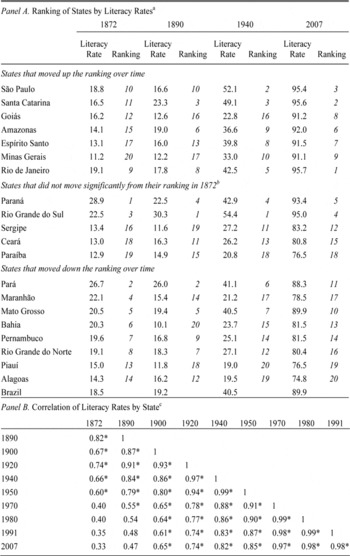
In this article, we study the effect that colonial institutions and subsequent changes in fiscal institutions had on educational outcomes in Brazilian states. Rather than correlating some variables in the past with today's outcomes, we document how the variation in export tax revenues in Brazilian states between 1889 and 1930, and their interaction with colonial institutions, explain which states spent on education and forged ahead, and which states lagged behind in the education rankings. This exercise is relevant because if we were looking only at the path-dependent effects of colonial institutions on education indicators at the end of the twentieth century, we would miss much of the radical changes and reversals that we find in the ranking of Brazilian states according to educational outcomes between 1872 and 1940. That is, many of the states that had low literacy rates throughout the nineteenth century ended up in the leading positions by 1940, while states that were among the most educated states in 1872 ended up at the bottom of the ranking in 1940 (see Table 1). Something changed, and it was not the colonial past.
We take advantage of the fact that Brazil had a peculiar federal arrangement during its First Republic, 1889–1930. During this period, the Constitution decentralized fiscal responsibilities and the right to tax exports. Thus, we show how the change in fiscal institutions in 1889 triggered changes in the development trajectories of states. We use the variation in fiscal revenues across states and over time to explain the variation in education expenditures at the state level. As the majority of revenues came from export taxes, states that exported commodities that had price ramp-ups could collect more revenues per capita and could—if they chose—spend more on education.
RANKING OF STATES BY LITERACY RATES IN THE LONG RUN

* denotes significance at 1 percent.
Notes:
a) Literacy rates are calculated as the number of literates over the population 4 years and older, except for 1940 when we have to divide it by the population 5 years and older. b) This group shows states that did not move more than five places in the overall ranking between 1872 and 2007. c) These correlations include all states except the Federal District.
Using both ordinary least square and instrumental variable techniques and controlling for a series of macro variables, fixed effects, year dummies, and state-specific linear trends, we find that changes in export prices and export tax revenues are positively correlated with education expenditures per capita and with education outcomes such as literacy and the number of schools. We then show how institutions, such as the extent to which slavery prevailed in each state by the 1860s, attenuated some of the positive effects of export tax revenue windfalls. The basic idea is that there are conditions that may come from the initial colonial settling and exploitation patterns (for example, the prevalence of slavery or the type of agricultural systems used) that led, in turn, to the creation of specific political institutions that, in turn, determined how much provincial elites and politicians wanted to invest in mass education. After adding a series of interactive effects between export tax revenues and different dummy variables that try to capture which states had more extractive colonial institutions, we find that in states in which slavery was stronger right before abolition (1888) and states that had the most exploitative cotton plantation systems at the end of the colonial era, increases in export tax revenues between 1889 and 1930 were not translated into more expenditures in education.
The shocks we document are not only statistically significant but also relevant in economic terms. During the period, we study Brazil as a whole had the largest increase in literacy rates in Latin America, going from 19.8 percent in 1890 to 40.5 percent in 1940 for the population over the age of four. However, this improvement in literacy rates was uneven across states, with states such as São Paulo improving literacy from 18.8 percent to 52.1 percent of the population and others such as Maranhão, Mato Grosso, or Bahia keeping literacy rates at 20 percent throughout the period we study.
Our findings contribute to a growing literature on the long-term effects of colonial institutions in Brazil. Joana Naritomi, Rodrigo R. Soares, and Julian J. Assunção (Reference Naritomi, Soares and Assunção2012) find that municipalities that exported mining products or sugar during colonial times tend to have worse current indicators of rule of law and legal sophistication. Tim Wegenast (Reference Wegenast2010) shows in a cross-sectional framework that, at the state level, land inequality, which supposedly persists from colonial times, is correlated with educational attainment. In contrast, William R. Summerhill (Reference Summerhill2010) finds no long-term correlation between colonial institutions and land inequality or GDP per capita among municipalities in São Paulo. Similarly, Irineu de Carvalho Filho and Renato P. Colistete (2Reference de Carvalho Filho and Colistete010) find strong correlation between education levels at the municipal level in São Paulo around 1905 and today; but do not attribute education levels today to colonial institutions.
Below we first review the rapid expansion in the provision of public education by the states of the Brazilian Federation between 1889 and 1930. We then examine the determinants of expenditures on schooling, presenting statistical evidence showing the relation between export tax revenue and expenditures on education. We end with a discussion of our results and of possible alternative explanations.
THE DIFFUSION OF ELEMENTARY EDUCATION IN BRAZIL, 1890–1930
We focus our attention on the period that goes from 1889 to 1930 because before that the political and fiscal institutions of Brazil held back the expansion of mass schooling. On the one hand, after independence in 1821 Brazilian politicians chose a political system that perpetuated the elitist nature of the political institutions imposed by the Portuguese during colonial times. For instance, in the 1824 Constitution Brazil's founding fathers adopted a constitutional monarchy with a clear division of power, an elected parliament, and an emperor, but they restricted the right to vote by imposing an income requirement that ranged between 100 and 200 times the annual income of most skilled workers. Moreover, elections were indirect, with parliamentarians (senators and deputies) elected by state electoral colleges.Footnote 1
On the other hand, even if elites across states in Brazil wanted to spend on education, the resources state coffers had were limited. This is because even though the 1824 Constitution decentralized the provision of education, the collection of revenues, mostly coming from foreign trade, was highly centralized during the Imperial period (1821–1889) (Hilsdorf Reference Hilsdorf and Spedo2003). The central government actually spent disproportionately on public goods that benefited the capital city of Rio de Janeiro or the armed forces (Villela Reference Villela2005, 2Reference Villela007).
Under such a political system, whatever resources provincial elites spent on public elementary education went to pay for schools that educated mostly their own children or those of other elites. As a sign of how elitist the system was, consider the following data. Enrollment rates during the Imperial period stayed below 10 percent. The privileged children who attended school in Brazil during that time benefited from public expenditures per enrolled student that were as high as the expenditures per children of school age observed in European countries at the time (Chaudhary et al. Reference Chaudhary, Musacchio, Nafziger and Yan2012).
By the end of the Imperial period, the low penetration of public education had left its mark in Brazil. Using data from the 1890 Census, we know that Brazil had one of the lowest literacy rates in the Americas (16.6 percent). In fact, some Brazilian states had literacy rates of 10.1 percent. Furthermore, there were two schools for every 1,000 school-age children in the country and in some states, such as Bahia and Ceará, there was only one school per 1,000 children.
In 1879 Leôncio de Carvalho, Minister for Internal Affairs, sent Congress a bill that introduced secular education and mandated the creation of schools of education to train teachers. Despite these reforms, there was no significant change in school infrastructure, the number of teachers, and the curriculum in the provinces until after the Republican parties took over in 1889.
Things changed rapidly after 1889 when a Republican revolution overthrew the monarchy and heralded positivism. One of the central tenants of positivism in Brazil was the idea that to become a civilized nation, the government had to provide secular education on a massive scale. Thus, the Republicans drafted a new constitution in 1891, significantly reforming the way schooling was financed and organized.
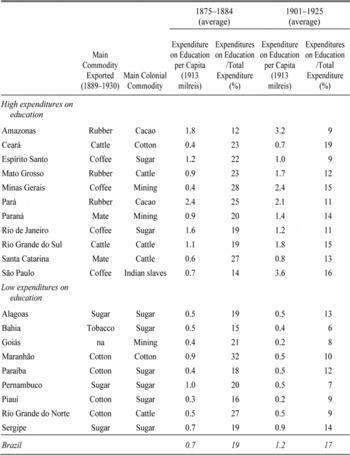
The 1891 constitution decentralized the collection of export taxes and the responsibility of providing public goods such as education, health care, and infrastructure. Because the constitution did not include any mechanism by which the federal government would aid poor states, other than some subsidies for ports and railroads, expenditures on education were limited to the funds states could generate from their own export and internal taxes. This boosted state coffers in states that exported commodities in high demand, such as rubber and coffee, and kept stable the public finances of states that exported commodities that did not have price increases such as sugar and tobacco. Table 2 shows that, from the empire to the Republic, real per capita expenditures on education increased 71 percent, on average, but declined in states that exported sugar and tobacco. Also in Table 2, we can see that the states with higher average expenditures on education per capita, higher enrollment rates, and more schools per capita between 1889 and 1930 were those that exported rubber, coffee, and cattle. States that exported coffee and rubber, for instance, outspent sugar-exporting states 2.5 times and cotton-exporting states 3.5 times.
STATE EXPENDITURES ON EDUCATION AND OUTCOMES BY COMMODITY EXPORTED


Sources:
See the Appendix.
With the change in ideology and the new revenues, state governments promoted a gradual and uneven transformation in elementary education in Brazil. They began a shift from the Lancaster method, in which students of all ages studied together in one room and helped each other learn with the guidance of one teacher, to a system that separated students according to grades and scheduled one subject at a time. These changes required more teachers and also more buildings, not only for the separate grades but also for facilities such as gyms and libraries. Some schools in large cities adapted more rapidly to such changes and introduced a new school layout and schedule, but schools in the interior were slower or never adopted such changes (De Souza Reference De Souza1998).
The transition to the Republic also brought about changes in the incentives of politicians and state parties to spend on education. The Constitution of 1891 introduced direct elections for governor, for local assemblies, and for representatives to the Senate and National Congress. Thus, improving education became a political prerogative, not only because voters could demand education, but because due to the literacy requirement to vote, increasing literacy could help local political bosses to mobilize more voters in state and national elections. At the national level, the introduction of direct elections changed the way local parties negotiated favors with the ruling national coalition. National parties no longer negotiated coalitions with state parties on the basis of electoral college votes, but rather on the basis of the total votes the state parties could deliver in national elections. The kind of favors state parties negotiated included subsidies for railways and port projects, and political support against opposition candidates.Footnote 2
All of those positive incentives and new ideologies led politicians to invest in public education at the state level, specifically on elementary education. School enrollment, teacher-pupil ratios, and the number of schools per children enrolled improved significantly between 1889 and 1930. Enrollment rates in elementary school, defined as the ratio of the number of students enrolled to the population of children from 5 to 14 years old, went from 6 percent in 1889 to 23 percent in 1933 (Table 2). These improvements were mostly due to improvements in the public provision of elementary education. In fact, the advance of state-sponsored schools was such that they gained market share from private and municipal schools; increasing their share of total enrollment from 53 percent to 65 percent between 1907 and 1933, while private, municipal, and the few federal schools lost ground proportionally.
With enrollment rates increasing at over 700 percent between 1889 and 1930, we would expect teacher-pupil ratios to have fallen. Yet, even with the rapid increase in enrollment, teacher-pupil ratios in state schools went down from 43 in 1889 to 40 in 1933. This was a consequence of the efforts to train and recruit teachers. Both national and state governments built new education schools, known as Normal Schools, and recruited their graduates en masse, paying them a higher salary than what teachers without a degree earned. Teachers without a degree were also hired in large numbers, but they had to pass an exam and were paid according to experience and training.Footnote 3
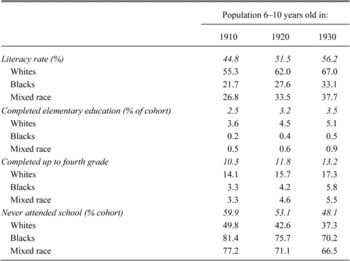
Thanks to cohort data from the 1960 Census, we know that some of these changes in the education system between 1889 and 1930 actually improved outcomes. Table 3 shows the literacy and attendance rates for children who were 6 to 10 years old in 1910, 1920, and 1930. While in the 1890 Census the literacy rate in Brazil was 19.2 percent, those children who attended school circa 1910 had a literacy rate of 44.8 percent. Moreover, the cohort that studied elementary education in the late 1920s (see the third column of Table 3) had a literacy rate of 56.2 percent according to the 1960 Census.
Yet there is a significant difference in the educational attainment of blacks and mixed-race Brazilians compared to whites. Literacy rates among white Brazilians who attended school during our period were close to 60 percent. In contrast, among black Brazilians the literacy rate was 33.1 percent according to cohort data from the 1960 Census. We think the poor improvement in education outcomes among blacks is to a large extent due to the fact that the percentage of blacks who never attended school in the 1910 cohort was 81.4 percent and in the 1930 cohort it was 70.2 percent (see Table 3).
EDUCATION OUTCOMES USING CENSUS DATA FROM 1960

Notes:
Part of the differences between whites and mixed race Brazilians and blacks could be driven by survival bias. Yet for it to be a problem, literate blacks would have to have had a lower mortality rate than other black Brazilians.
Source:
Brazil, VII Recenseamento Geral do Brasil, IBGE, 1960.
That is, during the period we study, the number of public schools and teachers grew rapidly, but the expansion of elementary education benefited mostly the white and mixed race elites. Despite the enthusiasm of the Republican elites for expanding public schooling and reducing illiteracy, the expansion of public education did not grow in all the states at the same rates. As we elaborate below, states in which the percentage of slaves to total population had been large during the empire saw less improvement in education outcomes after 1889.
EXPLAINING THE VARIATION IN EXPENDITURES ON EDUCATION
The period 1889–1930 had rapid increases in the number of schools, teachers, and students. This expansion required resources and not all states were able to collect the same level of revenues to pay for public schools. Thus, in this section we explain how the variation in export tax revenues explains increases in education spending at the state level.
To document the drivers of education expenditures, we created a panel with state-level data on expenditures, export tax revenues, population density, and imports per capita between 1890 and 1930 (the Appendix explains our data sources and methodology). The panel is unbalanced for expenditure, revenue, and education data. We have a complete panel with data on state's export prices and volumes exported between 1901 and 1930. However, we have expenditure and revenue data for only three periods: 1901–1907, 1914–1919, and 1923–1925.
We start by running a simple OLS regression using our panel and a baseline specification for examining the determinants of per capita expenditures on education of the following form:

where eeit is the log of expenditures on education per capita (or per child of school age, 5–14) in state i in year t and sit is the log of export tax revenue per capita for state i in year t. We also include a vector of state characteristics, X, which includes population density and debt per capita.Footnote 4 We use the natural logarithms of the variables to minimize the effect of outliers and to ensure that most variables follow a normal distribution. While all regressions include year dummies (φt ) to account for time-varying trends common to all states, we run regressions with and without state-fixed effects (ζi ) and state-specific, linear trends.
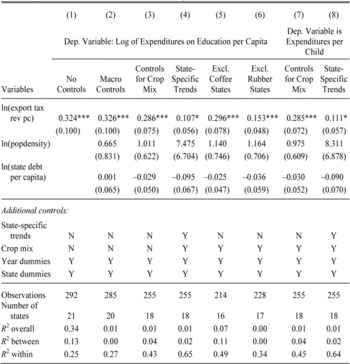
The main coefficient β, then, should be interpreted as an (export) income elasticity for state governments that tells us, in percentage points, how much education spending would increase given a 1 percent increase in export tax revenue. Our OLS estimates in Table 4 show that a 1 percent increase in export tax revenues is correlated with a 0.11 to 0.27 percent increase in education expenditures. If a state's export tax revenues per capita jumped 100 percent in one year, which indeed took place in states that exported rubber or cotton, education expenditures per capita could go up by over 20 percent. This is a large and significant effect. In fact, the “elasticity of income” for education expenditures is higher than the elasticity of income of other normal public goods such as healthcare.Footnote 5 Moreover, even when we control for the composition of the export basket, we find that the coefficient for export revenues per capita is still significant and of similar magnitude. That means that it was not changes in the composition of exports that determined the increase in revenues and expenditures, but either increases in export prices or changes in the capacity to export greater volume.
OLS REGRESSIONS WITH EXPENDITURES ON EDUCATION PER CAPITA AT THE STATE LEVEL, 1901–1926

Notes:
* denote statistical significance at 10 percent.
** denote statistical significance at 5 percent.
*** denote statistical significance at 1 percent.
Note:
Robust standard errors are in parentheses. Errors clustered are at the state level. All regressions include a constant. The sample includes only 18 states once we control for the export crop mix because we exclude the landlocked state of Goias and the capital of the country, the port of Rio de Janeiro, which had import duties as an additional source of revenue.
There is, however, a possible problem of using OLS with fixed effects to study how changes in export tax revenues affect education spending. Running OLS may confound the effect of, say, a commodity price increase with state-specific trends that may have begun before our period. There might even be state-specific trends that are correlated with commodity price increases but not caused by them. Therefore, in specifications 4 and 9 of Table 4, we run OLS specifications that include state-specific, linear time trends in addition to the fixed effects and time dummies we had in previous specifications. In these specifications, we find that export tax revenues still explain increases in education expenditures, and even if the coefficient is smaller (closer to 0.10), it is statistically significant at almost 5 percent.
In specifications 7 and 8, we run the baseline model with and without state-specific trends, using expenditure on education per child as the dependent variable. We find results that are consistent with our estimates using expenditures per capita. We prefer to rely on the per capita expenditures data because, in order to estimate expenditures per child, we have to make assumptions about the trend of the population pyramids between census years. Moreover, since some of the education was also for adults, expenditures per child may not be the proper way to think about education spending during this period.
ROBUSTNESS CHECKS
One concern with our estimates is how exogenous the variation in export tax revenues is. For instance, if Brazilian states could control the prices of the commodities they exported, then it would be hard to argue export tax revenue is exogenous to the political economy of each state. This is particularly a concern for states that were large coffee and rubber exporters. Brazil was the world's largest exporter of those two commodities in the period we study and there were efforts on the part of the national and state governments to control international coffee prices in different moments in time. The states of São Paulo, Minas Gerais, and Rio de Janeiro, as price setters in the international coffee market, largely determined the growth rate of national coffee exports (especially in 1905–1914 and in some years in the 1920s).
Amazonas and Pará were the principal suppliers in the international rubber market, but their governments did not coordinate to control prices. Thus, in specification 5 of Table 4, we omit the coffee-exporting states, Rio de Janeiro and São Paulo from the estimates. In this specification, the coefficient of export tax revenue is unchanged. Then, in specification 6 we omit the rubber-exporting states, Amazonas and Pará from the sample and the coefficient for the log of export tax revenues goes to 0.15, but remains statistically significant at 1 percent.
There are two additional concerns related to the exogeneity of our variable of interest. The first concern is whether the variation in export tax revenues is attributable to exogenous conditions in commodity markets, especially to changes in prices. The second concern is whether the variation in export tax revenues are a product of changes in tax rates rather than prices (since tax rates can be endogenous to political outcomes and to changes in prices).Footnote 6
To check the connection between export prices and expenditures on education, we created a series of export price indices (one per state) and used them as instruments for export tax revenues. We focus on international prices because we wanted an instrument that could capture both supply and demand conditions. During our period, most of the shocks to commodity prices were demand-driven, rather than created by, say, a drought or a bad harvest that reduced the supply.Footnote 7
In the first stage, we use these indices as an instrument for export tax revenue per capita, assuming that our export price indices per state will reflect how much state governments could extract in export taxes. Since export taxes were ad valorem, increases in export values were translated into higher tax revenues. In the second stage, we use our estimated state export tax revenues per capita as an independent variable to estimate the coefficient of the elasticity of export tax revenue to per capita education spending.
INSTRUMENTAL VARIABLES REGRESSIONS FOR EXPENDITURE ON EDUCATION

* indicates significance at 10 percent.
** indicates significance at 5 percent.
*** indicates significance at 1 percent.
Note:
Our instruments are a set of export price indices, one per state. We created an export price index for each state using the prices of the eight largest exports and leaving the weights fixed for the entire period (we use weights for 1900). Robust state cluster standard errors are shown in parenthesis.
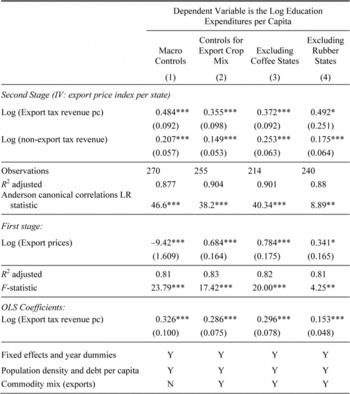
Table 5 shows the results of our instrumental variables (IV) estimates. The state-level variation in export prices seems to explain the variation in education spending over time quite strongly. We find strong and significant coefficients in the first and second stages. This might imply that what did the most to increase revenues and expenditures was the price ramp-ups and not, for instance, tax increases or changes in the export mix. In specification 2, we include a control for export shares, which should capture the dynamics of the export mix as a reaction to changes in prices. The coefficient of our instrumented export tax revenue per capita remains strong and significant, with an elasticity of 0.355, which is above all of our OLS estimates in Table 4.
Using price indices of commodity exports as instruments for export tax revenues (in Table 5), however, assumes that states did not themselves influence the growth rate of prices in international markets. To deal with the potential endogeneity in coffee and rubber prices, specifications 3 and 4 of Table 5 exclude coffee and rubber states, respectively. When we exclude coffee states, the results do not change, which is a comforting result given the explicit efforts those states made to control coffee prices in 1905–1914 and 1923–1928. Yet, when we exclude rubber states in Specification 4 of Table 5, the coefficient of our estimated export tax revenues per capita loses significance.
A final concern with our IV setup is that, when prices moved, state governments could have changed tax rates in order to smooth export tax revenue. In that case, our use of prices as an instrument should lead to weak first-stage results. But our strong first-stage results disprove that hypotheses and show that changes in taxes, which did take place from time to time, were not big enough or timed in such a way as to weaken the coefficient that measures the sensitivity of changes in export tax revenues to changes in export prices. In fact, the F-test of the first stage shows that our instrument is strong in the first stage and, according to the Anderson likelihood ratio test, does not seem to be correlated with the error term. We do, however, have a weaker instrument in specification 4.
Interestingly, the coefficients for the variable of interest (export tax revenues) in the second stage are larger than our OLS panel coefficient. These coefficients in the second stage, however, are close to one standard error larger than those of the OLS estimates. This leads us to believe there is no significant bias or measurement error driving our IV results. One could think that the coefficients could be biased upwards because the prices of commodities affect expenditures through other channels than export tax revenues, resulting in violation of the exclusion restriction. For example, commodity prices could have pushed land prices up and thus increased the collection of land taxes and, in turn, the expenditures on education. However, in Table 5 we have controlled for the other tax revenues—including land taxes, a tax on industries and professions, and other stamp taxes—in order to study the pure effect of export tax revenues on education expenditures. Even after including these other sources of funding for the state, the coefficient of the elasticity of export tax revenues per capita does not change much from what we found in the OLS regressions.
One final robustness check has to do with alternative factors that could be driving the demand for education and that have not been controlled for in our estimates. One obvious hypothesis to explain why positive windfalls coming from export taxes were used on education is that industrialists pressured governments to provide more education and that families themselves demanded more education because skill premia increased in states that were more industrialized. Another obvious hypothesis is that the rapid increase in European immigration to Brazil after 1890 created an increase in demand, either because planters (e.g., coffee planters) pushed local governments to offer better public education to attract immigrants or simply because the immigrants themselves demanded public schools.
For us to be concerned about immigration and industrialization as drivers of the demand for education, we would have to find positive correlations between these variables and education expenditures. We actually tested these hypotheses and find no evidence that either industrialization or immigration drove the increase in state-level education spending. Since there is no panel data for industrialization or immigration by state, we use cross-sectional data from the population censuses (1890, 1920, and 1940) and industrial censuses (1907, 1920, and 1940) and interact variables measuring either industrialization or the relative size of the immigrant population with our variable of interest (export tax revenue per capita), using panel data and our OLS basic specification. In fact, we find a negative correlation between education expenditures and the number of immigrants per state in 1890 and 1920 Similarly, when we interact export tax revenue per capita with growth in industrial production between 1907 and 1940, the number of industrial firms per state, or the value of industrial production in 1907, 1920, and 1940 we find statistically significant, but negative coefficients.
We feel confident about these results for at least two reasons. One the one hand, the great majority of the European immigrants who went to Brazil were from countries such as Italy, Portugal, and Spain, where governments did not spend much on education (Lindert Reference Lindert2004). Thus we have no reason to expect that people who did not demand more education in Europe demanded it in Brazil. On the other hand, the industrialization of Brazil did not depend mainly on technology with skill complementarities. For instance, following Claudia Goldin and Lawrence F. Katz (1Reference Goldin and Lawrence998), we divide the industries for which we have data on technology imports between those that use the technology of the first industrial revolution (textile and woodworking machinery) and those that use the technology of the second industrial revolution (turbines to generate electricity and all sorts of electric equipment); the former does not require skilled labor but the latter does. We find that the largest increase in machinery imports took place in sectors linked to the first industrial revolution, which were labor-intensive and required less-skilled workers. Therefore, we should not expect to find that either industrialists or families were pushing for more education because it is not clear that there were any skill premia in the more industrialized states.
All told, it is not clear that immigration or industrialization increased the demand for education. It could be the case that changes in income or in societal preferences may have changed the demand, but as we control for this only imperfectly in our statistical work, we prefer to leave such hypotheses as candidates for future research.
COLONIAL INSTITUTIONS AND EDUCATION EXPENDITURES
In the previous section, we explained how the decentralization of fiscal responsibilities created heterogeneity in export tax revenues and on expenditures on education. In this section, we examine how colonial institutions may have mitigated how much state governments spent on education when they had windfall revenues from export taxes. For instance, politicians may have spent less on education per capita in states with higher initial levels of education or in states in which there was more inequality in the distribution of assets such as land (Engerman, Mariscal, and Sokoloff Reference Engerman, Mariscal, Sokoloff, Lewis, Eltis and Sokoloff2009). Alternatively, political elites in Brazilian states in which there had been more slaves before emancipation might have wanted to restrict education for blacks, as a way to have a cheap pool of unskilled labor or as a way to preserve the political status quo.
We, therefore, examine both the direct and interactive effect of a set of variables proxying for colonial institutions. Our proxies for colonial institutions are (1) variables that measure the main commodity produced in a given province during colonial times, (2) the state's slave population as a percentage of its total population in 1819 and in 1864, (3) distance to the equator (to proxy for climate), (4) mortality rates from tropical diseases (using 1910 data), and (5) a dummy for high concentration of land ownership (indicating whether or not the percentage of large farms—those over 100 hectares—is above the mean).Footnote 8
We use three dummies to proxy for colonial commodities. First, we have a dummy for good and bad colonial institutions. This variable is coded as 0 if the state's main commodity during colonial times was produced using plantation agriculture or some form of coerced labor, 1 otherwise. We follow Miriam Bruhn and Francisco Gallego (Reference Bruhn and Francisco2012) in coding states according to an assumption that the production of certain commodity, such as sugar and mining, led to bad institutions. Second, following the work of Naritomi, Soares, and Assunção (Reference Naritomi, Soares and Assunção2012), we include a dummy for sugar, cotton, and mining because some of those industries may have left a worse system of political institutions that then hindered the expansion of education.Footnote 9 Third, we control separately for the agricultural commodities that relied most intensively on slaves during colonial times (and for a good part of the nineteenth century), such as sugar and cotton. This is a partial correction to the Bruhn and Gallego coding, which excluded cotton from the colonial commodities that relied on coerced labor.
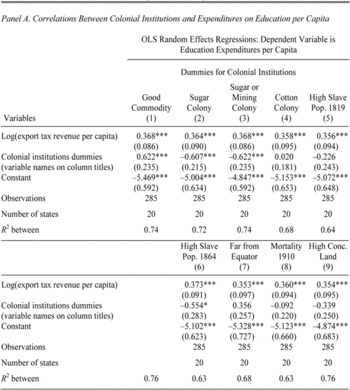
In Panel A of Table 6, we use random-effects regressions to examine the degree to which colonial institutions might explain cross-sectional variation in education spending. Specifications 1 through 3 show that, in states that used coerced labor for mining and sugar production during colonial times, per capita expenditures on education were significantly lower than the average between 1889 and 1930. Interestingly, being a cotton colony (Specification 4) was not correlated with having lower per capita expenditures in the long run, despite the fact that cotton states, such as Maranhão, had extremely large slave populations. In specifications 5 and 6 of Panel A, we can see that the dummy variable that that indicates when that ratio of slaves to population is higher than the average is only relevant to explain per capita expenditures across states when we measure it in 1864 and not when we measure it in colonial times (1819). That is, slavery may generate perverse elitist institutions, but it does not have to have begun in colonial times to be correlated negatively with expenditures on education.
OLS REGRESSIONS TO STUDY THE EFFECT OF COLONIAL INSTITUTIONS ON EDUCATION EXPENDITURES AT THE STATE LEVEL (random effects)


* denote statistical significance at 10 percent.
** denote statistical significance at 5 percent.
*** denote statistical significance at 1 percent.
Note:
Robust standard errors are in parentheses. Errors clustered are at the state level. The sample includes only 18 states once we control for the export crop mix because we exclude the landlocked state of Goias and the capital of the country, the port of Rio de Janeiro, which had import duties as an additional source of revenue.
Other than these variables, we do not find any other significant correlations of our dummies for colonial institutions with per capita education spending. The dummies for high distance from the equator, high mortality rates, and high concentration of land ownership are not significantly correlated with our dependent variable. For instance, specification 7 includes distance to the equator as a control and does not yield significant results. Specification 8 includes the 1910 mortality rate from tropical diseases as a proxy for mortality rates during colonial times and its coefficient is also not statistically significant.Footnote 10
We take a historical liberty when we include an interaction of export tax revenue with a dummy that measures if there was high concentration of land ownership in 1920, instead of measuring land concentration during colonial times. Wegenast (Reference Wegenast2010, pp. 115–18) assumes that land concentration has been stable since colonial times and even uses the Gini coefficient for land concentration in 1950 as an “exogenous” source of variation to explain expenditures on education in the twentieth century, using a cross-sectional regression. However, including a dummy for high concentration of land ownership in our panel setting (coded 1 when the percentage of farms with more than 100 hectares is above the mean) does not yield significant coefficients.
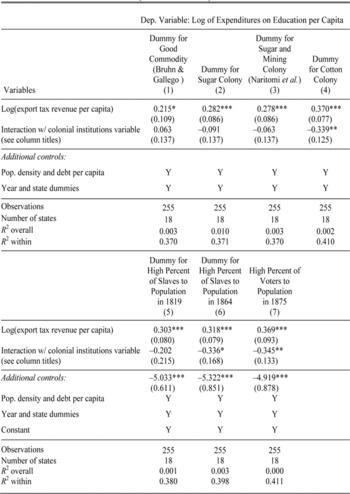
Beyond the direct effect of colonial institutions, we are interested in the interaction between our proxies for colonial institutions and expenditures on education per capita. That is, we want to understand how institutions moderated (or amplified) the effects that windfall revenues had on education expenditures. In Panel B of Table 6, we replicate the random-effects regressions of Panel A, but this time we include an interactive term for each of our colonial institutions with our main variable of interest (the log of export tax revenue per capita). The results we get in these specifications are slightly different from what we find in Panel A. The coefficients for the colonial institutions dummies lose all significance, with two exceptions. As we can see in specifications 4 and 6, the only coefficients that are significant are those for the interaction between export tax revenues and the dummies for cotton colonies and for high slave population in 1864. According to the results of those specifications, on average, cotton states or states with a high ratio of slaves to population had less than half the expenditures on education per capita than the average state. States with large slave populations in 1864 were the worst. Elites in those states did not show much interest in increasing education funding with their windfall export tax revenues. We do not have specific information as to whether elites in those states discriminated against blacks when they set up new schools, but we do know that most of the education expenditures in those states went to schools in the cities and that blacks rarely attended them.
Yet, these cross-sectional regressions and the inferences we can draw from them have to be interpreted carefully because we are not controlling for unobservables that may be driving the variation in expenditures. Therefore, in Table 8, we reproduce the same specifications of Panel B of Table 6, but adding state-fixed effects. Again, in this setting the only significant interactions are those with the cotton colony dummy and with the dummy that measures if a state had a high ratio of slaves to population in 1864.
We think that the interactions with the other commodity dummies are not yielding any results because there is too much variation in education expenditures within states that belong to each of the categories for colonial institutions. For instance, when we interact a dummy variable for states that produced sugar during colonial times with per capita export tax revenues, we do not get a significant coefficient (see specification 2 in Table 7). That is, there is wide variation even within the states that supposedly produced “bad” commodities during colonial times. We find sugar states with very poor records on education between 1889 and 1930, such as Pernambuco, which actually lowered its per capita spending, and we find states that did much better, such as Sergipe, which increased spending by almost 30 percent.
The case of states that exported cotton during colonial times exemplifies how institutions constrained how much of a state's windfall export tax revenues were put into education. We can see in specification 4 of Table 7 that a 1 percent increase in export tax revenues per capita would not lead to a large increase in education expenditures. This is because the net effect of an increase in export tax revenues would need to add up the elasticity of export tax revenues alone, which is 0.37, and the interaction with the cotton state dummy, which is −0.34. In fact, cotton had a large, positive price spike in the early 1920s, but that was not translated into greater spending on education in Maranhão, Piauí and Rio Grande do Norte, the main cotton states. Those states, toward the end of the colonial period, used slaves intensively to cultivate cotton and had some of the most extractive colonial systems in Brazil. In Maranhão, for instance, slaves represented 80 percent of the population during colonial times. This state was developed from a small outpost into one of the largest entrepôts of Brazil when the Portuguese Crown created the Companhia Geral do Comércio do Grão Pará e Maranhão (1755) with the explicit aim of importing African slaves to aid in the production of sugar and, later, of cotton (Silva 1984, p. 265).
EXPENDITURES ON EDUCATION INTERACTED WITH COLONIAL INSTITUTIONS (Fixed-effects OLS)

* denote statistical significance at 10 percent.
** denote statistical significance at 5 percent.
*** denote statistical significance at 1 percent.
Note:
Robust standard errors are in parentheses.
To avoid inferring too much from commodity dummies, in specifications 5 and 6 of Table 7 we add an interaction with the ratio of slaves to population in each state in 1819—right before independence—and in 1864—almost 25 years before the abolition of slavery in 1888. Interestingly, we do not get any significant effect when we interact export tax revenue with the dummy that measures if there was a high ratio of slaves to population in 1819, but we do get a large and significant (at 10 percent) coefficient when we use the 1864 ratio. Again, this coefficient shows how institutions may constrain the diffusion of education. In states with an above-the-mean proportion of slaves in 1864, a positive trade shock would not be translated into more education spending at all because the coefficient of the interaction is larger than the elasticity of export tax revenues. This means that there is something about the intensity with which slavery prevailed in a state which later led to lower education spending.
At least two hypotheses can explain the correlation of slavery with lower education spending in our regressions in Table 7. First, it could be that pure racism led the elites, who were mostly white, to spend less on education. In fact, as we show in Table 3, cohort data from 1960 shows that the expansion of education we document in this article benefited mostly whites. Second, it could be that the states in which slavery prevailed had a more unequal distribution of economic assets and political power and therefore the elites preferred not to expand public education because it could expand the voting population and, thus, disrupt the political status quo. In Pernambuco, a sugar state with a large slave population, governments actually decreased their spending on education during our period of study and the Monarchists stayed in power despite the rise of Republican parties throughout Brazil.
Additionally, we examined if the interaction of export tax revenue with the dummies that capture high distance to the equator, high mortality rates in 1910, and high concentration of land were correlated with expenditures on education and we did not find any significant coefficient (not reported on Table 7 for space considerations). Perhaps those variables are not the ones that create differences between states over time, or perhaps their effects are correlated with the crops those states produced and, thus, with export tax revenues per capita.
Finally, in specification 7 of Table 7, we include an interaction with the ratio of voters to population in 1875, 15 years before our period begins. We can see that in states with a higher percentage of voters in 1875, positive trade shocks are barely translated into higher spending on education. This could be counterintuitive if we agree with Peter H. Lindert that the percentage of voters in the population should be correlated with per capita spending on education (Lindert Reference Lindert2004, pp. 33–43). Yet, there are two explanations of why the results point in the opposite direction (i.e., more voters correlated with less education spending). First, in Brazil, there was an income requirement to vote until 1881. Since states with slaves were richer they also had more voters. Second, as we explain before, during the Republican years state parties had an incentive to invest in education to increase the number of voters they could mobilize for national presidential elections. States that started with a larger number of voters, thus, did not have to rush to educate future voters.
Therefore, it seems that if commodities can help us proxy for institutions, what matters is not what commodities a state exported during colonial times, but the economic system used to produce those commodities and the institutions that system left in place in the nineteenth century. This is the point that Engerman and Sokoloff made in their work and others have now simplified using dummies for commodities produced during colonial times.
Brazil and other New World colonies were under colonial rule for over 300 years, so it is unreasonable to expect simple commodity dummies or dummies to capture the intensity of slavery in one year will reflect a country or region's institutional dynamics since colonial times. Take for instance the ratio of slaves to population at the end of colonial times (in 1809). In São Paulo, Amazonas, Pará, and Minas Gerais, slaves made up over 25 percent of the population in 1819, yet these states were top spenders on education during our period of 1889–1930. In states such as Rio Grande do Norte and Piauí, slaves made up less than 15 percent of population in 1819, yet these states spent very little on education during our period (see Table 2). In contrast, states that ended up with more slaves before abolition, such as Sergipe, Pernambuco, and Bahia, ended up spending less on education during the Republican period. That is, it was not so much the specific colonial institutions that mattered, but how they were preserved or recreated in the nineteenth century that drove different states to spend more or less on education.
In sum, our empirical strategy shows that state governments collected more tax revenue when the prices of their export commodities went up. Those states that had higher export tax revenues and comparatively fewer slaves before abolition ended up spending more on education. We would expect those states to also end up having better education outcomes, such as higher literacy and enrollment rates or more schools. Below, we use reduced-form estimates to test that expectation.
EXPORT TAX REVENUES AND EDUCATION OUTCOMES
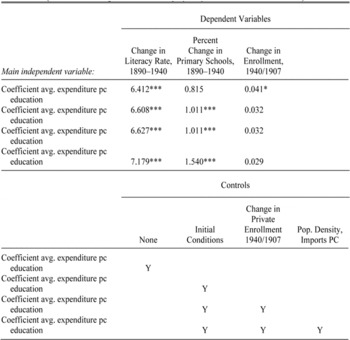
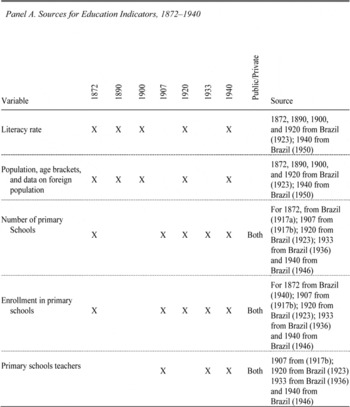
In this section, we argue that the variation in export tax revenues not only explains the variation in education spending, but that those expenditures were also translated into changes in education outcomes. We show the connection between revenue shocks and education outcomes using data from the Education Census of 1872, 1890, 1900, 1920, and 1940 (see the Appendix for sources). We take two approaches. First, in Table 8, we use the average of our variables to run a simple cross-sectional regression (with a limited sample size of 20) to see if average per capita education spending is correlated with the literacy rate (1890–1940), the number of schools (1890–1940), and the number of students (1890–1940). We find significant correlations for the first two. The correlation with number of students is only significant when we control for state characteristics.
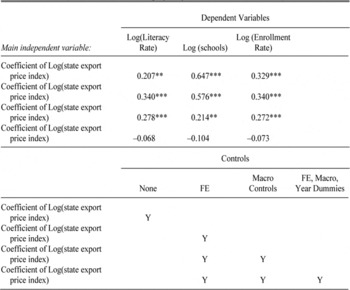
Second, in Table 9, we run a similar regression using panel data. We use export prices—the most exogenous component of export tax revenue—as our independent variable. We get consistent significant results showing that positive price shocks led to improvements in education outcomes (with the exception that the correlation with enrollment is not significant when we control for population density).
CONCLUSION
We have shown that there was progress in the provision of elementary education in Brazil between 1889 and 1930 and that it was largely a consequence of the decentralization of revenues and expenditures in this period. Thanks to the decentralization of fiscal resources states that could get more taxes from commodity exports were able to spend more on public education. In those states, education outcomes improved more rapidly.
We see at least two ways in which our findings are original and surprising for a broad literature that studies the political economy of development. First, the literature defending the persistent effect of colonial institutions seldom discusses in depth the kind of shocks that can change the development trajectory of a country or state. We show that institutional changes, such as fiscal decentralization, actually matter to determine major changes in the development path of states. More specifically, we show that the effect of rapid increases in revenues, due to commodity booms, did not lead to increases in education expenditures across the board but that such windfall revenues were only translated into education spending in states that had egalitarian institutions.
CONDITIONAL CORRELATIONS BETWEEN EXPENDITURES AND EDUCATION OUTCOMES (Cross-section regressions - we display only the coefficients of interest)

* indicates significant at 10 percent.
** indicates significant at 5 percent.
*** indicates significant at 1 percent.
Note:
Robust errors are in parenthesis.
Second, we show that major increases in tax revenues can have long-lasting effects on human capital accumulation and their distribution across states. For instance, we show that the ranking of Brazilian states according to literacy rates changed significantly between 1872 and 1930, but that it has not changed much since then. This is partly because the post-1930 industrialization and the massive internal migration of the second half of the twentieth century reinforced the ranking of states observed in 1930. That is, the initial push in some of the richer states generated increasing returns, such that states that were the most educated by 1930 became Brazil's most educated and industrialized states at the turn of the twenty-first century. Thus, our article suggests one explanation of the origin of Brazil's severe regional inequality.
OLS REGRESSIONS: TRADE SHOCKS AND EDUCATION OUTCOMES (Reduced Form - we display only the coefficients of interest)

* indicates significant at 10 percent.
** indicates significant at 5 percent.
*** indicates significant at 1 percent.
Notes:
Dependent variables are education outcomes. The independent variable of interest is logarithm of our state price indices for three periods. Panel data using three education census years: 1890, 1900, and 1920. In this reduced form, we test the hypothesis that favorable fluctuations in the international price of commodities increased the expenditure on schooling, which was reflected in higher education outcomes. The expected sign of the coefficient is positive. Robust standard errors are in parenthesis. Errors are clustered at the state level.
Now, despite the progress in education during the First Republic in Brazil, we are cautious because improvements in education did not translate into a broad improvement in human capital accumulation for the masses. Additionally, even if commodity booms generated windfall revenues that Brazilian state governments spent on education, the money was mostly spent on educating whites and mixed-race Brazilians. Former slaves and blacks in general did not benefit much from the expansion of public education between 1889 and 1930.
Appendix: Data Sources
VARIABLES USED AND THEIR SOURCES