Rather than negotiate first with protesting and then striking students, the administration of the University of Puerto Rico (UPR) shut down its flagship Río Piedras Campus from 21 April to 6 July 2010. Regular academic activity on the campus came to a standstill, and as a consequence the semester programmed to end in mid-May could not be finished until mid-August. Yet in those seventy-plus days of closure (cierre) a poignantly expressive culture of resistance took shape out of the continuous tension among the striking students who occupied the campus, the remote administration that refused to respond to their issues, the heavily armed state police officers who were stationed just outside the campus's gates, and the crowds of professors, nonteaching personnel, parents, and student supporters who gathered daily to urge the administration to open a dialogue with the students. Along with independent radio broadcasts, the skillful use of cyberspace, celebrity concerts, and other strategies to capture public and media attention, the protest movement also fostered the spectacle of mass rallies and marches that featured acts of performance and theatre. If the university's theatres were dark, the streets that surround the campus became the stages for seminude, placard-carrying bodies moving serpentine through crowds; stilt-walking masked portrayals of local politicians and university administrators; large, painted-cardboard dragons and wolf heads to stare down police officers; a twenty-foot-tall puppet whose shirt front read “the university is not for sale” (“La UPR no se vende”); processions of black coffins accompanied by black-clad lloronas (mourners); and red-nosed, broom-carrying clowns decked out in tactical police gear to parade comically in front of the heavily armed and real tactical forces.
The end of the strike in early July seemed to draw the curtain on those innovative and energetic acts of street theatre. A new academic year began at the end of August, and in mid-October the university's Drama Department staged La farsa de Maese Pedro Patelín (The Farce of Master Pierre Pathelin) in the open plaza in front of the University of Puerto Rico's iconic arabesque clock tower. Two weeks later, an out-of-doors staging of a Flaminio Scala commedia dell'arte text also met with success. Migdalia Cruz's Telling Tales (sand & fire) and María Irene Fornés's Mud played in late October in the experimental theatre, and Ariel Dorfman's Viudas (Widows) opened in November in the two-hundred-seat Julia de Burgos Theatre. The variety of and enthusiastic response to these productions would seem to attest to a return to normal. Although each in its own way reflected upon the strike, collectively they also recorded a sense of absence. The audacity, risk, commitment, and creative edge that characterized many of the performances that emerged during the protests were missing. By December 2010, the unresolved issues of the April–July strike had reemerged, and the University of Puerto Rico had once again become a center of controversy and confrontations.
Student strikes at UPR to object to administrative policies or to protest government intervention in university affairs date from 1933.Footnote 1 The current crisis began in early 2009, when the newly elected Governor Luis Fortuño of the statehood-seeking Partido Nuevo Progresista (PNP; New Progressive Party) confronted Puerto Rico's fiscal crisis by using his party's majorities in the island's Senate and House of Representatives to pass the controversial Law 7, an emergency bill that suspends existing public-employee union agreements and contracts, permits the radical revision of institutional budgets and funding formulas and the firing of personnel, levies new taxes, and penalizes resistance to its provisions. Before the end of 2009, between twenty and twenty-five thousand tenured and untenured public employees had been summarily dismissed. Cultural institutions were among the hardest hit by firings and radical cutbacks. Widespread protest broke out. Thousands marched in a national strike on 15 October 2009 that closed public and private-sector offices and businesses and converted the streets leading to the Plaza las Américas commercial center into multiple and moving stages for hundreds of musicians, visual artists, and theatre performers. In 2010, that energy, creativity, and resistance shifted its focus to the University of Puerto Rico.Footnote 2
Although tarnished by years of indifferent bureaucracy and political interference, UPR has remained Puerto Rico's most prestigious and internationally recognized public institution. In addition to being a beacon of intellectual and scientific endeavor for the Caribbean and Latin America, it has served as the training ground for generations of writers, doctors, teachers, scientists, artists, lawyers, social workers, urban planners, accountants, and journalists and communications, media, computer, and business specialists—the professional infrastructure of Puerto Rican society. The university boasts eleven campuses that serve more than sixty thousand students. It is the only unbroken institution in an otherwise largely dysfunctional public sector, and as a semiautonomous educational institution, it seemed, at first, to be immune to the impact of Law 7.
However, the new law changed the formula (the percentage of internal revenue) for university funding and excluded it from access to new sources of revenue created by the law. Funds from the Obama administration and the U.S. Department of Education stabilized the 2009–10 budget and helped limit cutbacks, but the 2010–11 budget projects a reduction of over 120 million dollars, nearly 40 million of which has been sliced from the Río Piedras Campus. Along with radical budget cuts came more-direct government intervention in academic policy, with the apparent purpose of disarticulating and privatizing academic and administrative services and, perhaps, even entire campuses.
The UPR faculty knew something of what to expect: the policies of no academic promotions, no cost-of-living increases, no sabbatical leaves, fewer classes and larger class sizes, heavier teaching loads, a severe reduction in the number of adjunct teachers, less or no funding for travel and research, no new faculty hiring, reduced technical and clerical staff, no hiring of new nonteaching personnel, only minor improvement of physical facilities, and cutbacks in academic services have been in effect since 2009. (As of December 2010, no full-time tenure-track professors have been fired.) But new restrictions were directed at the student body: a reduction in tuition waivers for academic, artistic, and sports excellence; the threat that Pell Grants would be taken away from those who do receive tuition waivers; reduced course offerings in future semesters and a severely limited summer-school offering; and the continued privatization of campus services. Rumors circulated that the administration planned to sell regional campuses to a local mass-education community college chain. And of course, students—and faculty—had no input in these decisions, and there was no transparency in terms of how and by whom the decisions were being made.
UPR's governing board (the majority of whom are appointed by the governor),Footnote 3 the unpopular president, and the (then) interim chancellor of the Río Piedras CampusFootnote 4 were inaccessible and could not be questioned or held accountable by students, their parents, faculty, nonteaching employees, the general public, the press, churches, unions, countless UPR graduates, or local businesses, many of whom would eventually support the students' strike for a voice in the policy and future of UPR as a public institution.
From January to early April, student protests, teach-ins, and requests for dialogue received no response. A large general student assembly elected a negotiating committee and voted in favor of a two-day class and work stoppage, during which they would occupy the Río Piedras Campus. That stoppage, it was decided, would become an indefinite strike only if the UPR administration refused to begin a serious dialogue with the negotiating committee over student issues. On the morning of 21 April, the first day, the administration gave its “full-metal-jacket” response. UPR campus police do not carry weapons, but the estimated 250 state police officers, including helmeted and armored tactical operation forces (the “riot squad”), who were brought in and placed at the campus gates were fully armed. They did not hesitate to use nightsticks and pepper spray, and this response virtually guaranteed a full-scale student strike. The situation worsened in the next three weeks. The administration made only halfhearted attempts to meet with the negotiating committee and broke off dialogue in the one meeting in which some progress seemed to be made. On 13 May, the students held another general assembly—this time off campus in the large San Juan Convention Center to permit full and free participation. At that point an overwhelming majority, representing all UPR system campuses, voted to continue the strike.Footnote 5
In response, the administration declared the Río Piedras Campus closed—at first for just a week and then until 31 July—and tried to prevent all food and water from being delivered to the students occupying the campus. A father who brought food and water to his son was beaten and arrested by police. Police also pushed, shoved, and hit groups of professors who brought food and water and gathered at the gates and the fences that surround the campus to hand it through to the protesting students. The flurries of police violence—some of it extreme—continued as parents, professors, local artists, and supporters arrived throughout the next week with food and water in defiance of directives from state police and the university administration. Media coverage of the strike, which was sympathetic to the students, proved disastrous for the police.Footnote 6 They relented and permitted supporters to hand staples for the students through the gates and fences.
In spite of administration attempts to provoke reactions, the students camped inside the Río Piedras and other campuses committed no violent acts or acts of vandalism. They separated their garbage for recycling and passed it over the fences for municipal garbage trucks to pick it up. They read, played soccer, listened to music, and established their own radio station, Web sites, and blogs. (In an early act of solidarity, professors handed books they had authored as well as others to students through the campus fences.) They painted posters and created plays and performances. They also found ways to slip in and out of the campus virtually undetected by campus and state police.
As a result, the student movement became the protagonist of a large social spectacle that the university administration could do little to control. A media war was waged: the administration placing well-funded (mis)information ads and announcements on local TV and radio and in newspapers, and the cybernetically more adept students creating a counterimage by using video and digital cameras, YouTube and social networks, blogs, and their own radio station. Most important, they maintained a media presence as an alert and educated group that was always open to discussion and negotiation. The image they projected was intelligent, controlled, and reasoned in comparison to the frantic, bad-reality-television interviews of the president of UPR's governing board and the relatively unintelligible pronouncements of UPR's president.
At the same time, a number of the university's educational and cultural functions continued informally. Classes were held in local bookstores and coffee shops within a block of the campus; faculty and graduate student symposiums continued even when invited guests had to forgo their speaker's fees; a symbolic graduation took place with faculty members in full academic regalia and four hundred students receiving their diplomas; M.A. and Ph.D. thesis consultation proceeded apace; and students and professors continued to read, study, create, and converse.
Inside the larger social spectacle of the strike, specific acts of installation, performance, and theatre assumed particular importance. In the weeks preceding the strike, student groups promoted the creation of spaces of artistic expression on campus. They held marches, painted murals, decorated the cement benches of the central plaza, and created collages and mobiles that incorporated the plaza's trees in collaborative acts of expression. Most of these acts were short-lived. The administration repainted benches and walls nearly as quickly as the students could invent new designs for them. Once the strike began, students directed most of these activities toward the growing physical and virtual audience outside UPR's closed main gate.
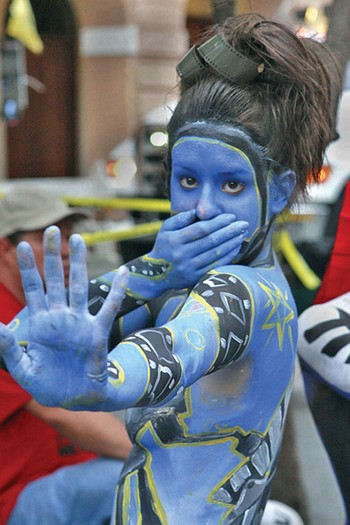
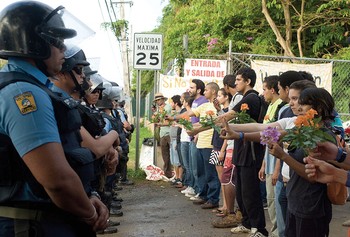
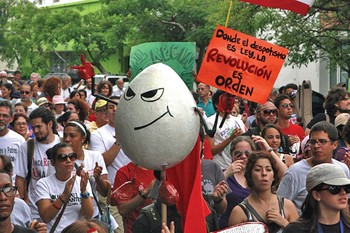
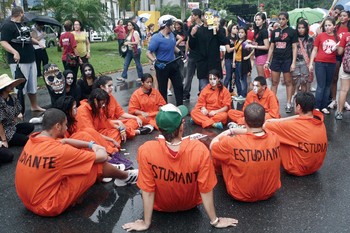
The most prominent expressions included large, colorful painted placards and banners that proclaimed academic and political slogans; almost-daily dramatic skits with characters identified by signs and stereotyped costumes and gestures that represented the funding crisis and the groups in conflict; painted, seminude bodies that became living choreographed sculptures (Fig. 1) that bore messages reading “Tolerance,” “Dialogue,” “Negotiation instead of violence,” and “Unity” and distributed texts that outlined the conditions to be negotiated. The campus cheerleading squad performed their “in-the-air” acrobatics through hours of marching. A large street concert took place near the Puerto Rican capitol building that gathered student musicians from several campuses who were threatened by the loss of tuition waivers. A line of fifty students gave bouquets of orange flowers to the police officers directly in front of them (Fig. 2). An egg-head mask and other egg-joke signs and illustrations mocked Governor Luis Fortuño for being pelted by an egg a year earlier for firing government employees (Fig. 3). A “chain gang” of masked “convicts” dressed in orange prisoner coveralls and another dirt-smeared group expressed their need to rise from enslavement (Fig. 4). A student artist carried a rough reproduction of Goya's Saturn Devouring One of His Children along a parade route. The list of others actions is too long to mention; suffice it to say that the ever-present music, rhythm, movement, and (at times) poetry of chanted phrases and slogans provided a daily dithyrambic sense of unity and interaction in the style of an Afro-Caribbean “theatre of relations.” The atmosphere of performance and celebration counterbalanced the tension of the constant police presence and the threat of violence.Footnote 7
Throughout the strike, students used their bodies as canvases to convey specific messages about the need for dialogue with the administration. Photo by Santos Hernández.

The students' campaign of passive resistance included peaceful confrontations with the police stationed just outside the campus. Photo by Sebastián Pérez. Reprinted with permission of Claridad.

The egg-head ironically mocks Governor Luis Fortuño, who was pelted by an egg in 2009. The sign reads, “Where despotism is law, revolution is order.” Photo by Sebastián Pérez.

Student “convicts” pause during the march in support of public education in May 2010. Photo by Sebastián Pérez.

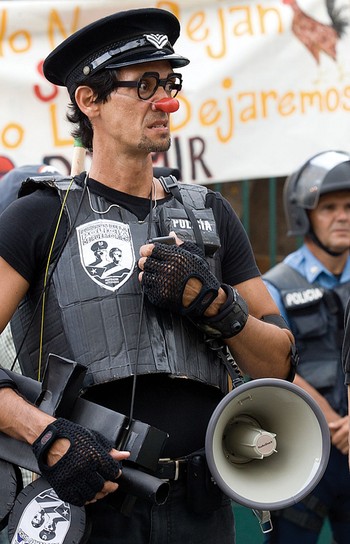
What follows traces a rough chronology of more specific performances by groups as they emerged after 21 April. Most involved an integration of community and university, student and former-student performers. Members of established alternative theatre groups arrived on the scene almost immediately and maintained a presence during the entire strike period. The Payasos Policias (Clown Police), an act conceived by professional actor and UPR graduate Israel Lugo, combined the talents of the student and professional members of the Y no había luz (And There Was No Light) collective and experienced performers such as Julio Ramos (also a UPR graduate) of the accomplished Agua, Sol y Sereno (Water, Sun, and Dew) performance group. The Clown Police costumed themselves as police but with brooms and other domestic tools and instruments, a comically modeled movie camera, oversized toy weapons, and red-ball clown noses (Fig. 5). The antics of their blundering slapstick circus act of martial discipline were performed directly in front of, and mimicked and mocked, the fully equipped riot squad and regular police that (unnecessarily) guarded the chained gates of the university. Rehearsed and theatrically disciplined, the Clown Police performed more often than, and were probably more photographed and recorded than, the other participating performance acts, and were the greatest crowd pleasers of all.Footnote 8
The chief of the Clown Police in full costume. Photo by Santos Hernández.

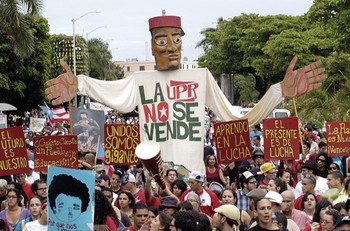
Papel Machete (Paper Machete), a cooperative political theatre guided by the work of activist, puppeteer, and mask maker Jorge Díaz, works with commedia dell'arte and other physical, visual, and dramatic techniques. Its members maintain high visibility in their resistance to political corruption and to property expropriations for urban renewal and the development of tourist resorts and complexes. Papel Machete also advocates for the rights of public school teachers. Perhaps their most developed action to date was the full-fledged write-in campaign for the candidate “Ninguno” (No One) in 2008, using campaign slogans such as “No One stands up for women's rights,” “No One protests against child abuse,” “No One fights against drug-trafficking,” and so forth. They were present in all the anti–Law 7 marches of 2009, and their UPR strike interventions began virtually at the same time as those of the Clown Police. In a style reminiscent at times of the Bread and Puppet Theater and at other times of the San Francisco Mime Troupe, but mainly focusing on their own reinventions of local and international street-theatre techniques, they marched the perimeter of the Río Piedras Campus with commedia-style masks, banners, and drums and a giant worker-student puppet in the midst of demonstrations and an atmosphere charged by heavily armed police operatives (Fig. 6). Student members of Paper Machete also worked on campus with groups to develop more localized comparsas (acts of performance).Footnote 9
Papel Machete's giant student puppet became an iconic image in many of the marches throughout the strike period. Photo by Santos Hernández.

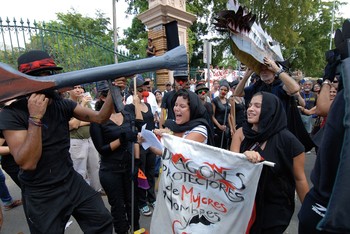
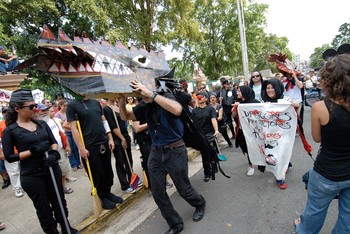
The umbrella research, creative, and educational group másTaller (mas[k] workshop), comprising students, faculty, and independent artists, offers mask-making workshops in schools and community activities in Puerto Rico, the Caribbean, and the United States. It also participates in marches and rallies such as the 15 October 2009 national strike with large dragon masks whose long cloth tails are supported by ten or more masked performers. These másTaller dragons first approached UPR's closed main gate on 22 April in an interplay that encouraged the comically militant Clown Police to unite with them and the gathered crowd in support of the students' demand for dialogue and negotiations (Fig. 7 and Fig. 8).
The Clown Police and the Dragons of másTaller clash comically in front of the main gate of the UPR–Río Piedras. The sign reads, “Dragons, protectors of women, men, and children.” Photo by Ricardo Alcaraz Díaz.

The Dragons of másTaller march along streets lined by Clown Police. Photo by Ricardo Alcáraz Díaz.

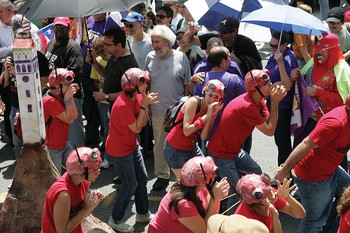
On 7 May, a large multisector march in support of public education took place. Participants, including nearly all the groups mentioned thus far, marched to the offices of the UPR president in the university's Botanical Garden. The student performance of lloronas—weeping women in mourning—left a lasting impression. The students were dressed in black (or their bodies were painted in black) and wore masks of gray, black, and white marked by teardrops. They accompanied a black coffin with “UPR” written on it in large letters. Student “convicts” clad in orange coveralls, a cross-dressed granny “for the students,” members of Papel Machete, and various other performers participated in the parade, much of which took place during a torrential downpour. Another student comparsa that appeared repeatedly was the hormigas (carpenter ants or termites), which featured reddish-brown torsos, legs, antennae, and papier-mâché headpieces. The group of ten to twelve moved through marches and crowds carrying an approximately four-foot-high model of the arabesque clock tower, symbol of UPR–Río Piedras, the base of which was a large anthill created by the termitic government and administration eating away its foundation (Fig. 9).Footnote 10 The lloronas, “convicts,” and hormigas represent a multitude of changing comparsas that surfaced in one or another activity and then disappeared or resurfaced in one or several future events.
The hormigas carrying a model of the arabesque clock tower, symbol of UPR–Río Piedras, whose foundation they have undermined. Photo by Sebastián Pérez.

The social action theatre Los jóvenes del '98 (Young People of '98) generates its own texts using improvisation techniques roughly based on Augusto Boal's idea of Image Theatre (The Theatre of the Oppressed). Since 1998 they have created more than twenty new plays and have performed throughout Puerto Rico and in Spain, the Hispanic Caribbean, Latin America, and Puerto Rican communities in the United States. Maritza Pérez Otero, the founder and director, works with student and nonstudent actors aged roughly fourteen to twenty-five. Graphic artist Rafael Trelles and UPR–Humacao theatre professor Gradissa Fernández are frequent collaborators, especially in the creation of the large visual images and comparsas that have established the group's presence inside protest marches and demonstrations during the past decade. Members of Los jóvenes del '98 created many of the more daring painted-body street-art collages during the 2010 student strike.
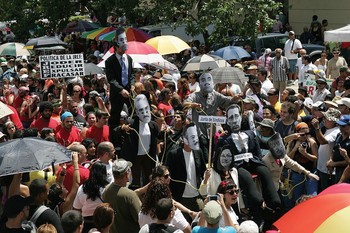
On 18 May, just a week and a half after the march in support of public education, the second “national strike” within nine months took place. Its focus was the UPR student strike. During this event, participation by theatre and performance groups reached its highest intensity.Footnote 11 Los jóvenes del '98 and their collaborators created large, photographically masked puppets of the principal government and university administration figures responsible for closing the university. In the action, Governor Luis Fortuño walks on stilts and holds a rope that encircles other figures who pull him forward: the UPR president and members of the governing board, the chancellor of the Río Piedras Campus, the president of the Puerto Rican Senate, and the government advisers said to dictate UPR administrative policy (Fig. 10).
Los jóvenes del '98 portray officials responsible for closing the university, including a stilt-walking Governor Luis Fortuño, using oversized photographic masks. Photo by Santos Hernández.

The dragons of másTaller returned on 18 May and staged a new “Wolf of Justice” comparsa in which a performer with a large wolf mask directly faced off police and riot squad officers while an accompanying speaker announced: “Officer Juan Pérez [all names were fictitious], badge number 51XX [51 for statehood], you beat a father trying to bring food and water to his striking son [an act graphically captured on YouTube footage].Footnote 12 Just or Unjust? Look into the eyes of the wolf.” At that point, the performer lifted the nose of the wolf's mask enough to reveal the solid black circles painted around his eyes. “Unjust. Dirt is your reward.” The wolf performer then sprinkled dirt on the ground in front of the officer while another masked performer wrote his or her name in a large black book titled just acts. The spoken text changed slightly with each officer. And there were “just acts,” because some of the police had helped students and parents, and those declared “just” received a white daisy as their reward. The wolf confronted more than a hundred police officers at five of the UPR–Río Piedras gates.
That the style of art-as-resistance exhibited during the 2010 student strike has existed before in Puerto Rico and elsewhere does not diminish the innovative aesthetic elements or the political, social, and cultural integrity from which they emerged. Students and their collaborators and supporters (including faculty) have revived a space of experimentation and commitment as part of an advanced learning process. Their democratization of performance and performativity stimulates interdisciplinary creativity that includes painting and graphic arts, clowns, mimes, theatrical gesture, sculptured masks and puppets, the painted letters of placards, and music—from Africa-inspired bomba to the creole forms of plena and from improvised décimas to jazz and chamber music. I have focused here on the Río Piedras Campus, but many similar acts took place at other campuses as well.
Creative expressions ranged from crude letters quickly painted on bare cardboard and the shouting of slogans to graphic art and performances created by student and professional artists for the street but with the same attention to detail, precision, and vision as that created for galleries, theatres, and concert halls. Even with limited access to materials, the striking UPR students produced works that surprised their teachers and audiences well beyond the university gates.
In mid-June, after nearly two months of the university being closed, a local judge intervened and forced UPR's governing board to negotiate with the student committee, whose members by that point came from all eleven UPR campuses. Agreements were reached to meet most of the student demands: that the university provide greater transparency about its decision-making process, that it rescind restrictions on tuitions waivers, and that it give students a voice in further tuition or other fee increases. A majority of the board members, although not the board's president or the president of the UPR system, signed the agreements, and a student assembly ratified the end of the strike. Two days later the legislature of Puerto Rico approved a law proposed by the governor to expand UPR's governing board by four members. The new members, who were all politically aligned with the governor and the board members who had refused to sign the agreements, were immediately named to create a new after-the-fact majority that in some cases overruled and in other cases simply ignored the agreements signed by the students. Among their first tasks was to enact a universal registration fee, or cuota, of $400 per semester that is unrelated to normal tuition and fees and begins with an initial payment of $800 in January 2011 to cover both semesters of 2010–11. The “quota” was unilaterally imposed without consultation and in violation of the agreements signed to end the strike. Thus, in spite of the apparent normality projected by the productions of the university's Drama Department in October and November 2010, the specter of a renewed strike loomed on the horizon. In early December, after the administration refused to consider alternative fee proposals submitted by students and faculty, the students again voted for a paro (stoppage). In an act of provocation, the administration ordered the dismantling of the university's historic gates and hired untrained private security forces to police the campus on the night before the stoppage began. Immediately after the stoppage ended peacefully, hundreds of armed state police entered and occupied the University of Puerto Rico. By mid-January 2011, their presence was a permanent feature of campus life.