Introduction
In vitro fertilization (IVF) programmes are expensive and time-consuming but still constitute the most successful approach to infertility treatment (Zeyneloglu & Onalan, Reference Zeyneloglu and Onalan2014). In assisted reproductive technology (ART) programmes, implantation takes place in around 20–30% of patients after fresh embryo transfer. In contrast, approximately 10% of infertile patients have at least two or three repeated implantation failures (RIFs) after an IVF protocol (Madkour et al., Reference Madkour and Bouamoud2016). Not only will the RIFs be psychologically stressful, but it will also be financially demanding for infertile couples. (Makrigiannakis et al., Reference Makrigiannakis and BenKhalifa2015). Nevertheless, there is lack of consensus about the clinical definition of RIF. According to Coughlan et al. (Reference Coughlan and Ledger2014) the best practice guidelines for RIF and repeated pregnancy loss (RPL) require therapeutic investigation, RIF in a woman under the age of 40 was defined as repeated failure to attain a clinical pregnancy after fresh or frozen transfer of at least four good-quality embryos.
Successful implantation mainly depends on local immune tolerance mechanisms that entail a spectrum of cytokines, interleukins and growth factors. The latter have played pivotal roles in the recruitment of immune cells (and notably T-lymphocyte cells). According to the available literature data, the presence of seminal fluid in the uterus cavity may recruit peripheral blood mononuclear cells (PBMCs) and trigger the initiation of endometrium decidualization and immune regulation by involving regulatory T cells (Tregs) and Th17 lymphocytes (Th17) (Bulmer & Lash, Reference Bulmer and Lash2005; Brazdova et al., Reference Brazdova and Senechal2016; Fujiwara et al., Reference Fujiwara and Araki2016; Nederlof et al., Reference Nederlof and Meuleman2017).
According to several studies, a simple Th1/Th2 imbalance and a lack of Th17s and Tregs in the endometrium prior to or after embryo transfer may cause RIF and/or RPL (Brazdova et al., Reference Brazdova and Senechal2016; Fujiwara et al., Reference Fujiwara and Araki2016; Lédée et al., Reference Lédée and Petitbarat2016; Madkour et al., Reference Madkour and Bouamoud2016). In concert with the endometrium and the blastocyst, the cytokine production profile is dominated by Th1 pro-inflammatory cytokines (mainly IL1, IL2, IL12, IL15, and IL18) and specific growth factors (such as vascular endothelial growth factor, VEGF, and leukaemia inhibitory factor, LIF) that are indispensable throughout the primitive stages of implantation. Next, for pregnancy maintenance, the endometrial immune profile is governed by Th2 anti-inflammatory cytokines (IL3, IL4, IL5, IL6, IL8, IL10, IL13, and GM-CSF) (Brazdova et al., Reference Brazdova and Senechal2016; Fujiwara et al., Reference Fujiwara and Araki2016; Lédée et al., Reference Lédée and Petitbarat2016; Madkour et al., Reference Madkour and Bouamoud2016).
It is assumed that approximately two-thirds of RIF patients suffer from inadequate endometrial receptivity, and that immune disruption in maternal–fetal cross-talk has a central role in implantation failure and miscarriages (Nakayama et al., Reference Nakayama and Fujiwara2002; Yoshioka et al., Reference Yoshioka and Fujiwara2006; Ly et al., Reference Ly and Aziz2010; Yu et al., Reference Yu and Yang2014). Hence, various clinical studies have evaluated the value of immunotherapy (the intrauterine administration of PBMCs prior to embryo transfer) in patients with RIF (Okitsu et al., Reference Okitsu and Kiyokawa2011; Yu et al., Reference Yu and Yang2014; Makrigiannakis et al., Reference Makrigiannakis and BenKhalifa2015; Madkour et al., Reference Madkour and Bouamoud2016; Yu et al., Reference Yu and Zhang2016; Li et al., Reference Li and Wang2017).
The objective of the present study was to evaluate the clinical effectiveness of intrauterine administration of treated PBMCs prior to frozen/thawed embryo transfer in RIF patients participating in an IVF programme.
Materials and methods
Patient selection and study design
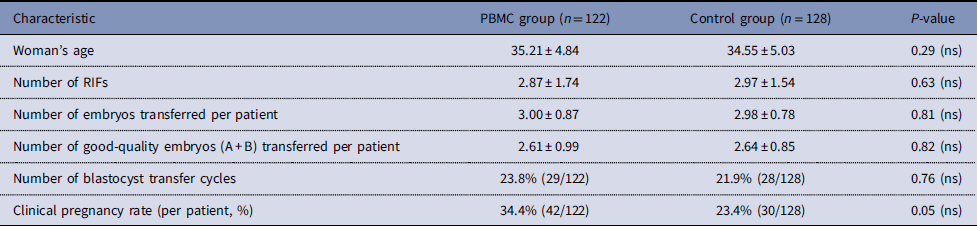
This study was a prospective, randomized study conducted at Ertfan Hospital (Tehran, Iran) between 2015 and 2017. It included 250 couples attending an IVF programme with frozen–thawed embryo transfer cycles. The main inclusion criteria were primary infertility and a history of at least one RIF. Women with a history of repeated infectious diseases, endometriosis or uterine disease (such as uterine leiomyomas) or a known aetiology of RIF (such as chromosomal disorders) were excluded. The study population was randomized into two groups: a group treated with PBMC immunotherapy (the PBMC group, n=122) and a non-treated control group (n=128). There were no significance intergroup differences in the clinical history or features (Table 1).
Comparison of patient characteristics and clinical pregnancy rates in the PBMC group and the control group

Results are expressed as n, n (%) or mean±standard deviation (SD). A difference was considered significant (s) when P<0.05; (ns), not significant.
Frozen–thawed embryo cycles
All embryos were cryopreserved using a vitrification kit (Kitazato BioPharma, Shizuoka, Japan), according to the manufacturer’s protocol. Briefly, the embryos were located in equilibration medium containing 7.5% ethylene glycol and 7.5% dimethyl sulfoxide (DMSO) at room temperature for 5 to 15 min. Next, they were transferred into vitrification medium containing 15% ethylene glycol, 15% DMSO and 0.5 mol/l sucrose at room temperature for 45 to 60 s. The embryos were placed in a cryotop (Kitazato BioPharma, Shizuoka, Japan) and swiftly plunged into a liquid nitrogen container (−196°C). A kit was used to thaw the vitrified embryos (Kitazato BioPharma, Shizuoka, Japan), based on the manufacturer’s protocol. The first step was the placing of embryos were placed in thawing medium containing 1.0 mol/l sucrose and HEPES-buffered human tubal fluid (HTF) for 1 min at 37°C. Next, the embryos were transferred into diluent medium-I containing 0.5 mol/l sucrose in HEPES-buffered HTF for 3 min at 37°C. Finally, the embryos were transferred into diluent medium-II containing 0.25 mol/l sucrose and incubated at 37°C for 5 min.
Hormone replacement therapy (HRT) for endometrium preparation was initiated with estradiol valerate (2 mg/day, then increased by 2 mg every 3 days in a down-regulated cycle). At day 21 of the previous HRT cycle, an intramuscular injection of decapeptyl 3.75 was given. Cyclogest 400 mg daily was given for 3 days before frozen embryo transfer (after the triple line endometrium reached at least 7 mm in thickness).
After thawing, morphologically selected embryos were transferred in utero. The number of embryo transfers depended on each patient’s profile. In all patients, a Cyclogest vaginal suppository was administered for luteal phase support for 2 weeks. Clinical pregnancy was confirmed by ultrasound imaging 6–8 weeks after embryo transfer. Each couple went through a single intracytoplasmic sperm injection frozen–thawed embryo transfer cycle during this study.
Embryos that were frozen in the early stages of cleavage or blastocyst were transferred to the uterus 2 days after intrauterine injection of the PBMCs.
PBMC immunotherapy
A blood sample was collected 5 days before the scheduled frozen–thawed embryo transfer. In the PBMC group, autologous PBMCs were isolated from the blood sample using Ficoll separation. The PBMCs were cultured in medium (Advanced Technologies Laboratory, La Verrière, France) for 48–72 h, as described by Madkour et al. (Reference Madkour and Bouamoud2016). Briefly, after separation and centrifugation, the cells were resuspended and cultured in basic culture medium containing mitotic factors, cytokines, interleukins, growth factors and corticoid-releasing hormone (CRH). The cells were prepared at a final suspension containing 2 × 10⁷ cells/200 µl in PBS and supplemented with 10−7 M CRH. Finally, 0.4 ml of cultured PBMCs were transferred into the uterine cavity using a embryo transfer catheter (Cook Ltd, UK) 2 days before the scheduled embryo transfer.
Statistical analysis
Data are presented as the mean±standard deviation (SD) or the number (percentage), and were analyzed with a t-test and a chi-squared test for comparisons of mean values or with a chi-squared test for comparisons of percentages. All analyses were performed using SPSS software (version 16.0, SPSS Inc.). The threshold for statistical significance was set to P<0.05.
Results
In total, 250 women were randomized. Overall, the mean±SD (range) age was 34.87±4.94 (21–46) years. The mean (range) number of IVF attempts at baseline was 2.92±1.63 (1–9). The mean (range) number of transferred embryos at baseline was 2.99±0.82 (1–5), and the mean (range) number of good-quality embryos (A+B) transferred per patient was 2.62±0.92 (0–5). Data analyses with a two-tailed t-test demonstrated that the PBMC and control group did not differ significantly with regard to age, the number of IVF trials, the number of transferred embryos, the number of good-quality embryos (A+B) transferred per patient, and the blastocyst transfer (Table 1).
As a guide to the effectiveness of PBMC treatment in RIF patients undergoing frozen–thawed embryo transfer cycles in IVF programme, the clinical pregnancy rate was found to be higher in the PBMC group (34.4%) than in the control group (23.4%), although this difference was not statistically significant (P=0.05 in a chi-squared test) (Table 1).
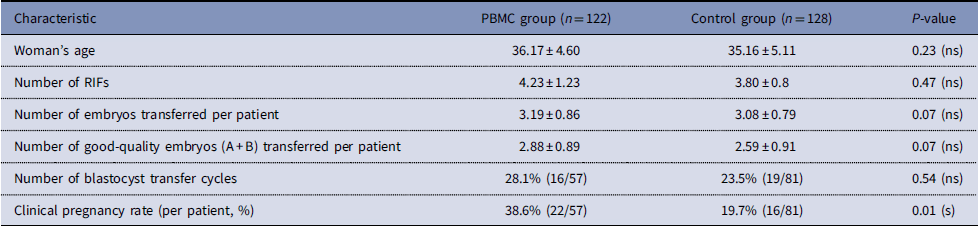
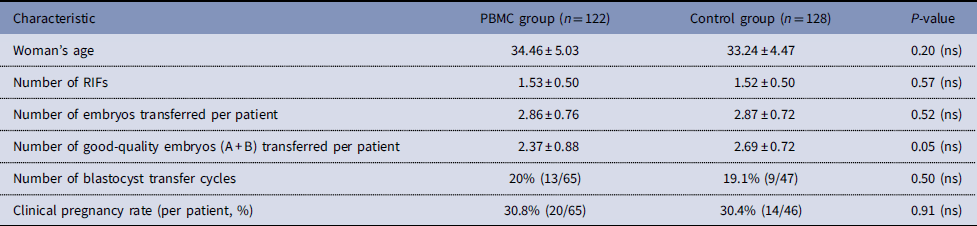
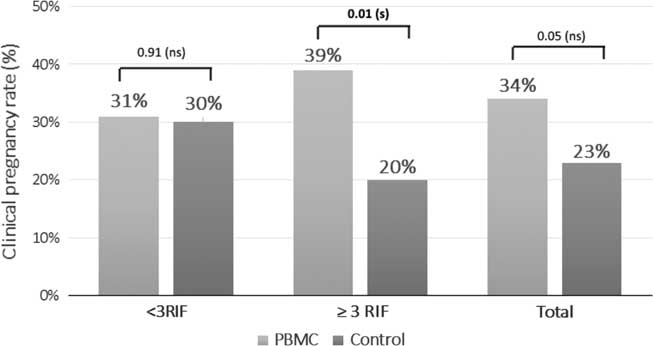
When we limited our analysis to patients with ≥3 RIF (n=138), there was a significant difference (P=0.01) in the clinical pregnancy rate between the PBMC group (n=57) and the control group (n=81) (38.6% vs. 19.7%, respectively) (Table 2). In patients with <3 RIFs (n=112), the PBMC group (n=65) had higher clinical pregnancy rate than the control group (n=47) (30.8% vs. 30.4%, respectively) but this difference was not statistically significant (P=0.91) (Table 3) and (Fig. 1).
Comparison of patient characteristics and the clinical pregnancy rate in the PBMC group and the control group with ≥3 RIFs

Results are expressed as n, n (%) or mean±standard deviation (SD). A difference was considered significant (s) when P<0.05; (ns), not significant.
Comparison of patient characteristics and the clinical pregnancy rate in the PBMC group and the control group with <3 RIF

Results are expressed as n, n (%) or mean±standard deviation (SD). A difference was considered significant (s) when P<0.05; (ns), not significant.
Clinical pregnancy rates of RIF’s patients of PBMC group compared with control. Clinical pregnancy was confirmed by ultrasound imaging 6–8 weeks after embryo transfer and calculated relative to the number of transferred cycles expressed as n (%). A difference was considered significant (s) when P<0.05; (ns), not significant.

Discussion
Nearly 10% of patients (20–25% of couples who attempted IVF) had a depicted repeated implantation failure after several ART cycles. The literature describes different sorts of RIF such as multifactorial (including immunological and psychological factors). In the present study, the clinical pregnancy rate was significantly higher following the intrauterine administration of PBMCs prior to frozen/thawed embryo transfer in patients with at least ≥3 RIFs (38.6% in the PBMC group vs. 19.8% in the control group; Table 2). This difference confirms the effectiveness of PBMC treatment reported in two previous studies of frozen–thawed cycles (Okitsu et al., Reference Okitsu and Kiyokawa2011; Yu et al., Reference Yu and Yang2014). Although the relative improvement in the present study (1.9-fold) was smaller than the value of 2.6-fold described by Okitsu et al. (Reference Okitsu and Kiyokawa2011) and 2.2-fold declared by Yu et al. (Reference Yu and Zhang2016), this disparity might be due to: (i) the small population mentioned in Okitsu et al.’s study (Reference Okitsu and Kiyokawa2011) (n=19 in the PBMC group and 32 in the control group) compared with the current study (n=122 in the PBMC group and 128 in the control group); and (ii) the sole inclusion of patients under 40 years in Yu et al.’s (Reference Yu and Zhang2016) study (vs. no limit in the present study).
Moreover, in fresh embryo transfer cycles, PBMC immunotherapy is reportedly more efficacious in patients with at least 2–3 RIFs (Yoshioka et al., Reference Yoshioka and Fujiwara2006; Makrigiannakis et al., Reference Makrigiannakis and BenKhalifa2015; Madkour et al., Reference Madkour and Bouamoud2016), as the clinical outcome rate doubles or triples. These differences might depend on the ovarian stimulation protocols and the patient selection criteria in each study. Furthermore, the relatively different clinical outcomes of this immunotherapy approach may be due to technical modifications to the PBMC preparation protocol developed by Yoshioka et al. (Reference Yoshioka and Fujiwara2006). Indeed, hCG supplementation of the culture for 24–72 h was objectively assessed to enhance the PBMCs’ secretion of cytokines particularly IL6 (Okitsu et al., Reference Okitsu and Kiyokawa2011; Yu et al., Reference Yu and Yang2014; Madkour et al., Reference Madkour and Bouamoud2016; Yu et al., Reference Yu and Zhang2016) which is essential for endometrium decidualization and embryo invasion (Fujiwara et al., Reference Fujiwara and Araki2016).
To assess implantation and invasion success the system should go via a dynamic and synchronized process and this depends on the competency of endometrial epithelial cells, cytokines, chemokines and growth factors production under the positive effect of oestradiol and progesterone. To rescue implantation failure, the literature has illustrated diverse strategies to improve the immunology of implantation such as endometrial perfusion with GM-CSF, PBMC intrauterine insemination, HCG or LIF, endometrial injury at day 21 of previous cycles or at follicular phase of ongoing cycles. The psychological environment and care can affect the efficiency of immunotherapy and the efficiency of autologous or heterologous PBMC insemination can be different from one patient to another because of their immunological status and patient reaction. For instance, stress can negatively affect the chance of pregnancy via weak suppression of Th1/Th2 unbalanced by Treg cells (Madkour et al., Reference Madkour and Bouamoud2016).
Furthermore, hCG effectively contributes to the maternal tolerance of the embryo, modulates several metabolic pathways within the decidua, and thus improves endometrial receptivity (Makrigiannakis et al., Reference Makrigiannakis and Vrekoussis2017). Nonetheless, Li et al. (Reference Li and Wang2017) cited that the intrauterine administration of hCG-activated autologous PBMCs in a frozen–thawed embryo transfer cycle did not have any benefit for patients with one to three IVF failures but did increase pregnancy and live birth rates for patients with four or more IVF failures.
Furthermore, two other groups (Makrigiannakis et al., Reference Makrigiannakis and BenKhalifa2015; Madkour et al., Reference Madkour and Bouamoud2016) revealed that intrauterine administration of PBMCs treated with CRH increased clinical pregnancy rates after embryo transfer in women with at least 2–3 RIFs. The CRH-treated PBMCs are better able to secrete the Th2 cytokines required for the implantation/pregnancy process (Makrigiannakis et al., Reference Makrigiannakis and BenKhalifa2015). Indeed, the inflammatory mediator CRH influences endometrial cells and stimulates the secretion of the PGE2, IL-1 and IL-6 (Makrigiannakis et al., Reference Makrigiannakis and BenKhalifa2015) required for implantation (Chaouat et al., Reference Chaouat and Dubanchet2007; Gleicher et al., Reference Gleicher and Kushnir2017). It has also been pointed out that CRH improves endometrial decidualization, increases the effect of the progesterone needed for pregnancy maintenance, and acts as an anti-inflammatory factor to activate Th2 cytokines (Makrigiannakis et al., Reference Makrigiannakis and Margioris1999). Furthermore, CRH is strongly expressed during embryo implantation (Novembri et al., Reference Novembri and Borges2011; Vergetaki et al., Reference Vergetaki and Jeschke2013), regulates the expression of Fas ligand, and induces the apoptosis of Fas-positive T cells and Th2 cells, tending to maternal tolerance for pregnancy maintenance (Makrigiannakis et al., Reference Makrigiannakis and Zoumakis2001).
Although manifold protocols for PBMC preparation, culture and intrauterine administration prior to embryo transfer have been tested, it is transparent that this immunotherapy approach effectively improves embryo implantation rates in patients with specific profiles (at least 3 RIFs). Indeed, the PBMCs’ effect on reproductive outcomes might be due to the modulation of decidualization and angiogenesis in the endometrium via the secretion of VEGF, platelet growth factor, LIF, and interferon (Makrigiannakis et al., Reference Makrigiannakis and BenKhalifa2015; Gleicher et al., Reference Gleicher and Kushnir2017). However, a simple lack or surplus of these factors (reflecting an immune imbalance) might cause RIF (Franasiak and Scott, Reference Franasiak and Scott2017; Gleicher et al., Reference Gleicher and Kushnir2017).
Today numerous studies have generated much information concerning the relation between the varied proteins at the site of implantation such as cytokines, growth factors, adhesion molecules and MMPs. However, the precise role of the MMPs in embryo implantation and the effect of their dysregulation in recurrent implantation failure have yet to be characterized but it seems that the balance between the matrix metalloproteinase (MMPs) and their tissue inhibitors (TIMPs) appear to play a crucial role in both the process of embryo implantation and invasion (Benkhalifa et al., Reference Benkhalifa2018).
Concerning endometrial scratching use in RIF, due to lack of evidence it is still unclear after how many failed embryo transfers endometrium injury become beneficial (Simon and Bellver, Reference Simon and Bellver2014; Nastiri et al., Reference Nastiri and Lensen2015), The latest systematic review and meta-analysis of randomised controlled trials concerning endometrium injury for patients with one or more previous RIF concluded that uterine scratching may improve IVF success and it is timing and technique that seems to play the outstanding role in determining its effect on embryo implantation but not in patient undergoing frozen thawed embryo transfer (Vitagliano et al., Reference Vitagliano and Sarda2018).
Even though we did not have a control group for neutral intrauterine (IUI) insemination without PBMC, the efficiency of an immunotherapy approach (CRH- and hCG-stimulated PBMCs) prior to frozen–thawed embryo transfer is emphasized by the results of our present study and previous work in a large population of patients with no maternal age limit and at least 3 RIFs.
In conclusion, our results illustrate that PBMC transfer is an effective treatment for infertile patients with RIF. This immunomodulation technique might be an appropriate approach to ART protocols, although further research is needed.
Acknowledgements
This was a substudy of an approved research project at the Cellular and Molecular Biology Research Center of Shahid Beheshti Medical University. We are grateful to the GIVAR Infertility Center, Erfan Hospital, and the women who participated in the study.
Financial support
This study was supported by a Grant from Cellular and Molecular Biology Research Center of Shahid Beheshti Medical University Foundation (grant no. 8829; Clinical Principal Investigator: Cellular and Molecular Biology Research Center of Shahid Beheshti Medical University).
Conflicts of interest
No conflicts of interest.
Ethical standards
The study was approved by the independent ethics committee at Shahid Beheshti Medical University. All patients provided their written, informed consent after being presented with information on the study’s objectives and procedures. All research procedures complied with the ethical standards of the pertinent national and institutional committees on human experimentation.