Introduction
Vocal fold cysts, like other vocal masses, are often complicated in treatment but are easily diagnosed. These lesions are usually multifactorial, with synergistic contributions from such factors as chronic voice use, poor vocal technique, medical conditions, medications and the environment.Reference Altman1–Reference Smith, Callanan, Harcourt and Albert3 Hoarseness is the most common symptom, and the most common cause is chronic vibratory trauma of the vocal folds.Reference Bastian, Charles and Bruce4 Although surgical enucleation or excision is the preferred treatment, total removal of the cyst without damaging the vocal ligament is technically difficult, especially in cases of intracordal cyst. Marsupialisation (i.e. creation of a wide opening) is a conservative treatment modality which can decrease the risk and the degree of secondary vocal deficit, atrophy or scarring.Reference Chang and Chang5 The marsupialisation technique has also been successfully used in cases of epiglottic and nasolabial cysts.Reference Su and Hsu6, Reference Su, Chien and Hwang7
In our experience, it is common to find a relatively large vocal cyst, together with vocal fold atrophy and a glottal gap. A vocal cyst may compress the vocal fold and eventually result in vocal ligament atrophy. The symptoms of vocal fold atrophy include a breathy, husky, weak voice together with difficulty or fatigue during phonation. Laryngostroboscopy usually reveals a bowed or thin vocal fold.
The most widely used procedures for vocal fold atrophy are medialisation laryngoplasty (e.g. using Teflon® implantation or fat or collagen injection) and type I thyroplasty with Silastic® implantation.Reference Isshiki and Isshiki8 The complications of these techniques include Teflon granuloma, reabsorption of fat or collagen, and implant protrusion.Reference Bray, Young and Harries9 Some years ago, Su et al. developed a new paramedian approach to strap muscle transposition laryngoplasty, to treat glottal incompetence caused by vocal fold atrophy, vocal deficit or unilateral vocal fold palsy.Reference Su, Lui, Lin, Chiu and Cheng10–Reference Su, Chuang, Tsai and Chiu12
In patients with a relatively large vocal cyst and vocal fold atrophy, a significant vocal deficit and glottal gap may develop following laryngomicrosurgical excision or marsupialisation of the cyst. In such cases, medialisation laryngoplasty may be needed. To the best of our knowledge, no previous report has described the use of combined surgery, using both marsupialisation and medialisation laryngoplasty, to simultaneously treat vocal cysts and correct glottal incompetence.
Materials and methods
Patient selection
Between July 2005 and November 2007, we encountered 25 patients with vocal fold cysts. Ten of the patients were found to also have significant vocal fold atrophy.
Seven of these 10 patients underwent transoral marsupialisation immediately followed by strap muscle transposition laryngoplasty.
The study was approved by the ethics committee of Chang Gung Memorial Hospital. Informed consent was obtained from all patients before undergoing any procedure.
Surgical procedure
Under general anaesthesia, a direct laryngoscope was inserted to reach the glottis and adequately expose the true vocal folds. Clear vision and magnification of the cyst was obtained by using an operative microscope with 400 mm objective lenses.
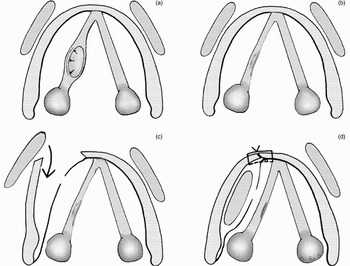
The margin of the cyst wall was retracted medially using microforceps, and microscissors were used to make an incision encircling the equator of the cyst. A disc-like portion of the cyst wall was removed together with the overlying mucosa. The mucous contents of the cyst cavity flowed out. The residual mucosa of the cyst lining, over the true vocal fold surface, was intact. After all the mucus had been aspirated, a sinus with a wide opening remained (Figure 1a and b).
Schematic representation of vocal cyst and treatment. (a) The vocal cyst and its contents exerts pressure on the adjacent elastic and collagen fibres of the vocal ligaments (arrows). (b) Using microscissors, an incision encircling the equator of the cyst is made, and the cyst contents are drained. A disc-like portion of the cyst wall, together with the overlying mucosa, is removed. (c) The thyroid cartilage is parasagittally separated. The inner perichondrium is freed from the overlying thyroid lamina, and the lamina is then retracted laterally. (d) The sternohyoid muscle is then transposed into the space between the thyroid lamina and the paraglottic space.

Following marsupialisation of the vocal cyst, the surgeon proceeded to medialisation laryngoplasty. The decision regarding the side on which to perform strap muscle laryngoplasty was made based on which vocal fold was more atrophic or bowed when viewed under the operating microscope. With the patient in the supine position, a horizontal incision was made and the strap muscles split in the midline and retracted laterally to expose the thyroid cartilage. The thyroid lamina was parasagittally incised and the inner perichondrium was freed thoroughly from the overlying thyroid ala (Figure 1c). The sternohyoid muscle was mobilised along its lateral border, and then transposed into the space between the thyroid lamina and the paraglottic soft tissue. The thyroid cartilage was sutured back, and the wound was closed in multiple layers with absorbable sutures (Figure 1d).Reference Su, Lui, Lin, Chiu and Cheng10–Reference Su, Chuang, Tsai and Chiu12
Evaluation of vocal function
Pre- and post-operative vocal function was analysed. Laryngostroboscopy was performed, and acoustic and aerodynamic parameters were analysed.Reference Su, Lui, Lin, Chiu and Cheng10–Reference Su, Chuang, Tsai and Chiu12 Laryngostroboscopy was performed with a Kay Elemetrics stroboscopy unit (model 8100; Lincoln Park, New Jersey, USA). The mucosa wave, amplitude and glottal closure parameters were assessed. Acoustic parameters (such as mean fundamental frequency, noise-to-harmonics ratio, jitter and shimmer) were measured using a Kay Pentax computerised speech laboratory (core model CSL 4300B; Lincoln Park, New Jersey, USA). Aerodynamic parameters (e.g. mean airflow rate and maximum phonation time) were measured with the circumferential vented pneumotachograph mask and differential transducers of the Aerophone system (Aerophone II, model 6800, Kay Pentax).
Pre- and post-operative perceptual assessments were completed by two otolaryngologists using the grade–roughness–breathiness–asthenia–strain scoring system. The patients assessed their own post-operative voice quality as either markedly improved, improved, unchanged or worse.
The Wilcoxon signed rank test was used for paired observations of ordinal variables.
When patients were assessed by the phone, the test of maximum phonation time was used. But the acoustic analysis was performed in clinic follow up.
Results and analysis
This study included seven patients with vocal cysts and vocal fold atrophy. Patients comprised five men and seven women, with an age range of 26 to 57 years (mean, 39 years).
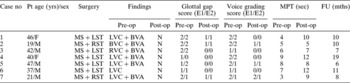
At their initial visit, all patients complained of a husky voice. Post-operative follow up ranged from six to 19 months (mean, 10 months). Videostroboscopy, perceptual assessment and acoustic analysis of these seven patients were used for analysis (Table I).
Summary of seven patients with vocal fold cysts treated with marsupialisation and strap muscle transposition

No = number; pt = patient; yrs = years; E1 = evaluator one; E2 = evaluator two; MPT = maximum phonation time; FU = follow up; mths = months; pre-op = pre-operative; post-op = post-operative; F = female; M = male; MS = marsupialisation; LST = left strap muscle transposition; RST = right strap muscle transposition; LVC = left vocal cyst; RVC = right vocal cyst; BVC = bilateral vocal cysts; BVA = bilateral vocal fold atrophy; N = normal
Videostroboscopic findings
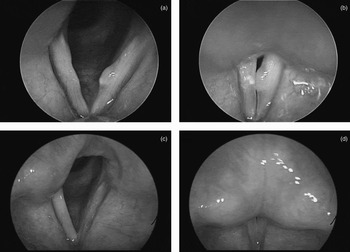
At their initial visit, all seven patients had vocal cysts, one on the right vocal fold, five on the left fold and, in one case, bilaterally. Pre-operative videostroboscopic findings indicated a grade one to two glottal gap, decreased mucosal waves and irregular vibration patterns (Figure 2). After surgery, all patients obtained significant post-operative improvement in glottal closure, mucosal wave and amplitude. Only three patients had a minimal posterior glottal gap. No patient suffered recurrence of their cyst.
Videolaryngostroboscopic findings in a 26-year-old woman with a vocal cyst: (a) & (b) pre-operative; (c) & (d) six months' post-operative. The cyst has been cured and the glottal closure markedly improved.

Perceptual assessment and patient self-assessment
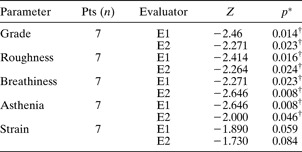
The results of perceptual assessment using the grade–roughness–breathiness–asthenia–strain scoring system are summarised in Table II. The statistical study was non-parametric, and the Wilcoxon signed rank test was used for analysis of the ranked data. Following surgery, there was a significant decrease (i.e. improvement) in the scales of grade, roughness, breathiness and asthenia (p < 0.05), but not strain. All patients reported an improved or markedly improved post-operative voice quality.
Post- vs pre-operative perceptual voice assessment

* Two-tailed. †Statistically significant at p < 0.05 (Wilcoxon signed rank test). Pts = patients; E1 = evaluator one; E2 = evaluator two
Acoustic and aerodynamic voice analysis
Wilcoxon signed rank test analysis showed that results for five of the seven acoustic parameters assessed were significantly improved post-operatively, as shown in Table III. There was a significant difference between the pre- and post-operative mean fundamental frequency (144.43 and 168.23 Hz, respectively). The mean maximum phonation time significantly increased after surgery (from 6.0 to 10.4 seconds). There was also a statistically significant post-operative decrease in the mean jitter and mean shimmer. The mean noise-to-harmonic ratio and the mean airflow rate improved post-operatively, but these differences were not statistically significant (the mean airflow rate decreased from 0.03 to 0.006 l/sec).
Pre- vs post-operative acoustic analysis: statistical comparison

* Two-tailed. †Statistically significant at p < 0.05 (Wilcoxon signed rank test). Pts = patients; SD = standard deviation; pre-op = pre-operative; post-op = post-operative; F0 = fundamental frequency; MPT = maximum phonation time; JITT = jitter; SH = shimmer; NHR = noise-to-harmonic ratio; MAR = mean airflow rate
Discussion
Vocal fold cyst is a benign laryngeal disorder with a good surgical outcome when it is correctly diagnosed and treated.Reference Monday, Cornut, Bouchayer, Roch and Loire13 A standard method of treatment for this lesion has still not been established, although combined management including voice therapy and phonosurgery has been suggested.Reference Shohet, Courey, Scott and Ossoff14
For many years, total excision or removal of such cysts was considered valid. In our experience, post-operative vocal deficit and glottal incompetence may develop in cases of relatively large vocal cysts. In fact, total removal of the cyst lining can be harmful to the vocal ligament and is technically difficult. Complications after surgical excision include vocal deficit, sulcus formation, scarring and glottal incompetence. Moreover, a recurrence rate of around 1 per cent has been reported.Reference Monday, Cornut, Bouchayer, Roch and Loire13
Taking these facts into consideration, one can see the need for new modalities of treatment with minimal damage to the vocal ligament. Over the last 10 years, Su et al. have successfully used a marsupialisation technique to treat various cystic lesions (e.g. nasolabial and epiglottic cysts).Reference Su and Hsu6, Reference Su, Chien and Hwang7 We have found this technique also to be effective in the treatment of vocal fold cysts. However, in particular cases the vocal cysts may be relatively large and located intracordally (Figure 2), and the vocal folds may be atrophic. This may be because the vocal cyst, with its internal contents, has had a compressive effect on the vocal ligament, resulting in vocal ligament atrophy (Figure 1). A large vocal cyst may also compress the contralateral fold during phonation, and it is not uncommon at the initial visit to find an atrophic or bowed contralateral fold. In such circumstances, a post-operative vocal deficit and glottal incompetence would be expected following excision or marsupialisation of the cyst, and voice quality would be unimproved or even worsened by the procedure.
• This study evaluated the efficacy of a combined treatment modality for vocal fold cysts, using marsupialisation immediately followed by strap muscle transposition laryngoplasty
• Marsupialisation is a reliable technique for vocal cysts, with a low recurrence rate and minimal damage to the vocal ligament
• In cases of relatively large vocal cysts with vocal fold atrophy, marsupialisation immediately followed by strap muscle transposition laryngoplasty is recommended
• This one stage procedure can cure the vocal cyst and markedly improved vocal performance; complications and recurrence are minimal
Medialisation laryngoplasty with strap muscle transposition has been reported to be effective in the correction of glottal incompetence caused by vocal fold atrophy, vocal deficit or unilateral vocal fold palsy.Reference Su, Lui, Lin, Chiu and Cheng10–Reference Su, Chuang, Tsai and Chiu12 In the current series, this technique was also found to be a suitable treatment for relatively large vocal cysts presenting alongside vocal fold atrophy (Figure 2). Strap muscle transposition laryngoplasty immediately following marsupialisation of the cysts confers the following advantages: (1) it avoids the need for staged surgery for vocal incompetence, (2) it avoids the need for prostheses, (3) it can effectively cure the cyst and improve the voice quality in a one-stage procedure, and (4) complications are minimal.
Conclusions
Marsupialisation of a vocal cyst is a reliable technique with a low recurrence rate, which causes minimal vocal ligament damage. In cases of relatively large vocal cysts with vocal fold atrophy, marsupialisation immediately followed by strap muscle transposition laryngoplasty is recommended. This one-stage procedure can cure the vocal cyst and markedly improve vocal performance. Rates of complications and recurrence are minimal.
Acknowledgements
The authors thank Ben-Hua Wang and Wei-Han Su for production of the figures, Hsiu-Ting Tseng and Yen-Huang Hsiao for their contribution to the study, and Dr Yu-Ming Wang MD for the statistical analysis. The study was supported in part by grants from the National Science Council, Taiwan (ROC) (NSC96-2628-B-182-005-MY3).