Introduction
The Pharmaceutical Benefits Scheme (PBS) was established in 1948 to provide 139 “life-saving and disease preventing” medicines free of charge for others in the community (1). The National Immunisation Program (NIP) was established in 1997 “to increase national immunisation coverage to reduce the number of cases of diseases that are preventable by vaccination.” (2)
The Pharmaceutical Benefits Advisory Committee (PBAC) is an independent expert body appointed by the Australian Government. The Committee is scheduled to meet three times a year, usually in March, July, and November (3), and extraordinary meetings are held out of session if required (4). The primary role of the PBAC is to recommend the listing of new medicines on the PBS and new vaccines on the NIP. Most applications for listing are prepared and lodged by sponsor pharmaceutical companies.
New medicines/vaccines cannot be listed on the PBS/NIP unless recommended by the Committee. Sponsors of submissions not recommended by the PBAC may reapply (resubmission).
The PBAC's decision-making process is evidence-based. The Committee considers the registered use of the medicine/vaccine, its clinical effectiveness, safety, and cost-effectiveness compared with other treatments (3).
PBAC outcomes have progressively become more transparent: first in 1999 (recommendations published), then in 2003 (all outcomes), and again in 2005 [Public Summary Documents (PSDs)]. The purpose of the PSDs is to “provide to the public, information pertaining to PBAC recommendations, so that stakeholders are aware of the rationale for specific PBAC recommendations, and gain an improved understanding of the overall PBS listing process.” (5)
Agendas for scheduled PBAC meetings have been published since late 2008 (November meeting). During our study period, there was one exception of the agenda for an extraordinary meeting being published beforehand. The published agenda primarily consists of applications relating to the listing of a PBS medicine or a NIP vaccine. The “full" agenda is not published. The published agenda is largely driven and determined by pharmaceutical companies (6). During our study period, agendas were published 10 weeks before a scheduled meeting.
The commencement of the publication of the agenda for a scheduled PBAC meeting coincides with the creation of an online portal for consumers to comment on agenda items. Commentators are prompted to disclose any financial, professional, or personal interest. Received comments are first vetted by the Department of Health. “Petitions, duplicate submissions from the same author, form letters (multiple copies of the same statements of support for access), or any material that is inappropriate in language or tone are not accepted.” (6) Acceptable consumer comments, with identifying information removed, are then provided to the PBAC's consumer representatives, who review and collate the comments. They then present them as part of the Committee's discussion of an agenda item. Summary information on the consumer comments and their consideration by the PBAC is published in some, but not all of the PSDs (6). A consumer representative has been a member of the PBAC for many years. A current nominee has been a member of the PBAC for over 20 years and is the current Deputy Chair.
Publication dates of the agenda for PBAC meetings are pre-determined and published in advance on the PBS Web site (PBS Calendars: https://www.pbs.gov.au/info/industry/useful-resources/pbs-calendar). Interested parties can subscribe to the PBS News alert service; they will receive an email whenever there is a new PBS News item, such as the publication of a PBAC agenda (7). There are no associated departmental and/or ministerial press releases. The publication of an agenda seldom attracts any mainstream media coverage.
Our objective was to review and analyze the content published in the “Consumer Comments” section of the PSDs since 2014. Although the Committee has solicited comments from consumers on agenda items since late 2008, the PBAC has only published information on consumer comments in the PSDs since 2014 (5).
Methods
We examined the PBS Web site to identify all PSDs published since 2014. PSDs associated with submissions considered at nonscheduled PBAC meetings were not considered, as an agenda was not published in advance of these meetings, consumers could not provide input.
We reviewed each PSD with a particular focus on the “Consumer Comments” section, which summarizes the nature of the received comments. We extracted the following information from each PSD:
• PBAC meeting date/code
• Technology (generic name)
• Sponsor/applicant
• Disease
• Submission purpose
• PBAC outcome
For these technologies and their associated indications, we also examined the Therapeutic Goods Administration (TGA) Web site to determine the orphan drug status (8).
These submissions were also categorized based off their therapeutic area. Some submissions were for medicines used in multiple diseases across multiple therapeutic areas, so it was not possible to assign a specific disease to a given submission. In these cases, the therapeutic area was assigned to the most common category.
In relation to the consumer comments, we collected the number of comments from:
• Individuals
• Healthcare professionals
• Organizations
Although our primary focus was on consumer comments from individuals, we also collected additional information on comments received from other stakeholders (healthcare professionals and organizations). These data are limited and will not be discussed further. If there was no commentary in a given PSD on consumer comments, then we assumed zero comments were received.
The PBAC publishes one PSD per submission. Some submissions were associated with more than one request [i.e., use of a medicine in two (or more) diseases or patient populations] and thus yielded more than one outcome. We were unable to assign the number of consumer comments to each request outlined in a PSD.
As some submissions do not have a PSD (including, but not limited to those withdrawn after the publication of an agenda), we also examined the “Outcomes” section of the PBS Web site to ensure we identified and collected information on all PBAC submissions and their published outcomes (9). There is a limited commentary on consumer comments in the “Outcomes” section of the PBS Web site.
Our objectives were to collect and analyze the consumer comments by way of:
• Submission
• Time (number of comments per meeting or year)
• Therapeutic area
• Orphan drug status
• Submission purpose
For submissions with a high number of consumer comments (>500), we analyzed:
• Their PBAC outcomes
• All related submissions (initial submission and resubmission/s)
• Consumer comments for related medicines (same disease/pharmacological class)
All extracted data were entered in a newly formed Excel spreadsheet. We conducted simple descriptive analyses.
Results
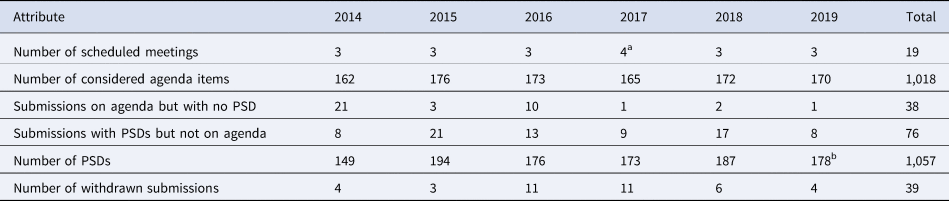
The PBAC held 19 scheduled meetings during the study period (2014–9) (Table 1).
Scheduled PBAC meetings (2014–9)

a There was a scheduled extraordinary meeting for which there was an agenda published beforehand.
b There was an additional PSD as one agenda item yielded two PSDs.
The Committee considered 1,018 submissions during this period, with 39 withdrawn submissions. We identified 1,057 published PSDs; several of these were for submissions which did not appear as a published agenda item. The results reveal a high number of missing PSDs in 2014, but much reduced thereafter.
Of the 1,057 published PSDs, 985 appeared as agenda items with an opportunity for consumers to provide comments. Two thirds of these had no consumer comments, over 90 percent had less than 50, and 1 percent had over 500. We found that initial minor submissions seldom had consumer comments, whereas consumer comments were frequently noted for minor resubmissions, which usually began as major submissions.
Of the 985 submissions, 123 (12 percent) were for orphan drugs. Half of these had no consumer comments, 84 percent had less than 50, and less than 1 percent had more than 500.
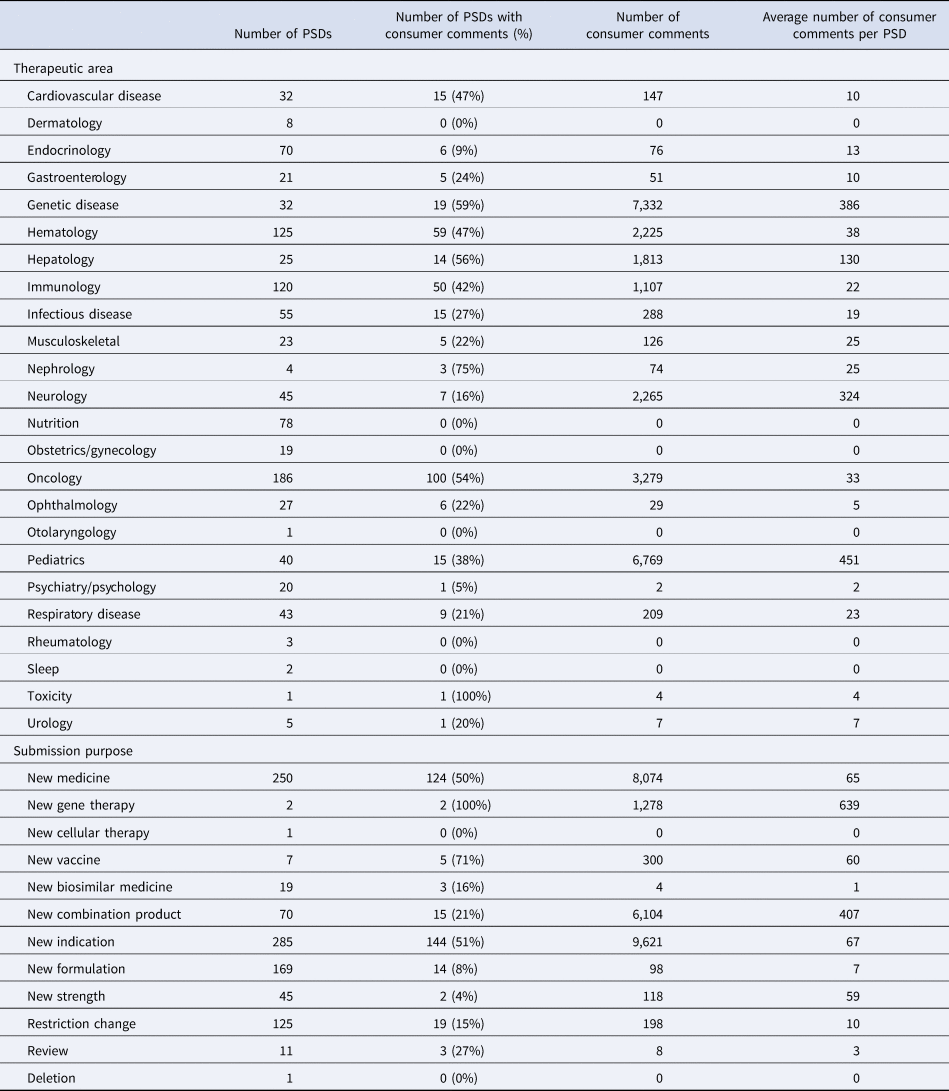
The number of consumer comments by therapeutic area and submission purpose also varied considerably (Table 2).
Consumer comments by therapeutic area and submission purpose (2014–9)

The therapeutic areas with the greatest number of PSDs with consumer comments were oncology (100), hematology (59), and immunology (50). The therapeutic areas with the most consumer comments were genetic disease (7,332), pediatrics (6,769), and oncology (3,279). The therapeutic areas with the highest average number of consumer comments per PSD were pediatrics (451), genetic disease (386), and neurology (324).
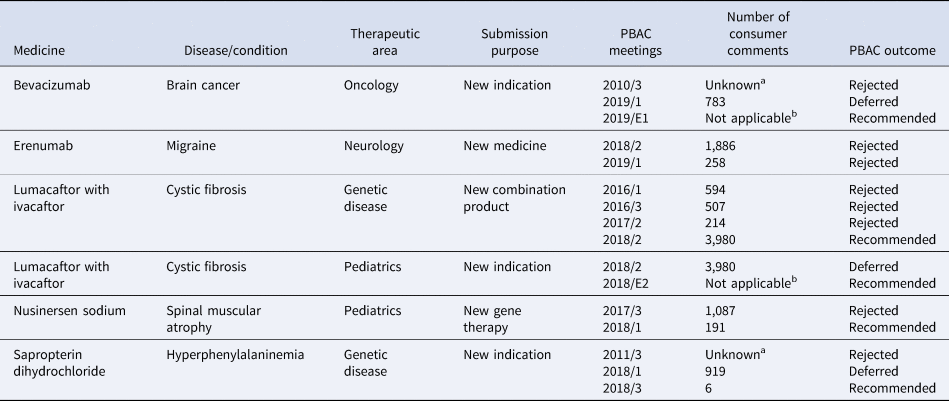
The two standout submission purpose categories were “new gene therapy” and “new combination product,” with 639 and 407 average number of consumer comments per PSD, respectively. We found that these were each driven by submissions for one technology. The series of these submissions and others with more than 500 consumer comments are presented in Table 3.
Submissions with >500 consumer comments (2014–9)

a PSD published before consumer comments data was included in the PSD.
b Considered by the Committee at out-of-session meetings with no pre-published agenda.
Discussion
To the best of our knowledge, we have conducted the first detailed analysis of consumer comments to the PBAC.
The effect and influence of comments from consumers on PBAC decision-making have come under recent scrutiny, as some commentators have formed the view that the decision-making process has been unduly influenced by pharmaceutical companies. A recent publication by Fabbri and colleagues found that pharmaceutical companies spent AUD34 million supporting patient advocacy groups over a 4-year period (Reference Fabbri, Swandari, Lau, Vitry and Mintzes10). The researchers found that sponsors of the most highly funded groups were pharmaceutical companies that in most cases had medicines under review by the PBAC for diseases/conditions covered by these organizations.
A detailed and balanced analysis of this issue starts with a review of the (consumer comments) process. It is important to note that consumers can only comment on published PBAC agenda items.
The agenda for a PBAC meeting can and does change. Items have been added after an agenda has first been published; we have noted as many as six versions for a given PBAC meeting. Some items have been withdrawn due to the applicant withdrawing its submission. Only recently, with the publication of the July 2021 agenda, has the Department of Health introduced a form of version control. Prior to this, we found that most withdrawals were noted in revised agendas; however, most additions and other revisions were not.
The agenda for a PBAC meeting notes which medicines, medicinal preparations, and vaccines are scheduled for consideration by the Committee and the associated disease/condition. Limited information is often provided in relation to the proposed target patient population and other important matters. Therefore, consumers often have little information about a given submission on which to base their comments.
The PBAC considers the consumer comments, minutes from sponsor hearings, consumer hearings, stakeholder meetings, as well as other technical papers when evaluating the relevant agenda item. Consumer issues are highlighted by the consumer representatives during discussion of agenda items.
To have a meaningful impact, consumers need to be aware of the PBS listing process and agenda publication timelines. Although some consumer groups will undoubtedly have a reasonable awareness of the consumer comments and PBAC decision-making processes (mostly through experience), others probably less so (i.e., a patient group for a disease/condition for which an associated technology is yet to be considered by the PBAC).
Given that the publication of an agenda is not widely publicized and an agenda often provides little information about each agenda item, pharmaceutical companies, who sponsor an agenda item, may seek to engage with consumers in some manner. With the objective of increasing the number of consumer comments, they may choose to:
• Notify the relevant patient group/s that the agenda for an upcoming PBAC meeting has been published and that there is at least one agenda item of interest to them
• Advise the relevant patient group/s about some non-commercially sensitive aspects of its submission
• Assist the relevant patient group/s in the preparation of comments to the PBAC
• Fund relevant patient group/s to undertake communication and advocacy activities
All are reasonable and legitimate commercial practices and several checks and balances are in place to prevent inappropriate activity. Having said that, individual consumers might not be aware that their representative organization has received funds from the pharmaceutical industry.
There are other ways consumers can provide direct formal input to the PBAC on a given agenda item:
• Prepare and lodge a submission
• Present to the Committee at a sponsor hearing
• Attend/participate at a PBAC consumer hearing
• Attend/participate at a PBAC stakeholder meeting
Consumers, either as an individual or as an organized group, do not have the information, experience, and resources to prepare a major submission. A consumer can provide input at a sponsor hearing and/or at a consumer hearing (only by invitation), which are held infrequently. Recent research indicates that has seldom occurred (Reference Flowers, Lybrand and Wonder11). PBAC stakeholder meetings are not commonplace and only occur after at least one rejection (12).
Considering the above, our analysis found that two thirds of all agenda items had not one consumer comment. Some of these were for new medicines. In some instances, there were more “consumer” comments from healthcare professionals and/or organizations than “actual” consumers. The high proportion of agenda items without consumer input indicates a lack of awareness of the process, a lack of interest in the medicine, or both. This high proportion is perhaps one reason why the local pharmaceutical industry is seeking to engage with consumers.
We could not find any evidence in the PSDs which suggests that consumer comments were pivotal in the PBAC's decision-making process; however, from time-to-time they do note if they were helpful or informative.
We found considerable variation in the number of consumer comments received per submission category. The two outstanding categories with the highest averages were “new gene therapy” and “new combination product.” Each was driven by one technology, nusinersen sodium and lumacaftor with ivacaftor, respectively.
Likewise, we found considerable variation in the number of consumer comments received per therapeutic area. The three therapeutic areas with the greatest number of submissions with consumer comments were oncology, hematology, and immunology. It is not a surprising result given one in every four submissions considered by the PBAC was for a cancer medicine.
The therapeutic areas with the greatest number of consumer comments were genetic disease, pediatrics, and oncology. These results could serve as a reflection of relative clinical need. The therapeutic areas with the highest average number of consumer comments per submission were pediatrics, genetic disease, and neurology. These results could serve as a reflection of greatest clinical need.
The submissions that received more than 500 consumer comments were for technologies used to treat patients with progressive disease that is unresponsive to initial treatment, patients with a disease with limited treatment options, or new first-in-class medicines.
The initial submission for a new gene therapy, nusinersen sodium for children with spinal muscular atrophy, was rejected by the PBAC at its November 2017 meeting (1,087 comments). The submission sought a PBS listing for three patient populations (types 1, 2, and 3). The PBAC had never considered a submission for this disease. Following a resubmission, the Committee recommended the listing in March 2018. A stakeholder meeting was held in January 2018.
Both submissions garnered strong consumer support. The number of consumer comments is likely to be greater than the number of patients. We could not confirm this as the estimates of the sizes of the three patient populations were redacted from the PSD. As the three patient populations are children, most if not all of the comments were probably prepared and lodged by parents/carers.
Similarly, a new combination product, lumacaftor with ivacaftor for patients with cystic fibrosis, was rejected three times by the Committee before its recommendation in July 2018. The initial submission and each resubmission also received a high number of consumer comments. A stakeholder meeting was not convened after each rejection. Two discrete submissions were considered at the July 2018 meeting, one for use by patients aged 12 years and older and another by children 6–11 years of age. A PSD was published for each submission; both reported the same number of consumer comments (3,980) which suggests that the comments were combined for both submissions.
Again, the number of consumer comments is likely to be greater than the number of patients, especially for the last submission. The patient number estimates in the PSDs were redacted. The initial target patient population was adolescents and adults, so the comments were likely prepared and lodged by patients and parents/carers. The target patient population for the new indication (children aged 6–11 years) is likely to be a much smaller patient population.
Erenumab was the first calcitonin gene-related peptide (CGRP) antagonist for patients with migraine to be considered by the Committee. The submission received a high number of consumer comments (1,886) but was rejected by the PBAC in July 2018. A resubmission with far fewer comments (258) was also rejected by the Committee in March 2019.
The PBAC has since considered submissions for other CGRP antagonists; they attracted far fewer consumer comments and yielded more favorable outcomes; galcanezumab was recommended in July 2019 (56 comments) and fremanezumab was deferred in November 2019 (57 comments). To date, the PBAC has not convened a stakeholder meeting or consumer hearing for the CGRP antagonists.
The high number of consumer comments associated with the initial submission for erenumab and the final submission for lumacaftor with ivacaftor were due, at least in part, by organized campaigns by their respective patient groups (Headache Australia, Migraine Australia, and Cystic Fibrosis Australia). These campaigns involved press releases, online petitions, social media activity, and blog posts (Reference Burke13–16). The target audiences of these campaigns were the PBAC and the Federal Government, in particular, the Minister for Health. A detailed analysis of these campaigns is beyond the scope of our analysis. Nonetheless, there can be no doubt that these campaigns were supported in some way by the sponsors of the technologies involved. The available data suggest that the campaigns had mixed results; the campaign for erenumab did not achieve the desired result. The PSD for erenumab makes no mention of whether the consumer comments were considered by the PBAC to be helpful/informative.
There are some limitations to our research:
• Our study period started in 2014, so we were unable to analyze the PSDs for important submissions like those for ivacaftor which were considered by the PBAC in 2013. We were also unable to determine the number of consumer comments associated with the earlier submissions for bevacizumab and sapropterin dihydrochloride.
• We noted over 30 agenda items without an associated PSD. It is unclear if any of these items received any consumer comments.
The “Consumer Comments” section of the PSDs is not structured in terms of the issues raised by consumers and how the collated data were viewed by the Committee. If consumer comments are reported for a technology, its PSD will note the number of comments received, broken down by individuals, healthcare professionals, and organizations. Unfortunately, this is the only information consistently reported across the PSDs. Some PSDs summarize the comments regarding the physical, mental, and social impact of the disease/condition on patients. A few make note of patients’ experience with the medicine. A meaningful qualitative analysis of the consumer comments is therefore difficult to achieve, considering the inconsistency of reporting.
We are not the first to examine the influence of patients on PBAC decision-making. Fabbri and colleagues examined the effect of the relationship between pharmaceutical companies and patient advocacy groups on PBAC decision-making. The study found that thirty-four companies provided support to 230 patient groups. This primarily came in the form of monetary support, with a total spend of AUD34,507,810, between January 2013 and December 2016. Ten out of these thirty-four companies provided over 65 percent of the total funding. They also explored whether there was a correlation between a company's commercial interests, measured by one (or more) of its technologies achieving a PBS listing, and the amount of support provided to patient groups. The results indicated that the main funders of the top five patient groups had medicines for conditions related to the patient group under review by the Committee. However, in most cases, these medicines took multiple submissions before a recommendation was issued. They noted that limitations with publicly available information prevented the ability for further analyses of potential industry influence (Reference Fabbri, Swandari, Lau, Vitry and Mintzes10).
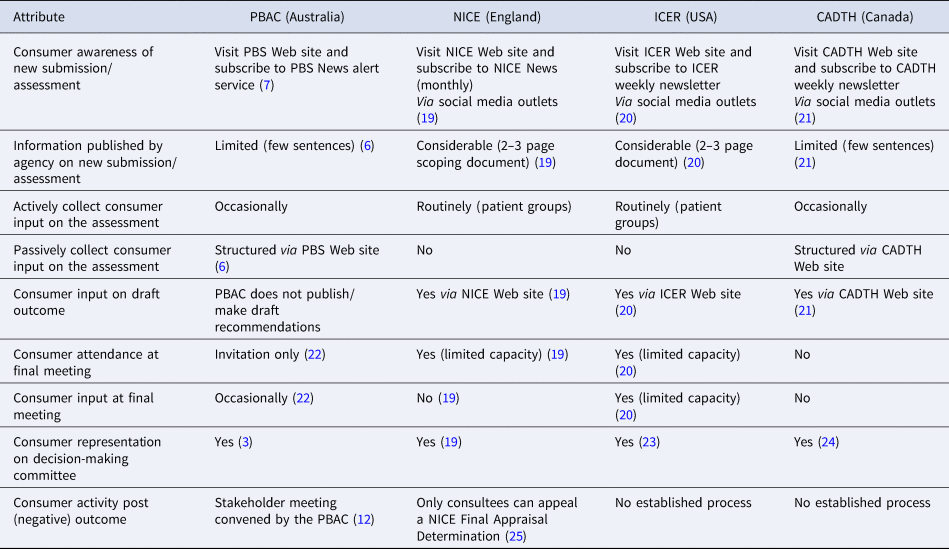
Reviews have been performed on the consumer comments processes of other HTA agencies (Reference Hashem, Calnan and Brown17;Reference Mandeville, Barker, Packham, Sowerby, Yarrow and Patrick18). We have performed our own review on England's National Institute for Health and Care Excellence (NICE), the United States of America's Institute for Clinical and Economic Review (ICER), and Canada's Canadian Agency for Drugs and Technologies in Health (CADTH), in order to compare and contrast them with the PBAC's process (Table 4), and have identified improvements which could be made to the PBAC.
Comparison of PBAC, NICE, ICER, and CADTH processes

Improve Agenda Content
At times, the agenda provides limited information regarding the target patient population (i.e., medicine for patients with disease X); thus, consumers have little information on which to base their comments. Therefore, more information about the target patient population is required. Cooperation from pharmaceutical companies may be needed to provide more detail regarding agenda items. This should be expressed in an easy-to-read, consumer-friendly format. Additionally, a link to corresponding documents such as the Consumer Medicines Information document for TGA-registered products, or a link to the corresponding clinical trial/s for products assessed under the TGA/PBAC parallel process should be included with each item. This will allow consumers to provide more informed and relevant consumer comments.
Decision-Making Process Change
In examining the NICE, ICER, and CADTH processes (Table 4), we found that draft outcomes are published which welcome consumer and stakeholder input. We recognize that this would require significant changes to the current PBAC process, but believe it could allow for further consumer engagement.
Improve Consumer Comments Reporting in PSDs
Currently, a proportion of PSDs published from 2014 onwards have a section summarizing the number of consumer comments received for the item. Some, but not all of these PSDs also detail the content of the comments, such as the submitting organizations, and details as to why they were in favor of/against reimbursement. Consistent and more descriptive reporting of consumer comments in the PSDs is needed to allow further qualitative analysis. Although dependent on privacy issues, the PBAC could also consider publishing the received comments in full.
Increase Public Awareness of the Agenda
Currently, there is an email notification system available on the PBS Web site; however, consumers cannot tailor this to areas of interest and instead will receive emails regarding all PBS news and the publication of documents such as the PBAC agenda, outcomes, and the monthly PBS schedule. These may not all be relevant to consumers. Allowing consumers to select areas of interest or having a separate, dedicated consumer comments notification system, may be more useful.
We could not find any evidence of press releases, issued by the Department of Health or the Minister for Health, relating to the publication of the agenda. Press releases and media coverage may help to alert the public to the release of the agenda, as well as the opening and closing of the consumer comments portal. This would diminish the need for patient groups to interact with pharmaceutical companies in relation to the agenda.
Consider the Use of Social media
In examining the NICE, ICER, and CADTH processes (Table 4), we found that social media outlets, such as Twitter and LinkedIn, were used to engage with and notify consumers. This may increase consumer awareness of, and involvement in, the PBAC process.
Greater Involvement of Patient Groups
A link to relevant patient group/s could be provided in the agenda, through which consumers could source further information on the target patient population. Patient groups could also remove burden from the consumer representatives by collecting and collating comments for relevant agenda items, then submitting a summarized document for the Committee's consideration. Additionally, the PBAC could look to actively collaborate with patient groups.
We note that on 7 September 2021, Medicines Australia and the Australian Government announced a 5-year strategic agreement centered on earlier patient involvement and influence in the availability of new medicines. This will include an Enhanced Consumer Engagement process, aiming to include consumers earlier in the PBAC process. Further public announcements on this process will be made in due course (26).
Conclusion
We have found that the PBAC consumer comments process is underutilized, as two in every three agenda items considered by the Committee did not receive a consumer comment. This could be due to a lack of awareness and/or detail provided. We have provided a number of policy suggestions that may assist to address these issues and improve consumer engagement.
Funding
This research received no specific grant from any funding agency, commercial, or not-for-profit sectors.