Introduction
Nursing homes (NHs) provide some of the highest levels of care to patients having a wide array of physical or mental disorders that do not need to be in a hospital but cannot be cared for at home.
In the Netherlands, nursing homes house their patients in units that provide specific care to a particular group, for example, in dementia special care units or units for physically frail elderly (Koopmans et al., Reference Koopmans, Lavrijsen and Hoek2013). In this latter unit type, more and more patients also have mental and/or behavioral problems in addition to their physical morbidity. This concerns older patients with primarily physical disorders that are accompanied by neuropsychiatric symptoms forming part of a physical disease, a relapse of existing psychiatric conditions triggered by physical problems, or physically frail patients with a late-onset psychiatric disorder (Fullerton et al., Reference Fullerton, McGuire, Feng, Mor and Grabowski2009).
The fact that their number increases in NHs is understandable. For decades, the number of elderly people in our society has been rising. This trend has gained momentum since 2010, because from that year on baby boomers have been reaching the age of 65 years. Since mental–physical multimorbidity (MPM) is common in older people (van den Brink et al., Reference van den Brink, Gerritsen, Voshaar and Koopmans2013), the number of elderly people with MPM is also increasing rapidly, which leads to more patients being admitted to a NH because of their need for 24/7 multiprofessional care. In the Netherlands, they usually are referred to a NH by healthcare services, such as district nursing, general practices, hospitals, rehabilitation clinics, and other long-term care (LTC) facilities.
Next to the graying society, a second trend is responsible for the growing number of patients with MPM referred to LTC facilities. Since the 1950s, deinstitutionalization has dominated mental healthcare reforms in most industrialized countries. As a result, the total number of psychiatric hospital beds has decreased dramatically (Novella, Reference Novella2010). Since then, LTC facilities have partly taken over the traditional asylum function of psychiatric hospitals (Bartels et al., Reference Bartels, Miles, Dums and Levine2003). Nowadays, approximately one-fourth of newly admitted NH patients have a mental illness, such as schizophrenia, bipolar disorder, depression, or anxiety disorder (Fullerton et al., Reference Fullerton, McGuire, Feng, Mor and Grabowski2009). These patients are mainly referred to a NH by mental healthcare services (MHS).
In the Netherlands, some traditional NHs are evolving toward centers for specialized care, among others for patients with MPM. Most of these centers have decided to house the two etiologically different groups of NH patients with MPM together on separate units, so-called geronto-psychiatric nursing home (GP-NH) units, because daily practice shows that the care needs of NH patients with MPM differ from the traditional patients in NHs having dementia and/or physical multimorbidity (van den Brink et al., Reference van den Brink, Gerritsen, Oude Voshaar and Koopmans2014). This is supported by the few studies about patients with MPM in LTC facilities (Seitz et al., Reference Seitz, Purandare and Conn2010). These suggest that LTC patients with MPM are more likely to be younger, male, and unmarried than other LTC patients. Also, they more often have challenging behavior and cognitive impairment no dementia. However, in the literature a clear overview of the characteristics of LTC patients with MPM is lacking entirely (van den Brink et al., Reference van den Brink, Gerritsen, Voshaar and Koopmans2013).
In order to create care that is appropriate for the needs of patients with MPM and that contributes to optimizing their well-being, more knowledge about this patient group is, therefore, the necessary first step. Accordingly, the primary aim of this study is to describe the demographics, physical and psychiatric morbidity, medication use, and care dependency of patients with MPM without dementia residing in GP-NH units. Because in these units care is provided for both patients with physical multimorbidity complicated with psychiatric conditions and for psychiatric patients with physical multimorbidity, the secondary aim is to describe whether the characteristics differ for these two groups.
Methods
The MAPPING study (patients with both mental and physical problems residing in Dutch NHs) is an explorative, descriptive, cohort study.
Participants
Participants were recruited in Dutch NHs. Eligible NHs were those with a GP-NH unit. To enhance external validity, we contacted NHs spread across the country that explicitly mentioned on their websites that they have a GP-NH unit. This resulted in 43 potential participating organizations. Fifteen organizations, of which two with GP units in two different NHs, responded positively, so 17 GP-NH units participated. No further selection criteria for NHs were applied.
The MAPPING study includes two groups of participants. The first group consists of patients who were newly admitted to a GP-NH unit. In this group two measurements were performed: at baseline and a follow-up after six months. Since, the admission rate of new patients on the participating GP-NH units proceeded less rapidly than expected, a second group of participants was added to enlarge the power of the study. This group consists of already residing patients on the GP-NH unit who met all the inclusion criteria. In this group a single measurement was performed. The patient characteristics in both groups were found not to differ significantly from each other in respect to age, sex, marital status, level of education, and cognitive functioning.
Patients were included if (1) they needed both physical and psychiatric care, as shown in the medical history, (2) the psychiatric or behavioral problems existed for two years or longer without prospect of substantial recovery and (3) they stayed for at least six months on the GP-NH unit. Exclusion criteria were: (1) dementia, (2) unable to give informed consent, (3) mentally or physically too ill for reliable data collection, and (4) refusal to participate. The physician of the GP-NH unit determined whether a patient met all these criteria; if so, written informed consent was requested from the patient by the physician.
In this paper, we present a cross-sectional overview of the data collected from all participants. Of the group of newly admitted patients data of the follow-up measurement were used in order to rule out confounding by temporary distress due to admission on the GP-NH unit at the time of the baseline measurement.
Data collection and assessments
Data collection took place between April 2012 and September 2015 and was carried out by the researcher (AvdB) and a research assistant (MdV). Both are certified elderly care physicians, a medical specialty in NH and primary care geriatric medicine in the Netherlands (Koopmans et al., Reference Koopmans, Lavrijsen, Hoek, Went and Schols2010). Beforehand, they were trained in administering the assessment instruments. Data collection consisted of chart review, semi-structured interviews, (brief) neuropsychological testing, and self-report questionnaires.
Medical and demographic data were collected from the patients’ medical file. Registered were: age, gender, ethnicity, marital status, level of education, residence prior to admission to the NH, and all known chronic conditions. These conditions were classified in a list of 56 diagnosis groups of chronic diseases based on ICD-10 codes (International Statistical Classification of Diseases and Related Health Problems, 10th Revision). Medication use was retrieved from pharmacy files. Drugs were classified using the Anatomical Therapeutic Chemical classification (ATC).
In addition to the registration of chronic psychiatric disorders by chart-review, current psychiatric disorders were assessed with the mini-SCAN (Nienhuis et al., Reference Nienhuis, van de Willige, Rijnders, de Jonge and Wiersma2010), a semi-structured diagnostic interview. The mini-SCAN is a shortened and computerized version of the Schedules for Clinical Assessment in Neuropsychiatry (SCAN) (Wing et al., Reference Wing1990), developed under the auspices of the World Health Organization Advisory Committee. The mini-SCAN covers a wide range of Axis I disorders. Severity, frequency, and interferences of individual psychiatric symptoms and signs are explored bottom-up, i.e. the rater must decide whether a symptom/sign is present, whereafter a computerized algorithm enables psychiatric diagnoses to be made. The mini-SCAN has good diagnostic properties for current psychiatric disorders (Nienhuis et al., Reference Nienhuis, van de Willige, Rijnders, de Jonge and Wiersma2010).
Cognition was assessed with the Standardized Mini-Mental State Examination (S-MMSE) (Molloy et al., Reference Molloy, Alemayehu and Roberts1991) and the Frontal Assessment Battery (FAB) (Dubois et al., Reference Dubois, Slachevsky, Litvan and Pillon2000). The MMSE (Folstein et al., Reference Folstein, Folstein and McHugh1975) is a widely used measure to screen for cognitive impairment. Scoring consists of a sum of correct responses on 11 items, resulting in a continuous scale from 0 to 30 points. The standardized version with explicit detailed guidelines for its administration and scoring was applied. The S-MMSE has been shown to have a better interrater and intrarater reliability than the MMSE (Molloy et al., Reference Molloy, Alemayehu and Roberts1991). The MMSE is more specific and sensitive in detecting cognitive deficits related to language and memory rather than frontal executive dysfunction (Woodford and George, Reference Woodford and George2007). For this purpose, the FAB is administered. This test consists of six subtests, each exploring one of the following functions related to the frontal lobes: conceptualization, mental flexibility, motor programming, sensitivity to interferences, inhibitory control, and environmental autonomy. For each subtest, three points can be achieved, which are summed into a score ranging from 0 to 18. The interrater reliability, internal consistency, and concurrent validity were found to be good (Dubois et al., Reference Dubois, Slachevsky, Litvan and Pillon2000).
Neuropsychiatric symptoms and agitation were assessed with the Neuropsychiatric Inventory Nursing Home version (NPI-NH) and the Cohen Mansfield Agitation Inventory (CMAI) respectively. The NPI-NH is a modified version of the original NPI (Cummings et al., Reference Cummings, Mega, Gray, Rosenberg-Thompson, Carusi and Gornbein1994) designed to measure psychiatric symptoms in geriatric patients with dementia. The NH version was developed for use by professional caregivers within institutions and was found to be valid and reliable for trained nursing staff (Wood et al., Reference Wood2000). The NPI-NH can also be used as a screen for neuropsychiatric symptoms in an elderly neuropsychiatric population (Lange et al., Reference Lange, Hopp and Kang2004). The NPI-NH includes 12 neuropsychiatric symptoms. The frequency (F) and severity (S) of a particular symptom are rated on a four- (1–4) and a three-point (1–3) Likert scale, respectively. A separate score can be calculated for each symptom by multiplying the frequency and severity scores (F×S score), resulting in values ranging from 0 to 12 for each symptom. The total NPI score is the summed symptom score and ranges from 0 to 144. The CMAI is designed (Cohen-Mansfield and Billig, Reference Cohen-Mansfield and Billig1986) and validated (Miller et al., Reference Miller, Snowdon and Vaughan1995) to assess 29 agitated behaviors and has been extensively used for assessment purposes in NHs. The frequency of each symptom is rated on a seven-point scale (1–7) ranging from “never” to “several times an hour.” Total score ranges from 29 to 203.
Care dependency was assessed with the Care Dependency Scale (CDS) (Dijkstra et al., Reference Dijkstra, Buist, Dassen and van den Heuvel2012). The CDS consists of 15 items on basic functional care demands that are scored on a five point Likert scale; the total score ranges from 15 (completely dependent on care) to 75 (almost independent of care). The NH version of the CDS was found to be reliable and valid for use in both physically disabled NH patients and those with dementia (Dijkstra et al., Reference Dijkstra, Tiesinga, Goossen and Dassen2002).
Ethical considerations
Formal approval according to the Medical Research Involving Human Subjects Act was not necessary, as established by the local Medical Ethics Review Committee “CMO Regio Arnhem-Nijmegen,” that has reviewed the study protocol (number 2011/171). NH management boards gave permission for the study, which was conducted in accordance with the Declaration of Helsinki and the Code of Conduct for Health Research.
Analysis
In accordance with previous studies, MMSE-scores were categorized into no (≥24), mild (21–23), and moderate (≤20) cognitive impairment (Jongenelis et al., Reference Jongenelis, Pot, Eisses, Beekman, Kluiter and Ribbe2004; Schaller et al., Reference Schaller2012). The presence of frontal impairment was defined as FAB-score ≤12 (Van Loo et al., Reference Van Loo, Wiebrands and Van Laar2007). Neuropsychiatric symptoms with a F×S score >3 on the NPI-NH were considered clinically relevant (Cravello et al., Reference Cravello, Palmer, de Girolamo, Caltagirone and Spalletta2011). Relevant agitation measured with the CMAI was defined as behavior occurring at least once a week (frequency score >2) (Zuidema et al., Reference Zuidema, Derksen, Verhey and Koopmans2007).
The data were analyzed for the entire group and, in order to describe whether characteristics differ for the two etiologically different groups, also stratified by the referring health services MHS or other healthcare services (OHS)).
Categorical variables were summarized as percentages (number); continuous variables were summarized as means (Standard Deviation; minimum–maximum) or medians (InterQuartile Range). Comparison of patients referred from MHS and patients referred from OHS was performed by cross tabulation with χ2 tests for nominal variables, with Student's t-tests for independent samples in the case of normally distributed continuous variables, and with Mann–Whitney U-tests for independent samples if continuous variables were not normally distributed. Although correcting for multiple comparisons may increase the risk of type II error, we did not correct for multiple testing, because our study was explorative. Instead, we have chosen to present all individual p values combined with the descriptives. Statistical analysis was carried out using SPSS version 22.0.0.1.
Results
One hundred seventy patients were eligible for enrollment into the study. Twenty-eight of them (man: 57.1% (n = 16), mean age: 71,4 years (SD = 9.3)) did not agree to participate. One hundred forty two patients provided informed consent and data of these patients were collected.
Patient characteristics
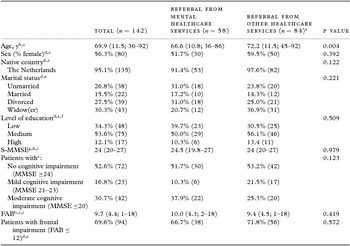
The patient characteristics are presented in Table 1, showing slightly more women than men, with a mean age of 70 years. Residents referred from MHS (n = 58) were younger than those who were referred from OHS (n = 84) (t = −2.93, df = 140, p = 0.004). The majority of the included patients had no partner. Nearly half of the patients had cognitive impairment (MMSE ≤23) and almost 70% had frontal impairment (FAB ≤12).
Patient characteristics

a Nursing home (26.1%; n = 37), Residential home (11.3%; n = 16), Independently at home (14.1%; n = 20), Other (7.7%; n = 11).
b Mean (SD; min–max).
c Student's t-test.
d % (n).
e χ2-test.
f Missing data n = 2.
g Median (IQR).
h Mann–Whitney U-test.
i Missing data n = 5.
j Missing data n = 7.
Physical conditions and associated use of medication
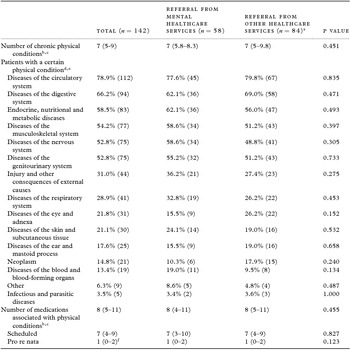
The median number of chronic physical conditions was 7 (IQR = 5–9) (Table 2). More than three quarters of the patients had one or more diseases of the circulatory system. Diseases of the digestive system were present in 66.2% of all patients, followed by endocrine, nutritional and metabolic diseases in 58.2%. Both the mean number and the type of chronic physical conditions did not differ significantly between the two categories of patients.
Physical conditions and associated use of medication

a Nursing home (26.1%; n = 37), Residential home (11.3%; n = 16), Independently at home (14.1%; n = 20), Other (7.7%; n = 11).
b Median (IQR).
c Mann–Whitney U-test.
d % (n).
e χ2-test.
f Analgetics: 0.42 Laxatives: 0.41 Other: 0.37 (sympaticomimetics, nitrovasodilators, antidiabetics, ophtamologicals).
Patients used a median number of 7 (IQR = 4–9) types of medicines plus 1 (IQR = 0–2) for pro re nata use. Almost everyone (99.3%) used drugs from the category “alimentary tract and metabolism” with the following top-3: vitamins and mineral supplements (88.7%), laxatives (72.5%), and proton-pump inhibitors (62.7%). Of the patients 67.6% used analgesics, of which 35.2% on a daily basis. Drugs for the purpose of disorders of the cardiovascular system were used in 59.9%. Medication use for physical conditions did not differ significantly between both patient groups.
Psychiatric conditions and associated use of medication
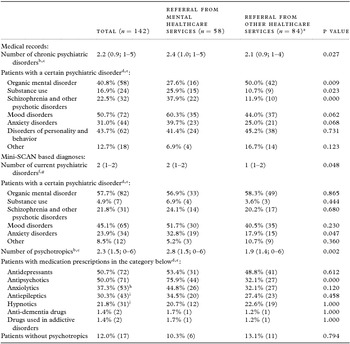
The mean number of chronic psychiatric conditions as registered in the medical record was 2.2 (SD 0.9; range 1–5) (Table 3). Patients referred from MHS had less organic mental disorders than other patients (27.6% vs. 50.0%; χ2 = 7.13, df = 1, p = 0.009), but more often mood disorders (60.3% vs. 44.0%; χ2 = 3.65, df = 1, p = 0.062), anxiety disorders (39.7% vs. 25.0%; χ2 = 3.45, df = 1, p = 0.068), and schizophrenia and other psychotic disorders (37.9% vs. 11.9%; χ2 = 13.31, df = 1, p < 0.001). The median number of current psychiatric diagnoses (not including disorders of personality and behavior) was 2 (IQR = 1–2).
Psychiatric disorders and associated use of medication

a Nursing home (26.1%; n = 37), Residential home (11.3%; n = 16), Independently at home (14.1%; n = 20), Other (7.7%; n = 11).
b Mean (SD; min–max).
c Student's t-test.
d % (n).
e χ2-test.
f Median (IQR).
g Mann–Whitney U-test.
h Another 20.4% (n = 29) has a prescription for pro re nata use of an anxiolytic.
i Of these 43 patients 44.2% (n = 19) have been diagnosed with epilepsy.
j Another 8.5% (n = 12) has a prescription for pro re nata use of a hypnotic.
The mean number of psychotropic drugs that patients used, was 2.3 (SD = 1.5; range 0–6); patients referred from MHS used more than those referred from OHS (2.8 vs. 1.9; t = 3.16, df = 140, p = 0.002). The largest difference in percentage of psychotropic drug use regarded antipsychotics: 75.9% versus 32.1% (χ2 = 24.83, df = 1, p < 0.001). About half of all patients used an antidepressant. More than one third used anxiolytics and another 20% had a prescription for pro re nata use of an anxiolytic.
Behavior and care dependency
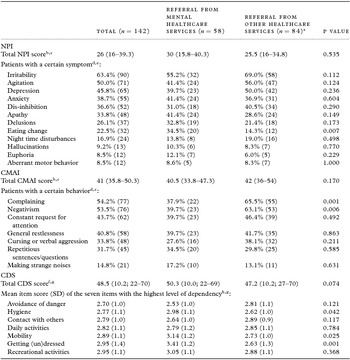
The mean total NPI-NH F×S score was 28.0 (SD = 16.2) (Table 4). 90.1% had clinically relevant neuropsychiatric symptoms. A majority of the patients (85.9%) had multiple clinically relevant symptoms (median = 4; IQR = 2–5). “Irritability,” “agitation,” and “depression” were the most prevalent neuropsychiatric symptoms with rates of 63.4%, 50.0%, and 45.8%, respectively. Prevalence rates of all neuropsychiatric symptoms did not differ significantly between the two patient groups.
Behavior and care dependency

a Nursing home (26.1%; n = 37), Residential home (11.3%; n = 16), Independently at home (14.1%; n = 20), Other (7.7%; n = 11).
b Median (IQR).
c Mann–Whitney U-test.
d % (n).
e χ2-test.
f Mean (SD; min–max).
g Student t-test.
h Mean (SD).
Agitated behavior as assessed with the CMAI was present in 85.9% of the patients and 76.0% had multiple agitated behaviors (median = 4; IQR = 2–5). The most prevalent symptoms were “complaining” and “negativism,” which both occurred more in OHS than in MHS patients (complaining: 65.5% vs. 37.9%, χ2 = 10.49, df = 1, p = 0.001; negativism: 63.1% vs. 39.7%, χ2 = 7.58, df = 1, p = 0.006). Other frequently occurring symptoms were “constant request for attention” and “general restlessness” with prevalence rates of 43.7% and 40.8%, respectively, and “cursing or verbal aggression” and “repetitious sentences/questions” with prevalence rates of 33.8% and 31.7%, respectively. Prevalence rates of these symptoms did not differ significantly between the two patient groups.
The mean total CDS score was 48.5 (SD = 10.2), which corresponds to “partially care dependent” (Dijkstra et al., Reference Dijkstra, Buist, Dassen and van den Heuvel2012). The care dependency varied considerably between patients, reflected by a broad range of the CDS sum score (22–70). The top-3 items on which patients showed the highest level of dependency in the MHS group was (1) avoidance of danger, (2) contact with others, and (3) daily activities, and in the OHS group (1) hygiene, (2) getting (un)dressed, and (3) mobility. Of the mean CDS-scores on the seven items with the highest level of dependency, only “getting (un)dressed” showed a significant difference between both patient categories (t = 3.52, df = 140, p = 0.001).
Discussion
To our knowledge, this is the first study that reports characteristics of NH patients with MPM. Despite exclusion of patients with dementia, the majority had cognitive impairment. Particularly the prevalence and severity of frontal impairment were high, as well as the number of patients with clinically relevant neuropsychiatric symptoms. Comparison of those referred from MHS and OHS showed that the MHS group was younger, had more chronic psychiatric disorders and more antipsychotic drug use than the OHS group. Nonetheless, neuropsychiatric symptoms as well as items of care dependency did not significantly differ between both groups, except complaining and the need for help with getting (un)dressed, which occurred more in the OHS group. Median number and distribution of physical conditions and concomitant medication use also did not differ significantly between the both subgroups.
Overall, MHS patients had more psychiatric disorders, driven by psychotic disorders, substance use disorders, mood disorders, and anxiety disorders (the latter two differences not statistically significant). Nonetheless, organic disorders were more prevalent in the OHS patients. These differences suggest that MHS patients were primarily referred because of severe mental illness and/or personality disorders, while OHS patients for organic mental disorders and/or personality disorders.
These observed differences were less pronounced if current psychiatric disorders according to the mini-SCAN were considered. The higher prevalence rates of organic mental disorder in both patient groups and psychotic disorders among OHS patients identified by the mini-SCAN compared to the medical records point to under-diagnosing and/or under-reporting of these disorders in routine daily practice. The lower prevalence rates for current substance use, mood, and anxiety disorders in both groups, are probably associated with environmental factors, such as no supply of alcohol in a NH and the continued presence of staff. Regrettably, the decline in prevalence rates of mood and anxiety disorders is relatively small. Probably, this can be explained by one of the inclusion criteria: psychiatric or behavioral problems existing for two years or longer without prospect of substantial recovery. Because of therapy resistance these patients could be referred to the NH with the aim to guide them in coping with their limitations. Interestingly, although we are dealing with two etiologically different subgroups, these differ not much regarding behavior and care dependency.
The fact that we hardly found statistically significant differences between both groups, particularly in cognition, neuropsychiatric symptoms and care dependency, can be regarded as a basis for housing the two subgroups together and developing care standards for the entire group of NH patients with MPM. Our findings indicate that not the diagnoses, but symptoms and behavior are responsible for the limitations in functioning and therefore for the content of the care needs.
As Seitz et al. (Reference Seitz, Purandare and Conn2010) reported in their systematic review, there are gaps in the existing literature in psychiatric disorders in LTC. Therefore, we were not able to compare our findings with similar studies. Because of the experience in practice that characteristics and care needs of NH patients with MPM differ from those of traditional NH patients, we discuss our results in the light of those from studies in NH patients with dementia and with only physical disorders.
The cognitive functions as measured with the MMSE (i.e. memory, orientation, language, and concentration) were less impaired in our study population (median MMSE score: 24 (IQR = 20–27)) than in patients on units for physically frail patients in Dutch NHs. In the AGED study, for instance, the mean score of the MMSE at baseline was 21.9 (SD = 3.8) and only 36.9% of the patients had no cognitive dysfunction (MMSE score ≥24) (Jongenelis et al., Reference Jongenelis, Pot, Eisses, Beekman, Kluiter and Ribbe2004). In the Act in case of Depression (AiD) study, the mean score of the MMSE at baseline was 19.5 (SD = 5.5) (Leontjevas et al., Reference Leontjevas2013). On the other hand, executive functions as measured by the FAB (mean FAB score: 9.7 (SD = 4.4)) were comparable to patients with dementia: Boban et al. (Reference Boban, Malojcic, Mimica, Vukovic and Zrilic2012) found mean total FAB scores of 11.5 (SD = 3.0) in patients with Alzheimer disease, 9.7 (SD = 2.8) in patients with subcortical vascular cognitive impairment, and 9.7 (SD = 3.9) in patients with frontotemporal lobar degeneration. Possibly, the combination of (neuro)psychiatric disorders and frontal cognitive impairment increases the need for hospitalization, resulting in high prevalence rates of impaired executive functioning in NH patients with MPM.
The total NPI-NH score in our study (median 26; IQR = 16–39.3) was lower than found in geriatric psychiatry inpatients (mean 32.6 (SD = 19.5) (Collet et al., Reference Collet, de Vugt, Verhey, Engelen and Schols2016) and mean 31.5 (SD = 25.5) (Iverson et al., Reference Iverson, Hopp, DeWolfe and Solomons2002)), but higher than in patients with dementia (mean 14.6 (SD = 13.6) (Wetzels et al., Reference Wetzels, Zuidema, de Jonghe, Verhey and Koopmans2010)). In comparison with chronic NH patients with stroke, in our study more patients had agitation (50.0% vs. 29.6%), delusions (26.1–9.9%) and hallucinations (9.2% vs. 3.6%), and less had depression (45.8% vs. 52.6%) (van Almenkerk et al., Reference van Almenkerk, Depla, Smalbrugge, Eefsting and Hertogh2012); compared with NH patients with dementia, more MPM patients had depression (45.8% vs. 20%) and less had aberrant motor behavior (8.5% vs. 29%) (Zuidema et al., Reference Zuidema, Derksen, Verhey and Koopmans2007).
Care dependency in patients in our study was comparable with physically frail NH patients (mean total score CDS 48.5 (SD = 10.2) vs. 51.7 (SD = 15.9)) (Dijkstra et al., Reference Dijkstra, Tiesinga, Goossen and Dassen2002) but lower than in NH patients with dementia (37.2 (SD = 17.1)) (Dijkstra et al., Reference Dijkstra, Buist, Dassen and van den Heuvel2012). The results indicated that the domains with the highest levels of care dependency are different in NH patients with MPM, in those with only physical disorders and in those with dementia (Dijkstra et al., Reference Dijkstra, Tiesinga, Goossen and Dassen2002, Reference Dijkstra, Buist, Dassen and van den Heuvel2012). “Avoidance of danger,” “hygiene,” and “contact with others” are uppermost in domains of care dependency in patients with MPM, “getting (un)dressed,” “hygiene,” and “mobility” in somatic NH patients, and “learning ability,” “daily activities,” and “recreational activities” in NH patients with dementia. Interacting with patients who need physical care but who also have problems with estimating danger and initiating or maintaining social contact, requires specific skills of the nursing staff such as mediating and counseling abilities.
In this study, an extensive range of data was collected. Since the interviews were conducted by two elderly care physicians who are familiar with this patient group, the data are of good quality and there are only few missing data. However, some limitations must be mentioned. First of all, study participants were recruited from specialized GP units in several Dutch NHs. These units have varying criteria for admission depending on, for example, the qualitative and quantitative composition of the multidisciplinary team and cooperation agreements with mental and other healthcare services. As the MAPPING study is an explorative, descriptive study with a small sample size, we did not investigate the effect of these criteria on the composition of the study population. We tried to reduce this impact by using inclusion criteria at the individual patient level and not at the level of a unit. Nevertheless, different profiles in GP-NH units could have influenced the severity of neuropsychiatric symptoms and care dependency of participants and also limit the generalizability. Furthermore, despite the use of inclusion criteria, patients with severe symptoms may be under-represented in our study population because the physician of the unit was responsible for judging whether a patient was able to participate in the study. Finally, albeit our sample is likely to be representative for patients with MPM admitted in Dutch NHs, the sample size is modest and representativeness for other countries remains unknown. Nonetheless, our data provide important information on the characteristics of NH patients with MPM.
Conclusion and recommendations
In order to create care and services that are appropriate for the specific needs of patients with MPM, we studied the characteristics of two groups of NH patients with MPM without dementia, one group referred from MHS and another group referred from OHS. These groups were heterogeneous in many characteristics, such as their physical and psychiatric multimorbidity, but differed not significantly regarding the consequences of these diseases for behavior and care dependency. Because these consequences are decisive for the daily care, it seems appropriate to accommodate and support patients of both patients groups together once care has become more indispensable than cure.
Our study indicates that NH patients with MPM without dementia differ from NH patients with dementia and those with only physical illnesses in particular regarding age, cognitive functioning, challenging behavior, and domains of care dependency. Interacting with patients with this specific characteristics, probably requires extra knowledge and skills of the staff. To uncover which knowledge and skills are necessary, the next step should be to investigate the specific care needs of NH-patients with MPM without dementia; this is essential in order to improve the quality of care for these patients.
Conflict of interest
None.
Description of authors’ roles
Anne M.A. van den Brink designed the study, collected the data, performed the analysis, and wrote the paper, Debby L. Gerritsen provided support with study design, methodology, statistical analysis and writing process, and reviewed the paper. Miranda M.H. de Valk collected the data and reviewed the paper, Richard C. Oude Voshaar and Raymond T.C.M. Koopmans supervised and supported the design of the study, assisted in the data interpretation, and reviewed the paper.