1. Introduction
The Palaeoproterozoic Svecofennian orogen in Finland contains a number of gold occurrences of various genetic types; many of these could be classified as orogenic gold linked to shear zones (Eilu et al. Reference Eilu, Sorjonen-Ward, Nurmi and Niiranen2003). Some prospects have been studied in detail; however, these studies were mostly restricted to the prospect-scale without considering links to the regional-scale structures and the tectonic evolution. The age of gold mineralization in southern Finland is also poorly known, hampering a regional interpretation and correlation of metallogenic provinces and events. In the light of a complex and polyphase tectonic evolution of the Svecofennian domain, the determination of the age of mineralized shear zones is critical for understanding the origin and tectonic setting of regional mineralization episodes as well as their genetic relationships.
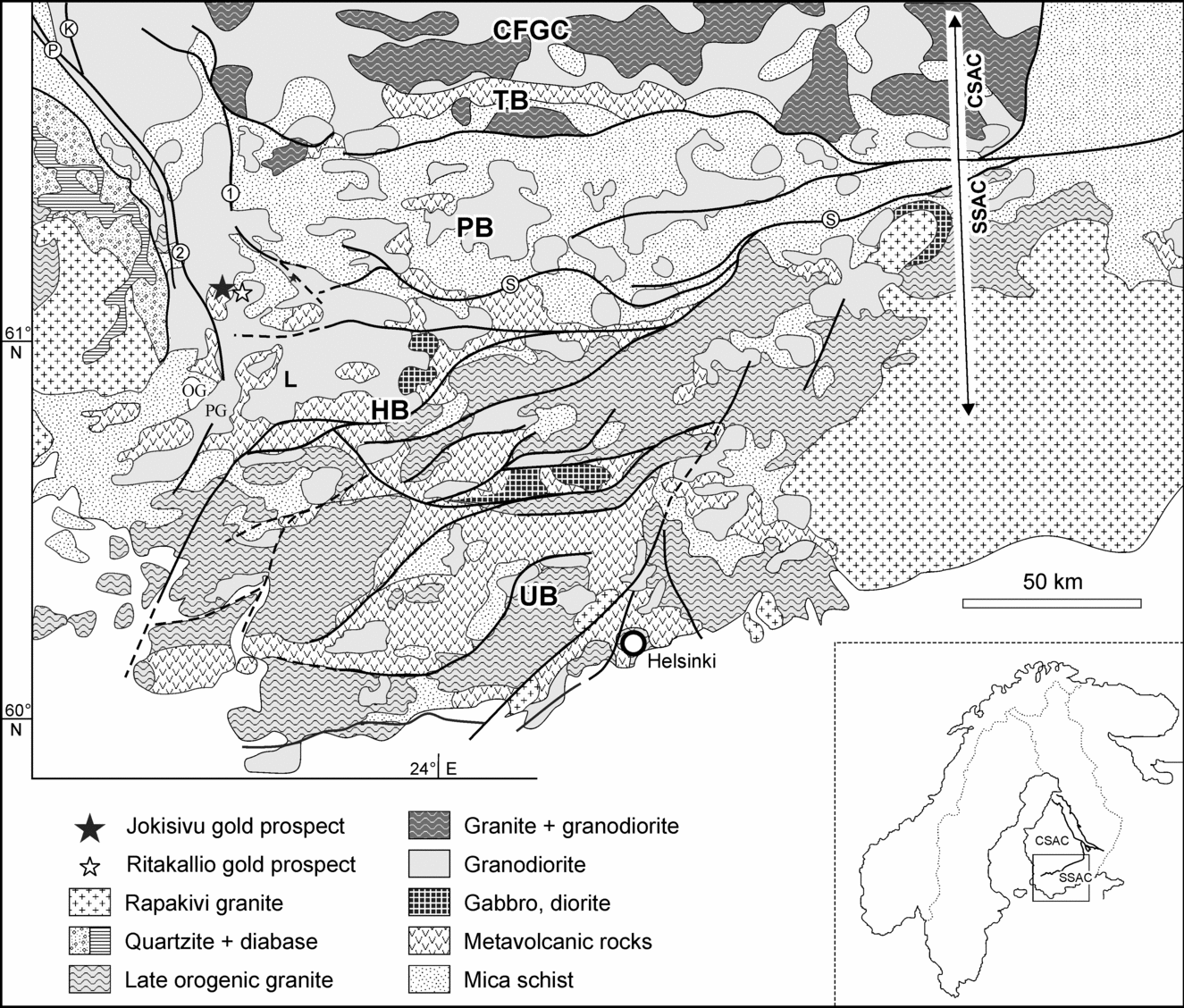
The Jokisivu prospect lies in southern Finland (Fig. 1), in the border zone between the Pirkanmaa belt and the Häme belt. These belts are considered to belong to two crustal blocks that were amalgamated during the Svecofennian orogeny (e.g. Lahtinen, Korja & Nironen, Reference Lahtinen, Korja, Nironen, Lehtinen, Nurmi and Rämö2005). The deposit has been classified as orogenic (Eilu, Reference Eilu2007), and is under feasibility study and test mining by Polar Mining Oy/Dragon Mining NL. The gold is hosted by a quartz diorite to gabbro (referred to as quartz diorite in the following text). Mineralization is controlled by shear zones which cut the quartz diorite.
Geological map of southern Finland (after Korsman et al. Reference Korsman, Koistinen, Kohonen, Wennerström, Ekdahl, Honkamo, Idman and Pekkala1997, modified and supplemented) with location of the Jokisivu prospect. CFGC – Central Finland granitoid complex; TB – Tampere schist belt; PB – Pirkanmaa belt; HB – Häme schist belt; UB – Uusimaa belt; L – Loimaa area; PG – Pöytyä granodiorite; OG – Oripää granite; numbered sheared zones: 1– Kankaanpää shear zone; 2 – Pori/Kynsikangas shear zone: P – continuation of the Pori shear zone; K – continuation of the Kynsikangas shear zone; S – suture proposed by Lahtinen (Reference Lahtinen1994); SSAC – Southern Svecofennian Arc Complex; CSAC – Central Svecofennian Arc Complex.
Structural observations, data collection and sampling for this study have been carried out mainly in two opened trenches and a small test pit in the prospect area. The major aim of this study is to date the mineralization event and to link it with the structural and tectonic evolution of this area.
1.a. Geological setting
The Svecofennian Orogen in southern Finland has been divided into (1) a primitive arc complex west of the archaean Karelian craton, (2) the Central Svecofennian Arc Complex, and (3) the Southern Svecofennian Arc Complex (Korsman et al. Reference Korsman, Koistinen, Kohonen, Wennerström, Ekdahl, Honkamo, Idman and Pekkala1997) (Fig. 1).
The Central Svecofennian Arc Complex contains the Central Finland Granitoid Complex, the volcano-sedimentary Tampere schist belt, the Pohjanmaa belt and the Pirkanmaa belt consisting mainly of migmatitic turbidites.
The Southern Svecofennian Arc Complex containing the Häme and Uusimaa belts is characterized by a strong overprint by late Svecofennian orogenic events between 1.84 and 1.79 Ga. The Häme belt consists of c. 1.89–1.88 Ga calc-alkaline arc-type volcanic rocks intercalated with minor metasedimentary units (Hakkarainen, Reference Hakkarainen, Nironen and Kähkönen1994; Kähkönen, Lahtinen & Nironen, Reference Kähkönen, Lahtinen, Nironen and Pajunen1994). The Uusima belt comprises remnants of 1.91–1.88 Ga island-arc-related magmatic and metaedimentary rocks (Huhma, Reference Huhma1986; Patchett & Kouvo, Reference Patchett and Kouvo1986; Väisänen, Mänttäri & Hölttä, Reference Väisänen, Mänttäri and Hölttä2002). A characteristic feature is a 100 km, ~W–E-trending high temperature–low pressure amphibolite- to granulite-facies migmatite zone with c. 1.84–1.82 Ga S-type granites (Korsman et al. Reference Korsman, Korja, Pajunen and Virransalo1999). The Southern Svecofennian Arc Complex could be traced to the southwest to Bergslagen in Sweden, containing similar arc-type rocks (Valbracht, Oen & Beunk, Reference Valbracht, Oen and Beunk1994; Allen et al. Reference Allen, Lundström, Ripa, Simeonov and Christofferson1996).
Isotope-geochemical data and zircon geochronology suggest the presence of c. 2.0 Ga evolved thick continental crust under the Central Finland Granitoid Complex (Kähkönen, Huhma & Aro, Reference Kähkönen, Huhma and Aro1989; Nironen & Kähkönen, Reference Nironen and Kähkönen1994; Lahtinen & Huhma, Reference Lahtinen and Huhma1997; Rämö et al. Reference Rämö, Vaasjoki, Mänttäri, Elliott and Nironen2001), called the Keitele microcontinent by Lahtinen, Korja & Nironen (Reference Lahtinen, Korja, Nironen, Lehtinen, Nurmi and Rämö2005). Two billion year old continental crust is inferred to underlie the Häme and Uusimaa belts as well, but is suggested by Lahtinen, Korja & Nironen (Reference Lahtinen, Korja, Nironen, Lehtinen, Nurmi and Rämö2005) to belong to another microcontinent (Bergslagen microcontinent). The suture zone between these two continental blocks is proposed to be located in the southern Pirkanmaa belt (Lahtinen, Reference Lahtinen1994, Reference Lahtinen1996) (Fig. 1).
The (post-1.92 Ga) tectono-metamorphic history of the southern Svecofennian domain can be divided into two major cycles, each comprising a HT metamorphic event (e.g. Korsman et al. Reference Korsman, Korja, Pajunen and Virransalo1999): an early Svecofennian cycle at c. 1.91–1.86 Ga, and a late Svecofennian cycle at c. 1.84–1.80 Ga, separated by an extensional episode between c. 1.86 and 1.84 Ga.
2. Geology of the Jokisivu area
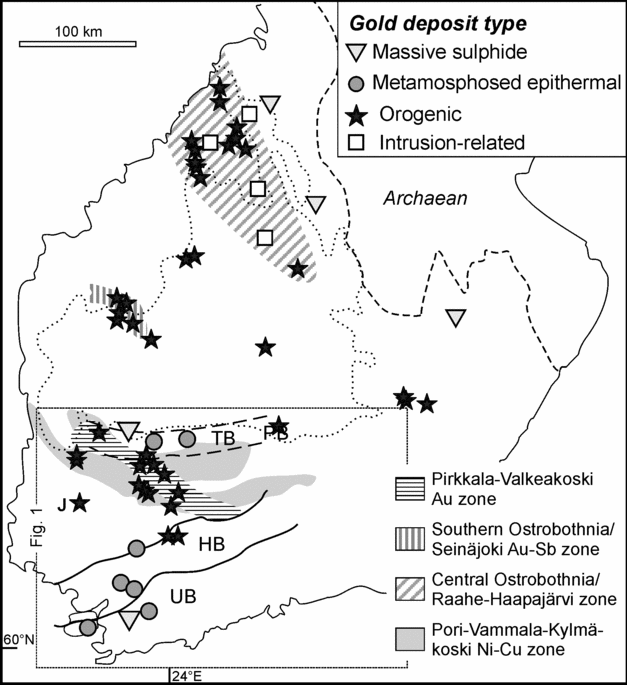
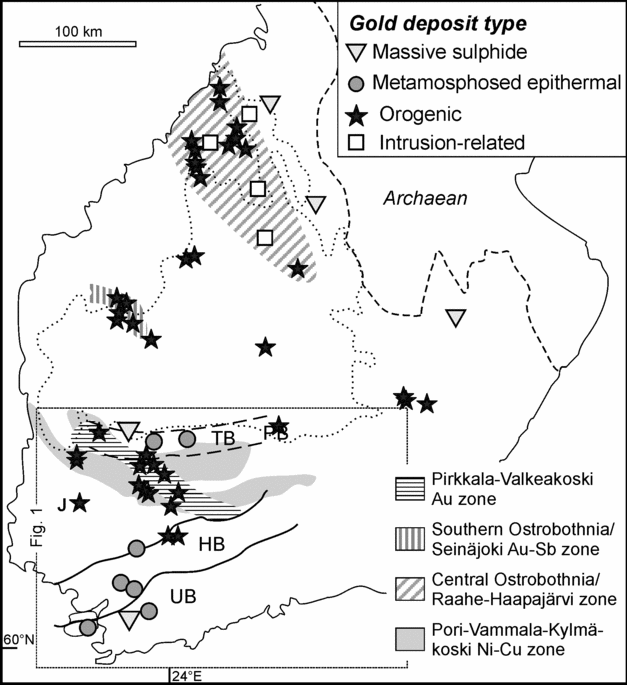
The Jokisivu prospect lies at 61.11739N, 22.62019E in the border zone between the southwestern Pirkanmaa belt and the Häme belt (Fig. 1). The distinction between these units, and their boundary, is not well defined, however, it is important since it marks the supposed suture zone between the Central Svecofennian and Southern Svecofennian Arc complexes. The geology of the region is characterized by a complex interplay of several generations of interfering folds and shear zones, and it may include several thrust sheets. Although the location of the boundary between the Häme and Pirkanmaa belts is far from resolved, the Jokisivu prospect is usually regarded as being part of the Pirkanmaa belt (Eilu, Reference Eilu2007; Saltikoff, Puustinen & Tontti, Reference Saltikoff, Puustinen and Tontti2006). This region is recognized for its Ni–Cu potential (Puustinen, Saltikoff & Tontti, Reference Puustinen, Saltikoff and Tontti1995) (Fig. 2). The Pirkkala–Valkeakoski Au zone of Saltikoff, Puustinen & Tontti (Reference Saltikoff, Puustinen and Tontti2006) (Fig. 2) overlaps with the Ni–Cu zone and comprises several minor gold mineralizations. The Jokisivu prospect and other small occurrences are located south of this zone, and Saltikoff, Puustinen & Tontti (Reference Saltikoff, Puustinen and Tontti2006) speculate whether they may form a separate province.
Gold occurrences and mineralization styles in southern Finland (source: Saltikoff, Puustinen & Tontti, Reference Saltikoff, Puustinen and Tontti2006; Eilu, Reference Eilu2007). TB – Tampere schist belt; PB – Pirkanmaa belt; HB – Häme schist belt; UB – Uusimaa belt. J – Jokisivu prospect. Box outlines – map area in Figure 1.
2.a. Lithological units
The bedrock of the Jokisivu area is composed of granodioritic to tonalitic gneisses, mica gneisses and minor mafic to intermediate volcanic rocks. The mica gneisses are migmatitic with tonalitic to trondhjemitic leucosomes and quartzo-feldspatic veins and pods. Some leucosome patches are granitic in composition and apparently represent later intrusions.
The mica gneisses are intercalated with metavolcanites and granodioritic and tonalitic gneisses. The supracrustal units are intruded by gabbroic to quartz-dioritic rocks.
Plutonic to subvolcanic gabbroic to quartz dioritic rocks intruding nearly concordantly into the pre-existing mica gneiss succession occur in the Pirkanmaa belt (Matisto, Reference Matisto1978; Kilpeläinen, Reference Kilpeläinen1998; Rutland, Williams & Korsman, Reference Rutland, Williams and Korsman2004) and in the Loimaa area (Häme belt) (Nironen, Reference Nironen1999). The Jokisivu gold deposit is hosted by such an intrusion that hosts two ore zones (see Section 2.c). Large parts of the medium-grained rock look homogeneous; however, both grain size and hornblende content may locally vary over short distances, leading to a patchy appearance of the rock. Locally it also displays a layered fabric. The quartz diorite contains elongated mafic enclaves and displays a strong alignment of hornblende and plagioclase.
Granites occur to the southwest of the study area. Some are medium-grained but the majority are pegmatitic and they contain gneissic and metavolcanic xenoliths of the country rocks (Luukkonen, Reference Luukkonen1994).
Numerous pegmatite dykes truncate the succession; they occur also in the Jokisivu deposit (see Section 2.b.4). It is not clear whether at least some of these pegmatitic dykes may belong to the granites or if they form a distinct event.
2.b. Structural evolution
Geological and aeromagnetic maps (Fig. 3) illustrate a complex geometry resulting from polyphase deformation. The Jokisivu prospect is located in an area with interference of three stages of folding (F3, F4, F5), followed by later shearing. This multiple-stage history with overprinting folds, foliations and lineations often make it impossible to assess the foliation–lineation relationships with certainty in this region. An overview of the structural evolution and correlation with the Loimaa area (Häme belt) and Pirkanmaa belt is presented in Figure 4.
(a) Aeromagnetic map of the Jokisivu area illustrating different fold generations and major shear zones. The Jokisivu prospect is located in the outer hinge of a NE–SW-trending F4 fold. In this area, F4 fold axes curve from a SW–NE trend to a NW–SE trend caused by open F5 and drag along major NW–SE-trending shear zones. 1 – Kankaanpää shear zone; 2 – Pori/Kynsikangas shear zone; 3 – Pomarkku block. Box outlines the area in (b). (b) Geological map of the Jokisivu area (after Matisto, Reference Matisto1978). Location of the Jokisivu deposit as well as the Ritakallio prospect showing comparable structures and mineralization.

Correlation of the structural evolution in the Jokisivu area with the Loimaa area (Häme belt; Nironen, Reference Nironen1999) and the Pirkanmaa belt (Kilpeläinen, Reference Kilpeläinen1998). An estimation of the age of deformation is given based on structural correlation, the obtained analyses and data from the literature.

The compositional layering within the mica gneisses in the Jokisivu area represents a composite foliation that transposed earlier layering or banding. In a few cases, intimate small-scale isoclinal folding may be recognized. In similar supracrustal rocks of the Loima area, an older internal foliation S1 is preserved in porphyroblasts surrounded by the external foliation S2 (Nironen, Reference Nironen1999). Thus, for comparison, the compositional layering in the Jokisivu area is also labelled S1–2.
2.b.1. D3
Prominent structures on the maps are regional-scale tight to isoclinal folds with subvertical axial planes that formed during D3. Emplacement of the quartz diorite hosting the gold mineralization at Jokisivu occurred either prior to, or in the early stages of, F3 folding. Because of the tight to isoclinal F3 fold shape, S3 and the F3 axial planes are nearly parallel to S1–2 in the mica schists. The original F3 trend was probably approximately WSW–ENE to E–W. In the Jokisivu area, F3 fold axial planes strike NW–SE because of later deformation (Figs 3, 4). Migmatitic leucosome veins in the mica gneisses cutting the layering S1–2 at a low angle have been folded together with the layering. Leucosome veins also occur parallel to F3 fold axial planes and in the fold hinge zones. The observed migmatitic structures correspond well to D3 features in migmatitic mica schists of the Loima area south of the study area described by Nironen (Reference Nironen1999), supporting the interpretation of syn-D3 migmatization.
2.b.2. D4, D5
Tight F4 folds with sub-horizontal fold axes and steep to sub-vertical fold axial planes cause F3/F4 regional dome and basin interference patterns (Fig. 3). On outcrop-scale, F4 is represented by crenulation and chevron-like folds that are second or third order folds to the map-scale F4 structures. S4 is a crenulation cleavage. The Jokisivu deposit is located in the outer hinge zone of a NE–SW-trending regional-scale F4 fold that refolds earlier F3 folds (Fig. 3). In the Jokisivu prospect the crenulation lineation L4 and F4 fold axes plunge to the NE. Further northwest and south, the F4 axial plane trend changes to NNW–SSE directions. This curvature is caused by F5 open folding (Figs 3, 4), as well as by drag along major NW–SE-trending, late tectonic shear zones (D6, see next Section).
2.b.3. D6 shearing
Major NW–SE (mainly NE-dipping)- and ~E–W-trending shear and fault zones (D6) cut the dome and basin fold structures (Figs 1, 3).
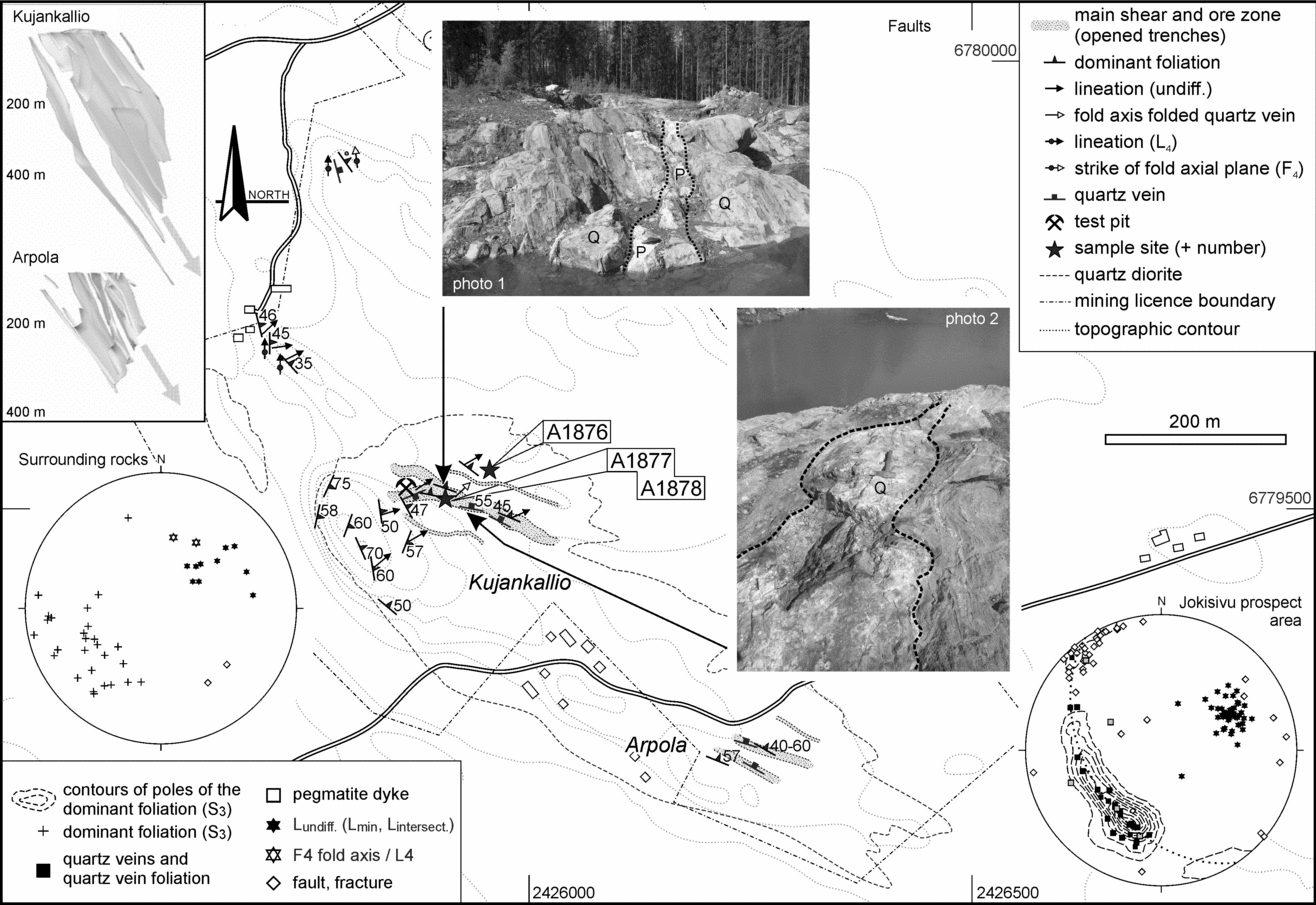
NW–SE to WNW–ESE-trending shear zones cutting the quartz diorite in the Jokisivu prospect (Fig. 5) play a major role in gold mineralization. The shear zone in the Kujankallio ore zone splays into NW–SE- and WSW–ENE-trending branches, which form a conjugate set or two synthetic splays of anastomosing shear zones. The shear zones were the site of fluid flow and quartz vein emplacement associated with precious metal deposition. Quartz veins have been formed in several stages, and vein thickness varies from a few centimetres to about 1 m. The two major shear zones (main ore zones in Fig. 5) show a strong alteration around decimetre- to metre-thick auriferous quartz veins and are accompanied by additional parallel, narrower shear and alteration zones. The shear zones are characterized by a well-developed 45–60° NE- to NNE-dipping planar S-fabric. In addition to a mineral lineation (L3 or L4) and a NE-plunging crenulation lineation (probably L4), both also occurring in the unaltered host rock, the shear zone also displays a locally developed rodding lineation of stretched quartz, and an intersection lineation that is related to the intersection of the shear foliation and fractures with earlier foliation planes. These shear zone structures overprint the earlier D3 and D4 structures, indicating that the quartz vein emplacement and gold deposition post-date D4. Luukkonen (Reference Luukkonen1994), in contrast, suggests that the shear zones, and thus the ore zone, have been folded by F2 (= F4 in this paper). However, the overprinting relationships clearly point to a post-D4 development. On the other hand, it is possible that D6 shearing associated with gold mineralization partly reactivated a pre-existing D3 shear zone.
Map of the Jokisivu prospect area, including structural data and sample sites for dating (outline of the quartz diorite and the mining licence boundary is based on Dragon Mining NL, 2005). Photo 1: View towards the west to the sample site for the altered quartz diorite and the pegmatite dyke (A1877, A1878). The pegmatite (P) cuts the auriferous quartz veins (Q) and the dominant foliation (left = S); mine test pit in the back. Photo 2: Pinching and swelling gold mineralized quartz vein in the Kujankallio ore zone (length of hammer = ~64 cm, left = N). The inlet illustrates the Kujankallio and Arpola ore bodies comprising stacked NE- to NNE-dipping vein sets. Map coordinates: Finnish Grid (KKJ). Stereoplots: equal area lower hemisphere projection.

Macroscopically well-developed shear sense indicators and a clear asymmetry of the fabrics are lacking, so that the kinematics of the D6 shear zone cannot be inferred with certainty; however, the fabric suggests a strong co-axial flattening component. It cannot be excluded that the shear zone may be dilational rather than contractional.
D6 shearing started at elevated temperatures with ductile deformation of the quartz dioritic host rock. Elongated, coarse-grained to pegmatititc quartzo-feldpatic dykes and patches intruded into the main shear zone and are locally boudinaged or folded. They represent early fluid batches of the hydrothermal fluid flow into the shear zone. The quartz veins were emplaced shortly after the quartz-feldspar dykes. With increasing distance from the main shear and ore zone, thickness, density and number of shear zones and quartz veins decrease. Alteration zones become more ‘diffuse’ and comprise spaced thin quartz veins accompanied by narrow anastomosing shear bands, of which some surround and locally cut the thick quartz veins of the main ore zone. They probably formed in the waning stages of shear deformation with progressive concentration of shearing in narrow zones. These relationships suggest a prolonged shearing and mineralization event.
The D6 shear zones may be linked with (W)SW–(E)NE-trending dextral shear zones in the Häme and Uusimaa belts formed during late Svecofennian dextral transpression (Ehlers, Lindroos & Selonen, Reference Ehlers, Lindroos and Selonen1993; Nironen, Reference Nironen1999; Väisänen & Hölttä, Reference Väisänen and Hölttä1999; Levin et al. Reference Levin, Engström, Lindroos, Baltybaev and Levchenkov2005; Saalmann, Reference Saalmann2007; Väisänen & Skyttä, Reference Skyttä2007; Pajunen et al. Reference Pajunen, Airo, Elminen, Mänttäri, Niemelä, Vaarma, Wasenius and Wennerström2008; Torvela, Mänttäri & Hermansson, Reference Torvela, Mänttäri and Hermansson2008). NW–SE-trending shear zones west of the Pirkanmaa belt (Kynsikangas and Kankaanpää shear zones; Figs 1, 3) were also active at this time. The shear zones in the Jokisivu prospect probably branch from second or third order structures parallel to the major NW–SE structures.
2.b.4. Late-D6 pegmatite dykes and quartz veins
A number of pegmatitic dykes partly follow the general strike of the ore zone. To the northwest, they leave the ore zone and clearly cut the dominant foliation of the quartz diorite. The dyke thickness ranges from a few centimetres to several decimetres. Different generations of dykes can be distinguished. Some dykes and patches pre-date the auriferous quartz veins since they are cut by them; the temperature during their emplacement was high. Other dykes show a narrow margin of biotite at the contact to the wall rock; some contain garnet. Some dykes show a shape-preferred orientation of biotite and of the long axes of large feldspar crystals forming a flaser-like foliation. Many dykes run at least partly sub-parallel to the NE-dipping shear zone foliation and it is likely that they were emplaced during the waning stages of shearing or shortly after deformation ceased. A slightly younger pegmatite dyke can be followed tens of metres along strike in the Kujankallio ore zone (Fig. 5, photo 1); however, it cuts the shear zone foliation as well as the auriferous quartz veins and thus post-dates quartz vein intrusion and the main gold mineralization stage. Its intrusion likely followed shortly after the quartz vein emplacement. This is supported by chemical analyses (Luukkonen, Reference Luukkonen1994) showing gold in the dyke, although the concentration is very low, and by the obtained age data (see Section 4). The dyke shows no signs of metamorphism or strong deformation, and quartz and feldspar crystals grew at right angles to the dyke walls. These features suggest that the intrusion of the pegmatite dykes occurred in a time span with decreasing temperature and shear strain.
Finally, the moderately NNE-dipping shear zone foliation and gold-bearing quartz veins locally show slickensides with 35–50° ENE-plunging slickenlines, which, together with steps on the slickenside surface, indicate a top-to-the-WSW directed transport.
2.b.5. Post-D6 deformation
Subsequent deformation is characterized by faulting and fracturing during further decrease in temperature. Narrow SW–NE-trending sub-vertical to mostly steeply SE-dipping, unmineralized quartz veins cut the gold-bearing quartz veins and the pegmatites. They are associated with brittle faults showing dextral strike-slip movements, with some of them also having a slight normal dip-slip component. Different fault sets and the reactivation of pre-existing faults indicate several faulting episodes formed in different stress fields (Fig. 4). Unequivocal cross-cutting relationships of fault sets have not been found; their development requires a more detailed analysis.
2.c. Mineralization
The prospect comprises two ore zones, Kujankallio and Arpola, about 300 m apart. Gold occurs in quartz veins emplaced in shear zones (D6) cutting the quartz diorite. Shearing was accompanied by fluid flow, and pinching-and-swelling and boudinaged quartz veins (Fig. 5, photo 2) imply that their emplacement occurred during progressive shearing.
Drilling and resource estimation showed that the Kujankallio and Arpola ore zones comprise a number of 50–60° NE- to NNE-dipping separate vein systems, which are stacked in a sub-parallel array (Grönholm, Reference Grönholm2006). The Ag content is low; the relative abundance of Au and Ag is on average 97% Au, 3% Ag (Luukkonen, Grönholm & Hannila, Reference Luukkonen, Grönholm and Hannila1992).
Gold mineralization occurs in quartz veins a few centimetres to a metre thick and surrounding mineralized alteration zones of a few decimetres to several metres width (Fig. 5, photo 1). The Arpola and Kujankallio vein sets have been drilled to the 350 m and 200 m level, respectively, and the latter has been estimated to extend to at least 500 m (Dragon Mining Ltd, 2007). The current in situ resource estimate is 1,473,000 tonnes of ore at an average grade of 6.8 g gold per tonne (Haga, Reference Haga2005). The alteration is strongest in the main shear and ore zones (Fig. 5) displaying greenish–brownish to rusty colours. Alteration is characterized mainly by silicification and biotitization; skarn reactions have also been reported (Luukkonen, Reference Luukkonen1994; Grönholm, Reference Grönholm2006). Sulphide minerals are common in the shear zone. To a much lesser extent, sericitization and chloritization can be observed. Garnet is quite common in the altered quartz diorite and close to mafic dykes within the alteration zone as well as in pegmatite dykes.
Typical ore minerals are gold, pyrrhotite, arsenopyrite, loellingite (mostly as inclusions in arsenopyrite), pyrite (mostly secondary after pyrrhotite), scheelite, Bi-tellurides and minor chalcopyrite and antimony minerals, as well as rare galena and sphalerite (Luukkonen, Grönholm & Hannila, Reference Luukkonen, Grönholm and Hannila1992; Luukkonen, Reference Luukkonen1994; Grönholm, Reference Grönholm2006). Pyrrhotite is the most common ore mineral, which also has been remobilized during later stages; arsenopyrite is very common as well, and several generations of this mineral have been reported by Luukkonen (Reference Luukkonen1994). Gold occurs mainly as free grains (Luukkonen, Reference Luukkonen1994; Grönholm, Reference Grönholm2006), often intergrown with tellurides as well as maldonite and aurostibite, sometimes it occurs as inclusion in scheelite, and it is also related to arsenopyrite and pyrrhotite (Luukkonen, Reference Luukkonen1994). Luukkonen (Reference Luukkonen1994) reconstructed a series of mineral assemblages at Jokisivu, starting with crystallization of oxide minerals (like magnetite, ilmenite, and scheelite) at T>400°C, followed by two subsequent stages of sulphide deposition beginning with arsenopyrite, loellingite and pyrrhotite at temperatures between 300 and 400°C, including first gold, and finally the precious metal mineralization at 200–300°C.
3. Samples and dating methods
In order to bracket the age of the gold mineralization, samples have been taken that (1) pre-date mineralization (unmineralized host rock, sample A1876), (2) are overprinted by the mineralizing hydrothermal event (altered quartz diorite truncated by gold-bearing quartz veins, sample A1877), and (3) post-date the auriferous quartz veins (cross-cutting pegmatite dyke, sample A1878).
3.a. Sample A1876 Kujankallio-1
A sample of the unaltered quartz dioritic host rock outside the ore zone has been taken in Kujankallio. The sample is not truncated by quartz veins and shows no macroscopically visible extensive alteration.
The sample yielded a large amount of zircon grains forming a heterogeneous population. In the density fraction 3.6–4.0 gcm−3 a heterogeneous group of zircon grains comprises large, stubby and turbid, and long, thin and transparent grains, as well as some rounded grains and crystals. The 4.0–4.2 density fraction consists mostly of euhedral, long, mostly transparent, pale zircon grains, but in addition contains grains with different morphologies.
3.b. Sample A1877 Kujankallio-2
Sample A1877 is from the granitic pegmatite dyke that partly follows the ore zone in Kujankallio and cuts the auriferous quartz veins, and therefore post-dates the main gold mineralization stage; it shows reliable cross-cutting relationships necessary for data interpretation.
The zircon grains are long, euhedral and translucent to turbid. In the heaviest fraction (ρ>4.3 gcm−3), some Au and a few various zircon types were found. In addition, turbid to translucent monazite grains have been separated for TIMS U–Pb analysis.
3.c. Sample A1878 Kujankallio-3
The strongly altered quartz diorite sample has been taken from the inner ore zone in Kujankallio surrounding the auriferous quartz vein. The sample yielded zircon with needle-like to almost equidimensional grain shapes. The most common grain types are colourless, transparent to translucent and turbid, brownish elongated prismatic grains. The sample also contains translucent titanite suitable for U–Pb dating.
3.d. Analytical methods
Zircons and titanite were dated with an ion microprobe using the SIMS (secondary ion mass spectrometry) technique. In addition, monazite was analysed with the TIMS (thermal ionization mass spectrometry) method.
Zircon for U–Pb work was selected by hand-picking after heavy liquid and magnetic separation. The selected zircons were mounted in epoxy, polished, and coated with gold. The ion microprobe (SIMS) analyses were made using a Cameca IMS 1270, a Nordic facility at the Swedish Museum of Natural History, Stockholm, Sweden. The spot-diameter for the 5–7 nA primary O2− ion beam was ~20 μm, and oxygen flooding in the sample chamber was used to increase the production of Pb+ ions. Three counting blocks, each including four cycles of the Zr, Pb, Th and U species of interest, were measured from each spot. The mass resolution (M/ΔM) was 5400 (10%). The raw data were calibrated against a zircon standard (91500; Wiedenbeck et al. Reference Wiedenbeck, Allé, Corfu, Griffin, Meier, Oberli, von Quadt, Roddick and Spiegeln1995) and corrected for modern common lead (T=0; Stacey & Kramers, Reference Stacey and Kramers1975). For the detailed analytical procedure, see Whitehouse, Kamber & Moorbath (Reference Whitehouse, Kamber and Moorbath1999) and Whitehouse & Kamber (Reference Whitehouse and Kamber2005).
For titanite SIMS analysis, two counting blocks, each including five cycles, were measured and no oxygen flooding into the sample chamber was used. Titanite analyses used a similar routine to that used for zircon (omitting 208Pb and ThO from the peak sequence); the CaTi2O4 peaks were used as a matrix reference at mass 200 and as a reference mass for 204Pb. Pb/U ratios were calibrated relative to a titanite from the Kahn mine, Namibia (from the collections at the Swedish Museum of Natural History), which has an age of 518 Ma (MJW, unpub. data; Kinny et al. Reference Kinny, McNaughton, Fanning and Maas1994 report an ID-TIMS concordant U–Pb age of 518±2 Ma). The raw data were corrected for modern common lead (T=0; Stacey & Kramers, Reference Stacey and Kramers1975).
For multigrain ID-TIMS (isotopic dilution-thermal ionization mass spectrometry) U–Pb age determinations, the decomposition of monazite and titanite and extraction of U and Pb mainly followed the procedure described by Krogh (Reference Krogh1973, Reference Krogh1982). 235U–206Pb (monazite) or 235U–208Pb (titanite) spiked and unspiked isotopic ratios were measured using a VG Sector 54 thermal ionization multicollector mass spectrometer. Based on repeated SRM981 standard runs, the measured lead isotopic ratios were normalized using fractionation correction of 0.10±0.05% per a.m.u. Pb/U ratios were calculated using the PbDat-program (Ludwig, Reference Ludwig1991). Plotting of the U–Pb isotope data, fitting of the discordia lines and calculation of the intercept and/or concordia ages were done using the program Isoplot/Ex (Ludwig, Reference Ludwig2003). Age errors are calculated at 2σ with ignored decay constant errors. Data-point error ellipses in figures are 2σ. All TIMS U–Pb analyses were done at GTK, Espoo.
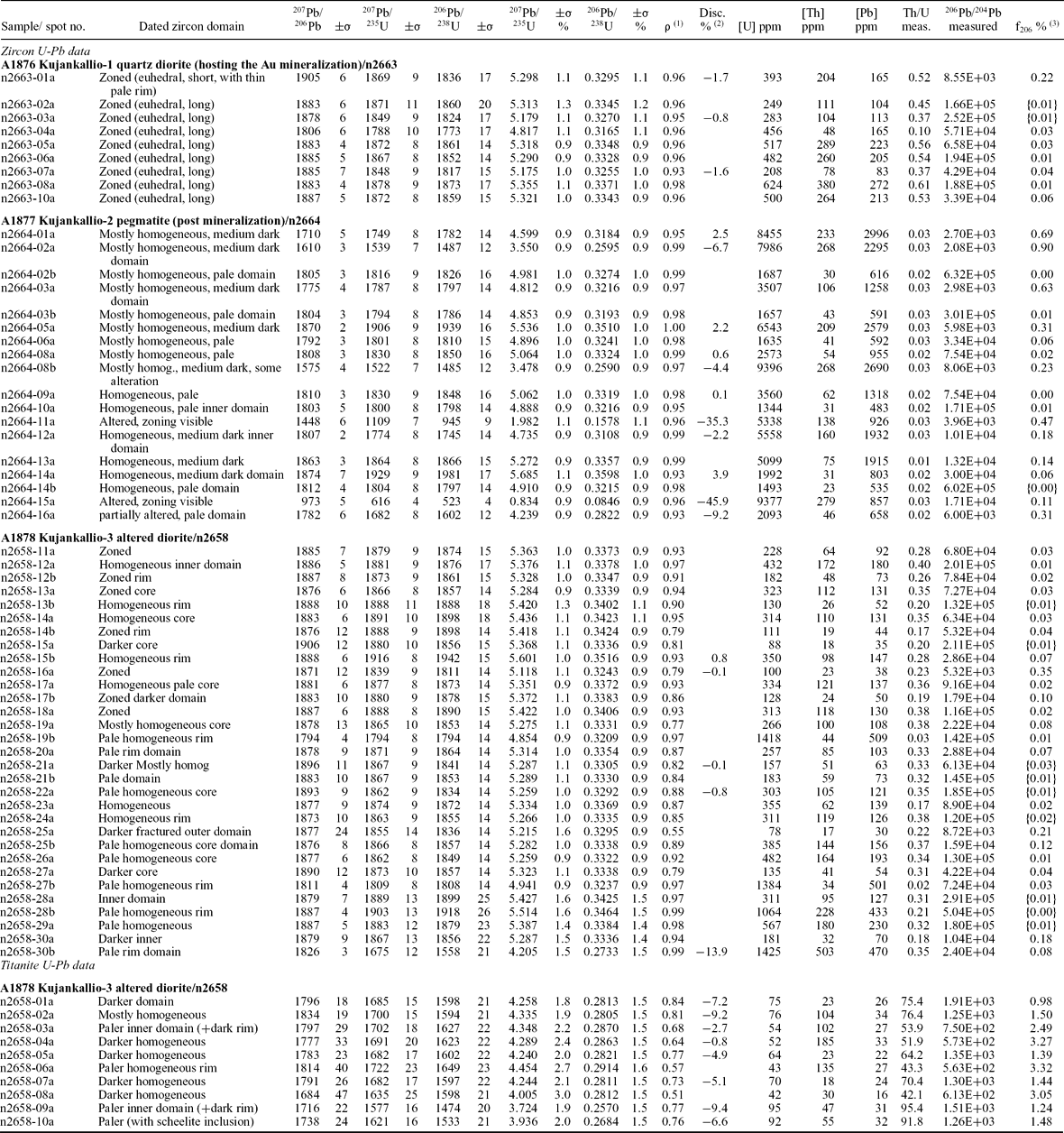
Analytical results are shown in Tables 1 and 2.
Zircon and titanite SIMS U–Pb isotopic data for Kujankallio rock samples related to gold mineralization

All errors are at 1σ level.
(1) Error correlation in conventional concordia space.
(2) Age discordance at closest approach of error ellipse to concordia (2σ level).
(3) Percentage of common 206Pb in measured 206Pb, calculated from the 204Pb signal assuming a present-day Stacey & Kramers (Reference Stacey and Kramers1975) model terrestrial Pb-isotope composition. Figures in brackets are given when no correction has been applied.
Multigrain TIMS monazite U–Pb isotopic data

(1) Isotopic ratios corrected for fractionation, blank (30 pg), and age related common lead (Stacey & Kramers, Reference Stacey and Kramers1975; 206Pb/204Pb ± 0.2, 207Pb/204Pb ± 0.1, 208Pb/204Pb ± 0.2).
(2) Rho: Error correlation between 206Pb/238U and 207Pb/235U ratios. All errors are 2σ.
4. Analytical results
4.a. Sample A1876 Kujankallio-1
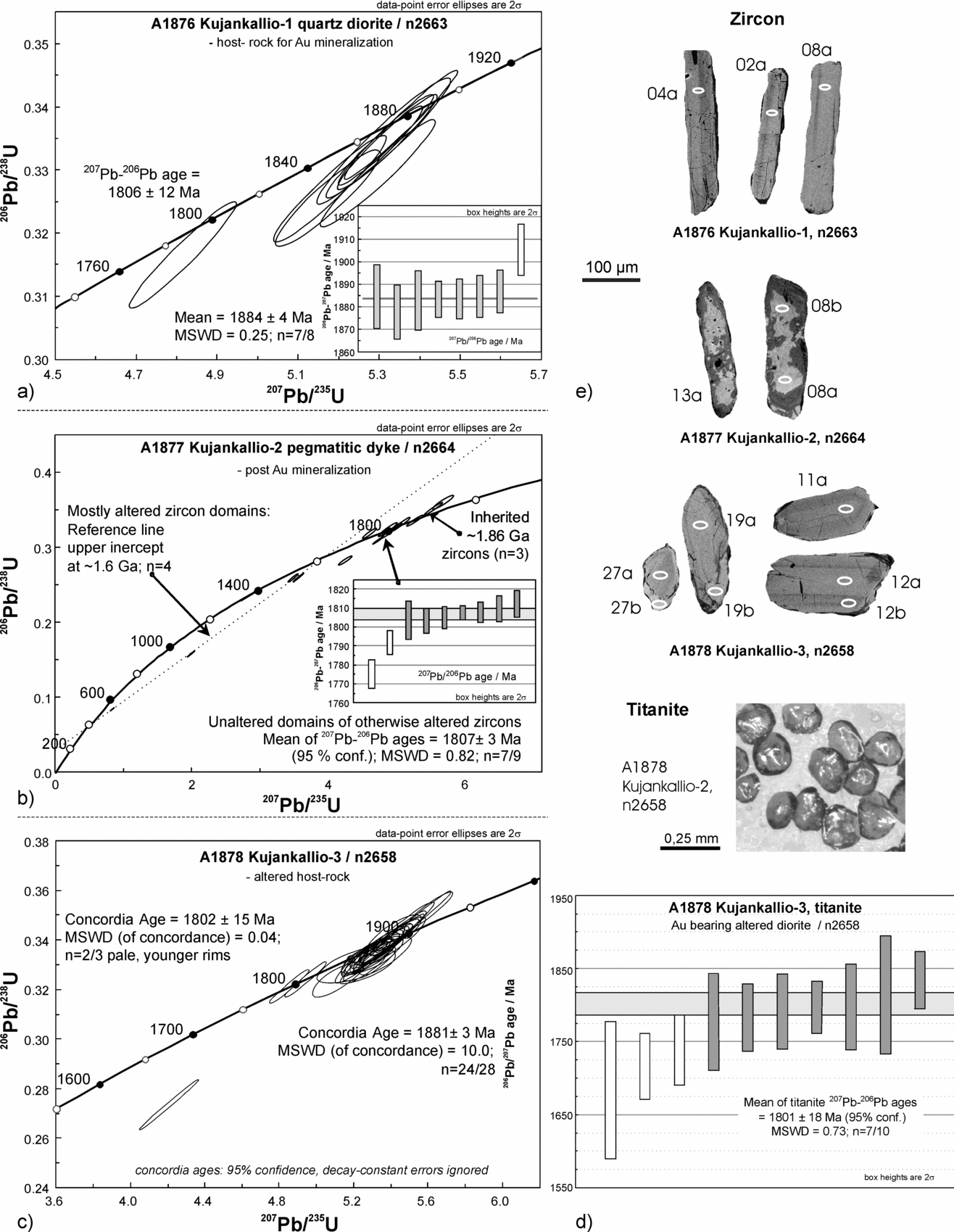
From sample A1876 Kujankallio-1 (unaltered quartz dioritic rock), a total of ten zircon domains were dated. The analyses were mostly done on typical euhedral, long prismatic zircons showing weak longitudinal zoning in BSE images. Eight analyses are nearly concordant or slightly discordant analyses and plot in a cluster. Seven of these (Fig. 6) determine a Pb–Pb mean age of 1884±4 Ma for the Kujankallio sample. Only a single zircon grain could be analysed, which yields a 207Pb–206Pb age of 1806±12 Ma.
(a) Concordia plot of zircon SIMS U–Pb isotopic data, A1876 Kujankallio-1 unaltered volcanic rock hosting the Au mineralization. Inset shows the distribution and the mean of 207Pb–206Pb ages. (b) Concordia plot of zircon SIMS U–Pb isotopic data, A1877 Kujankallio-2 pegmatitic dyke. Inset shows the distribution and the mean of 207Pb–206Pb ages from the pegmatitic zircons. (c) Concordia plot of zircon SIMS U–Pb isotopic data, A1878 Kujankallio-3 altered quartz diorite. (d) Diagram showing titanite 207Pb–206Pb ages and the corresponding mean age, altered host-rock sample A1878. (a–c) zircon ages, (d) titanite age; (e) BSE images of selected zircons and photo of titanite grains.

4.b. Sample A1877 Kujankallio-2
From the pegmatite dyke a total of 20 zircon domains were dated from typical long prismatic and coarse-grained pegmatitic zircons. In BSE images the zircon grains show that they are metamict with varying degrees of dark alteration with minor paler domains. Despite the alteration, the initial magmatic zoning is still visible in some grains. The spot U–Pb analyses were mostly done on pale, less altered zircon domains, but dark altered domains were also dated for reference. All the analyses show low Th/U (~0.02–0.03).
On the concordia diagram (Fig. 6), three separate age groups can be distinguished. Zircons c. 1.86 Ga old are interpreted to be inherited. Nine concordant or slightly discordant analyses plot in a cluster with an age of approximately 1.8 Ga (Fig. 6). Four U–Pb analyses from altered or less altered domains plot on the c. 1.6 Ga reference line, which indicates that the rocks in this area have been affected by younger rapakivi intrusion and related processes of that age.
Translucent monazite grains have been chosen for conventional TIMS U–Pb analysis to get further age constraints (Table 2). The result of 1792±3 Ma is comparable with the zircon data and gives the minimum or approximate crystallization age of the pegmatite.
4.c. Sample A1878 Kujankallio-3
A total of 31 zircon domains (rim and core domains) were dated from the altered quartz diorite sample taken from the gold-bearing shear zone. Most of the analyses are either concordant or only slightly discordant and the common lead proportions are low. Analyses from zoned, elongated zircons and those from core domains, as well as most of the rim analyses, plot in a cluster in the concordia diagram (Fig. 6). The concordia age of 1881±3 Ma is determined by 24 of 28 analyses, and this age coincides with the 1884±4 Ma age determined for unaltered host-rock sample A1876 Kujankallio-1.
From paler and structurally homogeneous rim domains (BSE images, Fig. 6), a concordia age of 1802±15 Ma can be calculated for two low Th/U concordant analyses.
Ten SIMS U–Pb analyses were performed on titanites from the alteration zone. Most of the data are discordant, and therefore a reasonable U–Pb age could not be calculated. However, a 207Pb–206Pb mean minimum age estimate of 1801±18 Ma for the mineralization-related alteration could be calculated for the titanite using seven 207Pb–206Pb ages (Fig. 6). Despite the large error, this age corresponds well with (1) the ages obtained from zircon rims from the same sample, (2) the age of the pegmatitic dyke (A1877 Kujankallio-2) post-dating the main mineralization stage, but having been emplaced in the late stages of the event, and (3) the younger age group observed in the unaltered quartz diorite host rock (A1876).
5. Discussion
5.a. U–Pb data summary and interpretation
The 1884±4 Ma and 1881±3 Ma zircon ages of the unaltered and altered quartz diorite, respectively, give a well-defined crystallization and intrusion age of the host rock. It defines the maximum age of gold mineralization in the Jokisivu prospect.
The 1802±15 Ma age that has been detected from low Th/U rim domains of zircons from the altered quartz diorite age is similar to the 1807±3 Ma age of the pegmatite, interpreted to determine the age of its emplacement, as well as the c. 1.80 Ga mean of 207Pb–206Pb titanite ages obtained from the altered quartz diorite wall rock. The closure temperature for diffusion in titanite is poorly known; estimates range from about 500°C for resetting during metamorphism (Gascoyne, Reference Gascoyne1986) to >650°C (Scott & St-Onge, Reference Scott and St-Onge1995; Schärer, Zhang & Tapponnier, Reference Schärer, Zhang and Tapponnier1994; Essex et al. Reference Essex, Gromet, Andreasson and Albrecht1997) or 700°C (Verts, Chamberlain & Frost, Reference Verts, Chamberlain and Frost1996) and even >700°C (Pidgeon, Bosch & Bruguier, Reference Pidgeon, Bosch and Bruguier1996). Frost, Chamberlain & Schumacher (Reference Frost, Chamberlain and Schumacher2000) consider that titanite is reactive during metamorphism, suggesting that titanite U–Pb ages are likely to be reset at low temperatures by growth of new grains, rather than by diffusion. These authors calculate a closure temperature of 660 to >700°C, depending on grain size and cooling rate (10°C/Ma and 100°C/Ma, respectively). In conclusion, titanite U–Pb ages will record crystallization of grains at medium to high temperature and therefore could serve as a geochronometer for hydrothermal and metamorphic processes (Frost, Chamberlain & Schumacher, Reference Frost, Chamberlain and Schumacher2000).
Titanite occurs exclusively in the alteration zone and not in the unaltered host-rock, so it probably dates a metamorphic or a hydrothermal event. The obtained c. 1.80 Ga age could indicate a young metamorphic event or just continued metamorphism after the metamorphic peak. Temperatures started to decrease after D4; however, it is possible that temperatures remained above 650°C before the onset of shear zone formation in the Jokisivu prospect, so that the U–Pb system stayed open for a considerable time span until at c. 1.82–1.78 Ga temperatures dropped below 650–600°C. This would also explain the absence of older metamorphic ages if the temperature did not change considerably for a long time span.
On the other hand, the titanite age may also represent a hydrothermal event that caused growth of new titanite and/or resetting of the titanite U–Pb system of earlier grains, as well as the growth of rims around zircon core domains in the altered quartz diorite. The age is similar to the crystallization age of the pegmatite dyke, supporting the structural interpretation that the pegmatite intrusion occurred during the late stages of mineralization, so that the obtained ages reflect both the magmatic pegmatite event as well as contemporaneous hydrothermal fluid flow through the shear zone. Shearing and mineralization started at high temperatures (see Section 2.b.4). In this scenario, the 1.82–1.79 Ga age obtained from zircon rims and titanite of the altered zone therefore dates the mineralization event. Since gold precipitation took place at temperatures between 200 and 400°C (Luukkonen, Reference Luukkonen1994), the titanite age in Kujankallio serves as an upper age limit for the gold deposition; however, taking into account the age of the cross-cutting pegmatite dyke being emplaced during the late stages of the mineralization, 1.80 Ga should give the minimum age for the Au mineralization.
5.b. The relationship of gold mineralization to the structural evolution
Figure 4 attempts to correlate the structural evolution with (1) the Loimaa area (Nironen, Reference Nironen1999) south of the study area (Häme belt) and (2) the Pirkanmaa belt (Kilpeläinen, Reference Kilpeläinen1998). This correlation is used in the following discussion for further age constraints on the deformation.
Quartz dioritic to gabbroic rocks of 1.88 Ga also occur in the Prikanmaa belt (Kilpeläinen, Reference Kilpeläinen1998; Rutland, Williams & Korsman, Reference Rutland, Williams and Korsman2004). The Hyyvinkää gabbro massifs in the Uusimaa belt likewise show an approximately similar 1.88–1.87 Ga age (Patchett & Kouvo, Reference Patchett and Kouvo1986). Since the quartz diorite at Jokisivu is affected by D3, its 1.88 Ga age also gives a maximum age for the onset of this deformation. D3 was accompanied by HT metamorphism resulting in migmatization. Leucosome veins like those in the mica gneisses in Jokisivu have also been observed in the Loimaa area, where the c. 1.87 Ga old Pöytyä granodiorite (PG in Fig. 1) is considered to have been emplaced during D3 (Nironen, Reference Nironen1999). If this interpretation is correct, the age of D3 and related HT metamorphism in this area is c. 1.87 Ga old and belongs to the early Svecofennian stage. In the Pirkanmaa belt, the age of migmatization has been obtained from c. 1878 Ma (Mouri, Korsman & Huhma, Reference Mouri, Korsman and Huhma1999) and 1880±6 Ma (Rutland, Williams & Korsman, Reference Rutland, Williams and Korsman2004) monazite ages, which overlap with the age of the Pöytyä graniodiorite. Inherited c. 1.86 Ga zircon grains found in sample Kujankallio-2 A1877 may have formed during this D3 event.
The Oripää granite (OG in Fig. 1) is interpreted by Nironen (Reference Nironen1999) to have been emplaced in the late stages of D4. Unfortunately, the granite contains heterogeneous zircon populations, and their age data show large errors (Nironen, Reference Nironen1999; Kurhila et al. Reference Kurhila, Vaasjoki, Mänttäri, Rämö and Nironen2005) so that the age of the granite can only be roughly estimated between 1.86 and 1.80 Ga.
Post-peak metamorphic shearing (D6), quartz vein emplacement and related mineralization in Jokisivu occurred at 1.82–1.78 Ga. The obtained age data and the structural relationships show that gold mineralization can be linked to the late Svecofennian tectonic cycle and support the correlation with approximately WNW–ESE dextral transpression in the Häme and Uusimaa belts. In the Uusimaa belt, late Svecofennian development is characterized by granulite facies metamorphism and voluminous granite formation, whereas most areas in the Häme belt were affected by amphibolite facies metamorphism. Peak metamorphic conditions (750–800°C, 4–5 kbar) were reached at 1830–1815 Ma in the western Uusimaa belt (U–Pb monazite; Mouri et al. Reference Mouri, Väisänen, Huhma and Korsman2005). Oblique contraction started from c. 1825 Ma onward (Skyttä, Reference Skyttä2007).
Depending on the precise orientation to the shortening axes, NW–SE- and WNW–ESE-trending structures may show dilational (oblique extensional) kinematics with a sinistral component along the former set. Particularly when crossing the ductile–brittle boundary these structures would serve as main fluid conduits. Oblique extensional shear may also explain the scarcity of clear shear-sense indicators at Jokisivu, which would be expected, for example, in typical oblique contractional shear zones. The moderate dip to the NNE is not characteristic for strike-slip regimes but indicates an oblique dip-slip component.
Fluid flow was focused into the approximately NW–SE- to WNW–ESE-trending shear zones in Jokisivu, and in turn led to further localization and concentration of the shear deformation in these zones. NW–SE-trending shear zones and associated quartz veins also occur in the country rocks outside the Jokisivu prospect, for example, in intermediate porphyric metavolcanic rocks about 1.2 km SW of the Jokisivu deposit; however, a strong mineralization and alteration is absent. At Ritakallio, located about 5 km ESE of Jokisivu (Fig. 3b), a quartz dioritic to gabbroic body similar to the Jokisivu host rock also hosts moderately NE- to NNE-dipping gold-rich quartz veins in shear zones (Vuori et al. Reference Vuori, Kärkkäinen, Huhta and Valjus2005). This implies that these plutonic bodies played an important role for the mineralization. A possible explanation is the rheological behaviour of these rocks. The titanite ages indicate that temperatures exceeded 550–650°C at the beginning of shearing, which is high enough for ductile deformation of the host rock. Due to competence contrast to the surrounding mica gneisses, the quartz diorites and gabbros formed more rigid bodies with semi-ductile deformational behaviour already at higher temperatures. As a result of further cooling, the ductile–brittle boundary for the deformation behaviour of the quartz diorite was crossed while deformation continued. Hence, it showed localized shearing and fracturing during contraction in contrast to ongoing penetrative ductile deformation of the wall rocks, so that the permeable shear zones and fractures served as pathways as well as precipitation sites for mineralizing fluids.
The gold-bearing quartz veins precipitated from mineralizing fluids that intruded into the shear zone during active deformation. The cross-cutting steep SW–NE-trending and barren quartz-filled faults forming after the main stage of mineralization may be explained by increasing localization of the deformation into narrow (dextral) strike-slip shear and fault zones during progressive cooling. Similar features can be observed in the Häme and Uusimaa belts further south where the strain became increasingly localized into dextral strike-slip shear and fault zones after peak metamorphism (e.g. Nironen, Reference Nironen1999; Väisänen & Hölttä, Reference Väisänen and Hölttä1999; Levin et al. Reference Levin, Engström, Lindroos, Baltybaev and Levchenkov2005; Saalmann, Reference Saalmann2007; Väisänen & Skyttä, Reference Väisänen and Skyttä2007; Torvela, Mänttäri & Hermansson, Reference Torvela, Mänttäri and Hermansson2008).
The described structural relationships suggest that shearing and fluid flow at Jokisivu took place over a prolonged time-span while temperatures were decreasing. This post-peak metamorphic setting is in accordance with mineralogical studies by Luukonen (Reference Luukkonen1994) and Grönholm (Reference Grönholm2006). The structural control of mineralization and its spatial association with shear zones and auriferous quartz veins formed in a metamorphic terrain during the retrograde stages of orogenic evolution are typical of mesothermal orogenic gold deposits sensu Groves et al. (Reference Groves, Goldfarb, Gebre-Mariam, Hagemann and Robert1998).
5.c. Regional implications
The Jokisivu prospect is located in the boundary zone between the Häme and Pirkanmaa belts. Although the structural evolution can be correlated with both areas, structures can be more easily compared with and traced to the Loimaa area further south, and together with the higher proportion of metavolcanic rocks, this may suggest that the Jokisivu area is part of the Häme belt rather than the Pirkanmaa belt.
During approximately WNW–ESE-oriented D6 shortening, major NW–SE-trending shear zones (e.g. the Kynsikangas and Kankaanpää shear zones; Figs 1, 3) very likely played a major role in fluid flow. The shear zones in the Jokisivu prospect probably branch from second or third order structures parallel to the major NW–SE structures. The distribution of orogenic gold occurences in the Svecofennian domain of southern Finland shows striking alignments along NW–SE trend-lines, in particular in the Pirkanmaa belt but also in southern and central Ostrobothnia (Fig. 2). The majority of orogenic-type gold occurrences are indeed located close to NW–SE-trending shear zones (Eilu, Reference Eilu2007). NW–SE- and (W)SW–(E)NE-striking shear and fault zones are also important for some gold occurrences in the Häme belt (Saalmann, Reference Saalmann2007). Moreover, the age of structurally controlled gold mineralization in this zone can be estimated at 1.83–1.80 Ga (Saalmann et al. Reference Saalmann, Mänttäri, Peltonen and Whitehouse2008) and overlaps with the age in the Jokisivu prospect. The apparent absence of orogenic gold in the Uusimaa belt may partly result from difficulties identifying overprinting orogenic-type gold mineralization on metamorphosed epithermal deposits. On the other hand, granulite facies metamorphism and granitoid intrusions are partly coeval to mineralization in Jokisivu implying that the crust in the south may still have been too hot. In cooler areas further north, deformation was, in contrast, more strongly localized into shear zones with oblique-slip movements showing enhanced permeability compared to the surrounding rocks, which enabled concentrated fluid flow. Furthermore, these regions already crossed the ductile–brittle boundary, giving rise to brittle fracturing that provided conduits and pathways for fluid infiltration and percolation. This would explain the NW–SE trend line of gold occurrences, provided that they have formed during the same event. In this case the tectonic setting during the period 1.82–1.79 Ga would represent the most important event for orogenic gold mineralization in the Svecofennian domain of southern Finland.
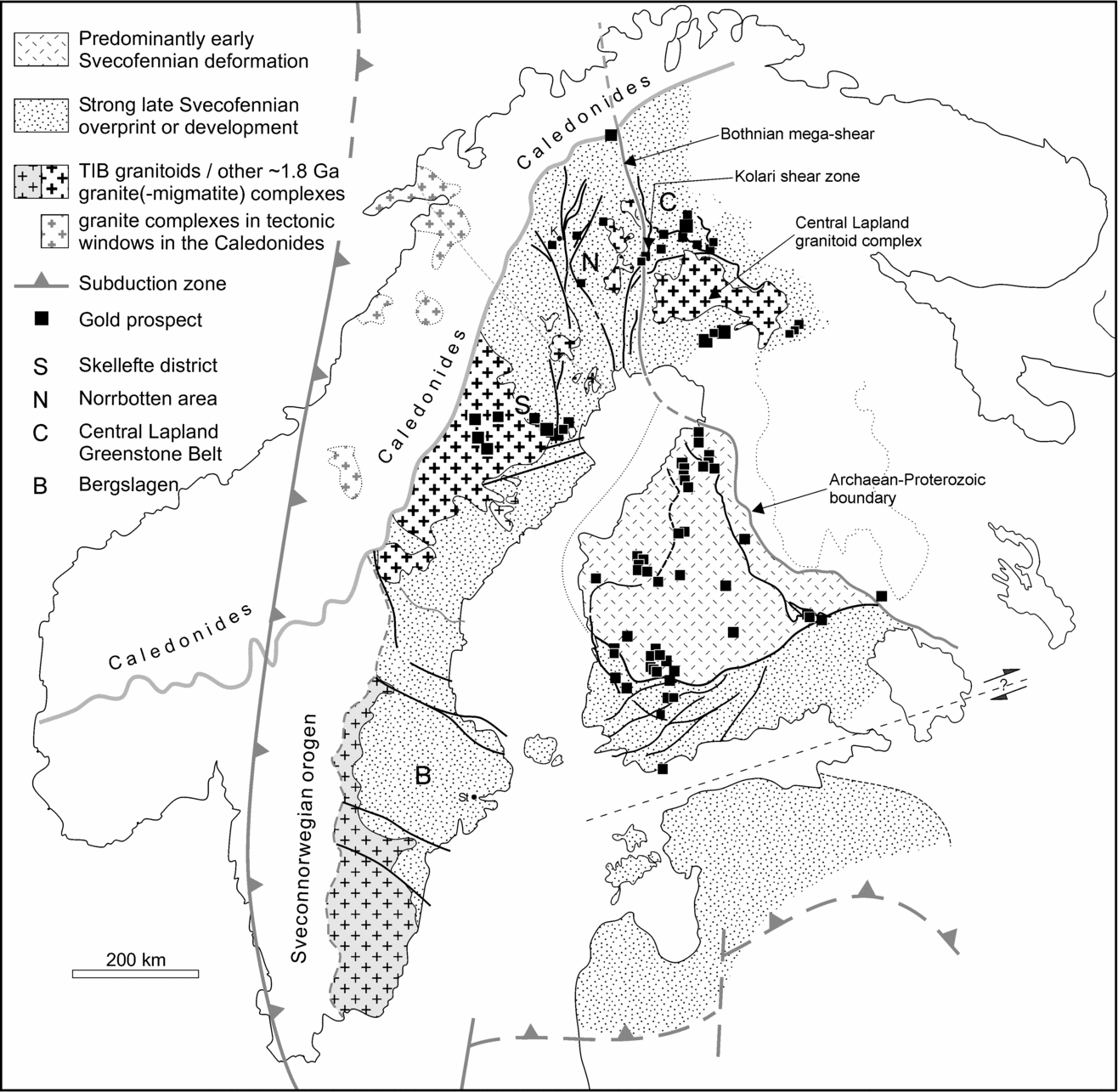
Late Svecofennian shearing, metamorphism and contemporaneous c. 1.8 Ga old magmatism play an important role for mineralization in northern Finland and Sweden as well. Mineralization (iron oxide copper gold) in the Kolari shear zone in Finnish Lapland (Fig. 7) took place during thrusting at c. 1.8 Ga (Niiranen, Poutiainen & Mänttäri, Reference Niiranen, Poutiainen and Mänttäri2007). Patison (Reference Patison and Ojala2007) notes an important association between gold mineralization and shear zones post-dating the main regional peak metamorphism in the Central Lapland greenstone belt further east. The structural relationship to the Kolari shear zone is not well studied; however, if thrusting took place at the same time, at least part of the gold mineralization in central Lapland would have an age of c. 1.8 Ga as well. In the Norrbotten area in northern Sweden, NNE- to NNW-trending dextral shear zones that formed during E–W shortening (Bergman, Kübler & Martinsson, Reference Bergman, Kübler and Martinsson2001) host copper–gold and gold mineralization, and they are comparable to the Kolari shear zone. This is confirmed by 1.80–1.78 Ga U–Pb titanite and monazite and ≤1.78 Ga hornblende Ar–Ar ages (Billström, Bergman & Martinsson, Reference Billström, Bergman and Martinsson2002).
Tectonic scenario for the c. 1.82–1.78 Ga late Svecofennian tectono-magmatic and hydrothermal development related to a Cordilleran-type margin. Shear zones in Sweden after Bergman, Kübler & Martinsson, Reference Bergman, Kübler and Martinsson2001; Weihed et al. Reference Weihed, Billström, Persson and Bergman Weihed2002; Hermansson et al. Reference Hermansson, Stephens, Corfu, Andersson and Page2007; in Finland after Korsman et al. Reference Korsman, Koistinen, Kohonen, Wennerström, Ekdahl, Honkamo, Idman and Pekkala1997; distribution of TIB granitoids after Högdahl, Andersson & Eklund, Reference Högdahl, Andersson and Eklund2004, and Weihed et al. Reference Weihed, Billström, Persson and Bergman Weihed2002; gold occurrences after Eilu (Reference Eilu2007) and Eilu et al. (Reference Eilu, Hallberg, Bergman, Feoktistov, Korsakova, Krasotkin, Lampio, Litvinenko, Nurmi, Often, Philippov, Sandstad, Stromov and Tontti2007). Note that the age of many gold occurrences is not well constrained and that not all prospects in this map necessarily belong to the 1.8 Ga late Svecofennian gold mineralization. K – Kiruna; St – Stockholm.

A temporal relationship between c. 1.8 Ga voluminous granite magmatism (Revsund suite) and major N–S-trending ductile shear zones and gold mineralization also exists in the Skellefte district (Bergman-Weihed, Reference Bergman-Weihed and Weihed2001; Weihed et al. Reference Weihed, Billström, Persson and Bergman Weihed2002; Bark, Broman & Weihed, Reference Bark, Broman and Weihed2007). The steep shear zones show reverse movements compatible with E–W shortening (Weihed et al. Reference Weihed, Billström, Persson and Bergman Weihed2002) and are thus comparable to the shear zones in Norrbotten and the Kolari region. Dextral transpression at around 1.82 Ga (Högdahl & Sjöström, Reference Högdahl and Sjöström2001), pegmatite intrusions with ages of 1.80–1.77 Ga (Romer & Smeds, Reference Romer and Smeds1997) and auriferous quartz veins in shear zones suggest a tectonic environment for mineralization similar to that in southern Finland.
In summary, many orogenic gold deposits in the Fennoscandian Shield formed after peak metamorphism and are structurally controlled by shear zones that formed in transpressional regimes associated with voluminous c. 1.8 Ga granitoid magmatism. Their distribution spreading from southern Finland and Sweden to Lapland in the north suggest a shield-wide tectono-magmatic and hydrothermal event, which in turn implies a comparable plate tectonic setting and control on mineralization.
It is beyond the scope of this paper to discuss various models for the tectonic evolution of southern Finland. In any case, the 1.82–1.78 Ga gold mineralization in Finland and Sweden took place during oblique contraction with E–W- to WNW–ESE-oriented shortening associated with widespread and voluminous granitoid magmatism, so that deformation was accompanied by high heat flow. Magmatism and metamorphism, reaching granulite facies conditions in some regions, started in extensional regimes (Korja & Heikkinen, Reference Korja and Heikkinen1995; Skyttä, Reference Skyttä2007; Pajunen et al. Reference Pajunen, Airo, Elminen, Mänttäri, Niemelä, Vaarma, Wasenius and Wennerström2008). Subsequent shortening beginning close to peak metamorphism affected a hot and partially molten crust and led to crustal stacking and thickening followed by immediate cooling of the lithosphere. In southern Finland these events represent the final stages of the Svecofennian orogenic evolution followed by cooling and (oblique) extension during orogenic collapse and stabilization.
Tectonic scenarios have to take into account the high heat flow as well as the cyclic orogenic evolution comprising two contractional episodes with HT metamorphism. Early Svecofennian deformation was followed by a period of uplift, erosion and sediment deposition at c. 1.85–1.83 Ga, which in turn was followed by renewed (late Svecofennian) contraction and metamorphism that also affected the post-1.86 Ga sedimentary rocks. Such episodic changes in stress can occur in subduction zone settings. It is suggested here that a subduction zone system and Cordilleran-type continental margin formed after the early Svecofennian accretionary events when the plate system was reorganized and the subduction system retreated further to the southwest and west. The subduction zone would have extended west of Sweden to the Baltic States (Fig. 7) because active continental margin magmatism at 1.85–1.78 Ga is also recorded in Lithuania (Skridlaite & Motuza, Reference Skridlaite and Motuza2001) and in parts of the Mazowsze massif in northern Poland (Wiszniewska, Krzeminska & Dörr, Reference Wiszniewska, Krzeminska and Dörr2007). Asthenospheric upwelling in the back-arc region (Finland, many parts of Sweden) as a response to slab rollback could have provided the high heat input, serving as a driving mechanism for magmatic and metamorphic events. In such a setting, a rapid tectonic switch from extension to contraction is triggered by a change from slab retreat (or rollback) to flat subduction, with the latter being initiated by arrival of a positively buoyant fragment (e.g. an oceanic plateau or continental crust) at the subduction zone causing contraction in the upper plate (e.g. Collins, Reference Collins2002).
Subduction of oceanic crust enabled influx of hot asthenosphere and would provide the heat supply for shield-wide c. 1.8 Ga magmatism, metamorphism and hydrothermal precious metal mineralization. In the area affecting southern Finland, subduction was locking up since there is no significant deformation after 1.78 Ga, whereas subduction continued further west, as recorded in the younger, <1.77 Ga, suites of the Transscandinavian Igneous Belt in Sweden, possibly after renewed migration of the subduction zone outwards. Post-orogenic (1.81–1.77 Ga) calc-alkaline and shoshonitic magmatism in southern Finland (Eklund et al. Reference Eklund, Konopelko, Rutanen, Fröjdö and Shebanov1998; Andersson et al. Reference Andersson, Eklund, Fröjjdö and Konopelko2006) may have been enabled by final slab break-off.
Acknowledgements
The authors would like to thank Polar Mining Oy/Dragon Mining NL for the permission to study the Jokisivu gold deposit. M. Karhunen, S. Mäenluoma and L. Järvinen are thanked for rock crushing and mineral separation. We are grateful to T. Hokkanen and A. Pulkkinen for laboratory work and mass spectrometry (TIMS). We also thank the personnel of the NORDSIM laboratory, L. Ilyinsky and K. Lindén, for assistance during different stages of sample preparation, analysis and data reduction. The ion microprobe facility in Stockholm (Nordsims) is operated under an agreement between the joint Nordic research councils (NOS-N), the Geological Survey of Finland and the Swedish Museum of Natural History. This is NordSIM contribution number 240. K.S. would like to express thanks to H. Arkimaa for processing the aeromagnetic map and an introduction to ErMapper. We greatly appreciate the helpful reviews of Ulf Söderlund and an anonymous referee, as well as suggestions made by the editor D. Pyle, which improved the manuscript. We also express our thanks to J. Holland for further editorial handling. This is a contribution to the project ‘Geological and metallogenic bedrock modelling’ of the Geological Survey of Finland.