Percutaneous balloon pericardiotomy is a percutaneous procedure that creates a window in the parietal pericardium by balloon dilation. Reference Ziskind, Pearce and Lemmon1,Reference Bertrand, Legrand and Kulbertus2 The indication of percutaneous balloon pericardiotomy is chronic, persistent, and/or recurrent pericardial effusion. Percutaneous balloon pericardiotomy has been reported as a less invasive alternative to a surgical pericardial window. Percutaneous balloon pericardiotomy was firstly described by Palacio et al in 1991 Reference Palacios, Tuzcu and Ziskind3 and has been reported to be the effective treatment for pericardial effusion associated with malignant diseases in adults. Reference Ziskind, Pearce and Lemmon1,Reference Ruiz-García, Jiménez-Valero and Moreno4-Reference Bhardwaj, Gharib and Gharib6 In contrast to the adult counterparts, percutaneous balloon pericardiotomy has been rarely reported in a paediatric population. Thanopolous et al reported 10 children undergoing percutaneous balloon pericardiotomy and concluded that percutaneous balloon pericardiotomy was safe and effective in children. Reference Thanopoulos, Georgakopoulos and Tsaousis7 Only a few case reports described the use of percutaneous balloon pericardiotomy in children to date. Reference Forbes, Horenstein and Vincent8,Reference Irugal Bandara, Karunarathne and Jayaweera9
At the Children’s Hospital of Michigan, percutaneous balloon pericardiotomy has been performed as an alternative to a surgical pericardial window in children with various etiologies of pericardial effusion. The hypothesis of this study was that percutaneous balloon pericardiotomy can be performed safely and effectively in children. The objective of this study was to describe the single centered experience of percutaneous balloon pericardiotomy in children.
Methods
This was a retrospective study to describe all the patients who underwent percutaneous balloon pericardiotomy in the paediatric cardiac catheterisation laboratories at the Children’s Hospital of Michigan. This study was approved by the Institutional Review Board of the Wayne State University and the Detroit Medical Centre. The study period was 18 years (2001-2019). The cardiac catheterisation database was used to identify the eligible patients. Inclusion criteria were children aged <20 years at the time of percutaneous balloon pericardiotomy. Data on demographics, clinical and surgical history, echocardiography, cardiac catheterisation, and clinical follow-up were collected through the medical records. Any adverse events associated with percutaneous balloon pericardiotomy were reviewed in detail. Technical success was defined as achievement of a pericardial window creation by a percutaneous balloon dilation, judged by identification of the balloon waist at the parietal pericardium and following disappearance of this balloon waist. Overall procedural success of percutaneous balloon pericardiotomy was defined as an ultimate resolution of the pericardial effusion without a need of subsequent surgical pericardial window.
Percutaneous balloon pericardiotomy
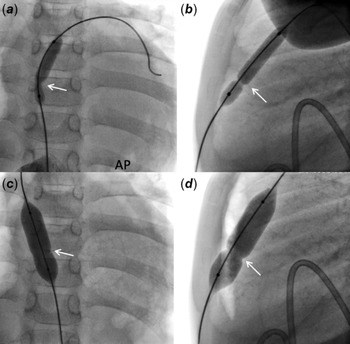
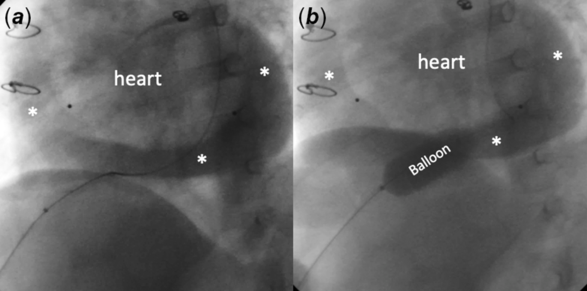
Percutaneous balloon pericardiotomy was performed under the fluoroscopic and echocardiographic guidance in the cardiac catheterisation laboratory. General anesthesia or conscious sedation along with local anesthesia was used based on the discretion of providers. Firstly, pericardiocentesis was performed with a needle entering the pericardial space via the subxyphoid approach. After insertion of the micro-guidewire through the needle, the micro-guidewire was exchanged to a 0.035” Rosen wire (Cook Medical, Bloomington, IN) through an exchange dilator. After, an 8–10 Fr dilator was used to dilate the skin tract and the balloon angioplasty catheter was advanced over the wire to the pericardial space. The balloon was situated with the goal of having a pericardial waist over the balloon while the balloon remained under the skin. Once the balloon catheter showed a clear waist with slow inflation (Fig 1), the balloon was completely inflated causing stretching and tearing of the parietal pericardium with a newly opened pericardial space. The diameter of balloon was upsized serially to achieve the final target diameter. To achieve a larger pericardial window, simultaneous inflation of two balloon catheters was performed in some patients (Fig 2). To visualise the pericardial space and the margin of parietal pericardium, a small amount of radiographic contrast was injected into the pericardial space (Fig 3). In most patients, the pericardial drain was left in situ after completion of percutaneous balloon pericardiotomy.
Percutaneous balloon pericardiotomy in an 8-year-old child, shown on the straight antero-posterior and lateral views. ( a , b ) Initial dilation with an 8 mm × 4 cm balloon catheter. ( c , d ) Subsequent dilation with a 14 mm × 4 cm balloon catheter. Clear waist (arrow) is shown at the pericardial margin.

Percutaneous balloon pericardiotomy using two balloon catheters in the straight antero-posterior and lateral views. Two 12 mm × 4 cm balloon catheters were simultaneously inflated at the pericardial margin. Balloon waist (arrow) is seen at full inflation.

( a ) Pericardial space (*) and margin delineated by contrast injection in the straight antero-posterior views. ( b ) A balloon catheter straddling the parietal pericardium.

Results
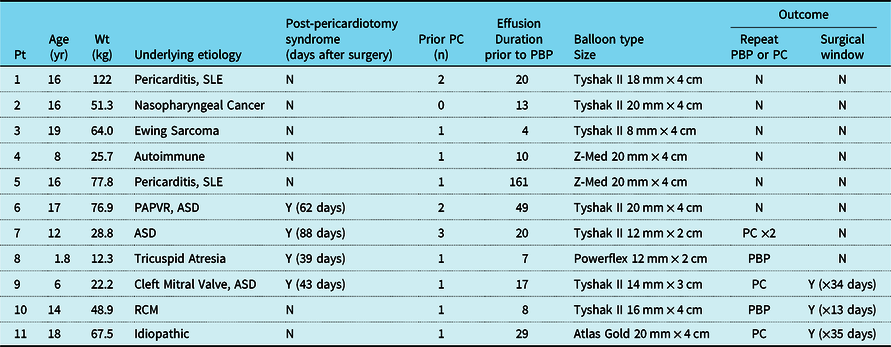
The median age of the study cohort (Table 1) was 12 years (range 1.8-19) with median weight of 50 kg (12.3–122). The underlying etiologies of the pericardial effusion were post-pericardiotomy syndrome after cardiac surgery (n = 4), restrictive cardiomyopathy (n = 1), autoimmune diseases (n = 3), malignancy (n = 2), and idiopathic (n = 1). Prior to percutaneous balloon pericardiotomy, three patients had significant amount of pericardial effusion with echocardiographic signs of pericardial tamponade. For post-pericardiotomy syndrome patients, percutaneous balloon pericardiotomy was performed after the median 58 days (39–88) post-cardiac surgery. All the patients except one received pericardiocentesis with/without drain placement prior to the percutaneous balloon pericardiotomy. The median duration from the first detection of pericardial effusion to percutaneous balloon pericardiotomy was 29 days (4–161).
Case Summary of Percutaneous Balloon Pericardiotomy (PBP)

PC, Pericardiocentesis; RCM, restrictive cardiomyopathy; SLE, systemic lupus erythematosus.
In 11 patients, 13 percutaneous balloon pericardiotomy’s were performed. Two patients received two percutaneous balloon pericardiotomy. At the time of percutaneous balloon pericardiotomy, the median volume of pericardial fluid removed was 5 ml/kg (0–45). The percutaneous balloon pericardiotomy was performed under general anesthesia (n = 3) and moderate sedation (n = 10). All the patients received serial balloon dilation using different types of balloon catheters (Tyshak II (B. Braun, Melsungen Germany), Z-Med (B. Braun, Melsungen Germany), Powerflex (Cordis, Hialeah, FL), and Atlas Gold (BD, Franklin Lakes, NJ). The largest diameter of balloon catheters used for percutaneous balloon pericardiotomy ranged from 8 to 20 mm. In most of the older children, 20 mm was the final dilation diameter. Among 11 patients, 6 received a concurrent pericardial drain placement.
The technical success percutaneous balloon pericardiotomy was 100%. There were no acute complications, with no incidence of balloon rupture or local bleeding. In all patients except one, echocardiography confirmed the near-elimination of pericardial effusion at the percutaneous balloon pericardiotomy. Among 11 patients, 5 (45%) required re-intervention due to re-accumulation of pericardial effusion. Two patients underwent repeat percutaneous balloon pericardiotomy, of which one required a surgical window. In total, three patients required surgical pericardial window 6 to 35 days after the percutaneous balloon pericardiotomy, resulting in the overall procedural success being 73%. Of note, one patient had a surgical window done first, followed by percutaneous balloon pericardiotomy due to re-accumulation of pericardial effusion. Post-percutaneous balloon pericardiotomy, four patients showed development of left pleural effusion but did not require chest tube drainage. No patient developed fever. All of the patients were treated medically with steroids (n = 8), non-steroidal anti-inflammatory drugs (n = 3), and colchicine (n = 2). At the time of procedure, all of the patients were either being treated or had completed a course or multiple courses of medical therapy.
At a long-term follow-up of median 6.5 years (0–18), all remained alive except one patient who died from his oncologic process. One patient did not have any follow-up after being discharged from the hospital.
Discussion
This study showed the safety and effectiveness of percutaneous balloon pericardiotomy in children. In our cohort, there were no significant adverse events associated with percutaneous balloon pericardiotomy. Although the percutaneous balloon pericardiotomy was technically successful in all the cases, the overall procedural success rate was 73%. There were no adverse events seen during any of the procedures. Our data indicates that three out of four patients avoided a surgical pericardial window by the use of percutaneous balloon pericardiotomy. In children with chronic, persistent, and/or recurrent pericardial effusion, percutaneous balloon pericardiotomy may be a useful alternative to an invasive surgical window.
The percutaneous balloon pericardiotomy creates a window at the parietal pericardium for a pericardio-pleural or pericardio-peritoneal communication. Reference Maisch, Ristić and Pankuweit10 The window at the parietal pericardium results from the fragmentation of the fibroelastic connective tissue. Reference Chow and Chow11 With the pericardio-pleural communication, left pleural effusion is often observed and may require a chest tube drainage. Reference Jneid, Ziskind, Palacios, Topol and Teirstein12 In our study, four patients (36%) developed left pleural effusion, indicating the successful creation of the pericardio-pleural communication. Technical details of percutaneous balloon pericardiotomy have been described well by Jneid et al. Reference Jneid, Ziskind, Palacios, Topol and Teirstein12 The balloon should be inflated gently to identify the balloon waist at the pericardial margin. It is not uncommon that the proximal portion of the balloon may not expand due to lack of space between the chest wall and the pericardial space. In this circumstance, the parietal pericardium needs to be separated from the chest wall by a “countertraction technique”. This maneuver helps isolate the pericardium, when the catheter is gently advanced as the skin and soft tissue are pulled manually in the opposite direction.
The use of percutaneous balloon pericardiotomy has been largely demonstrated in the adult population with safe and effective results in malignant pericardial effusions with few other etiologies. Reference Ziskind, Pearce and Lemmon1,Reference Ruiz-García, Jiménez-Valero and Moreno4-Reference Bhardwaj, Gharib and Gharib6 Technical success rate of percutaneous balloon pericardiotomy is almost 100% in adult literatures but about one-fifth of patients (5.5 to 23%) required repeat pericardial interventions. Reference Ruiz-García, Jiménez-Valero and Moreno4-Reference Bhardwaj, Gharib and Gharib6,Reference Swanson, Mirza and Wijesinghe13 Similar to these previous studies, our data showed a 100% technical success rate but about half (45%) of children required re-intervention. A torn pericardium by percutaneous balloon pericardiotomy is not a permanent phenomenon and may not provide longevity of its effectiveness. This may be one explanation as to why the procedural success was not obtained in all the patients. Other contributing factors may include final balloon size, inability to completely expand the balloon and having a residual waist or the etiology of the underlying effusion.
There is a paucity of data on the utility of percutaneous balloon pericardiotomy in children. The largest study of 10 children undergoing percutaneous balloon pericardiotomy was reported in 1997 (about two decades ago). Since then, there have been only a few case reports in children. This fact may indicate that percutaneous balloon pericardiotomy is an underutilised procedure in the paediatric population. In the previous study of 10 children, the majority of etiologies were autoimmune while our cohort had a very mixed etiology with the majority being post-pericardiotomy syndrome. Percutaneous balloon pericardiotomy was technically successful in all except one child whose procedure was complicated with a balloon rupture within the pericardial space. Two of their patients required repeat percutaneous balloon pericardiotomy due to rapid re-accumulation of pericardial fluid after the initial percutaneous balloon pericardiotomy. The overall procedural success was 100% with no further re-intervention in the follow-up period of 14.6 months. Reference Thanopoulos, Georgakopoulos and Tsaousis7 Our study cohort had heterogeneous etiologies of pericardial effusion, including four children with post-pericardiotomy syndrome. The effectiveness of percutaneous balloon pericardiotomy was inferior to this previous report, because three patients (27%) required surgical pericardial window ultimately.
Limitations
This was a retrospective study with its inherent limitations. Over the long study period, the percutaneous balloon pericardiotomy was infrequently performed at our centre. The sample size of our cohort was small, limiting its generalisability. The percutaneous balloon pericardiotomy was performed by a few different providers over the 18-year period. The success of percutaneous balloon pericardiotomy may depend on the interventional techniques of individual providers to some extent. Because the medical therapy was used for all the patients after percutaneous balloon pericardiotomy, resolution of pericardial effusion may not be solely dependent on the effectiveness of percutaneous balloon pericardiotomy. However, almost all the patients had chronic effusion resistant to prior medical therapy.
Conclusion
Percutaneous balloon pericardiotomy was performed safely with high technical success in children. Before considering a surgical pericardial window, percutaneous balloon pericardiotomy may be considered as a less invasive alternative therapy for recurrent and persistent pericardial effusion in children. Because percutaneous balloon pericardiotomy is underutilised in children, a larger scale study may be considered to evaluate the safety and effectiveness of percutaneous balloon pericardiotomy in a paediatric population, compared to a surgical window.
Acknowledgements
None.
Financial support
This research received no specific grant from any funding agency, commercial or not-for-profit sectors.
Conflicts of interest
None.
Ethical standards
All procedures performed in studies involving human participants were in accordance with the ethical standards of the institutional and/or national research committee and with the 1964 Helsinki declaration and its later amendments or comparable ethical standards. Informed consent was obtained from all individual participants included in this case report.