Colorectal cancer (CRC) is the third most common cause of cancer in the United Kingdom. Approximately 36,000 new cases are diagnosed annually in the United Kingdom, resulting in around 16,000 deaths annually. Increasing cost and resource pressures have led to an increasing requirement to consider not only whether health technologies are clinically effective but also whether they are cost-effective. In 2006, the Cancer Reform Strategy was announced, which intends to build on the Cancer Plan by disseminating best clinical practice and recommending work required by cancer networks and the National Health Service (NHS) to improve clinical outcomes, quality, and value for money. The achievement of these goals requires consistent, balanced decision-making concerning service provision across whole care pathways.
Health economic evaluation, which involves assessing the costs and consequences of options for change, is a commonly used vehicle for informing service investment. The decision problem posed is typically of the form “should we buy program A or B for disease C in population D (with our preference determined by outcome E)?” Health outcomes may be final, for example, survival and health-related quality of life (HRQoL), which can be used to estimate quality-adjusted life-years (QALYs), or intermediate, for example, cancers detected. Conventional economic evaluation relates to an isolated decision point within a broader pathway of care. Economic analysis involves projecting forward from the decision node to estimate profiles of costs and outcomes for each intervention under consideration. These are compared incrementally to produce an expected incremental cost-effectiveness ratio (ICER), with cost-effectiveness determined through comparison against some acceptable threshold. However, not all models are equal. Considerable work has been devoted to the development of good practice guidelines and Reference Cases (26). While this may reduce methodological differences and improve study quality, recent qualitative work suggests the absence of a shared understanding of how models should be developed (Reference Chilcott, Tappenden and Rawdin7). Consequently, models that are intended to represent the same underlying disease and treatment pathways may differ, thus influencing cost-effectiveness outcomes, and ultimately, resource allocation decisions.
This study presents a systematic review of economic evaluations of interventions for the detection, diagnosis, treatment, and follow-up of CRC. The review serves two related purposes. First, through examining the dispersion of economic evidence across the CRC pathway, the review highlights areas of clinical practice that are supported by economic evidence, as well as aspects that have emerged without economic consideration. Second, the available economic evidence base is summarized and critically examined to help decision makers understand the limitations of existing studies.
METHODS
Search Methodology
The review sought to identify all economic evaluations of technologies used across the entire CRC service; hence, its scope is necessarily broader than conventional cost-effectiveness reviews. A comprehensive electronic search strategy was developed using disease-specific MeSH terms and economic filters where appropriate. The search methodology did not follow the standard “PICO” (population, intervention, comparators, outcomes) review orthodoxy as the a priori specification of all intervention terms would have likely resulted in relevant studies being missed. Systematic searches were undertaken in Medline, PreMedline, Embase, CINAHL, EconLit, and the Cochrane Library. Recent oncology conference proceedings and reference lists of included studies, previous economic reviews, and guidelines were examined to identify other studies missed by the electronic searches. Studies that were not publicly available were excluded. No language, publication, or date restrictions were applied to the searches.
Inclusion Criteria
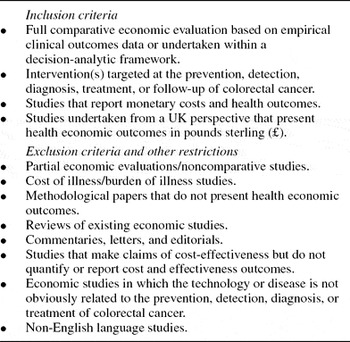
Inclusion criteria were constructed iteratively during an initial sift of search results using an approach analogous to the principles of grounded theory, whereby concepts and themes for the review were developed through consideration of the data (see Box 1). Originally, the review intended to identify any CRC economic evaluation irrespective of context or geographical jurisdiction. This remit was subsequently refined to include only UK-based evidence. This decision was taken pragmatically, as UK studies are likely to be most relevant to NHS decision makers and there are methodological problems associated with translating the results of economic evaluations across geographical locations. Through maintaining a UK-only focus, the review draws out inconsistencies between analyses which should relate to the same disease processes and health service. Studies were included if they reported a full economic evaluation (cost-effectiveness analysis, cost-utility analysis, and cost-benefit analysis). Cost-consequences analyses and cost-minimization analyses were included for completeness. Studies were included irrespective of reporting or methodological study quality.
Study inclusion/exclusion criteria

Critical Appraisal Methods
In line with the grounded theory approach, critical appraisal methodology emerged through the examination of identified studies. Emergent concepts included the decision problem scope, the conceptualization of disease processes and the representation of downstream service costs and outcomes. Critical appraisal was guided by a conceptual CRC management pathways model developed previously (Reference Trueman, Chilcott and Tappenden40). The conceptual model provides a discretized map against which to locate existing economic analyses and a means of assessing the conceptualization of downstream services.
RESULTS
Volume and Dispersion of Evidence
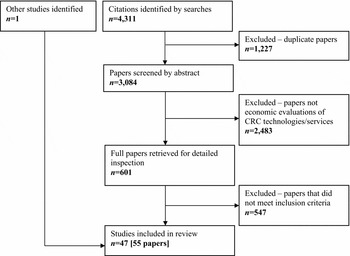
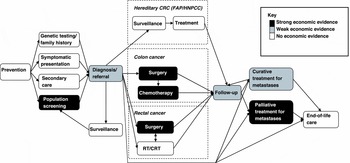
The searches identified 4,311 potentially relevant citations, of which 601 were retrieved for detailed inspection (Figure 1). One further unpublished study (Reference Neilson, Walker and Forbes27) was identified through inspection of an existing cost-effectiveness review. Of these, forty-seven studies met the inclusion criteria. Figure 2 presents the dispersion of evidence across the conceptual CRC model.
QUOROM flow diagram detailing study inclusions and exclusions. CRC, colorectal cancer.

Conceptual model of colorectal cancer services and dispersion of evidence. FAP, familial adenomatous polyposis; HNPCC, hereditary non-polyposis colorectal cancer.

Reassuringly, there is a substantial economic evidence base surrounding the use of screening, surgical procedures, and adjuvant/palliative chemotherapies. There is some, albeit limited, economic evidence surrounding diagnostic procedures, curative treatments for metastases, and follow-up schedules. Less reassuring is the dearth of economic evaluations surrounding the use of radiotherapy/chemoradiation for rectal cancer, and surveillance for nonmalignant colorectal pathologies. These are widely used interventions in the management of CRC in the UK. No economic analyses of end-of-life care options were identified. Most notable is the absence of evidence concerning the detection, diagnosis, and management of familial adenomatous polyposis (FAP) and hereditary non-polyposis colorectal cancer (HNPCC). In these areas, current practice appears to have emerged without the consideration of economic evidence. Headline study results are presented in Supplementary Tables 1 and 2, which can be viewed online at www.journals.cambridge.org/thc. Supplementary Table 3, which can be viewed online at www.journals.cambridge.org/thc, maps the specific colorectal service components included in identified studies across the conceptual model.
Critical Appraisal Results
Study types. Twenty-six studies explicitly adopted a modeling framework, involving extrapolation and/or evidence synthesis (commonly Markov models or decision trees). The remainder were analyses of empirical data from clinical studies. Twenty studies reported cost-effectiveness/cost-utility using life-years gained (LYGs) or QALYs, whereas the remainder reported intermediate outcomes. Fifteen studies reported cost-consequences analyses or cost-minimization analyses.
Colorectal screening. Thirteen colorectal screening analyses were identified (Reference Daniels and McKee10;Reference Neilson, Walker and Forbes27;Reference Robert, Brown and Garvican33;Reference Robinson, Marks and Farrands34;Reference Tappenden, Chilcott and Eggington37;Reference Walker, Whynes and Thomas42–Reference Walker, Whynes and Hardcastle45;Reference Whynes47–Reference Whynes, Neilson and Walker50). Interventions included screening tests (fecal occult blood tests [FOBT], flexible sigmoidoscopy [FSIG], and combinations), FOBT protocols (3-day versus 6-day), risk questionnaires, quality management tools, adenoma excision strategies, and colonoscopy for screen-positives. Most commonly, cost-effectiveness was assessed within the general population. Time horizons varied considerably, ranging from a single screening round to patients’ remaining lifetime.
Broadly speaking, the screening analyses fall into two groups. The first group comprises short-term analyses, which typically exclude any natural history component and report intermediate outcomes (Reference Daniels and McKee10;Reference Robinson, Marks and Farrands34;Reference Walker, Whynes and Thomas42–Reference Walker, Whynes and Hardcastle45;Reference Whynes, Walker and Hardcastle48). These include limited representations of downstream services, including only costs and outcomes associated with screening and follow-up. Typically, these analyses compare two or more active screening options against one another, which implicitly assumes that screening is cost-effective in the first place. The second group comprises analyses comparing screening versus no screening using final outcomes (Reference Neilson, Walker and Forbes27;Reference Robert, Brown and Garvican33;Reference Tappenden, Chilcott and Eggington37;Reference Whynes47;Reference Whynes, Neilson and Walker50, typically over a lifetime horizon using broader representations of downstream services. Five analyses include a natural history model, each assuming that disease progression exclusively follows the adenoma-carcinoma sequence (Reference Neilson, Walker and Forbes27;Reference Robert, Brown and Garvican33;Reference Tappenden, Chilcott and Eggington37;Reference Whynes, Walker and Hardcastle49;Reference Whynes, Neilson and Walker50. With the exception of two studies which used the same model (Reference Robert, Brown and Garvican33;Reference Whynes, Neilson and Walker50) descriptions of adenoma/carcinoma states, possible transitions and rates of progression differ between studies. One study represents an outlier, presenting LYGs for FOBT versus no screening using empirical trial outcomes (Reference Whynes47).
The range of outcome measures presented across the screening analyses limits their comparability and interpretation. Short-term analyses suggest that the incremental cost-effectiveness of FOBT screening ranges from £2,000 to £82,000/cancer detected (Reference Daniels and McKee10;Reference Walker and Whynes44;Reference Whynes, Walker and Hardcastle48) or £200 to £900/large adenoma detected (Reference Robinson, Marks and Farrands34). These results are highly dependent on the choice of comparator. Hydrated FOBT versus nonrehydrated FOBT costs £3,000/additional cancer detected (Reference Walker, Whynes and Hardcastle45). A 6-day versus 3-day FOB protocol costs over £6,000/additional cancer detected (Reference Walker, Whynes and Chamberlain43). Colonoscopic follow-up strategies cost between £1,000 and £37,000/additional cancer detected (Reference Walker, Whynes and Thomas42). Adenoma excision is expected to be cost-saving (Reference Whynes, Walker and Hardcastle49). These studies were narrowly scoped, including only a subset of relevant costs and outcomes associated with the intervention and the disease. These analyses omit key factors that could influence cost-effectiveness, for example, costs of inappropriate follow-up, and stage-specific differences in costs and outcomes. It is unclear how these studies could usefully inform resource allocation decisions. The long-term analyses that considered FOBT versus no screening (Reference Neilson, Walker and Forbes27;Reference Robert, Brown and Garvican33;Reference Whynes47;Reference Whynes, Neilson and Walker50) consistently reported ICERs below £7,000/QALY (or below £2,000/LYG). Only one study considered both FOBT and FSIG options, suggesting that FSIG alone or in combination with FOBT dominates FOBT alone (Reference Tappenden, Chilcott and Eggington37). If one considers this model credible, this finding effectively makes the results of the twelve earlier FOBT evaluations redundant.
Diagnostic technologies. Three cost-consequence analyses of diagnostic technologies were identified (Reference Barber, Abraham and Brydon2;Reference Brown, Davies and Williams4;Reference Vellacott, Clarke, Beech and Joshi41). Interventions included procedures for preoperative staging, Hemoccult versus Hemoquant FOBT, and FSIG in primary and secondary care. Two studies concerned patients with colorectal-related symptoms (Reference Barber, Abraham and Brydon2;Reference Vellacott, Clarke, Beech and Joshi41); the third concerned diagnosed unstaged rectal cancer patients (Reference Brown, Davies and Williams4). Clinical outcomes relate to cancer yield (Reference Barber, Abraham and Brydon2;Reference Vellacott, Clarke, Beech and Joshi41), and numbers of patients correctly/incorrectly diagnosed (Reference Brown, Davies and Williams4). Two studies relate solely to diagnosis and ignore subsequent treatment costs and outcomes (Reference Barber, Abraham and Brydon2;Reference Vellacott, Clarke, Beech and Joshi41), whereas the third includes costs and outcomes from diagnosis through to adjuvant treatment (Reference Brown, Davies and Williams4). None of these studies include a natural history model.
Hemoquant is expected to be more sensitive and less expensive than Hemoccult (Reference Barber, Abraham and Brydon2). FSIG in primary care was less expensive but less efficient than FSIG in secondary care (Reference Vellacott, Clarke, Beech and Joshi41). The preferred course of action within these studies is unclear. Only one study (Reference Brown, Davies and Williams4) presents a clear maximand, as magnetic resonance imaging dominated endoluminal ultrasound and digital rectal examination on all dimensions.
Colorectal surgery. Nine surgery-related analyses were identified (Reference Chaudhri, Brown and Hassan6;Reference de Verteuil, Hernandez and Vale11;Reference Eccersley and Williams13;Reference Franks, Bosanquet and Thorpe15;Reference King, Blazeby and Ewings20;Reference King, Blazeby and Ewings21;Reference Maslekar, Pillinger and Sharma24;Reference Mihai and Borley25;Reference Noblett and Horgan30). Seven studies evaluated surgical procedures, including laparoscopic and open surgery (Reference de Verteuil, Hernandez and Vale11;Reference Franks, Bosanquet and Thorpe15;Reference King, Blazeby and Ewings20;Reference Noblett and Horgan30), transanal endoscopic microsurgery (TEMS) (Reference Maslekar, Pillinger and Sharma24;Reference Mihai and Borley25), and anorectal reconstruction versus permanent stoma (Reference Eccersley and Williams13). Other interventions included enhanced recovery programs (ERP) (Reference King, Blazeby and Ewings21) and intensive preoperative community-based stoma education (Reference Chaudhri, Brown and Hassan6). Comparators were consistently defined as conventional care. Populations were consistently defined as patients eligible for surgical resection, or patients who had recently undergone resection; however, specific patient characteristics differed between studies. Two studies adopted a modeling framework and presented final outcomes (Reference de Verteuil, Hernandez and Vale11;Reference Eccersley and Williams13). The remainder were cost-consequence analyses, which reported short-term outcomes (Reference Chaudhri, Brown and Hassan6;Reference Franks, Bosanquet and Thorpe15;Reference King, Blazeby and Ewings20;Reference King, Blazeby and Ewings21;Reference Maslekar, Pillinger and Sharma24;Reference Mihai and Borley25;Reference Noblett and Horgan30). Three studies assumed equivalent effectiveness between interventions (Reference Franks, Bosanquet and Thorpe15;Reference King, Blazeby and Ewings20;Reference Maslekar, Pillinger and Sharma24). Where the direction of benefit was not consistent across all clinical outcomes, the preferred decision alternative was often unclear. Time horizons were generally short (≤3 months); only one study adopted a lifetime horizon (Reference de Verteuil, Hernandez and Vale11). The difference in complexity between the two models was marked. One study (Reference de Verteuil, Hernandez and Vale11) presents a six-state Markov model of long-term postsurgical costs and outcomes based on relapse risk and subsequent prognosis, whereas the other reports a “back of the envelope” model (Reference Eccersley and Williams13). Six studies included only costs and outcomes associated with surgery (Reference Chaudhri, Brown and Hassan6;Reference Eccersley and Williams13;Reference Franks, Bosanquet and Thorpe15;Reference Maslekar, Pillinger and Sharma24;Reference Mihai and Borley25;Reference Noblett and Horgan30). Three studies included downstream costs for chemotherapy, radiotherapy, and follow-up, albeit using different assumptions and data sources (Reference de Verteuil, Hernandez and Vale11;Reference King, Blazeby and Ewings20;Reference King, Blazeby and Ewings21).
Economic outcomes for laparoscopic surgery were equivocal. The long-term model suggests that open surgery dominates laparoscopic surgery (Reference de Verteuil, Hernandez and Vale11), whereas the short-term cost-consequence evaluations produced mixed results. Two studies suggested that laparoscopic surgery dominated open surgery (Reference King, Blazeby and Ewings20;Reference Noblett and Horgan30), whereas one study indicated the converse (Reference Franks, Bosanquet and Thorpe15). One study suggested that TEMS dominates open surgery (Reference Maslekar, Pillinger and Sharma24); within the other study, it was unclear whether TEMS or open surgery would be preferred on economic grounds (Reference Mihai and Borley25). ERP was cost-saving versus conventional postsurgical care (Reference King, Blazeby and Ewings21).
Adjuvant chemotherapy. Three adjuvant chemotherapy evaluations were identified (Reference Aballea, Boler, Craig and Wasan1;Reference Cassidy, Douillard and Twelves5;Reference Eggington, Tappenden and Pandor14). Each study related to Dukes’ C colon cancer. There was some commonality in the decision problems addressed. One study compared oxaliplatin+5-FU/LV versus 5-FU/LV (Reference Aballea, Boler, Craig and Wasan1), one study compared capecitabine versus 5-FU/FA (Reference Cassidy, Douillard and Twelves5), and one study evaluated both comparisons using the same model (Reference Eggington, Tappenden and Pandor14). All three studies adopted a lifetime cost-utility modeling framework. The models used similar structures and health state definitions. Key clinical outcomes within each model concerned time to metastatic recurrence and time to death. Assumptions concerning recurrence varied between studies; two assumed that patients who remain relapse-free after 5 years are cured (Reference Aballea, Boler, Craig and Wasan1;Reference Eggington, Tappenden and Pandor14), whereas the third assumed a constant lifetime relapse risk (Reference Cassidy, Douillard and Twelves5). Each study included adjuvant chemotherapy, follow-up and palliative chemotherapy costs; one study also appears to include costs of curative treatments for metastases (Reference Aballea, Boler, Craig and Wasan1).
Despite heterogeneity in the scope and methods of the adjuvant chemotherapy analyses, results were broadly consistent. The cost-effectiveness of oxaliplatin+5-FU/LV versus 5-FU/LV was reported to be between £3,000 and £5,000/QALY gained over a lifetime horizon (Reference Aballea, Boler, Craig and Wasan1;Reference Eggington, Tappenden and Pandor14). Both evaluations of capecitabine suggest that this option dominates 5-FU/LV (Reference Cassidy, Douillard and Twelves5;Reference Eggington, Tappenden and Pandor14). None of the studies included an incremental analysis of all relevant treatment options; whereas capecitabine and oxaliplatin+5-FU/FA both appear economically attractive, the preferred policy alternative is unclear.
Nonmetastatic follow-up. Two CRC follow-up models were identified (Reference Macafee, Whynes and Scholefield23;Reference Renehan, O'Dwyer and Whynes32). Both studies compared intensive versus conventional follow-up, however “intensive” and “conventional” schedules were inconsistent between studies. Model populations included patients who have had their primary tumor resected. One study undertook separate analyses Duke's A-C and Duke's B-C cancer (Reference Macafee, Whynes and Scholefield23); within the other study, it was unclear whether the availability of follow-up would be stage-dependent (Reference Renehan, O'Dwyer and Whynes32). One study reported LYGs over a lifetime horizon (Reference Renehan, O'Dwyer and Whynes32); the other reported additional resectable recurrences over a 5-year horizon (Reference Macafee, Whynes and Scholefield23). The representation of baseline risk appears to differ between studies. Renehan et al. (Reference Renehan, O'Dwyer and Whynes32) meta-analyzed survival benefits of intensive follow-up from five RCTs; recurrence risk was not explicitly modeled. The methods used by Macafee et al. to estimate the benefits of follow-up on relapse/mortality risks were unclear (Reference Macafee, Whynes and Scholefield23). The models differed in their representation of downstream CRC services. One study appears to include costs associated with follow-up, curative, and palliative treatments for recurrence, and end-of-life care (Reference Renehan, O'Dwyer and Whynes32); the other included a narrower representation of downstream services (Reference Macafee, Whynes and Scholefield23).
Economic comparisons across the two follow-up models are problematic due to differences in their scope. The cost-effectiveness of intensive versus conventional follow-up was reported to be around £3,000/LYG (Reference Renehan, O'Dwyer and Whynes32), and between £16,000 and £36,000/additional resectable recurrence (Reference Macafee, Whynes and Scholefield23).
Curative treatments for metastases. Two models of curative treatments for metastatic disease were identified (Reference Beard, Holmes, Price and Majeed3;Reference Poston, Benjamin and Diamond31). One study reported a cost-effectiveness analysis of surgical resection versus standard nonsurgical cytotoxic treatment in patients judged as having liver metastases potentially resectable with curative intent (Reference Beard, Holmes, Price and Majeed3). The second study presented a cost-effectiveness analysis of oxaliplatin+5-FU/FA versus 5-FU/FA alone for downstaging before surgery in patients with liver metastases (Reference Poston, Benjamin and Diamond31). Both studies presented LYGs but excluded HRQoL. One study used a lifetime horizon (Reference Poston, Benjamin and Diamond31); the other presented scenarios over 5, 10, and 20 years (Reference Beard, Holmes, Price and Majeed3). Whereas the key clinical event concerns resectability of liver metastases, this was handled inconsistently. One model included a complex series of disease events and treatment decisions, representing differing outcomes according to curative intent, disease recurrence, liver involvement, and curative or palliative treatments received (Reference Beard, Holmes, Price and Majeed3). The other model estimated LYGs according to chemotherapy-specific resectability rates based on direct trial outcomes (Reference Poston, Benjamin and Diamond31). Of interest, no other economic analyses at other points in the CRC pathway report clear assumptions concerning both the costs and benefits of curative resection. One model includes a broad set of downstream services (Reference Beard, Holmes, Price and Majeed3); the other includes only the costs of downstaging chemotherapy and surgery (Reference Poston, Benjamin and Diamond31).
Given differences in scope, there is little basis for comparing model results. Hepatic resection versus chemotherapy alone yields an ICER of around £6,000/LYG (Reference Beard, Holmes, Price and Majeed3), whereas oxaliplatin+5-FU/FA versus 5-FU/FA as downstaging chemotherapy yields an ICER of around £12,000/LYG (Reference Poston, Benjamin and Diamond31). A full incremental analysis of curative surgery and downstaging chemotherapy is not available.
Palliative treatments. Fifteen studies reported economic analyses of palliative chemotherapies (Reference Cunningham8;Reference Cunningham, Falk and Jackson9;Reference Durand-Zaleski, Earlam, Fordy, Davies and Allen-Mersh12;Reference Hale, Cohen, Maughan and Stephens16–Reference Kerr and O'Connor19;Reference Lloyd, Hummel, Bansback, Orr and Seymour22;Reference Nicholls, Cassidy, Freemantle, Harrison and Carita28;Reference Nicholls, Cassidy, Freemantle, Harrison and Carita29;Reference Rowe, Valle, Swindell, Fitzsimmons and James35;Reference Starling, Tilden, White and Cunningham36;Reference Tappenden, Jones and Paisley38;Reference Tappenden, Jones, Paisley and Carroll39;Reference Ward, Kaltenthaler and Cowan46). These include comparisons of active cytotoxic therapies, including irinotecan, oxaliplatin, raltitrexed, 5-FU/FA, capecitabine, UFT, and mitomycin-C. Three models evaluated monoclonal antibodies (Reference Starling, Tilden, White and Cunningham36;Reference Tappenden, Jones and Paisley38;Reference Tappenden, Jones, Paisley and Carroll39). Other interventions include hepatic arterial infusion (HAI), systemic chemotherapy, and supportive care. Populations were broadly consistent; most studies evaluated first-line treatments (Reference Cunningham8;Reference Cunningham, Falk and Jackson9;Reference Durand-Zaleski, Earlam, Fordy, Davies and Allen-Mersh12;Reference Hale, Cohen, Maughan and Stephens16;Reference Hind, Tappenden and Tumur17;Reference Kerr and O'Connor19;Reference Lloyd, Hummel, Bansback, Orr and Seymour22;Reference Nicholls, Cassidy, Freemantle, Harrison and Carita28;Reference Nicholls, Cassidy, Freemantle, Harrison and Carita29;Reference Tappenden, Jones, Paisley and Carroll39;Reference Ward, Kaltenthaler and Cowan46) or second- and subsequent-line treatments (Reference Iveson, Hickish, Schmitt and Cutsem18;Reference Starling, Tilden, White and Cunningham36;Reference Tappenden, Jones and Paisley38) for patients with metastatic CRC. Within one study, the line of therapy and population were unclear (Reference Rowe, Valle, Swindell, Fitzsimmons and James35). One study evaluated palliative chemotherapy in patients with unresectable hepatic metastases (Reference Durand-Zaleski, Earlam, Fordy, Davies and Allen-Mersh12), and one study evaluated treatment in patients with advanced metastatic carcinoma for whom palliative chemotherapy was the only remaining active treatment option (Reference Hale, Cohen, Maughan and Stephens16). Ten studies were cost-effectiveness or cost-utility analyses (Reference Cunningham, Falk and Jackson9;Reference Durand-Zaleski, Earlam, Fordy, Davies and Allen-Mersh12;Reference Hind, Tappenden and Tumur17;Reference Iveson, Hickish, Schmitt and Cutsem18;Reference Lloyd, Hummel, Bansback, Orr and Seymour22;Reference Nicholls, Cassidy, Freemantle, Harrison and Carita28;Reference Nicholls, Cassidy, Freemantle, Harrison and Carita29;Reference Starling, Tilden, White and Cunningham36;Reference Tappenden, Jones and Paisley38;Reference Tappenden, Jones, Paisley and Carroll39), three were cost-consequences analyses (Reference Cunningham8;Reference Hale, Cohen, Maughan and Stephens16;Reference Rowe, Valle, Swindell, Fitzsimmons and James35) and two were cost-minimization analyses (Reference Kerr and O'Connor19;Reference Ward, Kaltenthaler and Cowan46). Eight studies reported final outcomes (Reference Cunningham, Falk and Jackson9;Reference Durand-Zaleski, Earlam, Fordy, Davies and Allen-Mersh12;Reference Hind, Tappenden and Tumur17;Reference Iveson, Hickish, Schmitt and Cutsem18;Reference Lloyd, Hummel, Bansback, Orr and Seymour22;Reference Starling, Tilden, White and Cunningham36;Reference Tappenden, Jones and Paisley38;Reference Tappenden, Jones, Paisley and Carroll39); the remainder presented a diverse range of intermediate end points (Reference Cunningham8;Reference Hale, Cohen, Maughan and Stephens16;Reference Kerr and O'Connor19;Reference Nicholls, Cassidy, Freemantle, Harrison and Carita28;Reference Nicholls, Cassidy, Freemantle, Harrison and Carita29;Reference Rowe, Valle, Swindell, Fitzsimmons and James35;Reference Ward, Kaltenthaler and Cowan46).
Only one study included a symptom control comparator which excludes active therapy (Reference Durand-Zaleski, Earlam, Fordy, Davies and Allen-Mersh12), whereas two studies included a combined active/best supportive care comparator (Reference Starling, Tilden, White and Cunningham36;Reference Tappenden, Jones and Paisley38). Comparators within the remaining studies include active chemotherapy (Reference Cunningham8;Reference Cunningham, Falk and Jackson9;Reference Hale, Cohen, Maughan and Stephens16–Reference Kerr and O'Connor19;Reference Lloyd, Hummel, Bansback, Orr and Seymour22;Reference Nicholls, Cassidy, Freemantle, Harrison and Carita28;Reference Nicholls, Cassidy, Freemantle, Harrison and Carita29;Reference Rowe, Valle, Swindell, Fitzsimmons and James35;Reference Tappenden, Jones, Paisley and Carroll39;Reference Ward, Kaltenthaler and Cowan46). Selected comparator regimens differ considerably in terms of administration setting, delivery mode, and dosage. For example, 5-FU/FA regimens include de Gramont, Modified de Gramont, Lokich, Mayo, Machover, AIO, and other bolus regimens, many of which have never been commonplace in the United Kingdom. Whereas evaluations appear similar in scope, the inclusion of nonstandard comparators impedes their interpretation. Furthermore, a full incremental analysis of all relevant treatments options is not available. Given methodological heterogeneities in the valuation and extrapolation of outcomes and costs, together with a lack of commonality in assumptions concerning chemotherapy regimens, between-study comparisons of results are unlikely to be helpful.
The key clinical events of interest within the analyses are inconsistent between studies, with some focusing on progression-free survival, survival, HRQoL, tumor response, or toxicity. Only five studies include some form of health outcome extrapolation (Reference Hind, Tappenden and Tumur17;Reference Lloyd, Hummel, Bansback, Orr and Seymour22;Reference Starling, Tilden, White and Cunningham36;Reference Tappenden, Jones and Paisley38;Reference Tappenden, Jones, Paisley and Carroll39. The remaining ten studies compare empirical trial outcomes, which are inevitably subject to censoring (Reference Cunningham8;Reference Cunningham, Falk and Jackson9;Reference Durand-Zaleski, Earlam, Fordy, Davies and Allen-Mersh12;Reference Hale, Cohen, Maughan and Stephens16;Reference Iveson, Hickish, Schmitt and Cutsem18;Reference Kerr and O'Connor19;Reference Nicholls, Cassidy, Freemantle, Harrison and Carita28;Reference Nicholls, Cassidy, Freemantle, Harrison and Carita29;Reference Rowe, Valle, Swindell, Fitzsimmons and James35;Reference Ward, Kaltenthaler and Cowan46). Three studies report indirect comparisons; the remainder involve within-trial chemotherapy comparisons (Reference Hind, Tappenden and Tumur17;Reference Starling, Tilden, White and Cunningham36;Reference Tappenden, Jones and Paisley38). Whereas all fifteen studies include immediate costs and outcomes for palliative chemotherapy, specific cost components included differ between evaluations. Few studies clearly included end-of-life care costs (Reference Starling, Tilden, White and Cunningham36;Reference Tappenden, Jones and Paisley38;Reference Tappenden, Jones, Paisley and Carroll39).
The interpretation of these studies is difficult due to inconsistencies in outcomes and the omission of relevant treatment options. As such, cost-effectiveness results are likely to be dependent on the comparator selected and the economic outcome adopted. Cetuximab and bevacizumab are expected to cost more than £50,000/QALY (Reference Starling, Tilden, White and Cunningham36;Reference Tappenden, Jones and Paisley38;Reference Tappenden, Jones, Paisley and Carroll39). Oxaliplatin+5-FU/FA and irinotecan+5-FU/FA may have an ICER below £30,000/QALY when used within specific chemotherapy sequences (Reference Hind, Tappenden and Tumur17). The cost-effectiveness of first-line irinotecan versus 5-FU/FA ranged from dominating (Reference Iveson, Hickish, Schmitt and Cutsem18) to £15,000/LYG (Reference Cunningham, Falk and Jackson9). HAI had an ICER of £25,000/LYG and £26,000/LYG when compared against systemic chemotherapy and symptom control, respectively (Reference Durand-Zaleski, Earlam, Fordy, Davies and Allen-Mersh12). The eight studies which presented intermediate outcomes are difficult to interpret in a policy context (Reference Cunningham8;Reference Hale, Cohen, Maughan and Stephens16;Reference Kerr and O'Connor19;Reference Lloyd, Hummel, Bansback, Orr and Seymour22;Reference Nicholls, Cassidy, Freemantle, Harrison and Carita28;Reference Nicholls, Cassidy, Freemantle, Harrison and Carita29;Reference Rowe, Valle, Swindell, Fitzsimmons and James35;Reference Ward, Kaltenthaler and Cowan46).
DISCUSSION
This review highlights an imbalance in economic considerations across the CRC pathway. Much economic consideration has been devoted to several aspects of CRC management, particularly screening, surgery, and palliative chemotherapies. However, there are numerous gaps where current practice appears to have emerged without consideration of economic evidence. Most notably, the review did not identify any relevant economic evidence relating to the surveillance of increased-risk groups, the diagnosis and management of patients with hereditary CRC, or the use of radiotherapy/chemoradiation for rectal cancer. Other aspects of CRC services, particularly diagnostic interventions, were supported by only weak economic evidence; this is surprising as around one quarter of CRC expenditure is spent in this area (Reference Trueman, Chilcott and Tappenden40). These gaps raise questions concerning how policy recommendations are made in the absence of economic evidence.
Crucially, where economic evidence is available, it is incongruent and difficult to interpret. Between-study differences are not solely due to methodological heterogeneity (doing things differently), but rather “scoping heterogeneity” (doing different things). Inconsistencies are evident in four interrelated aspects of economic analyses: (i) Definition of the objective function: the means by which a preferred option is determined. (ii) Specification of relevant decision alternatives: the alternative courses of action available. (iii) Disease natural history/baseline risk: the assumptions concerning underlying disease progression and risk of clinical events, the discretization of continuous disease processes and the level of granularity through which phenomena are abstracted. (iv) Service organization and delivery: the underlying assumptions concerning the costs and benefits of downstream services beyond the intervention itself.
Definition of the Objective Function
The narrow inclusion of different dimensions of clinical benefit hinders the interpretation of economic evaluations. The identified economic analyses adopted a miscellany of clinical outcomes, many of which fail to encapsulate key clinical concerns, i.e., survival and HRQoL. In many instances, the preferred decision alternative is ambiguous.
Specification of Relevant Decision Alternatives
The economic comparison of interventions relating to the same point in the CRC pathway is hampered by inconsistencies in the definition of relevant decision alternatives. Few analyses included all relevant decision alternatives, and few included a “do nothing” option. In some instances, technologies appeared economically attractive solely because they were compared against a little used or cost-ineffective alternative.
Disease Natural History/Baseline Risk
A more subtle inconsistency between studies relates to assumptions concerning relevant events, the risk or hazard of events over time, and how these phenomena are abstracted within a model. Reporting standards were often poor, and it was unclear exactly what models had assumed concerning preclinical and postdiagnosis disease processes, and why such assumptions were made. Nonetheless, what was apparent was that the same phenomena had been modeled differently. This suggests the absence of a mutual understanding of the underlying disease course and how this should be represented both conceptually and mathematically. Often differences concerned the level of granularity through which disease processes were represented, whereas in other instances, potentially relevant aspects of the same disease process were missing entirely. In particular, screening evaluations differed in their definition of disease states and assumptions concerning the adenoma-carcinoma process. Models of laparoscopic surgery, adjuvant chemotherapy, and nonmetastatic follow-up options, which relate to similar clinical events, adopted different structures and characterized relapse risk inconsistently. Upstream screening models typically adopted Markov frameworks, which assume that survival is exponentially distributed; this is incompatible with downstream models of adjuvant and palliative chemotherapies, which commonly assume that the hazard of death is time-dependent. This indicates a degree of “shoe-horning” model structures without proper consideration of downstream clinical evidence.
Service Delivery and Organization
Very few studies represented the entire breadth of downstream services. A key requirement of economic evaluations is that the time horizon is sufficiently long to reflect all the key differences between options in terms of costs and effects. Using a lifetime model horizon is a necessary but not sufficient condition for this requirement to be met; it also requires that downstream benefits and costs are appropriately captured. This aspect of model structuring appears to be poorly handled.
CONCLUSIONS
For many aspects of the CRC service, current practice appears to have emerged without the consideration of economic evaluation. Where evidence is available, studies are subject to important differences concerning treatment options, decision criteria, and incongruent assumptions concerning the disease and its management. There is a need to develop a common understanding of how CRC models should be structured and implemented.
SUPPLEMENTARY MATERIAL
Supplementary Table 1: http://www.journals.cambridge.org/thc
Supplementary Table 2: http://www.journals.cambridge.org/thc
Supplementary Table 3: http://www.journals.cambridge.org/thc
CONTACT INFORMATION
Paul Tappenden, MSc, BA (p.tappenden@sheffield.ac.uk), Senior Research Fellow, Alan Brennan, PhD, MSc, BSc (a.brennan@sheffield.ac.uk), Professor, Director of Health Economics and Decision Science, Jim Chiltott, MSc, BSc (j.b.chilcott@sheffield.ac.uk), Reader in Health Care Operational Research, Hazel Pilgrim, MSc, BSc (h.pilgrim@sheffield.ac.uk), Research Fellow, The School of Health and Related Research, University of Sheffield, Regent Court, 30 Regent Street, Sheffield S1 4DA, UK