Introduction
Global efforts to control the spread of HIV/AIDS have become almost synonymous with the fight against stigma associated with the epidemic. HIV/AIDS management and control programmes almost everywhere continue to be challenged by the persisting presence of stigma linked to this disease (UNAIDS, 2012). Stigmatizing responses to HIV/AIDS are reported in people's overestimation of the risk of infection from casual contact with people living with HIV/AIDS (PLHA) (Herek et al., Reference Herek, Capitanio and Widaman2002; Hong et al., Reference Hong, Anh and Ogden2004; Thi et al., Reference Thi, Brickley, Vinh, Colby, Sohn and Trung2008), higher intentions to avoid them in social life (Thi et al., Reference Thi, Brickley, Vinh, Colby, Sohn and Trung2008; Ekstrand et al., Reference Ekstrand, Bharat, Ramakrishna and Heylen2012), greater attribution of blame for their condition (Bharat et al., Reference Bharat, Aggleton and Tyrer2001; Ekstrand et al., Reference Ekstrand, Bharat, Ramakrishna and Heylen2012) and endorsement of denial of their human rights and support for public policies that restrict PLHA's freedom of action (Herek et al., Reference Herek, Capitanio and Widaman2002; Boer & Emons, Reference Boer and Emons2004; Lau & Tsui, Reference Lau and Tsui2005; Ekstrand et al., Reference Ekstrand, Bharat, Ramakrishna and Heylen2012). Stigmatizing responses are disproportionately severe towards HIV-positive women and those belonging to socially marginalized groups such as men who have sex with men (MSM), sex workers and injection drug users (IDUs) (Herek, Reference Herek, Costa and Vanden Bos1990; Bharat et al., Reference Bharat, Aggleton and Tyrer2001; Nyblade, Reference Nyblade2006; Mbonu et al., Reference Mbonu, Van Den Borne and De Vries2010; Malave et al., Reference Malave, Ramakrishna, Heylen, Bharat and Ekstrand2013). Evidence suggests that stigma due to AIDS affects people's intentions to test for HIV (Adeneye et al., Reference Adeneye, Brieger, Mafe, Adeneye, Salami, Titiloye, Adewole and Agomo2006; Nguyen et al., Reference Nguyen, Oosterhoff, Ngoc, Wright and Hardon2008), and when tested positive, their intentions to enter into or maintain personal and social relationships (Anderson et al., Reference Anderson, Elam, Gerver, Solarin, Fenton and Easterbrook2008; Malave et al., Reference Malave, Ramakrishna, Heylen, Bharat and Ekstrand2013), access treatment (Nyirenda et al., Reference Nyirenda, Makwiza, Bongololo and Theobald2006; Rahangdale et al., Reference Rahangdale, Banandur, Sreenivas, Turan, Washington and Cohen2010), adhere to an ART regime (Rao et al., Reference Rao, Kekwaletswe, Hosek, Martinez and Rodriguez2007; Dlamini et al., Reference Dlamini, Wantland, Makoae, Chirwa, Kohi and Greeff2009) and disclose sero-status to significant others (Bharat et al., Reference Bharat, Aggleton and Tyrer2001; Calin et al., Reference Calin, Green, Hetherton and Brook2007). Within care-giving contexts, particularly health settings (Li et al., Reference Li, Wu, Wu, Zhaoc, Jia and Yan2007; Mahendra et al., Reference Mahendra, Gilborn, Bharat, Mudoi, Gupta, George and Samson2007), and often in family settings too (Bharat et al., Reference Bharat, Aggleton and Tyrer2001), stigma influences the willingness of care-givers to provide care and treatment to PLHA.
A number of factors are found to be associated with stigmatizing attitudes and behaviours towards PLHA. In general, people in poverty and those less educated (Shisana & Simbayi, Reference Shisana and Simbayi2002; Volks, Reference Volks, Kauffman and Lindauer2004; Stephenson, Reference Stephenson2009; Corno & de Walque, Reference Corno and de Walque2013), those with incomplete knowledge and misconceptions about HIV/AIDS (Herek et al., Reference Herek, Capitanio and Widaman2002; Hong et al., Reference Hong, Anh and Ogden2004; Ogden & Nyblade, Reference Ogden and Nyblade2005; Dias et al., Reference Dias, Matos and Goncalves2006; Ekstrand et al., Reference Ekstrand, Bharat, Ramakrishna and Heylen2012) and those blaming witchcraft and supernatural forces for causing HIV (Kalichman & Simbayi, Reference Kalichman and Simbayi2004; Visser et al., Reference Visser, Makin, Vandormael, Sikkema and Forsyth2009) are found to stigmatize more than others. Better knowledge about the epidemic (Dias et al., Reference Dias, Matos and Goncalves2006; Stephenson, Reference Stephenson2009) and in some settings personal acquaintance with PLHA is associated with lower levels of stigma (Visser et al., Reference Visser, Makin, Vandormael, Sikkema and Forsyth2009).
Much of AIDS stigma research has employed Goffman's (Reference Goffman1963) definition of stigma ‘as an attribute that is significantly discrediting’ and which reduces the individual with that attribute (such as AIDS) in the eyes of others. In recent years this individualized and attribute-centric understanding of stigma has been expanded to include the social processes underlying stigma production and manifestation (Link & Phelan, Reference Link and Phelan2001; Parker & Aggleton, Reference Parker and Aggleton2003). Stigma production is increasingly seen as embedded in social relationships and social order making a case for exploring the role of social attitudes and norms, social inequalities and power structures, in the construction of stigma. The focus has thus shifted from the stigmatized or labelled to the stigmatizers or labellers, and from the sociological model of ‘deviance’ and ‘differentness’ to the structural model of ‘oppression’ (Thomas, Reference Thomas2007) and the broader social processes and political economy of social exclusion, power and dominance (Parker & Aggleton, Reference Parker and Aggleton2003; Scambler, Reference Scambler2009). This shift in understanding stigma as a social process and not as a static attribute possessed by an individual advances the understanding that AIDS stigma operates through established norms and reinforces pre-existing social inequalities linked to race, class, gender, ethnicity and sexual identities and in this way legitimizes social hierarchy and power imbalance (Parker & Aggleton, Reference Parker and Aggleton2003). This new way of looking at stigma helps, for example, in explaining multiple and layered stigma experienced by groups historically marginalized on account of their gender, sexual identity, non-normative sexuality, or socially undesirable behaviours, in most societies.
Within this revised conceptualization of stigma as a process linked to power, dominance and social inequalities, it is important to understand the role of gender-based norms and community-level attitudes and feelings towards marginalized social groups in shaping responses to people living with HIV and AIDS. In developing countries context gender norms expect girls/women to be sexually naïve until marriage and to be faithful to their husband/partner after marriage (Bhende, Reference Bhende1995). Boys/men, on the other hand, are generally condoned and tolerated for their sexual explorations and experimentations, whether before or after marriage. This duality in norms governing men's and women's behaviour is shaped by differential values attached to men's and women's sexuality in society and the acceptance of male dominance in all spheres of social life (Gupta, Reference Gupta2000). Men's sexual urges are perceived to be ‘natural’ while women's sexuality is linked to their family's ‘honour’. Women are thus more harshly judged for their sexual behaviour while men are condoned for the same behaviour (Bhende, Reference Bhende1995). Many studies report on the differential manifestation and experience of stigma among men and women infected by HIV (Bharat & Aggleton, Reference Bharat and Aggleton1999; Hong et al., Reference Hong, Anh and Ogden2004; Malave et al., Reference Malave, Ramakrishna, Heylen, Bharat and Ekstrand2013). In India, for example, HIV is most commonly associated with women in sex work and women who are HIV-positive are blamed for being promiscuous and unfaithful in marriage even when they are found to have no risk behaviour of their own (Bunting, Reference Bunting1996; Bharat, et al., Reference Bharat, Aggleton and Tyrer2001; UNAIDS, 2012). However, there are no Indian studies that have specifically examined the role of gender-based norms and attitudes in shaping stigma production. The absence of studies examining social norms and influences shaping AIDS stigma is noted for other health conditions as well (Pescosolido et al., Reference Pescosolido, Martin, Lang and Olafsdottir2008) and warrants attention. The other process that is critical to understand is the community-level feelings and perceptions around the HIV epidemic. Examining how communities perceive, and feel about, those living with HIV or those presumed to be infected with the virus (e.g. sex workers or MSM) is important for explaining the production and maintenance of AIDS stigma in society (Scambler & Paoli, Reference Scambler and Paoli2008). Not just PLHA and the HIV epidemic, but several other groups and health conditions are discriminated against in Indian society, for example migrants, women in dance bars, truck drivers and TB patients. With reference to TB, for example, community perceptions have been found to be important in influencing people's responses towards TB patients (Liefooghe et al., Reference Liefooghe, Baliddawa, Kipruto, Vermeire and De Munynck1997; Atre et al., Reference Atre, Kudale, Morankar, Gosoniu and Weiss2009). Similarly, a common perception of migrants as having multiple partners and engaging in paid sex has resulted in their stigmatization within communities (Vemuri, Reference Vemuri2004).
In recent years stigma studies have also been framed within the human rights framework (Human Rights Watch, 2003a, b; Baral et al., Reference Baral, Trapence, Motimedi, Umar, Lipinge and Dausab2009). Studies have reported violation of PLHA rights in the context of health services, housing, work and inheritance (Human Rights Watch, 2003a, 2004) and for MSM (Abell, et al., Reference Abell, Rutledge, McCann and Padmore2007; Baral et al., Reference Baral, Trapence, Motimedi, Umar, Lipinge and Dausab2009), sex workers (Evans et al., Reference Evans, Jana and Lambert2010) and IDUs (Abell et al., Reference Abell, Rutledge, McCann and Padmore2007). Human rights violations of PLHA, including of those who are presumed to be infected with the virus on account of their membership of groups considered at risk for HIV, underscore yet again the need to understand stigma more as a structural issue because rights violations are expressions of power asymmetry.
In this paper findings are presented that, for the first time, attempt to explain stigmatization of PLHA as shaped by gender norms and attitudes, and community-level knowledge of HIV/AIDS and perceptions of socially marginalized groups in a metropolis of India. Specifically, this paper examines the association between gender norms, community-level feelings towards marginalized groups commonly associated with the HIV epidemic in India, and HIV transmission knowledge and stigmatization measured as avoidance intentions and endorsement of punitive actions against PLHA. The paper is based on a quantitative study, part of a two-site large community survey, on HIV stigma in India. Most existing studies on AIDS stigma in India have been small-sample-based qualitative studies (Bharat, Reference Bharat2011). These mainly explore the forms and dynamics of stigma, mostly among the ‘victims’ of stigma (Bharat et al., Reference Bharat, Aggleton and Tyrer2001; Pallikadavath et al., Reference Pallikadavath, Garda, Apte, Freedman and Stones2005; Chakrapani et al., Reference Chakrapani, Newman and Shunmugam2007, Reference Chakrapani, Newman, Shunmugam, Kurian and Dubrow2009; Thomas et al., Reference Thomas, Nyamathi and Swaminathan2009). This study was carried out among three population groups: PLHA, health providers and health-care-seeking members of the general public. Only findings based on the sample drawn from the general public are reported here.
Methods
Participants
Participants (n=546) for the study were drawn from the population of outpatients seeking non-HIV-related health care, and persons accompanying them, in thirteen hospital settings (ten private/charitable trust and three municipal/government hospitals) in Mumbai, India, during 2007–2008. The population of outpatients and their attendants or escorts was treated as representative of the cross-section of the non-HIV-infected general population for the purpose of this study. Only one person – either the outpatient or the escort – was considered for inclusion. Inclusion criteria for participation were: individuals 18 years or older, able to speak English or one of the two site-specific languages (Hindi, Marathi) and able to give informed consent. Fewer patients (47.4%) than attendants (52.6%) participated in the study and nearly all attendants were relatives of the patients. For recruiting the participants, interviewers attended clinics for the entire working hours and approached every person who was likely to have a wait for more than an hour at the clinic to ensure their health-care seeking was not affected. Persons appearing critically ill, in visible distress, with an obvious psychiatric condition, under the influence of medication or alcohol, seeking HIV-related health care or having a family member with HIV, were not considered for the study. Participants were read out the exclusion criteria to allow self-exclusion without specifying reasons for doing so.
Procedures
Human subjects approval for the study was obtained from the Institutional Review Boards of the respective Institutions with which the authors were affiliated, and from the Health Ministry Screening Committee of the Government of India. Participants were provided with a study information sheet in the language of their choice, which was read out to those who were illiterate. No identifying information was noted on any study forms. A token amount of Rs100 (approximately US$2.20) was paid to each respondent to cover travel cost/loss of wages. Survey instruments were developed in English, translated into the local languages (Marathi and Hindi) and back-translated into English, as recommended by Marin & Marin (Reference Marín and Marín1991). Instruments were administered by hired staff who were specially trained for the study. Staff carried out face-to-face interviews that lasted approximately 70 minutes. Nearly half of the sample completed the survey in Marathi (48%), about a third (32.2%) in Hindi and about a fifth (19.6 %) in the English language.
Measures
Questions measuring specific aspects and forms of stigma and stigma scales were developed based on previous research (Bharat et al., Reference Bharat, Aggleton and Tyrer2001) and suitably modified (Steward et al., Reference Steward, Herek, Ramakrishna, Bharat, Chandy, Wrubel and Ekstrand2008). For the purpose of this paper, only the relevant measures are described below. A Feelings Towards Marginalized Groups Rating Scale was used to rate the feelings of participants towards PLHA and other social groups on a scale of 0 (least liked group) to 100 (most liked group). The social groups were: poor people, migrant workers, people who inject drugs, people with tuberculosis (TB), people with leprosy, PLHA, female sex workers (FSW), men who visit FSW, men who have sex with men (MSM), male sex workers (MSW) and hijras (male-to-female transgender persons). The basis for selecting these particular social groups from several others was that they were either disproportionately and most directly affected by HIV (e.g. MSM, FSW, MSW, hijras, men who visit FSW, PLHA), and/or they were commonly perceived to be the cause of spreading the epidemic (the poor, migrant workers), or belonged to other commonly stigmatized disease groups (TB, leprosy) associated with contagion by casual contact. Based on available epidemiological data India's National AIDS Control Organisation (NACO) identifies MSM, FSWs, MSWs, IDUs, male clients and hijras as high-risk groups for HIV (NACO, 2008). Phase 3 of the National HIV Prevention Programme (NACO, 2008) also included migrants as a risk group based on recent research (Saggurti et al., Reference Saggurti, Verma, Jain, RamaRao, Kumar and Subbiah2008). Tuberculosis and leprosy are diseases most commonly associated with stigma in Indian society (Balasubramaniam et al., Reference Balasubramaniam, Oommen and Samuel2000; Atre et al., Reference Atre, Kudale, Morankar, Gosoniu and Weiss2009). Participants' ratings of these marginalized groups were mathematically centred around their feelings towards their own gender (i.e. score for own gender group minus score for marginalized group). Larger positive scores reflect more negative feelings. For analysis purposes centred scores towards the five groups potentially associated with ‘risky sex’ (FSW, their clients, MSM, MSW and hijras) were averaged and combined into one composite variable ‘risky sex group’, which had an internal consistency of α=0.89.
Gender attitudes scale
This consisted of three items measuring participants' attitudes towards gender-based norms and values. The items, e.g. ‘A good woman has sex only after marriage,’ were rated on a five-point scale ranging from ‘strongly disagree’ (0) to ‘strongly agree’ (4). A gender score was obtained as the mean of all items. Internal reliability of the scale was α=0.65.
HIV/AIDS awareness
Respondents were asked if they had ever heard about HIV or AIDS at all, and if they knew the difference between the two. They also answered questions about whether they personally knew any PLHA, and how.
HIV transmission knowledge scale
Based on previous research (Bharat et al., Reference Bharat, Aggleton and Tyrer2001) this scale comprised five questions regarding activities through which HIV can be transmitted (e.g. having sex with a person with AIDS without using a condom). A knowledge index score was computed as the percentage of correct answers to these five questions.
HIV transmission misconceptions scale
This contained six items reporting on casual contact through which HIV is not transmitted based on Bharat et al.'s (Reference Bharat, Aggleton and Tyrer2001) previous research. An example is, ‘Do you think that HIV, the AIDS virus can be transmitted by sharing a glass of drinking water with someone who is infected with HIV/AIDS?’ Response options were 0=‘no’, 1=‘don't know’, 2=‘maybe’, 3=‘yes’. An overall score was obtained by taking the mean of all six items, with a higher score suggesting more misconceptions. The scale's internal reliability was α=0.79.
Avoidance intentions scale
This comprised seven items assessing intentions to avoid PLHA in situations of varying proximity and actions – from close physical contact to more social interactive situations (e.g. ‘I would refuse to live next door to someone with HIV/AIDS’). Response options ranged along a five-point scale from ‘strongly disagree’ (0) to ‘strongly agree’ (4). An overall scale score was created using the mean of all items, after reverse coding as necessary, so that higher scores indicate greater avoidance intentions. Internal reliability for this scale was α=0.73.
Denial of rights of PLHA scale
This comprised eight items measuring participants' endorsement of statements that deny PLHA the right to choose to disclose their sero-status, to attend school, to marry or to have children, on a five-point scale ranging from ‘strongly disagree’ (0) to ‘strongly agree’ (4). An overall score was created by taking the mean of all items, again after reverse coding as necessary. Internal reliability of this scale was α=0.78.
Demographics
These included age, gender, education, income, marital status and religion.
Data analysis
Besides descriptive univariate analyses, multiple linear regression models were employed to find the predictors of the two dependent variables of interest: ‘Avoidance Intentions towards PLHA’ and ‘Denial of PLHA Rights’. Based on available literature the following set of variables were entered as a single block: age, gender, monthly household income, education, transmission knowledge, transmission misconceptions, gender attitudes, feelings towards PLHA and the feelings towards ‘risky sex group’ composite. Age and monthly household income were mean-centred for ease of interpretation of the parameter estimates. Plots of standardized residuals versus standardized predicted values provided no evidence to reject the assumptions of random errors and homoscedasticity. No problematic outliers were discovered through calculation of Mahalanobis distances. All analyses were performed in SPSS (version 15.0.1).
Results
Demographics
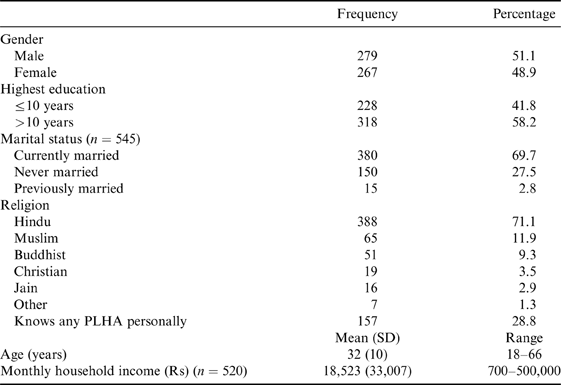
A total of 546 respondents participated in the study with nearly equal proportions of males (51%) and females (49%), and a mean age of 32 years (SD=10). Table 1 presents select socio-demographic information for this sample. More than half of the respondents (58%) had completed more than 10 years of formal education. The average monthly household income was Rs 18,523 (SD=33,006). A majority of the participants were currently married (70%). In terms of religion, a majority were Hindu (71%), followed by Muslims (12%) and Buddhists (9%). Less than one-third (29%) knew a person with HIV among friends, co-workers or in the neighbourhood, but nearly two-thirds (n=100/157) of this subgroup with an HIV-positive acquaintance reported never having any conversation about HIV with them.
Study participants by socio-demographic information, Mumbai, 2007–2008

n=546 unless otherwise indicated.
Knowledge about HIV transmission, gender attitudes and feelings towards marginalized groups
Almost all study participants had heard about AIDS (99%) and HIV (93%). However, just over one-third (39%) knew that there was a difference between HIV and AIDS, while over half (51%) said there was no difference, and 10% stated that they did not know or were not sure whether the two terms meant different things. Among those who said there was a difference between HIV and AIDS, less than half could correctly say what the difference was: 33% knew HIV was the virus and AIDS was the disease, and 42% knew HIV was the initial stage and AIDS was the disease stage. In terms of HIV transmission routes, a high percentage correctly identified unprotected sexual intercourse with a person with HIV (98%), sharing needles for drug injection with PLHA (98%) and sex with multiple partners (99%) as transmission routes, and over 80% said transmission via these routes was ‘very likely’. On average, respondents answered 71% (SD=20) of the knowledge items correctly. However, correct knowledge was mixed with several misconceptions about HIV transmission among one-quarter or one-fifth of the participants. These participants endorsed the view that sharing an item of personal use with a PLHA, such as a glass of water (24%), eating utensils (21%) or a public toilet (24%), would cause HIV infection. Misconceptions about transmission via casual contact like shaking hands or sitting close to a PLHA were endorsed by less than 5% of the sample. Women scored significantly higher on transmission misconceptions than men (0.5 vs 0.3 respectively, t(543)=−2.77, p<0.01). Participants reported fairly traditional attitudes towards gender norms with a mean (SD) of 3.4 (0.9) on a scale from 0 to 4. The ratings of different marginalized groups showed that groups associated with risky sexual behaviours and behaviours thought to be immoral – MSM, FSW, hijras, male clients of FSW and male sex workers – were rated least likeable, with mean difference scores (own gender rating minus marginalized group rating) between 39 and 58, compared with those with infectious diseases such as TB, leprosy and HIV (mean difference scores between 14 and 16) and migrants (17) or poor people (−3). Importantly, feelings towards PLHA were correlated more strongly with feelings towards other diseased groups, namely TB (r=0.67) and leprosy (r=0.73), than with feelings towards groups traditionally associated with HIV such as FSW (r=0.51), MSM (r=0.41), injecting drug users (r=0.40) and male sex workers (r=0.40) (all correlations: p<0.001).
Stigmatizing responses: avoidance intentions and denial of rights of PLHA
Avoidance intentions towards PLHA were not uniformly high. The mean (SD) Avoidance Intentions score was 1.3 (1.0) on a 0–4 scale. Situations involving potential personal contact with PLHA elicited the most avoidance intentions: 51% of respondents wanted to avoid eating from the same plate, 38% seeking health care from an infected health provider and 24% hand-feeding a PLHA. Fewer participants expressed wanting to avoid living near PLHA (18%) or visiting relatives with HIV (12%). Only 9% expressed avoidance intentions in a situation involving care for a child with HIV.
In terms of denial of PLHA rights, far more participants supported denying PLHA the right to marry (73%) and have children (82%), than denying PLHA the right to health care (5%) or to be able to maintain their job (8%). Eighteen per cent disagreed that PLHA had a right to choose to disclose their HIV status. Overall, the mean (SD) Denial of PLHA Rights score was 2.6 (0.9) out of 4.
Factors associated with stigmatizing responses
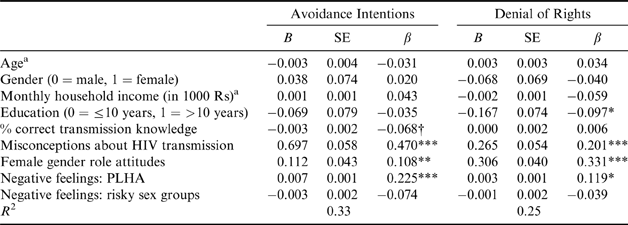
Results of the multiple linear regression analyses of Avoidance Intentions and Denial of PLHA Rights are summarized in Table 2. All predictors together accounted for 33% of the observed variance on the Avoidance Intentions scale and 25% of the variance on the Denial of Rights scale. The regression model for the Avoidance Intentions scale showed that after controlling for all other factors in the model, on average stronger misconceptions about HIV transmission (β=0.47; p<0.001), more traditional gender attitudes (β=0.11; p<0.01) and more negative feelings towards PLHA (β=0.23; p<0.001) were associated with higher avoidance intentions. Higher HIV transmission knowledge was marginally associated with lower avoidance intentions (β=−0.07, p<0.07).
Multiple linear regression results for Avoidance Intentions and Denial of Rights of PLHA, Mumbai, 2007–2008
B: unstandardized regression coefficient; SE: standard error; β: standardized regression coefficient.
a Mean centred.
†p<0.07; *p<0.05; **p<0.01; ***p<0.001.
Results from the regression model for Denial of Rights similarly showed that, on average, higher misconceptions about HIV transmission (β=0.20; p<0.001), more traditional gender attitudes (β=0.33; p<0.001) and more negative feelings towards PLHA (β=0.12; p<0.05) were related to higher endorsement of denial of rights for PLHA. In addition, respondents with more than 10 years of education had significantly lower mean Denial of Rights scores than those with less education (β=−0.10; p<0.05).
Discussion
The results of the study reveal persistence of stigma towards PLHA in Mumbai city, which was among the first few metropolitan areas in the country to roll out AIDS intervention programmes in the late 1980s. Although the mean avoidance intentions score was not uniformly high, substantial numbers of participants expressed the desire to avoid PLHA in various situations of casual contact. For example, half the participants stated they would avoid using the same plate as an infected person, more than a third would refuse treatment from an infected health provider and nearly a fifth would avoid living near a PLHA, even when these are not the modes of HIV transmission. These findings are consistent with previous studies that report fear of casual contact with PLHA as an underlying cause of stigma among the general public (Herek et al., Reference Herek, Capitanio and Widaman2002; Hong et al., Reference Hong, Anh and Ogden2004; Dias et al., Reference Dias, Matos and Goncalves2006). Avoidance intentions of PLHA within family networks seemed less strong in comparison, and the least in relation to care for a child with HIV. Both these observations seem to suggest the continuing cultural significance of family as a support network for PLHA in India (Bharat et al., Reference Bharat, Aggleton and Tyrer2001) and the tendency within society to treat children as ‘innocent’ victims. This is supported by findings in developing country settings where families show willingness to provide care to their HIV-positive sick members (Ndinda et al., Reference Ndinda, Chimbwete, McGrath and Pool2007) and children with HIV draw sympathetic responses in comparison to adult PLHA (Norman et al., Reference Norman, Abreu, Candelaria and Sala2009). Stigmatization in terms of endorsement of punitive actions against PLHA was comparatively more evident. Study participants in general expressed intolerance towards rights of HIV-positive people and endorsed coercive measures against them. Reproductive rights were particularly under scrutiny in the case of PLHA. For instance, around three-quarters of participants showed lack of respect for rights of PLHA to marry or have children. This lack of respect displayed for rights, particularly in relation to marriage and fertility intentions, calls for serious attention. By contrast, denying PLHA the right to seek health care and continue in employment was not as high. This duality of response possibly indicates people's heightened concern with PLHA as potential transmitters of infection following their marriage, pregnancy and childbirth, even as they seem to uphold their right to earn a livelihood and obtain health care. This distinction that society seems to make between PLHA in their individual roles in work settings for example, versus PLHA in their kinship and social roles, is important to note. This is a worrying finding on various accounts. Firstly, it hints at ‘blaming the PLHA’ attitude. Secondly, it indicates the limits society wants to place on PLHA to realize their normal life goals of marriage, procreation and family formation, in a way questioning their need for any ‘normalcy’ in their lives. And thirdly, such non-accommodative responses are inaccurate from the public health perspective since treatment with ART has made it possible for people to live longer and fulfil their fertility intentions. Unsympathetic public attitude towards PLHA could be based on poor understanding and knowledge about possible ways of HIV prevention within couple/marital relationships, including the role of ART for preventing mother-to-child transmission. This suggests that the rights-based approach to HIV prevention, together with public education on new HIV prevention approaches, needs greater push from all sides. Respect for the rights of PLHA and creation of an enabling environment to ensure life free from stigma and discrimination are two of the eight guiding principles in phase 3 of India's National AIDS Control Program (NACO, 2008). The study findings underscore the need to promote PLHA rights still more vigorously within the national AIDS control programme of India. They also stress the need to educate people about human rights and on advances made in the field of prevention, especially in preventing vertical transmission. NACO's efforts at supporting HIV-positive people's networks and integrating them in work and community settings are constructive steps in this direction (NACO, 2008). Educational level had the desired positive effect with regard to rights of PLHA, but importantly, not with regard to avoidance intention towards them. It appears that even the better educated, who can appreciate the rights of PLHA, lack complete knowledge on HIV as they have some unwarranted contagion fears that need to be addressed.
Correct knowledge about HIV transmission among the respondents co-existed with transmission misconceptions and, of the two, misconceptions were more strongly associated with stigmatizing responses. Misbeliefs and misconceptions linked with HIV have been reported as fuelling stigma in various other studies (Ogden & Nyblade, Reference Ogden and Nyblade2005; Ekstrand et al., Reference Ekstrand, Bharat, Ramakrishna and Heylen2012). Despite more than two decades of government Information, Education and Communication (IEC) programmes, perceived vulnerability to HIV through some forms of casual social contact remains high in this metro city, as almost a quarter of participants believed that sharing a glass of water or using the same toilet can transmit HIV. Further, this perceived risk of casual contact was strongly associated with both intentions to avoid PLHA and deny them their fundamental rights. These findings indicate that more intensive and serious efforts are required to educate the public with correct, scientific facts about casual transmission of HIV. A closer look at the misconceptions suggests that study participants seem to make a distinction between types of contacts. Simple acts of touching (hand shake) or being in proximity (sitting close) were not perceived as posing risk, but acts that had the potential of contact with body fluids (as in drinking from the same drinking glass or sharing toilets) or ingesting anything touched by an infected person (as in eating food from the same plate) were estimated to be particularly risky. One explanation for this could lie in the notion of ‘pollution’ associated with food or drinks in large parts of India. Touching of food or water by someone who is seen as ill or with an infection, or eating together with such a person, can evoke strong sentiments, as this is considered to pollute the food and cause ill health. Keeping people with an infectious condition away from food preparation activities has been reported in the context of TB in India (Atre et al., Reference Atre, Kudale, Morankar, Gosoniu and Weiss2009). A few qualitative studies on HIV-related stigma in India indeed report separation of utensils within homes (Bharat et al., Reference Bharat, Aggleton and Tyrer2001), or preventing HIV-infected women from cooking (Pallikadavath et al., Reference Pallikadavath, Garda, Apte, Freedman and Stones2005) as instances of discrimination. IEC campaigns in India need to focus particularly on such exaggerated fears as the basis of discrimination that derive their meanings from local cultural practices and norms. Greater efforts are needed to develop culturally relevant messages that can dispel such fears.
Among the marginalized groups, the least liked groups were those linked with behaviours considered immoral, and with ‘deviant’ identities such as FSW and MSM, followed by those with diseases such as leprosy and TB. These results reveal the levels of misunderstanding in the public about groups with socially disapproved status, alternative sexuality and curable health conditions underscoring the need for customized IEC campaigns to create better social awareness. At another level these findings seem to suggest that diseased groups perhaps elicit some amount of sympathy compared to those engaging in behaviours considered socially undesirable. However, despite the strong negative feelings for the ‘risky sex’ groups of FSW, MSM and male clients of FSW, it was the dislike for the PLHA subgroup that was a strong and significant predictor of avoidance intentions and denial of PLHA rights. It is possible that for the study respondents PLHA represent in symbolic terms all the marginalized groups associated with AIDS and, being infected with the virus, the more obvious target of their dislike and stigmatization. In the light of this observation, the positive correlation of feelings towards PLHA with feelings towards other diseased groups (TB, leprosy) is important to note. When considered together with high HIV transmission misconceptions, or instrumental stigma, and denying PLHA the right to marry and have children reported above, it appears that stigmatizing attitudes in this study sample can perhaps be better explained as fear of contagion and infection transmission than as symbolic stigma. In other words, AIDS stigma perhaps serves the function of ‘avoidance of disease’ more than of ‘norm enforcement’ in this study sample. In general, respondents seem to be more concerned about keeping infection away from them through avoidance behaviour than about passing judgments on HIV status of others. In a recent paper Phelan et al. (Reference Phelan, Link and Dovidio2008) theorized that attention to functions of stigma is important in efforts to reduce stigma. Although more research is needed to support this observation, the results presented here suggest that the ‘disease avoidance’ function of stigma related to AIDS be given serious consideration and be combined with the strategy of promoting a rights-based approach to stigma reduction. In programmatic terms this would imply adopting twin strategies of PLHA rights promotion and public education to reduce overestimation of risk perception in casual interactions with PLHA.
As expected, based on previous research (e.g. Bharat et al., Reference Bharat, Aggleton and Tyrer2001; Mbonu et al., Reference Mbonu, Van Den Borne and De Vries2010), traditional gender attitudes were strongly associated with both avoidance intentions towards PLHA and denial of their rights. This is in accordance with the idea that AIDS stigma is a vehicle to express dislike towards marginalized groups, including women, and to reinforce gender-biased norms and values in society. Thus, dual norms for men and women that condone male sexual behaviour and proscribe women for that same behaviour, and norms that distinguish ‘good women’ from ‘bad women’ in terms of their sexual conduct, underlie dislike shown towards PLHA who are seen transgressing norms of moral conduct and traditional gender relations. Understandably, respondents with these highly gendered values stigmatize PLHA more, holding them responsible for their infection and arguing against granting them their basic human rights to marry and found a family. These data support findings from previous Indian studies on the gender dimension of HIV/AIDS (Bharat et al., Reference Bharat, Aggleton and Tyrer2001; Pallikadavath et al., Reference Pallikadavath, Garda, Apte, Freedman and Stones2005) and also those in the context of other stigmatizing diseases such as TB (Somma et al., Reference Somma, Thomas, Karim, Kemp, Arias and Auer2008; Atre et al., Reference Atre, Kudale, Morankar, Gosoniu and Weiss2009). Biased gender norms explain why women with HIV are blamed for their partner's infection, judged more harshly for their positive sero-status and experience greater stigma and discrimination in nearly all parts of the world. A recent Nigerian study, for example, has explained reactions towards PLHA in terms of gender-related power differentials and traditional gender norms (Mbonu et al., Reference Mbonu, Van Den Borne and De Vries2010). Clearly these findings argue for structural interventions such as programmes to transform gender norms and attitudes in society to tackle the entrenched gender inequality and biases for AIDS stigma reduction programmes to become effective and succeed. Together with this, improving HIV information, removing misconceptions and promoting a rights-based approach to addressing the twin issues of avoidance behaviour and rights violation should also be a priority with stigma reduction interventions.
Acknowledgment
This paper is based on research supported by the Fogarty International Center at the National Institutes of Health (RO1 TW6314, M. L. Ekstrand, Principal Investigator).