INTRODUCTION
The anthropogenic movement of marine species has been increasing in recent times due to enhanced human transport mechanisms throughout the world's oceans (Ruiz et al., Reference Ruiz, Fofonoff, Carlton, Wonham and Hines2000a; Kaluza et al., Reference Kaluza, Kölzsch, Gastner and Blasius2010). To date the greatest proportion of marine invasions has been facilitated by the international commercial shipping industry through the transportation of large numbers of animal and plant species in ballast water and hull fouling (Ruiz et al., Reference Ruiz, Fofonoff, Carlton, Wonham and Hines2000a, Reference Ruiz, Rawlings, Dobbs, Drake, Mullady, Huq and Colwellb).
The transportation of fouling species on the hulls of ships is probably the most ancient vector of introductions for marine species such as sponges, hydroids, corals, sessile polychaetes, barnacles, mussels, bryozoans, ascidians and macroalgae (Carlton & Hodder, Reference Carlton and Hodder1995). These new members of a so-called ‘fouling community’ may find specific conditions within harbours and marinas that could facilitate their establishment (Minchin & Gollasch, Reference Minchin and Gollasch2003). For example, metals such as copper and zinc are typical pollutants within harbours and marinas that can appear in the form of antifouling paints or industrial waste and several studies have linked high abundance of non-indigenous species (NIS) with elevated concentrations of copper (Piola & Johnston, Reference Piola and Johnston2008; Canning-Clode et al., Reference Canning-Clode, Fofonoff, Riedel, Torchin and Ruiz2011; Crooks et al., Reference Crooks, Chang and Ruiz2011).
Bryozoans constitute a group of colonial invertebrate marine benthic systems and several appear in biofouling communities (Gollasch, Reference Gollasch2002) providing a mechanism for their movement with boating and shipping activities. Particularly in Portugal, several recent studies have contributed to an updated inventory of bryozoans, including both mainland and islands (Marchini et al., Reference Marchini, Cunha and Occhipinti-Ambrogi2007; Canning-Clode et al., Reference Canning-Clode, Kaufmann, Wahl, Molis and Lenz2008, Reference Canning-Clode, Fofonoff, McCann, Carlton and Ruiz2013; Amat & Tempera, Reference Amat and Tempera2009; Wirtz & Canning-Clode, Reference Wirtz and Canning-Clode2009; Souto et al., Reference Souto, Reverter-Gil and Fernández-Pulpeiro2010).
Celleporaria brunnea (Hincks, Reference Hincks1884) was originally described from British Columbia by Hincks (Reference Hincks1884) and is considered a very common species on the Pacific coast of North America, particularly on the California coast (Soule, Reference Soule1961; Soule & Soule, Reference Soule and Soule1964). The west coast distribution extends from British Columbia to the Galapagos Islands, Ecuador (O'Donoghue & O'Donoghue, Reference O'Donoghue and O'Donoghue1926; Hastings, Reference Hastings1929; Soule, Reference Soule1961; Soule & Soule, Reference Soule and Soule1964; Osman & Haugsness, Reference Osman and Haugsness1981; Keough & Downes, Reference Keough and Downes1982). More recently, Celleporaria brunnea was found in the eastern Mediterranean, from the Aegean Sea and this record was considered the first invasive record of Celleporaria brunnea in the Mediterranean (Koçak, Reference Koçak2007; Çinar et al., Reference Çinar, Katağan, Koçak, Öztürk, Ergen, Kocatas, Önen, Kirkim, Bakir, Kurt, Dağli, Açik, Doğan and Özcan2008). The present study, which was conducted as part of a broader field survey to examine NIS in Portuguese marinas (João Canning-Clode, unpublished), reports the first record of Celloporaria brunnea in both Portugal and the wider East Atlantic region.
MATERIALS AND METHODS
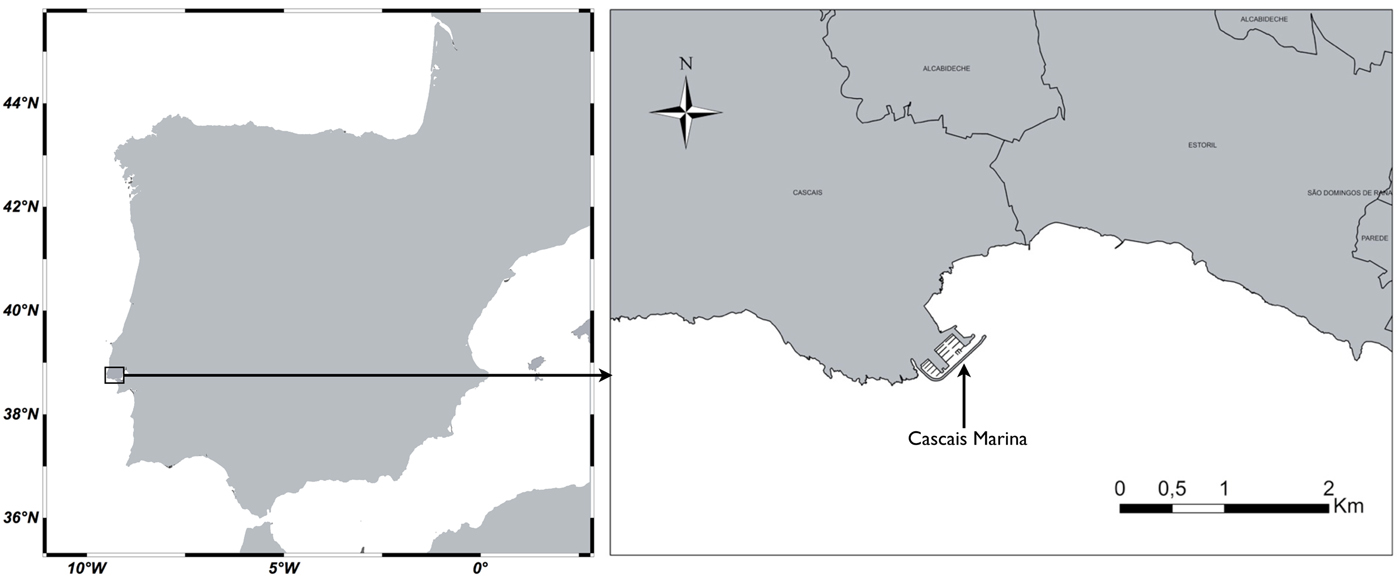
A field survey was conducted over a 3-month period (June–September 2012) simultaneously at three marinas on the Portuguese mainland: Cascais marina (38°41′N 9°25′W), Setúbal marina (38°31′N 8°53′W) and Sines marina (37°57′N 8°51′W). However, Celloporaria brunnea was only found in Cascais marina, located west of Estoril in the greater Lisbon area (Figure 1). We deployed five grey polyvinylchloride plates (PVC, 10 × 10 × 0.4 cm), which were mounted on bricks using cable ties, and suspended vertically on individual racks underneath docks at approximately 0.5 m depth. Minimum distance between racks was 2 m. After three months of colonization, PVC plates were detached and retrieved from the field and photographed. Species richness and abundance were determined by recording the number of species identified from the photographs using the image analysis software CPCe (Kohler & Gill, Reference Kohler and Gill2006). Moreover, plates were examined using a dissecting microscope for better resolution.
Celleporaria brunnea was detected on PVC settling plates deployed at Cascais marina, located at approximately 25 km west of Lisbon, Portugal.

Samples of Celleporaria brunnea were examined with a Leica MZ12 stereomicroscope. Some fragments of the specimens were treated with bleach for observation by scanning electron microscopy (SEM). The photographs were taken with an Inspect S50 SEM, from uncoated material, with a back-scattered electrons detector in the low vacuum mode. Measurements were taken with the software ImageJ (Rasband, Reference Rasband2012) on the SEM photographs. A voucher specimen of Celleporaria brunnea from Cascais marina has been deposited at the Museu de História Natural do Funchal, Madeira, under the Accession number MMF 42534.
RESULTS
SYSTEMATICS
Class GYMNOLAEMATA Allman, 1856
Order CHEILOSTOMATIDA Busk, 1852
Family LEPRALIELLIDAE Vigneaux, 1949
Genus Celleporaria Lamouroux, 1821
Celleporaria brunnea (Hincks, Reference Hincks1884)
(Figure 2; Table 1)
Cellepora brunnea Hincks, Reference Hincks1884, p. 56; O'Donoghue & O'Donoghue, Reference O'Donoghue and O'Donoghue1926, p. 21.
Holoporella brunnea: Hastings, Reference Hastings1929, p. 731, p. 16, figures 7 & 108–110; Osburn, Reference Osburn1952, p. 496, pl. 62, figures 10–12; Soule, Reference Soule1961, p. 33; Soule & Soule, Reference Soule and Soule1964, p. 38, figures 13 & 14.
Celleporaria brunnea: Koçak, Reference Koçak2007, p. 192, figure 2A–D; Seo & Min, Reference Seo and Min2009, p. 29, figure 7.
Measurements (in mm) of Celleporaria brunnea specimens from Cascais marina, Portugal.

MATERIAL EXAMINED
Number of collection: MMF 42534; Celleporaria brunnea; Cascais, Portugal (38°41′N 9°25′W).
DIAGNOSIS
Irregular encrusting colony, unilaminar or multilaminar (Figure 2A). Opercula and mandibles dark brown in colour, zooids white to grey, and lophophore tentacles brown, all characters distinctive to the species (Figure 2B). Autozooids rectangular, in radiating linear series in the first layer, but more irregular in position and morphology in areas of frontal budding. Frontal wall granular, more when the secondary calcification is extensive, with a marginal pore series. Primary orifice slightly wider than long (Figure 2C). Distal margin rounded, and proximal margin lightly bowed with a single large, rounded central sinus, often pinched together at the top so that the sinus is almost closed. Two widely spaced, distal, oral spines present in early ontogeny, later lost, and their bases obscured by calcification. Orifice rounded with a slight peristome, raised proximally, with an umbo that supports an oval suboral-avicularium, with toothed distal rim, perpendicular to frontal plane. Vicarious avicularia large, spatulate, with dark brown spade shaped columella, a parallel-side rostrum (Figure 2E). Ovicell non-cleitral, widely open (Figure 2D); covered by the granular secondary calcification.
Scanning electron microscopy photographs of Celleporaria brunnea specimens collected at Cascais marina, Portugal: (A) colony; (B) zooids from the first layer; (C) orifice; (D) ovicell; (E) spatulate avicularium.

REMARKS
The identification of our specimens was according to the original description (Hincks, Reference Hincks1884) and later and more recent descriptions (ex. Soule, Reference Soule1961; Koçak, Reference Koçak2007). Colonies of Celleporaria brunnea were present in all five settling plates with 3% mean cover. Other bryozoan species were very abundant in the PVC plates namely, Crisia cf. denticulata (35%) and Umbonulla ovicellata Hastings, 1944 (15%), and the other invasive species Watersipora subtorquata (35% mean cover).
DISCUSSION
The Celleporaria comprise a large genus that include some 89 recent species (Bock, Reference Bock, Bock and Gordon2012b) and 37 fossils (Bock, Reference Bock2012a). Living species are primarily native to the Pacific and Indian Oceans, with only some 13 species in western Atlantic waters. Our findings indicate that to the best of our knowledge, this is the first record of Celleporaria brunnea in the East Atlantic region and the first record of a species of this genus in the north-eastern Atlantic.
The native range of Celleporaria brunnea is unclear, though existing data suggest it is likely in the Americas. Its distribution on the west coast of North America extends from British Columbia to the Galapagos Islands, Ecuador. Palaeontological surveys of the fossil record (NMITA, 2012) of Caribbean and Pacific Panama yielded one record on the Pacific, near the border with Costa Rica, and many records from the Caribbean western Atlantic, including Costa Rica, the Dominican Republic and Atlantic Panama, from at least as far back as the Pliocene, suggesting that the species may have been present on both sides of Panama before the isthmus formed. However, the authors have not examined this material and SEMs available on the NMITA website suggest the material may comprise more than one species. Osburn (Reference Osburn1952) indicated that his earlier records under Holoporella vagans from Puerto Rico and Bermuda, and those of Canu & Bassler (Reference Canu and Bassler1928) from Florida were also very likely Celleporaria brunnea. All of these records need to be examined more carefully and compared to present-day material.
In 2004, this species was detected in the Aegean Sea, eastern Mediterranean (Koçak, Reference Koçak2007; Çinar et al., Reference Çinar, Katağan, Koçak, Öztürk, Ergen, Kocatas, Önen, Kirkim, Bakir, Kurt, Dağli, Açik, Doğan and Özcan2008), for the first time. The specimens were attached to Mytilus galloprovincialis, in a fouling community with at least six other NIS (4 Polychaeta, 1 Isopoda, 1 Bivalve). These authors suggest Celleporaria brunnea was probably introduced into the Mediterranean via hull fouling. This bryozoan has also recently been found in Korea (Seo & Min, Reference Seo and Min2009), but has not been recorded elsewhere in the western Pacific. Its presence as a common biofouling species on ships (Linda McCann, unpublished data) and artificial substrates may have facilitated its spread to the western Pacific, Mediterranean and eastern Atlantic from the Americas.
ACKNOWLEDGEMENTS
João Canning-Clode holds a FCT post-doctoral grant (SFRH/BPD/75775/2011). Current funding of Javier Souto is provided by the Austrian FWF (Lise Meitner Program No. M1444-B25). We thank two anonymous referees for helpful criticism and suggestions that improved an earlier version of this manuscript. This is contribution number 21 from the Marine Biology Station of Funchal.