Introduction
Imagine the ability to generate electric power simply by stretching and relaxing a low-cost rubbery material. Such is the promise of electroactive polymers and, in particular, the type of electroactive polymer known as the “dielectric elastomer.” The term electroactive polymers (EAPs) typically refers to materials that can deform in response to the application of an electrical stimulus (although other mechanical responses are possible too). The many types of EAPs can be divided into two categories: ionic, where mass transport from a flowing charge causes the deformation; and electronic, where a voltage-induced electric field creates the deformation. Bar-CohenReference Bar-Cohen1 and CarpiReference Carpi, Kiil, Kornbluh, Sommer-Larsen, Alici and Borgmann2 provide good reviews of EAPs. EAPs offer unique properties compared with more conventional transducer technologies, such as those based on rigid materials such as piezoelectrics, magnetostrictives, or electromagnetics. Because of the relatively soft polymer composition and large strain, response can be similar to that of natural muscle; such EAPs are often called “artificial muscles” and find applications in biologically inspired robots, as well as human prosthetic or orthotic devices.
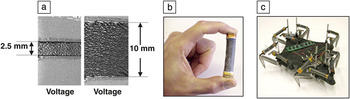
Dielectric elastomers, a type of electronic EAP, have shown great promise for a variety of applications. Dielectric elastomer transducers are composed of deformable polymer films that respond to an electric field applied across their thickness. In a sense, they are stretchable capacitors. When acting as an actuator, dielectric elastomers are capable of large strains (in some cases >100%),Reference Pelrine, Kornbluh, Pei and Joseph3 with the relatively fast response and high efficiency associated with electric-field-activated materials.Reference Kornbluh, Pelrine, Pei, Oh and Joseph4 A number of materials, including relatively inexpensive, commercially available ones such as natural rubber, silicone rubbers, and acrylic elastomers, can be used for the component materials of dielectric elastomers. The elastomers can be quite soft, suggesting their potential for a variety of applications involving human interaction or unusual load-matching requirements. The simple structure, wide availability, and unique properties of dielectric elastomers have allowed researchers to explore their use in a wide variety of actuator applications. Brochu and PeiReference Brochu and Pei5 and Carpi et al.Reference Carpi, DeRossi, Kornbluh, Pelrine and Sommer-Larsen6 include surveys of state-of-the-art dielectric elastomers in their reviews. Figure 1 shows an example of how dielectric elastomers can be incorporated into a muscle-like actuator. While the promise of muscle-like actuation technology has not yet been completely fulfilled, dielectric elastomers are more than laboratory curiosities and are emerging on the commercial market. Artificial Muscle, Inc. (Sunnyvale, California, USA) is now providing actuators that are incorporated into a handheld gaming console to provide enhanced tactile feedback.
Example of dielectric elastomer actuation: acrylic elastomer material undergoing 300% linear strain (a), material incorporated into a linear roll-type “artificial muscle” actuator (b), and artificial muscle actuators incorporated into a biologically inspired six-legged robot (c). Source: SRI International.

Although first reported in 2001,Reference Pelrine, Kornbluh, Eckerle, Jeuck, Oh, Pei and Stanford7 the use of dielectric elastomers as electrical power generators has been less widespread. Only in the past two years has research in their use as generators increased dramatically, as evidenced by an increase in the number of publications on this topic (some of which are cited herein). Interest in new approaches to power generation is not surprising, given the interest in developing clean and renewable sources of energy, as well as more convenient ways to recharge the batteries of the ever-growing number of power-hungry mobile electronic devices. This article considers applications that address both needs as it presents the promises and challenges of dielectric elastomer energy harvesting. First, the basic technology of dielectric elastomers and their use in electric power generation is presented. It will be evident that dielectric elastomer transducers are indeed stretchable capacitors and thus fit the stretchable electronics theme of this special issue. Next, the use of this technology for power generation is discussed. Specific examples of a variety of dielectric elastomer generators (shoe-mounted generators, ocean wave harvesters, and a new type of fuel-burning engine-generator system) are presented. Finally, the challenges to the adoption of this technology for power generation are discussed.
Much of the information in this article is derived from the authors’ own experiences developing dielectric elastomer energy-harvesting systems for applications, including power-generating boots and buoys that harvest the power of ocean waves. Additional information on such generators may be found in articles by Ashley,Reference Ashley8 Chiba et al.,Reference Chiba, Waki, Kornbluh and Pelrine9 and Prahlad et al.Reference Prahlad, Kornbluh, Pelrine, Stanford, Eckerle and Oh10
Background on dielectric elastomer power generation
Principles of operation
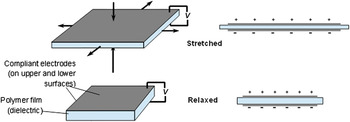
The basic operational element of a dielectric elastomer generator, shown in Figure 2, is a film of an elastically deformable, insulating polymer that is coated on each side with a compliant electrode. In generator mode, dielectric elastomers convert the mechanical work of stretching the polymer film into electrical energy. To achieve this conversion, it is necessary to add electrical charge to the surface of the polymer film while it is in a stretched state, allowing the elastic forces on the film to relax the film to a state of lower stretch. When the film relaxes, it shrinks in area and increases in thickness. If most of the charge on the film is conserved, then both geometric effects tend to increase the electrical energy on the film, since like charges on each electrode are forced together while unlike charges on the opposite electrodes are pulled apart. This increase in energy may be many times greater than that required to initially place the charge on the film.
Basic operational element of a dielectric elastomer generator: perspective view (left) and edge view (right). Note: V, applied voltage. Source: SRI International.

The maximum amount of energy that can be converted using a given amount of film depends on the material properties. Several different material properties come into play, including the maximum strain that can be imposed before mechanical failure, the maximum electric field that can be supported before electrical breakdown, and the need to maintain elastic restoring forces.
Writing simple equations for the amount of energy that can be extracted is not easy, due to the highly nonlinear elastic behavior and the complex interactions with the energy source. If we assume that a given amount of stretch can be imposed on the film, it is easier to see how a “stretchable capacitor” generator functions and how certain material and operational parameters affect the amount of energy generated.
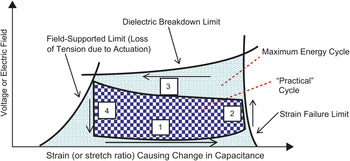
While we cannot immediately discern the maximum amount of energy that can be produced from a given volume of material by this simplification, we can determine the energy output for certain operational cycles. There are four basic steps in the simplest operational cycles: (1) the film is stretched by tensile forces to its maximum stretch state; (2) a voltage or charge is applied to the film; (3) the film relaxes from its internal elastic energy; and (4) charge is removed from the film to return it to its initial state. Three common operational cycles are constant charge, constant voltage, and constant field. The names of these cycles refer to what occurs during step 3.
Figure 3 illustrates an energy-harvesting cycle. Note that the cycles must all be contained within the operational boundaries defined by the material limitations. The horizontal axis is a variable that represents the geometric change in the film, which is related to the change in capacitance. The vertical axis is the square of the voltage or electric field across the film. By choosing the correct variables, the energy that can be extracted for each cycle (not including losses) is proportional to the area enclosed by the cycle curve (e.g., capacitance versus the voltage squared).
Graphic representation of performance limits and energy cycles. Key to steps indicated in the figure: (1) The film is stretched by tensile forces to its maximum stretch state; (2) a voltage or charge is applied to the film; (3) the film relaxes from its internal elastic energy; and (4) charge is removed from the film to return it to its initial state.

The net amount of energy per unit volume of film that can be extracted for the constant charge (uQ), constant voltage (uV), and constant field (uE) cycles, respectively, areReference Graf, Maas and Schapeler11



where E elmax is the maximum field that is applied during the cycle, εp is the permittivity of the film, and γ is the area stretch ratio (stretched area/unstretched area). These equations show the benefits of one cycle compared with another for different stretch conditions if we select materials based on the maximum field level. It is possible to implement cycles that can exceed these energy outputs by more closely approaching the material performance limits or including lower losses. Electrical losses result from resistive losses in the electrodes and leakage losses across the film, as well as additional losses in the harvesting circuit and any storage or transmission systems. Graf et al.Reference Graf, Maas and Schapeler12 were able to model these losses by making simplifying assumptions, such as constant polymer material conductivity and electrode resistance. Mechanical losses include viscoelastic losses in the polymer and electrodes, as well as those in any mechanical transmission system that couples to the external driving loads.
Materials
The performance of a material for dielectric elastomer generators depends on a combination of electrical and mechanical properties. From the simplified analysis of energy harvesting presented previously, it can be seen that it is generally desirable to have a material that has high dielectric breakdown strength and high permittivity (dielectric constant). To minimize losses, it is desirable to select a material with low leakage and other dielectric losses. The importance of leakage depends on the frequency of operation. A vibrational energy-harvesting system might operate at more than 100 Hz, while an ocean wave power harvesting system might operate at less than 0.1 Hz. On the mechanical side, it is generally desirable to have a material that can sustain large stretch ratios. It is also desirable to minimize viscoelastic losses as well as creep and stress relaxation effects.
The question of selecting the best material stiffness is more complex. At first glance, it would seem best to choose a material with a low stiffness so that smaller forces are needed to produce the desired polymer stretch, allowing a simpler generator structure and fewer mechanical losses. However, softer materials may experience a loss of tension in the film in the field-supported region of operation at a lower electric field. Further, many soft materials would be more prone to pull-in failure (a mode of electrical failure caused by opposing electrodes attracting each other with a force greater than the opposing force offered by the elasticity of the dielectric material that separates them) due to mechanical instabilities resulting from film defects or thinner film regions (a source of dielectric failure in softer insulating films).Reference Pelrine, Kornbluh and Joseph13
The most common candidate materials considered for dielectric elastomer generators, the same as for dielectric elastomer actuators, are those based on commercial formulations of acrylics and silicones.Reference Carpi, DeRossi, Kornbluh, Pelrine and Somer-Larsen14 These materials have a favorable combination of high dielectric breakdown strength, high elongation, and relatively low mechanical and electrical losses. Other materials under development by researchers include styrene ethylene butadiene styrene and acrylonitrile rubbers, as well as polyurethane-based polymers.Reference Pelrine, Kornbluh, Pei and Joseph3 Recognizing the advantages of high permittivity in achieving greater energy density (as is evident from Equations 1, 2, and 3, for example), many researchers have experimented with adding particulates to elastomers to increase the permittivity (summarized in Brochu and PeiReference Brochu and Pei5). Recently, Kofod et al.Reference Kofod, McCarthy, Stoyanov, Kollosche, Risse, Ragusch, Rychkov, Dansachmuller and Wache15 have shown that certain nanoparticles can increase the dielectric constant of the elastomers without adversely affecting the breakdown strength or leakage.
It is important to note that the best choice of material may not be the one capable of the greatest energy density; there are also economic considerations. The effect of economic factors is more critical in large-scale energy harvesting (such as ocean wave power, as discussed later). Koh et al.Reference Koh, Keplinger, Li, Bauer and Suo16 have rigorously modeled the electromechanics of this interaction for the simplified case of uniform biaxial stretching. They use a nonlinear material model to show how under some operating conditions, natural rubber can outperform 3M VHB acrylic, a material that offers favorable properties for many dielectric elastomer applications.Reference Pelrine, Kornbluh, Pei and Joseph3
In addition to the dielectric material, the overall performance of a dielectric generator is also based on the electrode material that coats the surfaces of the films. In general, it is desirable to make the electrode as compliant as possible. Because dielectric elastomers typically operate at high voltage and low current conditions, it is acceptable to use relatively high resistance materials for the electrodes. Electrode materials for dielectric elastomers typically include various carbon particles in polymer binders or patterned or corrugated metal coatings.Reference Carpi, DeRossi, Kornbluh, Pelrine and Somer-Larsen17 Most research on electrodes has been oriented toward actuation. For energy generation, the requirements are similar, except that the materials may have to undergo even larger strains.
Recently, a silicone dielectric elastomer material already coated with a compliant electrode material (corrugated silver) was introduced to the market.Reference Benslimane, Kiil and Tryson18 We also note that the 3M VHB acrylic (uncoated dielectric elastomer) is also available in large quantities. The fact that such materials can be manufactured in large-scale roll-to-roll operations supports the feasibility of large-scale power generation.
Transducer configurations
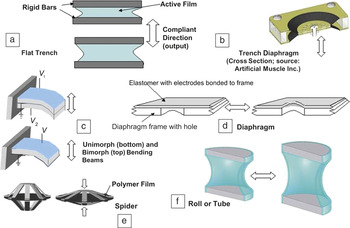
The basic operational element of Figure 1 must be incorporated into a transducer or structure that allows the stretching of the film to be coupled with the forces that cause stretching. KornbluhReference Kornbluh, Carpi, DeRossi, Kornbluh, Pelrine and Sommer-Larsen19 has surveyed a variety of configurations for actuators. These same configurations can also be applied to generators. Figure 4 shows several important configurations, many of which have been used in the application examples in the following section.
Configurations for dielectric elastomer generators. For the (a) flat trench, (c) bending beams, and (f) roll or tube configurations; the dielectric elastomer film is indicated with a bluish color. For the (b) trench diaphragm and (e) spider configurations, the dielectric elastomer film is colored black. For the (f) diaphragm configuration, the dielectric elastomer film is colored gray. V is the applied voltage. V 1 and V 2 are applied voltage to the upper and lower actuator regions. (The bimorph type of actuator contains two regions of actuation on either side of a thin flexible but non-extensible material, such as polyimide. The unimorph contains a single actuation region on one side of the flexible material.) Source: SRI International.

The selection of the best configuration depends on many factors, including the type of driving force and mechanical transmission, operating strain, total amount of film needed, and the desired form factor. It is desirable for the boundary conditions to impose a uniform strain over the entire range of operation (stretch the film evenly) such that there are no concentrations of electric field or mechanical stress that would prematurely damage the film. The examples in Figure 4 come close to this ideal, but it is difficult to avoid some stress or field concentrations at the edges.
Unique capabilities of dielectric elastomers for energy harvesting
Comparison with other technologies
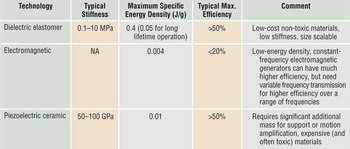
We have already touched on some of the unique properties of dielectric elastomers and the implications for energy harvesting. Table I quantifies some of these properties and compares them with common power generation technologies.
Comparison of dielectric elastomer with other power generation technologies.Reference Pelrine, Prahlad, Carpi, DeRossi, Kornbluh, Pelrine and Sommer-Larsen20, Reference Jean-Mistral, Basrour and Chaillout21

Source: SRI International.
Other electronic (electric-field responsive) electroactive polymers besides dielectric elastomers, such as ferroelectric polymers (which often include a polyvinylidene fluoride component) and composites that include piezoelectric ceramics, have not shown the capacity for large energy densities (e.g., Liu,Reference Liu, Ren, Hofmann and Zhang22 Jean-Mistral et al.Reference Jean-Mistral, Basrour and Chaillout21). Jean-Mistral et al. also noted that wet (ionic) electroactive polymers have not shown high energy densities. These include conductive polymers and ionic polymer metal composites. Further, these materials are generally more expensive than dielectric elastomers and cannot yet be readily made into the large-area films needed for large-scale power production.
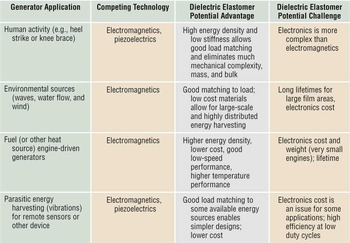
A great many potential energy generation applications can take advantage of the benefits of dielectric elastomer generators. Table II highlights the potential benefits of dielectric elastomers for several categories of energy sources. The following sections give examples of dielectric elastomer generators in the first three application categories of Table II.
Advantages of dielectric elastomers for various energy sources.

Source: SRI International.
Human activity—Heel-strike generator
The proliferation of mobile electronics for the general public, soldiers, and emergency first responders has put demands on the life of batteries and has introduced the need to simplify the logistics of recharging systems. Harvesting the energy of human activity can help.
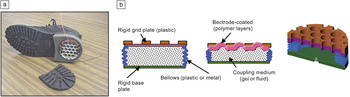
The current authors have developed a “heel-strike generator” that can be located in a normal shoe or boot.Reference Ashley8 The compression of the heel during normal walking was selected as the means of harvesting power from human activity because it does not add any physical burden to the wearer. Further, proper tuning of the amount of energy absorption at the heel could actually increase the comfort or walking efficiency of the wearer by absorbing and returning the optimal amount of energy per step. This device, shown in Figure 5, produced an electrical output of 0.8 J per step, or about 1 W. The dielectric elastomer generator is a diaphragm type that uses a fluid (or gel) coupling to transfer the compression of the heel into deflection of the diaphragm. The diaphragms in this device consist of 20 stacked layers of dielectric elastomer films. While intended primarily for battery charging, the device also directly powered night vision goggles with the high-voltage output from the energy harvesting circuit stimulating a photomultiplier tube. This device used prestrained VHB 4910 acrylic and performed with a maximum energy density of about 0.3 J/g.Reference Kornbluh, Pelrine, Prahlad, Wong-Foy, McCoy, Kim, Eckerle and Low23
Heel-strike generator based on a dielectric elastomer: photo of the device installed in boot (a) and a cross-section of the device (b). Source: SRI International.

This power level far exceeds outputs demonstrated by many other more complex, more costly, and heavier heel-strike generators based on direct deformation of piezoelectric elements,Reference Paradiso and Starner24 as well as that which would be possible with direct-drive electromagnetic devices (note the 100x difference in specific energy shown in Table I). The power level therefore supports the claims of high efficiency and energy density possible with dielectric elastomers. By comparison, one can roughly estimate the available energy per step as weight times the maximum deflection of the heel. Based on this example, 2.4 J of energy is available from an 80 kg person with a maximum of 3 mm diaphragm deflection.
Environmental sources—Wave energy harvesting
New clean and renewable sources of electric power are critical as the world moves toward a more secure and sustainable energy future. Ocean wave power has the potential to produce clean, renewable energy in an environmentally sound manner that offers greater reliability than solar or wind, and lower visual and auditory impact than wind. Further, this energy source tends to be available near many centers of population and industry. The Electric Power Research Institute estimates that wave energy could potentially meet 10% of total worldwide electric demand.25 Recently, the U.S. Department of Energy estimated that more than 25% of the United States’ electrical power needs could, in principle, be met by harvesting ocean wave energy.26
Ocean wave power is not yet used for electrical power generation to any significant degree. Widespread adoption of wave power harvesting is hampered by certain economic and logistical factors. For instance, the primary converter structure of conventional ocean wave power harvesting systems must be over-engineered to deal with high sea events (such as storms that cause high wave activity), and, as a result, these systems are very expensive. Similarly, efficient power take-off systems (the structure and transmission systems needed to convert the hydrodynamic energy into electrical power) are typically highly complex and expensive. Dielectric elastomers can potentially address these issues by enabling a simple, low-cost power take-off system.
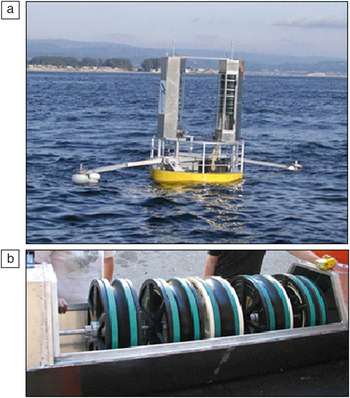
The use of dielectric elastomers for harvesting the energy of ocean waves has been demonstrated. This work included two sea trials during which a complete energy-harvesting system was deployed at sea. The first system was based on a suspended proof mass that stretched the spring-like dielectric elastomer material as the buoy heaved on the waves. The roll type of configuration was used (see Figure 4).Reference Chiba, Waki, Kornbluh and Pelrine9 The system was a proof-of-principle demonstration of how a buoy, such as a navigation buoy, might use ocean waves to power its onboard lighting or instrumentation and communications systems. The proof-mass approach is not practical for large-scale, grid-level power generation due to the large proof mass that would be needed. Therefore, we developed a proof-of-principle system based on the direct conversion of hydrodynamic energy to mechanically stretch and contract the dielectric elastomer.Reference Kornbluh, Pelrine, Prahlad, Wong-Foy, McCoy, Kim, Eckerle and Low23 This system is shown in Figure 6. For logistical convenience, the system used the same oceanographic buoy platform as the proof-mass system. An optimum system would likely not use such a platform.
Dielectric elastomer ocean wave power generator based on an articulated, multibody system buoy at sea trial site (a); concatenated rolls in a generator module (b). When a wave passes, the outriggers move relative to the buoy and stretch the rolls using a lever arm. The green-edged black material between the rings (visible in the bottom photo) is the electrode-coated dielectric elastomer material. Photos courtesy of SRI International.

The system was tested at sea in the Pacific Ocean near Santa Cruz, California. The device produced an output of more than 25 J in laboratory testing. It used about 220 g of active dielectric elastomer material for a corresponding energy density of more than 0.1 J/g. At sea, the maximum voltage applied to the dielectric elastomer was deliberately limited to conservatively guard against inadvertent failure, and the system only produced about half this energy density. The energy-harvesting circuit used in the sea trial was 78% efficient;Reference Kornbluh, Pelrine, Prahlad, Wong-Foy, McCoy, Kim, Eckerle and Low23 that is, it harvested 78% of the expected energy for the particular energy-harvesting cycle used. This performance level suggests that dielectric elastomers may indeed be practical for large-scale power generation.
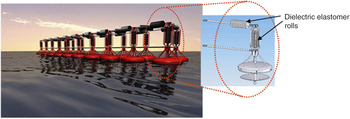
The ocean wave energy harvesting buoys described previously were proof-of-principle systems whose structure and mechanics were not optimized for maximum efficiency or economic benefit. The low cost and simplicity of using dielectric elastomer materials for energy harvesting can enable fundamentally new system designs. Figure 7 shows a conceptual design of such a generator. The basic harvesting element is similar to that used in the single buoy device shown in Figure 6, but here it is built into a highly modular system that can be easily assembled and transported. (The individual modules can each be transported by truck.)Reference Kornbluh, Pelrine, Prahlad, Wong-Foy, McCoy, Kim, Eckerle and Low23 Its size can be tailored to the prevailing wave conditions (e.g., open ocean deep water waves versus waves that might hit an existing seawall or breakwater).
Highly modular distributed ocean wave energy harvesting system based on dielectric elastomer transducers. The system is composed of individual floating buoys (shown in red) connected by dielectric elastomer rolled transducers. Additional buoys can be added to make the system longer or wider as desired. Source: SRI International.

Fuel or heat sources—Polymer engine generator
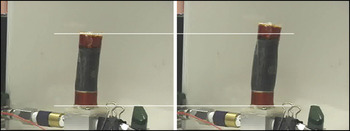
A dielectric elastomer heat engine has been demonstrated by making the engine cylinder itself out of dielectric elastomer.Reference Prahlad, Kornbluh, Pelrine, Stanford, Eckerle and Oh10 In other words, expanding gases directly drive the expansion of the dielectric elastomer. In addition to minimizing mass and structure, this approach allows for greater efficiency of a small engine because of fewer losses from fuel leakage or friction of sliding seals, less wear, and potentially less heat loss for the same mass, since the polymer is a better thermal insulator. This work demonstrated that a polymer cylinder can indeed sustain the temperature of combustion and can provide 11% fuel-to-mechanical efficiency—a good value for a small (<20 W) engine. Figure 8 shows the expansion of a rolled dielectric elastomer actuator due to combustion of butane. A small, milliwatt-level amount of electrical power was generated with this proof-of-principle device.
Dielectric elastomer cylinder of a “polymer engine” undergoing 23% linear expansion during internal combustion. A rolled transducer made with an acrylic elastomer was used. Butane was the combustion fuel. Source: SRI International.

In addition to rolls, diaphragms and tubes were also demonstrated as cylinders of a polymer engine. Such engines could use a variety of hydrocarbon or hydrogen fuels as an energy source and might also harvest solar energy or waste heat. This kind of simple engine design can enable unique energy-harvesting systems.
Summary and discussion of remaining challenges
Dielectric elastomer generators are capable of good characteristics and performance, both in theory and in experimental and demonstration devices. Properties of these generators include high energy density and high efficiency. Devices such as the heel-strike generator and ocean wave power harvester have also demonstrated that simple, low-compliance devices can directly couple to the mechanical energy source. The ocean wave energy harvesters have shown that devices that incorporate large amounts of film can produce significant amounts of power. No other direct drive, smart material technology has produced as much energy per stroke as have dielectric elastomer systems. Despite this potential and progress, several challenges remain.
Lifetime and reliability issues may be the greatest challenge to adoption of dielectric elastomers. We will likely need to trade off performance versus lifetime and reliability. While these tradeoffs have not been fully characterized, we note some exemplary lifetimes. Rolled transducers identical to the individual elements used in the ocean wave harvesting buoy have survived for more than 5 million cycles with an energy density of 0.01 J/g.Reference Kornbluh, Wong-Foy, Pelrine, Prahlad and McCoy27 While this energy density is more than an order of magnitude less than that achievable with small amounts of film, or over short lifetimes,Reference Pelrine, Kornbluh, Eckerle, Jeuck, Oh, Pei and Stanford7 dielectric elastomer transducers can still outperform many competing technologies, considering overall system mass and complexity. Since dielectric elastomers are still a relatively young technology, many further improvements can be expected. Fault tolerance or self-healing capabilities will likely be needed for large-scale power outputs. Kornbluh et al.Reference Kornbluh, Wong-Foy, Pelrine, Prahlad and McCoy27 discuss lifetime issues in more detail.
Modeling is another area with remaining challenges. While progress is being made, fully modeled systems that include the full range of electromechanical coupling effects and environmental sensitivities do not yet exist. Further, the necessary software tools to model or solve for the material behavior, nonlinear electrical effects, and complex interactions with the environment are not available. Better modeling tools would not only allow for better design and material selection, but also help guide the development of new materials.
The design of energy-harvesting circuits is another area that has opportunities for further development. In many cases, tradeoffs will be necessary between circuit complexity (to get high efficiency) and simplicity or cost. Further, the optimal energy-harvesting cycle cannot be implemented unless the material is well characterized and modeled. Large-scale energy-harvesting systems might benefit from numerous simple energy-harvesting circuits as opposed to more centralized and sophisticated circuits. Again, integrated modeling can help address this issue. In some cases, energy-harvesting circuitry could be too large and/or too expensive for a given application, negating many of the benefits of using dielectric elastomers. To date, there has been little market for transistors suited to the relatively high voltages used in electroactive polymer energy-harvesting circuits. As a result, few such transistors are available in the marketplace. As better high-voltage transistors become available and harvesting circuits are refined, the shortcomings of today’s circuitry can be overcome.
How achievable is the promise of more economical and convenient power generation with a simple, low-cost rubbery material? Physically small applications will likely be first, because the technological and economic barriers are lower. To enable applications where it is desired to produce large amounts of electrical energy (hundreds of watts up to megawatts), such as ocean wave power harvesting to feed the electrical power grid, to be practical, we will need advances in large transducer fabrication, operational lifetime, energy-harvesting circuitry, modeling, and system engineering.
Acknowledgments
The authors wish to thank their colleagues at SRI International, whose efforts contributed to the work presented here. We would also like to thank the numerous clients and government funding agencies whose support over the past 20 years has enabled much of this work. In particular, Shuiji Yonemura and Mikio Waki of HYPER DRIVE Corp. have generously supported our development of the ocean wave power harvesting systems.