INTRODUCTION
Improving feed utilization in ruminant nutrition is one of the most important features that determine farming profitability. Many strategies have been considered to improve feed utilization; including, for example, the use of live yeast (Elghandour et al. Reference Elghandour, Vázquez Chagoyán, Salem, Kholif, Martínez Castañeda, Camacho and Cerrillo-Soto2014), phytogenic extracts (Salem et al. Reference Salem, Kholif, Elghandour, Buendía, Mariezcurrena, Hernandez and Camacho2014) or fibrolytic enzymes (Valdes et al. Reference Valdes, Salem, Lopez, Alonso, Rivero, Elghandour, Domínguez, Ronquillo and Kholif2015).
A large number of commercial enzyme products, either from fungal or bacterial sources, in relatively concentrated and purified forms and containing specific controlled enzyme activities, have been used in livestock feeding (Dean et al. Reference Dean, Staples, Littell, Kim and Adesogan2013; Abdel-Aziz et al. Reference Abdel-Aziz, Salem, El-Adawy, Camacho, Kholif, Elghandour and Borhami2015). Feeding fibre-degrading enzymes seems to improve feed utilization as well as animal performance (Khattab et al. Reference Khattab, Gado, Kholif, Mansour and Kholif2011; Alsersy et al. Reference Alsersy, Salem, Borhami, Olivares, Gado, Mariezcurrena, Yacuot, Kholif, El-Adawy and Hernandez2015), but the mode of action remains unclear. Some possible modes of action have been postulated including hydrolysis of dietary fibre before ingestion, synergistic interaction with endogenous microbial enzymes within the rumen (Morgavi et al. Reference Morgavi, Beauchemin, Nsereko, Rode, McAllister and Wang2004), favoured ruminal fermentation (Salem et al. Reference Salem, Gado, Colombatto and Elghandour2013; Rojo et al. Reference Rojo, Kholif, Salem, Elghandour, Odongo, Montes De Oca, Rivero and Alonso2015), and enhanced ruminal microorganisms attachment and colonization to the plant cell wall (Wang et al. Reference Wang, McAllister, Rode, Beauchemin, Morgavi, Nsereko, Iwaasa and Yang2001).
Although some of the reported results on supplementing animal rations with fibrolytic enzymes are encouraging, they are also inconsistent. In some studies, exogenous enzymes improved feeding value and animal performance by enhancing fibre degradation, increasing intake and feed digestion in vitro (Salem et al. Reference Salem, Ammar, Kholif, Elghandour and Ortiz2015a ), in situ (Togtokhbayar et al. Reference Togtokhbayar, Cerrillo, Rodríguez, Elghandour, Salem, Urankhaich, Jigjidpurev, Odongo and Kholif2015) and in vivo (Salem et al. Reference Salem, Alsersy, Camacho, El-Adawy, Elghandour, Kholif, Rivero, Alonso and Zaragoza2015b ; Morsy et al. Reference Morsy, Kholif, Kholif, Kholif, Sun and Salem2016). However, in other studies no effects of exogenous enzymes on feed intake and digestion were observed (Elwakeel et al. Reference Elwakeel, Titgemeyer, Johnson, Armendariz and Shirley2007; Dean et al. Reference Dean, Staples, Littell, Kim and Adesogan2013). Although the reasons for this discrepancy are unknown, it could be due to differences in enzyme activity, application rate and composition, type of diet fed to the animals, physiological stage of the animal, time of enzyme delivery, ruminal activity and enzyme stability, enzyme-feed specificity and the portion of the diet to which enzymes are applied (Dean et al. Reference Dean, Staples, Littell, Kim and Adesogan2013).
Exogenous enzyme may affect some serum metabolites that reflect the nutritional and health status of animals (Morsy et al. Reference Morsy, Kholif, Kholif, Kholif, Sun and Salem2016). Xylanase is an exogenous enzyme that may alter ruminal degradation of feeds and change concentrations of fermentation end-products (Lin et al. Reference Lin, Vonk, Slooff, Kuipers and Smit1995). Moreover, it may also cause an indirect glucose sparing effect through the pentose-phosphate pathway (Jackson & Nicolson Reference Jackson and Nicolson2002).
The objective of the present study was to investigate effects of adding an exogenous xylanase enzyme at different application rates on feed intake, ruminal fermentation, total tract and ruminal digestibility, and blood urea, phosphorus and triglyceride concentrations in Rambouillet sheep fed a basal diet with 300 g maize stover and 700 g concentrate/kg dry matter (DM).
MATERIALS AND METHODS
All procedures involved in handling animals during the experimental period were conducted according to the official Mexican standard of animal care (NOM-051-ZOO-1995).
Study location
The experiment was conducted at the animal metabolic unit and the laboratory of animal nutrition of the Colegio de Postgraduados, Texcoco, Montecillo, Estado de México, México (2240 m a.s.l.). The climate is moderately humid with an average temperature of 15–18 °C and annual rainfall of 650 mm. The experiment was conducted during the autumn.
Enzyme activity
The enzyme product (Xylanase® plus, Dyadic® PLUS, Dyadic International, Inc., Jupiter, FL, USA) was assessed for endoglucanase and xylanase activities as described by Robyt & Whelan (Reference Robyt and Whelan1972) by catalytic hydrolysis of xylan from oat spelt and determining the released reducing groups using alkaline copper reagent. The product contained 34 000–41 000 units of xylanase/g, 12 000–15 000 units of β-glucanase/g and 45 000–55 000 units of cellulase/g.
Animals, housing and feeding
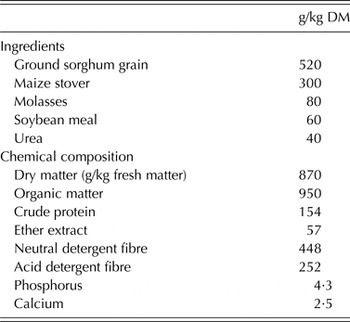
Four Rambouillet rams, weighing 39 ± 1·8 kg body weight (BW) and fitted with permanent cannulae in the rumen (2·5 cm internal diameter (i.d.)) and duodenum (T-type 0·8 cm i.d.) were used. The sheep were housed in individual cages equipped with high flow valve steel water bowls and fed a basal diet composed of 300 g maize stover and 700 g concentrate/kg DM (Table 1) ad libitum for 84 days. The basal diet was balanced for minerals and vitamins and formulated to match the nutrient requirements of sheep according to NRC (1985) recommendations plus a margin of 0·10. The ingredients and chemical composition of the basal diet are shown in Table 1. At the beginning of the experiment, sheep were treated with Ivermectin (Ivomec®-F-1 1 ml/50 kg BW, subcutaneous), Bacterin (Covexin® 10 ml/animal; intramuscular) and vitamins A, D and E (Vigantol® ADE 1 ml/animal, intramuscular).
Ingredients and chemical composition of the basal diet fed to Rambouillet sheep (g/kg dry matter (DM), unless otherwise stated)

The experiment was laid out according to a 4 × 4 Latin square design with four treatments, i.e. four application rates of xylanase (XY), namely 0 (control, XY0), 1 (XY1), 3 (XY3) and 6 (XY6) μl/g DM of the basal diet. In the first experimental period, treatments were assigned randomly to the experimental units (sheep). Experimental periods consisted of 21 days with days 1–15 considered as the adaptation period to the experimental diets and days 16–21 as the measurement and sample collection period. Sheep were fed twice daily in two equal meals at 07·00 and 19·00 h. The enzyme was added at the corresponding application rate, mixed with the diet individually and fed at 07·00 h. During the collection period, i.e. days 16–21, the amount of feed offered was recorded and orts collected and weighed for determination of daily feed intake. Additionally, feeds were sampled daily, composited weekly, dried at 60 °C to constant weight and stored for later chemical analysis.
Feed digestibility
Total tract digestibility was determined by total faecal collection during days 16–21 of each period. Faeces were collected daily before the morning feeding and stored at −10 °C for later analysis. A sub-sample of about 100 g/kg of the total faeces collected from each sheep was taken daily and composited for chemical analysis.
Apparent ruminal fibre digestibility was determined on days 16 and 17 following the procedure of Kozloski et al. (Reference Kozloski, Stefanello, Mesquita, Alves, Ribeiro Filho, Almeida and Moraes Genro2014). Duodenal digesta samples (approximately 50 ml) were collected from each sheep 4 h after morning feeding and then at 4 h intervals over a period of 48 h. Samples were obtained from the duodenal cannula, collected in a 100 ml amber vial and immediately frozen until analysis. Samples were subsequently thawed and dried at 55 °C for 48 h, homogenized and analysed for neutral detergent fibre (NDF) and acid detergent fibre (ADF).
Dried feed, feed orts and faecal samples were ground through a Wiley mill (Arthur H. Thomas, Philadelphia, PA, USA) using a 1 mm screen and analysed according to AOAC (1997) for DM (#930·15), ash (#942·05), ether extract (EE; #920·39), nitrogen (N; #954·01) and ADF (#973·18), while NDF was analysed according to Van Soest et al. (Reference Van Soest, Robertson and Lewis1991). Organic matter (OM, g/kg DM) content was calculated by difference (1000-g ash/kg DM).
Rumen and blood sampling and analysis
Rumen fluid was collected on day 18 of each experimental period, directly through the rumen cannula from the ventral sac of each sheep at 3, 6 and 9 h after morning feeding. The rumen samples (approximately 50 ml/sheep) were filtered immediately through four layers of cheesecloth, strained and stored in 45 ml glass bottles. Ruminal fluid pH was then determined using a portable pH meter (Orion, model SA 210, USA). Subsequently, 4 ml of rumen fluid was mixed with 1 ml of a solution of metaphosphoric acid (250 g/l) in a test tube and stored at −18 °C for subsequent volatile fatty acid (VFA) analysis. A sub-sample of 5 ml of rumen fluid was acidified with 5 ml of 0·2 m hydrochloric acid (HCl) for ammonia-N analysis.
Concentrations of acetic, propionic and butyric acids in rumen fluid were measured by gas-liquid chromatography (Hewlett Packard, Little Falls, DE, USA) using a capillary column (30 m length, 0·32 mm i.d., 0·25 mm film thickness; Elite-FFAP, Perkin Elmer Instruments, Shelton, WA, USA) according to the method of Erwin et al. (Reference Erwin, Marco and Emery1961). The injector temperature was set at 240 °C, flame ionization detector at 250 °C and oven at 140 °C with hydrogen gas (H2) and air flows at 40 and 400 ml/min, respectively.
Concentrations of ammonia-N were determined photometrically in an ultraviolet light spectrophotometer (VARIAN CARY 1-E, CA, USA) set at a wavelength of 630 nm according to McCullough (Reference McCullough1967).
On day 21 of each experimental period and 4 h after morning feeding, a sample of 10 ml of blood was collected via jugular vein of each sheep into clean dry test tubes, without anticoagulant. Blood samples were centrifuged at 5000 g at 4 °C for 20 min. Serum was separated into 2 ml Eppendorf tubes and frozen at −20 °C until analysis. Blood serum samples were analysed for concentrations of urea, phosphorus and triglycerides using specific kits (Stanbio Laboratory, Boerne, TX, USA) according to the manufacturer's specifications.
Statistical analysis
Data on feed intake, digestibility, ruminal fermentation parameters (at each time post-feeding) and blood parameters were examined by analysis of variance according to a 4 × 4 Latin square design with four periods and four experimental diets (XY0, XY1, XY3, XY6) using PROC MIXED of SAS (SAS Institute 2006). One ram was used within each period and treatment. The statistical model was:
 $${Y_{ijkl}} = m + {A_i} + {P_j} + {T_k} + {\varepsilon _{ijkl}}$$
where Y ijkl is the observation for a given response variable, μ is the overall mean, A i is the random effect of ram, P j is the fixed effect of period, T k is the fixed effect of rate of addition of enzyme (XY0, XY1, XY3, XY6) and ε ijkl is the residual error. Tukey's test was used for multiple comparisons of means. Polynomial contrasts (linear, quadratic and cubic effects) were fitted to the four rates of addition of the enzyme. A treatment (average of all treatments receiving XY) v. control contrast was also performed. Significance was declared at a level of P < 0·05 and P ⩽ 0·10 was considered as a tendency approaching significance.
RESULTS
Feed intake, digestibility and blood parameters
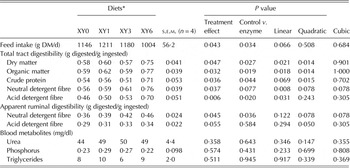
Sheep fed XY1 and XY3 had greater (P = 0·035) feed DM intake than the control sheep (increases of 6 and 3% with XY1 and XY3, respectively). However, at the greatest application rate (XY6) feed intake was decreased slightly when compared with the control.
Sheep fed XY1 and XY6 had greater (P < 0·05) total tract DM, OM and crude protein (CP) digestibility than the control sheep. Dry matter digestibility increased by 30% with XY6 when compared with the control diet. Digestibility of ADF increased linearly (P = 0·008) with increasing enzyme application rates. The NDF digestibility of the enzyme treated diets tended (P = 0·077) to be greater than that of the control sheep (Table 2).
Feed intake, digestibility and blood metabolites in Rambouillet sheep fed a diet treated with increasing concentrations of xylanase (XY)

DM, dry matter. *Diet (Table 1) without addition of xylanase (XY0) or with addition of xylanase at 1 (XY1), 3 (XY3) and 6 (XY6) μl/g DM.
Sheep fed enzyme had greater (P < 0·036) ruminal NDF digestibility than control sheep. With XY6, ruminal NDF digestibility was increased by 28% when compared with the control diet. There was no difference in ruminal ADF digestibility between sheep fed the enzyme and the control diet (Table 2).
There were no differences in the blood concentrations of urea, phosphorus or triglycerides due to the different levels of xylanase addition (Table 2).
Ruminal fermentation
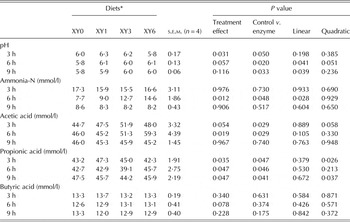
Ruminal pH of sheep fed with the enzyme was greater at all sampling times (P values were 0·050, 0·020 and 0·033 at 3, 6 and 9 h post-feeding, respectively) compared with control sheep. Within enzyme treatment, at the 3 h sampling, increasing enzyme application rate had no effect on pH. Sheep fed XY1 had maximum pH at the 6 h sampling and minimum pH at the 9 h sampling.
At the 6 h sampling, the ruminal ammonia-N concentration of sheep fed enzyme-treated diets was greater (P = 0·048) than the control sheep. Within enzyme treatment, XY6 showed the maximum ammonia concentrations (linear effect, P = 0·028), with an increase of 90% over the control value. At the 3 and 9 h sampling, there were no differences.
Acetic acid concentrations (mmol/l) were greater (quadratic effect, P = 0·029) in enzyme treatments compared with the control at 3 and 6 h post-feeding. With XY6 these concentrations were increased by 7 and 28% compared with the control at 3 and 6 h post-feeding, respectively. At 9 h, there were no significant differences. Propionic acid concentrations (mmol/l) at 3 h post-feeding were greatest in XY1 (quadratic effect, P = 0·026); however, at the 9 h sampling, all enzyme treatments had lower (P = 0·041) propionic acid concentrations compared with the control. Among enzyme application rates, XY3 had the lowest propionic acid concentration (quadratic effect, P = 0·037). No effects were observed on ruminal butyric acid concentrations between different treatments at all sampling times (Table 3).
Rumen fermentation at different times post-feeding of a diet treated with increasing concentrations of xylanase (XY) in Rambouillet sheep

*Diet (Table 1) without addition of xylanase (XY0) or with addition of xylanase at 1 (XY1), 3 (XY3) and 6 (XY6) μl/g DM.
DISCUSSION
Feed intake
Addition of xylanase to diets at low (i.e. XY1) and moderate (i.e. XY3) rates increased feed intake by about 6 and 3%, respectively, compared with XY0; however, intake decreased by 9% when xylanase was applied at a greater concentration (i.e. XY6) compared with XY0. Therefore, addition of fibrolytic enzymes at certain concentrations may increase the intake of fibrous feeds. Beauchemin et al. (Reference Beauchemin, Colombatto, Morgavi and Yang2003) concluded that high rates of enzyme application could be less effective than low rates of application in increasing feed intake, indicating the importance of determining the optimal rate of enzyme addition. The current results are in agreement with Gado et al. (Reference Gado, Salem, Robinson and Hassan2009), who observed about 13% greater DM intake in dairy cows due to enzyme supplementation at 40 g/day.
Digestibility
When xylanase was applied to the diet at the highest concentration (i.e. XY6), whole tract digestibility was increased (by 28–42%) compared with other xylanase concentrations. Improving digestibility, in particular, that of the fibre fractions is the main purpose of adding fibrolytic enzymes to ruminant feeds. Improved digestibility with xylanase at some application rates supports the hypothesis that a suitable enzyme concentration could improve fermentation efficiency during the initial stages of digestion (Jalilvand et al. Reference Jalilvand, Odongo, Lopez, Naserian, Valizadeh, Shahrodi, Kebreab and France2008).
The greater digestibility observed with the XY6 diet may be related, as previously mentioned, to improved rate of ruminal digestion of the potentially digestible NDF fraction (Yang et al. Reference Yang, Beauchemin and Rode1999) and to changes in gut viscosity (Hristov et al. Reference Hristov, McAllister and Cheng2000); although these features were not determined in the present study. Altered ruminal fermentation (Kholif & Aziz Reference Kholif and Aziz2014; Rojo et al. Reference Rojo, Kholif, Salem, Elghandour, Odongo, Montes De Oca, Rivero and Alonso2015), enhanced microbial attachment and colonization to the plant cell wall (Wang et al. Reference Wang, McAllister, Rode, Beauchemin, Morgavi, Nsereko, Iwaasa and Yang2001) and complementary interactions with ruminal microbial enzymes (Morgavi et al. Reference Morgavi, Beauchemin, Nsereko, Rode, McAllister and Wang2004) are different possible reasons for the improved rate of ruminal digestion.
In most reports, addition of fibrolytic enzymes to the ruminant feedstuffs increased the numbers of non-fibrolytic and fibrolytic bacteria in rumen fluid and provided more total polysaccharidase activity to digest feedstuffs (Giraldo et al. Reference Giraldo, Tejido, Ranilla, Ramos and Carro2008). Mao et al. (Reference Mao, Wu, Wang and Liu2013) found that addition of cellulase and xylanase increased the numbers of total bacteria and Fibrobacter succinogenes in in vitro incubation medium resulting in enhanced fermentation. Results in the present study are consistent with Khattab et al. (Reference Khattab, Gado, Kholif, Mansour and Kholif2011) and Salem et al. (Reference Salem, Gado, Colombatto and Elghandour2013; Reference Salem, Alsersy, Camacho, El-Adawy, Elghandour, Kholif, Rivero, Alonso and Zaragoza2015b ), who observed greater feed digestibility in response to exogenous enzyme addition.
Ruminal NDF digestibility was increased by 7·5, 17 and 28% (compared with the control diet), respectively, with increasing xylanase application rates. Thus, the increased total tract fibre digestibility seems to be due, in part, to enhance fibre digestion in the rumen. Fibrolytic enzymes not only improve fibrolytic activity in the rumen, but also raise xylanase activity in the small intestine (Hristov et al. Reference Hristov, McAllister and Cheng1998, Reference Hristov, McAllister and Cheng2000). Hristov et al. (Reference Hristov, McAllister and Cheng1998) reported that addition of enzymes elevated duodenal xylanase activity by 30% and cellulase activity by 2–5%. Hristov et al. (Reference Hristov, McAllister and Cheng2000) showed that xylanase activity in the faeces was increased with enzyme supplementation, suggesting that xylanase and probably other exogenous fibrolytic enzymes, may work synergistically with the microbes within the large intestine.
Blood metabolites
None of the measured blood metabolites (urea, phosphorus and triglycerides) was affected by xylanase addition to feed and all were found within the reference ranges (Boyd Reference Boyd1984). Serum urea concentration is an indicator of the nutritional status of sheep (Kumar et al. Reference Kumar, Singh and Verma1981), in particular regarding the provision of total and degradable protein in the feed. Normal serum urea values indicate that protein catabolism was not increased in the muscles and that kidney function was not adversely affected by diet.
Ruminal fermentation
Sheep fed xylanase had greater ruminal pH values compared with the control. One of the most important factors affecting fibre digestion is ruminal pH. For xylanase treatments, rumen pH ranged from 5·98 to 6·15, which was within the range considered acceptable for fibre digestion (Ørskov & Ryle Reference Ørskov and Ryle1990). Fibrolytic bacteria are very sensitive to ruminal pH changes (Sung et al. Reference Sung, Kobayashi, Chang, Ha, Hwang and Ha2007). Greater ruminal pH values are more favourable for fibrolytic microbial activity than low ruminal pH (Sung et al. Reference Sung, Kobayashi, Chang, Ha, Hwang and Ha2007).
Ruminal ammonia-N concentrations ranged from 7·7 to 17·3 mmol/l which were above the range that Satter & Slyter (Reference Satter and Slyter1974) considered as sufficient for microbial protein synthesis. Greater ruminal ammonia-N concentrations in sheep fed the enzyme treated diets (XY6 and XY3) compared with the un-supplemented control support the possibility that xylanase enhances rumen protein degradation, probably in response to a shift in ruminal microbiota (Salem et al. Reference Salem, Gado, Colombatto and Elghandour2013). Kholif & Aziz (Reference Kholif and Aziz2014) found that feeding goats on diets treated with a fibrolytic enzyme elevated ruminal ammonia-N concentration compared with un-supplemented control diets. The observed dose-effects reinforce the importance of defining the optimum application rate of enzyme for better feed utilization.
Greater acetic acid concentrations were obtained with xylanase-treated diets (especially with XY6) compared with the control. Improving fibre digestion usually alters rumen fermentation and affects the production of individual VFA. The greater acetic acid concentrations with xylanase addition could be associated with improved digestion of structural carbohydrates (Soltan et al. Reference Soltan, Abdalla, Silva, Natel, Morsy and Louvandini2013). Changes in individual VFA concentrations observed when fibrolytic enzymes were added to feed suggest that these exogenous enzymes could affect microbial growth and activity, causing a shift in the metabolic pathways by which specific microbes utilize substrates (Almaraz et al. Reference Almaraz, González, Pinos-Rodríguez and Miranda2010). Shifts in ruminal fermentation may be the result of altered fibre structure, which could stimulate microbial colonization (Giraldo et al. Reference Giraldo, Tejido, Ranilla, Ramos and Carro2008), or a shift in the species profile of fibre-colonizing bacteria in response to enzyme addition (Wang et al. Reference Wang, McAllister, Rode, Beauchemin, Morgavi, Nsereko, Iwaasa and Yang2001). Gado et al. (Reference Gado, Salem, Robinson and Hassan2009) and Salem et al. (Reference Salem, Gado, Colombatto and Elghandour2013) also observed greater acetic acid concentrations in the rumen when animals were fed diets supplemented with exogenous enzymes.
Among the tested xylanase application rates, concentrations of 3 and 6 µl xylanase/g DM of the basal diet resulted in enhanced digestibility and ruminal fermentation in Rambouillet sheep. However, with 6 µl xylanase/g DM of the basal diet feed intake decreased, whereas ruminal ammonia-N and individual VFA increased compared with the other rates of enzyme addition. Generally, addition of xylanase had no effects on blood serum concentrations of urea, phosphorus and triglycerides.
The authors acknowledge the financial support from the IAEA (Vienna, Austria) Research Contract number MEX16307 within the D3·10·27 Coordinated Research Project. First author would like to thank the Mexican National Council for Science and Technology (Consejo Nacional de Ciencia y Tecnología-CONACYT) for the PhD scholarship received.