Introduction
With a rapidly aging population, Singapore faces a rising need for personalized elder care (Iecovich, Reference Iecovich2011). However, meeting such a need is challenging on the family, community, and society level. First, traditional social norms perceive that women's familial role involves caregiving (Chan, Reference Chan2005). However, as an increasing number of married women join the workforce (Bai et al., Reference Bai, Kwok, Chan and Ho2013; Østbye et al., Reference Østbye, Malhotra, Malhotra, Arambepola and Chan2013), their caregiving role will be compromised. The Asian value of filial piety also upholds that families remain the primary unit of support and care for seniors (Yeoh and Huang, Reference Yeoh and Huang2009). Unfortunately, juggling caregiving, domestic duties, and vocational responsibilities could impose considerable stress on family caregivers physically, emotionally, and economically (Yap et al., Reference Yap, Seow, Henderson and Goh2005). In Singapore, several barriers hinder caregivers’ uptake of formal care services for seniors. For example, there is a shortage of facilities such as hospital beds (Yeoh and Huang, Reference Yeoh and Huang2009), enrolment into nursing homes could take up to several months, and home medical and therapy services are not always available, beneficial, or affordable (Wee et al., Reference Wee, Hu, Yong, Chong, Raman and Chan2015). Lastly, there is a paucity of pro-family policies at the workplace (Cheng, Reference Cheng2003). Therefore, the trend of employing foreign domestic workers (FDWs) to help with domestic affairs including eldercare is likely to increase in Singaporean families.
A FDW is usually a stay-in migrant female waged domestic worker attached to one employer and works for only a single household, under Singapore's strict legal permit system (Basnyat and Chang, Reference Basnyat and Chang2016). FDWs mainly come from Indonesia, the Philippines, and Myanmar (Ministry of Manpower, 2016). Currently, one in five households employs FDWs, and as many as 50% of familial caregivers engage FDWs specifically to care for seniors (Institute, 2013), revealing a significant dependence on them (Cheng, Reference Cheng2003). FDWs are tasked to take care of domestic chores and provide physical caregiving for seniors, in particular round-the-clock care for seniors with dementia (SWD).
A typical dementia family caregiver cares for the SWD at home (Yap et al., Reference Yap, Seow, Henderson and Goh2005), thereby contributing to the need for FDWs (Alzheimer's Disease Association, 2008). With the number of SWD in Singapore expected to top 103,000 in 2030, the demand for FDWs is projected to increase to 300,000 (National Population Talent Division, 2010; Alzheimer's Disease International, 2014). FDWs usually help with basic activities of daily living (Basnyat and Chang, Reference Basnyat and Chang2016), while familial caregivers settle the finances and determine care-related decisions. In larger families, the FDWs and SWD are arranged to rotate and reside with different children for certain periods of time. In smaller families, from time to time, the FDW is the only person staying with the SWD in a one- or two-room flat (The Singapore Family Physician, 2013).
Caring for SWD is unequivocally challenging (Mould-Quevedo et al., Reference Mould-Quevedo2013). Familial caregivers of SWD experience a significant level of stress and higher risk of depression (Chang et al., Reference Chang, Chiou and Chen2010). They may also suffer financially due to the need to shorten their working time, stop work, or even deplete their savings to afford medications and home- or community-based services (HCBS) (Yap et al., Reference Yap, Seow, Henderson and Goh2005). As such, support from FDWs has been instrumental to alleviate the impact of stressors on spousal caregivers (Chong et al., Reference Chong, Kwan, Chi, Lou and Leung2014), correlates with better caregiving outcomes such as less disturbed schedule and poor health (Østbye et al., Reference Østbye, Malhotra, Malhotra, Arambepola and Chan2013), and predicts lower institutionalization for frail seniors (Chau et al., Reference Chau, Woo, Kwok, Chan, Hui and Chan2012). However, while extant literature has focused on the coping strategies of familial caregivers, how FDWs cope with caregiving demands remains largely unknown (Østbye et al., Reference Østbye, Malhotra, Malhotra, Arambepola and Chan2013). Only one qualitative study highlighted the significance of family connections and networks for immigrants to achieve burden relief (de la Cuesta-Benjumea et al., Reference de la Cuesta-Benjumea, Donet-Montagut and Galiana-Gómez de Cádiz2012). While a recent study established that the ability to adapt was one of the determinants leading to FDWs’ job satisfaction (Bai et al., Reference Bai, Kwok, Chan and Ho2013), the dynamic interactions between familial and FDW caregivers influencing job satisfaction, and their impact on care recipients, remain un-investigated. Furthermore, current caregiver programs are targeted mainly at familial caregivers and only a very limited number are designed for FDWs. As FDW caregivers originate from a variety of backgrounds, with some nationalities facing greater stress than others, understanding their caregiving needs and eventually addressing these needs may prove to be most valuable. (Gallart et al., Reference Gallart, Cruz and Zabalegui2013).
This study endeavors to explore FDWs’ challenges and coping strategies while caring for frail seniors in Singapore. It also aims to catalyze development of appropriate services and support for FDW caregivers through exploring their caregiving experiences and needs.
Methods
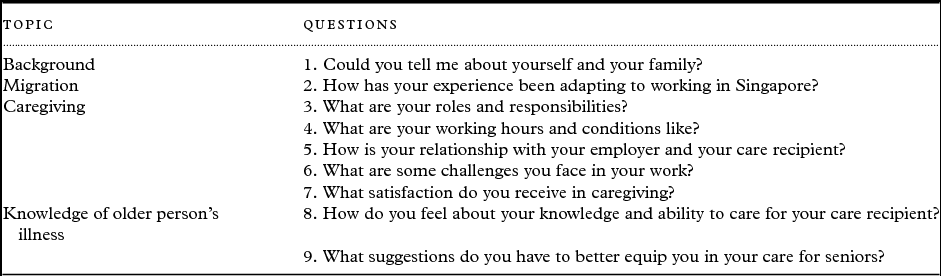
An inductive, qualitative approach was chosen to uncover the interviewees’ in-depth perceptions. FDWs caring for seniors at the Khoo Teck Puat Hospital (KTPH) geriatric ward and outpatient clinic were purposively sampled. We oversampled FDWs caring for SWD to better understand the problems inherent in dementia caregiving. In-depth interviews were conducted with 25 FDW caregivers and five full-time staff at KTPH from January to April 2016, in English or Bahasa Melayu. One interview required a Myanmese translator. All recordings were transcribed directly into English and took about 45 minutes. The interviews were conducted at KTPH's premises using an interview guide (refer to the appendix). Identifiers numbering 001 to 030 were given to participants to protect their identities, with “F” referring to FDWs and “S” referring to staff. Written informed consent was obtained. All audio recordings and transcripts were linked by pseudonyms to ensure anonymity and stored securely in password-protected files.
Analysis
This study followed an interpretivist approach. Our aim was to explore participants’ caregiving experiences, comparing their challenges and coping mechanisms when caring for seniors with and without dementia. Thematic analysis was used to identify data themes inductively. NVivo 10 was used to code data. Coding finished when analysis produced no new codes. To confirm saturation, authors identified opinions that fit the majority and deviant cases that produced exceptions. Finally, authors compared emergent themes with existing literature to improve validity.
Results
FDWs interviewed were from Indonesia, Philippines, and Myanmar, looking after frail seniors in Singapore who were vulnerable to severely frail (Rockwood et al., Reference Rockwood2005). Nineteen of the 25 FDW participants looked after SWDs. They aged between 21 and 50 years, falling mostly in the 31–40 year range. More than half were married; the remaining were single, separated, or widowed. A handful had worked as FDWs previously. Majority worked in Singapore between 1 and 3 years, with several working between 6 and 10 years. None had prior formal training in eldercare. A few were allowed by employers to attend dementia training programs after they started work.
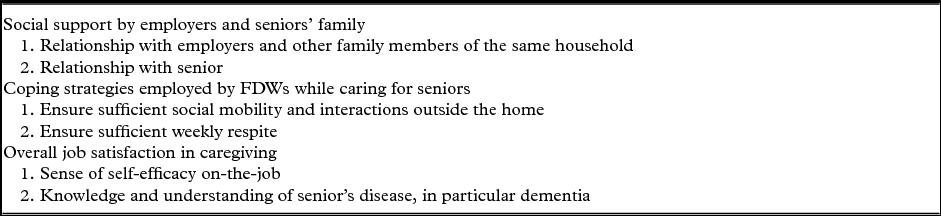
We derived six salient themes, clustered into three groups: two described social support to the FDW by the employers, two described coping strategies of the FDW, and two described the FDW's job satisfaction (refer to Table 1).
Themes and subthemes for FDWs caring for seniors

Social support by employers and seniors’ family
The two subthemes under social support include the relationship of the FDW with the employer and other family members in the same household, and with the senior.
Relationship with employers and other family members of the same household
Several FDWs expressed strains in their relationships. Those fearful of their employers often hid their caregiving challenges, resulting in compromised eldercare. One social worker recounts:
Staff: One grandma had a heel ulcer and her children were really fierce. The FDW was so scared, she stuffed newspaper into the ulcer to cover it and it got infected. (S030)
Among FDWs whose employers viewed their relationship as more transactional, conversations were often task-focused. FDWs perceived this as stressful and felt like “outsiders.” A few FDWs lived alone with the senior, with the senior's children visiting occasionally, which they perceived as spot checks.
FDW: They give me salary, that's all. They always say, ‘I will sue you if anything happens to Ah Gong (Grandpa)’. (F011)
In contrast, those with good relationships with their employers perceived greater trust. A “good relationship” was surmised through words of affirmation, gifts like clothes, opportunities to attend courses, having sufficient rest, and caring for the senior together. This helped FDWs feel “a part of the family.”
FDW: I am happy. . . they are like family. . .. I eat with them at the same table. (F008)
Having a good relationship with one's employer instilled confidence in helping FDWs cope better, while those caring for highly dependent SWD benefited when employers were willing to help. One FDW who cared for a senior with severe dementia shared,
Caring for Grandma is difficult but everybody nice to me. So, okay. (F014)
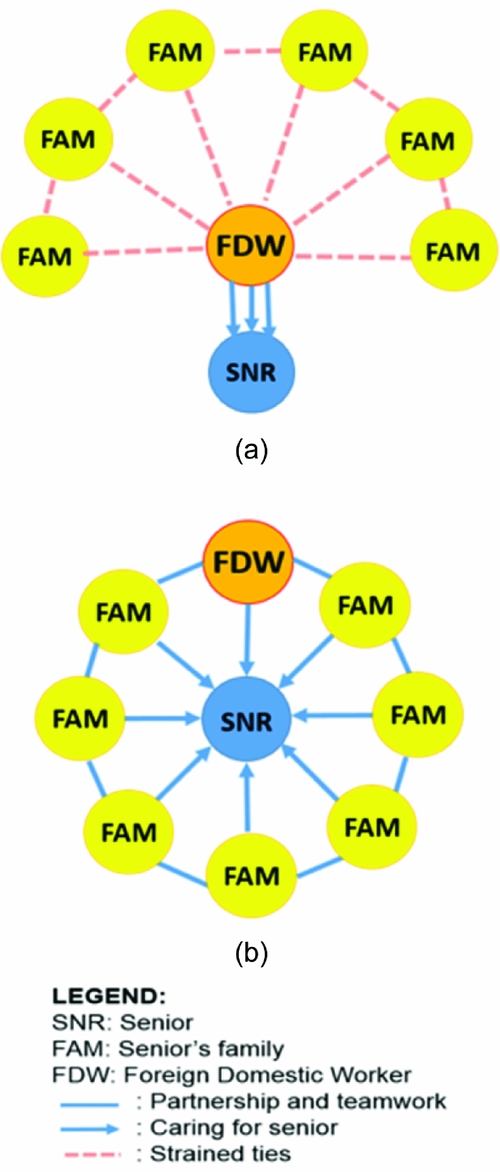
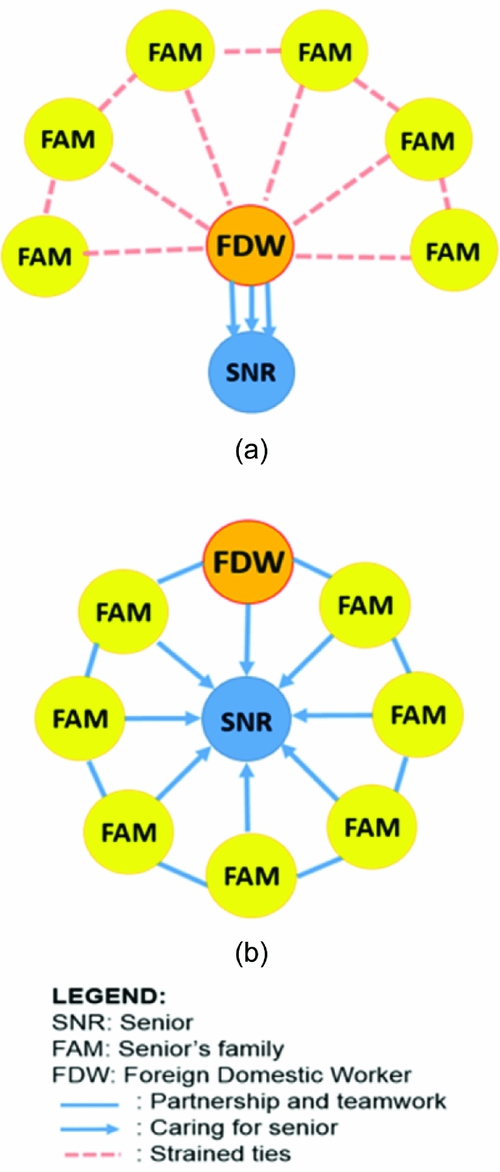
We derived two family models of care for comparison. Figure 1(a) illustrates FDW-centered family dynamics, where family members center pressure on the FDW to perform most of the caregiving and domestic duties, resulting in high stress experienced by the FDW and poor impact on the senior's well-being. Figure 1(b) illustrates team-based family dynamics, where family members and the FDW share caregiving responsibilities through teamwork, resulting in lower stress experienced by the FDW and the senior's better well-being.
Models of care illustrating (a) FDW-centred (b) and team-based caregiving dynamics.
Relationship with senior
FDWs who faced challenges with their care recipients often struggled as they perceived their antagonism as personal rejection. This was prominent among FDWs caring for SWD, and was compounded if employers blamed them.
FDW: If Grandma doesn't want to eat, she will throw hot food at me. My employer doesn't understand. If Grandma is tired, I let her rest. But her son will call my employer to say I am lazy. . . I'm so tired. (F001)
Verbal and physical abuse by SWDs caused severe strains on the carer–recipient relationship. Several FDWs shared embarrassing episodes in public with the SWD, causing them to dread leaving home, contributing to isolation. Strained relationships with SWDs also led to conflicts between the FDW and other family members, increasing tensions.
FDW: When we're on the train, Grandpa will shout, ‘You asshole! Stupid!’ I feel so ashamed. . . But my employers’ family doesn't understand. When we arrive late for lunch, they shout at me. (F011)
Nonetheless, many FDWs found ways to overcome this by positive self-talk. Those with adequate social support from their employers often defended the senior's antagonistic behavior.
It is okay, Grandma is old. I can ‘tahan’(endure). (F001)
Many had culturally ingrained respect for seniors and were determined to care for them as they would their own parents.
I treat Grandma like my own mother, I want her to be happy. (F017)
Good rapport was often facilitated by words of appreciation by the senior, which motivated several FDWs to overcome language barriers by learning the seniors’ dialects.
Coping strategies employed by FDWs while caring for seniors
There were two subthemes under coping strategies. Participants articulated the need for sufficient social mobility outside the home, and adequate respite.
Ensure sufficient social mobility and interactions outside the home
The need for “freedom” was commonly mentioned, referring to mobility out of the house, social interactions with other FDW friends, or the use of mobile devices to maintain relationships. Those with restrictions over mobile phone use and rules against forming friendships often felt lonely and mistrusted. Those who found creative channels of social interaction felt recharged by encouraging one another in their caregiving challenges. Many reported the opportunity for emotional ventilation as important to their well-being as they were unwilling to share work-related troubles with their employers.
Social interaction with other FDWs was limited for FDWs caring for highly-dependent seniors as it restricted their mobility. A sense of responsibility and guilt was evident:
FDW: I'm so scared. If I go out, (what if) Ah Ma has problems? Then becomes a problem for me, right? So I don't want to go out. (F003)
This applied particularly to FDWs caring for SWD if the senior displayed socially inappropriate behavior. One FDW recounts,
Previously, I bring Grandma to supermarket. But now, she is scared of strangers. . . So I go shopping in the 24-hour supermarket after she sleeps. (F001)
Ensure sufficient respite in the form of “off-days”
Sufficient respite was important, contributing to the longevity of the FDW's employment tenure. Nearly all FDWs did not have any “off-days” during the first few months of work, as stipulated by their agents, as they had to repay their agent fees with several months of labor. Even when employers allowed FDWs to take rest days, many chose to forgo it for extra money. FDWs who did not have regular off-days often experienced burnout.
However, a few FDWs who felt a part of the family and enjoyed a good relationship with the senior, did not think “off-days” were necessary. These FDWs were typically given freedom to use their mobile phones, watch television, and enjoyed activities with the senior or employer such as baking.
FDW: I'm okay with no ‘off-days’. I enjoy my work, don't feel stressed. . . I've a good employer. (F021)
Conversely, some who had regular “off-days” still struggled with persistent exhaustion as their employers continued to telephone them on their “off-days.” Only a handful of employers made arrangements to care for the senior while allowing the FDW to enjoy a worry-free day of rest.
Sufficient respite was a problem for FDWs caring for SWD with poor sleep at night. Many struggled with seniors continuously talking, pacing around, or banging on doors through the night. They suffered sleep deprivation due to household responsibilities on top of caregiving responsibilities, and were desperate to quit.
Job satisfaction
Overall job satisfaction was an important enabler in helping FDWs enjoy their work and lengthen work longevity. It comprised two subthemes: self-efficacy on-the-job and, for those caring for SWD, an in-depth understanding of dementia.
Self-efficacy on-the-job
Self-efficacy is the belief in one's ability to succeed in specific situations and to mobilize the resources needed to accomplish a task (Bandura, Reference Bandura1982). Those who were able to apply creativity and resourcefulness in caregiving felt most satisfied. One FDW who was a previous masseur shared that her skills could relieve the senior's pain; another with hairdressing skills was the first to persuade the SWD to have a haircut to improve her appearance. One FDW expressed sentiments shared by a handful.
My employer trusts my suggestions for Grandma. . . I'm really happy working. (F021)
Knowledge and understanding of dementia
FDWs caring for SWD faced more challenges, especially if the SWD had behavioral symptoms such as aggression, paranoia, and refusing to cooperate in custodial care. These challenges were exacerbated by a lack of knowledge about the illness. One FDW articulated,
If we have proper training, we can do a better job. . . we can ask about what we don't know, share our knowledge and feelings. (F001)
Several FDWs characterized dementia as “forgetfulness” or a “brain problem,” but a few could relate the senior's behavior to the disease. Limited information was available through their employers or the healthcare providers. One searched for information on the Internet. Nonetheless, a superficial understanding of the illness meant that behavioral symptoms were often interpreted as antagonism by the senior.
FDW: Grandpa throws away food I make. But in front of his family, he eats. That's why I'm very sad, he doesn't like me. (F011)
A few FDWs, who attended courses run by the Alzheimer's Association, better understood dementia and acquired caregiving tips. However, this could be negated in unsupportive family environments by employers who did not agree with their caregiving methods.
Discussion
Our study shows that FDWs cope better with caring for frail seniors when they receive support from the senior's family, are allowed to employ coping strategies in having sufficient respite and social interactions outside the home, and derive job satisfaction from caregiving. Social support is especially important in mediating burden of familial caregivers, and this was found to apply likewise to FDWs in our study (Chiou et al., Reference Chiou, Chang, Chen and Wang2009; Østbye et al., Reference Østbye, Malhotra, Malhotra, Arambepola and Chan2013; Chong et al., Reference Chong, Kwan, Chi, Lou and Leung2014).
FDW–employer relationships often have an uneven balance of power, leaving FDWs vulnerable to inadequate social and emotional support (Yeoh and Huang, Reference Yeoh and Huang2009). Most staff interviewees articulated the common perception by employers that FDWs are hired to provide round-the-clock care and also upkeep the household (Yeoh and Huang, Reference Yeoh and Huang2009). This differs from the typical role description of FDWs as a “moderator” of stress for familial caregivers (Østbye et al., Reference Østbye, Malhotra, Malhotra, Arambepola and Chan2013). Conflicts and abuse in FDW–employer relationships, within the realm of private, asymmetrical social relations are well-documented, and their vulnerability is compounded by heavy agent fees to pay off if they switch employers (Yeoh and Huang, Reference Yeoh and Huang2009; Seow, Reference Seow2015). Worry about caregiving performance, particularly salient in Chinese culture emphasizing filial piety, further complicates FDW–employer relationships (Huang et al., Reference Huang2009). The transference of this worry upon FDWs could underlie certain obsessive supervisory behaviors by employers such as installing closed-circuit televisions to monitor FDWs, random spot checks, and repeated nagging. FDWs with employers who frequently found fault with them inherited the same worry about their performance, augmented by concerns of being repatriated, which would undermine their ability to pay back hefty agent fees (Humanitarian Organization for Migration Economics, 2015).
The finding of inequity in workload of FDWs may be beyond the jurisdiction of regulatory authorities to address given the hidden nature of issues within households. However, it calls for an attitudinal change in society to invite FDWs into a more equitable familial ecosystem to care collectively for the senior, instead of placing undue expectations on them to manage all domestic affairs (Østbye et al., Reference Østbye, Malhotra, Malhotra, Arambepola and Chan2013). Negative correlations have been found between social support and depression in familial caregivers of seniors. This can apply equally to FDWs as many, similarly, report feeling lonely or sad, especially under employers who distrust them (Østbye et al., Reference Østbye, Malhotra, Malhotra, Arambepola and Chan2013). It calls for healthcare providers to not only provide familial caregiver-centered care, but to assess the familial caregiver–senior–FDW dynamic and determine the need for employers to provide reciprocal support.
Due to relatively lower costs and constant availability of FDWs in the home, employers were often less willing to spend more on other HCBS, which were viewed as superfluous. In Singapore, these include day care services and therapy programs, which are still not widely available. Just as how the utilization of home-care services can reduce the impact of senior's activities of daily living limitations on caregiver burden, these interventions could likewise be beneficial for FDWs (Chang, Reference Chang2009). The presence of FDWs as “home help” should not negate the role played by formal home-care services, which help to buffer the caregiving stresses of FDWs. The current low uptake of HCBS suggests the need to increase uptake of HCBS but may face greater resistance among households hiring FDWs (Cheng, Reference Cheng1996; Rockwood et al., Reference Rockwood2005.
Østbye's study, which captures the complexity of the caregiver–senior–FDW dynamic, reveals that FDWs reduce the perceived lack of family support by familial caregivers, especially when the senior has more behavioral problems (Østbye et al., Reference Østbye, Malhotra, Malhotra, Arambepola and Chan2013). This coheres with our study, as FDWs often took on tasks which involved assisting or supervising seniors. However, the same study also revealed that behavior and mood issues in SWDs were associated with more disturbed schedules and poor health of the familial caregiver, irrespective of FDW support (Østbye et al., Reference Østbye, Malhotra, Malhotra, Arambepola and Chan2013). This may suggest that a failure to cope by FDWs has a cascading effect on familial caregivers, providing little buffer to their well-being. Another study also revealed that among the foremost needs expressed by familial caregivers’ caring for SWD, is the desire to cope better with difficult behavior (Alzheimer's Disease Association, 2008).
Caregiver esteem, a positive outcome seen in familial caregivers, was also articulated by FDWs in the form of job satisfaction and perceived self-efficacy (Østbye et al., Reference Østbye, Malhotra, Malhotra, Arambepola and Chan2013). This was enhanced under employers who were affirmative of their suggestions on caring for the senior. Self-efficacy gave FDWs a sense of mastery, especially when family members felt helpless with the senior's behavior. Several FDWs attending dementia therapy sessions with the SWD reported the benefits of exchanging their experiences through opportunistic chats among themselves. This is supported by studies that associate well-being through the transferring of beliefs in socio-emotional support to personal capacity, which can then mediate stress in individuals (Østbye et al., Reference Østbye, Malhotra, Malhotra, Arambepola and Chan2013). Among those who cared for SWDs, the actual demands arising from the senior's behavior were not direct predictors of stress, as the support received from employers, their understanding of dementia, and social network among friends led them to develop ways of coping and increased their self-efficacy (Østbye et al., Reference Østbye, Malhotra, Malhotra, Arambepola and Chan2013). The revised Caregiving Self-efficacy scale consists of three subscales: obtaining respite, responding to disruptive behaviors, and controlling upsetting thoughts (Steffen et al., Reference Steffen, McKibbin, Zeiss, Gallagher-Thompson and Bandura2002). This concurs with our study's findings, which show that FDWs often faced a reduced sense of self-efficacy, in addition to sleep deprivation and emotional conflicts due to disruptive behaviors of the seniors.
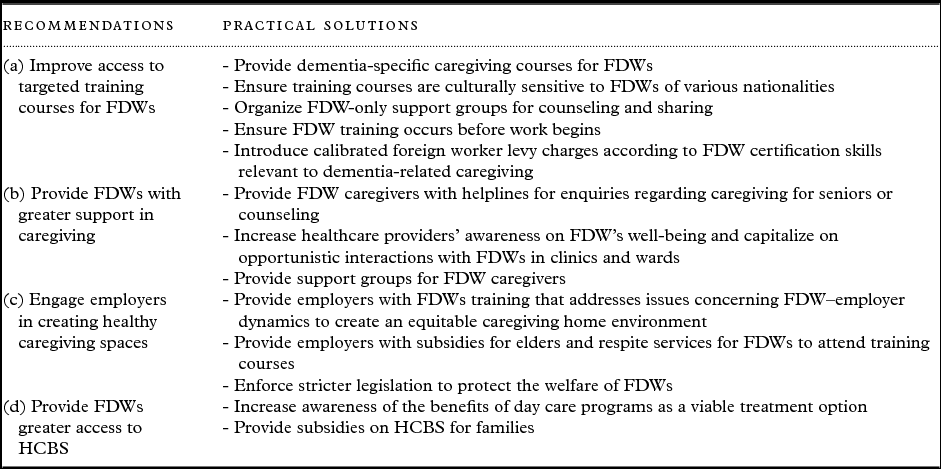
Much can be done to improve the working conditions for FDWs, these include access to training courses in eldercare, providing them with greater practical and emotional support, engaging employers to create healthy caregiving spaces at home, and tapping on HCBS (refer to Table 2).
Recommendations to help FDWs caring for seniors in Singapore

Although formal eldercare courses exist, many are generic or target only familial caregivers (Yeoh and Huang, Reference Yeoh and Huang2009). While the local manpower ministry and FDW agencies have started offering training courses (Yeoh and Huang, Reference Yeoh and Huang2009), FDWs face unique barriers: disapproval by employers, time limitations, and difficulties in understanding culturally insensitive curricula. Attending courses in eldercare ought to be mandatory and conducted in the FDWs' language. They should comprise FDW-only support groups and include a component to engage employers. Ideally, such training should start once FDWs are matched with prospective employers, and can be made more attractive by calibrated waivers on FDW levy charges according to their level of competence and certification (Yeoh and Huang, Reference Yeoh and Huang2009).
Helplines may serve as an avenue for FDWs to seek help and receive counseling by qualified professionals, especially when they are distressed. Healthcare providers should capitalize on opportunistic interactions with them to assess their well-being and consider if they require formal assistance or informal support by organizing support group sessions just for FDW caregivers. Additionally, training employers in managing domestic tensions, stricter legislation to protect the welfare of FDWs, and caregiver programs addressing FDW–employer dynamics may also help.
A previous study on dementia-carer profiles revealed that many carers felt they did not see the need to use HCBS (Alzheimer's Disease Association, 2008). In this study, a few SWDs attended dementia services, which is not surprising given that the top reasons for not utilizing dementia day care are the presence of a FDW and refusal by the SWD (Alzheimer's Disease Association, 2008). However, attending day care was viewed positively by FDWs as it afforded them respite and they noticed the benefits on the SWD. Employers should thus be informed about the utility of HCBS and that day programs can serve as viable adjunctive treatments (Alzheimer's Disease Association, 2008).
Limitations
Several limitations are noteworthy. First, as the study was set in a tertiary hospital, seniors tended to present with more serious health conditions, which could have skewed FDWs’ caregiving experience. Second, shortlisting willing interviewees was challenging due to FDWs’ fear of their employers which could have led to sampling bias. Some FDWs even requested to shorten their interviews which could have compromised the quality of the interviews. Third, our study did not explore FDWs’ understanding about seniors’ illnesses other than dementia, which may have provided insights into other knowledge deficits.
Conclusion
FDWs face great demands caring for seniors but encounter barriers in acquiring appropriate training and coping skills, especially in caring for SWD. In reality, FDWs face many stresses similar to familial caregivers and those unique to themselves. Efforts to improve accessibility and availability of culturally sensitive eldercare training programs to FDWs, provide them with greater emotional support, engage employers, and improve access to HCBS, can ultimately benefit our seniors and their families. These recommendations may be extended to other developed countries where FDWs likewise assist in familial care of seniors and face similar challenges.
Conflict of interest
None.
Description of authors’ roles
W.J. Tam, P. Yap, G. Koh, and H. Legido-Quigley planned and designed the study, and supervised the data analysis. W.J. Tam conducted the interviews, analyzed the data, and drafted the manuscript. N.H.L. Ha recruited subjects and drafted part of the manuscript. All authors played an active role in revising and finalizing the paper.
Acknowledgments
This work was financially supported by Saw Swee Hock School of Public Health, National University of Singapore. Ethics approval was provided by the Domain Specific Review Board of the National Healthcare Group, Singapore.
Questions posed to FDW participants