1 The functional load hypothesis
Berinstein (Reference Berinstein1979) put forward and experimentally investigated the hypothesis, stated in (1), that a non-random relationship exists between correlates of stress and the phonological structure of languages.
-
(1)

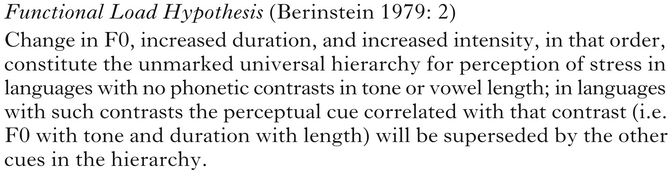
We put aside the issue of a universal hierarchical ordering,Footnote 1 and focus on the claim for which Berinstein is classically cited: languages that use a suprasegmental property contrastively will not use that property, or will use it only minimally, in the realisation of stress; this is the proposal typically referred to as the functional load hypothesis (FLH).
Berinstein experimentally compared English, which lacks a length contrast and is known to use duration to cue stress, to K'ekchi, which has phonemic vowel length. Her key findings were that (i) increasing vowel length on syllables did not make K'ekchi speakers more likely to recognise those syllables as stressed, in contrast to the results for English speakers, and (ii) F0 ratio, peak F0 and peak vowel intensity all correlate with stress in K'ekchi, whereas acoustic measurements showed that duration ‘is poorly correlated with stress’ (1979: 37). To rule out a connection between the facts that K'ekchi does not use duration and that it has fixed final stress, Berinstein experimentally investigated the perceptual effect of increased vowel duration on speakers of Kaqchikel (‘Cakchiquel’ in Berinstein Reference Berinstein1979), a language closely related to K'ekchi that also has final stress, but lacks a phonemic length contrast. Berinstein found that, unlike speakers of K'ekchi, speakers of Kaqchikel do equate increased duration with stressed-syllable identification. Berinstein thus concluded that there is evidence for the FLH, observing:Footnote 2
Duration has little or no cue value to the stress/no stress distinction in a language in which there are long and short vowels distinguished solely by length (1979: 46).
While Berinstein's hypothesis in (1) also makes predictions for the use of F0, we restrict our investigation to uses of duration. Her investigation focuses on uses of duration, and she further observes (note 1) that F0 may be used in different ways within the same language: a language could have, for example, a high tone, but still use F0 to signal stress with a rising or falling tone, without violating the FLH.
Following Berinstein's work, various languages have been reported to conform to the predictions of the FLH. Other languages with contrastive vowel length which eschew duration as a cue to stress include Anejom̃ (Lynch Reference Lynch2000), Bhojpuri (Shukla Reference Shukla1981), Creek (Martin Reference Martin2011), Fijian (Dixon Reference Dixon1988), Halkomelem/Musqueam (Suttles Reference Suttles2004), Hungarian (White & Mády Reference White and Mády2008, Vogel et al. Reference Vogel, Athanasopoulou, Pincus, Heinz, Goedemans and van der Hulst2016), Konkow (Ultan Reference Ultan1967), Nisenan (Eatough Reference Eatough1999) and Palula (Liljegren Reference Liljegren2008).
But while many languages provide support for the FLH, others run contrary to expectations. Languages with contrastive vowel length which do use duration as a stress correlate include Aleut (Rozelle Reference Rozelle1997, Taff et al. Reference Taff, Rozelle, Cho, Ladefoged, Dirks and Wegelin2001), Arabela (Rich Reference Rich1963), Barok (Du Reference Du2010), Chickasaw (Gordon Reference Gordon2004), Diola-Fogny (Sapir Reference Sapir1965), Leti (Hume et al. Reference Hume, Muller and van Engelhoven1997, Hume Reference Hume1997), Masbatenyo (Rosero Reference Rosero2014), Nhanda (Blevins Reference Blevins2001) and Northern Paiute (Snapp et al. Reference Snapp, Anderson, Anderson and Langacker1982, Thornes Reference Thornes2003).
As published work often reports only on a single language, most reflections on whether or not Berinstein's FLH holds have been made on a language-by-language basis. For example, Taff et al. (Reference Taff, Rozelle, Cho, Ladefoged, Dirks and Wegelin2001) specifically address the consequences of Aleut, which has contrastive vowel length and uses duration to cue stress, for the FLH (see also Rozelle Reference Rozelle1997). The authors propose that, while still correlating with stress, duration may perhaps be a weaker cue to stress in languages with contrastive vowel length. However, it is difficult to judge how robust the FLH is, or to what degree it holds on a case-by-case basis.
The exception to the language-specificity of many publications referencing the FLH is the ongoing work of the University of Delaware Stress Typology Lab, whose website lists 15 languages that are being investigated with standardised methodology that separates word-level stress from sentence-level focus.Footnote 3 The results of the acoustic investigation of four of these languages (Greek, Hungarian, Spanish and Turkish) are presented in Vogel et al. (Reference Vogel, Athanasopoulou, Pincus, Heinz, Goedemans and van der Hulst2016). The authors found results consistent with what they refer to as an extended version of the FLH: Hungarian, the language of the four with contrastive vowel length, was found not to use duration as a cue to stress (see also Vogel et al. Reference Vogel, Athanasopoulou, Pincus, Kiss, Surányi and Dékány2015), and Greek and Spanish were found to use different cues for word-level stress (F0, in both cases) and sentence-level focus (duration, in both cases). This kind of careful experimental investigation is what is needed to ultimately assess the validity of the FLH across languages, as well as to understand more broadly what types of cues remain distinct.
It is worthwhile, however, to assess the correlation between vowel length and stress-related duration on the basis of the current state of reported stress correlates across a wide variety of languages.Footnote 4 To this end, we have looked for evidence for Berinstein's FLH by compiling a database of languages for which we could find information on stress correlates. This database, which contains 140 languages, is introduced in the following section, and the correlations between uses of duration are examined in §3.
2 The Stress Correlate Database
The Stress Correlate Database (Lunden & Kalivoda Reference Lunden and Kalivoda2017) is a compilation of reported stress correlates among the world's languages.Footnote 5 A main source for the database was grammars (books, and PhD and MA theses), but it also reflects information from articles, manuscripts and personal communications with researchers. The database includes information on 140 languages from 53 language families (with one creole, one unclassified and four isolates counted as belonging to separate families). The parameters included are listed, grouped by type, in (2). We then discuss the coded levels for each, and how they were determined.
-
(2)
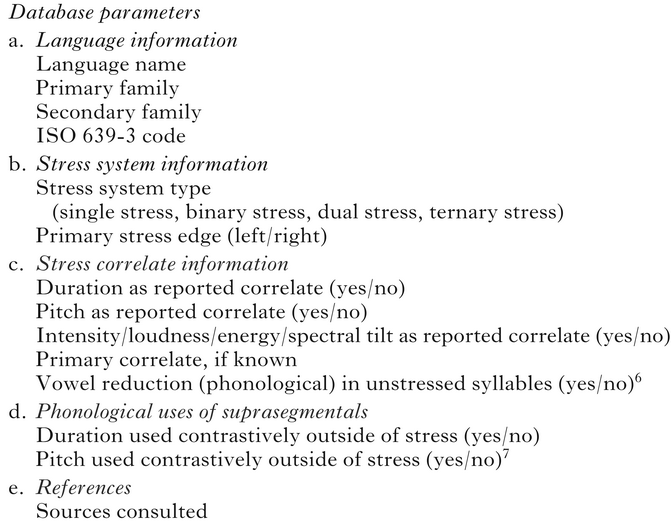
The language name is generally the one given by the source article, although in some cases an updated one is used instead. The primary language family is the largest known family affiliation, and the secondary family gives the relevant branch of larger families.
The stress system type column indicates whether a language is reported to have only a single stress per word, a binary system, a dual stress system or a ternary system. The single main stress in languages of the first type may be accompanied by secondary stress that is unpredictable in location and number (i.e. not rhythmic). If a primary stress and one secondary stress were both mentioned in the source, with secondary stress occurring either two syllables after (if the primary stress was leftward) or before (if the primary stress was rightward), the language is assumed to be binary unless other information was provided. Stress systems are coded as dual if the primary and secondary stresses appeared to come from opposite directions and no other (non-weight-sensitive) stresses were mentioned; e.g. if the primary stress was penultimate and the secondary stress initial. The cells in this column in the database each have comments that briefly describe the stress pattern. The stress pattern was taken from the stress correlate source where possible; otherwise additional sources were consulted. Following the usual practice for stress systems, quantity-sensitive systems (where weight affects the stress pattern) are described on the basis of the stress pattern in words with all light syllables, unless otherwise stated. Whether stress is leftward or rightward is also coded. If no stress window was listed, lexical stress is not coded as either leftward or rightward.
The reported stress correlates were taken from descriptions of the realisation of stress. Researchers often only discussed the correlates used by the language; in such cases, other suprasegmental correlates (duration, pitch and/or intensity) are coded as not present, even if not specifically mentioned. The exception to this practice is when a correlate was mentioned in passing in a different context, or when the status of a correlate was specifically mentioned as not known. In these cases the other correlates are left blank, rather than coded as not present.
Sometimes correlates were stated with a hedge of some kind. Any statement that indicated the correlate was present more often than not was treated as a positive statement. Thus correlates that were mentioned as occurring ‘frequently’, ‘often’ or ‘typically’ are coded as being present, whereas those described as occurring ‘occasionally’, ‘to some degree’ or ‘for some speakers’, or which were associated with the phrase ‘may occur’, are coded as being absent. The quote that each language's stress correlates was based on is included as a cell comment in the duration column. Finally, because sources did not consistently clarify whether correlates were for primary or secondary stress, the database conflates the two.Footnote 8 If a correlate was mentioned as being present in the realisation of any word-level stress, it was coded as positive. Sometimes stress, especially in older texts, was only referred to by a correlate (e.g. ‘the tone’; Dillmann Reference Dillmann and Crichton1907); however, if that feature clearly followed a culminative pattern that was present in every word, we assumed that the author was referring to stress and coded the term the author used as a correlate.Footnote 9
Some further points are relevant for each of the suprasegmental correlates. Regarding duration, the occurrence of long vowels only in stressed syllables was not taken as sufficient evidence for duration as a stress correlate, unless it was specifically mentioned that short vowels were longer when stressed (or, hypothetically, if all stressed vowels were long, and long vowels only occurred under stress). The use of pitch as a word-level stress correlate can be difficult to untangle from pitch accents, due to sentence-level intonation. We did not code pitch as a correlate if it was clear the author was discussing sentence-level stress. However, as Gordon (Reference Gordon and van der Hulst2014) and Vogel et al. (Reference Vogel, Athanasopoulou, Pincus, Heinz, Goedemans and van der Hulst2016) discuss, many descriptions of stress correlates are based on words uttered in citation form, and thus with sentence-level stress/intonation. Therefore, this confound was undoubtedly present in some data presented as information about word-level stress. Finally, we grouped statements referencing physical, acoustic and auditory properties such as ‘force’, ‘energy’, ‘intensity’, ‘loudness’ and ‘spectral tilt’ under the heading intensity, as the inconsistency in terminology does not, in most cases, appear to reflect a real difference in the cue being referenced.Footnote 10
Although vowel reduction can serve as a correlate of stress, it is common for stress correlates to be discussed without mention of the segmental correlate of vowel reduction. Therefore, we did not code vowel reduction as not present when it was not mentioned in the discussion of stress correlates. In most cases we had to look further (within a source or at a different source), in order to determine whether there was any evidence for or against vowel reduction. While vowel reduction occurs on a continuum, we only considered phonological vowel reduction, which we assumed would reliably be reflected in IPA transcriptions, whereas vowel undershoot would not be. Phonological vowel reduction typically involves a reduction of the number of vowel contrasts, although not necessarily; e.g. Bhojpuri phonologically reduces all vowels, although they remain distinct (Shukla Reference Shukla1981). Phonetic vowel undershoot (in the sense of Lindblom Reference Lindblom1963 and Stevens & House Reference Stevens and House1963) and other phonetic reduction were not considered to be vowel reduction. Vowel reduction was also coded as not present if we could clearly see that every vowel could be present in both stressed and unstressed positions, or if, in a section devoted to phonological quality changes of vowels or vowel distribution, mention of vowel reduction was absent. The observations in the sources that prompted the determinations are given as quotations in comments in the cells of the vowel reduction column.
In cases where multiple stress correlates were given, one or two were often mentioned as being stronger, more reliable or more important. The database therefore codes for the primary correlate when either duration, pitch or intensity was singled out. No primary correlate is coded in cases where two correlates were said to be more important than a third, because, in addition to not identifying a unique primary correlate, this type of statement was often used to show the weakness of one correlate, rather than the importance of the others.
Whether length or pitch was used contrastively outside each language's stress correlates was also determined. If the stress correlate source did not include the relevant information (phonemic inventory, etc.), an additional source was consulted in order to ascertain whether vowel length was contrastive in the language. We also searched for any mention of tone or contrastive pitch accent in the language. We assumed that a contrast was absent when it was not mentioned; quotations are therefore provided whenever the feature is listed as present, but not if the feature is not present, unless the author explicitly mentioned its absence. When languages were described as having a vowel contrast based on both length and quality, we coded these as not having contrastive length. This was done because the vowel reduction gives a cue to stress that could be utilised by listeners, who would then not need to attend to the actual vowel length.Footnote 11
2.1 Testing the database
Some of the reported correlates are the result of acoustic investigation on a language; however, most are the researchers’ auditory impressions of how stress is realised. While care was taken to apply a consistent set of criteria to the coding of the presence/absence of various correlates, the fact that the information came from a wide variety of researchers across times and locations means that the auditory criteria applied by the researchers were not in any way standardised.
In order to test the database for evidence of consistency, we worked from the assumption that languages within a family are more likely to resemble each other in their realisation of stress than a randomly selected subgroup from the database. Looking for robust-enough language families to compare to random samplings, we found there to be seven language families with at least four members.
A Monte Carlo simulation was used to determine where each of these seven language families fell, for each parameter, in the distribution of language sets of the same size taken from the database (based on 10,000 random pulls from the database). We compared the number of actual languages within each family that use each of duration, pitch and intensity to the average number found for sets of language groupings of the same number of languages from the overall database. For example, of the 18 Austronesian languages, 72% have duration as a reported stress correlate, 83% have pitch and 61% have intensity. We then compared this to the average for each correlate in 18 languages randomly pulled from the database. On average, over 10,000 random sets of 18 languages, 59% used duration, 66% pitch and 61% intensity. Thus we can see that the Austronesian languages are more likely than any average group of 18 languages to use duration and pitch, but just as likely to use intensity.
Each value (from each of the three parameters in each of the seven language families) was calculated as a z-score (based on distributional curves for each language-family size). The absolute values of these z-scores were taken, as a language family may show internal consistency by tending either to use or eschew a particular stress correlate. The mean of the absolute z-scores was 0.7361. In comparison, the mean absolute z-scores across sampled same-sized sets of languages was 0.5107, with a standard deviation of 0.0905.
Thus the value from our actual families is 2.4908 standard deviations away from the expected value, which is a significant difference (p = 0.0127, two-tailed). This shows that the actual languages within families are more similar to each other than we would typically find with random groupings of languages. Specifically, we would have to pull random language sets of the size of those seven families an average of 87 times (based on 500 iterations) in order to find one with a z-score of at least 0.7361.Footnote 12 Thus we have evidence that the database shows something of the internal consistency that we would expect to find.
Another reasonable expectation we can test the database for is the correlation of intensity and pitch. As noted by Lehiste (Reference Lehiste1970: 125), and supported by Titze (Reference Titze1989), the subglottal pressure that results in increased intensity also causes an increase in the rate of vocal fold vibration. Lehiste observes that increased duration, on the other hand, cannot be seen as a physiological consequence of increased respiratory effort. Given this, we would expect to find that languages reported to have either pitch or intensity as a stress correlate would have the other as well, but that this should not hold for the co-occurrence of either with duration. Table Ia shows that the occurrence of pitch and intensity both being reported as stress correlates is more frequent than either being reported without the other. Table Ib is restricted to only those languages reported to have exactly two of the three suprasegmental correlates.
We can see from these tables that if either intensity or pitch is reported to be a stress correlate, it is more likely than not that the other is also a reported correlate, and that the likelihood of either occurring with duration is much lower. One-sample χ2 tests of equal proportions for the data in Table I found that the three categories are not distributed equally (p<0.001, p = 0.022 respectively).
Correlation of use of pitch and intensity: (a) for all languages; (b) for languages with exactly two correlates.

Both the Monte Carlo simulation and the pitch/intensity correlation indicate that the database is robust enough to be informative regarding the FLH.
3 Correlations
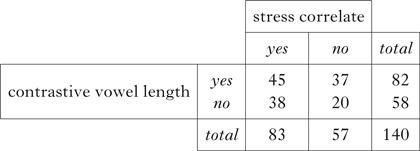
Table II shows the correlations between contrastive vowel length and duration (of any sort) as a reported correlate of stress.
Correlations of stress-based duration and contrastive vowel length.

We see that, of the 82 languages that have contrastive vowel length, 54.9% use duration as a stress correlate, which is not very different from the 65.5% of the 58 languages that do not have contrastive vowel length that use duration as a stress correlate. Looking at it the other way around, of the 83 languages which reportedly use duration as a stress correlate, 54.2% nevertheless have contrastive vowel length, compared to 64.9% of the 57 languages which do not use duration as a stress correlate and have contrastive vowel length. A χ2 statistical test shows there is not a significant relationship between duration as a stress correlate and contrastive vowel length (φ = –0.107; χ2(1) = 1.593, p = 0.207).
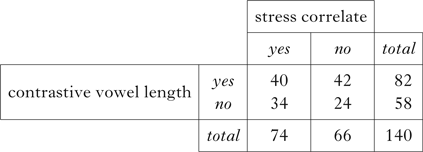
A few of the languages that use duration as a correlate of stress are in fact described as lengthening a (preceding or following) consonant in at least some cases. For example, Łukaszewicz (Reference Łukaszewicz2015) found that secondary stress in Polish is realised through additional duration of the onset consonant, and the following consonant is reported to lengthen in Nambikuara as the durational cue to stress in closed syllables (Kroeker Reference Kroeker2001). Languages were coded for whether they always used only consonant duration as a correlate (N = 5), sometimes used consonant duration without simultaneously using vowel duration as a correlate (N = 4) or sometimes or always used consonant duration as a correlate in addition to vowel duration (N = 1). Because of the greater frequency of vowel duration as a correlate in comparison to consonant duration, we assumed that mention of duration referred to the length of the vowel, unless the source clearly specified otherwise. Table III is a revised version of Table II, with the durational correlate limited to consistent vowel duration. Languages in which consonant lengthening, whether consistent as in Polish or structure-dependent as in Nambikuara, is the durational stress correlate (without concurrent vowel duration) have been reassigned to the second column.
Correlations of stress-based vowel duration and contrastive vowel length.

Even with the cases involving consonantal duration counted as not using duration as a stress correlate, 48.8% of languages with a vowel-length contrast use (specifically vowel) duration as a stress correlate, not very different from the 58.6% of the languages without a vowel contrast that use (vowel) duration as a cue to stress. A χ2 test finds no relationship between the use of vowel duration to cue stress and the presence of contrastive vowel length (φ = –0.097; χ2(1) = 1.320, p = 0.251).Footnote 13
We could imagine that increased duration might be present to some degree in stressed syllables, and therefore be reported as a stress correlate, but not carry the primary load of cueing stress. While Berinstein's conclusion quoted above states that duration will have ‘little or no [stress] cue value’ in languages that use duration contrastively, her original hypothesis suggests that languages might still use stress cues that also have a contrastive function in the language, but to a lesser degree than other stress cues.
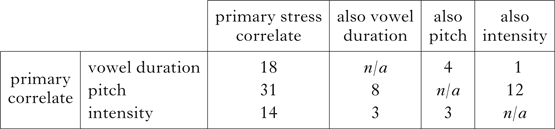
Many sources where multiple stress correlates were listed singled out one which was said to be the most important or the key component. We coded cases where a single correlate was identified as the primary correlate, so that the correlations of this subset with the use of contrastive vowel length could be examined. Languages for which only one correlate was reported were coded as having that correlate as the primary correlate. Table IV shows, in the first column, the primary correlate in the 63 languages for which one was identified, and, in the subsequent columns, the number of those that also use vowel duration, pitch or intensity as a correlate.Footnote 14
Languages for which a primary correlate is specified: primary and other correlates.

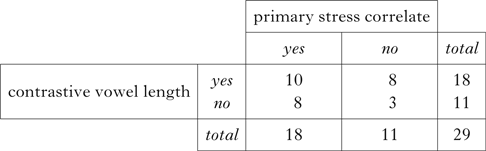
For those languages that are reported to use duration as a correlate of stress, Table V shows the correlations between using vowel duration (i.e. the more restrictive ‘duration as a stress correlate’ criterion reflected in Table III) as the primary correlate and having a vowel-length contrast.
Correlations of duration as primary stress cue and contrastive vowel length among languages that use stress-based duration.

As seen in Table V, even when the dataset is restricted to those languages that are identified as having a primary stress correlate, no aversion to using duration as the primary cue to stress is seen in languages with contrastive vowel length. Of the 18 languages that have contrastive vowel length and have a primary correlate, 55.6% use duration as the primary stress correlate, compared to 72.7% of the eleven languages lacking a vowel-length contrast that use duration as the primary stress correlate. A Fisher's exact test (used because the cell counts are too small for a χ2 test) finds no significant relationship between the primary stress correlate and the use of contrastive vowel length among languages that use duration to cue stress (φ = –0.172, p = 0.449).
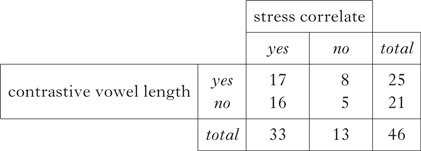
A reviewer suggested examining the correlations for the subset of languages for which the reported correlates were based on acoustic studies. There are 46 such languages, and the correlation within this subset of vowel-based duration as a cue to stress with contrastive vowel length is given in Table VI.Footnote 15
Correlations of stress-based vowel duration and contrastive vowel length in acoustically investigated languages.

We see a very similar distribution to that found in Table III for the full dataset. Of the 25 languages with contrastive vowel length, 68% use duration as a cue to stress, which is similar to the 71.7% of languages without contrastive vowel length which use duration as a cue to stress. A χ2 test finds no relationship between the use of vowel duration to cue stress and the presence of contrastive vowel length in this subset of the data (φ = –0.091; χ2(1) = 0.378, p = 0.539).
4 Conclusion
The functional load hypothesis is intuitively appealing, and, if correct, would provide a natural explanation for the stress-related suprasegmental differences between K'ekchi and Kaqchikel. It is not unusual to find Berinstein's work referenced as demonstrating that languages with contrastive vowel length do not use duration in the realisation of stress. However, many languages must be considered in order to truly test the hypothesis. The stress correlate database presented here is designed to do this, and indicates, perhaps surprisingly, that the FLH is not borne out. Among the languages in the database, there is no correlation between a language's use of vowel duration in the realisation of stress and its use of contrastive vowel length, and this does not change when the relative importance of the stress correlates in a given language is taken into account.
We conjecture that these issues for the FLH are due at least in part to languages’ flexibility in putting suprasegmentals to work. For example, Taff et al. (Reference Taff, Rozelle, Cho, Ladefoged, Dirks and Wegelin2001) document that long vowels in Aleut are statistically significantly longer than short vowels, and stressed vowels are statistically significantly longer than unstressed vowels of the same phonological length. This results in four levels of duration, showing that increased duration under stress does not conflate the vowel-length contrast. The phonetic details of duration in Aleut give an insight into how languages can use duration both for a phonological contrast and as a phonetic correlate of stress. Thus we see that duration as a correlate of stress may coexist alongside contrastive length, without obscuring these contrasts. Further, as a reviewer notes, there are multiple additional sources of durational differences, from final lengthening, syllable shape, effects from neighbouring consonants, etc., and so it perhaps should not be surprising to find that duration can be used both for contrastive length in vowels and to cue stress.
Others have also noted that Berinstein's FLH may be too strong. For example, Turk (Reference Turk, Cohn, Fougeron and Huffman2012: 251) suggests that ‘prosodic use of duration is constrained, but not precluded, by its use for segmental contrasts’, and also suggests that other uses of duration may be the reason that three-way quantity distinctions are rare, as two-way systems leave room for other influences on duration.
It is important to emphasise that, while our results raise a question of whether there is any correlation between language's use of contrastive vowel length and use of duration as a stress correlate, we do not expect the results of our typological study to conclusively decide the fate of the FLH. As Vogel et al. (Reference Vogel, Athanasopoulou, Pincus, Heinz, Goedemans and van der Hulst2016) point out, inconsistent methodologies cast doubt on even the validity of acoustic investigations. Furthermore, Vogel et al. find support for a pressure for languages to distinguish the cues to word-level stress and focus accent. Suomi et al. (Reference Suomi, Toivanen and Ylitalo2003: 114) suggest that Berinstein's work actually investigated sentence accent. It may therefore be that there is a level at which Berinstein's FLH does hold, even if it is not between segmental contrasts and word-level stress.
We hope that the survey of languages presented here will be helpful not only in showing that languages may use duration both in vocalic contrasts and in the domain of stress, but also in serving as a useful reference for identifying languages for which more detailed acoustic investigations should be carried out to clarify the use of duration at different levels.