INTRODUCTION
Sphaeroma terebrans Bate, Reference Bate1866, an isopod of the family Sphaeromatidae, is common in tropical and subtropical waters throughout the world. It is reported to be distributed in the intertidal areas of Hawaii, Virginia, Florida, Venezuela, Brazil, the east coast of Southern Africa, India, Pakistan, Malaysia, Singapore and Eastern Australia (Brooks & Bell, Reference Brooks and Bell2005; Schotte et al., Reference Schotte, Kensley and Shilling2007). In total 36 species of the genus Sphaeroma are known around the world (NHM, 2012), but only three species of Sphaeroma have been identified from Malaysia, the country neighbouring Brunei (Singh & Sasekumar, Reference Singh and Sasekumar1994).
Sphaeroma terebrans is an ecologically and economically important species, as it bores into the wood of boats, marine pilings and other wooden structures (including live mangrove trees) (Rehm & Humm, Reference Rehm and Humm1973). However, no species of Sphaeroma had been identified from Brunei to date. In this note the first record of S. terebrans Bate, Reference Bate1866 from the Brunei coastal area is reported.
MATERIALS AND METHODS
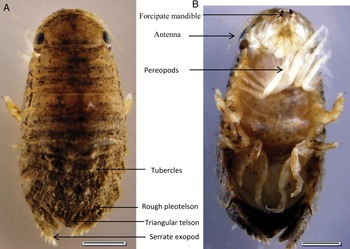
During a benthic study at various stations (Damuan, Bandar, Sg. Besar and Bedukang) in the Sungai Brunei estuary (4°45′–5°02′N 114°58′–115°10′E) (Figure 1) from May to June, 2012 we encountered a wood boring isopod in fallen dead wood and other wooden structures in water villages: it was identified as Sphaeroma terebrans (Figure 2). Fallen wood with bore-holes was collected randomly by hand hatchet, and saw. The wood was brought to the laboratory and dissected immediately with a pocket knife in a white tray. At least 50 specimens of S. terebrans were collected and preserved in 70% ethyl alcohol for identification. Identifications were made using several online keys and guides (Kensley & Schotte, Reference Kensley and Schotte1989; Bruce, Reference Bruce2003; http://www.itis.usda.gov; www.marinespecies.org), and some taxonomic and illustrative papers including Kensley & Schotte (Reference Kensley and Schotte1999) and Brusca et al. (Reference Brusca, Coelho and Taiti2001). The specimens are stored in the Biology Department, Universiti Brunei Darussalam.
Study area map showing Sphaeroma terebrans recorded in Brunei.

Dorsal (A) and ventral (B) view of Sphaeroma terebrans. Scale bars: 2 mm.

RESULTS AND DISCUSSION
Morphological description
Length 11.86 ± 0.86 mm (N = 10), body strongly dorsoventrally compressed and convex dorsally, smoothly ovate in outline, frequently rolling into a ball; colour brownish red. Two comparatively large compound sessile eyes. Epistome triangular and nearly equilateral. Mandible not projecting anteriorly, both together forcipate. Maxillule lateral lobe apex without hooked robust setae. Maxilliped endite obvious. Seven pereonites distinct dorsally. Coxae extending ventrally and laterally; pereopods 5–7 without flattened setose articles, five pairs of pleopods present, pleopods subequal, of modest size, basis not elongate. Surface of pleotelson irregularly granular. Transverse ridges on the 4th and 5th pereonites and four distinct tubercles on the 5th to 7th pereonites. Uropods biramous, positioned proximally on pleotelson; exopod with outer margin serrate. Peleotelson triangular posteriorly.
Sphaeroma terebrans is readily distinguished from other similar species in the genus by a combination of characters. It differs from S. quadridentata by its irregular rough surface and its possession of obvious strong tubercles on the 5th to 7th pereonites. It shares the character of tubercles on the pleotelson with S. walkeri and S. quadridentata. However, it differs from these species by other characters as detailed in Table 1. There remains confusion over whether this species is synonymous with S. destructor (Richardson, Reference Richardson1897); Richardson (Reference Richardson1905) argued that S. destructor bores into wood pilings in estuarine waters, while S. terebrans was found in the prop roots of red mangroves (Rhizophora mangle L.). A number of databases (e.g. the Integrated Taxonomic Information System (IT IS) Report–http://www.itis.usda.gov) also do not agree with this synonymy and distinguish S. destructor as a valid species; conversely, S. destructor is not even mentioned as a synonym in the World Register of Marine Species (Schotte, Reference Schotte, Schotte, Boyko, Bruce, Poore, Taiti and Wilson2012).
Morphological comparison of Sphaeroma terebrans with other Sphaeroma species elsewhere.

No detailed taxonomic description of the species was found from the south-east Asian region with which the present description could be compared. However, the present specimens correspond with Stebbing's (1904) Ceylon specimens; for example, Stebbing (Reference Stebbing1904) remarks on the dorsum being ‘tuberculated with low but distinct tubercles, each one surmounted by a small tuft of stiff hairs’. The granulated pleotelson of the present specimens is in agreement with Cheriyan (Reference Cheriyan1973) and Barkati & Tirmizi (Reference Barkati and Tirmizi1990) but the posterior apex is more pointed in the present material. The Brunei material is somewhat larger (11–12 mm) than the specimens previously described by Stebbing (Reference Stebbing1904), Cheriyan (Reference Cheriyan1973), and Barkati & Tirmizi (1993; 8–10 mm). This is attributed to ecological and geographical variation.
There have been significant increases of new species and new distributional records of tropical marine crustacean isopods over the last few decades (Cheriyan, Reference Cheriyan1973; Barkati & Tirmizi, Reference Barkati and Tirmizi1990; Singh & Sasekumar, Reference Singh and Sasekumar1994; Nair, Reference Nair1996; Bamber et al., Reference Bamber, Chatterjee and Marshall2012), indicating that our knowledge is far from being complete. A unified and continuous effort is needed to identify the species of this region, and comprehensive and illustrated identification keys and guides are urgently required for ease of identification in this region.
The isopod genus, Sphaeroma has received much attention due to the debate as to whether these isopods damage or are beneficial to mangroves (Estevez & Simon, Reference Estevez, Simon, Walsh, Snedaker and Teas1975; Simberloff et al., Reference Simberloff, Brown and Lowrie1978; Rehm & Humm, 1983; Perry, Reference Perry1988). Some reports (Rehm & Humm, 1983; Perry, Reference Perry1988; Ellison & Farnsworth, Reference Ellison and Farnsworth1990; Svavarsson et al., Reference Svavarsson, Osore and Olafssan2002) suggest that the boring activities of S. terebrans damage the prop roots of red mangroves. Others (Simberloff et al., Reference Simberloff, Brown and Lowrie1978; Brooks & Bell, Reference Brooks and Bell2002), however, indicate that the boring effects of S. terebrans may actually be beneficial to mangroves promoting the increased branching of prop roots that allow the trees to better withstand wave action. Ellison & Farnsworth (Reference Ellison and Farnsworth1990) demonstrated experimentally that the most common sponge and ascidian species inhibited isopod colonization and hence indirectly facilitate root growth. Brooks & Bell (Reference Brooks and Bell2002) argued that other factors such as productivity and healing versus branching responses of mangroves should be examined to have a comprehensive understanding of this animal and mangrove interaction.
The presence and abundance of S. terebrans in Brunei waters is clearly of concern, as there is a prevalence of wooden structures in the coastal and estuarine waters, notably water villages and boats, and any threat to their integrity through the boring activities of this isopod has the potential for major economic and social impact.
ACKNOWLEDGEMENTS
This work is part of the ongoing PhD research of the first author working under the project ‘Chemical Ecology of Brunei Estuary’ funded by University Brunei Darussalam through the grant number UBD/GSR/ S & T/ 16. We thank the Wet Laboratory Biology team for their assistance in the field. Thanks are also extended to Mr Amran Hossen who assisted us in the field and laboratory.