1. Introduction
It is well-known from dialectology and sociolinguistics that dialect leveling—or dialect convergence—may occur when speakers of one particular dialect meet or form networks or new speech communities with speakers of another dialect.Footnote 1 The question is, what outcome does one expect when conservative dialect speakers meet and form a speech community with “less dialectal” or “de-dialectified” speakers of the same dialect? What will be the process of dialect convergence in such a situation? Which variety will win the battle: the conservative variety with many traditional dialectal features or the more leveled variety?
The Danish-speaking immigrant community that existed in Hamlin, Kingsbury, and Brookings counties in Eastern South Dakota, USA, offers an answer to these questions. During the period from the late 1870s up to the 1920s, this area was settled by speakers of the Danish dialect Northwest Jutish (NW Jutish); they formed a community, which, according to available sources, remained a NW Jutish stronghold up to the 1980s. Since the regiolectification of the Danish dialects intensified during the period of emigration (Pedersen Reference Pedersen2003), this Danish-speaking commu-nity included speakers of NW Jutish that represented different stages of the de-dialectalization. This range of more or less regiolectified NW Jutish is represented in the data to be analyzed below by speakers who were born in South Dakota to immigrants from NW Jutland and by speakers who were born in NW Jutland but migrated to the USA. The article shows that in spite of an assumed strong NW Jutish identity and possible identity-driven language change processes (for example, Hickey Reference Hickey and Hickey2003, Tuten Reference Tuten2003), general universal principles of accommodation (Giles Reference Giles1973, Giles et al. Reference Giles, Coupland and Coupland1991), or what Trudgill (Reference Trudgill2008:252) refers to as general “behavioural coordination,” convergence did not take place to any significant degree in this immigrant community.
The following two facts are important for the purposes of this study: First, the speakers born in the USA have inherited their parents’ more traditional NW Jutish dialect. This becomes clear from the interviews with the speakers, whose speech was analyzed in this study (see section 2). Second, the speakers who were born in Denmark and then migrated to the USA represent a younger, more leveled, or “regiolectified” dialect stage. This is because during the period from the late 19th to mid 20th century, Denmark went through a process of de-dialectalization—or linguistic standardization—at a higher speed and in a more profound way than its neighbors. As a result, today the traditional dialects are on the verge of extinction (Pedersen Reference Pedersen1996, Reference Pedersen2003, Reference Pedersen2009; Kristiansen Reference Kristiansen1998, Reference Kristiansen2009; Kristensen Reference Kristensen2003).
Pedersen (Reference Pedersen2003:10) estimates that in “premodern and early modern time the linguistic diversity was considerable” and that a “majority of 80–90 percent of the population spoke local rural dialects with a limited reach.” Following the Auer model (Auer & Hinskens Reference Auer and Hinskens1996), some of the factors that contributed to the process of dialectal convergence—both horizontal and vertical—included agrarian and educational reforms, increased mobility, and, starting in the 1870s, industrialization and overpopulation. Horizontal convergence takes place when features from smaller dialect areas disappear, while features shared by dialects in larger areas become stabilized. Vertical convergence happens when features from the standard language influence the local speech. Both processes contribute to dialect leveling, that is, to a decrease in traditional dialect features. Pedersen (Reference Pedersen2003) considers the dialect leveling in Denmark during the 1800s a case of primarily horizontal convergence, with vertical convergence taking off in about 1900. During the 19th century, the dialects “were modernized, they converged to each other and to the standard language, that is, the differences were leveled” (p. 18).
The linguistic situation in the NW Jutish-Danish immigrant community in South Dakota could lead to a number of possible outcomes. If NW Jutish is preserved, to a considerable degree by both the early immigrants and their descendants (US-born speakers) and the late immigrants (Denmark-born speakers; henceforth DK-born), two scenarios are possible: According to one scenario, speakers from both groups could have preserved the traditional dialect inherited from their parents; in this case, the de-dialectification of Danish spoken by the early immigrants would not have influenced the speech of the late immigrants. Alternatively, in the beginning, the speech of the late immigrants could have been less dialectal than the speech of the US-born speakers (as a result of the de-dialectification in Denmark), but it could have later converged to the more traditional variety of NW Jutish already represented in South Dakota. If neither of the two speaker groups is particularly dialectal, it may be because it was not so from the outset, or because of a process of dialect convergence, whereby the (probably less dialectal) speech of the late immigrants influenced the (more dialectal) speech of the descendants of the early immigrants.Footnote 2
If, however, traditional NW Jutish is preserved best among the US-born speakers, this could suggest that the dialect of their parents, who emigrated in the 1870s–1880s, was more conservative than the one brought by the immigrants in 1910–1930; this more conservative variety has somehow resisted a potential linguistic pressure from the less dialectal newcomers. Under this scenario, the language community of South Dakota, as represented in the dataset, shows a “deep-freezer effect”: The speakers’ dialects are preserved as they were at the time of their transmission from Denmark to the USA. The aim of this article is to examine to what extent leveling has taken place in this immigrant community.
The argumentation in this article draws on a detailed analysis of 15 phonological variables, supplemented with information from available historical sources, including anecdotal evidence from the speakers themselves. Unfortunately, information on networks, societal behavior, and domains of language use throughout the settlement period is rather limited; studies on the relationship between language and societal matters carried out today are usually based on a much more substantial amount of data. Nor can one rely on a control group comprised of Danish Thyian speakers in Denmark, who are of the same age, social class, etc. as the speakers in the present sample.
Furthermore, it would have been desirable to rely on descriptions of Thyian spoken in Denmark to shed light on certain features of Thyian spoken in South Dakota. Such comparative analysis would help identify the distribution of certain variables, as well as their possible inclination for being (non)dialectal. Unfortunately, such descriptions do not exist at the time of writing (to the author's knowledge). The type of data used in this study presents the analyst with the so-called “bad data problem” (Labov Reference Labov1994:10–11), whereas the design-of-study-related parameters form “limitations of data that cannot be compensated for” (Labov Reference Labov1994:11). Given those circumstances, the analysis presented below constitutes an effort to make the best of nonideal data. The aim is to contribute to a discussion of the possible scenarios that may have led to the distribution of (non)dialectal pronunciation features—that is, dialectal convergence—in a rural immigrant or heritage language community.
The structure of this article is as follows: Section 2 gives a brief survey of the settlement history of Danes in South Dakota. This survey is followed by a presentation of the data and the speakers in section 3. In section 4, I present the phonological variables. Section 5 contains the analysis, the results of which are discussed in section 6. Section 7 contains concluding remarks.
2. Danes and Danish in Eastern South Dakota
2.1. A NW Jutish Stronghold
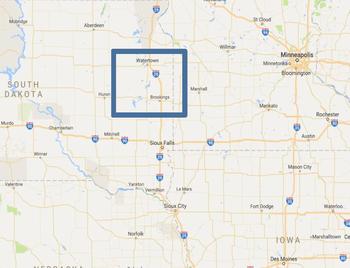
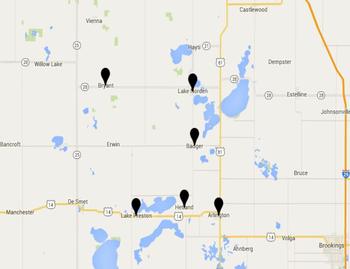
Most of the Danish settlements in South Dakota and elsewhere in North America were established by immigrants from different places in Denmark; they spoke a variety of rural dialects, more or less regiolectified. However, the Danish settlements in Hamlin, Kingsbury, and Brookings counties in Eastern South Dakota (see figure 1) attracted primarily Thyians and speakers of the Thy dialect from other places in the USA, as well as directly from Thy in NW Jutland (Jørgensen Reference J⊘rgensen1916, Christensen Reference Christensen1928).Footnote 3 Those settlements were to form a “steady and fairly large” community (Olsen Reference Olsen1940), which encompassed the small towns Lake Norden, Lake Preston, Badger, Hetland, Bryant, and Arlington (see figure 2; Kjær & Baumann Larsen Reference Baumann Larsen1981).Footnote 4
Central and Eastern South Dakota with Hamlin, Kingsbury, and Brookings counties framed.

Towns with Danish-speaking immigrants in Hamlin, Kingsbury, and Brookings counties, South Dakota.

Early historical sources, newspaper reports, and anecdotal evidence all point to a specific and strong Thyian identity among the settlers in Hamlin, Kingsbury, and Brookings counties. According to a local historian, the settlers from Thy were renowned for being “very conservative” and unwilling to change customs (Olsen Reference Olsen1940:18); they were “so loyal to home traditions that [their] dialect is now spoken by the grandchildren of the Danish pioneers in addition to national Danish and English” (Christensen Reference Christensen1928). The loyalty to the dialect, and, perhaps, cultural practices of the homeland have also been emphasized in a Danish context. In an article in the newspaper Aalborg Stiftstidende from 1980, Overgaard (Reference Overgaard1981) tells the reader that in the years around 1900 “everybody” in Lake Norden spoke Danish, and everybody knew each other.Footnote 5 Furthermore, according to Overgaard (Reference Overgaard1981), the inhabitants in Lake Norden and in and around neighboring towns were for many years “quite isolated,” known for “keeping together” and for primarily marrying other Danes (see also Baumann Larsen Reference Baumann Larsen1981:5 and Kjær & Baumann Larsen Reference Baumann Larsen1981).
The claims of such a robust effort on the part of the inhabitants of the three counties to preserve their NW Jutish identity are supported by anecdotal evidence. Overgaard (Reference Overgaard1981) reports that in Viborg, 160 km south of Lake Norden, a “normal Standard Danish” can be heard, whereas the Viborgians consider the Danish spoken up north as flat Danish (platdansk; see also Baumann Larsen Reference Baumann Larsen1981). Overgaard (Reference Overgaard1981) also informs his readers that Emma Nielsen from Lake Norden, aged 76, speaks “almost fluent Thy dialect” even though she has never been to Denmark. Emma Nielsen herself reports that they “only spoke Thy dialect at home. Mother forced that through, so that my father had to give up his Vendsyssel dialect.”
Anecdotal evidence for a strong determination to preserve Thyian identity also comes from the interviews conducted for the purposes of this study (see section 3). For example, HON, born in South Dakota in 1901, says that his father learnt to speak English, but his mother did not, because she was afraid of being ridiculed. He quotes his mother as saying (in Danish): “I'm afraid they will ridicule me.” HON also recalls that many “around here” spoke the Thy dialect. In response to the interviewer's question whether he could understand that dialect, he answers with a laugh (in Danish): “No, I couldn't understand—I couldn't understand it.” During another interview, PLU, the interviewee's husband, comes home and interrupts the conversation by asking the interviewers (in Thyian): “Are you the Danes? You are not Thyians, I guess. But you can understand Thyian? Oh, that's good, because that is what we speak best.” Later during the same interview, PLU's wife, MLU, embarks on an elaborate 2.5-minute narrative about a miscommunication that took place some years earlier, when the couple visited NW Jutland. There MLU realized that she used traditional NW Jutish vocabulary that was no longer used by her Danish family-in-law. EMN, whose parents were born in South Dakota, recalls that “it was flat Danish…it was mostly Thyian around here, yes, it was all Thyian.” SOA shares his memories as well: “yes, there were a lot of really old Thyians, there were maybe two or three families from other places, but apart from them, there were mostly people from Thy.” Furthermore, an outsider, a retired priest from Solvang in California who used to travel around Danish settlements, recalls his experience: “we learned to understand almost all the dialects, and I came out to a Thyian community in South Dakota and they all talked so broad Thyian, yes, they spoke broader Thyian than they do in Denmark.” Finally, the idea of being Thyian and possessing characteristic Thyian features shows itself in a quote from HAJ: “We, Thyians, we are critical, but we're not two-faced.”
2.2. The Decline of NW Jutish in South Dakota
Overgaard's (Reference Overgaard1981) observations indicate that Danish, or Thyian, was still spoken in 1980–1981 when he reported from Lake Norden to Danish newspaper readers. He adds that the older generation “safeguards” the dialect and is proud of it. This is consistent with Kjær & Baumann Larsen's (Reference Kjær, Larsen and Weinstock1976:189) observation made a few years earlier that in “an isolated settlement in South Dakota … a mixed Danish-American language is still heard in the streets.”
However, there is also opposing evidence with respect to language retention, which paints an ambiguous picture of the status of Danish, or Thyian, in the second half of the 20th century. For example, Overgaard (Reference Overgaard1981) points out that descendants of the Danish immigrants no longer use either the Thy dialect or standard Danish on a daily basis. The language has become a “sentimental Sunday language,” only to be used on festive occasions. Language death is also evident from the interviews that provide the data for this study. Only seldom do the speakers say that they use Danish among themselves. The speakers’ children “know” Danish, but they prefer not to speak it. Moreover, contrary to Overgaard's (Reference Overgaard1981) reports, their grandchildren neither speak nor understand Danish. Thus, the reports of thriving Thyian Danish and strong Thy identity cited above stand in contrast to evidence showing that language death, or domain loss, started relatively early. Already in 1928 Christensen (Reference Christensen1928:550) reports that the descendants of the immigrants in South Dakota “are being molded into a common type of citizenship…” Olsen (Reference Olsen1940:25, 30) provides indirect evidence for language death. She observes that Norwegian congregations took over in the Danish areas populated by Danes because there were not enough Danes to keep separate Danish churches and to maintain Danish as the language at church services. The early decrease in the use of Danish as a language of the church is also emphasized by the informants in the interviews. Many of them state that in the 1930s, Danish was no longer used in the churches (see also Baumann Larsen Reference Baumann Larsen1981:4). In addition, there are no reports about Danish schools in the area of focus. On the contrary, HON, cited above, recalls an episode from his childhood when he was punished by the teacher for speaking Danish at school (“no recess”).
Another factor contributing to the decline of Danish in South Dakota may have been migration: In general and after the Second World War in particular, Danes were moving from the Midwest to states on the West Coast. For example, around 1950 up to 5,000 Danes moved to California from South Dakota, primarily because of better job opportunities, and also because they wished to spend retirement in a milder climate (Grøngaard Jeppesen Reference Gr⊘ngaard Jeppesen2009). It is likely that such drainage of Danish speakers dealt a final blow to Danish as a widely-spoken language of daily use in South Dakota.
Thus, the sources from the 1970s and early 1980s quoted above clearly show that Thy culture had a strong presence in the Hamlin, Brookings, and Kingsbury counties, and that the Thyian Danish dialect played an important part in maintaining this culture. However, there is also evidence that the use of the Thyian dialect was limited, and that Danes were leaving the area. These facts, in turn, suggest that the status of the Thyian dialect drastically changed some time in the middle of the 20th century, which eventually resulted in language death.
3. The Data and the Speakers
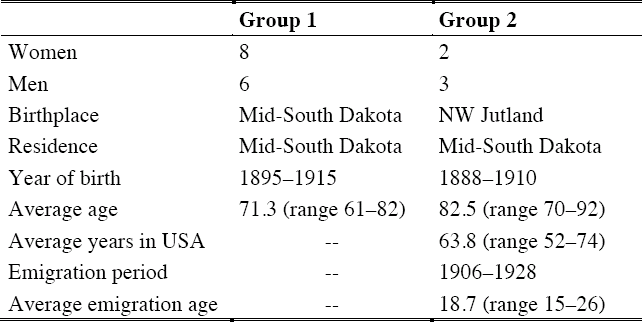
The data come from semistructured interviews with immigrants from Denmark and their descendants. All interviews follow a question-answer format. However, they vary with respect to formality and the amount of data each participant contributes to the study.Footnote 6 There are 19 speakers in the dataset: 10 women and 9 men. The participants were divided into two groups on the basis of their country of birth: USA (South Dakota, group 1) and Denmark (NW Jutland, group 2). These data appear in table 1, which also gives supplementary biographic information about each group.Footnote 7
The two speaker groups with NW Jutish dialect background with additional biographical and linguistic information.

Information about family or other network relations among the speakers in the dataset comes from the interviews and from the biographical documentation collected by Kjær & Baumann Larsen in the period 1966–1980. According to Kjær & Baumann Larsen, there are three married couples in the dataset: SOH and AHO (group 1), MLU and PLU (group 1 and 2, respectively), and FAB and PAB (group 1). US-born speaker HON is the uncle of US-born speaker EMS (group 1). DK-born speaker MIJ (group 2) is the mother of US-born speaker MBP (group 1).
All speakers are bilingual. All US-born speakers have Thyian Danish (NW Jutish) as their L1, having learnt English later in childhood or in school. The immigrants have learnt English late in their life, and some of them speak English with a clear Danish accent. It seems safe to assume that English is the dominant language for all the speakers. However, it is not always clear from the interviews to what extent the speakers use Danish in their daily lives—for example, through their engagement in Danish associations and clubs or by attending churches with services in Danish. That said, it does not seem to be a challenge for any of the speakers to be interviewed in Danish. They speak without much hesitation throughout the interviews, with only limited code-switching to English. There is occasional use of loanwords and of lexical and phrasal calques. Hence, the Danish—or NW Jutish—in the analyzed recordings is probably a remembered language for most of the speakers, although a well-remembered language.
4. Variables
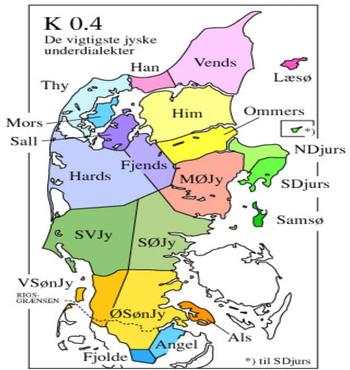
The variables have been defined according to the standard reference literature on Jutish dialects, as well as the online dialect maps on dialekt.dk and Jutish Dictionary (Jysk Ordbog).Footnote 8 In the traditional grouping of Danish dialects, the regions Thy and Mors (the island south of Thy in the strait Limfjorden) in the north-west part of Jutland, constitute the area where the NW Jutish dialect is spoken.
Map of the major Jutish dialect areas, with Thy, light blue area, indicated (source: Jysk Ordbog).

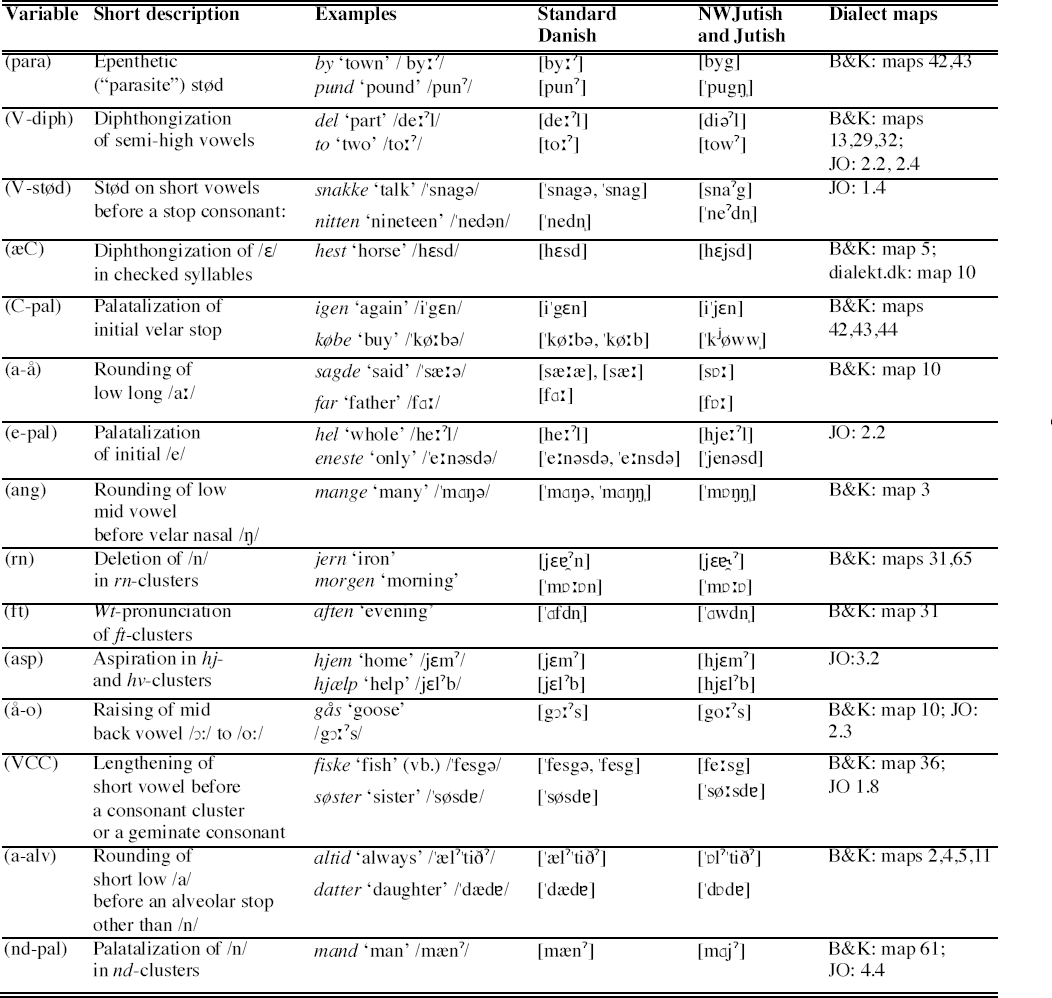
Table 2 gives an overview of the variables, their Standard Danish and dialectal realization, as well as references to dialect maps.Footnote 9 Some of the variables in this study are only characteristic of Thy, whereas others are found in both Thy and Mors (NW Jutish).Footnote 10 Still others are characteristic of larger parts of Jutland. Taken together, as one dialect bundle, the variables’ dialectal realization can only be found in Thy. All variables are defined as binary with either a dialectal or not dialectal realization, that is, a realization is considered Standard Danish. The realization of the variables has been analyzed auditorily by the author, a trained transcriber of Danish and other languages, with some support in a spectrogram presentation of the pronunciation.
Variables with Standard Danish and dialectal realization.

5. Analysis
5.1. Overview: Descriptive Statistics
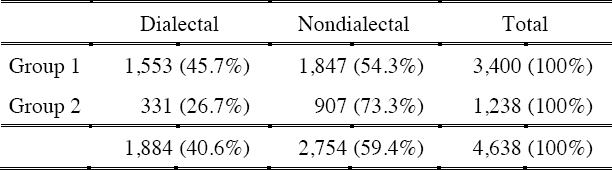
There is a considerable difference between group 1 and group 2 with respect to dialectal realization of the variables. Group 1 shows dialectal realization for 45.7% of all tokens of all variables, whereas group 2 only 26.7%, as shown in table 3.
Dialectal and nondialectal realization of all variables across the two speaker groups.

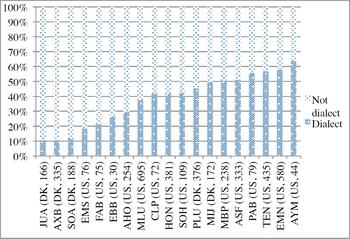
The data also show considerable individual variation with respect to (non)dialectal realization of variables. No speakers in either of the groups can be said to be primarily perfectly or completely dialectal. Figure 4 illustrates the individual tendency for dialectal pronunciation when considering all the variables together. Country of birth and total number of tokens appear in parentheses.
Ratio of dialectal to nondialectal realization for each speaker in groups 1 and 2, for all variables.

The most dialectal speakers belong to group 1, that is, speakers born in the USA: AYM (male) is the most dialectal speaker, with 62% dialectal realization of the variables; EMN (female) is second most dialectal speaker, with 58% dialectal realization; TEN (female) is third most dialectal speaker, with 57% dialectal realization. The speakers least dialectal in their realization of the variables belong to group 2 (DK-born speakers): JUA (female), AXB (male), and SOA (male). In general, the US-born speakers in group 1 are more dialectal than the group 2 speakers. Against this tendency go DK-born PLU (male) and MIJ (female), who score relatively high on dialectality, and US-born EMS (female), FAB (female), and EBB (male), who score relatively low. The significance of the factor Country of Birth is examined further below.
There is an ambiguous indication of influence from family or close network relations. As regards the married couples, PLU and MLU (male–female) are relatively homogenous in their realization of the variables (39–45%). In contrast, SOH (female, 41%) and her husband AHO (29%), both US-born, are less homogeneous with respect to their linguistic behavior and DK-born FAB (21%) and her US-born husband PAB (52%) are not at all homogeneous. As regards other family relations, HON is somewhat more dialectal than his niece, EMS (41% versus 18%). Interestingly, MIJ (mother, DK-born) and MBP (daughter, US-born) are very close (50–49%).
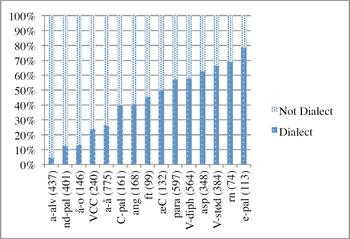
As shown in figure 5, the variables also differ significantly with respect to propensity for dialectal realization. The number of tokens appears in parentheses.
Ratio of dialectal to nondialectal realization of eight variables in both groups.

Three variables, (a-alv), (nd-pal), and (å-o), are only realized dialectally in 13% or less of all occurrences; five variables, (VCC), (a-å), (C-pal), (ang), and (ft), have between 22% and 45% dialectal realization; the remaining seven variables are realized dialectally in 50% of cases or more, with (e-pal) showing the highest percentage of dialectal realization. There is no clear correlation with respect to a variable's degree of dialectal realization and its frequency in the sample. The least-dialectal variables (a-alv) and (nd-pal) have a high frequency, and so do (V-stød), (asp), (V-diph), and (para). In the following discussion, the three variables (a-alv), (nd-pal), and (å-o) were excluded from further analysis on the grounds that they contain too little variation; I return to them in section 6.1.
5.2. The Effects of Nonlinguistic Factors
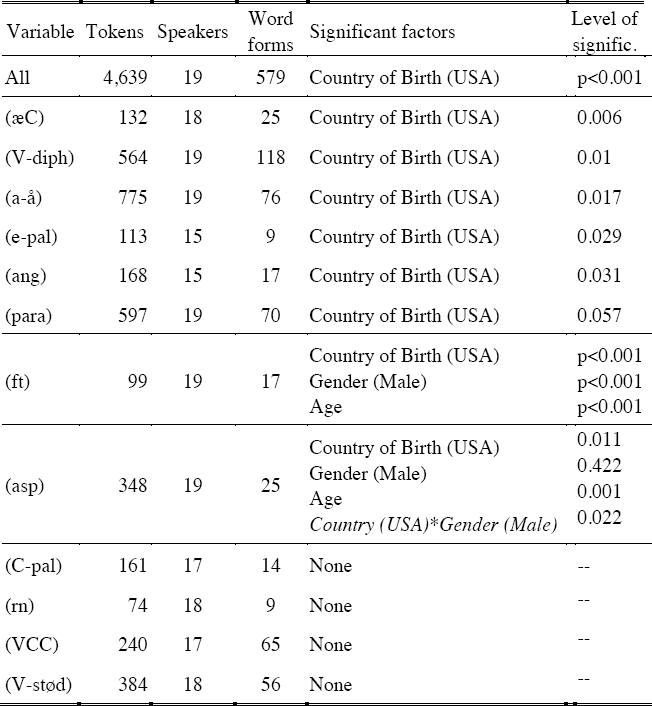
Table 3 and figure 4 show that the US-born speakers in group 1 have a tendency toward a more dialectal pronunciation than the DK-born speakers in group 2. In order to test whether the factor Country of Birth has a statistically significant effect on the realization of the variables, all variables, grouped as well as individually, were analyzed using a multi-factorial mixed-effects regression model. This analytical tool tests to what extent a number of factors (hence multifactorial) can explain the variation found in a data sample, here—the variation dialectal versus nondialectal realization. The independent variables, that is, the potentially influencing factors, tested in all 13 trials, were Country of Birth (with the levels USA and DK), Gender (with the levels Male and Female), and the numeric variable Age (lowest 61, highest 92).Footnote 11
The advantage of the mixed-effect analysis over other regression analyses is that it allows for the testing of random factors (hence mixed-effect). By including the individual speaker and word form as random factors, the statistical tool controls for any potential bias in the data. The bias may be caused by an individual speaker's tendency to be particularly dialectal or nondialectal; the bias may also arise because an individual word form is realized primarily in a dialectal or a nondialectal variant.Footnote 12 The statistical analysis generates values for the degree and direction of the influence of a fixed factor on the dependent variable, together with a value of significance. The analysis is summarized in a simplified way in table 4. The table provides data for variables grouped together and for individual variables with more than 20% dialectal realization and factors contributing significantly to variation. Speaker and Word form are random factors. Significant factors are given for dialectal realization, except for the variable Age (ft) and the interaction between the factors Country of Birth (USA)*Gender (Male) (asp).
The summary of the mixed-effects analysis.

For the six variables (æC), (V-diph), (a-å), (e-pal), (ang), and (para), the sample is divided in two groups, corresponding to speakers’ country of birth, that is, group 1 and group 2. With respect to these variables, the group 1 speakers, that is, US-born speakers, are significantly more dialectal than the group 2 speakers.
With respect to the four variables (C-pal), (rn), (VCC), and (V-stød), there is no difference between the two speaker groups; the gender groups or age groups show no difference either. With respect to (C-pal) and (VCC), which are only a little dialectal overall (see figure 5), neither speaker group is particularly dialectal. With respect to the variables (rn) and (V-stød), which are relatively dialectal overall (see figure 5), the two speaker groups overall and both gender groups are relatively dialectal.
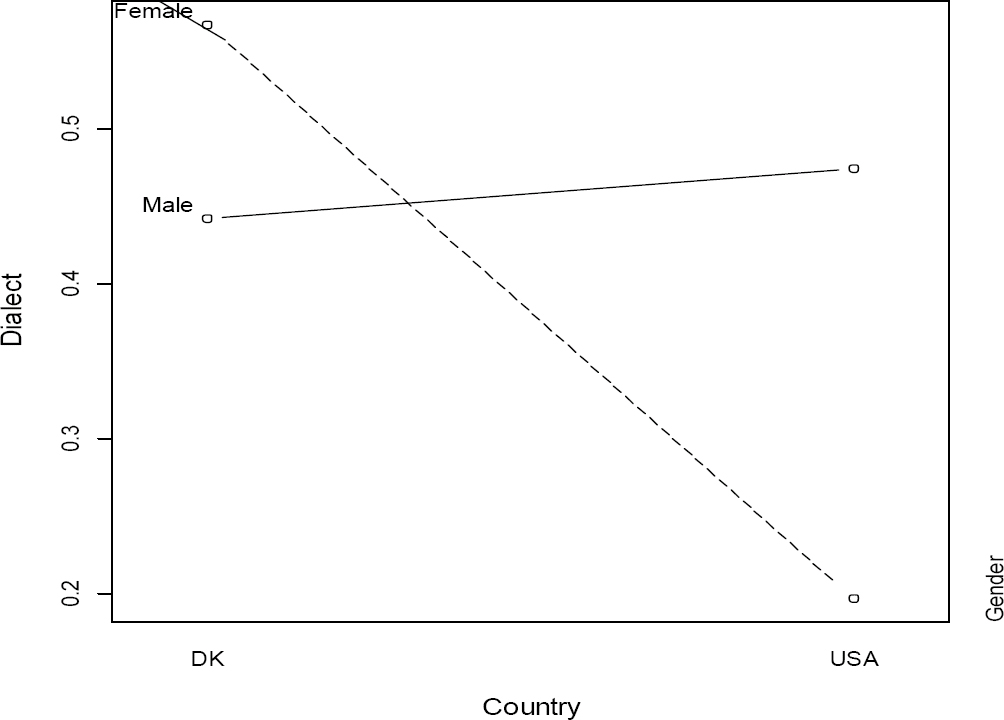
With respect to variables (ft) and (asp) the situation is more complicated. For (ft), the values of significance show that a) the US-born speakers (group 1) are more dialectal than the DK-born speakers (group 2; the same results as for the six variables above), b) the male speakers in both speaker groups are less dialectal than the female speakers, and c) the oldest speakers are more dialectal than the youngest speakers. For (asp), it is again seen that the US-born speakers and the older speakers are more dialectal than the DK-born speakers and the younger speakers. The analysis also reveals that there is a significant interaction between Country of Birth and Gender, as shown in figure 6: The figures on the y-axis indicate the likelihood of dialectal realization, where 1 is least dialectal and 0 most dialectal. The US-born male speakers are significantly less dialectal than the US-born female speakers. In contrast, the DK-born male speakers are a little more dialectal than the DK-born female speakers.
Interaction of Country of Birth and Gender; variable (asp).

It is a peculiar result that with respect to the variables (ft) and (asp) only, the US-born female speakers are more dialectal than their male counterparts, and the older speakers are more dialectal than the younger speakers. It is an indication that female and older speakers preserve to a larger extent the traditional dialectal pronunciation. This may not in itself be a surprise, but I have no explanation as to why these tendencies toward sociolinguistic grouping only appear for these variables. I refrain from discussing possible implications of this finding. The discussion in section 6 only focuses on the general finding that Country of Birth correlates with the variation in the data for eight of the variables.
5.3. The Variables as a Resource for Individual Speakers
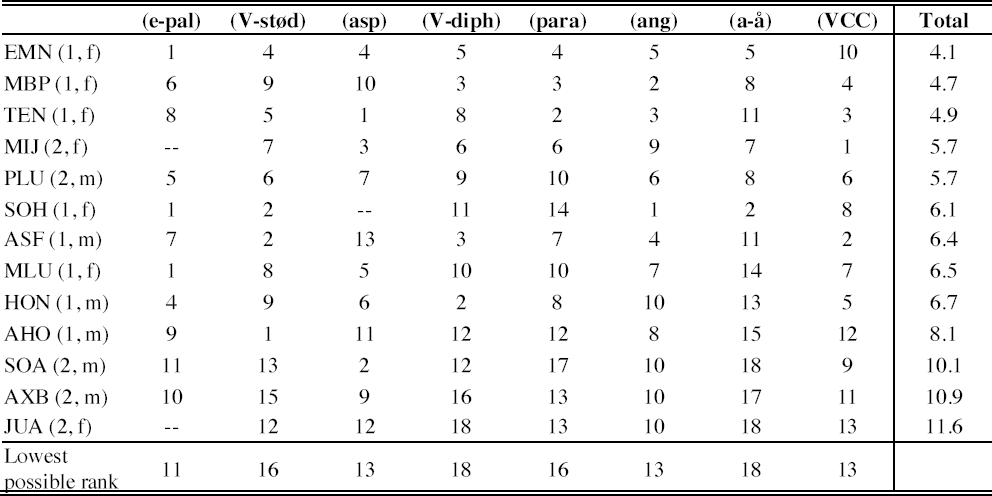
Figure 4 showed that the speech of individual speakers is dialectal to varying degrees when all variables are considered together. Figure 5 showed that some variables have a more pronounced tendency toward dialectal realization than others. The question now arises whether individual speakers have a preference for dialectal realization of certain variables. This question is answered with the information presented in table 5. For the sake of simplicity, only 13 speakers were ranked according to their preference for dialectal realization of certain variables (the most dialectal speaker is ranked 1, the second most dialectal 2, etc.). The figures in the variable columns show the rank of each individual speaker for that variable, whereas the figures in the bottom row show the lowest possible ranking for each variable. The table only includes the variables with 10 or more tokens per speaker. The total ranking in the right-most column, however, is calculated for all speakers and for all variables.
Overall, the total average ranking corresponds to the ranking in figure 4: Speakers who are most dialectal in their realization of all variables (in figure 4) also have a high average ranking for each individual variable. Accordingly, speakers who are least dialectal in their realization of all variables also have a low ranking for each variable. Also, consistent with the ranking in figure 4, it appears that group 2 speakers have a low average ranking; the two highest ranking group 2 speakers in figure 4, MIJ and PLU, are among the top-most in table 5. There are two exceptions: MBP, who has the highest average ranking but is only ranked 6th in figure 4, and ASF, who is in the top 5 in figure 4 but in the middle in table 2. This divergence is due to idiosyncratic preference for a particular realization of a given, high-frequency variable. For example, MBP does not show a pronounced dialectal realization of (V-stød) and (asp), two highly frequent variables. As a result, her overall ranking is lower. It is also noticeable that 6 speakers, MIJ, PLU, SOH, ASF, MLU, and HON, are very close in the average ranking, 5.7–6.7. This means that regardless of their individual preferences for dialectal realization of certain variables (see below), they appear, on average, more or less equally dialectal. Also noticeable is the fact that the three highest-ranking speakers are US-born women, which indicates a gender bias. Notice, however, that in table 5, gender is a significant factor for only two variables, (ft) and (asp).
Individual speakers' ranking for a selection of the most frequent variables in the dataset.

The ranking of the speakers with respect to individual variables shows variation. For example, no speakers are consistently ranked at the top. Among the three speakers with the highest average ranking, MBP is ranked low for (V-stød), (asp), and (a-å); EMN is ranked low for (VCC), whereas TEN is ranked low for (a-å) and (e-pal). Among the speakers with the lowest average ranking, JUA and AXB are ranked low for all variables, SOA and AHO for most, SOA—for all except (asp), and AHO—for all except (V-stød). In general, the ranking of many speakers varies depending on the variable. Apart from those already mentioned, PLU, SOH, ASF, MLU, and HON are ranked low for some variables and high for others; for yet another set of variables they appear in the middle. This variability may reflect certain speakers’ preference for adopting (or not) a particular variable as an indicator of their (non)dialectal speech (see the observation above that some variables are more dialectally marked than others).
There is no clear pattern with respect to the ranking of the speakers who are related to each other, which is consistent with the patterns in figure 4. For example, the married couple MLU and PLU are, in general, concordant for the variables (ang), (asp), (para), (VCC), (V-diph), and (V-stød), but not for (e-pal). The married couple SOH and AHO disagree much more, being concordant for the variables (V-stød), (V-diph), and (para) but not for (a-å), (ang), and (e-pal). Mother and daughter, MBP and MIJ, are in concordance for most variables, except for (asp) and (ang). There is also no clear pattern as to which variables are treated similarly or differently by related speakers. One exception is (V-stød), for which the speakers in each pair received similar ranking. This indicates that this variable's potential for being (non)dialectal may be influenced by close networks and personal relations.
To summarize, the data sample shows a widespread inter-speaker variation with respect to the degree of dialectality; yet no speakers are close to being primarily dialectal. The speech of the most dialectal speaker is only 62% dialectal. The speech of the least dialectal speaker is only 10% dialectal. Some variables have a stronger tendency toward dialectal realization than others, with six variables being dialectally realized in over 50% of cases, and no variables being dialectally realized in more than 79% of cases. Three variables, (å-o), (a-alv), and (nd-j), are very rarely realized dialectally, all below 13%. The mixed-effect regression analysis pointed out that Country of Birth is the strongest factor that shows a significant correlation with the realization of a subset of the variables. The models showed that for 8 out of 12 variables there is a statistically significant difference between the DK-born and the US-born speakers: The speakers born in the USA are more dialectal than the speakers born in Denmark. For four variables, no nonlinguistic factors correlate with the variation, and for two variables, there is a more complex relationship between the linguistic variation and the examined sociolinguistic factors. Finally, there is a high degree of variability in how dialectal the speakers are relative to each other, with respect to each variable, except for those speakers who in general are less dialectal. Otherwise, there is no evident or general pattern in how the speakers are ranked for the individual variables.
6. Discussion
6.1. Dialectally-Stable and Unstable Variables
The analysis has clearly shown that some variables are realized more dialectally than others (for example, (e-pal) versus (ang) versus (a-alv); see section 5.1, figure 5). Such inter-variable variability is well known in the dialect and sociolinguistic literature, in particular with respect to the notion of saliency. The usability of saliency in explaining dialect accommodation is widely debated (for an overview, see Kerswill & Williams Reference Kerswill, Williams, Jones and Esch2002). This notion is defined using objective as well as subjective criteria. Subjective criteria encompass parameters such as speakers’ attitude toward their language, representation of the variable in writing, and the use of the variable in mimicry (see, for example, Auer et al. Reference Auer, Barden and Grosskopf1998). As I do not have access to this type of data for the speech community studied here, I refrain from discussing the variables in relation to saliency or from ranking them according to the above criteria.Footnote 13
Inter-variable variation has also been discussed in a number of studies on regiolectalization processes in Danish (see, for example, Kristensen Reference Kristensen1977, Lund Reference Lund, Erik and Kjær1977, Bengtson Reference Bengtson1985, Højensgaard Reference Giles, Coupland and Coupland1991). These studies have shown that prosodic features, including the stød, are more resistant to de-dialectalization than, for example, segmental, vocalic, or consonantal features. This contrast is confirmed by the findings in this study: The variables (para) and (V-stød) can be termed prosodic, since they involve the stød (see table 2 and Appendix) and both score over 55% in dialectal realization (see figure 5).Footnote 14 However, segmental, that is, vocalic and consonantal variables score as high, so a variable's prosodicity does not provide a satisfying explanation for the observed variation.
Another explanation as to why some features may be maintained more often than others is put forward by Andersen (Reference Andersen and Fisiak1988:39–40, 60ff.). He suggests that “closed” or “peripheral” communities are more likely to develop or maintain specific and “slightly unusual” phonetic features than “open” or “central” communities: “Dialects that serve predominantly local functions are more prone to elaborate phonetic detail rules than dialects with a wider sphere of use” (p. 60).Footnote 15 Of particular relevance to this study is Andersen's focus on the development of a parasitic stop consonant in a number of remote dialects in Europe, including NW Jutish, as an example of an “elaborate phonetic detail rule.” Following Andersen, the relatively strong preference for this traditional NW Jutish feature among the US-born speakers (see table 5) gives phonological support for regarding this language community as small, close-knit, and isolated.
However, Andersen (Reference Andersen and Fisiak1988:71) also makes it clear that the “relative openness or closedness of a community is a matter of the empirically ascertainable communicative networks in which it participates.” This view calls for further linguistic research on Danish in South Dakota; local historical archives need to be searched for information on relations, associations, and network activities. This information, together with lexical and grammatical variables, may take one a step further toward a better understanding of what types of linguistic change may be expected in an immigrant and “closed-community” setting, such as the one studied here.
6.2. Dialectal Convergence in the Speech Community?
Table 4 showed that, with respect to 11 variables, there is a split between the US-born and the DK-born speakers. The US-born speakers are significantly more dialectal than the DK-born speakers: The former speak the more traditional dialect, which they presumably inherited from their parents, whereas the latter speak the less traditional dialect. This indicates that convergence has not occurred. Had the two dialects converged, the data would have shown a smaller gap between the two speaker groups.
Four variables show no difference between the US- and DK-born speakers: two variables that are relatively infrequently realized dialectally, (C-pal) and (VCC); 39.8% and 23.8%, respectively, and two variables that are frequently realized dialectally, (rn) and (V-stød); 68.9% and 58.6%, respectively. This agreement between the two speaker groups may suggest that with respect to these particular variables convergence has occurred or that convergence has not occurred. If convergence did occur, two scenarios are possible. Under one scenario, initially the US-born speakers had a more dialectal pronunciation, but later they accommodated to the DK-born speakers, whose speech was less dialectal. In other words, the US-born speakers’ realization of the relatively strongly dialectal (rn) and (V-stød) initially would have been even more dialectal. This implies that the DK-born speakers may have been looked at as the ones who set the norm; their language may have been regarded as more prestigious, which perhaps was a reflection of them being viewed as innovators, as the “new blood” of the appraised Thy identity (see section 2.1). Alternatively—but less likely—the US-born speakers could have been less dialectal initially, but then they would accommodate to the DK-born speakers’ more dialectal realization of these variables. This suggestion would go against the general and well-documented trend in Denmark that dialect speakers become less dialectal in the following generations (Pedersen Reference Pedersen2003, among others).
If convergence did not occur, the two least dialectal variables (C-pal) and (VCC) would have been relatively nondialectal from the outset within both speaker groups. For the DK-born speakers, this would be the time of their emigration. For the US-born speakers, this would be the time when the dialect was being transmitted to them by their parents, around 1900–1910, or even the time of their parents’ emigration, 1870–1900. This scenario would imply that the role of these variables as markers of NW Jutish decreased early in the regiolectification process in Denmark (or, for some reason, shortly after or during the immigration period).Footnote 16 For the relatively strongly dialectal variables (rn) and (V-stød) the picture would have been the reverse: Both groups of speakers retained their dialectical realization; as such, these variables can be said to stand out as the only phonological markers of “Thyness” shared by both speaker groups, in contrast to the other 11 variables, which are dialectally realized by the US-born speakers only.
Overall, on a community level there is not much indication of convergence. When it comes to the actual realization of the phonological variables, the analysis does not support a hypothesis that the speakers agree as to what a typical NW Jutish pronunciation is; only low-frequency (rn) and high-frequency (V-stød) come forward as candidates.
6.3. Individuation in the Speech Community
The analysis and discussion above have revealed the lack of a shared uniform way of speaking NW Jutish, or of enacting one's “Thyness”; the speakers differ considerably with respect to how dialectal their pronunciation is. One speaker can be more dialectal depending on a particular variable that is being considered. The analysis does not indicate a clear “founder-effect”, that is, it does not point in a general and consistent way to a speaker or a group of speakers, who is considered linguistically prestigious. Instead, individual speakers use a given variable's dialectal realization, which is typical of a postdialectal, dedialectalized community, as tellingly described by Lund (Reference Lund, Erik and Kjær1977:80):Footnote 17
A standard feature may be successful with some speakers; in the speech of others it may exist side by side with a regional variant; the speech of yet others may be quite unaffected by it, but be influenced instead by a different feature altogether. Some speakers may consistently apply the newly introduced feature in words with a certain sound structure. Other speakers may show more context-dependent variation.
Under this view, individual variation found among the NW Jutish speakers in South Dakota suggests that individual speakers can use many of the Thyian (phonological) features as they please. Now one could revisit PLU's remark quoted in section 2.1, “But you can understand Thyian? Oh, that's good because that is what we speak best,” and add, “but in our own special ways, except when we use words with an rn-cluster [(rn)] or words that contain a short vowel with a stød [(V-stød)].”
The analysis has not yielded particularly good or uniform phono-logical evidence for the existence of a specific NW Jutish community in Eastern South Dakota. Rather, the results point in the direction of a phonological individuation within the community, even though with respect to 11 variables, the US-born speakers seem to agree on what constitutes “dialectal pronunciation” from the perspective of Denmark Danish. Thus, the general picture resembles what Johnstone (Reference Johnstone, Chambers and Schilling2010) refers to as an “imagined” dialect, following Anderson Reference Anderson1991. According to this view, languages and dialects (like localities) are “imagined” as they “exist as useful, even necessary ideas, not as things objectively observable by a socio-cultural outsider” (p. 392). Under this view, Johnstone (Reference Johnstone, Chambers and Schilling2010:392) defines languages and dialects as follows:
[a]ssociations between particular features of pronunciation, grammar, and vocabulary, on the one hand, and imagined “languages”, “dialects” and “speech communities”, on the other, [that] arise in local social and discursive practices that are enabled and constrained by larger-scale political and economic conditions.
This perspective is in line with Silverstein (Reference Silverstein2003:408), who states that “users of languages in essence construct culturally particular concepts of [linguistic] normativity that bind subsets of them into ‘language’-bearing groups.” Johnstone (Reference Johnstone, Chambers and Schilling2010:392) paraphrases this statement as follows: “‘languages’ and ‘dialects’ are cultural constructs, produced by a group of people using, orienting to, and/or talking about a particular set of linguistic features, in a process that also constructs the group itself.” For the Danish immigrant community in South Dakota as a whole, however, there is no clear indication that the linguistic “normativity” is expressed in the (comprehensive) set of phonological variables analyzed in this article; considering its frequency and mostly dialectal realization within both speaker groups, the (V-stød) feature is the only possible candidate.
6.4. Further research
This study analyzed in detail the realization of 4,638 tokens of 15 phonological variables in the Thyian dialect spoken by a Danish immigrant community in Eastern South Dakota. The goal of the study was to establish how (non)dialectal the speech of the community was. It would be beneficial to expand the study by adding three variables typical of NW Jutish: [v]/[w]-variation, velarization of /l/, and vocalization of /r/. These variables were not included in the study due to, among other reasons, possible American English influence. A likely scenario is that the dialectal realization of these variables, that is, [w], [ɫ], and [V˞], would be frequent and dominant in both speaker groups, perhaps as a result of contact-induced reinforcement. As such, these phonological variables would have become socially emblematic. This hypothesis is for future studies to verify.
It is also for future studies to examine whether and to what extent morphological, syntactic, and lexical characteristics of NW Jutish has contributed to the Thy identity of the speech community. In particular, speakers may be aware of certain lexical items, which makes those items good candidates for social emblematicity.Footnote 18
This study has also pointed out possible ramifications for the regiolectification of certain variables of Thyian in Denmark. Since documentation of traditional NW Jutish exists in the shape of old recordings and vocabulary collections stored in archives, it may be a future enterprise for dialectologists to compare the developments in two varieties of NW Jutish, Homeland Thyian and South Dakota Thyian.
The discussion above has emphasized the nonuniform realization of the variables, pointing out the phonological consequences of what has been termed individuation in a community, that is, the fact that there are no clear convergence patterns within a group, in spite of what may be assumed from the anecdotal and historical evidence of a shared and strong awareness of being Thyian, except, maybe, for the variable V-stød. As such, the results may be viewed as supporting the following point made by Trudgill (Reference Trudgill2008:253):
[T]here is an increasing body of evidence that suggests that “large-scale and prolonged dialect contact always leads to dialect mixture” and “behavioral congruence is the default and prolonged largescale dialect contact will always lead inevitably to dialect mixture and to new dialect formation. [emphasis in the original]
The emphasized parts of this quote may be crucial for the explanation of the results of the present study, even though it investigates possible convergence between two varieties of the same dialect, not the leveling of two or more dialects. The lack of clear evidence of convergence may be due to the fact that the community has not had time to develop or establish itself as a speech community where well-known (linguistic) accommo-dation processes occur and develop. This interpretation should be discussed in comparison to quantitative studies of other, similar rural immigrant, heritage language communities.
7. Conclusion
The study has investigated the realization of 15 phonological variables, altogether 4,639 tokens (distributed across 19 speakers and 579 different word forms), of the Danish spoken by DK- and US-born immigrants in three counties in Eastern South Dakota. The analysis does not confirm any assumptions or theories about dialect leveling; there is no widespread phonetic consensus about what it means to speak Thyian: The US-born speakers are, overall, more phonologically conservative than the DK-born speakers. However, the analysis has also shown a sizeable inter-speaker variation in both speaker groups. The discussion has emphasized this finding as an example of what has been referred to as individuation of the speech community: It reflects the fact that each speaker has his/her own way of phonologically expressing his/her Thy identity. The study has also emphasized the need for supplementary studies that would include other analytic levels, such as morphology, syntax, and lexicon. It has also addressed the need for supplementary historical documentation of (Danish) networks and (Thyian or Danish) cultural practices in the former Danish settlement in South Dakota.
 ], [y