Background
Physical activity has been described as the best preventative medicine for older adults (Swedish National Institute of Public Health 2007). It is proven to delay the need for care (British Heart Foundation National Centre for Physical Activity and Health (BHFNC) 2013) and substantial evidence describes its impact on cardiovascular as well as psychological health, regardless of age (BHFNC 2013; Department of Health 2011; Frost, Haw and Frank Reference Frost, Haw and Frank2010; National Institute for Health and Clinical Excellence (NICE) 2012; US Department of Health and Human Services 2008; World Health Organization 2011a, 2011b). Many exercise-referral, exercise on prescription, active lifestyle and similar schemes, whether age-specific or not, are now funded by health and social care services throughout the developed world (Halbert et al. Reference Halbert, Silagy, Finucane, Withers and Hamdorf2000; Harrison, McNair and Dugdill Reference Harrison, McNair and Dugdill2005; Rush Reference Rush2003). Programmes are usually delivered by third parties but are widely accessible to patients in contact with a variety of health professionals. However, problems with non-uptake and non-completion are common, with adults at risk of a cardiovascular event being especially likely not to complete (Dugdill, Graham and McNair Reference Dugdill, Graham and McNair2005). Also, the ways in which such schemes are delivered vary (Dugdill, Graham and McNair Reference Dugdill, Graham and McNair2005; Gardiner et al. Reference Gardiner, Cane, Rumsey and Michie2012; NICE 2012), and evaluation tends to focus on measures of attendance and satisfaction (Katikireddi et al. Reference Katikireddi, Higgins, Bond, Bonell and Macintyre2011) at the expense of other psychological and social outcomes (Dugdill, Graham and McNair Reference Dugdill, Graham and McNair2005), in spite of their known influence on adherence and completion (BHFNC 2010; NICE 2007; Pentecost and Taket Reference Pentecost and Taket2011).
This study aims to understand the factors influencing attendance at a community-based active lifestyle scheme, and experiences and perceptions of any related benefits.
Study setting
We interviewed attenders and former attenders at a community-based active lifestyle scheme. This was a single-centre scheme based in a deprived area of a large Northern city in England. The programme was free for 12 weeks for anyone referred by a health-care professional (not solely the sampled population); thereafter a minimal charge was made for attendance. Our sample comprised adults over the age of 60 who had been referred by a health-care professional, and who were deemed to be at higher risk of a cardiovascular event due to being overweight, obese or having high blood pressure. Following referral, they were offered an individual appointment with a Health and Physical Activity Co-ordinator to discuss their goals and concerns about lifestyle change. They were then permitted free access to a 12-week weekly group education programme on the causes and management of chronic lifestyle-related conditions through activity and healthy eating (though indefinite attendance was allowed), and weekly supervised access to gym facilities. Programme sessions were delivered by a Health and Physical Activity Co-ordinator.
Prior to the current study, routine attendance and satisfaction data had demonstrated that overall uptake and completion of the programme were poor, and there were mixed views about the perceived impact it had on cardiovascular health.
In presenting a preliminary exploration of the views and experiences of a sample of attenders and former attenders, this paper aims to inform the design and development of future schemes and their evaluation. The small sample and single-centre setting limit the generalisability of the findings but nevertheless this study adds useful information in an area where there is limited evidence of effectiveness.
Method
Recruitment
A Health and Physical Activity Co-ordinator approached attenders of the active lifestyle scheme (N=25) about participating in a focus group to discuss their experiences. At a later date, potential participants for interview were identified through retrospective evaluation data, and invited to participate in an interview to discuss the scheme by letter (N=45). Follow-up letters were sent to encourage participation.
This study reports data from 13 older adults referred to the scheme. The focus group comprised eight participants; all current attenders. Four of the eight participants then went on to participate in individual interviews, at which point data saturation was achieved. The remainder participated in the focus group alone. Purposive sampling was then employed (for those who did not participate in the focus group) to obtain, via interview, the views of former attenders and those who chose not to attend the scheme at all, in order to illustrate a range of opinions (N=5). This provided a total of nine individual interviews. The overall response rate was 18.6 per cent. Reasons for declining the invitation included age, being too busy or health difficulties.
Measures
A focus group topic guide was developed, and adapted in vivo by one of the authors (KH) to allow participants to lead the conversation. It covered reasons for engagement with the scheme, its impact and views about non-engagement. The focus group took place at the community centre and lasted for an hour. A semi-structured interview schedule was developed for individual interviews, covering topics identified from the focus group in addition to participants’ perspectives on referral, health, age and future lifestyle intentions. Assessments of alcohol use using the AUDIT-C (Babor et al. Reference Babor, Higgins-Biddle, Saunders and Monteiro2001), diet (Public Health England 2010) and physical activity (Washburn et al. Reference Washburn, Smith, Jette and Janney1993) were conducted using a specially designed health questionnaire. Interviews were conducted by one of the authors (GF) and lasted for one to two hours.
Analysis
We categorised participants by their levels of engagement with the scheme, using a published categorisation system as a guide (Pentecost and Taket Reference Pentecost and Taket2011). We described ‘current-regulars’ as those who had attended the majority of scheduled individual appointments, education sessions and gym sessions in the three months prior to contact; ‘previous-regulars’ had attended the majority of scheduled individual appointments, education sessions and gym sessions, but ceased doing so (for any reason) more than three months prior to contact; ‘low-contact’ participants had, at any time, attended none or only some of the scheduled gym sessions, and any number of scheduled individual appointments or education sessions, and ‘no-contact’ participants had attended none or only some of the scheduled individual appointments, and none of the scheduled education or gym sessions.
The qualitative data collected during the focus group and individual interviews were supplemented by field notes and the descriptive data collected via the specially designed health questionnaire. Transcribed focus group and interview data were imported and analysed with thematic framework analysis (Ritchie and Spencer Reference Ritchie, Spencer, Bryman and Burgess1994) using Nvivo 9 (QSR International 2010). Regular team discussions took place to gain a consensus of emerging themes. Descriptive statistics from demographic and health questionnaire information provided by participants were produced using SPSS 18 (SPSS 2009).
Ethical approval was obtained from local National Health Service Research Ethics Committees. Data collection took place in 2011 and 2012.
Results
Participant characteristics
Five participants (Participants 1–5) were classed as ‘previous-regulars’, one as ‘no-contact’ (Participant 9), one as ‘low-contact’ (Participant 10) and six as ‘current-regulars’ (Participants 6–8 and 11–13). Twelve (92%) were retired and nine (69%) lived with a spouse. Only current-regulars reported caring responsibilities (67% of this group; N=4). Demographic and clinical characteristics have been summarised in Table 1.
Participant demographic and clinical characteristics by level of scheme engagement

Note: NA: not applicable (as N=1).
Health difficulties amongst interviewed participants
Participants’ descriptions of health difficulties and diagnoses were used as formal clinical data were unavailable. Of the range described, high or borderline-high blood pressure was most common (N=6; 67%), followed by high cholesterol, arthritis or temporary limits to mobility (N=4; 44%). Three participants reported more than one health-related reason for referral, five (38%) reported high blood pressure, ten (78%) excessive weight and all were unanimous in having accepted the reasons for the referral.
Lifestyle choices amongst interviewed participants
Of all interviewed participants, one (a current-regular) smoked and two previous-regulars had given up. Only one (a previous-regular) was classified as at ‘increased risk’ of alcohol problems.
Activity data were available for eight participants, comprising four previous-regulars, three current-regulars and one non-active participant. We were unable to collect reliable data from all participants due to the limited resources within the active lifestyle scheme to collect such data systematically and routinely. Of the four previous-regulars, two described activity levels within average and lower than average ranges. One participant of each range reported their activity levels as being lower than typical due to temporary health difficulties. Of the three current-regulars who provided data, all reported recent activity levels within the average range and said these were typical. Only the non-active participant regularly exceeded the average levels for their age and gender.
All participants reported making some changes to their diet for health reasons. Participants were more likely to follow recommendations for protein and sugar consumption (Public Health England 2010) (N=7) than for fruit and vegetables, fat and dairy consumption.
Qualitative analysis
Participants were of similar ages, reported similar reasons for referral and commonly described an increased awareness of their own health needs with advancing age. Current-regulars were more likely to report social circumstances incorporating caring responsibilities and a greater range of health difficulties. All current and previous-regulars perceived the referral to have been appropriate, and some level of attempt to improve their health prior to referral was commonly reported. These factors may explain our participants’ overall levels of engagement with the scheme; at least initially.
Identified themes
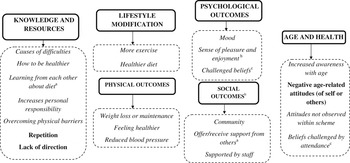
Participant-generated themes around positive and negative aspects of the scheme are illustrated in Figure 1. Variations between categories of attender are described below.
Identified themes. Notes: Main themes are those represented in boxes with a bold outline. Sub-themes are represented in boxes with dashed lines. Italicised sub-themes represent those generated by current-regulars in particular. Sub-themes in bold represent those identified by previous-regulars in particular. a,b,cConnects related sub-themes.

Knowledge and resources
Participants generally agreed that their attendance at the scheme had educated them about a range of health difficulties that they either had, or were at risk of developing, and said they had learned how to lead a healthy lifestyle to minimise the impact of such difficulties or prevent them.
[They talked about] things that could happen if you weren't active … I found that really interesting … if you don't help yourself: that's what can happen. (Participant 4)
All participants mentioned the opportunities that the group provided for learning from each other. This was either learning related to preventing health difficulties in themselves, or for practical advice on healthier eating. They generally reported the knowledge as having increased their sense of personal responsibility and willingness to engage with both the scheme and a healthier lifestyle.
The course has proved helpful in explaining: ‘the reason you've got high blood pressure is because you overate, didn't exercise enough, etc.’ … [this] hands me the choice and tools necessary to make any changes. (Participant 1)
Others felt that knowledge helped them overcome physical barriers to activity.
…normally when I got gout I don't want to do anything, it's painful … The advice were brilliant: ‘just ’cos you can't use your feet, you can use your arms’. (Participant 6)
Perceptions of content varied, and may have influenced attendance. Whilst previous-regulars understood that the repetition of facts was necessary in order to accommodate newcomers, they also said it meant they no longer felt they gained anything and so stopped attending: ‘…seemed to be going on about the same thing over and over’ (Participant 5). In contrast, one current-regular felt each session was different, which they said they enjoyed.
Previous-regulars also spoke of difficulties in accessing and using gym equipment due to it being busy, which they said meant the Health and Physical Activity Co-ordinators were unable to supervise their use of the equipment as intended, or to provide instruction. Both factors led them to stop attending.
You were just left to your own devices till he [a Health and Physical Activity Co-ordinator] came in [and said] ‘you've all had ten minutes – change’. Well, if he hadn't shown you what to do in the beginning, you didn't know whether you'd been doing it right or wrong. (Participant 5)
Lifestyle modification
Improvements to levels of physical activity and diet were described by current-regulars in particular.
I do more exercise at home … I wouldn't have done that, I wouldn't have gone walking … I'd have thought ‘ooh, Coronation Street's on…’ (Participant 7)
Physical and psycho-social outcomes
Physical benefits such as weight loss or maintenance, feeling healthier and reduced blood pressure, were attributed to engagement.
When I first come here I was 14 stone 9, and I'm down to 12 stone 3 … it's been a slowish thing…, but if it comes off slower it'll go on slower … (Participant 7)
Psychological benefits were also reported. For example, current-regulars attributed engagement with the group to improved mood, and spoke of a ‘more positive outlook’ (Participant 6) and ‘healthier mind’ (Participant 7). Regardless of categorisation, several spoke of the pleasure and enjoyment they got from attending, and of the impact on their beliefs.
Social and relational benefits, including a sense of community (with the centre itself being described as like a ‘church without God’ – Participant 1) were reported by current-regulars in particular. As Participant 9 said: ‘We have got to know them all, you know, and we're friends.’ One participant said the social aspect was the main factor affecting their intentions to continue. ‘[I'll keep coming back because] it's a fantastic social … I enjoy the company’ (Participant 8).
Support offered to or received from other participants was also referred to, regardless of categorisation. ‘…talking to everybody … gets a lot out of it for me … it's like being with a family’ (Participant 7).
Several participants also reported perceived levels of support from the staff.
He [a Health and Physical Activity Co-ordinator] put my mind to rest; he said everything's gradual, everybody's in the same boat. He's the personality that keeps it all together… (Participant 6)
Age and health
An increased awareness of personal health problems with advancing age, related to an expectation that this was normal due to an increasing number of physical health difficulties, was commonly reported.
Since I've got older, I've got two new knees … my friends, they're more or less in the same group, they have bad backs or bad knees. (Participant 8)
Negative age-related health and lifestyle attitudes included previously held beliefs that it was ‘too late’ to change, and that those around them had attitudes such as ‘I'm old now … I've just got to sit here and … wait for death coming’ (Participant 7). Participants also thought some health professionals portrayed negative age-related attitudes.
You get a lot of that, ‘oh well, how old are you?’ … and once you say you are over 70, ‘oh right well you can expect your body to start deteriorating’. (Participant 8)
Contrarily, others spoke of the value of having a doctor, or other professionals, with positive attitudes towards age.
Everything has fallen into place … because of the attitude of the doctor … How many people effectively are being sentenced to death by walking into a doctors’ [and being told] ‘oh well, what do you expect at your age?’ (Participant 1)
The reported impact of the scheme on participants’ age-related beliefs was also marked.
I think they've put into us mind, ‘yes you can go on living older, and you can be healthier older’. (Participant 7)
Discussion
The aim of the current study was to conduct a preliminary investigation of factors influencing attendance at a community-based active lifestyle scheme, and experiences and perceptions of any related benefits.
The majority of participants referred reported making some effort to improve their health. Continued engagement was related to how participants evaluated the knowledge and resources provided by the scheme. All who engaged attributed increased knowledge about risk factors, healthier lifestyles and age-related capabilities, as well as a sense of personal responsibility for behavioural change, to their attendance. Attenders also appreciated the relational benefits such as support, encouragement and opportunities to learn from each other; though to differing degrees. Similarly, psychological benefits were commonly reported, including mood or challenging age-related expectations and beliefs.
Beliefs about health difficulties, contributing factors and lifestyles were related to participants’ sense of responsibility for change. Such beliefs are known to influence the uptake and maintenance of behavioural changes that can reduce risk of a cardiovascular event (Murray et al. Reference Murray, Craigs, Hill, Honey and House2012a, Reference Murray, Honey, Hill, Craigs and House2012b, Reference Murray, Fenton, Honey, Bara, Hill and House2013). Beliefs about how risk can be modified through lifestyle change are also important (Murray et al. Reference Murray, Fenton, Honey, Bara, Hill and House2013), as are those relating to age. For example, some potential participants used ‘age’ as a reason to decline our invitation to interview, and some attenders perceived some health professionals as believing older adults incapable of change.
It seems reasonable to hypothesise that those who did not attend or complete the programme may have held different beliefs to our participants, whether referral, health, lifestyle or age-related, and these are likely to have presented barriers to their engagement. If participants’ perceptions of ageist attitudes amongst some health-care professionals are correct, these may preclude referral in the first instance (Cranney et al. Reference Cranney, Warren, Barton, Garder and Walley2001). Such attitudes and missed opportunities are of concern, not least because advancing age in itself does not prohibit increasing levels of activity (Burbank et al. Reference Burbank, Reibe, Padula and Nigg2002).
The impact of the scheme on lifestyle change and actual cardiovascular risk reduction was less clear. Current-regulars reported a greater range of health difficulties and attributed physical improvements to scheme-initiated changes to activity levels and diets. However, questionnaire data suggest they were eating less healthily than previous-regulars, and were not significantly more active. This is counter-intuitive, and may reflect issues with the small data set. Alternatively, it may reflect that current-regulars had significantly more unhealthy diets or sedentary lifestyles prior to referral, and so reported improvements are relative to (unrecorded) baseline data. It also implies that current-regulars did not continue attending for benefits to their physical health and diet. This was also implied by the differing group-level perspectives of the knowledge and resources provided, and current-regulars’ more frequent reporting of positive mood and social benefits.
The scheme evolved from a twice-repeated six-week programme to a flexible, participant-driven approach in an attempt to meet the needs of those referred. However, such flexibility has also allowed indefinite attendance, and may explain why previous-regulars perceived sessions as repetitive. Indefinite attendance also seems to have been problematic in that current-regulars appeared to continue attending for social and support, over and above health-related, factors. A lack of social support is a recognised barrier to the initiation and maintenance of lifestyle change in those at risk of a cardiovascular event (Coghill and Cooper Reference Coghill and Cooper2009; Murray et al. Reference Murray, Craigs, Hill, Honey and House2012a, Reference Murray, Honey, Hill, Craigs and House2012b; Williams et al. Reference Williams, Hendry, France, Lewis and Wilkinson2007), and the benefits of positive social experiences on health and ageing are clear (Boyes Reference Boyes2013).
Recommendations for future scheme delivery
Undoubtedly, active lifestyle schemes are associated with a number of benefits, particularly for those at risk of a cardiovascular event. However, in spite of the myriad benefits reported by our participants, we cannot ignore the data on non-uptake, the views of previous-regulars and the limited evidence on the reduction of risk of a cardiovascular event; all of which suggest that the scheme may not be meeting the needs of all referred. We believe our results point to a number of ways in which this and other active lifestyle schemes could be re-organised to maximise attendance and potential benefit.
Address beliefs
Our results, alongside the published literature, demonstrate the significance of beliefs not only to the referral process but to the uptake and adherence to schemes, in particular, and active lifestyles, in general. It may be helpful to identify and address patients’ beliefs about referral, health, lifestyle change and age, and health professionals’ beliefs about age, as soon as possible in the referral process so they do not become a barrier to referral or attendance. Our findings suggest that age-related beliefs, whether on the part of referred participants or health professionals, may have a significant impact upon scheme engagement and ultimately risk reduction. We do not believe the results would justify the development of a scheme specifically for older adults as some authors have suggested (Avers Reference Avers2010), as addressing beliefs could ensure that those that present barriers to referral or attendance could be overcome.
Deliver a structured, fixed-term, closed programme
Indefinite attendance may lead to social, but not necessarily health-related benefits, feel repetitive to some and deter attendance in others, but a structured, fixed-term rolling programme, closed to new members after starting, may address this barrier. Whilst referred patients might have to wait a number of weeks, a structured programme of sessions would be less likely to become repetitive, and commitment may seem more manageable. Fixed-term physical activity interventions, particularly those of less than six months duration, also tend to lead to better physical outcomes for attenders (Gourlan, Trouilloud and Sarrazin Reference Gourlan, Trouilloud and Sarrazin2011). A closed group may encourage trust and the development of important supportive relationships which are known to impact upon health behaviours (Boyes Reference Boyes2013; Coghill and Cooper Reference Coghill and Cooper2009; Murray et al. Reference Murray, Craigs, Hill, Honey and House2012a, Reference Murray, Honey, Hill, Craigs and House2012b, Reference Murray, Fenton, Honey, Bara, Hill and House2013; Williams et al. Reference Williams, Hendry, France, Lewis and Wilkinson2007). Facilitating gym access, particularly ensuring attendees have closed, personalised access times and sessions, may overcome resource-related barriers (Williams et al. Reference Williams, Hendry, France, Lewis and Wilkinson2007).
Increase accessibility by altering delivery times and following up non-attenders
The fact that older adults with no commitments during the working day were most likely to complete the programme suggests the need for flexible delivery times. Similarly, following up non-attenders may provide opportunities to identify and address beliefs and other potential barriers to attendance.
Improve data collection
Finally, reported outcomes could be enhanced by the systematic and regular collection of clinical and lifestyle data at all points of the process. This would allow conclusions to be drawn about the impact of schemes on lifestyles and reducing risk of a cardiovascular event, without an over-reliance on attendance and satisfaction data (Katikireddi et al. Reference Katikireddi, Higgins, Bond, Bonell and Macintyre2011).
Recommendations for future research
Our results illustrate the perspectives of a small sample of older adults referred to a community-based active lifestyle scheme in England, enhancing the existing body of literature evaluating similar schemes. Obtaining larger samples of participants with varying degrees of contact with schemes would improve the generalisability of the results.
Ultimately, the results of this study comprise practice-based evidence that supports the existing literature on healthy lifestyles amongst adults at risk of a cardiovascular event. They also provide further evidence for the importance of addressing health and lifestyle-related beliefs before, during and after attendance at active lifestyle schemes, to ensure they meet their objectives of cardiovascular disease risk reduction.
Acknowledgements
We would like to thank all our participants and colleagues from the active lifestyle scheme, our colleagues at the University of Leeds for their assistance in transcribing interviews, reviewing the interview schedule and coding data, and The Leeds York Bradford Collaboration for Applied Health Research and Care (CLAHRC) vascular theme collaborators: Professors Bob Lewin, Simon Gilbody, Ian Watt at the University of York and Lucy Jackson at NHS Leeds. The views and opinions expressed in this paper are those of the authors and not necessarily those of the National Health Service (NHS), the National Institute of Health Research or the Department of Health. This work was supported by the National Institute of Health Research Collaboration for Leadership in Applied Health Research and Care (NIHR CLAHRC) for LYB (Leeds, York and Bradford) – a collaboration between two universities, the NHS and Social Services (KRD/012/001/006). GF contributed to the design of the study and development of the interview schedule and health questionnaire, led recruitment, conducted the individual interviews, and led the analysis and writing of the manuscript. KH contributed to the design of the study, designed the focus group and topic guide, conducted the focus group and contributed to the design of the interview schedule and health questionnaire and analysis of the data. RS significantly edited the manuscript. AH contributed to the design of the study. All authors have read and approved the final manuscript. The authors declare that they have no conflicts of interest.