Introduction
The catastrophic outcome of the 1845 Franklin expedition has captured and held the public’s imagination for more than 170 years, initially (and still for some) as a story of Victorian heroism, but later and more commonly as a case study in Eurocentric hubris and incompetence, in comparison with Inuit whose ancestors had inhabited that region successfully for centuries. However, the fundamental reason the third Franklin expedition remains so famous is because all of the expedition members died. The corpus of scholarly and popular writing on the Franklin expedition is, of course, voluminous and still growing and, since the earliest days, has focused on (1) determining the specific sequence of events that took place between May 1845 and the summer of 1848 or whenever the last crewmembers died (Cyriax, Reference Cyriax1939; Hall & Nourse, Reference Hall and Nourse1879; M’Clintock, Reference M’Clintock1859b; Rae, Reference Rae1855; Schwatka & Stackpole, Reference Schwatka and Stackpole1965); and (2) determining the proximate and ultimate causes of those events and of the deaths of all 129 officers and crew. Some aspects of the sequence of events have been reconstructed by study of the one revealing written document that survives from the expedition, by Inuit accounts recorded in the 19th century, and by archaeological investigation of the sites the Franklin crews created on land, and (since 2014) of the shipwrecks themselves. As for the causes of the catastrophe, several very specific proximate causes have been proposed, including disease (scurvy, tuberculosis, trichinosis) and poisoning (by lead, zinc, or botulism). We will return to a discussion of these possible causes later, but, to read some modern discussions of the event, one can be left with the impression that the ultimate cause of the expedition’s catastrophic failure was both cultural and inevitable—that is, of course a British Navy expedition of wooden sailing ships attempting to find and traverse a navigable passage through the North American Arctic was bound to end in disaster. For example, “…the long-sought cause of the Franklin disaster was in fact multiple and mundane—a combination of hubris, poor preparation and technological inadequacies, endemic in the Admiralty’s Eurocentric approach to exploration” (Craciun, Reference Craciun2012, p. 3). As archaeologists who have spent decades focusing most of our research on how Inuit and their predecessors managed to survive so successfully in the same region not just for three years but for more than four thousand years, such a viewpoint has obvious appeal. But adopting that particular perspective renders mysterious the fact that so many comparably equipped and commanded British Navy expeditions in the decades before and immediately after the Franklin expedition did not suffer the same catastrophic fate. So, to the extent that there is any true mystery about the Franklin expedition and its failure, it is why so many died on that expedition and not on all the others.
Mortality on Royal Navy Arctic expeditions
Royal Navy mortality
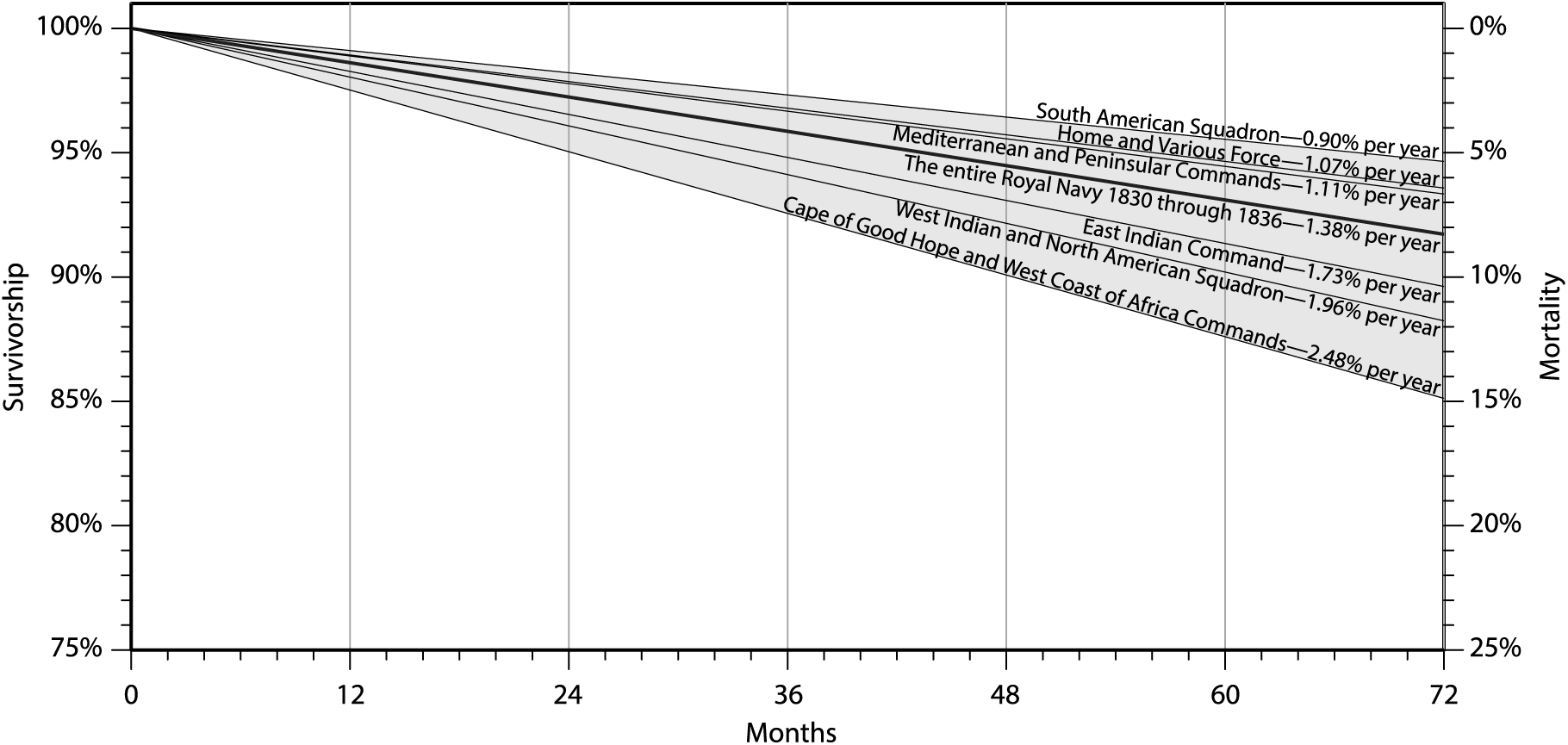
The death of some members of the Franklin expedition over its planned three-year duration would not have been unexpected to members of the 1840s Royal Navy. A statistical study of health in the entire Royal Navy between 1830 and 1836 summarized average annual mortality rates from wounds and accidents, and from illness (Troubridge, Reference Troubridge1841, p. 211). As shown in Figure 1 in the form of survivorship curves, mortality varied geographically to some extent, but for the entire Royal Navy, the average yearly mortality rate for that period from wounds and accidents was 0.19%, and 1.18% from illness, producing a total annual average mortality rate of 1.38%. Over three-years—the length of time for which the Franklin expedition was provisioned—a cumulative mortality of 4.14% of the 129-man complement would, therefore, have been expected, or between five and six deaths.
Survivorship curves for the various Royal Navy commands, calculated from data in Sir Thomas Troubridge’s Reference Troubridge1841 Statistical Reports on the Health of the Navy, for the Years 1830, 1831, 1832, 1833, 1834, 1835, and 1836.

Mortality on other Arctic expeditions
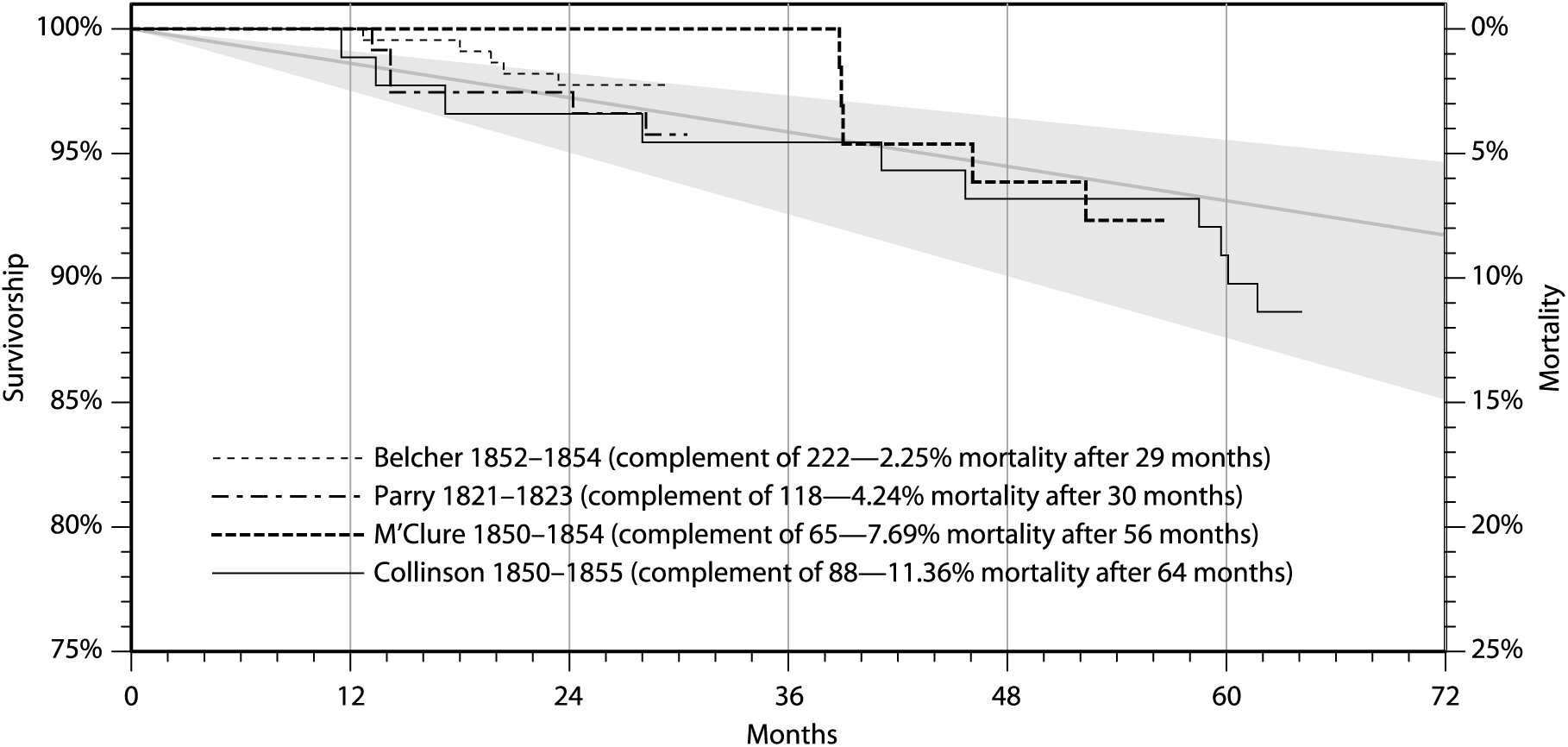
Figure 2 presents survivorship curves for four Royal Navy Arctic expeditions which utilized essentially the same basic technologies and strategies employed by the Franklin expedition. Each of these expeditions brought a large contingent of sailors into the Arctic for at least two winters, and the total duration of the voyages, from the time they departed Britain until their return, ranged from 29 to 64 months. One pre-dated the Franklin expedition by two decades (William Parry’s 1821–1823 expedition); the other three were Franklin search expeditions dispatched in the early 1850s (Richard Collinson 1850–1855; Robert M’Clure 1850–1854; Edward Belcher 1852–1854). These examples show cumulative mortality entirely consistent with overall Royal Navy rates: Belcher—2.25% over 29 months; Parry—4.24% over 30 months; M’Clure—7.69% over 56 months; and Collinson—11.36% over 64 months.
Survivorship curves for four Royal Navy Arctic expeditions.

Franklin expedition mortality
The mortality on the Franklin expedition—100% in what was probably less than 42 months—is thus clearly extraordinary, and the timing of the deaths to the extent that it can be reconstructed is informative. We know that John Torrington, John Hartnell and William Braine died at Beechey Island on 1 January, 4 January and 3 April 1846, respectively (Beattie & Geiger, Reference Beattie and Geiger2014, pp. 60–61; Kane, Reference Kane1854, p. 163). Thus, at least three individuals died during the first 11 months of the expedition. We also know that John Franklin died on 11 June 1847 (M’Clintock, Reference M’Clintock1859b, p. 286). The only other certain information we possess is that, by 25 April 1848, when the survivors came ashore in the vicinity of Victory Point on King William Island, 20 additional individuals, only one of them identified (Graham Gore), had already died. Apart from Franklin himself we do not know the dates of their deaths, but from the absence of additional graves at Beechey Island, it seems plausible to assume that after Hartnell’s death there were no further fatalities before the expedition left that location, so all 20 must have died sometime between late summer 1846 and April 1848, which were the expedition’s 15th through 35th months after leaving Britain. Gore died in the later part of that period, sometime after June 1847 (Cyriax, Reference Cyriax1939, pp. 160–161). Researchers have frequently made relatively precise inferences concerning the timings of the rest of those deaths within those 20 months. Cyriax (Reference Cyriax1939, p. 135) concluded that:
most of the twenty-four deaths reported on April 25th, 1848, must have occurred after May 24th, 1847 […]. Secondly, the heaviest losses were probably at the end rather than the beginning of that time, because Commander Fitzjames’s use of the expression “All well” on May 24th, 1847, shows that the general health of the officers and crews was at least good enough to cause no alarm.
Subsequent researchers have been even more precise. Cookman (Reference Cookman2000, p. 207) concluded that “no more fatalities or serious disease” occurred before June 1847, inferring that: “There is no other explanation for Commander Gore’s ‘All well’ message in the spring of 1847.” Similarly, Millar, Bowman, Battersby, and Welbury (Reference Millar, Bowman, Battersby and Welbury2016, p. 433) explicitly assume that the expedition “entered the winter of 1847 with 125 men alive”.
The significance of “All well” for the note’s writer was not that none of the expedition’s complement had died, since three sailors were dead by April 1846. But if “All well” did not mean that no one had died, presumably it reflected the belief that the expedition was still well situated to complete its task—the ships had been caught in the pack ice the previous autumn, but they were just 200 km from the known waters off the Arctic coast and the commanders believed that once they reached there after the ice broke up that summer the crews were healthy enough that they would be able to sail along the already mapped route westwards to the Bering Strait. Therefore, the inference that there had not been a very large number of deaths before the “All well” message was written seems safe, but the inference that Torrington, Hartnell, Braine and Franklin’s were the only deaths before the winter of 1847 seems tenuous—there may have been others.
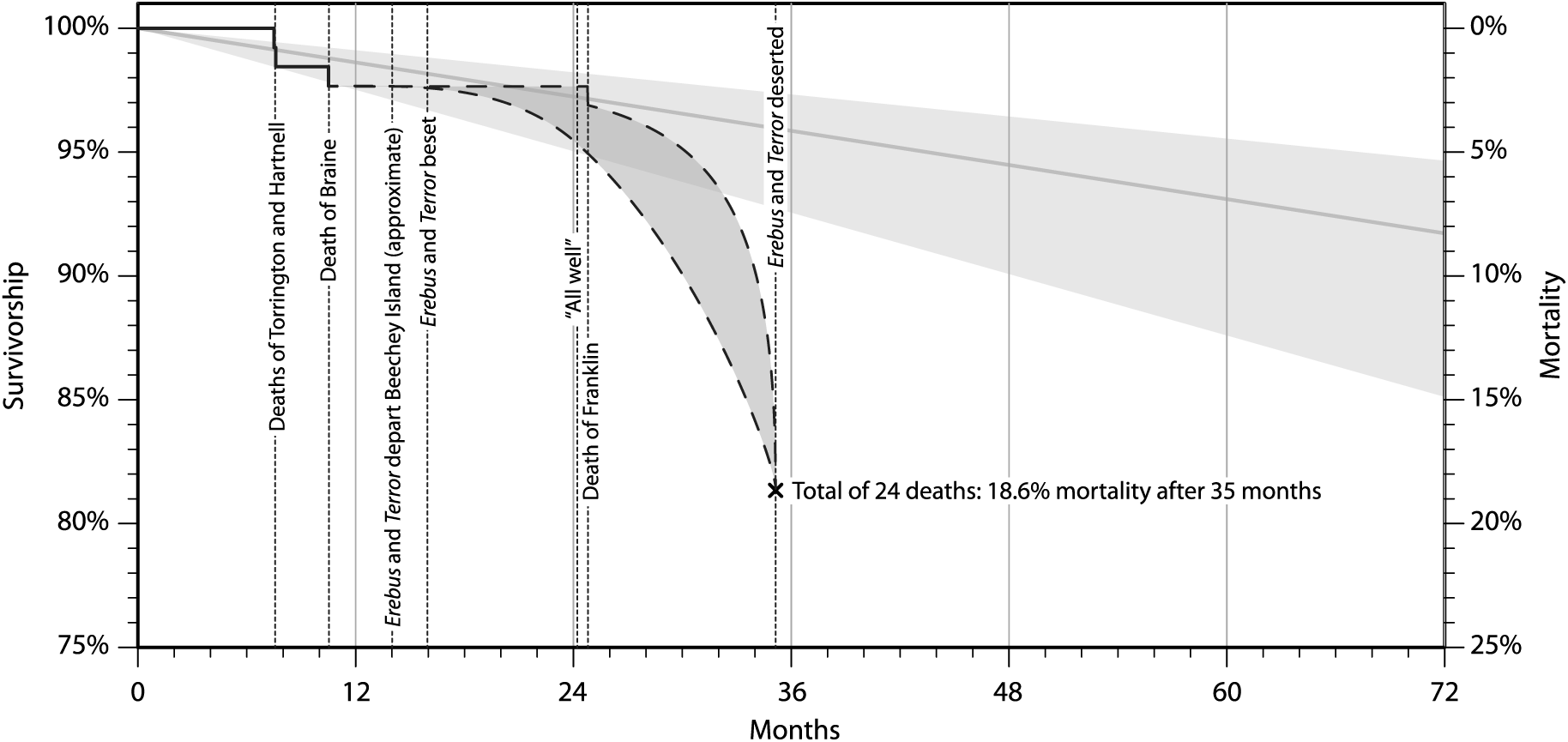
Following that reasoning, Figure 3 presents survivorship curves for the Franklin expedition, showing the known curve through the Beechey Island deaths as well as the precise survivorship as of 22 April 1848 when the ships were deserted. In-between those known points, two dotted curves show the limits of probable scenarios, with the upper curve predicated on Franklin’s 11 June 1847 death being the next death after Braine’s, and the lower curve illustrating a scenario in which Franklin’s was the sixth or seventh of the 24 deaths that would occur before the ships were deserted—that is, that no more than six sailors had died at the time the “All well” message was written. Both of these scenarios appear to be consistent with the interpretations of previous Franklin scholars outlined above, and on the date of the “All well” message, both fall within the range of expected mortality rates in the Royal Navy, so it seems likely that the actual mortality pattern lies somewhere within this range. If that inference is correct, then the Franklin expedition’s significant divergence from the predictable pattern of mortality across the entire Royal Navy and from the mortality experienced on other comparable Royal Navy Arctic expeditions did not begin until the third year of the expedition.
Survivorship curve for the third Franklin expedition up to the time the ships were deserted.

What can be documented concerning the mortality that occurred subsequent to the April 1848 desertion of the ships—that is, the remaining 105 men—has been outlined elsewhere (Stenton, Reference Stenton2018), and the events of the escape attempt are beyond the scope of this paper, except for the salient fact that at least 24 are known to have perished after having proceeded no further than Erebus Bay, only 75 km from Victory Point (Stenton, Keenleyside, Fratpietro, & Park, Reference Stenton, Keenleyside, Fratpietro and Park2017). It had taken just three days for some or all of the 105 sailors to cover the 27 km from the ships to Victory Point, so, even assuming a slower pace, it is likely that they would have reached Erebus Bay within two or three weeks. No archaeological evidence has been found there of tent rings, such as the Franklin crews are known to have created at Beechey Island, Cape Felix and Terror Bay, so the most plausible interpretation is that the 21 individuals whose remains have been found at Erebus Bay perished within the time it took to travel there or very soon afterwards (Stenton & Park, Reference Stenton and Park2017). This in turn suggests that a significant proportion of the 105 must already have been in desperately poor health on 22 April when they left the ships. This inference can be highlighted by comparing the desertion of Erebus and Terror after 35 months and the survivors’ subsequent journey of just over 100 km to Erebus Bay, with the comparable desertion of Robert M’Clure’s Investigator between April and June 1853. That event took place more than 39 months into that expedition and, despite many being described as being in poor health, the survivors of that ship took approximately two weeks to walk more than 300 km with no fatalities during the trek and only two further deaths over the next year while they remained in the Arctic on other ships (M’Clure & Osborn, Reference M’Clure and Osborn1857; Miertsching, Reference Miertsching and Neatby1967). Thus, although the M’Clure crew were probably pulling significantly lighter loads, the exigencies of the trek made by the Franklin crew to Erebus Bay are not sufficient to explain the quick deaths of so many of them.
Taking all of that information into account, the remainder of this paper poses a specific question: what was different about the Franklin expedition that could account for such massive mortality as of 22 April 1848? The difference or differences must be consistent with:
-
1. A rate of mortality through the first 24 months of the expedition similar to that in other Arctic expeditions and in the Royal Navy generally.
-
2. A state of crew health at the end of 24 months consistent with the “All well” report.
-
3. A rate of mortality between the 25th and 35th months that was far higher than that seen in other comparable Arctic expeditions, even ones that remained in the Arctic considerably longer.
-
4. Among those individuals still alive on 22 April 1848, health so poor that almost 25% would perish after having travelled little more than 100 km from the ships.
Theories concerning the Franklin catastrophe
Many possible ultimate or proximate causes—that is, causal factors that, on their own, might account directly for much or all of the massive mortality suffered by the expedition—have of course been advanced over the years and it makes sense to start by examining them through this comparative lens. In other words, would any of these proposed causes, on their own, explain the specific pattern of mortality seen in the Franklin expedition but not in the others?
Scurvy
The disease of scurvy, which results from a deficiency of ascorbic acid (vitamin C), has been offered as a primary cause of the Franklin expedition’s high mortality ever since the basic details of the expedition’s fate were known (Berton, Reference Berton2000, p. 146; Cyriax, Reference Cyriax1939, p. 151; M’Clintock, Reference M’Clintock1859a, p. 5). However, by 1845 the Navy possessed adequate methods to process and store lemon juice so as to retain its ascorbic acid over extended periods (Baron, Reference Baron2009; Mays, Maat, & Boer, Reference Mays, Maat and Boer2015). Millar et al. (Reference Millar, Bowman, Battersby and Welbury2016, pp. 431–432) present a clear summary of the reasons why the lemon juice provided to Arctic expeditions may not have contained as much ascorbic acid as desired, and conclude from their study of the health records of other expeditions that the incidence of scurvy was “greatly under-reported”. However, it is nonetheless clear from their data and from ours that scurvy did not cause massive mortality on the other Arctic expeditions studied here, although written accounts from those and other expeditions mention serious concern if its symptoms began to appear, and a small number of deaths from it. It is possible that the Franklin expedition’s supply of antiscorbutic was unusually defective in some fashion, but if that were the case, then the effects should have been serious much earlier than the third year of the expedition. Scurvy commencing only in the third year of the expedition, but then severe enough to produce so many fatalities prior to the ships’ desertion and immediately afterwards, might be consistent with some accident causing the loss or destruction of their antiscorbutics sometime early in that third year. With that possibility in mind, Cyriax (Reference Cyriax1939, p. 141) suggests that freezing or cold might have reduced the effectiveness of their lemon juice but, if this happened, then the antiscorbutics on the Franklin expedition must have been stored differently than on those other expeditions that spent as long or longer in the Arctic.
Researchers have looked for evidence of scurvy in the human remains recovered from the Franklin expedition, but the findings are inconclusive. An early analysis of osteological remains found on King William Island from sailors who had deserted the ships and then walked more than 250 km before perishing revealed some changes consistent with scurvy (Beattie & Savelle, Reference Beattie and Savelle1983, p. 102), but a more recent re-analysis of those and other skeletal remains has challenged the osteological evidence for scurvy (Mays et al., Reference Mays, Ogden, Montgomery, Vincent, Battersby and Taylor2011, Reference Mays, Maat and Boer2015). Fundamentally, however, osteological evidence of scurvy is more likely to show up in the remains of individuals who suffered from and then recovered from the disease, rather than in individuals who died from it, so there are legitimate reasons why we might not expect to find such evidence in the skeletons of any Franklin crew members who perished from scurvy. Thus, osteological evidence is unlikely to resolve the issue.
In sum, although it cannot be ruled out, no very probable scenario has yet been proposed that would account for this disease being the primary cause of the dramatic increase in mortality in the expedition’s third year, and for the subsequent rapid deaths of so many of the escapees.
Lead poisoning
The hypothesis that lead poisoning was the primary cause of the Franklin catastrophe is much more recent but has attracted considerable attention from researchers. First proposed by Beattie (Reference Beattie and Sutherland1985), the hypothesis builds upon our knowledge that Victorian sailors were exposed to lead from many sources but proposes that the Franklin sailors were exposed to a much greater extent. The particular circumstances that might explain why this problem would have afflicted the Franklin expedition to a greater extent than other expeditions derive from the demonstrably poor construction of the tins in which their canned food was held (Beattie & Geiger, Reference Beattie and Geiger2014; Kowal, Beattie, & Baadsgaard, Reference Kowal, Beattie and Baadsgaard1990; Kowal, Krahn, & Beattie, Reference Kowal, Krahn and Beattie1989), or a unique water system with which expedition’s ships may have been equipped (Battersby, Reference Battersby2008; Battersby & Carney, Reference Battersby and Carney2011, p. 208).
Unexpectedly high levels of lead were indeed discovered in the tissues of sailors who died at Beechey Island in the early months of the expedition (Amy, Bhatnagar, Damkjar, & Beattie, Reference Amy, Bhatnagar, Damkjar and Beattie1986; Beattie & Geiger, Reference Beattie and Geiger2014), and radiographs did not reveal evidence that their lead poisoning was chronic, leading to the inference that their high lead intake occurred during the expedition (Farrer, Reference Farrer1993; Notman, Anderson, Beattie, & Amy, Reference Notman, Anderson, Beattie and Amy1987). High levels of lead were also found in the skeletal remains of some Franklin sailors who died two years later, after the ships were deserted, and isotopic evidence appeared to link that lead directly to the lead used to seal the expedition’s cans (Beattie, Reference Beattie and Sutherland1985; Keenleyside, Song, Chettle, & Webber, Reference Keenleyside, Song, Chettle and Webber1996; Kowal et al., Reference Kowal, Krahn and Beattie1989, Reference Kowal, Beattie and Baadsgaard1990). This evidence led Beattie and Geiger (Reference Beattie and Geiger2014, p. 240) to conclude that:
it was the insidious and poorly understood poison, lead, entering their bodies at high levels over the course of the first months of the expedition, that weakened these three young men [Torrington, Braine and Hartnell] to the point that they were easily killed off by supervening diseases. Other crewmen would have been as severely affected by the poisoning, which probably explains at least some of the other twenty-one deaths experienced by the expedition in the early period before the ships were deserted on 22 April 1848.
Later research has, however, revealed difficulties with ascribing lead poisoning as a proximate or uniquely contributory cause for the 24 pre-abandonment deaths, and for the subsequent rapid deaths of many of the escapees. Recent analyses have identified comparably high levels of lead in other Royal Navy skeletal collections from this period (Giffin et al., Reference Giffin, Swanston, Coulthard, Murphy, Cooper and Varney2017), and further studies of the Franklin skeletal remains have identified levels of lead insufficient to be consistent with high mortality, and failed to discover an increase in ingestion of lead after the beginning of the expedition (Christensen, McBeth, Sylvain, Spence, & Chan, Reference Christensen, McBeth, Sylvain, Spence and Chan2017; Martin, Naftel, Macfie, Jones, & Nelson, Reference Martin, Naftel, Macfie, Jones and Nelson2013; Millar, Bowman, & Battersby, Reference Millar, Bowman and Battersby2015; Swanston et al., Reference Swanston, Varney, Kozachuk, Choudhury, Bewer, Coulthard and Cooper2018). There is also the difficulty of understanding a mechanism whereby lead ingestion, from either the food cans or from the ship’s water piping, would produce the very distinctive timing of mortality seen in the Franklin expedition. At Beechey Island, searchers found many empty food cans from the expedition’s first winter, more than 600 of them in one location (Kane, Reference Kane1854, p. 164), so the canned food was being consumed from the beginning of the expedition. Therefore, if they were a source of lead poisoning, both the food cans and the ships’ water systems would be expected to produce a steady rate of lead ingestion over the course of the expedition, and therefore a steady increase in health problems and mortality.
Thus, the most recent analyses would seem to be inconsistent with the sailors on Erebus and Terror ingesting dramatically greater quantities of lead than other sailors in the British Navy, and also inconsistent with lead ingestion producing the distinctive pattern of mortality seen in the Franklin expedition—that is, normal mortality over the first 24 months followed by an unprecedented increase in mortality in the expedition’s third year.
Botulism
Another kind of poisoning that has been advanced by Cookman (Reference Cookman2000) as a possible primary cause for the failure of the Franklin expedition is botulism, from the canned foods. Horowitz (Reference Horowitz2003) has also proposed botulism, from stored local game, as a cause but that proposal makes no sense based on our knowledge of hunting on these expeditions (see below). However, Cookman’s botulism scenario might be consistent with what we know. The particular circumstances that he offers to explain why botulism might have afflicted the Franklin expedition to a greater extent than other expeditions derive from the hypothesis that the supplier of the canned goods, Stephan Goldner, prepared them in a hurry and based on a very low bid; in order to make any profit at all, it is hypothesized that he would have economized on both the quality of the food and on the fuel needed to sterilize the contents before the cans were sealed. Cookman even has an explanation for why the bulk of the deaths happened after the May 1847 “All well” message. He argues that certain types of canned food were more favourable for botulism toxin than others, especially the canned soups. If the contents were thoroughly cooked after opening, the danger was removed. But Cookman proposes that sledging expeditions, dispatched in the late spring of 1847 to survey the route that the ships would need to take to reach the Arctic coast, would have taken along and consumed these canned foods with minimal heating, and then suffered the effects of botulism.
The botulism hypothesis is, however, inconsistent with some crucial evidence. Goldner produced canned food for other expeditions, and there is no evidence that they experienced botulism (Millar et al., Reference Millar, Bowman, Battersby and Welbury2016, p. 435). More significantly, we know that the Franklin expedition consumed considerable quantities of canned foods during the winter at Beechey Island, and the searchers found evidence in the Beechey Island vicinity that Franklin’s crews carried out sledging expeditions that spring, probably extensive ones, as would have been expected (Kane, Reference Kane1854; Osborn, Reference Osborn1852). Thus, if consuming the cans’ contents during sledge expeditions exposed the crews to botulism, then that disease should have been a problem in the spring of 1846, and there should therefore have been more deaths before the expedition departed Beechey Island. For these reasons the botulism hypothesis appears inconsistent with the known timing of the expedition’s deaths as outlined above.
Tuberculosis
Tuberculosis is another disease that has been proposed as a proximate cause of the Franklin disaster (Bayliss, Reference Bayliss2002; Taichman, Gross, & MacEachern, Reference Taichman, Gross and MacEachern2017). The disease possibly affected the three sailors who died during the expedition’s first year—evidence of tuberculosis was found in the lungs of Torrington, Hartnell and Braine (Amy et al., Reference Amy, Bhatnagar, Damkjar and Beattie1986, p. 116; Beattie & Geiger, Reference Beattie and Geiger2014, p. 241), although more recent DNA testing of one of Braine’s ribs produced no evidence of the disease (Forst & Brown, Reference Forst and Brown2017). The scenario whereby tuberculosis might have led to the failure of the entire expedition is outlined by Taichman et al. (Reference Taichman, Gross and MacEachern2017, p. 32), who propose that “a severe outbreak of TB may have led to the abandonment of the ships in April of 1848 and may explain why the death rate among the officers was higher than expected”. Their argument is based on observations by Inuit of some Franklin survivors who had reached the south coast of King William Island—that is, after the 105 survivors who came ashore had been reduced by at least 24 who had died around Erebus Bay and then by the unknown additional number who are known to have perished at Terror Bay (Stenton, Reference Stenton2018). Therefore, these Inuit accounts must document the appearance of some of the last survivors. The specific observations were that the men were thin and some of their mouths were “hard and dry and black” (Taichman et al., Reference Taichman, Gross and MacEachern2017, p. 27) which the researchers identify as characteristic of “miliary TB targeting the adrenal gland”, producing Addison’s disease (Taichman et al., Reference Taichman, Gross and MacEachern2017, p. 33).
The evidence that contradicts this complex scenario is, however, convincing. First, Mays et al. (Reference Mays, Ogden, Montgomery, Vincent, Battersby and Taylor2011) found no DNA evidence of tuberculosis in the remains of a sailor who reached the south coast of King William Island before perishing. Thus, if tuberculosis had been the factor that led to so many fatalities in the months and weeks surrounding the desertion of the ships, the survivors who made it as far as the south coast of King William Island, and who were observed by the Inuit, likely were individuals who were not affected by the disease, so the characteristics of their mouths must have had some other cause. Finally, it is hard to understand how tuberculosis, in an entirely isolated population and with the disease’s well-known symptoms and progression, would be consistent with the timing of mortality outlined above—that is, normal Royal Navy mortality over the first 24 months followed by an unprecedented increase in mortality in the expedition’s third year.
Zinc deficiency
Given the perceived mystery surrounding the catastrophic failure of the Franklin expedition, and the fact that detailed medical information is available only from the three sailors who died during the expedition’s first 11 months, it is logical that those sailors’ bodies would be studied in minute detail for clues that might explain the deaths of the remaining 126. Such a detailed study of a preserved fingernail and toenail from John Hartnell, who died on January 4, 1846, just seven months into the expedition, reveals that he may have suffered from chronic zinc deficiency related to malnutrition, and that it contributed to his early death from tuberculosis and pneumonia (Christensen et al., Reference Christensen, McBeth, Sylvain, Spence and Chan2017). Based on Hartnell’s condition, those authors propose that the entire crew ultimately became malnourished because some of Goldner’s canned food supplies were so bad they could not be consumed. Christensen et al. (Reference Christensen, McBeth, Sylvain, Spence and Chan2017, p. 439), therefore, infer that “other crewmen on the expedition were also malnourished, zinc deficient, immuno-suppressed, and exposed to the bacterium responsible for tuberculosis, and these factors likely played a role in their untimely deaths”.
Millar and Bowman (Reference Millar and Bowman2017) question Christensen et al.’s hypothesis by first noting that there is no reason to conclude that the Goldner canned food was so bad that it could not be eaten, and that if it had been that bad, and the crews already on reduced rations and exhibiting the effects of zinc deficiency, then the expedition would have returned to Britain after the winter of 1845–1846 instead of proceeding deeper into the Arctic archipelago. They also explore other factors that might have caused the distinctive levels of zinc in Hartnell’s tissues idiosyncratically—that is, without being representative of the health conditions of other members of the crews. Millar and Bowman thus raise cogent objections to zinc deficiency being a proximate cause for more than Hartnell’s own death. Further, even if Christensen et al.’s proposal were correct—that is, that both crews were malnourished for much of their time in the Arctic, and that this led to widespread zinc deficiency, we would not expect the pattern of mortality outlined in this paper: that is, a very few deaths in the first 7 months of the expedition, followed by a hiatus of at least 16 months, and then a great many deaths over the following year. For all these reasons, the zinc deficiency hypothesis appears inconsistent with the known timing of the expedition’s deaths outlined above, and thus does not represent a plausible proximate cause for the distinctive fate of the Franklin expedition.
Trichinosis
The parasite-born disease trichinosis, which can be contracted through the consumption of meat from infested animals, including polar bears, has been proposed by McGoogan (Reference McGoogan2017, p. 397) as the primary cause for at least some of the mortality on the Franklin expedition. In particular, he proposes that the high proportion of officers among the dead at the time the ships were deserted (9 of the 24 deaths) might be accounted for by “undercooked polar-bear meat, unevenly distributed among officers and crew”. The trichinosis hypothesis is, however, inconsistent with other evidence and also inadequate to explain the pattern of mortality outlined above. Several contemporary expeditions consumed numerous bears (e.g. 18 bears by the crews of the Resolute, Assistance, Intrepid and Pioneer in 1850–1851, and 14 by the crew of the Investigator between 1850 and 1853) with no evidence of subsequent mortality (M’Dougall, Reference M’Dougall1857, pp. 498–499). Further, while it is certainly possible that a few individuals on-board the Franklin vessels might have suffered illnesses and even fatalities through the consumption of meat from one or a very few infested bears, that scenario cannot explain the widespread poor health among the 105 who came ashore in April 1848, of whom almost 25% would perish before having travelled more than 100 km.
Other causes
Through an exhaustive study of ships’ medical records from other Arctic expeditions, Millar et al. (Reference Millar, Bowman, Battersby and Welbury2016) reviewed the prevalence of scurvy, other vitamin deficiencies, lead poisoning, botulism and other medical conditions and, from that evidence, they similarly could not identify a probable primary medical cause for the major mortality on the Franklin expedition prior to the ships’ desertion. In the absence of any hints from the medical records of these other, successful expeditions, they instead speculate that, for the Franklin expedition, “The intense cold of the final winter and the isolated position of the ships in a hostile environment would have made survival difficult” (Millar et al., Reference Millar, Bowman, Battersby and Welbury2016, p. 438). However, there is no reason to believe that the winter of 1847–1848 was so much colder than the winters experienced by other expeditions that it would have so negatively affected health (Alt, Koerner, Fisher, & Bourgeois, 1885, p. 91), nor that Franklin’s Erebus and Terror were more isolated than some others, such as M’Clure’s Investigator or Collinson’s Enterprise. Dealing specifically with the deaths of so many Franklin expedition officers (9 of the 21 deaths between their departure from Beechey Island and the time the ships were deserted), they further speculate that these “may be ascribed to accidental causes, perhaps resulting from hazards inherent in their pursuit of the navigational and scientific objectives of the expedition and the burden placed upon them to hunt in the most arduous circumstances” (Millar et al., Reference Millar, Bowman, Battersby and Welbury2016, p. 438). There is, however, no reason to believe that the Franklin expedition officers performed more arduous or dangerous tasks, prior to the desertion of the ships, than the officers of the search expeditions. Further if so many deaths prior to the ships’ desertion had been due to accidents, rather than ill health, why were the remaining crewmembers in such demonstrably poor health in April 1848 that a quarter of them would perish between Victory Point and Erebus Bay? Perhaps recognizing the inadequacy of accidents, cold or isolation as proximal explanations for the Franklin catastrophe, Millar et al. (Reference Millar, Bowman, Battersby and Welbury2016, p. 438) conclude their review of insights from those other ships’ medical records by suggesting, “Equally, the expedition may have encountered so unusual a set of circumstances as to remain unimagined.”
Thus, there is good reason to reject each of the factors listed above as a proximal or primary cause for the catastrophe that befell the Franklin expedition, on the basis that none can fulfil the criteria we have outlined: that is, be consistent with a rate of mortality through the first 24 months of the expedition similar to that in other Arctic expeditions and in the Royal Navy generally, and with the “All well” report at the end of that period, and also be consistent with an unprecedented increase in mortality rate over the final 11 months on-board the ships and in the weeks immediately following their desertion.
This brings us back to our central question: what was different about the Franklin expedition that could account for such massive mortality during the last 11 months on-board the ships and then during the first leg of the escape attempt? Here we draw upon the anthropological subfield of cultural ecology, which explores the social and physical relationship of a society with its environment and resources, and which has provided important insights into the adaptations of many societies around the world, including the Inuit of Nunavut (Damas, Reference Damas1969, Reference Damas1972, Reference Damas2002; Flannery, Reference Flannery and Flannery1976; Gowdy, Reference Gowdy1998; Steward, Reference Steward, Steward and Murphy1977). This approach focuses our attention on the entire range of resources that they exploited and on their seasonal availability, and on the scheduling of extractive activities. Focusing on these factors reveals the one significant factor that does distinguish the Franklin expedition from previous and subsequent expeditions: wintering location and its impact on hunting success.
Wintering locations
Based on the techniques pioneered on previous Arctic voyages, the normal procedure for such ship-borne expeditions was, as the open-water sailing season came to an end, to find a harbour in which the ships could overwinter. For example, in 1819–1820, William Parry wintered the Hecla and Griper in a small bay on Melville Island that they named Winter Harbour (Parry, Reference Parry1821). In 1822–1823, Parry wintered the Fury and Hecla at Winter Island, and then at Igloolik the following winter (Parry, Reference Parry1824). In 1829 John Ross secured the Victory at Felix Harbour (Ross, Reference Ross1835). Indeed, Franklin’s orders included specific instructions to follow that same procedure:
If […] the season shall be so far advanced as to make it unsafe to navigate the ships, and the health of your crews, the state of the ships, and all concurrent circumstances should combine to induce you to form the resolution of wintering in those regions, you are to use your best endeavours to discover a sheltered and safe harbour, where the ships may be placed in security for the winter. (Belcher et al., Reference Belcher, Richardson, Owen, Bell, Salter and Reeve1855, p. 278)
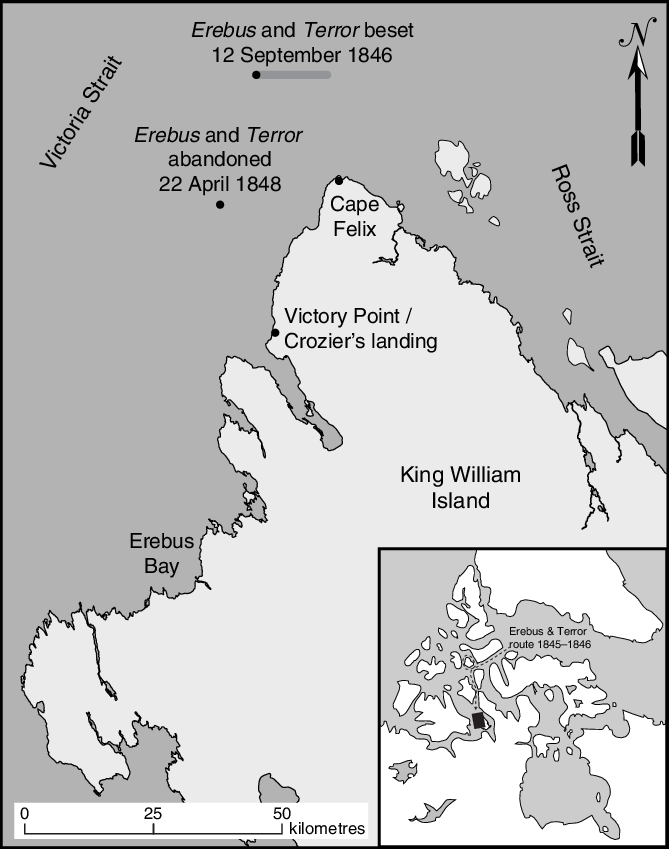
Franklin appears to have followed this directive in the autumn of 1845, by locating a sheltered and safe harbour at Beechey Island. But for some reason he did not follow it in the autumn of 1846 when the Erebus and Terror were beset in the open sea, at least 20 km from the nearest coast, King William Island (Figure 4). As many have noted, the decision to attempt Victoria Strait, west of King William Island, rather than Ross Strait to the east of King William Island, may in hindsight have been the difference between remaining stuck in the pack ice throughout the summer of 1847, or of being freed from the more reliable annual ice in Ross Strait and then being able to proceed westward along the Arctic coast towards the Bering Strait. But regardless of why he chose that route, it is unknown why in September 1846 Franklin allowed his ships to become frozen far out in Victoria Strait rather than following his orders to seek a safe harbour along one of the adjacent coastlines. Cyriax (Reference Cyriax1939, p. 125) speculated, “This besetment may have been accidental but was probably the result of a deliberate attempt to enter Victoria Strait.” Cookman (Reference Cookman2000) similarly suggested that getting frozen was the result of a failed attempt to beat the freeze-up by traversing the strait under steam power. The inference that overwintering in the pack was unintended seems highly plausible, but the May 1847 “All well” message implies that the ships successfully survived their first winter in the pack, and probably that the crews anticipated the summer break-up would soon free them to continue their journey.
King William Island, showing the locations discussed in the text. The dot indicating where Erebus and Terror were abandoned in 1848 is based on the Victory Point cairn note stating that the ships were “5 leagues NNW”. The dot indicating where the ships were first beset represents the latitude and longitude reported in the cairn note. However, because that note’s longitude for “Crozier’s landing” is 14 km too far-west, the shaded line extending eastward from the reported coordinates indicates the possible range of where they were first frozen if their longitude errors were consistent.

The emphasis in Franklin’s orders regarding wintering was, at least partly, for the protection of the ships themselves from the dangers of the Arctic ice, which had caused serious structural damage to ships in the past (Back, Reference Back1838; Lyon, Reference Lyon1825; Parry, Reference Parry1826). But from Parks Canada’s recent discoveries of both Erebus and Terror far to the south, we now know for sure that the ships themselves survived at least two winters frozen in the pack—the decision in April 1848 to desert the ships must, therefore, not have been due to any structural damage that had rendered one or both in imminent danger of sinking, as some had speculated (Cyriax, Reference Cyriax1939, p. 143). However, one of the specific questions we are seeking to answer in this research is why the Franklin expedition experienced such massive mortality during the last 11 months on-board the ships and then during the first leg of the escape attempt. That period began after the ships had already been beset in the pack for approximately 10 months, and there is reason to infer that the ships’ location may have led directly to this mortality.
Hunting on Arctic expeditions
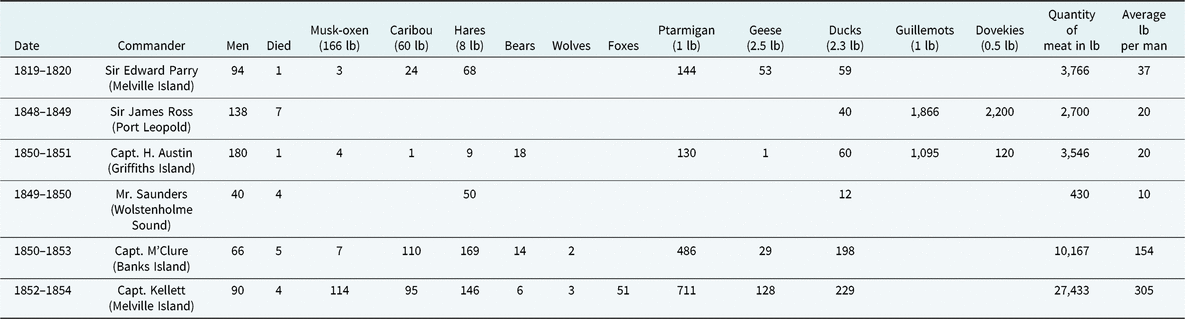
All ship-borne British Arctic expeditions of this era—those preceding Franklin’s, Franklin’s, and then the search expeditions—set out with enough supplies to be self-sufficient for the duration of the time they anticipated spending in the Arctic. Franklin’s expedition was supplied so as to be self-sufficient for a period of three years (Cyriax, Reference Cyriax1939, p. 40). However, all of the expeditions for which we have records were also equipped to make, and assiduous in making, efforts to acquire game and fish during their time in the Arctic. For example, Table 1 reproduces data from an 1857 publication, after the end of the main searches, documenting both the numbers of animals acquired and the quantity of meat they provided (M’Dougall, Reference M’Dougall1857). The inclusion in this same table of the size of each crew and the number of mortalities suffered clearly indicates the linkage that was ascribed between this fresh food and the health of the crews. Fish, although not listed in this table, were clearly also valued—for example, in 1852–1853 the Enterprise wintered at Cambridge Bay where fish were acquired in such quantities that 1100 char could be “cured for sea service” (M’Clure & Osborn, Reference M’Clure and Osborn1857, p. 269) over and above the ones consumed immediately.
Contemporary list of game from several Arctic expeditions, extracted from Abstracted List of Game Procured during Various Voyages in the Arctic Regions (M’Dougall, Reference M’Dougall1857, Appendix, pp. 498–499)

Hunting and fishing were conducted primarily between the time that the ships were preparing to be frozen in the autumn until they were freed from the ice the following summer. A lot of thought and organizational effort was clearly invested in these activities. Several accounts speak of rules that were established so as to ensure that as much meat as possible was distributed to the entire crew while also providing an incentive for the hunters:
We now were under the game laws, as they existed at Melville Island; by which it was enacted that, for the purpose of economizing our ships’ provisions, all deer or musk-oxen killed should be served out, in lieu of the usual allowance of meat: hares, ducks, and other birds, were not at this time to be included. As an encouragement to sportsmen, the heads, legs, and offal of the larger animals were to be the perquisites of those who procured the carcasses for the general good. (Lyon, Reference Lyon1824, p. 66)
Lieutenant Jago was this week sent out towards Cape Colborne; and what with the game he sent in, and that obtained by the surgeon and assistant-surgeon, together with others in the vicinity of the ship, we had three general issues of game during the week; a small quantity of fish was also obtained, but it did not prove very good, or in sufficient abundance, to repay the trouble. (Collinson, Reference Collinson1889, p. 275)
But at Melville Island in 1853-54, Captain Kellett formed a regular hunting organisation; within a range of 15 miles there were five hunting parties, and game of various kinds was plentiful; and they obtained enough to supply from 1 to 1.5 lbs. per man of the crew, per day, for a considerable time. (Collinson, Reference Collinson1889, p. 427)
Hunting on the Franklin expedition
In July 1845, in Greenland, the Erebus and Terror took on board some live bullocks that they intended to slaughter once they reached the ice (Cyriax, Reference Cyriax1939, p. 57), but after that, they would have been dependent on foraging for any other fresh food to supplement their stored supplies. Franklin himself had indicated that his plans included using every available opportunity to obtain game (Cyriax, Reference Cyriax1939, pp. 64–65), and we know that during their first winter at Beechey Island they hunted, from the discovery several years later of hunting camps and of bird bones and hare fur (Osborn, Reference Osborn1852, p. 84). For example,
Arriving at the margin of a lake, which was only one of a series, and tasted decidedly brackish, though its connection with the sea was not apparent, we found the site of a circular tent, unquestionably that of a shooting-party from the “Erebus” or “Terror”. The stones used for keeping down the canvas lay around; three or four large ones, well blackened by smoke, had been the fire-place; a porter-bottle or two, several meat-tins, pieces of paper, birds’ feathers, and scraps of the fur of Arctic hares, were strewed about. (Osborn, Reference Osborn1852, p. 95)
However, during the winters of 1846–1847, and 1847–1848, when the Erebus and Terror were beset on the sea ice at least 20 km from the nearest coastline, the logistics of acquiring game or fish would have been far more difficult. In the weeks immediately following their besetment on 12 September 1846, the crews probably would not have been able to get to shore due to the dangers of traversing the pack ice until it was frozen solid. By whatever date they would have been able to reach shore, they would have been contending with dwindling hours of daylight, increasing cold and a seasonal scarcity or absence of terrestrial game. The sea ice environment would have provided few opportunities for hunting, apart from the occasional polar bear. The techniques used by Inuit to hunt seals at their breathing holes would have been quite beyond the capabilities of the British sailors (M’Clintock, Reference M’Clintock1859a, p. 5). For these reasons it is probable that the crews were not able to acquire significant quantities of fresh food that autumn or throughout the winter.
By the spring of 1847, travel to King William Island would have been feasible and we have the campsite at Cape Felix, whose initial occupation may date to this time, as evidence that at least some individuals were camping on shore and hunting or fishing (Cyriax, Reference Cyriax1939, p. 132; Klutschak, Reference Klutschak and Barr1987, p. 87; Schwatka & Stackpole, Reference Schwatka and Stackpole1965, p. 83). The first investigator of that site, William Hobson, reported seeing “a quantity of Ptarmigan feathers, some salt meat bones, the jaw of a fox, and some very small fragments of partially consumed wood” (Stenton, Reference Stenton2014, p. 514). The absence of any mention of bones from large game (e.g. caribou) may be significant—there is a low density of large mammal species on northern King William Island in contrast to many other nearby parts of the Arctic (Freeman, Reference Freeman1976; Riewe, Reference Riewe1992). Hobson’s account of his journey along the entire west coast of King William Island in May 1859 appears to bear out the paucity of game in late spring and early summer. He reported that polar bears and foxes were common, but that “There is not the slightest chance of a party subsisting by hunting on this shore, we saw no traces of deer or musk ox” (Stenton, Reference Stenton2014, p. 519). The only time of year when game may have been available there in significant numbers is mid-summer, and from his experience during a three-week period in the summer of 1879, Frederick Schwatka characterized the area as “teeming with animal life sufficient to subsist a much larger party properly armed and with good hunters” (Schwatka & Stackpole, Reference Schwatka and Stackpole1965, p. 79). Schwatka’s conclusion has, however, been refuted by land use studies. Waterfowl and seabirds are common in the area, as are polar bears, but it does not support large numbers of caribou, muskoxen or fish (Riewe, Reference Riewe1992, pp. 107, 210–213).
We know that in 1847 one or more Franklin expedition teams were also exploring other parts of King William Island, including the party of eight that deposited the cairn notes near Victory Point that May (M’Clintock, Reference M’Clintock1859a, p. 3). However, the long distance between the ships and shore undoubtedly precluded sending out the numbers of hunting parties dispatched by other expeditions, and for this reason they would have been unable to acquire comparable quantities of fresh meat and fish. This inference is supported by the fact that extensive archaeological surveys of the northwest coast of King William Island have found only the Franklin expedition campsite at Cape Felix; no other hunting campsites such as the ones at Beechey Island and Cape Felix have been found (Stenton, Reference Stenton2018; Stenton & Park, Reference Stenton and Park2017). The single other possibility is that a hunting campsite existed in the Victory Point vicinity, and that its presence is invisible due to the effects of the post-abandonment “Crozier’s Landing” campsite there.
Part-way through the summer of 1847, in preparation for the breakup of the sea ice that the crews awaited, it is likely that any hunting parties were recalled to the ships in anticipation of the ice between the ships and the shore becoming dangerous. That would have ended hunting, and only once it was clear that the ships would not be released from the pack that summer, weeks or even months later, would they have been able to resume sending hunting parties to King William Island. Thus, they would have missed what would have been the most productive hunting period—mid-summer. For all of these reasons, it seems clear that it would have been more difficult for the Franklin expedition to obtain game and fish due to their distance from shore, and that the periods during which they could have pursued these activities were much shorter than those exploited by other expeditions. Thus, after they left Beechey Island, around July or August 1846, the Franklin crews would have been forced to rely to a far greater extent than other expeditions on their stored supplies. The “All well” message was written approximately 10 months into this period, and the dramatic departure from the mortality rate of other Royal Navy voyages, including other Arctic voyages, documented in Figure 3, commenced 11–18 months into it. By the time the 105 survivors left the Erebus and Terror, the crews had been cut off from significant fresh supplements to their stored food for a minimum of 21 months.
Therefore, a clear difference between the Franklin crews and the crews of all those other expeditions was where they spent their second and third winters in the Arctic, from which we can infer that the Franklin expedition was severely limited in the amount of fresh food they were able to secure through hunting or fishing. We are not the first to recognize this difference. In his very first summary of the findings of the 1857–1859 Fox expedition, to the Royal Geographical Society of London on November 14 1859, Leopold M’Clintock reported:
We know that Franklin’s ships were cut off from all supplies of game for three consecutive winters, and that this is the only case on record of ships’ crews subsisting solely upon their own supplies for so long a period. (M’Clintock, Reference M’Clintock1859a, p. 5)
Is it plausible that the Franklin expedition’s comparative lack of fresh game and fish, and enforced reliance on their own stored supplies, could have led directly or indirectly to the catastrophic mortality in the months prior to the ships’ abandonment and immediately afterward? In fact, there are serious nutritional deficiencies that could be expected for individuals living for an extended period primarily or solely on the kind of stored provisions with which these Arctic expeditions set out.
Hunting and nutrition
The best known nutritional deficiency from consuming Royal Navy stored food is, of course, scurvy, but, as outlined above, it should not have been a serious problem until after the third year of the expedition because they left England with enough lemon juice for three full years. The very limited number of scurvy fatalities on the other expeditions, including ones that stayed in the Arctic significantly longer, would suggest that Royal Navy lemon juice could be an adequately effective antiscorbutic. It definitely was effective on sea voyages that lasted many months but, apart from Franklin expedition, no Royal Navy voyages relied continuously on stored supplies and antiscorbutics over a period spanning multiple years. In fact, Millar et al. (Reference Millar, Bowman, Battersby and Welbury2016, pp. 431–432) present a clear summary of the problems associated with the lemon juice provided to Arctic expeditions and conclude, “It is therefore doubtful that lemon juice alone could reliably protect these crews from scurvy.” They suggest that on the expeditions they studied, which suffered very few scurvy fatalities, the ascorbic acid from lemon juice was supplemented by “the highly variable contribution of vitamin C from hunting and other foods” (Millar et al., Reference Millar, Bowman, Battersby and Welbury2016, p. 432).
The conclusion that Royal Navy expeditions could obtain ascorbic acid from game is well supported by evidence, contrary to the common wisdom that cooking “boiled or roasted away all the vitamins from the fresh provisions that were sometimes available” (Berton, Reference Berton2000, pp. 57–58). In a carefully controlled experiment in the late 1920s, anthropologist Vilhjalmur Stefánsson demonstrated that it was possible to remain in excellent health for a year on a solely meat diet, much of it cooked well-done (Stefánsson, Reference Stefánsson1946, pp. 66, 88–89; Stefánsson, Reference Stefánsson1956), and studies have documented the adequate quantities of ascorbic acid available from uncooked and cooked meat (Fediuk, Hidiroglou, Madere, & Kuhnlein, Reference Fediuk, Hidiroglou, Madere and Kuhnlein2002; Frankenburg, Reference Frankenburg2009; Geraci & Smith, Reference Geraci and Smith1979, p. 91). Meat and fish, often cooked, are also the source from which Inuit obtain their ascorbic acid. However, Millar et al. (Reference Millar, Bowman, Battersby and Welbury2016, p. 438) go on to infer that the amount of scurvy on the Franklin expedition would have been comparable to that on the other expeditions because they too would have been able to supplement their lemon juice with ascorbic acid from game: “It would seem probable that scurvy would have affected some of Franklin’s men but the disease would not have contributed to the disaster prior to deserting the ships.” However, as noted above, it is not true that the Franklin expedition would have been able to supplement their lemon juice with ascorbic acid from fresh game to the same extent as those other expeditions. Therefore, it is probable that scurvy was much more prevalent on the Franklin expedition. Based on his own extensive experiences with Royal Navy stored foods, M’Clintock (Reference M’Clintock1859a, p. 5) inferred that by the time they left the Erebus and Terror, Franklin’s “whole crew had become affected by scurvy, and greatly debilitated”.
Scurvy is not the only nutritional deficiency that likely affected the Franklin expedition due to their disproportionate reliance on their stored food. The disease beriberi results from a deficiency in thiamine (vitamin B1). It produces a complicated range of symptoms, but initially produces severe weakness and pain in the legs, to such an extent that walking may be difficult or impossible. Beriberi is famously associated with diets predominated by polished rice, but it was also documented in the early 20th century in poor Newfoundland fishing communities reliant seasonally on stored food diets limited to little more than tea, white flour and biscuits, salt beef, salt pork, salt cod, margarine, molasses and berries (Aykroyd, Reference Aykroyd1930; Frankenburg, Reference Frankenburg2009, pp. 15–24). It is readily treatable by the addition to the diet of foodstuffs containing thiamine, but many Newfoundlanders suffered from it seasonally, and from 1912 to 1916, between 11 and 20 died of it per year (Aykroyd, Reference Aykroyd1930, p. 358). The apparent relevance of the Newfoundland example’s particular circumstances to Arctic exploration makes Aykroyd’s summary worth quoting from at length:
By custom and necessity, in most outlying parts of Newfoundland, food supplies and other stores for winter and spring are laid in during November or December, to last till replenishment in the following May or June. […] Poor families may be found who, having neither gardens nor livestock, are entirely dependent during winter and spring on whatever supplies of imported food their catch of fish may enable them to buy, or on supplies granted on credit. […] In the summer, fresh fish is plentiful; usually there is game to be had in the autumn, while supplies are freshly bought for the winter. One would expect deficiency disease to show a corresponding seasonal incidence. […] It will be seen from the chart that the majority of cases of beriberi were admitted in April, May and June, well known on the coast to be the beriberi season. Many patients have an annual recurrence in the late spring months. (Aykroyd, Reference Aykroyd1930, pp. 360–361)
Beriberi has always been less common on the Labrador coasts than in North Newfoundland, in spite of the greater scarcity of vegetables in the former country and of a severer degree of poverty. This may be explained by the greater abundance of game on the Labrador coasts. Labrador families are common who, having nothing for the winter beyond white flour, molasses and tea, with a very little salt meat, salt fish and margarine, are able to kill plenty of fresh meat during the winter and spring. Such families keep fairly healthy. […] The observation that a very small raising of the dietary level from the basic bread, with some salt meat and molasses, will check the appearance of beriberi, is confirmed by the seasonal incidence. The admission rate to hospital falls in July and August, when the only addition to the dietary is fresh fish, before the autumn supplies of potatoes, cabbages, and turnips have been harvested. (Aykroyd, Reference Aykroyd1930, pp. 364–365)
From this example it is clear that thiamine deficiency over just a few months can produce debilitating symptoms which can culminate in death if thiamine is not reintroduced to the diet. The Newfoundlanders developed the disease during the time of year when they consumed a diet roughly analogous to the Royal Navy stored foods, but the consumption of fresh fish or game provided enough thiamine to prevent the disease or promote recovery from it. Finally, it may be relevant that studies of long-term storage of different kinds of food have revealed that the amounts of thiamine and ascorbic acid decrease much more rapidly than other vitamins (Cecil & Woodruff, Reference Cecil and Woodruff1962; Desrosier & Desrosier, Reference Desrosier and Desrosier1977, pp. 463–464), so even stored food that started out with adequate quantities of thiamine may have become deficient in it after several years in a ship’s hold.
It is thus plausible that all of the Royal Navy Arctic expeditions entered the Arctic with food supplies that were either already deficient in both ascorbic acid and thiamine, or that the amounts of those essential vitamins in their stored food dwindled over time. All of the expeditions that were successful in hunting and fishing each autumn and spring were largely able to avoid fatalities from deficiency diseases such as scurvy and beriberi, but the crews of the Erebus and Terror, beset for almost two years far out in Victoria Strait, would not have been able to supplement their stored supplies with fresh foodstuffs to any significant degree. The timing of the Franklin expedition mortality is consistent with the crews suffering from the effects of compounding nutritional deficiencies due to complete reliance on stored provisions commencing no later than their departure from Beechey Island—that is, by the expedition’s 13th or 14th month after leaving Britain. The effects were presumably not severe by the time the “All well” report was written approximately 10 months into this period, but, during the subsequent 11 months when between 17 and 20 crewmembers died, the cumulative effect became devastating. And if our estimates of how long it took the escapees to reach Erebus Bay from Victory Point are correct, many of the survivors were already so debilitated that at least 24 more died within weeks of departing the ships.
Conclusion
As noted at the start of this paper, to the extent that there is any true mystery about the Franklin expedition and its failure, it is why so many died on that expedition and not on all the others. To answer that question, we have searched for a factor that was different about the Franklin expedition and which would be consistent with a rate of mortality similar to that in other Arctic expeditions and in the Royal Navy generally through the first 24 months of the expedition, but vastly higher between the 25th and 35th months. It also had to be consistent with both the “All well” report in May 1847, and with the death of almost 25% of the April 1848 survivors after having travelled little more than 100 km from the ships.
Adopting that approach, it would appear that the most significant difference, and the ultimate cause of the catastrophe as it unfolded, was wintering in the ice pack more than 20 km from the nearest shore. This was contrary to Franklin’s orders to “use your best endeavours to discover a sheltered and safe harbor” and distinguished the Franklin expedition from all of the other comparable overwintering expeditions. Most crucially, it precluded the Erebus and Terror crews from significantly supplementing their stored foods with fresh game and fish. That in turn led to the proximate cause of the unprecedented mortality on the expedition during its final year on the ships and then in the weeks immediately after they were deserted: nutritional deficiencies due to much greater reliance on stored provisions than other expeditions. This model may even explain something that has puzzled researchers since the discovery of the cairn note: the fact that officers had died at a disproportionate rate by the time the ships were deserted. It may be that the officers’ solicitude for their sailors meant that while beset in the ships they reserved the little available fresh game that could be acquired for the ordinary seamen. Ultimately, of course, it would not matter—by the time they deserted the ships, most or all of the survivors were so debilitated, and the land they traversed so devoid of game at that time of year that none would survive.
Acknowledgements
The fieldwork that inspired this research was funded by the Government of Nunavut Department of Culture and Heritage, Nunavut Archaeology Program. We wish to thank the officers and crew of the Canadian Coast Guard Ship Sir Wilfrid Laurier for providing the outstanding logistical support that made it possible for us to explore so thoroughly the region where the Franklin catastrophe unfolded. Finally, we thank the editor and anonymous reviewers whose comments helped improve the final version of this paper.