Introduction
The study of conductive polymers has gained relevancy over the last decade because their properties can be optimized for specific applications.[Reference Balint, Cassidy and Cartmell1] Among them, poly(3,4-ethylenedioxythiophene) (PEDOT) has become an interesting material, due to its high charge injection, low impedance, and biocompatibility.[Reference Starbird, García-González, Smirnova, Krautschneider and Bauhofer2] Several authors have conducted experiments to improve polymerization,[Reference Asplund, von Holst and Inganäs3] adhesion,[Reference Boehler, Oberueber, Schlabach, Stieglitz and Asplund4] and electrochemical properties of PEDOT-based materials,[Reference Gribkova, Iakobson, Nekrasov, Cabanova, Tverskoy and Vannikov5] for applications such as neuronal stimulation, immobilization of organisms, and biosensors.[Reference Ogata, Edgar, Majumdar, Briggs, Patterson, Tan, Kudlacek, Schneider, Weiss and Penner6, Reference Starbird, Bauhofer, Meza-Cuevas and Krautschneider7] In order to successfully enhance those applications, biocompatible conductive materials must be improved, seeking a safe interaction with living systems in the long-term.[Reference Mantione, del Agua, Sanchez-Sanchez and Mecerreyes8]
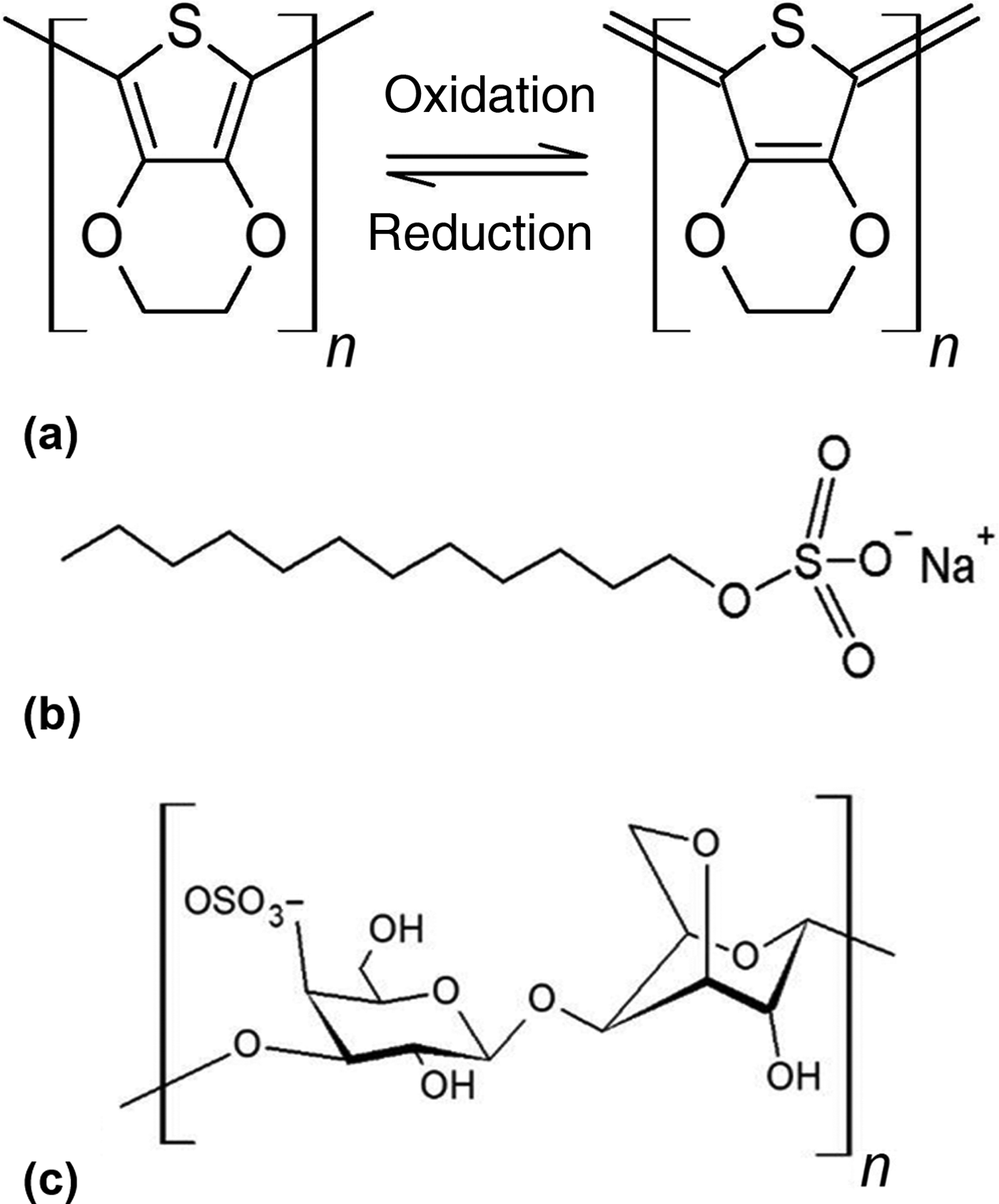
PEDOT has been broadly used since it is synthesized through simple techniques (i.e., electrochemical polymerization) and its charge injection mechanisms: a combination between Faradaic and non-Faradaic processes,[Reference Starbird, Bauhofer, Meza-Cuevas and Krautschneider7] as shown in Fig. 1; with this method, it is possible to obtain thin films from aqueous dispersions.[Reference Chiu, Travaš-Sejdić, Cooney and Bowmaker9] Some studies have reported the use of surfactants during PEDOT synthesis in order to reduce the oxidation potential, favoring 3,4-ethylenedioxythiophene (EDOT) polymerization and acting as a doping agent in the polymer layer.[Reference Nasybulin, Wei, Kymissis and Levon10] Sodium dodecyl sulfate (SDS) [Fig. 1(b)] is a well-known surfactant with a critical micellar concentration (CMC) of 8.2 mM.[Reference Stokes and Evans11] Furthermore, it has been used in aqueous micellar dispersions for the polymerization of EDOT,[Reference Sakmeche, Aaron, Fall, Aeiyach, Jouini, Lacroix and Lacaze12] due to its enhancement in the solubility of this monomer in water.[Reference Sakmeche, Aeiyach, Aaron, Jouini, Lacroix and Lacaze13] This system presents a suitable performance for electronic applications and chemical detection devices in aqueous media.[Reference Wu, Pei, Zhang, Chen, Guo, Chen and Wang14, Reference Atta, Galal and Ahmed15] Nonetheless, SDS and other polymeric surfactants [i.e., poly(sodium 4-styrene sulfonate)] are not appropriate for cell regeneration, since they exhibit antimicrobial properties[Reference Muñoz-Bonilla and Fernández-García16] and it may induce cell lysis, low cellular repopulation, and retarded cell growth.[Reference Gratzer, Harrison and Woods17, Reference Rieder, Kasimir, Silberhumer, Seebacher, Wolner, Simon and Weigel18]
(a) Benzenoid and quinoid structures of PEDOT. (b) Chemical structure of surfactant SDS. (c) Chemical structure of surfactant κC.

In order to integrate biologically active structures into a PEDOT matrix, it is necessary to develop an adequate environment that ensures the viability of these biologic systems. Therefore, a biopolymer may provide an appropriate media, while performing as a doping agent in the conductive layer. Polymerization of a matrix with anchored biomolecules has been successfully reported for PEDOT:biopolymer, through water-based dispersions and no effect in cell proliferation or cytotoxicity has been found.[Reference Mantione, del Agua, Sanchez-Sanchez and Mecerreyes8, Reference Asplund, Thaning, Lundberg, Sandberg-Nordqvist, Kostyszyn, Inganäs and Von Holst19] Moreover, these materials retained the electrical properties of the conductive layer when compared with the standard surfactants.[Reference Nasybulin, Wei, Kymissis and Levon10, Reference Asplund, Thaning, Lundberg, Sandberg-Nordqvist, Kostyszyn, Inganäs and Von Holst19]
A promising biopolymer is κ-carrageenan (κC), which is a sulfonated polysaccharide extracted from seaweed [Fig. 1(c)] that has been used for enzyme and microbial cell immobilization and in pharmaceutics.[Reference De Ruiter and Rudolph20] The use of κC as a surfactant during the PEDOT synthesis in aqueous media may allow to carry out the electrochemical polymerization through a micellar system. Additionally, it has already been reported as a doping agent into the conductive polymer, reducing the impedance and increasing the capacitance of the material.[Reference Zamora-Sequeira, Ardao, Starbird and García-González21]
The aim of this study is to compare the PEDOT conductive behavior obtained from a κC dispersion and a standard non-biocompatible SDS dispersion, in order to understand the potential application of PEDOT:κC as a conductive biocompatible system. The dispersions and the conductive layers were analyzed by means of dynamic light scattering (DLS), charge injection capacity, μRaman spectroscopy, and profilometry. An assessment of the potential biomolecular immobilization through this biocompatible material is presented.
Experimental
Monomer EDOT (97% purity), κC (ACS reagent), potassium perchlorate (KClO4, ACS reagent), SDS (99% purity), acetylcholinesterase from Electrophorus electricus (electric eel) (AChE), acetylthiocholine chloride (ATCh, 99% purity), TRIS hydrochloride (TRIS HCl, 99% purity), and potassium chloride (KCl, ACS reagent) were acquired from Sigma-Aldrich (San José, Costa Rica). Deionized water was used in all experiments.
The surfactant dispersions, SDS (CMC = 8.2 mM) and κC (0.2% w/v)[Reference Ng and Camacho22] were prepared in deionized water. The samples were sonicated and centrifuged, before and after adding the monomer EDOT (10 mM). The particle size and ζ-potential characterization were measured in a Zeta Sizer (Malvern, model: ZetaSizer Nano ZS, Worcestershire, UK).
The electrochemical polymerization was carried out in a three-electrode cell configuration with a patterned gold electrode as a working electrode, platinum (Pt) as a counter electrode, and silver chloride (Ag|AgCl, 3 M KCl) as a reference electrode, using a AutoLab Potentiostat (AUTOLAB, model: PGSTAT-302, module FRA32M, Utrecht, Netherlands) with a fixed charge density of 240 mC cm−2.
The enzyme immobilization was achieved by electrochemical polymerization with a dispersion of EDOT-κC-acetylcholinesterase enzyme (0.350 U/ml). Enzymatic activity of immobilized AChE with 200 µM ATCh was evaluated by the Ellman method,[Reference Dohi, Terasaki and Makino23] using a UV-visible spectrophotometer (PerkinElmer, model: Lambda 25 MA, USA). The enzymatic activity was monitored by measuring the absorption of the hydrolyzed substrate at a 412 nm wavelength.
The electrode topography was studied by profilometry analysis (Bruker, model: Dektak TX Advance, AZ, USA) and the arithmetical mean height (S a) and the maximum height (S z) were calculated in order to describe the roughness of the materials by using a 2 µm tip radius and a force of 2 mg in a 500 × 500 µm2 scan area.
The electrochemical characterization was performed in the same AutoLab Potentiostat (AUTOLAB, PGSTAT-302 model, Utrecht, Netherlands), to study the behavior of the materials when polarizing between −0.1 and 0.8 V (at a 100 mV/s scan rate in a 0.5 M KClO4 aqueous solution as an electrolyte); the electrochemical impedance spectroscopy (EIS) analysis was performed in a 1 M KCl solution, at 25 mV, in a frequency range of 1–3000 Hz. The Kramers–Kronig test and the data fitting were performed using the NOVA v.2.1 software (Utrecht, Netherlands). An equivalent model was built by a combination of resistors (R), capacitors (C), and constant-phase-elements (Q).
All samples were measured immediately after cycling in order to avoid polymer layer relaxation. Raman spectroscopy was conducted using a confocal Raman microscopy (WITec, GmbH, model Alpha300 R, Ulm, Germany) with a 735 nm excitation laser. The system was equipped with a high-resolution camera for capturing microscopy images of the measured area. The band at 988 cm−1 was used for data normalization.
Results and analysis
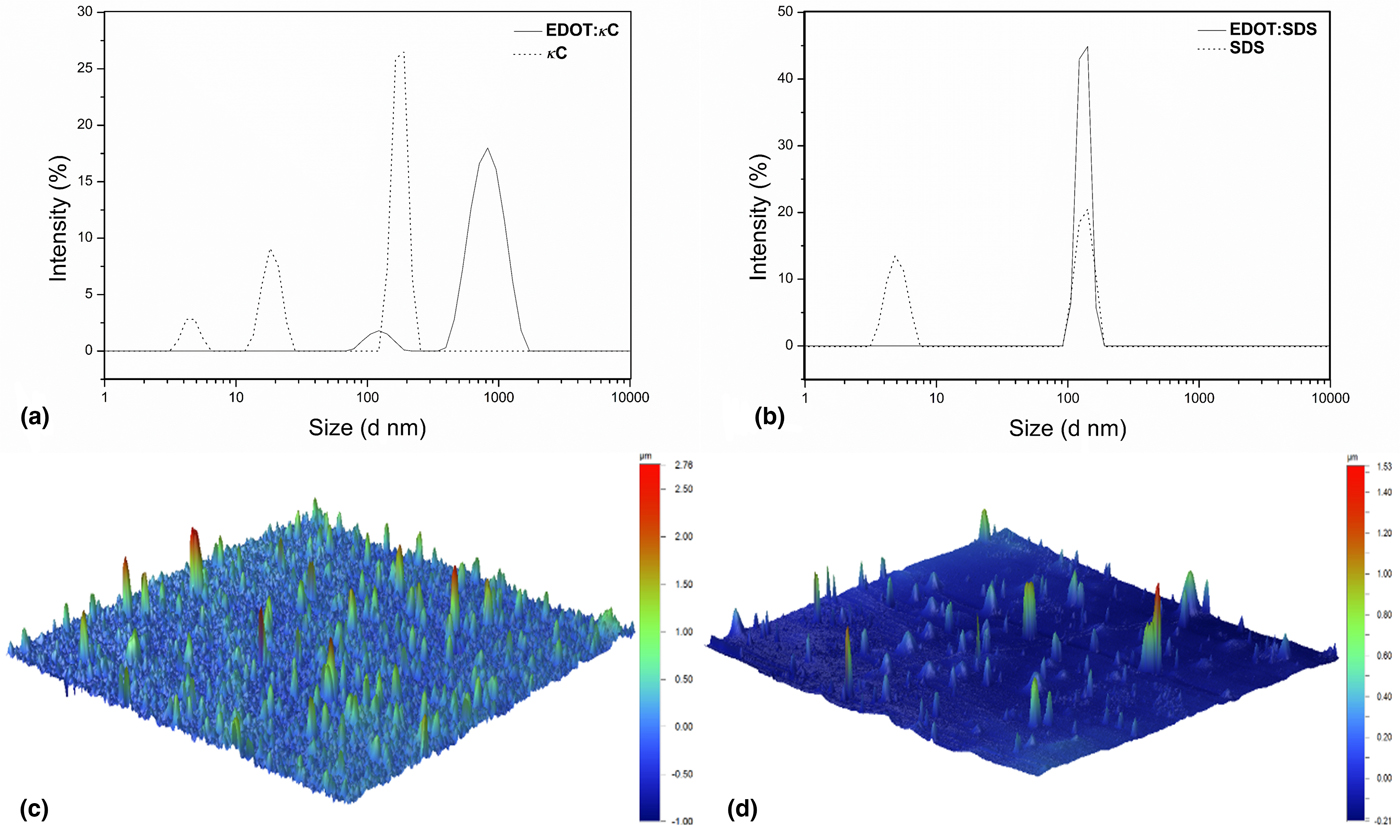
The stability of the dispersions, used to deposit the materials, was determined by measuring the ζ-potential values. Although both systems showed a proper dispersion stability (SDS = −48 mV, κC = −37 mV, EDOT:SDS = −31 mV, and EDOT:κC = −37 mV), particle size distribution indicates the presence of two and three populations prior the addition of the monomer for κC and SDS, respectively [see Figs. 2(a) and 2(b)].
(a) Particle size distribution for κC dispersions. (b) Particle size distribution for SDS dispersions. (c) Optical profilometry images obtained for PEDOT:κC. (d) Optical profilometry images obtained for PEDOT:SDS.

The κC dispersion presents three populations before adding the monomer [Fig. 2(a)], because the polyelectrolyte chain structure increases the gel behavior and aggregation in some regions, due to its polysaccharide nature, which results in heterogeneous dispersions.[Reference Nickerson, Paulson and Hallett24] For the SDS system [Fig. 2(b)], two populations are observed before adding the monomer, and after adding the monomer, sonicating and centrifuging, only one population remained.
The stability of the dispersions depends on the type and concentration of surfactant and it has been reported that its properties also affect the uniformity and roughness of the conductive polymer layer obtained from a dispersion.[Reference Balint, Cassidy and Cartmell1, Reference Walsh and Ponce de Leon25] Therefore, the roughness of the PEDOT:SDS and PEDOT:κC layer was studied to assess the effect of the surfactant nature during the electrodeposition.
SDS is a monodisperse system [see Fig. 2(b)] because the concentration used was the CMC, thus, high stability and uniformity was expected for the PEDOT:SDS film. Profilometry confirms [see Fig. 2(d)] that the deposited layer from the SDS dispersion presents an evidently smoother surface (S a = 0.062 µm, S z = 1.736 µm). In contrast, κC concentration was selected through experimental criteria, causing polydispersity in this system [Fig. 2(a)], which is foreseen to induce differences in the roughness of the film when compared with the PEDOT:SDS coat. PEDOT:κC coating presents a larger roughness (S a = 0.132 µm, S z = 3.754 µm) than PEDOT:SDS [see Fig. 2(c)]; this enlargement in the surface roughness of the conducting coat increases the specific surface area, which can enhance the contact between a biomolecule and an electrode.[Reference Zhang, Arugula, Wales, Wild and Simonian26]
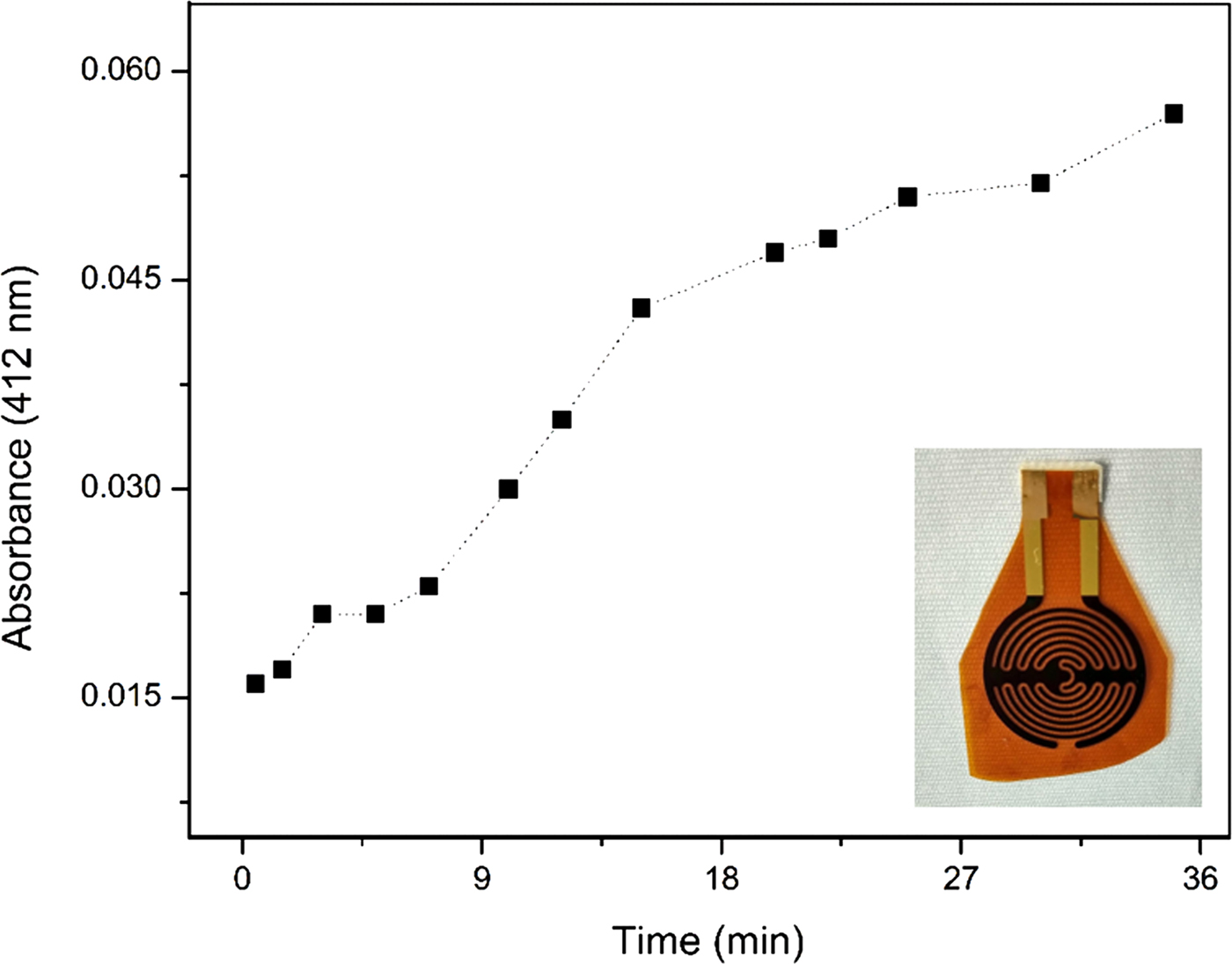
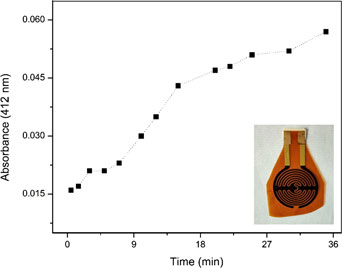
The PEDOT:κC was evaluated as a matrix for enzyme immobilization. The results indicate that this synthesis method is adequate to immobilize biologically active structures on the conductive biopolymer film. A typical time dependent absorbance response plot of the AChE enzymatic activity was obtained on the biopolymeric composite using the Ellman's method (see Fig. 3) where the absorbance at 412 nm is related to thiocholine concentration. The production of thiocholine confirms the successful immobilization of AChE in the PEDOT–surfactant matrix. The enzymatic affinity for ATCh suggests that the enzyme maintains its bioactivity.
Enzyme activity of the AChE followed by Ellman's reagent at 412 nm of the acetylcholinesterase immobilized in a PEDOT:κC matrix. Inset: modified electrode.

The use of κC as a surfactant has an effect on the conductive properties of the PEDOT:κC system, because it can also act as a doping agent on the film; for this reason the new conductive properties obtained must be evaluated, in order to determine if this material is suitable for bioelectronics applications.
The conductive properties of the materials were analyzed as the electrochemical activity during 1000 cycles. The charge injection capability (Q) of the samples was studied as the integral of the cathodal current density enclosed in cyclic voltammograms at 50 mV/s, between −0.1 and 0.8 V, and the ratio of the first cycle (Q i) and at the n-th cycle (Q n) was calculated. The oxidation ratio was studied by μRaman spectroscopy analysis, and the ratio of the intensity at 1530 and 1500 cm−1 bands,[Reference Gribkova, Iakobson, Nekrasov, Cabanova, Tverskoy, Tameev and Vannikov27] was calculated for the PEDOT films corresponding to a relation between bipolaron and quinoid structure bands[Reference Stavytska-Barba and Kelley28] (see online Supplementary Fig. S1).
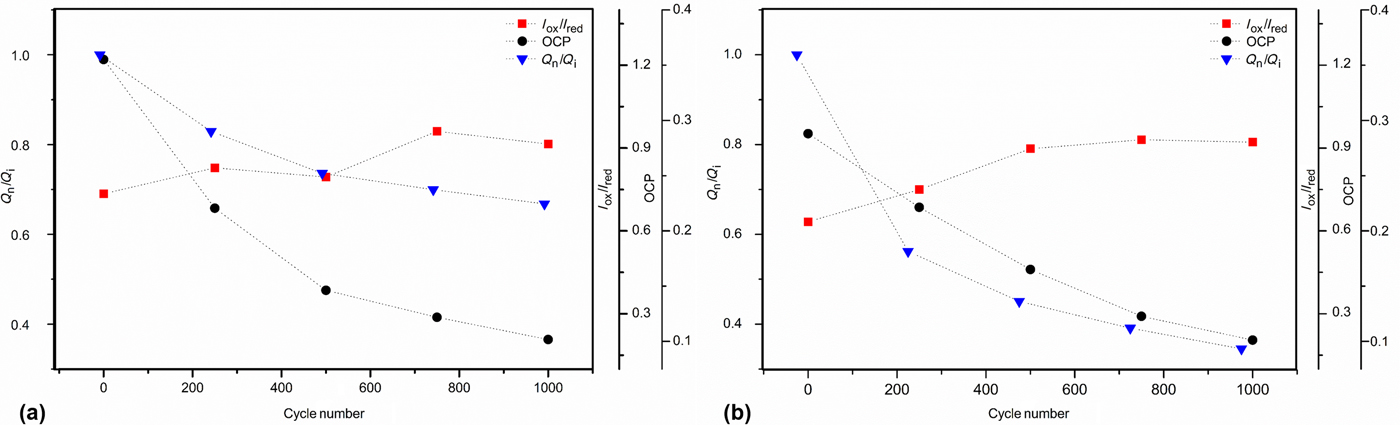
Charge injection capabilities (Q n/Q i), oxidation ratio (I ox/I red), and open circuit potential (OCP) of the polymer layer showed a similar response for both films (Fig. 4). The charge injection capability decreases equally due to the reduction of charge carrier concentration upon cycling.[Reference Gribkova, Iakobson, Nekrasov, Cabanova, Tverskoy, Tameev and Vannikov27] However, the ratio calculated (Q n/Q i) for PEDOT:κC is higher (0.7) [Fig. 4(a)] than PEDOT:SDS (0.4) [Fig. 4(b)], showing an improvement in the electrochemical performance. The oxidation rate increases slightly for both materials when cycled, indicating that stabilization is similar for the two systems, confirmed by a similar trend of the OCP upon cycling and the small change of the Raman band in the vicinity of 1520 cm−1.
Effect of the cycling in the charge injection capability ( ), oxidation ratio (
 ), and OCP (●) for (a) PEDOT:κC and (b) PEDOT:SDS.

The Raman spectrum (online Supplementary Fig. S1) showed different baselines and intensities due to its absorbance,[Reference Tran-Van, Garreau, Louarn, Froyer and Chevrot29] thickness, and refractive index;[Reference Correia and Abrantes30] therefore, in order to compare the samples the spectra were normalized using a band in the range of 990–1000 cm−1 attributed to the oxyethylene ring deformation.[Reference Gribkova, Iakobson, Nekrasov, Cabanova, Tverskoy, Tameev and Vannikov27] Vibrational bands in the region of 1420–1430 cm−1 are associated with the neutral form of PEDOT (benzenoid structure). Meanwhile, the relative portion of Raman vibrations in the area around 1490–1500 cm−1 increased indicating the appearance of the quinoid form of the polymer, along with the characteristic area of 1529–1536 cm−1 related to the PEDOT bipolaron.[Reference Gribkova, Iakobson, Nekrasov, Cabanova, Tverskoy, Tameev and Vannikov27]
Although both materials showed similar conductive properties, the capacitance and diffusive behavior vary, as shown by the impedance spectroscopy data (see online Supplementary Fig. S2). The PEDOT:κC, after one cycle [Fig. S2(a)], presents a diffusive behavior, showing a slope near 30° and as the cycling increases [Fig. S2(b)], a capacitive pattern develops at lower frequencies. The PEDOT:SDS shows a predominant diffusive tendency for the first cycle [Fig. S2(c)].[Reference Asplund, von Holst and Inganäs3] However, after cycling [Fig. S2(d)], the capacitive behavior becomes more significant in a similar trend to the PEDOT:κC system.
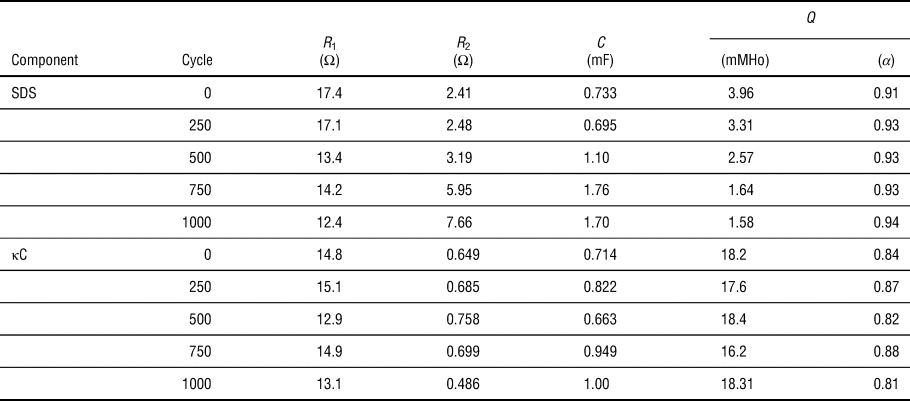
The conductive PEDOT:κC layer showed an improvement in performance when compared with the PEDOT:SDS layer. The impedance model fitting (R 1R 2CQ) (see Table I) shows that the transfer charge resistance (R 2) is higher in the PEDOT:SDS (2.41 Ω at 0 cycles to 7.66 Ω at 1000 cycles) than in the PEDOT:κC layer (0.649 Ω at 0 cycles to 0.486 Ω at 1000 cycles). The κC doping agent keeps the PEDOT stable upon cycling since there is a decrease in the transfer charge resistance.
Fitting parameters obtained from the modeling of the Nyquist plots for the SDS and κC doping agents in a PEDOT layer at 25 mV, following the equivalent circuit model R 1R 2C-CPE.

The microscope images (see online Supplementary Fig. S2, inset) confirmed a heterogeneous coating for PEDOT:κC. However, the PEDOT:κC system has better adhesion and a more stable structure upon cycling conditions, at difference of the PEDOT:SDS that delaminates upon cycling.
Conclusions
The PEDOT:κC system successfully immobilized active biomolecules and it can be synthesized from a stable biopolymer dispersion. The resulting conductive material was more stable and a better conductor than the PEDOT:SDS. From the electrochemical characterization, the PEDOT:κC system shows better charge injection capabilities indicating higher system stability upon cycling. Additionally, the oxidation rate and OCP trend show a similar behavior of the two samples studied, results confirmed by μRaman spectroscopy. The PEDOT:κC exhibited a larger roughness and a better adhesion compared with the standard SDS coat, which is useful in the biologic applications. Overall, the unique combination of properties obtained for this biocompatible material is of high significance for the immobilization of biostructures in advanced applications, such as biosensors and biomedical devices.
Supplementary material
The supplementary material for this article can be found at https://doi.org/10.1557/mrc.2018.189.
Acknowledgments
This work was supported by the Consejo Nacional de Rectores (CONARE), Tecnológico de Costa Rica (TEC), and Vicerrectoría de Vida Estudiantil y Servicios Académicos (VIESA). The authors would like to thank Centro de Investigación y Extensión en Materiales (CIEMTEC).