1 Introduction
It is an empirically robust finding that semantic change in grammaticalizing forms, across different languages and across different historical periods, typically proceeds in one direction only, namely from relatively more concrete and specific meanings to relatively more abstract and schematic meanings (Heine & Kuteva Reference Heine and Kuteva2002; Hopper & Traugott Reference Hopper and Traugott2003). Examples of semantic unidirectionality include pathways such as the development of future markers out of motion verbs (e.g. English be going to), or the emergence of causal connectors out of temporal connectors (e.g. English since). Meaning changes of this kind have been studied in great detail, and the principal processes that drive them, notably metaphor (Lakoff & Johnson Reference Lakoff and Johnson1980), metonymy (Benczes et al. Reference Benczes, Barcelona and de Mendoza Ibáñez2011) and invited inferencing (Traugott & Dasher Reference Traugott and Dasher2002), are reasonably well understood. What is at present not understood very precisely is why meaning change in grammatical forms is highly asymmetrical, so that the development of future markers out of motion verbs (as in be going to) is cross-linguistically very common, while the inverse process, i.e. the development of a motion verb out of a grammatical marker of future time, is virtually non-existent. The idea of unidirectionality in grammatical change, which has a broader scope than just semantic unidirectionality, has been severely criticized (Campbell Reference Campbell2001; Janda Reference Janda2001). The source of the criticism is, however, not the question whether unidirectionality exists, but rather the question whether or not there are exceptions. Regardless of this issue, unidirectionality is generally accepted as a strong statistical tendency that is in need of an explanation. The leading question for this article is therefore the following: why is there a strong tendency of unidirectionality in grammatical semantic change?
In a programmatic paper, Jäger & Rosenbach (Reference Jäger and Rosenbach2008) suggest an answer to this question. They appeal to the psychological phenomenon of asymmetric priming in order to explain why semantic change in grammaticalization typically evolves from more concrete meanings towards more schematic meanings. In this article, we aim to evaluate their proposal on the basis of experimental evidence. We present experimental evidence from a maze task (Forster et al. Reference Forster, Guerrera and Elliot2009), in which we test whether asymmetric priming obtains between lexical forms (such as go) and their grammaticalized counterparts (be going to). On the asymmetric priming hypothesis, lexical go should prime grammatical be going to, but not vice versa. Using a set of twenty different pairs of lexical forms and grammaticalized counterparts, we do in fact observe an asymmetric priming effect, which, however, deviates from our expectations. Our results hint at a negative priming effect: speakers who have recently been exposed to a given lexical element are significantly slower to process a grammaticalized variant of that lexical element. We interpret this observation as a horror aequi phenomenon (Rohdenburg & Mondorf Reference Rohdenburg and Mondorf2003), so that processing the same form twice within a short time span is difficult for language users, especially if the form is used with different meanings or functions. The horror aequi effect does, however, have a twist: processing a grammaticalized element does not slow down the subsequent processing of its lexical counterpart. As we will explain in more detail below, we hold that differences in the semantic specificity of lexical elements and their grammaticalized counterparts can explain this observation.
The remainder of this article is organized in the following way. Section 2 offers a discussion of the asymmetric priming hypothesis and positions it in the context of grammaticalization (Hopper & Traugott Reference Hopper and Traugott2003) on the one hand and semantic priming (McNamara Reference McNamara2005) on the other. Section 3 presents our methodology, which draws on the experimental paradigm of the maze task (Forster et al. Reference Forster, Guerrera and Elliot2009). We explain how this technique works and how we operationalize the predictions of the asymmetric priming hypothesis. Section 4 discusses the results. We analyse reaction time measurements from the maze task through mixed-effects regression modeling (Baayen Reference Baayen2008), which yields evidence for an asymmetric priming effect in which lexical primes slow down the processing of grammatical forms but not vice versa. Section 5 takes a step back and discusses whether and how the empirical observations can be reconciled with Jäger & Rosenbach's version of the asymmetric priming hypothesis. Section 6 concludes the article.
2 The asymmetric priming hypothesis
How is it that semantic change in grammaticalizing forms is overwhelmingly unidirectional? Jäger & Rosenbach (Reference Jäger and Rosenbach2008) suggest that semantic unidirectionality can be explained with reference to a concept from cognitive psychology, namely asymmetric priming. Asymmetric priming describes a pattern of cognitive association in which one idea strongly evokes another, while that second idea does not evoke the first one with the same force. For instance, given the word paddle, an immediate association for many speakers is the word water. The reverse is not true: given the word water, many speakers offer the immediate associations sea, ship, or drink, rather than paddle. Asymmetric priming would elegantly explain the observation that many types of meaning change in grammar proceed in one direction only: from more specific and concrete towards more abstract and schematic, but not the other way around. The suggestion by Jäger & Rosenbach has spawned a lively discussion. Chang (Reference Chang2008) acknowledges the potential of their hypothesis, but also points out that most documented semantic priming effects have very short durations of one second or less. Primed with a word such as nurse in a lexical decision task, responses for doctor show shorter latencies, but not if several words intervene between prime and target. Chang does, however, point out that research into syntactic priming has yielded long-term effects, which motivate a view of priming as implicit learning. On such a view, priming effects would not be completely transient, but rather, they would be able to modify cognitive representations of language over the long term. Further evidence of long-term priming effects supports this idea. For example, Kaschak (Reference Kaschak2007) demonstrates that structural priming can have effects that go beyond the immediate influence that is reported in classic studies on syntactic priming (e.g. Bock Reference Bock1986). To make this point, Kaschak used a sentence completion task in which participants could complete a sentence fragment in different ways. Given a fragment such as The mailman gave. . ., the participants could either produce a ditransitive, direct object construction (DO – The mailman gave the woman the letter) or the dative construction with a prepositional object (PO – The mailman gave the parcel to the child). The participants’ behaviour was influenced through a prior phase in the experiment, during which they were exposed to sentence fragments that could only be completed in one way, either as a DO construction (The car salesman sold the couple . . .) or as a PO construction (The car salesman sold the minivan . . .). During this priming phase, Kaschak varied the ratio with which the participants were exposed to the two fragment types. For one group of participants, all fragments required a DO completion. For another group, 75 per cent of the fragments required the DO construction, while the remaining 25 per cent required the PO construction. Three other groups with ratios of 50/50, 25/75 and 0/100 completed the set-up. Kaschak demonstrates that the ratio of the priming phase significantly predicts the participants’ behaviour in the sentence completion task. Speakers who were exposed to a ratio of 100/0 between DO and PO subsequently show the highest ratio of DO production. The lower the DO ratio in the priming phase, the lower the DO ratio in the sentence completion task (Kaschak Reference Kaschak2007: 929). A view of syntactic priming as a short-lived phenomenon would predict that speakers’ behaviour reflects only the most recent event of relevant exposure and that speakers after that exposure quickly regress to their normal baseline production ratio of DO and PO constructions. Contrary to this view, Kaschak's experiment reveals an altered ratio that is measured over several tokens of production. Investigating the longevity of this effect, Kaschak et al. (Reference Kaschak, Kutta and Schatschneider2011: 385) further provide evidence that speakers’ altered production ratios are still measurable with a seven-day delay between the priming phase and the testing phase of the experiment. We acknowledge of course that Kaschak and colleagues investigated syntactic priming, while the asymmetric priming hypothesis addresses a semantic phenomenon, but we agree with Kaschak et al. (Reference Kaschak, Kutta and Schatschneider2011: 386) that it would be ‘important to know whether the cumulative priming effects observed using different paradigms persist as strongly as they did in our current paradigm’.
Coming back to the issue of potential problems of the asymmetric priming hypothesis, Eckardt (Reference Eckardt2008) shares Jäger & Rosenbach's point that the causes of language change must lie in ordinary language use. Yet, Eckardt is sceptical whether priming effects are the crucial variable to look out for. Moreover, Eckardt doubts that the asymmetric priming hypothesis would generate testable predictions. She argues that the source domain of a metaphor (e.g. the domain of space) will not usually prime the target domain (time). Hence, priming would not have any substantial role to play in the development of the lexical verb to go into a future marker such as be going to. Empirical counterevidence to Eckardt's argument is offered by Williams & Bargh (Reference Williams and Bargh2008), who demonstrate that experiencing physical warmth does in fact prime experimental subjects for feelings of interpersonal warmth, such as kindness and generosity. Subjects who were given a warm cup of coffee to hold prior to evaluating the CV of a job candidate gave more positive evaluations than subjects who held a chilled soft drink. While these results are intriguing, Traugott (Reference Traugott2008) raises the question whether the semantic priming effects that are observed under controlled laboratory conditions are also at work in ordinary conversation. All of these concerns are valid and point to the fact that the asymmetric priming hypothesis needs further substantiation. At the same time, it has to be pointed out that these criticisms are mostly based on theoretical arguments only. What is needed in order to assess the asymmetric priming hypothesis more thoroughly is an empirical engagement with the predictions that this hypothesis generates. Unlike Eckardt (Reference Eckardt2008), we believe that such predictions are indeed feasible. The aim of this article is therefore to re-approach the issue and investigate empirically whether the cognitive phenomenon of asymmetric priming can in a satisfactory way explain why there is unidirectionality in the semantic change of grammatical forms. Importantly, we do not want to advance the hypothesis that asymmetric priming would be the only driving factor. What we aim to determine is whether it is plausible to assume that it has a role to play at all.
The lack of empirical research on the putative connection between semantic unidirectionality and asymmetric priming is regrettable for three reasons. First, attractive though the idea might look initially, psychological investigations of asymmetric priming (Koriat Reference Koriat1981; Thompson-Schill et al. Reference Thompson-Schill, Kurtz and Gabrieli1998; Neely et al. Reference Neely, Verwys and Kahan1998; Kahan et al. Reference Kahan, Neely and Forsythe1999; Hutchison Reference Hutchison2002, amongst others) have yielded mixed results that have not been fully acknowledged in the linguistic literature. For instance, Thompson-Schill et al. (Reference Thompson-Schill, Kurtz and Gabrieli1998) fail to find differences in priming strength in pairs such as lamp–light or termite–wood, which could be thought to yield highly asymmetric results, with for instance termite strongly evoking wood but wood only weakly evoking termite. Experimental participants do show asymmetries in free association tasks (Given lamp, which five words come to mind?), but in lexical decision tasks (Is the following a word of English: light, frim, lamp, dunt, etc.?), reaction times are actually indistinguishable: primed with lamp, speakers are fast to recognize light as a word, but they are just as fast when the words are presented in the inverse order. Hence, despite the initial appearance, it is far from clear whether asymmetric priming is robust enough as a cognitive force to explain the substantial regularity that is observed in historical meaning change. Second, recent psycholinguistic research on metaphorical reasoning has yielded evidence for a phenomenon that is called source-domain activation. Whereas Jäger & Rosenbach (Reference Jäger and Rosenbach2008) cite evidence that metaphorical reasoning is a one-way street, e.g. from space to time but not vice versa (Boroditsky Reference Boroditsky2001), this has been falsified for other metaphors. For instance, Zhong & Leonardelli (Reference Zhong and Leonardelli2008) show that metaphorical reasoning from temperature to social relations (as in She gave me an icy look) also works the other way around. Zhong & Leonardelli prompted one group of experimental participants to imagine a scenario in which they were socially excluded, and another group to imagine a scenario of interaction with friends. When subsequently asked to give an estimate of the ambient room temperature, the first group gave lower estimates, which suggests that the idea of exclusion literally made them feel cold. Similarly, Tseng et al. (Reference Tseng, Hu, Han and Bergen2007) showed participants a picture of a smiling person, asking them to indicate whether that person was experiencing happiness or joy. While these two concepts are roughly synonymous, they differ in terms of their metaphorical underpinnings. Joy is metaphorically understood as a fluid (She was overflowing with joy), happiness is metaphorically understood as something that is searched for (She finally found happiness). Tseng et al. report that participants who were drinking a liquid at the time of the survey were more likely to respond with joy, whereas participants searching for a book in the library were relatively more likely to respond with happiness. The task of deciding on a word for an abstract concept thus takes recourse to the more concrete source domains of drinking liquids or searching for something. In other words, abstract reasoning involves activation of simple, embodied concepts. These findings cast doubt on an explanation of grammatical meaning change that downplays or completely denies bi-directional associations in metaphorical reasoning. A third problem is that most research on asymmetric priming has investigated linguistic forms that are lexical, rather than grammatical. With the exception of Boroditsky (Reference Boroditsky2001), who used experimental prompts with temporal prepositions (before, after), which are grammatical closed-class elements, the literature on semantic priming primarily focuses on lexical open-class elements such as lamp–light, baby–stork, eagle–bird or joy–happiness. This is a problem because the meanings of grammatical items are much more general and schematic than those of lexical items, which has repercussions for the cognitive associations that these elements will form with other elements. To illustrate, a lexical item such as toast evokes a set of words that will be highly similar across experimental participants: butter, breakfast, tea and so on. By contrast, a grammatical item such as because will not elicit a similarly focused set of associated words. To make matters worse, there is another difference between lexical and grammatical elements that pertains to meaning change. Semantic unidirectionality is only a characteristic of grammaticalization, but not of semantic changes that are observed with lexical elements. In the domain of lexis, there are semantic developments that are decidedly unsystematic. To take a well-known example, the English adjective silly used to mean ‘blessed’, and the word manager used to refer to ‘a servant who looked after horses in the manège’ (see the etymology sections in the Oxford English Dictionary entries for silly and manager). If most results about asymmetric priming concern lexical elements, and lexical elements do not even show unidirectional semantic change, that poses a severe problem for the asymmetric priming hypothesis.
The findings reviewed above make clear that unidirectionality in the meaning change of grammaticalizing forms is a robust empirical result that is in need of an explanation. Asymmetric priming is a possible explanation, but there are two problems. First, there are several theoretical arguments that cast doubt on a possible connection between the two phenomena (Chang Reference Chang2008; Eckardt Reference Eckardt2008; Traugott Reference Traugott2008). Second, the empirical research on asymmetric priming has yielded mixed results (Thompson-Schill et al. Reference Thompson-Schill, Kurtz and Gabrieli1998) and has furthermore focused on lexical forms, rather than grammatical forms, which are subject to semantic unidirectionality. This means that there is a gap between the status quo in the field and a satisfying answer to the question whether asymmetric priming explains unidirectionality. The present article aims to gather empirical evidence that may shed light on this issue.
3 Methodology
3.1 The maze task
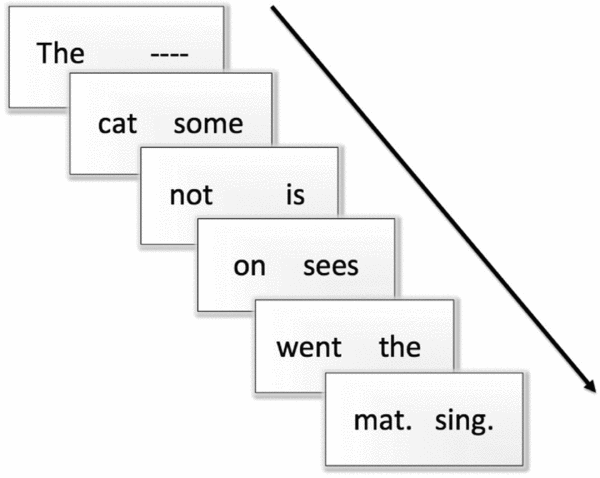
Our study relies on reaction time measurements from a maze task (Forster et al. Reference Forster, Guerrera and Elliot2009; Forster Reference Forster2010), which is a task that combines self-paced reading with a forced choice between two competitor words. In a maze task, subjects sit at a computer and are presented with screens that show two words in a large font, one on the left side of the screen, another one on the right. The subjects need to select one of the words as quickly as possible by clicking on a key that is situated on the left or on the right of the computer keyboard. The words have to be chosen in such a way that the words that are selected successively combine into a well-formed sentence of English. Figure 1 illustrates the general structure of a trial in a maze task. There are six successive screens, each with a pair of words to choose from. On the first screen, the initial word The does not have a proper competitor, but only a dummy dashed line (----), so that here, subjects will choose the left option. The following screen gives subjects the choice between the words cat and some. Since the cat is a legal phrasal sequence in English but the some is highly dubious, subjects are likely to choose the left option once more. On the third screen, subjects have the choice between not and is, which boils down to the competition between the cat not, which is rather unlikely, and the cat is, which is a highly canonical beginning of a sentence. Eventually, subjects arrive at the full sentence, in this case, The cat is on the mat.
Trial structure in a maze task

As subjects make their way through an on-going sentence, they have to entertain different possible syntactic parses and produce regular updates of their interpretation of the sentence. This requires them to engage thoroughly with sentence meaning, which is a substantial advantage of the maze task over other self-paced reading designs, where thorough sentence comprehension has to be checked with regular verification questions. In the words of Forster et al. (Reference Forster, Guerrera and Elliot2009: 163), the maze task ‘forces the reader into an incremental mode of processing in which each word must be fully integrated with the preceding context before the next word can be considered’, which is exactly what we want them to do. With each pair of words, the subjects’ choice is recorded and reaction times are measured. Whereas some variants of the maze task abort a running sentence in the case of a wrong choice, the subjects in our experiment were allowed to finish sentences even when wrong words were selected at some point during a trial.
3.2 Materials
As was discussed in earlier sections, our study tests whether asymmetric priming obtains between lexical forms and their grammaticalized counterparts, i.e. pairs such as go to California (lexical go) and going to think about it (grammatical be going to), or keep the light on (lexical keep) and keep reading (grammatical keep V-ing). On the asymmetric priming hypothesis, the former, lexical forms should prime the latter, grammatical forms, but not vice versa. The stimuli that we presented to our subjects are sentences such as the following, which include sequences of related lexical and grammatical elements:
(1) The student keptlexical the light on to keepgrammatical reading.
(2) The student turnedunrelated the light on to keepgrammatical reading.
(3) The student keptgrammatical checking facebook to keeplexical up to date.
(4) The student wasunrelated checking facebook to keeplexical up to date.
The asymmetric priming hypothesis predicts that grammatical keep should be processed faster in (1) than in (2), because in (1), the preceding instance of lexical keep should yield a priming effect and hence a shorter response time for grammatical keep. In (2), the first verbal element turned is unrelated to grammatical keep, and hence there is no priming involved in the processing of the latter. While we thus expect a difference between (1) and (2), no such difference is expected between (3) and (4). In (3), grammatical keep precedes lexical keep, but since the grammatical element should not facilitate the subsequent processing of lexical keep, reaction times should not differ from a stimulus such as (4), in which the first verbal element was is unrelated to the subsequent instance of lexical keep. The sentences above thus represent four different conditions that we analysed in our experiment. The conditions reflect the lexical or grammatical nature of the second verbal element and the question whether or not this element has been primed. Example (1) illustrates the ‘primed grammatical’ condition, example (2) the ‘unprimed grammatical’ condition. Example (3) shows the ‘primed lexical’ condition, and finally example (4) shows the ‘unprimed lexical’ condition.
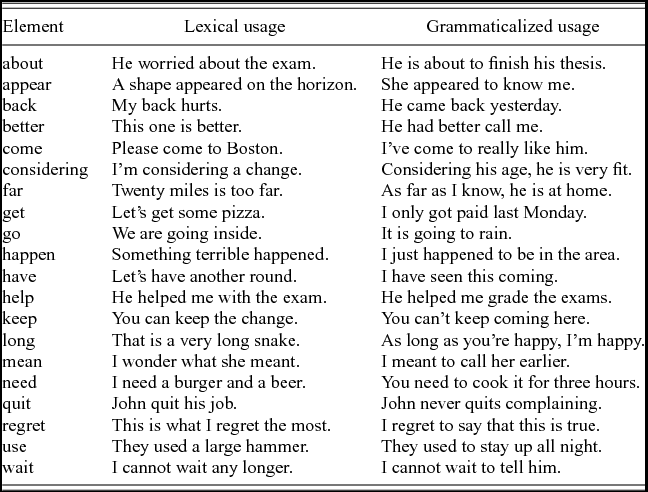
We constructed stimuli sentences on the basis of twenty different pairs of lexical and grammatical elements, that is, pairs such as go somewhere vs be going to, keep something vs keep V-ing, about something vs be about to, etc. Our choice of these elements was motivated by the following considerations. First, we aimed at a diversified portfolio of verbal, nominal, adjectival and prepositional forms, so that different grammatical domains, such as tense, aspect, voice, modality and spatial language, would be represented. Second, we aimed at a range of forms that would represent a wide frequency spectrum, including both highly frequent constructions such as the English present perfect with have and rather infrequent constructions such as the English past habitual used to. Table 1 lists the pairs of constructions that were included in our study; a full list of our stimuli sentences can be found in the Appendix.
Pairs of lexical and grammaticalized elements

A brief discussion of some of the elements in table 1 is in order. First, we acknowledge that verbal elements are overrepresented in our sample, which has to do with the fact that verbal categories are a particularly frequent target of grammaticalization, specifically in the domains of tense, aspect and modality. We do not believe that the overrepresentation of verbs as such poses a general problem for our investigation. Second, table 1 presents a categorical distinction between lexical usage and grammaticalized usage, which does not adequately reflect our understanding of grammaticalization as a continuous, gradient process (see Traugott & Trousdale Reference Traugott and Trousdale2010). It is clear that some of the constructions in the right-hand column of table 1 are very strongly grammaticalized (e.g. the perfect with have, the get-passive, be going to), whereas other constructions are only weakly grammaticalized (happen to V, wait to V, etc.). Our classification of these constructions as grammaticalized elements is based on criteria that pertain to both form and meaning. To illustrate, a lexical verb such as happen has very tight selectional restrictions with regard to possible subjects and syntactic subcategorization frames. Things that happen are events such as meetings, concerts, accidents, etc., but typically not objects or persons. Syntactically, lexical happen is restricted to intransitive argument structure, which is sometimes augmented with a prepositional phrase that expresses a patient (as in Something terrible happened to me). By contrast, the construction happen to V, which we view as a weakly grammaticalized marker of non-agentivity, takes a broader semantic range of subjects, including objects and persons, and has a more complex argument structure that includes a to-infinitive complement. In Heine's (Reference Heine1993) cline of auxiliation, happen to V would be a stage B auxiliary, which still retains much of its erstwhile lexical meaning, but which has already changed its syntactic behavior. Similar arguments can be made for constructions such as help V (Lohmann Reference Lohmann2011) or considering NP (Hopper Reference Hopper, Traugott and Heine1991: 31).
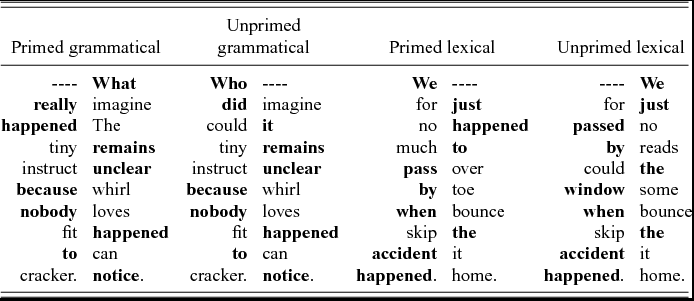
The example sentences in table 1 are meant to be a first illustration of the constructions we used for our study. Importantly, they are not the stimuli sentences that our subjects saw in the experiment. The actual stimuli were constructed in such a way that we prepared four sentences, one for each of the four conditions that we described above, for each of the twenty elements in table 1. Each of these sentences contains exactly ten words, and each of the ten words is matched with a competitor word for the maze task. Table 2 presents the four sentences that we constructed for the element happen. The sentences should be read column-by-column from top to bottom. Words that our subjects were meant to select are printed in boldface; competitor words are printed in normal roman font. The side of the screen on which the correct word appeared was determined randomly. Looking at table 2, it can easily be verified that in each case, the words in boldface build up to a meaningful sentence of English, whereas the words in roman font either lead to downright ungrammatical structures or highly unlikely continuations.
Maze task sentences involving the database element happen

The sentences in table 2 illustrate that in the priming conditions, subjects saw two instances of the verb form happened. In the unprimed condition on the other hand, there was only one form. Crucially, the sentences in the two grammatical conditions and the two lexical conditions differ only in the first half. In the second half, where the critical instance of happened occurs, the respective words are fully identical, so that any differences in response times must be a result of how the first half of the sentence was processed. In order to avoid exposing our subjects to highly similar sentences twice, we distributed the stimuli across two lists of the experiment, so that for instance list A contained the ‘primed grammatical’ and the ‘unprimed lexical’ sentences from table 2, whereas list B contained the ‘unprimed grammatical’ and the ‘primed lexical’ sentence. By constructing four sentences for each of our twenty elements, we ended up with 80 stimuli sentences so that list A and list B of our experiment presented our subjects with 40 trials each.
3.3 Procedure
To implement the maze task in such a way that it could be administered to participants on the World Wide Web, we used the QualityCrowd2 software (Keimel et al. Reference Keimel, Habigt, Horch, Diepold, Domański, Grajek, Karwowski and Stasiński2012).
We used Amazon's Mechanical Turk platform to recruit 200 native speakers of American English for the experiment, which means that all participants completed the experiment on their own computers in an environment of their choice. The participants signed up voluntarily and were compensated with a fee. They were told that there was no risk, they could withdraw their participation at any time, and that personal data would be handled confidentially. Participants who had signed up for list A could not re-do the experiment and sign up for list B, and vice versa. We asked participants to indicate their native variety of English, the gender with which they identified, their age and their handedness. Before the actual experiment, the participants saw a visual representation of the maze task and completed a training sentence. After the training, all participants were exposed to a randomized sequence of 40 sentences with different pairs of lexical and grammatical forms. During the experiment, accuracy and reaction times were recorded for each response. The suitability of the Mechanical Turk platform for reaction time experiments has been systematically investigated by Enochson & Culbertson (Reference Enochson and Culbertson2015), who replicated a number of classic laboratory-based findings in a series of on-line experiments. We can also report that our on-line results are fully in line with results that we obtained in a laboratory-based pilot study.
3.4 Analysis
As we will explain in more detail below, we conducted a mixed-effects regression analysis (Baayen Reference Baayen2008) in which we tried to model participants’ reaction times in terms of a series of explanatory variables. Each of the 200 participants completed 40 sentence trials, so that we were able to collect 8,000 reaction time measurements for the critical primed or unprimed element in each sentence. In a first analytical step, we determined for each trial whether there had been any errors. A total of 6,782 trials (84.8 per cent) were error-free, so that we decided to discard all trials that had one or more errors at some point in the sentence. We determined the mean and standard deviation of the reaction time measurements and removed outliers in such a way that all observations that differed from the mean with more than three standard deviations were discarded. This led to the exclusion of 55 measurements, leaving us with a dataset of 6,727 observations (84.1 per cent). The dataset and the R code that we used for the analysis are available upon request. The following paragraphs describe the variables that inform our analysis and our predictions concerning the different levels of those variables.
3.4.1 Dependent variable
Response times: the time it took our participants to respond to the critical items in the stimuli sentences constitutes our dependent variable. The asymmetric priming hypothesis predicts that reaction times will differ according to the preceding context of the critical elements. After outlier removal, the mean reaction time was 1,073 ms (sd = 545 ms). For the subsequent analysis, we used logged values of the response times.
3.4.2 Fixed factors: predictor variables
The following paragraphs describe the variables that we included in our regression analysis.
Priming: a first explanatory variable is the question whether or not the critical element has been primed. We operationalized this as a binary categorical variable with a positive value for both primed grammatical trials and primed lexical trials. The dataset contains 3,327 observations from trials with priming and 3,400 observations from trials without priming. Since we predict an asymmetrical priming effect, we not only expect a facilitatory main effect of priming, but rather an interaction effect between priming and the following variable, the distinction between lexical and grammatical forms.
Lexical vs grammatical: this binary categorical variable captures the distinction between the different constructions that were presented in table 1, that is, the distinction between lexical forms and their grammaticalized counterparts, such as lexical happen vs grammaticalized happen to V. With regard to this variable, we do not predict any main effect, but only an interaction with priming, so that grammatical forms that are primed by their lexical counterparts should yield short latencies, whereas lexical forms that are primed by their grammatical counterparts should show longer latencies.
Frequency: it is a well-established finding that highly frequent elements in language are processed more quickly and efficiently than low-frequency elements (Bybee Reference Bybee2006; Diessel & Hilpert to appear). It is therefore important to control for the fact that the critical elements in our stimuli come from quite different frequency ranges. We decided to operationalize frequency in terms of lemma frequency, so that the frequency value for a form such as keep is determined on the basis of all verb forms that this verb can produce. We determined the lemma frequencies of the elements in the first column of table 1 in such a way that we performed exhaustive lemma searches in the British National Corpus (Davies Reference Davies2004) and recorded the frequencies. To illustrate, the different forms of the lemma keep (keep, keeps, keeping, kept) add up to 48,194 occurrences in the BNC (482 instances per million words). We used logged frequency values for the analysis. For our frequency variable, we predict a facilitatory main effect, so that elements with more frequent lemmata are processed more quickly. We furthermore hypothesized that the variable of frequency might interact with the variable of priming, such that highly frequent forms would not benefit as much from priming as low-frequency forms would. Since high-frequency forms have a high resting potential and are thus easily activated, priming might not yield a substantial advantage here.
3.4.3 Fixed factors: control variables
The following is a list of factors that we do not predict to have any effect within the scope of the asymmetric priming hypothesis, but that we wanted to control for.
Age: We asked our subjects to indicate their age (mean = 35.6, sd = 10.3).
Gender: All of our participants self-identified as either female (n = 112) or male (n = 88).
Handedness: Most of our participants are right-handed (n = 174), but more than 10 per cent are left-handed (n = 26).
Language variety: because the Mechanical Turk platform is accessible via the World Wide Web, anyone with an internet connection could have signed up for our experiment, which is why we asked participants to name the language variety that they identified with. Since, however, all of our participants answered ‘American English’ or ‘English’, this variable does not enter our analysis.
3.4.4 Random effects: participants and items
Mixed-effects modelling allows for the inclusion of random effects that reflect non-systematic variation in the data. In our case, this kind of variation relates to unsystematic differences between our participants and potential idiosyncrasies of our linguistic stimuli. We therefore included the following variables as random intercepts (Baayen Reference Baayen2008: 85–91):
Worker ID: this variable assigns an unambiguous identifier to each of our participants.
Stimulus: this variable identifies each of our 80 sentences that were presented as stimuli.
4 Results
We fitted a linear mixed-effects regression with reaction times as the dependent variable, six fixed factors (Priming, Lexical vs Grammatical, Frequency, Age, Gender, Handedness), an interaction term between Priming and Lexical vs Grammatical and another interaction term between Priming and Frequency, and two random factors (Worker ID, Stimulus) that we modelled as random intercepts. We used the packages lme4 (Bates et al. Reference Bates, Maechler, Bolker and Walker2014) and lmerTest (Kusnetsova et al. Reference Kuznetsova, Brockhoff and Christensen2015) for the statistical software R (R Core Team 2015). The formula for the regression model is shown in (5).
(5)


In this first model, the control variables of Age, Gender, and Handedness did not reach significance, so that they could be discarded. Furthermore, there was no significant interaction effect between Priming and Frequency, so that this interaction term could be taken out of the model. Tests for multicollinearity between the remaining predictors did not indicate any problems. We thus constructed a minimal adequate model that is based on the formula shown in (6).
(6)

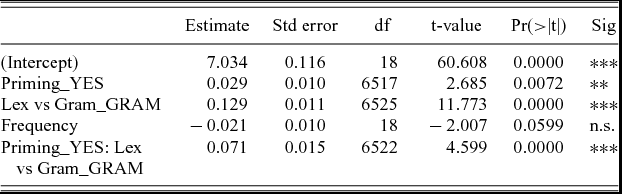
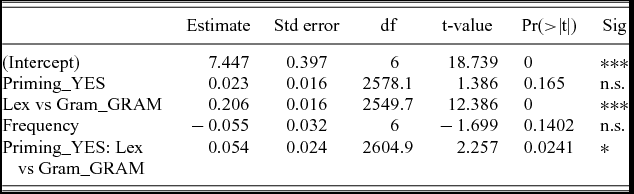
The regression analysis finds significant effects for Priming and Lexical vs Grammatical, including a significant interaction between the two. The variable of Frequency approaches significance. Both random effects are found to be significant. A comparison based on the AIC and BIC information criteria shows no difference between the minimal model and the earlier, more comprehensive one. The effect structure in the minimal model is identical to the one we observed in the first, full model. Table 3 summarizes the significant fixed effects of the minimal model.
Fixed effects in the minimal model

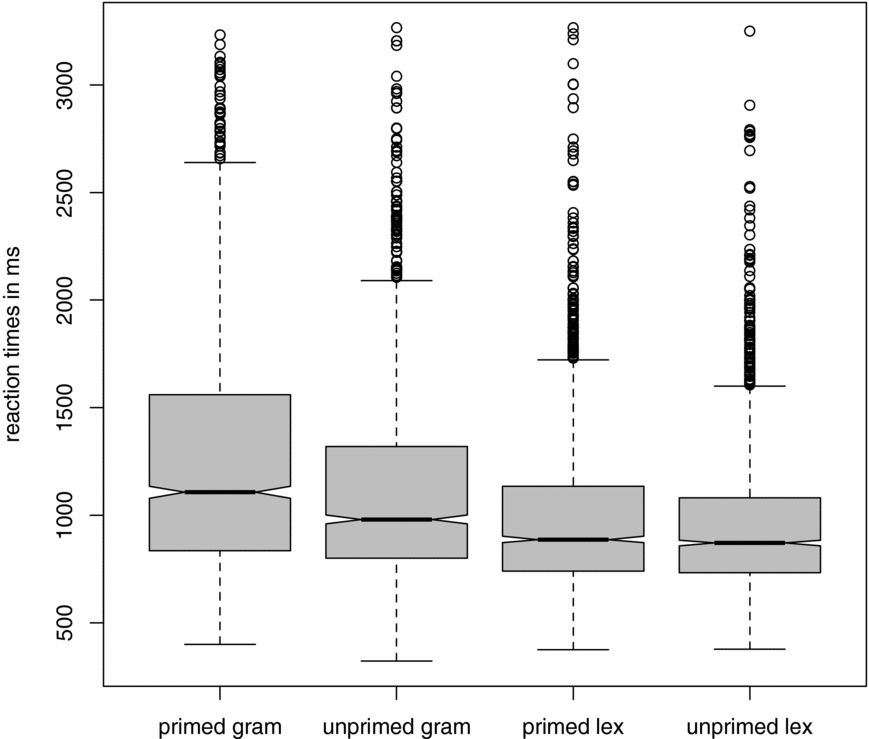
As the second line of table 3 shows, we observe an inhibitory main effect of priming, which goes against our predictions. In general, forms that have been encountered before yield longer latencies than unprimed forms. The third line of table 3 shows another unexpected result, namely a main effect of the Lexical vs Grammatical variable that results in longer reaction times for grammatical elements. The fourth line shows that more frequent forms are processed more quickly, which is in line with our expectations. However, it needs to be pointed out that the effect only approaches significance. The final line of table 3 yields the result that the negative priming effect we observed in line 2 is indeed asymmetric: grammatical elements that have been primed with their lexical counterparts are processed relatively more slowly. Figure 2 visualizes this observation and shows average reaction times across the four conditions of our experiment.
Reaction times in milliseconds across the four conditions of the experiment

Figure 2 shows that on the whole, grammatical forms are processed more slowly than lexical forms. It can also be seen that grammatical forms show a difference with regard to priming, whereas no such difference is apparent for lexical forms. In the two lexical conditions, on the right side of the graph, reaction times are statistically indistinguishable – priming does not seem to make a difference. In the two grammatical conditions, on the left side of the graph, there is a clear disadvantage for primed forms. We thus observe an asymmetric priming effect, but contrary to our expectations, it is a negative, inhibitory asymmetric priming effect. The question whether lexical forms prime their grammaticalized counterparts but not vice versa hence receives a positive answer with a twist: go actually slows down be going to, but apparently not vice versa. The following section discusses the implications of this result.
5 Discussion
Our empirical results allow us to reflect on the proposal of the asymmetric priming hypothesis in a new light. To clarify what exactly is at stake, it is worth considering the following quotation from Jäger & Rosenbach (Reference Jäger and Rosenbach2008: 105):
[T]he idea we are advocating in this paper is the following: Unidirectional change ultimately goes back to the fact that a form or a concept/meaning A primes the use of a form or concept/meaning B if it is sufficiently similar to it, but that B doesn't prime A. Via repeated usage and implicit learning B will become entrenched over time. That is, what appears as diachronic trajectories of unidirectional change is ultimately decomposable into atomic steps of asymmetric priming in language use. It is in this way that the actions of individual speakers may come to have a long-term impact on the shape of a grammar, without speakers consciously conspiring to change language in a certain direction.
On the basis of this proposal, we have reasoned that an expression such as keep the change (concept/meaning A) should facilitate the subsequent processing of keep checking the temperature (concept/meaning B), which is in accordance with how Jäger & Rosenbach (Reference Jäger and Rosenbach2008: 109) envision an empirical test of the asymmetric priming hypothesis:
Under this view it is then possible to test any unidirectional changes that have been put forward in the literature (see most prominently the list given in Heine & Kuteva Reference Heine and Kuteva2002) with respect to asymmetric priming. Very generally, the prediction is that in any reported case of change, where the development goes unidirectionally from A to B, A should prime B, but not vice versa.
Convinced by Jäger & Rosenbach's reasoning, we have tried to implement an empirical test along these lines. Contrary to our expectations, our experiment shows a negative priming effect: speakers who have recently been exposed to lexical keep are significantly slower to process grammatical keep, but interestingly not vice versa, so that the priming effect is asymmetric. How could this observation be explained, and where does it leave the asymmetric priming hypothesis?
One possible explanation would be to ascribe the effect to frequency asymmetries between the lexical and grammatical variants of the linguistic elements we have used. To illustrate, a weakly grammaticalized construction such as happen to V, as in I just happened to be in town, is much less frequent than the lexical use of happen in the intransitive construction, as in We don't know why the accident happened. Hearing and processing a lexical instance of happen might make it more difficult to process a grammaticalized instance of happen just a few seconds later, since the latter would be less strongly entrenched in the hearer's mind because of its relatively lower frequency. If one adopts this interpretation, the asymmetric priming hypothesis is not a possible explanation for unidirectional semantic change in grammaticalization, since newly grammaticalizing variants of a linguistic element are by necessity less frequent than their lexical sources when they first start to develop. The empirical fact that semantic change does occur and that new variants do emerge casts doubt on an explanation in terms of frequency differentials.
Another possible explanation for the effect we observe, and in fact one that we will endorse in the following, is a phenomenon that is called horror aequi, which literally translates as ‘fear of the same’ (Rohdenburg & Mondorf Reference Rohdenburg and Mondorf2003). Our stimuli included sentences such as The boys need new shoes that we need to buy, which are unnatural in the sense that ordinary speakers would under normal circumstances strive to avoid a repetition of the verb need within the space of just a few words. It is quite plausible to assume that our participants were slower to respond to the second need because they were mildly irritated by the repetition, even though the oral debriefing of our pilot study showed that participants tended not to be consciously aware of these repetitions. Now, if horror aequi is invoked as an explanation, why is this effect asymmetrical? After all, the participants did not seem to mind a second need when that form was lexical, as in You need to make a list of things you need. What we propose is that the horror aequi effect is strongest for forms that have highly specific meanings and weak to non-existent for forms that have only very general or abstract meanings. In other words, a strongly grammaticalized form such as have in the English present perfect construction will not deter speakers in any way from producing lexical have just a few words later, or even immediately after the auxiliary, as its verbal complement. The fading of horror aequi is actually a diagnostic for grammaticalization that Heine (Reference Heine1993: 58ff) uses for advanced stages of auxiliation. Speakers of English may thus use expressions such as He is going to go or He has had an idea, while ?He used to use a typewriter or ?It happened to happen on a Tuesday are stylistically marked and strongly dispreferred.
If this explanation is adopted, where does it leave the asymmetric priming hypothesis? If the prediction that Jäger & Rosenbach (Reference Jäger and Rosenbach2008) make is correct, then a positive priming effect should be observable in contexts where a highly general lexical item that should not cause any substantial horror aequi effect is followed by a grammatical item that benefits from some prior activation via priming. In our list of stimuli, this description nicely fits the eight elements about, come, get, go, have, help, need and use (see table 1 for an overview of the relevant constructions). We therefore decided to take a second look at these elements in order to see whether they might, after all, behave in a way that would be consistent with the asymmetric priming hypothesis. We took a subset of our data, namely only the responses to about, come, get, go, have, help, need and use in the different conditions, and computed another regression model on the basis of the formula that we presented in (5) above. Table 4 shows the fixed effects of that model.
Fixed effects in the model based on the reduced dataset

Table 4 shows that in the new analysis, the main effect of negative Priming disappears, whereas the effect of Lexical vs Grammatical persists. This means that on the whole, grammatical forms are still harder to process than lexical forms. Also the effect of Frequency disappears, which is most likely due to the fact that all eight elements that enter this analysis are highly frequent. The interaction term between Priming and Lexical vs Grammatical reaches significance and thus indicates that primed grammatical forms are processed more slowly than unprimed ones, just as in the full model. While the disappearance of the negative priming effect in this model is a change in the right direction, the results are still far away from the actual predictions of the asymmetric priming hypothesis. On the whole then, the evidence in this study does not support the asymmetric priming hypothesis.
6 Conclusions
This article has addressed the hypothesis that unidirectionality in grammatical semantic change might be due to the psychological process of asymmetric priming, which is an empirically attested phenomenon. With regard to language change and particularly grammaticalization, asymmetric priming would offer an elegant explanation for the empirical observation that semantic developments in grammaticalization overwhelmingly start with rather concrete meanings that over time turn into more abstract and schematic meanings. It would also be in line with the uniformitarian principle, which is the assumption that the forces that have shaped language change in the past are the very same ones that are at work in language change today. What this study has shown is that asymmetric priming between grammatical constructions and their lexical sources cannot be observed in present-day speakers of English. We have included a broad range of grammatical constructions in our analysis; we have made sure that they cover different parts of speech, different grammatical domains and different stages of grammaticalization, and yet the effect that we observe has the opposite direction of what the asymmetric priming hypothesis would predict. Does that mean that the hypothesis is falsified and should be laid to rest? We are not completely convinced that it should. For one thing, our study has only taken the perspective of language comprehension into account. Further psycholinguistic experiments might focus on the speaker's perspective, especially since it is known that production-to-production priming is stronger than comprehension-to-production priming (Gries Reference Gries2005). In on-going work, we investigate the asymmetric priming hypothesis on the basis of corpus data, which allows us to focus more on the role of language production.
Another consideration that we would like to raise implies that the asymmetric priming hypothesis might actually be impossible to falsify beyond any shadow of a doubt. Testing it in the way we have done in the scope of this article relies on the uniformitarian assumption, and the assumption that cognitive processes such as chunking, categorization or priming should have had some role to play in earlier periods of language development seems very plausible. Yet, there are important caveats. Trudgill (Reference Trudgill2011) convincingly argues that most of the grammaticalization processes that have shaped the languages that are spoken today have actually taken place in prehistoric societies that were structured very differently from today's societies. Specifically, there are many grammatical categories that could only have developed in close-knit societies in which most knowledge is shared knowledge. To illustrate this concept, Trudgill (Reference Trudgill2011: 178) mentions the pronoun system of Onya Darat, which incorporates the distinction of whether the addressee belongs to the same generation as the speaker, to an older generation, or to a younger generation. Clearly, this kind of knowledge presupposes an intimate knowledge of the community in which the speaker is living. In the modern society in which the participants of our experiment live, much of our linguistic input comes from people we barely know, and with whom we share relatively little knowledge. It stands to reason that speakers in earlier times would have been subject to asymmetric priming just as we are, but perhaps the linguistic consequences of asymmetric priming were mediated by social contexts that were different from the ones we experience today. In other words, if we cannot see asymmetric priming at work in language change today, we should not hastily conclude that it never was. We thus look forward to seeing further tests of the asymmetric priming hypothesis.
Supplementary material
To view supplementary material for this article, please visit https://doi.org/10.1017/S1360674316000496
Appendix: Stimuli
List A
The student kept checking Facebook to keep up to date.
The old man switched the light on to keep reading.
My uncle used a technique that used to work fine.
My father wanted to tell me to use a compass.
Her sister has told me that the dog has fleas.
Her daughter called a friend who has written two books.
I told him to quit his job and quit complaining.
If you don't stop smoking you must quit the team.
He was turning back and fell flat on his back.
Yesterday my knee was hurting when I came back home.
He came here to die as I came to understand.
Yeltsin was elected as president after he came to Moscow.
As far as I know he didn't get very far.
Madrid is too expensive as far as I am concerned.
We talked about the game that was about to begin.
John was ready to talk to me about the problem.
You need to make a list of things you need.
The boys want new shoes that we need to buy.
Mary and Frank got kids long before they got married.
The scientists were confused about the strange results they got.
Someone is going to ask you where you are going.
We are staying inside because it is going to rain.
He helped me with the party I helped to organize.
The mayor wanted to contact all neighbors who had helped.
We just happened to pass by when the accident happened.
Who did it remains unclear because nobody happened to notice.
I'm waiting for the movie I can't wait to see.
I really want to get this letter I'm waiting for.
Bob appeared to know exactly when each Beatles album appeared.
The moon looked very large which appeared to amaze everyone.
You should consider the matter carefully considering that it's crucial.
Since she is highly qualified we should consider her application.
Your brother had better be careful and show better behavior.
If Mary doesn't arrive soon we had better call home.
What he meant was that Sue hadn't meant to leave.
They wanted to ask him what he meant by that.
I regret to say that John will deeply regret this.
I really like his rudeness as I regret to say.
Long knives are permitted as long as nobody gets hurt.
If only my mother agrees we can stay out long.
List B
My father used to tell me to use a compass.
My uncle had a technique that used to work fine.
Her daughter has a friend who has written two books.
Her sister once told me that the dog has fleas.
If you don't quit smoking you must quit the team.
I told him to leave his job and quit complaining.
Yesterday my back was hurting when I came back home.
He was turning around and fell flat on his back.
Yeltsin came to be president after he came to Moscow.
He went to the museum as I came to understand.
Madrid is too far as far as I am concerned.
The officer was convinced that he didn't get very far.
John was about to talk to me about the problem.
We waited for the game that was about to begin.
The boys need new shoes that we need to buy.
You have to make a list of things you need.
The scientists got confused about the strange results they got.
Mary and Frank had kids long before they got married.
We are going inside because it is going to rain.
Someone is calling to ask you where you are going.
The posters helped to contact all neighbors who had helped.
He was talking about the party I helped to organize.
What really happened remains unclear because nobody happened to notice.
We just passed by the window when the accident happened.
I can't wait to get this letter I'm waiting for.
I've rented out this movie I can't wait to see.
The moon appeared very large which appeared to amaze everyone.
Bob seemed to know exactly when each Beatles album appeared.
Considering that she's highly qualified we should consider her application.
You should plan the matter carefully considering that it's crucial.
If Mary doesn't get better we had better call home.
Your brother needs to be careful and show better behavior.
They meant to ask him what he meant by that.
What he thought was that Sue hadn't meant to leave.
I really regret my rudeness as I regret to say.
I have to say that John will deeply regret this.
As long as John agrees we can stay out long.
Sharp knives are permitted as long as nobody gets hurt.