Introduction
Nicotine withdrawal and craving for cigarettes may be one of the greatest challenges that smokers face during a quit attempt (Baker et al., Reference Baker, Piper, Schlam, Cook, Smith and Loh2012). As per Shiffman, West, Gilbert, and the Society of Research on Nicotine and Tobacco (SRNT) Work Group (Reference Shiffman, West and Gilbert2004), tobacco withdrawal is ‘a syndrome of behavioural, affective, cognitive, and physiological symptoms, typically transient, emerging upon cessation or reduction of tobacco use and causing distress or impairment’ (p. 600). Hughes (Reference Hughes2007) upheld his earlier review of the effects of nicotine abstinence by stating that anger, anxiety, depression, difficulty in concentrating, impatience, insomnia, and restlessness are valid withdrawal symptoms that peak within the first week and last for two to four weeks. The Minnesota Nicotine Withdrawal Scale (MNWS) developed by Hughes and Hatsukami (Reference Hughes and Hatsukami1986) is a commonly used instrument for assessing withdrawal symptoms. This scale assesses craving and eight other symptoms: anger/irritability/frustration, anxiety, difficulty in concentrating, depression, increased appetite, insomnia, restlessness, and impatience.
Smoking cessation treatments target nicotine withdrawal symptoms and triggers for craving. For example, psychosocial treatment provides education on increased awareness of craving triggers and ways to manage withdrawal symptoms. Accordingly, pharmacological treatment has been focused on alleviating nicotine withdrawal symptoms. Compared with placebo, nicotine replacement therapy reduces many of cognitive, physiological, and psychomotor withdrawal symptoms in abstinent smokers (Cole et al., Reference Cole, Beckmann, Long, Matthews, Durcan and Beaver2010; Gourlay, Forbes, Marriner, Pethica & McNeil et al., Reference Gourlay, Forbes, Marriner, Pethica and McNeil1995; Menossi et al., Reference Menossi, Goudriaan, de Azevedo-Marques Périco, Nicastri, de Andrade and D’Elia2013).
Individuals may differ in the experience of nicotine withdrawal symptoms, depending on their levels of nicotine dependence and other factors such as gender and depression. Women are likely to have more withdrawal symptoms than men (Pauly, Reference Pauly2008; Toll et al., Reference Toll, Salovey, O’Malley, Mazure, Latimer and McKee2008), although some found the opposite (Pomerleau, Tate, Lumley & Pomerleau, Reference Pomerleau, Tate, Lumley and Pomerleau1994). Smokers with a history of depression report more withdrawal symptoms and have a greater risk of relapse to smoking after a quit attempt than smokers with no history of depression (Breslau, Kilbey & Andreski, Reference Breslau, Kilbey and Andreski1992; Pomerleau et al., Reference Pomerleau, Tate, Lumley and Pomerleau1994; Weinberger, Desai & McKee, Reference Weinberger, Desai and McKee2010; Weinberger, Pilver, Desai, Mazure & McKee, Reference Weinberger, Pilver, Desai, Mazure and McKee2012). Furthermore, the association between depression and smoking is more pronounced among women than men (Husky, Mazure, Paliwal & McKee, Reference Husky, Mazure, Paliwal and McKee2008). Women also have more depressive symptomatology than men following quitting (Leventhal et al., Reference Leventhal, Waters, Boyd, Moolchan, Lerman and Pickworth2007; Pomerleau, Brouwer & Pomerleau, Reference Pomerleau, Brouwer and Pomerleau2001; Xu et al., Reference Xu, Azizian, Monterosso, Domier, Brody and Fong2008).
Significant gender differences were found in perceived risks of quitting smoking among smokers who were seeking cessation treatment (McKee, O’Malley, Salovey, Krishnan-Sarin & Maure, Reference McKee, O’Malley, Salovey, Krishnan-Sarin and Mazure2005). Compared with men, women anticipated more risks of craving, weight gain, and other withdrawal symptoms. However, except for weight gain, the perceived risks did not differ by gender among non-treatment seeking smokers (Weinberger, Mazure & McKee, Reference Weinberger, Krishnan-Sarin, Mazure and McKee2008). In addition, gender differences in nicotine withdrawal symptoms have been explicated in light of female hormones affecting faster nicotine metabolism, which results in more severe withdrawal symptoms compared with men (Allen, Allen, Widenmier & Al’absi, Reference Allen, Allen, Widenmier and Al’absi2009; Carpenter, Upadhyaya, La Rowe, Saladin & Brady, Reference Carpenter, Upadhyaya, La Rowe, Saladin and Brady2006; Hogle & Curtin, Reference Hogle and Curtin2006).
The purpose of the present study was to examine factors that might predict nicotine withdrawal symptoms among Korean American smokers during the early phase of quitting while they were receiving cessation treatment. Both men and women of this ethnic subgroup are known for the highest rates of smoking within the Asian American population (Caraballo, Yee, Gfroerer & Mirza, Reference Caraballo, Yee, Gfroerer and Mirza2008; Kim, Ziedonis, Chen, Reference Kim, Ziedonis and Chen2007; Li, Kwon, Weerasinghe, Rey & Trinh-Shervin, Reference Li, Kwon, Weerasinghe, Rey and Trinh-Shervin2013). Information gained from this study will help clinicians identify subgroups of Korean American smokers who may have more severe withdrawal symptoms and therefore require more intensive treatment for successful smoking cessation. We hypothesised that gender, depression, and perceived risks of quitting smoking would predict withdrawal symptoms while adjusting for abstinence status.
Methods
Design
This is a secondary analysis of a two-arm randomised controlled trial of an eight-week smoking cessation intervention for Korean Americans (Kim et al., in press). Participants were randomly assigned either to a culturally adapted intervention arm or to a brief standard intervention arm (i.e., treatment as usual). Regardless of treatment condition, participants in both arms received eight weekly individualised sessions of cognitive behavioural therapy and eight-weeks of nicotine patches. The length of session differed between the cultural and standard arms as 40 minutes versus 10 minutes and the medication was given with a gradual-dosage tapering schedule as follows: 21-mg dosage for four weeks, 14 mg for two weeks, and then 7 mg for two weeks. Quit day was set between the second and fourth therapy sessions of the individual therapy and each participant selected the day in consultation with the counselor. Except for one, all participants received the interventions in the Korean language. The study was approved by the Institutional Review Board of the University of Massachusetts Medical School.
Participants
Participants included Korean Americans who self-reported having smoked at least 10 cigarettes per day for the past six months. Of the 109 participants in the original study (Kim et al., in press), 90 (82.6%) were included in this study. Irrespective of lapses or relapse to smoking, individuals were excluded if they had missed more than two weekly assessments of withdrawal symptoms. The original study did not exclude participants who had a history of depression. Seven had been diagnosed with the disorder and of these four (two women and two men) were included in this study.
Procedures
Participants self-administered the MNWS just before each weekly therapy session. The first assessment was usually done within the first three days from the target quit day (Mean (M) = 3.28, Standard Deviation (SD) = 2.59) and then weekly thereafter. Participants were instructed to rate each of the nine symptoms as they experienced these at the time of the assessment. The overall response rate to the four weekly assessments was 94.2% (339 observations out of all possible 360 observations).
Measures
Withdrawal symptoms and smoking status (abstinence vs. lapses/relapse) were assessed weekly for four weeks after quitting. The variable ‘perceived risks of quitting smoking’ was assessed at baseline and the fourth post-quit week. However, only baseline data were used in this study. All other variables, including depressive symptoms, were assessed only once at baseline. All measures listed below had been translated and back-translated through a rigorous process of cross-cultural validation, and pilot-tested with Korean Americans. Findings pertaining to their psychometric functions have been reported elsewhere (e.g., Kim, Fang, DiFranza, Ziedonis & Ma, Reference Kim, Fang, DiFranza, Ziedonis and Ma2012; Kim, Gulick, Kim & Seo, Reference Kim, Gulick, Kim and Seo2007).
Nicotine withdrawal
The variable was assessed using MNWS (Hughes & Hatsukami, Reference Hughes and Hatsukami1986) that is a 5-point Likert-type scale of nine items: craving, irritability/frustration/anger, difficulty in concentrating, anxiety, restlessness, increased appetite, disturbed sleep, depression, and impatience. The total score is the sum of the nine-item scores and can range between 0 and 40 (Jorenby et al., Reference Jorenby, Hatsukami, Smith, Fiore, Allen and Jensen1996). The measure has been validated with Korean Americans in a previous study (Kim et al., Reference Kim, Gulick, Kim and Seo2007).
Demographic data and acculturation
Information was gathered with respect to gender, age, marital status, education, employment status, annual family income, and religion. Acculturation was assessed using the Suinn–Lew Asian Self-Identify Acculturation Scale (Suinn, Rickard-Figueroa, Lew & Vigil, Reference Suinn, Rickard-Figueroa, Lew and Vigil1987) and the scale items included familiarity with spoken and written languages, preference for language, ethnic identity, friends, food, movie, and music. Scores of the 21 items were averaged to estimate the scale score that ranges between 1 and 5.
Female reproductive information
The Yale Transdisciplinary Tobacco Use Research Instrument (Freeman et al., Reference Freeman, Sammel, Liu, Gracia, Nelson and Hollander2004) was used to assess reproductive status among the three stages (premenopause, perimenopause, and post-menopause). In addition, information was collected on menstruation cycle dates, a history of gynecological surgeries, and use of hormonal replacement therapies and contraception.
Smoking behaviours and nicotine dependence
The following information was gathered: age at smoking onset, a history of any quit attempts in the past year, and any serious quit attempts that lasted at least 24 hours in the past year. Nicotine dependence was assessed using the Fagerström Test for Nicotine Dependence (FTND; Heatherton, Kozlowski, Frecker & Fagerström, Reference Heatherton, Kozlowski, Frecker and Fagerström1991). The total score is the sum of the six-item scores and can range between 0 and 10. A high score indicates high dependence on nicotine. We used the Korean version developed by Park and colleagues (Reference Park, Son, Lee, Lee, Kang and Lee2004).
Depressive symptoms
The Center for Epidemiologic Studies-Depression Scale (Radloff, Reference Radloff1977) was used. The total score is the sum of the 20-item scores and can vary in the range of 0 to 60. The scale had been translated into Korean and found to be a valid and reliable measure for use with Koreans (Cho & Kim, Reference Cho and Kim1998). Instead of the cutoff score of 16 recommended for the determination of depression, we used a score of 21 that was recommended for Koreans (Cho & Kim, Reference Cho and Kim1998).
Perceived risks
The variable was assessed using the perceived risk subscale of the Perceived Risks and Benefits Questionnaire (McKee et al., Reference McKee, O’Malley, Salovey, Krishnan-Sarin and Mazure2005). The subscale consists of 18 items on perceived risks of quitting smoking (e.g., ‘I will be less able to concentrate,’ and ‘I will miss the taste of cigarettes’) that can be divided into six dimensions: weight gain, negative affect, attention/concentration, social ostracism, loss of enjoyment, and craving. The mean of the 18-item scores is the scale score that can range between 1 and 7.
Smoking status
Abstinence, lapse, and relapse were assessed weekly right after the assessment of withdrawal symptoms, using the seven-day Timeline Follow-Back Scale (Sobell & Sobell, Reference Sobell, Sobell, Allen and Wilson2003). Abstinence was defined as having not smoked even a single puff within the past seven days (seven-day point prevalence abstinence; Hughes et al., Reference Hughes, Keely, Niaura, Ossip-Klein, Richmond and Swan2003). Self-reported abstinence was verified with expired-air carbon monoxide (CO) levels using a cutoff point of 6 parts per million (ppm) (Kim et al., in press). Those who reported having not smoked a single cigarette but earned the CO levels higher than 5 ppm were all classified as smoking. Lapse was defined as any slips in smoking within the past seven days. Relapse was defined as having smoked five or more cigarettes per day for at least two consecutive days in the fourth week of the assessment. Those who missed the fourth-week assessment were all treated as having relapsed to smoking.
Data Analyses
Analyses were performed in STATA 11. Baseline data were compared by gender and abstinence status (the seven-day point prevalence abstinence in the fourth week) using Chi-squared (χ2) tests for categorical variables and the Mann–Whitney U tests or independent t-tests for continuous variables. Using the robust standard error option, we estimated linear mixed-effects models (also used as multilevel models and random-coefficient models) to examine whether time (week) and other psychosocial variables would predict each of the nine nicotine withdrawal symptoms. We also used a growth curve model with an unstructured covariance structure of random effects to examine the random slopes (rates of change) of withdrawal symptoms over time for the total sample and individuals (Reinsel, Reference Reinsel1982). For this, we used the restricted maximum likelihood option to reduce small-sample biases (Kenward & Roger, Reference Kenward and Roger1997). We also examined whether the rates of change of withdrawal symptoms would differ by gender.
Results
Baseline Characteristics by Gender
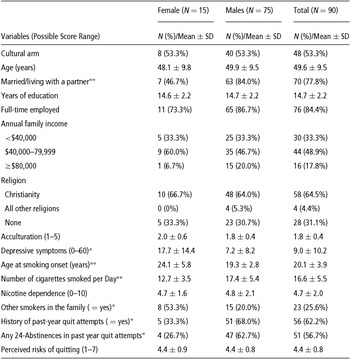
Many differences were found in demographics and smoking behaviours between female and male smokers (Table 1). Compared with men, women were more likely to be single (χ2 = 10.08, p < 0.01) and to live with a family member who also smoked (χ2 = 7.30, p < 0.05). Women earned much higher scores of depressive symptoms than men (Z = 2.73, p < 0.05). Using the cutoff score of 21 recommended for Koreans, seven women (46.7%) and six men (8.0%) could be classified as depressed (χ2 = 15.1, p = 0.001). Women initiated smoking at older age (Z = 3.17, p < 0.01) and smoked fewer cigarettes per day (Z = 3.20, p < 0.01) than men but the two had no difference in nicotine dependence. Fewer women than men attempted to quit smoking (χ2 = 6.39, p < 0.05) and had 24-hour abstinence in the past year (χ2 = 6.60, p < 0.05). In contrast, no differences were found in any baseline characteristics between the two treatment conditions.
Comparison of demographics and smoking characteristics by gender

N = number, SD = standard deviation.
*p < 0.05, **p < 0.01.
Six women had menstrual cycles; however, only two of them had a regular cycle (22–35 days) and the remaining four reported irregular cycles such as longer than 35 days and skipped cycles in the past year. Of the two with a regular cycle, one had the quit day in the follicular phase and the other one in the luteal phase. The nine women without menstrual cycles were all post-menopausal and their menopause occurred between the age of 43 and 53 years (M = 47.3, SD = 3.74; median = 47). None had hormone treatments or used contraception at the time of the study.
Treatment Outcomes
At the fourth week assessment, 67 participants reported seven-day point prevalence abstinence but four were classified as smoking because their expired CO levels were in the range of 6 to 20 ppm. Twelve had lapses to smoking and 11 relapsed to smoking. The participants in the cultural arm (40/48, 83.3%) were more likely to be abstinent than those in the standard arm (23/42, 52.4%, χ2 = 8.71, p < 0.01). All women (8/8) and 80.0% of the men (32/40) in the cultural arm achieved abstinence and the difference between women and men was not significant. In contrast, one woman (14.3%) and 22 men (62.9%) in the standard arm were abstinent, which showed a significant difference (χ2 = 5.56, p < 0.05). Individuals who were abstinent were far more likely to be adherent to nicotine patches during the four-week assessment period than those who lapsed or relapsed to smoking (95.2% versus 63.0%; χ2 = 15.9, p < 0.001).
Smoking Withdrawal Symptoms over Time
The relationship between time (week) and withdrawal symptoms was examined by linear mixed models using robust standard errors (data not shown here). Among the nine withdrawal symptoms, craving (p < 0.001) and disturbed sleep (p < 0.05) significantly decreased over time. Difficulty in concentrating and restlessness showed a downward trend whereas appetite showed an upward trend. The remaining four symptoms (irritability/frustration/anger, anxiety, depression, and impatience) did not have a significant effect of time. The total score of the nine withdrawal symptoms showed a significant decline over the four-week assessment period (p < 0.05). However, the change was no longer significant when the score of craving was removed from the total score, which indicated no significant effect of time.
Predictors of Withdrawal Symptoms
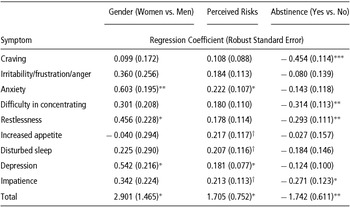
Among baseline characteristics, gender, depressive symptoms, and perceived risks of quitting smoking were all significant predictors of the total score of the nine withdrawal symptoms when they were analysed individually. Neither nicotine dependence nor treatment condition was a significant predictor of the symptoms. Due to the significant correlation between gender and depressive symptoms (Spearman's rho = 0.28, p < 0.01), only gender and perceived risks were entered in multivariate regression analyses while controlling for abstinence status (Table 2). Compared with men, women had higher anxiety, restlessness, and depression symptoms. Individuals who perceived greater risks reported more anxiety and depression symptoms than their counterparts. Those who lapsed/relapsed to smoking had more symptoms of craving, difficulty in concentrating, restlessness, and impatience than those who were abstinent. A separate analysis with baseline depressive symptoms revealed that the variable predicted the following symptoms: irritability/frustration/anger (p < 0.01), difficulty in concentrating (p < 0.01), depression (p < 0.001), disturbed sleep (p < 0.05), and impatience (p < 0.05). The relationships with the first three symptoms remained significant even after controlling for perceived risks of quitting smoking and abstinence status.
Predictors of nicotine withdrawal symptoms by multivariate linear mixed models (N = 90)

†p < 0.10, *p < 0.05, **p < 0.01, and ***p < 0.001.
Results of a Random Growth Curve Model
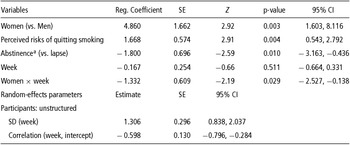
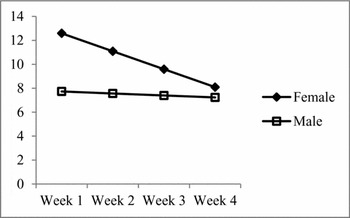
The growth curve model indicated that gender and perceived risks of quitting smoking were significant predictors of changes in the total score of the nine nicotine withdrawal symptoms over time after controlling for abstinence status (Table 3). Women reported significantly higher withdrawal symptoms at the first post-quit week than men. The symptoms increased with perceived risks of quitting smoking but decreased with abstinence. The average weekly rate of changes (the fixed effect of the slope) was not significant; while the random effect of the slope was significant (95% Confidence Interval (CI): 0.84 to 2.04). In other words, there was no significant effect of time in the change of nicotine withdrawal symptoms for the total sample, but the rates of change varied randomly across individuals. The difference in the average weekly rate of changes of withdrawal symptoms was significant by gender (p = 0.03); women showed a significant decline over time (Z = −2.68, p = 0.007) whereas men showed not much change (Z = −0.66, p = 0.51; Figure 1).
Predictors of the change of nicotine withdrawal symptoms by a random growth curve model (N = 90)

Reg. = regression, SE = Standard error of regression coefficient, CI = confidence interval, SD = standard deviation.
a7-day point prevalence abstinence.
Linear prediction of nicotine withdrawal symptoms over time by gender, fixed portion.

Discussion
To the best of our knowledge, this is the first study examining nicotine withdrawal symptoms in Korean American smokers following quitting. Among the nine withdrawal symptoms listed in the MNWS, craving and disturbed sleep significantly decreased over time whereas the remaining symptoms had no significant effect of time. In this study, we included craving because it is an essential symptom of nicotine withdrawal (Etter & Huges, Reference Etter and Hughes2006) and the most frequently reported symptom among Korean American smokers (Kim et al., Reference Kim, Gulick, Kim and Seo2007). Nevertheless, we provided both results with and without craving if the item had caused any differences in findings between the two. Gender and perceived risks of quitting smoking predicted post-quit withdrawal symptoms and their changes over time even after controlling for abstinence status. Women and individuals who perceived greater risks of quitting smoking reported more withdrawal symptoms. The symptoms did not change, on average, with time but the rates of change varied randomly across individuals. In addition, the rates of change were significantly higher for women than men.
Similar to previous studies (Carpenter et al., Reference Carpenter, Upadhyaya, La Rowe, Saladin and Brady2006; Leventhal et al., Reference Leventhal, Waters, Boyd, Moolchan, Lerman and Pickworth2007), Korean American women in this study reported more nicotine withdrawal symptoms related to negative affects (e.g., anxiety and depression) than their male counterparts. Furthermore, women had more depressive symptoms at baseline than men, which supports the pronounced relationship between depression and smoking among female smokers compared with male smokers (Husky et al., Reference Husky, Mazure, Paliwal and McKee2008). Baseline depressive symptoms also predicted post-quit withdrawal symptoms, which is in support of the notion that negative moods are independent of risk factors for withdrawal symptoms (e.g., Breslau et al., Reference Breslau, Kilbey and Andreski1992; Johnson, Stewart, Rosenfield, Steeves & Zvolensky, Reference Johnson, Stewart, Rosenfield, Steeves and Zvolensky2012; Leventhal, Ameringer, Osborn, Zvolensky & Langdon, Reference Leventhal, Ameringer, Osborn, Zvolensky and Langdon2013; Pomerleau et al., Reference Pomerleau, Pomerleau, Mehringer, Snedecor, Ninowski and Sen2005).
Korean American smokers who anticipated greater risks of quitting smoking reported more severe withdrawal symptoms following quitting than their counterparts. A study with general US smokers who were seeking cessation treatments also found that those with high levels of perceived risks were more likely to experience withdrawal symptoms than their counterparts during the first post-quit week abstinence (Weinberger, Krishnan-Sarin, Mazure & McKee, Reference Weinberger, Mazure and McKee2008). Abstinence status among Korean American smokers had a significant association with withdrawal symptoms, which supports the finding among general US smokers (Baker et al., Reference Baker, Piper, Schlam, Cook, Smith and Loh2012).
Korean American smokers who received a culturally adapted cessation intervention had a higher abstinence rate at the fourth post-quit week than those who received a standard cessation intervention. However, neither treatment condition nor nicotine dependence was assessed by FTND, a predictor of craving or other withdrawal symptoms. Similar to our findings, Robinson et al. (Reference Robinson, Lam, Carter, Minnix, Cui and Versace2011) did not find any significant effect of FTND on post-quit withdrawal symptoms. In contrast, Baker and others (Reference Baker, Piper, Schlam, Cook, Smith and Loh2012) found significant relationships between FTND and post-quit craving and negative affect withdrawal symptoms. Both of the two studies (Baker et al., Reference Baker, Piper, Schlam, Cook, Smith and Loh2012; Robinson et al., Reference Robinson, Lam, Carter, Minnix, Cui and Versace2011) assessed withdrawal symptoms using the Wisconsin Smoking Withdrawal Scale (Welsch et al., Reference Welsch, Smith, Wetter, Jorenby, Fiore and Baker1999). More studies are required to determine the effect of nicotine dependence on post-quit withdrawal symptoms.
Findings from the present study should be interpreted with caution because of the following limitations. First, the female sample was relatively small compared with the male one (15 versus 75) and the gender differences founded in this study need to be further validated with large female and male samples. Nevertheless, the main outcome variable ‘nicotine withdrawal symptoms’ was administered four times for each woman, which yielded a total of 53 observations. In addition, we were not able to examine the potential effects of menstruation cycle on withdrawal symptoms due to the small female sample. Studies with large samples of Korean American women will help us understand the potential effect of menstrual cycle on withdrawal symptoms. Second, we did not assess physiological measures to validate self-reported withdrawal symptoms. Third, we did not assess baseline anxiety that may also have a significant effect on post-quit withdrawal symptoms (Johnson et al., Reference Johnson, Stewart, Rosenfield, Steeves and Zvolensky2012). Finally, we did not assess baseline withdrawal symptoms, which might have helped better understand the change of symptoms after quitting.
In spite of the limitations described above, the present study is the first one that examined factors predicting post-quit withdrawal symptoms among Korean American smokers who were receiving psychosocial and pharmacological treatments for smoking cessation. Compared with Korean male smokers, Korean female smokers were more likely to have depressive symptoms at baseline and experience post-quit anxiety, restlessness, and depression symptoms. A qualitative study with Korean American women revealed that they smoke to cope with stresses (Kim, Kim, Seward, Fortuna & McKee, Reference Kim, Kim, Seward, Fortuna and McKee2013). They may require more intensive treatment whereby they can learn constructive coping strategies to effectively deal with stresses, which may explain in part the poor outcome of the female smokers who received the brief cessation intervention.
Irrespective of gender, Korean American smokers who perceived greater risks of quitting smoking at baseline reported more withdrawal symptoms following quitting. Korean immigrants generally have very limited access to tobacco dependence treatment due to various structural, cultural, and linguistic barriers (Kim et al., in press). Except for three, all participants in this study were first-time treatment seekers who might have experienced severe withdrawal symptoms in their previous quit attempts. They might have anticipated more withdrawal symptoms than those who had never made a quit attempt or who received cessation treatment. Most Korean smokers were unaware of the underlying pharmacological mechanism of nicotine patches and other cessation medications (Kim, Son & Nam, Reference Kim, Son and Nam2005). Clinicians should explain how and why the medications help quit smoking and the importance of medication adherence. This information may reduce Korean American smokers’ perceived risks of quitting and facilitate their medication adherence. In this study, those who were adherent to the medication were more likely to achieve abstinence and reported less severe withdrawal symptoms than their counterparts. Clinicians also need to carefully screen Korean American smokers for depression and other negative mood disorders and advise them to seek treatment for the comorbid conditions.
Acknowledgement
This work was supported by the National Institute on Drug Abuse (5K23DA021243-02 to Dr. Kim) and partially supported by the National Institute on Drug Abuse (R01DA033323-01A1 to Dr. Fang) and (P50DA033945 to Dr. McKee).
Conflict of Interest
None.