Introduction
Vestibular dysfunction may occur following cochlear implantation. The reported incidence of post-operative vestibular symptoms is highly variable. In 1998, Ito et al. reported subjective dizziness in 47 per cent (26 out of 45) of adults with implants; in 2001, Steenerson et al. reported vertigo or imbalance in 74 per cent of patients.Reference Ito1, Reference Steenerson, Cronin and Gary2 Pre-operative vestibular assessment including vestibular testing has been recommended for patients undergoing cochlear implantation. Electronystagmography or videonystagmography (hereafter referred to together as ENG) is often selected for vestibular system evaluation because of its simplicity and reliability, and its ability to identify which side has the vestibular lesion. In addition to providing baseline information for post-operative balance assessment, vestibular testing has comprised part of the cochlear implant candidacy evaluation to aid selection of the appropriate ear for implantation. In the setting of asymmetric caloric responses, it has been recommended that the ear with the poorer caloric response should be preferentially selected for cochlear implant so as to preserve the ear with the better vestibular function and minimise post-operative vestibular symptoms.Reference Parmar, Savage, Wilkinson, Hajioff, Nunez and Robinson3
The utility of pre-operative ENG in predicting post-operative vestibular symptoms is unclear. In a retrospective review, Fina et al. found no significant difference in pre-operative caloric test results among cochlear implant recipients with and without post-operative dizziness.Reference Fina, Skinner, Goebel, Piccirillo, Neely and Black4 Similarly, Krause et al. found no significant differences in pre-operative canal paresis between patients with and without post-operative dizziness.Reference Krause, Wechtenbruch, Rader, Berghaus and Gürkov5 In 2013, Katsiari et al. examined the influence of cochlear implantation on vestibular function by measuring the caloric response and vestibular evoked myogenic potential.Reference Katsiari, Balatsouras, Sengas, Riga, Korres and Xenelis6 While changes in peripheral vestibular function on the implanted side were observed, permanent deficits were rare. Parmer et al. investigated the relationship between post-operative dizziness and cochlear implantation in the ear with the weaker caloric response.Reference Parmar, Savage, Wilkinson, Hajioff, Nunez and Robinson3 These authors found no differences in post-operative dizziness in patients implanted on the side with the weaker caloric response by pre-operative ENG testing. However, they found impaired visual fixation suppression, an indicator of central involvement, to be a major risk factor for post-operative dizziness.
Interestingly, despite the intimate anatomical and functional relationships between auditory and vestibular function, the predictive value of ENG testing for post-operative hearing sensitivity and speech recognition performance following cochlear implantation has not been investigated. This study investigated whether pre-operative ENG testing can predict post-operative dizziness, sensitivity to warble tones and speech perception outcomes.
Materials and methods
Study design
The study was approved by the Columbia University Medical Center institutional review board. A retrospective analysis of data from 37 adults (i.e. 18 years or older) who received cochlear implants at Columbia University Medical Center between 1998 and 2012 was performed. These individuals were selected from a pool of 80 cochlear implant recipients who had undergone pre-operative ENG. Exclusion criteria were incomplete medical records, bilateral cochlear implantation, and patients for whom English was not the primary language.
Patients
Pre-operative ENG caloric responses were obtained for 37 patients with unilateral cochlear implants. Age at implantation ranged from 21 to 86 years (mean 52.7 years, median 57 years, standard deviation (SD) = 19.1). The duration of profound hearing loss ranged from 2 months to 70 years (mean 21.6 years, median 20 years, SD = 18.8). The aetiology of deafness was unknown for 43.2 per cent (n = 16) of the cohort. The Cochlear® (Sydney, Australia) device was implanted in 62.2 per cent (n = 23); the Advanced Bionics (Valencia, California, USA) device was implanted in 27.0 per cent (n = 10); and the Med-El (Innsbruck, Austria) device was implanted in 10.8 per cent (n = 4) of the cohort.
Procedures
Audiological assessments were conducted in soundproof booths, and all equipment was calibrated to American National Standards Institute standard S3.6.6-1989. Auditory sensitivity and speech perception ability were tested pre- and post-operatively. Auditory sensitivity was evaluated using either pure tones (for testing with earphones) or frequency-modulated warble tones (for sound-field testing). Speech perception ability was evaluated using Northwestern University Auditory Test Number 6. Unaided auditory performance was tested pre-operatively using insert earphones. Aided testing was performed pre-operatively in a sound field with a hearing aid and post-operatively with the cochlear implant processor. Sound-field measures (warble tone thresholds and speech perception) were made at a 0° azimuth, 3 feet from the speaker. ENG was performed according to standard practice, using the open-loop water method.7 Caloric irrigations used a water temperature of up to 7°C higher or lower than body temperature.
Data analysis
The following measures were collected and analysed: pre-operative ipsilateral ENG cold and warm caloric responses of the implanted ear; pre- and post-operative subjective dizziness as documented in the medical record; and pre- and post-operative tonal thresholds and speech perception outcomes. Subjective dizziness was documented by a patient report. The relationship between pre-operative ENG caloric responses and post-operative vestibular symptoms was analysed using a chi-square (χ2) test.
We analysed the relationship between pre-operative unaided (residual) hearing and cochlear implant outcomes. We also investigated by regression analysis whether ENG caloric responses and residual hearing are independent predictors of post-operative cochlear implant outcomes.
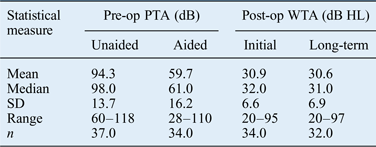
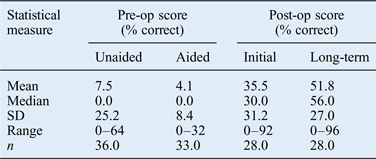
Outcomes were measured using tonal detection data from warble tone average (at 0.5, 1 and 2 kHz) and speech perception data from the Northwestern University Auditory Test Number 6.Reference Tillman and Carhart8 Data from warble tone average (in dB HL) and the Northwestern University Auditory Test Number 6 word recognition score (per cent correct) were collected from the initial (one to three months) and later (six months or later) periods following cochlear implant activation. A higher warble tone average signifies poorer performance in tonal detection; a higher Northwestern University Auditory Test Number 6 score indicates better speech recognition. Tables I and II summarise the warble tone average and word recognition score, respectively, both pre-operatively in unaided and aided conditions and after cochlear implantation. The relationship among ENG caloric response, warble tone average and speech perception outcomes were assessed by determining Pearson correlations.
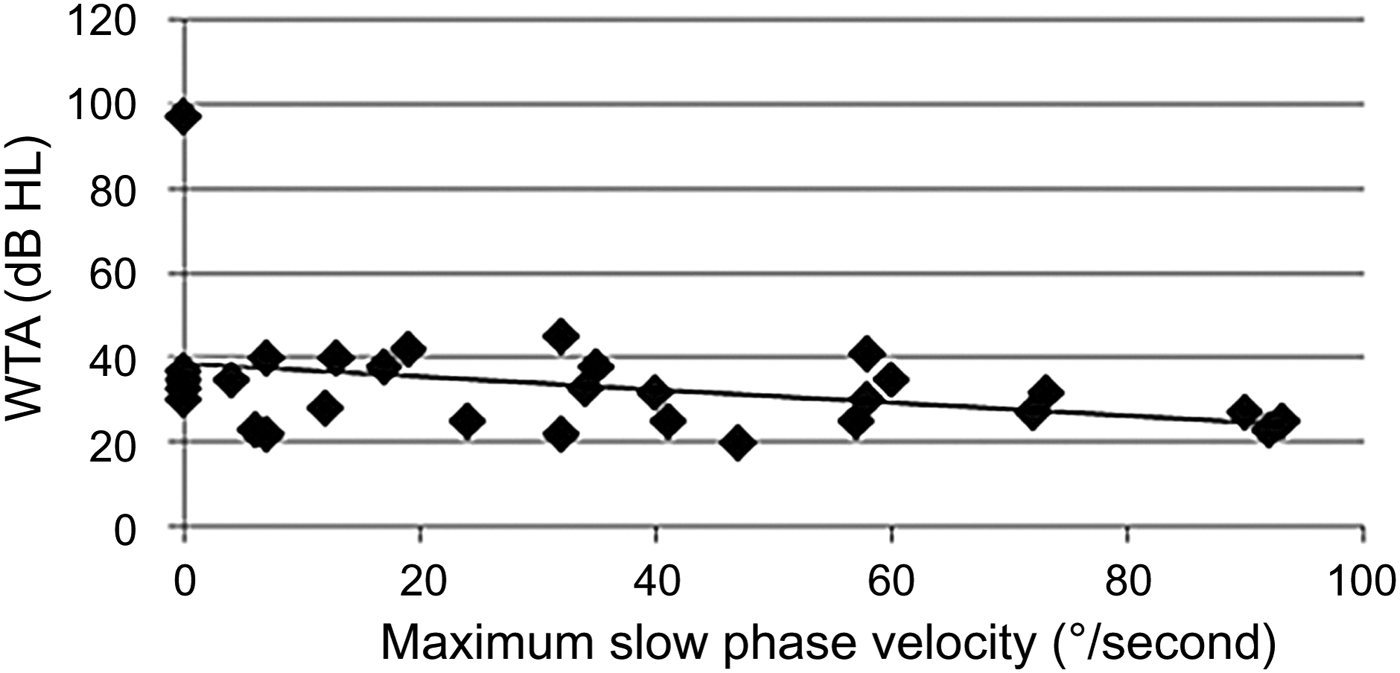
Graph showing the inverse relationship between long-term post-operative warble tone average (WTA) following cochlear implantation and pre-operative total caloric response (warm plus cold irrigations) of the implanted ear (r≥− 0.34, n = 34, p < 0.05).

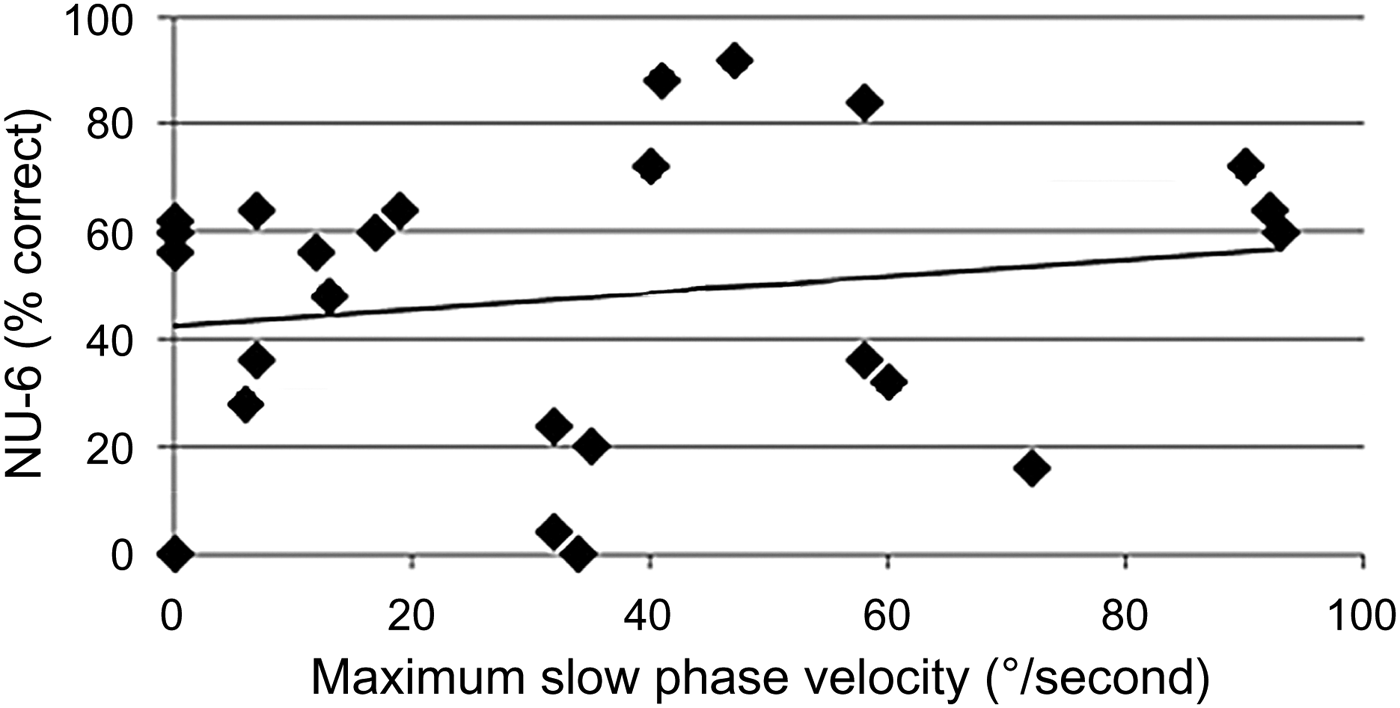
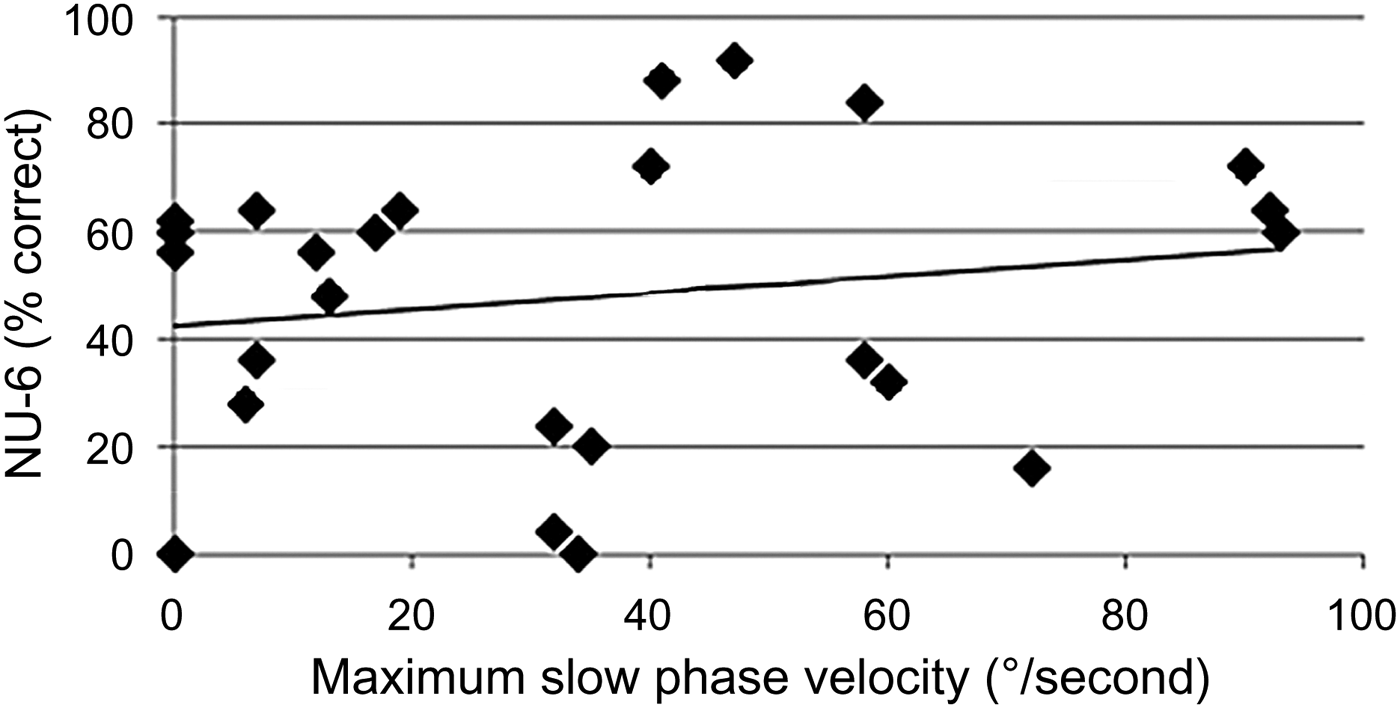
Graph showing the positive relationship between pre-operative total caloric response (warm plus cold irrigations) of the implanted ear and the long-term post-operative Northwestern University Auditory Test Number 6 (NU-6) word recognition score following cochlear implantation (r > 0.16, n = 27, p > 0.05).
Hearing before and after cochlear implantation
Pre-op = pre-operative; PTA = pure tone average; Post-op = post-operative; WTA = warble tone average; SD = standard deviation
Nu-6 word recognition score before and after cochlear implantation
NU-6 = Northwestern University Auditory Test Number 6; Pre-op = pre-operative; Post-op = post-operative; SD = standard deviation
Results
Relationship between electronystagmography and vestibular function
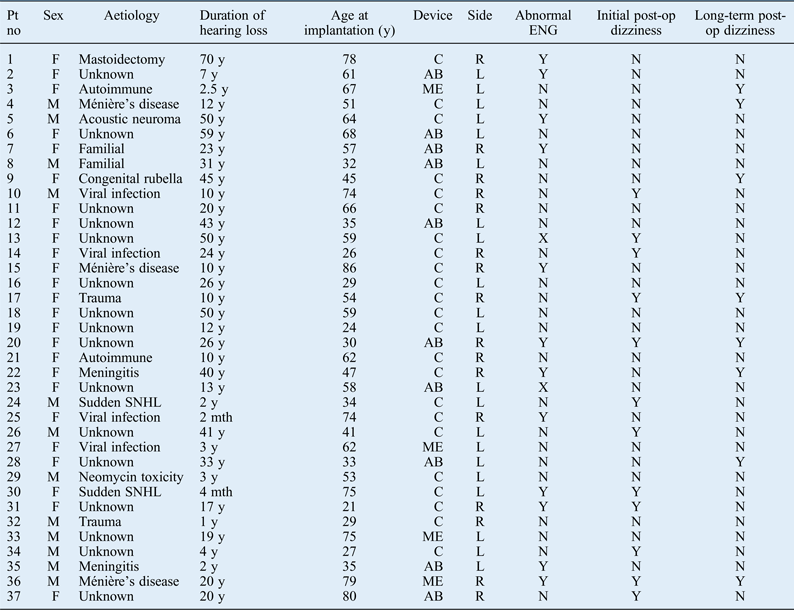
Table III summarises the cohort demographics, the pre-operative ENG caloric responses of the implanted ear and the initial (one to three months) and long-term (six months or later) post-operative dizziness recorded in the medical records. The long-term post-operative period ranged from 6 months to 10 years after cochlear implant activation (mean 2.5 years, median 2 years, SD = 2.1).
Demographics, eng caloric responses, and post-operative dizziness
Pt no = patient number; y = years; ENG = electronystagmography or videonystagmography; post-op = post-operative; F = female; C = Cochlear®; R = right; Y = yes; N = no; X = data unavailable; AB = Advanced Bionics; ME = MED-EL; M = male; SNHL = sensorineural hearing loss; mth = months
Pre-operatively, 44.7 per cent (n = 17) of patients reported vestibular symptoms; post-operatively, 21.6 per cent (n = 8) of patients reported vestibular symptoms. There was no relationship between the pre-operative caloric responses and post-operative vestibular symptoms (χ2 = 0.12, p > 0.05).
Relationship between electronystagmography and outcome measures
Pearson correlation coefficients (r) between pre-operative ipsilateral caloric responses of the implanted ear under cold, warm and total irrigation conditions and both Northwestern University Auditory Test Number 6 and warble tone average speech perception outcomes are shown in Table IV. There was no significant correlation between the ENG caloric response and short-term warble tone average or auditory test scores. Pre-operative ENG caloric responses correlated with post-operative auditory sensitivity, as measured by warble tone average six months or more after cochlear implant activation for cold irrigation (r ≥ −0.35, n = 34, p < 0.05) and for the combined warm and cold caloric responses (r ≥ −0.34, n = 34, p < 0.05; Figure 1). However, there was no significant correlation between pre-operative ENG caloric responses and post-operative Northwestern University Auditory Test Number 6 word recognition scores six months or more after cochlear implant activation (r > 0.16, n = 27, p > 0.05; Figure 2). Furthermore, there was no significant correlation between pre-operative ENG caloric responses and pre-operative word recognition scores or warble tone average speech perception outcomes (r < 0.04, n = 38, p < 0.05).
Correlation between pre-operative caloric response and post-operative cochlear implant speech recognition
*Of the implanted ear; †Significant Pearson correlation coefficient value; ‡One to three months after cochlear implant activation; **Six months or more after cochlear implant activation. Pre-op = pre-operative; Post-op = post-operative; WTA = warble tone average; NU-6 = Northwestern University Auditory Test Number 6
Relationship among residual hearing, electronystagmography and outcome measures
Table II summarises pre-operative pure tone thresholds under unaided (i.e. residual hearing) conditions. Residual hearing correlated significantly with the post-operative warble tone average (r ≥ 0.43, n = 32, p < 0.05) and Northwestern University Auditory Test Number 6 word recognition score (r > 0.5, n = 27, p < 0.05).
To determine whether electronystagmography caloric responses and residual hearing are independent predictors of post-operative cochlear implant outcomes, we conducted two multiple regression analyses in the form y = a 0 + b 1 × x 1 + b 2 × x 2. The first analysed the Northwestern University Auditory Test Number 6 word recognition score against ENG calorics and residual hearing (with y = Northwestern University Auditory Test Number 6), and the second analysed the warble tone average against ENG calorics and residual hearing (with y = ENG caloric responses). The results demonstrated that ENG calorics and residual hearing are not independent predictors of cochlear implant outcomes (p > 0.05).
Discussion
In this study, we evaluated the utility of ENG in predicting pre- and post-operative vestibular symptoms, auditory sensitivity to warble tones, and speech perception outcome. Consistent with previously reports, we found that pre-operative ENG caloric testing does not predict post-operative dizziness. There are several possible explanations for this. Firstly, ENG is a gross, not a fine, measurement of vestibular function, and the caloric response is indicative only of the horizontal canal. It is most useful for evaluating whether signals originating from one ear are consistent with those from the contralateral ear, and whether responses are absent, hyperactive, or hypoactive. Secondly, inner-ear inflammation resulting from cochlear implant surgery is likely to vary from patient to patient; thus, heterogeneity in vestibular injury will diminish the predictive value of ENG testing. Finally, post-operative vestibular disturbance is multi-sourced: the central nervous system, the visual system and proprioception, among others, are known to affect post-operative dizziness.
Using a pre-operative battery of tests, we aimed to identify which factors provide insight into auditory system function following cochlear implantation, with a special focus on vestibular testing. As expected, we found a correlation between pre-operative auditory function and post-operative speech performance.Reference Rubinstein, Parkinson, Tyler and Gantz9–Reference Green, Bhatt, Mawman, O'Driscoll, Saeed and Ramsden11 We also found that better pre-operative ENG caloric responses correlated with better post-operative hearing performance. Specifically, a better pre-operative caloric response was associated with improved post-operative hearing sensitivity, as indicated by the warble tone average. The warble tone average is a measure of access to sound: a lower warble tone average indicates a greater ability to hear sounds in both quiet and background noise conditions. We did not find a positive correlation between pre-operative ENG testing and post-operative speech discrimination, as indicated by Northwestern University Auditory Test Number 6 word recognition scores. It is possible that a correlation may be detected with a more robust metric, such as the Hearing In Noise Test (‘HINT’), the AzBio Sentence Test or the Consonant-Nucleus-Consonant (‘CNC’) word test. However, insufficient participants in our database had undergone these tests to enable investigation of this hypothesis. Finally, although both residual hearing and ENG caloric responses were associated with a better post-operative hearing performance, we were unable to demonstrate whether they are independent predictors of cochlear implant outcome. A larger study is required to specifically address this very important question. If pre-operative vestibular function and pre-operative hearing should be interdependent and equally predictive of post-operative outcome, then the hearing test may be the preferred metric because it is quicker and easier to perform than ENG. However, in completely deaf patients, ENG may be the only modality available to measure residual labyrinthine function.
A possible explanation for ENG correlating with cochlear implant outcome is that a more intact pre-operative vestibular system indicates better auditory system function, leading to improved sensitivity and speech perception outcomes. Auditory and vestibular systems experience similar, parallel age-related changes associated with functional decline.Reference Gleeson and Felix12, Reference Enrietto, Jacobson and Baloh13 Zuniga et al. found that hearing loss at high frequencies correlates significantly with reduced vestibular evoked myogenic potential amplitudes (or reduced saccular function; r = −0.37, p < 0.0001) in participants aged 70 years or older.Reference Zuniga, Dinkes, Davalos-Bichara, Carey, Schubert and King14 Several studies using mouse models have analysed the relationship between age-related changes in hearing and vestibular function.Reference Mock, Jones and Jones15, Reference Jones, Jones, Johnson, Yu, Erway and Zheng16 Jones et al. reported a concomitant decline in vestibular and cochlear function in CochG88E/G88E (‘knock-in’) and Coch−/− (‘knock-out’) mouse models, although vestibular function seemed to be compromised before hearing.Reference Jones, Robertson, Given, Giersch, Liberman and Morton17 The authors concluded that the genes responsible for early onset hearing loss affect otolithic function, although the time course of functional change may vary. Shiga et al. evaluated age-related changes in vestibulo-ocular responses in C57BL/6 mice, considered a model of presbycusis. They conducted a histological analysis of vestibular and auditory peripherals, and found a similar decline in both systems.Reference Shiga, Nakagawa, Nakayama, Endo, Iguchi and Kim18 Degeneration of the auditory periphery was closely related to functional loss caused by ageing. However, although vestibular peripherals exhibited morphological signs of age-related degeneration, age-related dysfunction was not apparent.
• The value of electronystagmography (ENG) for predicting post-operative vestibular symptoms, hearing sensitivity and speech perception outcomes following cochlear implantation is not well established
• Pre-operative caloric responses did not correlate with post-operative vestibular symptoms
• Pre-operative ENG caloric responses correlated with post-operative auditory sensitivity at six months or later
• Pre-operative ENG testing may be useful for predicting hearing outcomes after cochlear implantation
Thus, the ENG caloric response may be an indirect measure of the pre-operative auditory neuronal population. In theory, a better pre-operative ENG caloric response indicates that more vestibular hair cells and neurons are present; a more robust vestibular system may in turn indicate greater preservation of pre-operative auditory function. Consequently, a higher pre-operative ENG caloric response may reflect better preservation of the auditory neuron population, leading to improved post-operative electrically stimulated hearing sensitivity.
Conclusion
Our results demonstrate that pre-operative ENG testing has a potential use in predicting post-operative hearing outcomes following cochlear implantation. However, whether this is caused by an indirect association between ENG and residual hearing requires clarification by further hearing studies. ENG may be more useful where results of auditory tests do not provide sufficient insight into VIIIth cranial nerve function. Larger studies are needed to reproduce this novel finding and more clearly define the relationship between pre-operative vestibular function and post-operative rehabilitative outcome in a cochlear implant recipient.
Acknowledgements
We would like to thank Jimmy K Duong, of the Department of Biostatistics, Mailman School of Public Health, Columbia University, New York, for providing advice on statistical analysis.