Introduction
Weeds are a unique group of plant species that can infest and thrive in intensively disturbed habitats (Murphy and Lemerle Reference Murphy and Lemerle2006). Infestation by weeds usually results in decreased crop yield (Cousens Reference Cousens1985) and increased environmental costs associated with chemical control (Fletcher et al. Reference Fletcher, Pfleeger and Ratsch1994; Tsai Reference Tsai2013). Weed species compete with crops for the same resources, mainly nutrients, water, and light (Smith et al. Reference Smith, Mortensen and Ryan2010); consequently, they are often removed. Farming practices, such as herbicide application (Chauhan and Opena Reference Chauhan and Opena2012), tillage (Santín-Montanyá et al. Reference Santín-Montanyá, Martín-Lammerding, Walter, Zambrana and Tenorio2013), irrigation (Mahajane et al. Reference Mahajane, Chauhan, Kumar, Chauhan and Mahajane2014), fertilization (Zhang et al. Reference Zhang, Sun, Li, Sun, Yuan, Han, Duan, Ji, Zhu, Shen and Ran2019), and rotation and continuous cropping (Barroso et al. Reference Barroso, Miller, Lehnhoff, Hatfield and Menalled2015), may selectively determine the composition and diversity of weed communities and the dominant species in the weed community in a crop field (Hyvönen and Salonen Reference Hyvönen and Salonen2002; Mahajane et al. Reference Mahajane, Chauhan, Kumar, Chauhan and Mahajane2014; Riar et al. Reference Riar, Norsworthy, Steckel, Stephenson, Eubank, Bond and Scott2013).
Fertilizer application is considered crucial for determining the crop–weed competition relationship and affects the species composition and biodiversity of weeds by stimulating plant growth and modulating competition for belowground (soil nutrients) and aboveground resources (e.g., light and space) (Di Tomaso Reference Di Tomaso1995; Yin et al. Reference Yin, Cai and Zhong2005, Reference Yin, Cai and Zhong2006). Studies have shown that weed vegetation under certain fertilization conditions was predominantly composed of a few species, and the species, density, and biomass of dominant weeds varied with different fertilization regimes (Lal et al. Reference Lal, Gautam, Raja, Nayak, Shahid, Tripathi, Bhattacharyya, Mohanty, Puri, Kumar and Panda2014; Tang et al. Reference Tang, Cheng, Wan, Li, Wang, Tao, Pan, Xie and Chen2014). High nitrogen levels favor weed species that possess either the ability to elongate to access more favorable light conditions [esp. catchweed bedstraw (Galium aparine L.)] or exhibit physiological shade tolerance (esp. common chickweed [Stellaria media (L.) Vill.]) (Haas and Streibig Reference Haas, Streibig, LeBaron and Gressel1982). The type and rate of fertilizers applied, and the physiology of the species involved play an important role in weed population shifts (Murphy and Lemerle Reference Murphy and Lemerle2006). Galium aparine had the highest density and caused 10.3% to 57% yield losses in high-fertility wheat (Triticum aestivum L.) fields (Mennan and Zandstra Reference Mennan and Zandstra2005; Tang et al. Reference Tang, Cheng, Wan, Li, Wang, Tao, Pan, Xie and Chen2014). Zhang et al. (Reference Zhang, Sun, Li, Sun, Yuan, Han, Duan, Ji, Zhu, Shen and Ran2019) indicated that the increased use of chemical fertilizer was a major influential factor for the increasing infestation of American sloughgrass [Beckmannia syzigachne (Steud.) Fernald], which caused more than 50% yield losses when its density reached 50 plants m−2 in wheat fields (Li et al. Reference Li, Rao, Dong and Zhang2010). Beckmannia syzigachne has become one of the most predominant and troublesome weeds in wheat fields rotated with rice (Oryza sativa L.) in the middle and lower reaches of the Yangtze River in China (Li et al. Reference Li, Bi, Liu, Yuan and Wang2013; Rao et al. Reference Rao, Dong, Li and Zhang2008). Beckmannia syzigachne has evolved resistance to photosystem II, acetyl-CoA carboxylase, and microtubule-inhibiting herbicides (Du et al. Reference Du, Qu, Jiang, Li, Ju, Lu and Wang2019; Heap Reference Heap2020; Pan et al. Reference Pan, Li, Zhang and Dong2015), and the resistance (even multiple resistance) of G. aparine to acetolactate synthase inhibitors and synthetic auxin herbicides has been widely reported in wheat fields in China, Iran, and Turkey (Deng et al. Reference Deng, Di, Cai, Chen and Yuan2019; Heap Reference Heap2020). Therefore, studies of the impacts of farming practices on these two weeds and sequential alternative control measures have become essential.
Previous weed research involving swine manure mostly assessed effects on weed characteristics, crop–weed competition responses to different fertilization regimes, or weed communities alone (Liebman et al. Reference Liebman, Menalled, Buhler, Richard, Sundberg, Cambardella and Kohler2004; Menalled et al. Reference Menalled, Buhler and Liebman2005). However, little research has focused on the effects of long-term fertilization with respect to weed growth, particularly in the rice–wheat rotation cropping pattern (alternate cropping of summer rice and winter wheat), and many questions remain unanswered, such as the role of fertilization in determining the dominant weed species, density, shoot biomass, and seed yields in a mixed community. Additionally, it remains unknown whether it is possible to maintain a diverse weed community while sustaining a high crop yield through appropriate fertilization patterns.
The effects of different fertilization regimes (absence of fertilization, replacement of 50% of the total nitrogen application of chemical fertilizer with composted pig manure, chemical fertilizer only, and straw return combined with chemical fertilizer) on weed richness and abundance during the 2014 and 2015 wheat crops of a rice–wheat rotation in the middle and lower reaches of the Yangtze River in China were assessed in our previous study (Zhang et al. Reference Zhang, Sun, Li, Sun, Yuan, Han, Duan, Ji, Zhu, Shen and Ran2019). The results showed that with fertilizer application, the number of weed species, density of broadleaf weeds, and Simpson index of weed communities were significantly reduced, the height of weeds increased significantly, and higher wheat yields were obtained. Moreover, while the chemical fertilizer plus composted pig manure treatment and the chemical fertilizer-only treatment increased the density of grassy weeds and the total weed community density, the rice straw return plus chemical fertilizer treatment did not increase weed density. The exclusive application of chemical fertilizer also resulted in the highest density of B. syzigachne, while rice straw return combined with chemical fertilizer and the control yielded the lowest densities of B. syzigachne (Zhang et al. Reference Zhang, Sun, Li, Sun, Yuan, Han, Duan, Ji, Zhu, Shen and Ran2019). In the current study, the same experimental plots and fertility treatments were assessed for two additional seasons (2017 and 2018) to identify whether composted manure and straw amendments would change the dominant species of wheat-associated weeds and influence their growth and seed yield.
Materials and Methods
Experimental Site
A field with relatively uniform weed species and density distribution was selected in 2010 at Jianchun Village (31.662°N, 119.473°E; elevation 10 m above mean sea level), Jiangsu Province, China. This study site is located in a region with a humid subtropical monsoon climate. The minimum, maximum, and mean temperature and rainfall of the study area in wheat (from November to May of the following year) cropping seasons in 2017 to 2018 are presented in Table 1. The soil is classified as Fe-leachic-gleyic-stagnic Anthrosol and has a clay loam texture with 9.8% sand (1 mm to 0.05 mm), 38.5% coarse silt (0.05 mm to 0.01 mm), and 51.7% physical clay (<0.01 mm). Before the establishment of the experiment, the initial soil chemical properties of the field were analyzed, which were 0.014% organic carbon, 0.0016% total nitrogen, and 0.018% and 0.056% available phosphorus and potassium on a dry weight basis with a pH of 7.3 (Liu et al. Reference Liu, Guo, Ran, Whalen and Li2015). Until the wheat harvest in 2018, three different fertilization regimes had been continuously used for 15 seasons, and the chemical properties of the soil significantly differed in different treatment plots since 2015 (Zhang et al. Reference Zhang, Sun, Li, Sun, Yuan, Han, Duan, Ji, Zhu, Shen and Ran2019).
Minimum (Tmin), maximum (Tmax), and mean (Tmean) temperature and rainfall of the study area in the wheat cropping season in 2017 and 2018.

Experimental Design
The study has been ongoing since the wheat season of November 2010 under the long-term cropping pattern of annual rotation of summer rice and winter wheat. The design of the experiment involving four fertilization treatments was a randomized complete block with four replications. The four fertilization treatments consisted of the following: (1) control (CK): no fertilization; (2) chemical fertilizer (Changzhou Dadi Fertilizer Technology, Changzhou, China) only (CF); (3) replacement of 50% of the total nitrogen application of chemical fertilizer with composted pig manure (Jiangsu Tianniang Agricultural Technology, Changshu, China) (PM); and (4) straw return (all the straw from the previous rice crop) combined with chemical fertilizers (SF). The details for the type and composition of the fertilizers applied as treatments during the wheat season are presented in Table 2 (Zhang et al. Reference Zhang, Sun, Li, Sun, Yuan, Han, Duan, Ji, Zhu, Shen and Ran2019). During the rice season, the amount of pig manure compost used was the same as that in the wheat season in the PM treatment, and all the straw from the previous wheat crop was returned in the SF treatment. The amounts of chemical fertilizer were 300 kg N ha−1, 37.5 kg P2O5 ha−1, and 71.25 kg K2O ha−1 in the CF and SF treatments and 150 kg N ha−1, 18.75 kg P2O5 ha−1, and 35.63 kg K2O ha−1 in the PM treatment.
Type and composition of the fertilizers applied as treatments in the wheat season.

a CK, control; CF, chemical fertilizer; PM, composted pig manure combined with chemical fertilizer; SF, straw return combined with chemical fertilizer, respectively.
b Basal fertilizer was applied before planting.
c Supplementary fertilizer, which was applied at the panicle stage.
d Straw from the previous rice crop was carefully harvested (exclusive of weed seed), shredded to a particle size less than 5 cm, and uniformly broadcast to the plot from which it had been harvested. The rice straw consisted of 45% organic matter, 0.09% N, 0.03% P2O5, and 0.23% K2O.
e The composted pig manure consisted of 45.4% organic matter, 2.0% N, 2.9% P2O5, 1.2% K2O, and 29.1% water.
Each treatment plot measured 40 m2 (8 m by 5 m) and was isolated by cement ridges to ensure there was no interflow of water and fertilizer between plots. Wheat (‘Yangfumai No. 4’) seeds were sown at a density of 150 kg ha−1 on the same date (November 5) in 2016 and 2017, and wheat harvest was conducted on June 3 in 2017 and June 4 in 2018. Drainage was provided by a 20-cm-deep furrow in the middle of each plot into the lateral side channels. Weed control was conducted 20 d after wheat sowing by applying 987 g ai ha−1 isoproturon combined with 63 g ai ha−1 bensulfuron methyl (Jiangsu Kuaida Agrochemical, Matang, China) in all plots. The pig manure compost used in our experiment was a commercial organic fertilizer, each bag of which weighed 40 kg. Three bags of commercial organic fertilizer were used to meet the experimental demand (96 kg for the four experimental plots) in each wheat and rice cropping season. Before each fertilization, five holes were equidistantly drilled with a sampling drill in each bag of commercial organic fertilizer, and 1 kg of fertilizer was sampled from each hole to detect seed contamination. The samples from one bag were mixed and elutriated with a 0.075-mm sieve. After elutriation, the remnant of each mixed sample was air-dried and put under a binocular dissecting microscope (maximum magnification was 40×; YSZ205T, Suzhou Yueshi Precision Instrument, Suzhou, China) to determine the seed species and number of each species. Subsequently, seeds were subjected to a tetrazolium test (Grabe Reference Grabe1970) by placing them in petri dishes on filter paper moistened with a solution of 1% tetrazolium. After 48 h at room temperature, the seeds were examined for red staining at the growing point, an indication of respiration and hence viability.
Weed Surveys
During the wheat dough stage, the density of each weed species was determined on April 21, 2011 (initial weed density data in the wheat field) in nine 0.25-m2 (0.5 m by 0.5 m) quadrats positioned in accordance with an inverted W 9-point sampling method (Thomas Reference Thomas1985) in each experimental plot. The species, number, and plant height of the weeds in each experimental plot were determined on April 21, 2017, and April 22, 2018, using the same number of quadrats with the same method. The aboveground parts of all weeds in each quadrat in 2017 and 2018 were taken back to the laboratory, and their dry weights were determined after oven-drying at 70 C until constant weight. At the seed-filling stage, the seed yield of 20 plants each of B. syzigachne and G. aparine at two randomly sampled points in each experimental plot was determined on May 8, 2017 and 2018 (if the plant number was less than 20 in an experimental plot, all plants were sampled). Wheat yield was measured by weighing the wheat grain harvested from a 20-m2 area of each plot.
Data Processing
The phytosociological structure in each plot was assessed by common parameters, such as the relative values of the frequency, density, height, and abundance for each weed species. Calculations were performed based on the following formulas:
 $${\rm{Frequency}} = {{{\rm{number}}\ {\rm{of}}\ {\rm{quadrats}}\ {\rm{with}}\,{\rm{species}}\ {\rm{present}}} \over {{\rm{total}}\ {\rm{number}}\ {\rm{of}}\ {\rm{quadrats}}}}$$
 $${\rm{Relative}}\ {\rm{frequency}}\,(Rf) = {{{\rm{frequency}}\ {\rm{of}}\ {\rm{a}}\ {\rm{species}}} \over {{\rm{sum}}\,{\rm{of}}\,{\rm{frequency}}\,{\rm{of}}\,{\rm{all}}\,{\rm{species}}}} \times 100\% $$
 $${\rm{Relative}}\ {\rm{density}}(Rd) = {{{\rm{mean}}\,{\rm{density}}\,{\rm{of}}\,{\rm{a}}\,{\rm{species}}} \over {{\rm{sum}}\,{\rm{of}}\,{\rm{density}}\,{\rm{of}}\,{\rm{all}}\,{\rm{spcies}}}} \times 100\% $$
 $${\rm{Relative}}\ {\rm{height}}(Rh) = {{{\rm{mean}}\,{\rm{height}}\,{\rm{of}}\,{\rm{a}}\,{\rm{species}}} \over {{\rm{sum}}\,{\rm{of}}\,{\rm{height}}\,{\rm{of}}\,{\rm{all}}\,{\rm{spcies}}}} \times 100\% $$
 $${\rm{Relative}}\ {\rm{abundance}}(Ra) = {{Rf + Rd + Rh} \over {\rm{3}}}$$
The relative abundance of a species indicates its degree of dominance or subordination in the weed community (i.e., the greater the relative abundance of a species in the weed community, the higher its dominance; Poggio Reference Poggio2005).
Data were tested for normality (Shapiro-Wilk test, P > 0.05) and homogeneity of variance (Levene’s test, P > 0.05) before being subjected to a two-way ANOVA to assess the effects of fertilization regime, year (photoperiod, temperature, and rainfall between cropping years of 2017 and 2018), and interactions between the two on the species number and density; weed community plant height and shoot biomass; dominant weed species’ relative abundance, seed yield, density, and shoot biomass; their percentages among the total weed density and shoot biomass; and the wheat density, plant height, and yield. When the treatment means were different, the LSD test was performed to identify significant differences at P < 0.05. Data were averaged over years when significant interaction effects were not observed between the fertilization regime and the years 2017 and 2018. The weed density difference between 2010 and 2018 in each plot was calculated and averaged by treatment to obtain the mean density variation in the wheat-associated weeds under different fertilization regimes between 2011 and 2018. The paired-sample t-test was used to assess the significance of mean density variation at P < 0.05. All analyses were performed using SPSS v. 18.0 (IBM, Armonk, NY, USA). The figures were generated using Origin 8.0 (Origin Lab, Hampton, MA, USA).
Results and Discussion
Height, Density, and Yield of Wheat
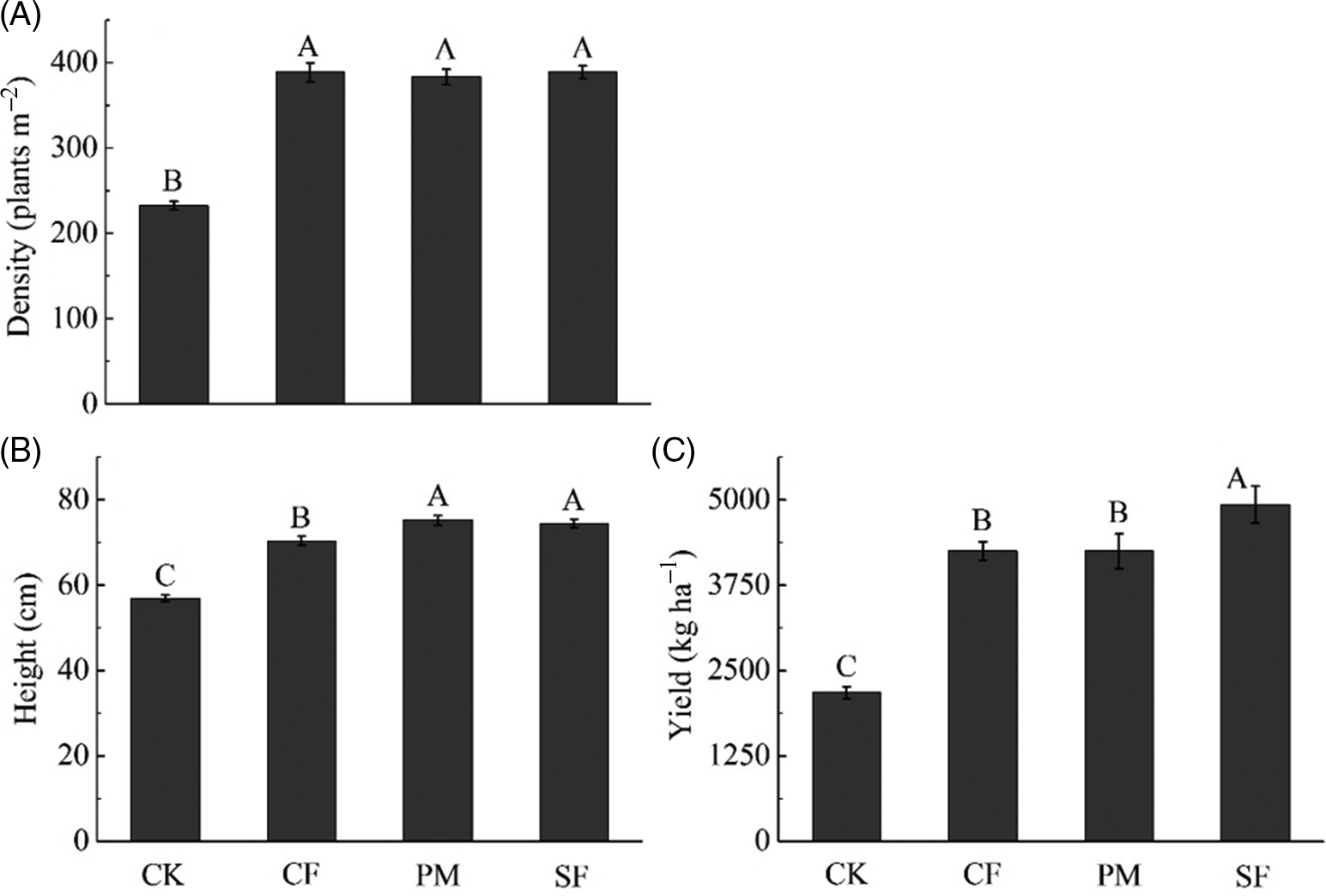
Different fertilization regimes provide various agrestal habitats for plants when they modify the soil fertility, chemical properties, aggregates, and microbial communities, changes that were observed in the plots of this study and have been reported by other researchers (Huang et al. Reference Huang, Jiang, Li, Ma, Tang, Ran and Shen2016; Liu et al. Reference Liu, Guo, Ran, Whalen and Li2015; Zhao et al. Reference Zhao, Ni, Li, Xiong, Ran, Shen, Shen and Zhang2014). In our study, the two-way ANOVA (Figure 1) indicated that the fertilization treatments (CF, PM, and SF) significantly increased the wheat density (P < 0.001), height (P < 0.001), and yield (P < 0.001) compared with the nonfertilized control treatment. The results were averaged over years for these three variables, as there was no significant fertilization by year interaction (P = 0.072, P = 0.094, and P = 0.225, respectively). Fertilization significantly increased the density, height, and yield of wheat, which is likely to be due to the greater competitive ability of the crop for the applied nutrients than the weeds. Straw retained in croplands could improve the soil structure and increase the amount of plant-available water and soil organic matter content and therefore could potentially enhance crop productivity (Yin et al. Reference Yin, Zhao, Li, Cheng and Liu2018; Zhao et al. Reference Zhao, Shar, Li, Chen, Shi, Zhang and Tian2018). In this study, averaged over 2017 and 2018, the wheat yield with the SF treatment was significantly higher than that obtained with the CF and PM treatments; however, in 2014 and 2015, the increase in wheat yield with the SF treatment was not significantly different from the yield increases with the CF and PM treatments (Zhang et al. Reference Zhang, Sun, Li, Sun, Yuan, Han, Duan, Ji, Zhu, Shen and Ran2019).
Mean density (A), height (B), and yield (C) of wheat under different fertilization regimes in 2017 and 2018. CK, control; CF, chemical fertilizer; PM, composted pig manure combined with chemical fertilizer; SF straw return combined with chemical fertilizer. Bars with the same letter are not significantly different according to the LSD test at P < 0.05.

Species, Density, and Shoot Biomass Differences at the Community Level
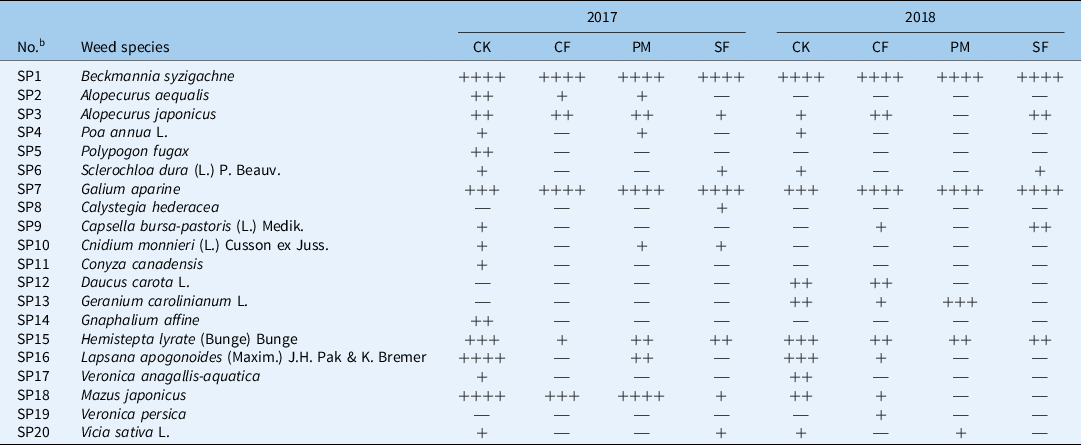
A total of 17 weed species belonging to 17 genera and 8 families were recorded in the experimental wheat fields in 2017, and 14 weed species representing 14 genera and 8 families were found in 2018 (Table 3). Of the 20 total species found in the two wheat seasons, 18, 11, 11, and 9 species occurred in the CK, CF, PM, and SF plots, respectively. Two species, B. syzigachne and G. aparine, were widely distributed regardless of treatment in 2017 and 2018. Five weed species were found in 2017 but not in 2018, and three weed species occurred in 2018 but did not occur in 2017. Four species, horseweed [Conyza canadensis (L.) Cronquist], Gnaphalium affine D. Don., water speedwell [Veronica anagallis-aquatica L.], and Asia minor bluegrass (Polypogon fugax Nees ex Steud.), grew only in the CK plots, whereas two species, Persian speedwell (Veronica persica Poir.) and Japanese bindweed (Calystegia hederacea Wall.), were absent in the CK plots in the two wheat seasons.
Weed community composition in wheat under different fertilization regimesin 2017 and 2018.a

a In this table, ++++, +++, ++, and + indicate the occurrence of the listed weed species in 4, 3, 2, and 1 replications, respectively; and — indicates no occurrence of the listed weed species.
b SP1–SP5, grassy weeds; SP6–SP21, broadleaf weeds.
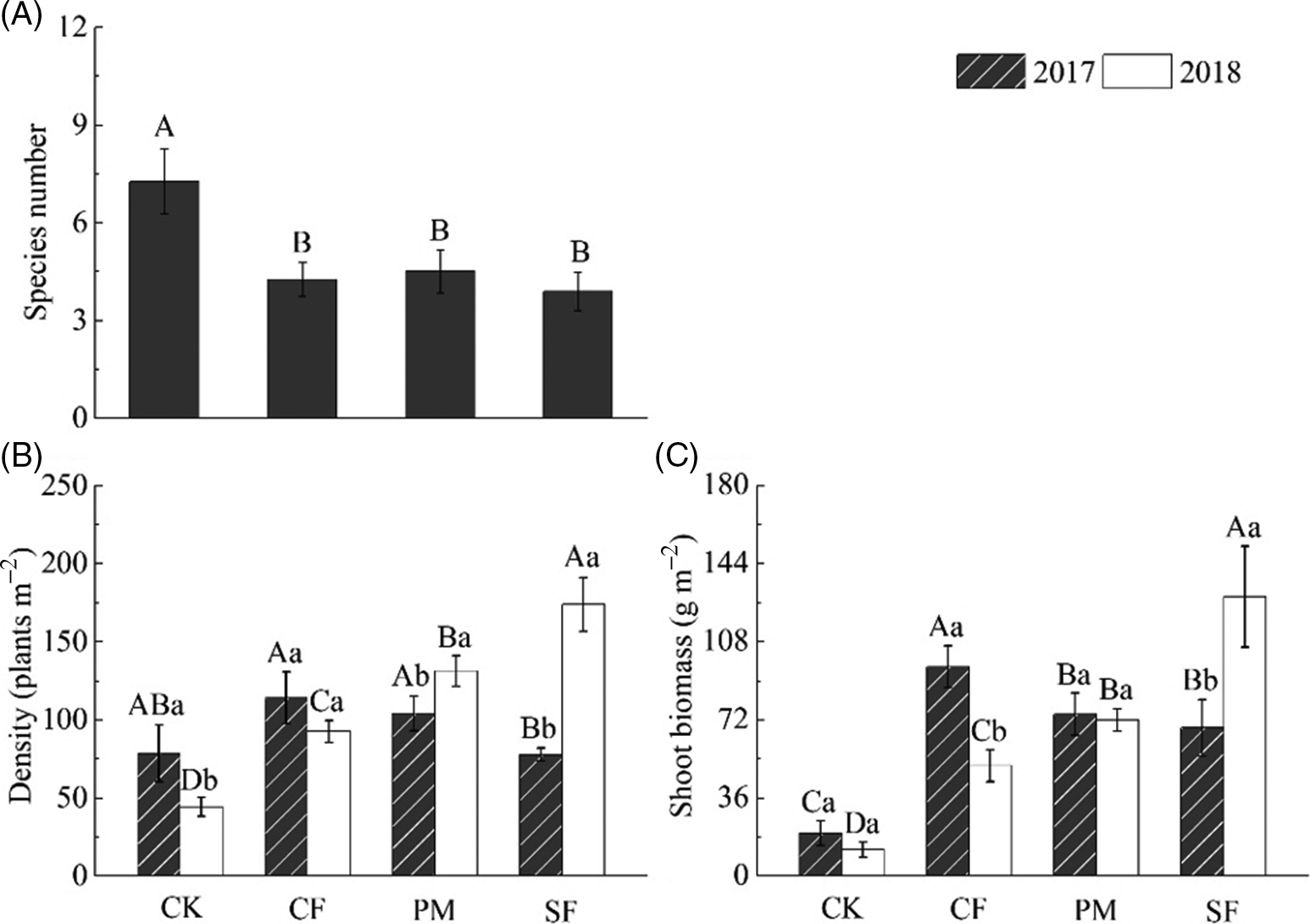
Because there was no significant year by treatment interaction effect on weed species number (P = 0.379), the effects of the different fertilization regimes were averaged over years (Figure 2A). Fertilization significantly reduced the weed species number (P = 0.010), while no differences among different fertilization treatments were observed. With fertilization, a decline in broadleaf weed species but no effect on grass weed species was observed in the previous report of this long-term trial (Zhang et al. Reference Zhang, Sun, Li, Sun, Yuan, Han, Duan, Ji, Zhu, Shen and Ran2019), which also implied a decrease in total weed species.
Species number (A), density (B), and shoot biomass (C) of wheat-associated weeds under different fertilization regimes in 2017 and 2018. CK, control; CF, chemical fertilizer; PM, composted pig manure combined with chemical fertilizer; SF straw return combined with chemical fertilizer. In different fertilization regimes during the same year, bars with the same uppercase letters are not significantly different, while within the same fertilization regime in different years, bars with the same lowercase letters are not significantly different according to the LSD test at P < 0.05.

The total density (Figure 2B) of wheat-associated weeds was significantly affected by fertilizer application (P < 0.001), while significant interaction effects between fertilizer application and year were also detected (P < 0.001); therefore, the effect on total weed density of the different treatments varied between 2017 and 2018. Compared with the CK treatment, the shoot biomass (P < 0.001) of wheat-associated weeds significantly increased in all fertilization treatments (CF, PM, and SF), and a significant interaction (P < 0.001) between fertilizer application and year was detected. The highest total weed density and mean shoot biomass of wheat-associated weeds occurred in the SF treatment in 2018. Temperature and rainfall are crucial environmental factors that can influence weed emergence (in addition to seasonal dormancy) as well as subsequent weed growth (Forcella et al. Reference Forcella, Benech-Arnold, Sanchez and Ghersa2000; Gardarin et al. Reference Gardarin, Guillemin, Munier-Jolain and Colbach2010). The lower minimum temperature of weed emergence and seedling stage and mean temperature of the wheat cropping season in 2018 (Table 1) may be responsible for the lower densities and biomass of wheat-associated weeds in the CK, CF, and PM treatments; whereas straw return may have reduced the soil temperature amplitude (Teasdale and Mohler Reference Teasdale and Mohler1993) and increased the amount of plant-available water (Zhao et al. Reference Zhao, Shar, Li, Chen, Shi, Zhang and Tian2018), which could explain the increase in density and biomass of wheat-associated weeds in the SF treatment in 2018. Although fertilization reduced the number of weed species, it significantly increased both the mean weed density in 2018 and weed biomass in both years. Therefore, the harmfulness of wheat-associated weeds was increased, because this parameter is determined by the total weed density and biomass rather than by the number of species (Moss et al. Reference Moss, Storkey, Cussans, Perryman and Hewitt2004; Moyer et al. Reference Moyer, Roman, Lindwall and Blackshaw1994).
Differences in the Dominant Weed Population
Relative Abundance (Ra)
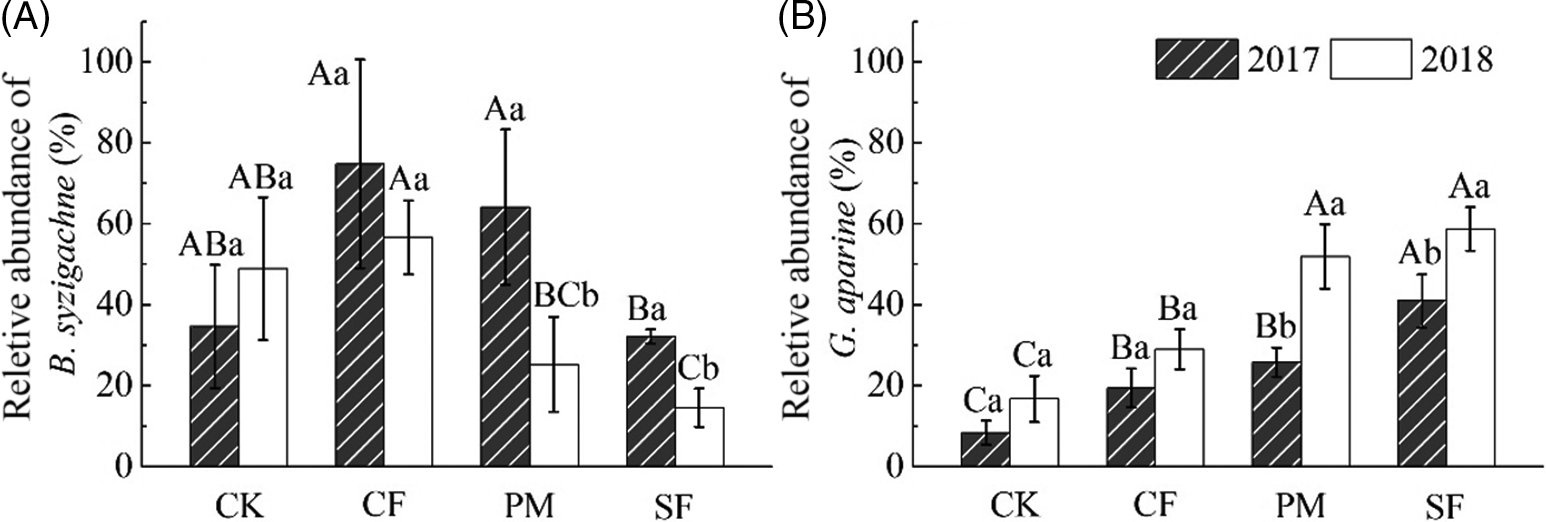
During the field surveys, we observed that B. syzigachne and G. aparine infested all plots regardless of treatment, and their relative abundance (Ra) was higher than that of other wheat-associated weeds (data not shown). The Ra of B. syzigachne (Figure 3A) was significantly affected by the fertilization regime (P = 0.001), and the treatment by year interaction was also significant (P = 0.016), due to lower Ra of B. syzigachne with the PM and SF treatments in 2018 than in 2017. While there was no difference in Ra between the CK and the CF treatments, Ra values with these two treatments were higher than those with the PM treatment in 2018 and the SF treatment in both 2017 and 2018. Both fertilization (P < 0.001) and year by treatment interaction (P = 0.003) significantly affected the Ra of G. aparine (Figure 3B), which was due to the higher Ra of G. aparine in the PM and SF treatments in 2018 compared with 2017. While all fertilization treatments increased the Ra of G. aparine compared with the CK treatment, the effect was greatest with the SF treatment in 2017 and with both the PM and SF treatments in 2018. It should be noted that G. aparine became the most dominant weed species in the PM and SF treatments, with Ra values higher than 50%.
Relative abundance (Ra) of Beckmannia syzigachne (A) and Galium aparine (B) in the wheat fields under different fertilization regimes in 2017 and 2018. CK, control; CF, chemical fertilizer; PM, composted pig manure combined with chemical fertilizer; SF straw return combined with chemical fertilizer. In different fertilization regimes during the same year, bars with the same uppercase letters are not significantly different, while within the same fertilization regimes in different years, bars with the same lowercase letters are not significantly different as determined by the LSD test at P < 0.05.

Densities
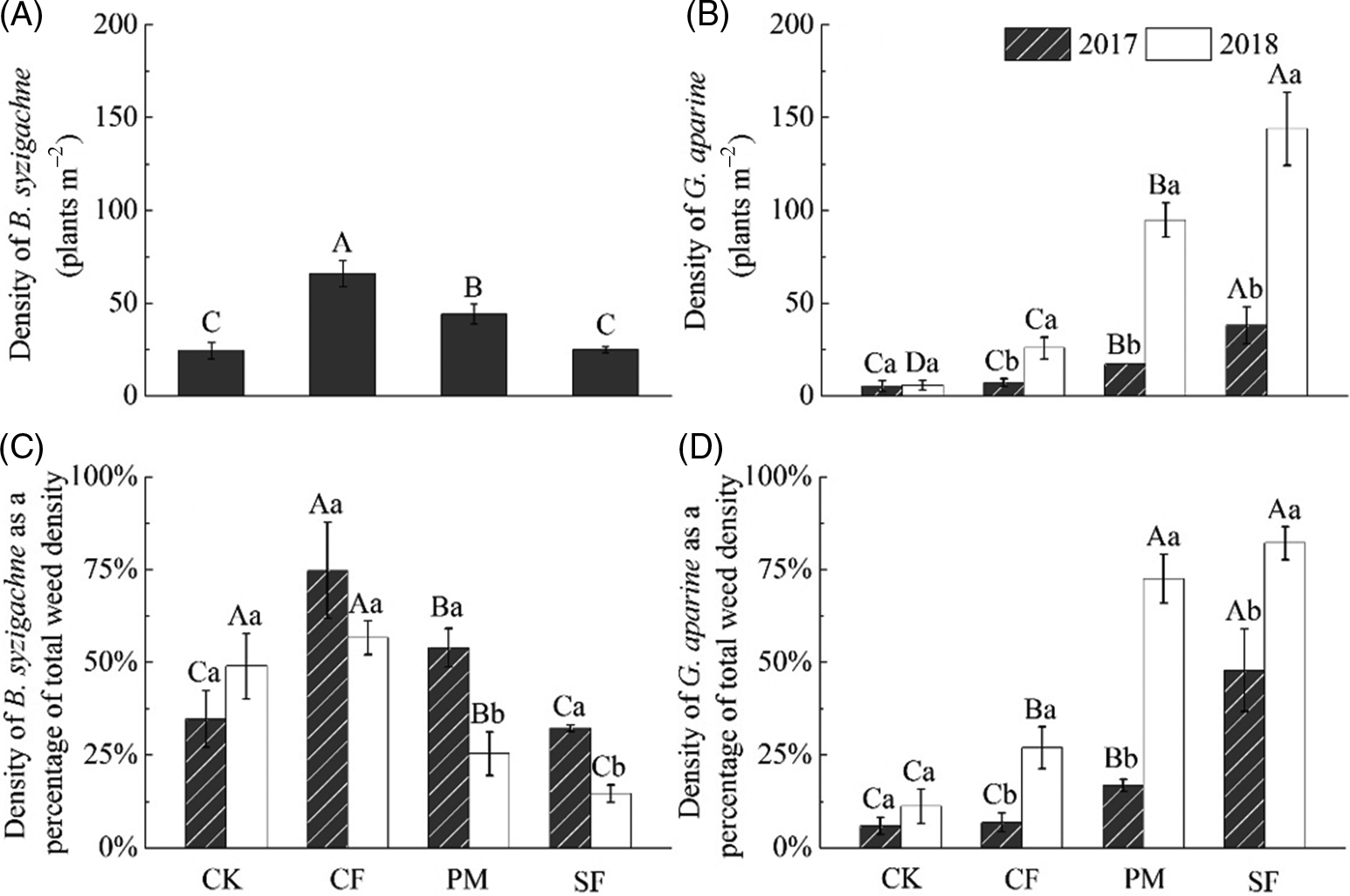
The B. syzigachne and G. aparine densities were greatly affected by fertilization (P < 0.001, P < 0.001, respectively) and year (P = 0.002, P < 0.001, respectively) (Figure 4A and B). However, only G. aparine density was affected by a significant fertilization by year interaction (P < 0.001), which manifested as significantly higher densities of G. aparine under PM and SF treatments in 2018 compared with those under the corresponding treatments in 2017 (Figure 4B). Averaged over years, B. syzigachne density was highest with the CF treatment, intermediate with the PM treatment, and lowest with the CK and SF treatments (Figure 4A).
Density of Beckmannia syzigachne and Galium aparine (A and B) as plants per square meter and as a percentage (C and D) of total weed density in wheat under different fertilization regimes in 2017 and 2018. CK, control; CF, chemical fertilizer; PM, composted pig manure combined with chemical fertilizer; SF straw return combined with chemical fertilizer. In different fertilization regimes during the same year, bars with the same uppercase letters are not significantly different, while within the same fertilization regimes in different years, bars with the same lowercase letters are not significantly different as determined by the LSD test at P < 0.05.

Although the densities of B. syzigachne and G. aparine as a percentage of the total weed density were significantly affected by fertilization (P < 0.001, P < 0.001, respectively), there were also significant year by treatment interaction effects (P = 0.030, P = 0.001, respectively) (Figure 4C and D). As a result, the densities of B. syzigachne as a percentage of the total weed density were higher than the CK with the CF and PM treatments in 2017 but not in 2018 (Figure 4C). With G. aparine, whereas all fertilization treatments in 2018 resulted in higher densities as a percentage of the total weed density than the CK, only the PM and SF treatments resulted in higher densities as a percentage the total weed density in 2017 (Figure 4D). In 2014 and 2015, G. aparine was not a dominant species (Zhang et al. Reference Zhang, Sun, Li, Sun, Yuan, Han, Duan, Ji, Zhu, Shen and Ran2019), and the density of broadleaf weeds was lower with the fertilization treatments than with the control; in 2018, the density of G. aparine was greatly increased and represented more than 70% of the total weed density with the PM and SF treatments. However, B. syzigachne maintained high infestation levels with the CF treatment from 2014 to 2018 (Figure 4C; Zhang et al. Reference Zhang, Sun, Li, Sun, Yuan, Han, Duan, Ji, Zhu, Shen and Ran2019).
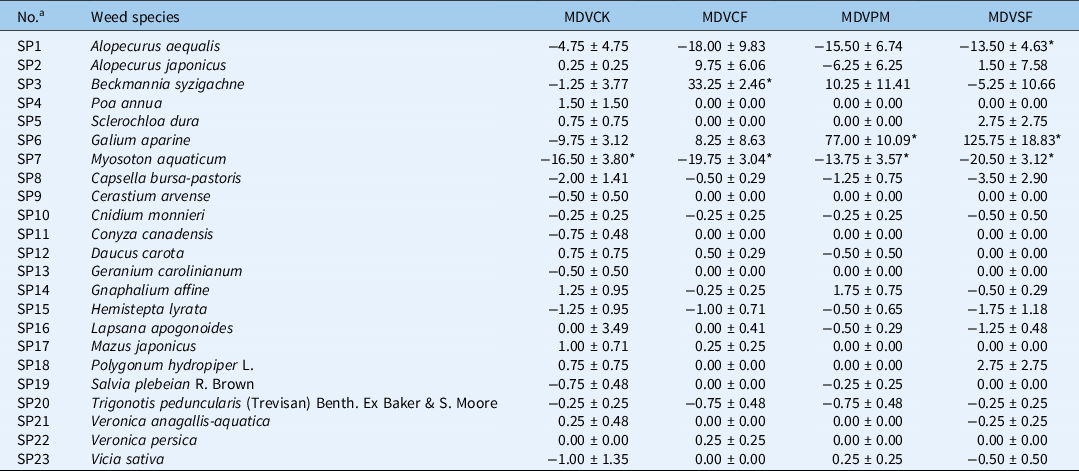
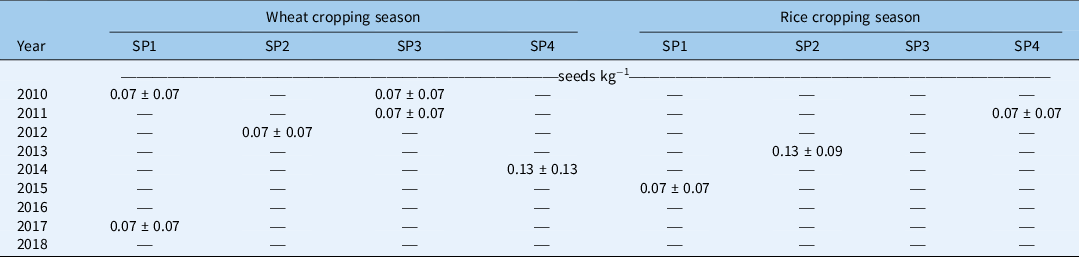
Mean density variation was also calculated to determine whether there were significant differences in weed densities due to fertilization treatments for the years 2011 and 2018. Compared with the initial wheat-associated weed density under different fertilization regimes in 2010 (Table 4), with the exception of shortawn foxtail (Alopecurus aequalis Sobol.), Japanese foxtail (Alopecurus japonicus Steud.), B. syzigachne, G. aparine, and water starwort [Myosoton aquaticum (L.) Moench], only a small variation was observed in the density of most weed species in 2018 compared with 2011. Although apparent decreases in density were observed with A. aequalis in the CF (P = 0.117) and PM (P = 0.061) treatments in 2018 compared with 2011, only the density decrease with the SF treatment was significant (P = 0.027). A significant increasing trend in the density of B. syzigachne was observed only in the CF treatment (P = 0.005) between 2011 and 2018, which was consistent with the results in Figure 4A and in our previous report (Zhang et al. Reference Zhang, Sun, Li, Sun, Yuan, Han, Duan, Ji, Zhu, Shen and Ran2019). The mean density variation between 2011 and 2018 for G. aparine was significant only with the PM (P < 0.001) and SF (P = 0.001) treatments (Table 4). Myosoton aquaticum was the only weed species that exhibited a decrease in mean density variation between 2011 and 2018 in all treatments (P = 0.005, P = 0.001, P = 0.008, and P = 0.001, respectively). The results of the seed contamination test of the pig manure compost showed that only a few seeds of Chinese milk vetch (Astragalus sinicus L.), barnyardgrass [Echinochloa crus-galli (L.) P. Beauv.], green foxtail [Setaria viridis (L.) P. Beauv.], and redroot pigweed (Amaranthus retroflexus L.) were observed in the pig manure compost (Table 5), and none of these seeds was viable from 2010 to 2018, which indicated that the density variation in wheat-associated weeds between 2011 and 2018 was unrelated to the seeds observed in the pig manure compost.
Mean density variation in the wheat-associated weeds under different fertilization regimes between 2011 and 2018 (mean ± SE).

a In this table, MDVCK, MDVCF, MDVPM, and MDVSF represent the mean density variation in wheat-associated weeds between 2011 and 2018 in no fertilizer, chemical fertilizer, composted pig manure combined with chemical fertilizer, and straw return combined with chemical fertilizer treatments, respectively. For the mean density variation, a positive value means a higher density occurred in 2018 than in 2011, a negative value means a lower density occurred in 2018 than in 2011, and an asterisk (*) indicates that the increase or decrease is significant according to the LSD test at P = 0.05.
b SP1–SP5, grassy weeds; SP6–SP23, broadleaf weeds.
The seed density of weed species contained in the pig compost manure in each wheat and rice cropping season from 2010 to 2018 (mean ± SE).a

a In this table, SP1, SP2, SP3, and SP4 represent Astragalus sinicus, Echinochloa crus-galli, Setaria viridis, and Amaranthus retroflexus, respectively; and — indicates no occurrence of the listed weed species.
The nature of the system plays an important role in the occurrence and distribution of weed species (Anderson Reference Anderson2005). Gao et al. (Reference Gao, Zhang, Shen, Mao, Wei, Wei, Zuo, Li, Song and Qiang2020) demonstrated that the rice–wheat cropping system favored the spread of paddy field weeds, with an increase in the seedbank of the proportion of rice-associated weeds, such as smallflower umbrella sedge (Cyperus difformis L.), monochoria [Monochoria vaginalis (Burm. f.) C. Presl ex Kunth], and prostrate false pimpernel [Lindernia procumbens (Knock.) Borb.], while a decrease occurred in the proportion of wheat-associated weeds, such as M. aquaticum, Asian mazus [Mazus japonicus (Thunb.) Kuntze], and neckweed (Veronica peregrina L.), in the soil seedbanks of both weeded and unweeded fields. Similar to our result, the density of M. aquaticum significantly decreased in a long-term rice–wheat rotation regardless of fertilization regime, which indicated that M. aquaticum may not be adapted to persist and thrive in the alternating dry–wet environment of wheat–rice cropping systems.
Crop residues can affect weed seed germination via physical and chemical changes in the weed seedbank by reducing the light transmittance and soil temperature amplitude (Teasdale and Mohler Reference Teasdale and Mohler1993) and releasing allelochemicals (Khanh et al. Reference Khanh, Xuan and Chung2007; Kruidhof et al. Reference Kruidhof, Bastiaans and Kropff2008). Moreover, compost could release phytotoxic compounds that may influence weed germination (Baskin and Baskin Reference Baskin and Baskin1998) or change the incidence and severity of soil-borne diseases of weeds (Conklin et al. Reference Conklin, Erich, Liebman, Lambert, Gallandt and Halteman2002). Our study further demonstrated that the CF treatment resulted in the highest density of B. syzigachne, while the densities of G. aparine with the PM and SF treatments were significantly higher than with the CK and CF treatments. The low density of B. syzigachne in the SF treatment (i.e., straw return with the same levels of chemical fertilizers as in the chemical fertilizer only treatment) implied that returning rice straw to the soil could possibly inhibit the germination and establishment of B. syzigachne observed with the CF treatment. The absence of a stimulatory effect on B. syzigachne with the SF fertilization regime was also reported for this long-term experiment in 2014 and 2015 (Zhang et al. Reference Zhang, Sun, Li, Sun, Yuan, Han, Duan, Ji, Zhu, Shen and Ran2019). Galium aparine has been reported to grow well under high nitrogen fertilization treatments (Mahn Reference Mahn1988), and a gradual decline of G. aparine was observed with the cessation of mineral fertilizer application due to a shift to organic farming with legumes used as green manure (Van Elsen Reference Van Elsen2000). Similarly, the increase in G. aparine density might be due to the increase in soil total nitrogen content with continuous compost and straw amendments, which was observed in our previous study in 2015 (Zhang et al. Reference Zhang, Sun, Li, Sun, Yuan, Han, Duan, Ji, Zhu, Shen and Ran2019).
Plant Height and Shoot Biomass
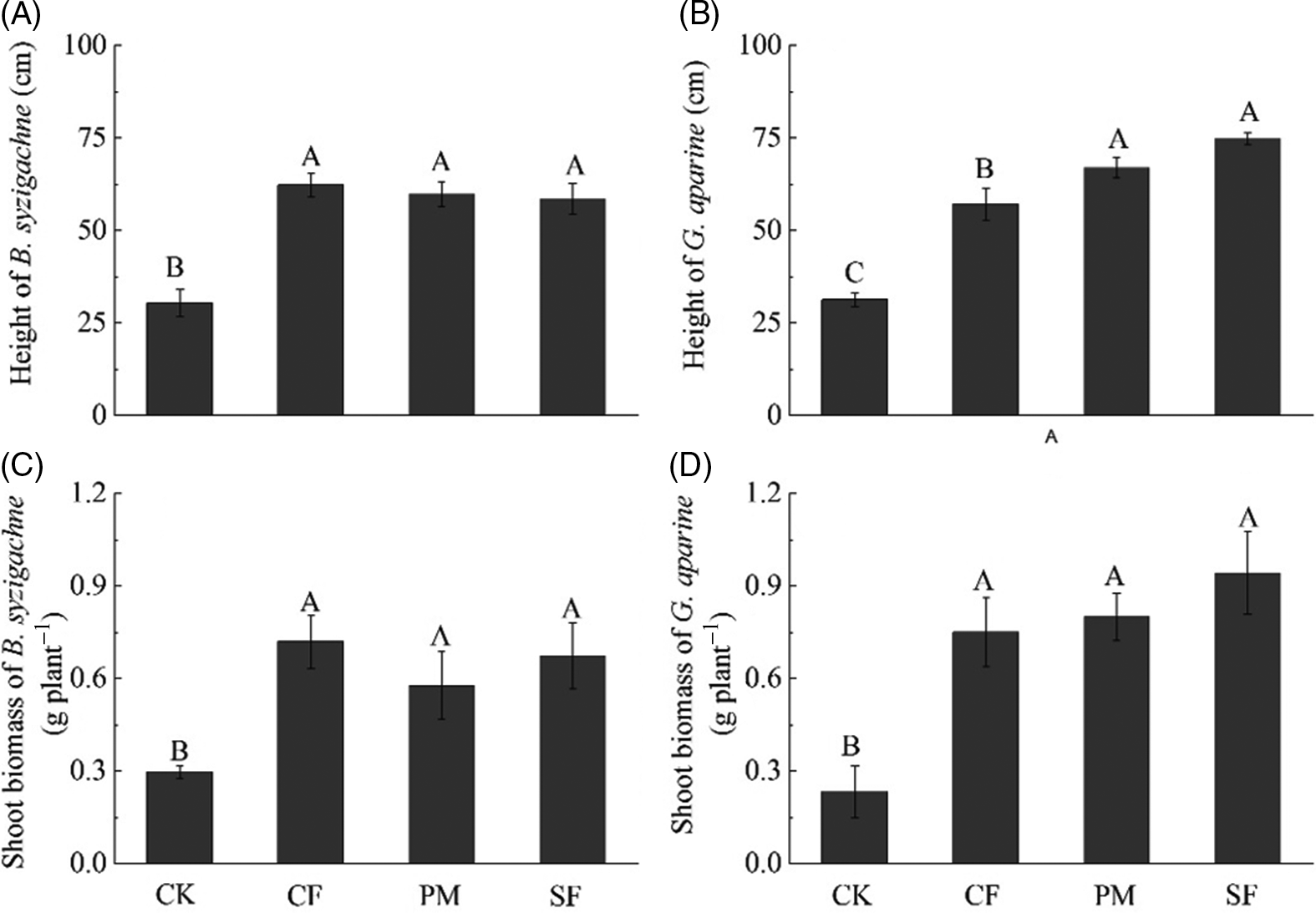
In the absence of significant year by treatment interaction, the main effects of fertilization regime on plant height and shoot biomass per plant of B. syzigachne and G. aparine averaged over years are presented (Figure 5). Fertilization significantly increased the height of B. syzigachne (Figure 5A) and G. aparine (Figure 5B) (P < 0.001, P < 0.001, respectively). While significant differences in the height of B. syzigachne were not observed among different fertilization treatments, G. aparine was taller with the SF and PM treatments than with the CF treatment, indicating that the pig manure compost application and straw return plus chemical fertilizer were more beneficial to the plant height of G. aparine than chemical fertilizer only.
Plant height (A and B) and shoot biomass (C and D) per plant of Beckmannia syzigachne and Galium aparine in wheat under different fertilization regimes in 2017 and 2018. Data were averaged over years. CK, control; CF, chemical fertilizer; PM, composted pig manure combined with chemical fertilizer; SF straw return combined with chemical fertilizer. Bars with the same uppercase letters are not significantly different as determined by the LSD test at P < 0.05.

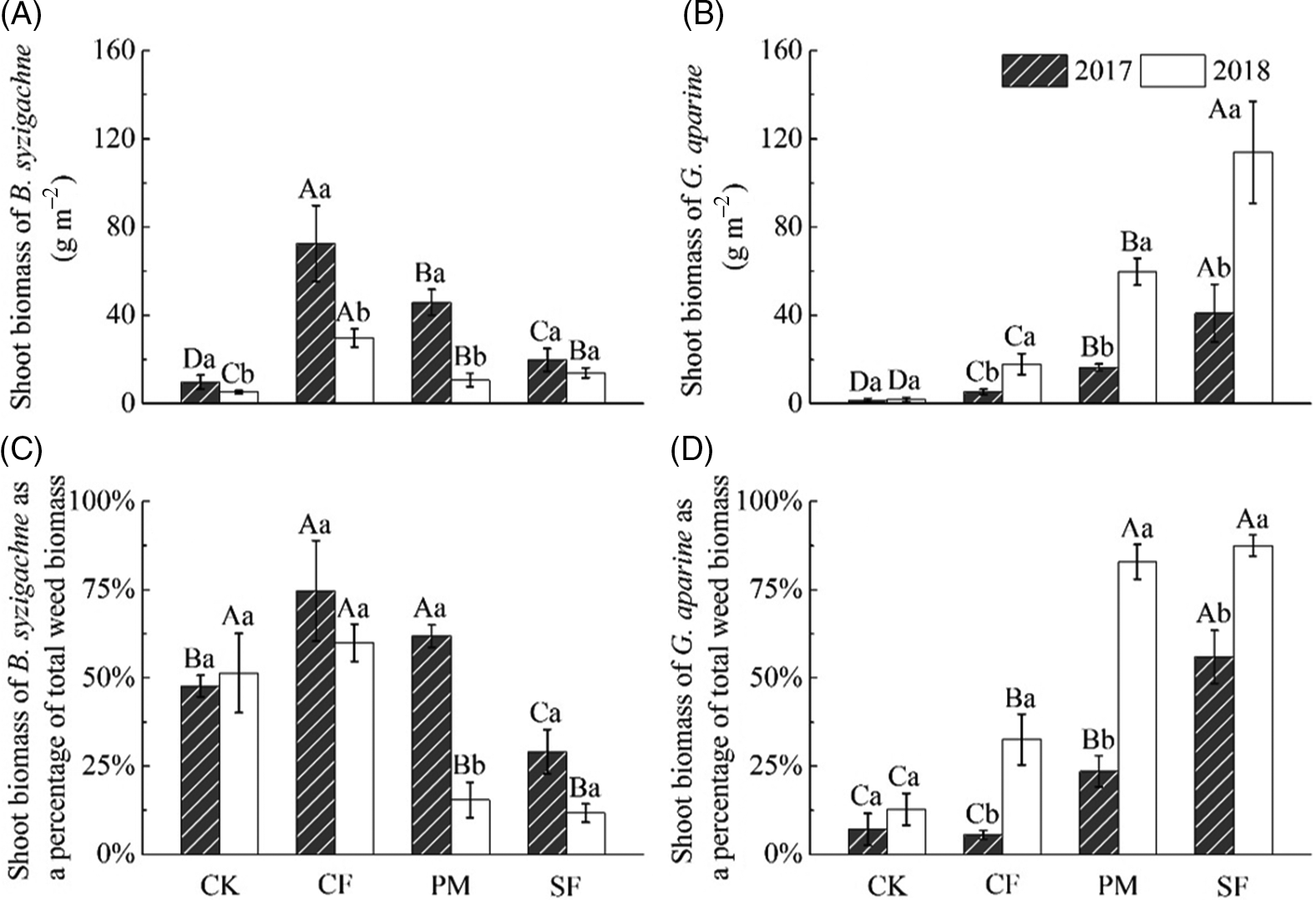
Fertilization significantly increased the shoot biomass per plant of B. syzigachne (P = 0.001) and G. aparine (P < 0.001), with no significant difference among different fertilization treatments (Figure 5C and D). The shoot biomass per square meter of B. syzigachne and G. aparine and their percentages of shoot biomass relative to total weed biomass were significantly affected by fertilization by year interaction (P = 0.021, P = 0.005, respectively; P = 0.022, P < 0.001, respectively) (Figure 6). The shoot biomass per square meter of B. syzigachne was highest with the CF treatment, while that of G. aparine and its percentage relative to total weed biomass were higher with the PM and SF treatments than with the CF and CK treatments in 2017 and 2018 (Figure 6A and B).
Shoot biomass of Beckmannia syzigachne and Galium aparine per square meter (A and B), and as a percentage of total weed shoot biomass (C and D) in wheat under different fertilization regimes in 2017 and 2018. CK, control; CF, chemical fertilizer; PM, composted pig manure combined with chemical fertilizer; SF straw return combined with chemical fertilizer. In different fertilization regimes during the same year, bars with the same uppercase letters are not significantly different, while within the same fertilization regimes in different years, bars with the same lowercase letters are not significantly different as determined by the LSD test at P < 0.05.

Under high soil fertility conditions, similar to crops, weed species may grow taller to capture more sunlight and increase their competitiveness (Tang et al. Reference Tang, Cheng, Wan, Li, Wang, Tao, Pan, Xie and Chen2014). As for fertilizer effects on weed density, our plant height and shoot biomass results indicated that for some weeds, the type of fertilizer matters. Although the height and shoot biomass per plant of B. syzigachne were significantly increased by fertilization with no significant difference among the fertilization treatments, the plant height and shoot biomass of G. aparine plants were greater with chemical fertilizer plus composted manure or rice straw amendments than with the chemical fertilizer-only treatment.
Seed Yield
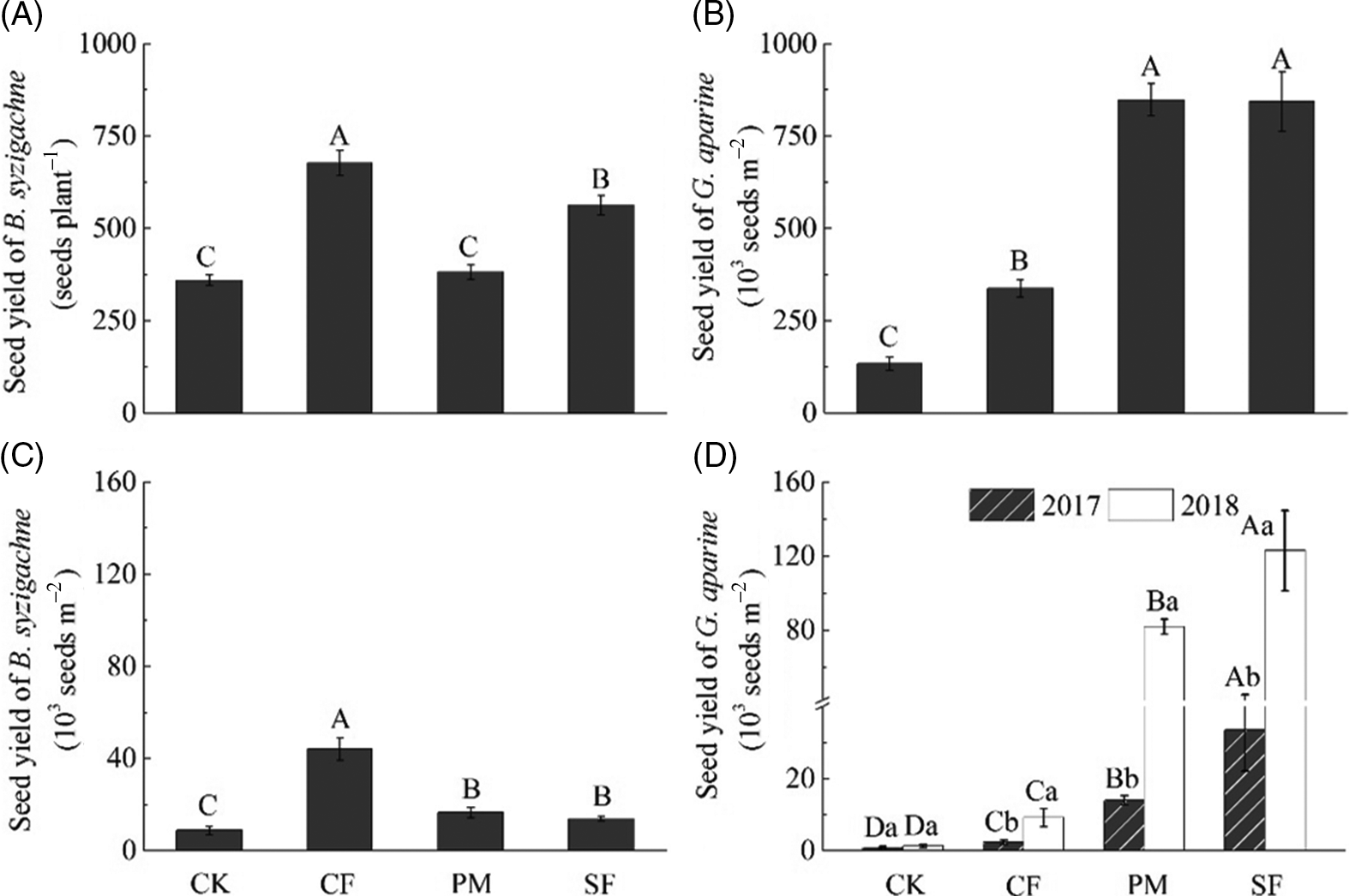
No significant effect of year by treatment interaction (P = 0.725, P = 0.989, respectively) was found for the seed yield per plant of B. syzigachne and G. aparine; therefore, the effects of fertilization regime were averaged over years (Figure 7A and B). The seed yield per plant of B. syzigachne was significantly affected by fertilization regime (P < 0.001), which was significantly increased with CF and SF treatments, but no significant differences were observed under the PM treatment. The seed yield per plant of G. aparine was significantly increased by fertilization (P < 0.001), with higher seed yields per plant with the PM and SF treatments than with the CF treatment.
Seed yield by weight and seed number of Beckmannia syzigachne (A and C) and Galium aparine (B and D) in wheat fields under different fertilization regimes in 2017 and 2018. CK, control; CF, chemical fertilizer; PM, composted pig manure combined with chemical fertilizer; SF straw return combined with chemical fertilizer. In different fertilization regimes during the same year, bars with the same uppercase letters are not significantly different, while within the same fertilization regimes in different years, bars with the same lowercase letters are not significantly different as determined by the LSD test at P < 0.05.

Seed yield was also assessed on a per unit area basis. Although seed yield per square meter of B. syzigachne was significantly affected by year (P = 0.009), no significant year by treatment interaction was detected (P = 0.177). Therefore, the effects of fertilization regimes on the seed yield per plant of B. syzigachne were averaged over years (Figure 7C). Fertilization significantly increased the seed yield per square meter of B. syzigachne (P < 0.001), and the effect was greatest with the CF treatment. Although the seed yield per plant of B. syzigachne was lower with the PM treatment than with SF treatment, there was no significant difference in the seed yield per square meter of B. syzigachne between PM and SF treatments, which can be attributed to the higher density of B. syzigachne with the PM treatment. The seed yield per square meter of G. aparine was significantly affected by year by treatment interaction (P < 0.001) (Figure 7D), with higher seed yields per square meter in 2018 than in 2017 with fertilizer application. As for seed yield per plant, seed yield per square meter was also highest with the PM and SF treatments.
Seed production is closely correlated with individual biomass (Jørnsgård et al. Reference Jørnsgård, Rasmussen, Hill and Christiansen1996); thus, species adapted to certain fertilizer conditions would produce more offspring than other weeds and increase in abundance in the community (Yin et al. Reference Yin, Cai and Zhong2005). Research has shown that the addition of pig manure compost not only increased the plant height, density, and shoot biomass of velvetleaf (Abutilon theophrasti Medik.) and waterhemp [Amaranthus tuberculatus (Moq.) Sauer] but also increased the seed yield of these two weeds, whereas it did not have an effect on the number of seeds produced by giant foxtail (Setaria faberi Herrm.) (Liebman et al. Reference Liebman, Menalled, Buhler, Richard, Sundberg, Cambardella and Kohler2004). Similarly, in our study, the plant height, density, and shoot biomass of G. aparine were increased by the compost and straw amendments, and the seed yield of G. aparine increased correspondingly. Jiang et al. (Reference Jiang, Shen, Gao, Shen and Dai2014) demonstrated that the long-term application of organic fertilizers could significantly reduce the density of the soil weed seedbank in a rice–wheat rotation system and improve diversity by increasing the advantage of crops and inhibiting the growth of dominant weeds. However, this finding is not well supported by our results, as the increased dominance of G. aparine was observed in wheat fields when fertilization regimes included pig manure compost and rice straw amendments. The density variation of B. syzigachne and G. aparine might be due to the different availability of nitrogen from different nutrient sources. The immediate and high availability of nitrogen from chemical fertilizer-only may favor B. syzigachne, whereas the compost and straw amendments may provide a slow release of nitrogen that favors G. aparine.
Fertilization and weeding are important agricultural practices that can contribute to higher productivity. Fertilization alters soil fertility, which affects crop growth as well as weed diversity and weed community composition. In the current assessment of this long-term trial in 2017 and 2018, the most commonly occurring weed species during wheat of a rice–wheat rotation were B. syzigachne and G. aparine. The application of the chemical fertilizer-only treatment resulted in increased density, shoot biomass, and seed yield per unit area of B. syzigachne, while compost manure and straw amendments applied together with chemical fertilizer led to significant increases in the corresponding characteristics of G. aparine. Different fertilization regimes resulted in the selective dominance or disappearance of some of the weed species. Further research is needed to identify sustainable ways of enhancing the diversity of rice–wheat rotation systems to prevent the selection of dominant weed species that are adapted to a limited suite of crop management practices.
Acknowledgments
The authors gratefully acknowledge the Key Research & Development Program of Jiangsu Province (BE2019343), the National Key Research and Development Program of China (2016YFD0200503-4; 2016YFD0200805), the Special Fund for Agro-scientific Research in the Public Interest (201103004) and the Independent Innovation Project of Agricultural Science & Technology of Jiangsu Province [CX(14)4044], the Postdoctoral Science Foundation of China (2020M671616), and a project funded by the Priority Academic Program Development of Jiangsu Higher Education Institutions (PAPD) for financial support. We thank Sheng Qiang (Nanjing Agricultural University, China) and Bernal E. Valverde (Tropical Agriculture Research and Development, Costa Rica) for their thoughtful advice on improving the article. The authors have no conflicts of interest to declare.