Introduction
Female stalkers are perhaps most closely associated in the public mind with the jilted former lover portrayed by Glenn Close in the film Fatal Attraction – a role that gave rise to the popular term ‘bunny boiler’ for women who refuse to relinquish relationships. Female stalkers of this type are not uncommon, although they do not represent all women who attract attention for stalking (Purcell et al. Reference Purcell, Pathé and Mullen2001; Meloy & Boyd, Reference Meloy and Boyd2003; Meloy et al. Reference Meloy, James, Mullen, Pathé, Farnham, Preston and Darnley2011). Female stalkers constitute between 10% and 25% of stalkers in epidemiological adult victim studies (Purcell et al. Reference Purcell, Pathé and Mullen2002; Baum et al. Reference Baum, Catalano, Rand and Rose2009), and similar rates in clinical and forensic samples (Palarea et al. Reference Palarea, Zona, Lane and Langhinrichsen-Rohling1999; Rosenfeld & Harmon, Reference Rosenfeld and Harmon2002; McEwan et al. Reference McEwan, Mullen, MacKenzie and Ogloff2009). To date there have been only three empirical investigations of adult female stalkers, the first describing 40 female stalkers and comparing them with 150 male stalkers seen at an Australian forensic psychiatric clinic (Purcell et al. Reference Purcell, Pathé and Mullen2001); the second an archival study of clinician and police records of 82 female stalkers from the USA, Canada and Australia (Meloy & Boyd, Reference Meloy and Boyd2003); and the third a comparative file review of 143 female stalkers and 862 male stalkers from across North America (Meloy et al. Reference Meloy, James, Mullen, Pathé, Farnham, Preston and Darnley2011).
In all three studies the rate of psychosis was high (25, 50 and 16% respectively), with delusions the most prominent symptom in the two former studies. Personality disorder was present in 50% of samples where information was available (13 of 22 assessed for personality disorder in Meloy & Boyd's sample; information on personality disorder was not available in the 2011 Meloy et al. study). Purcell et al. (Reference Purcell, Pathé and Mullen2001) found the only significant gender difference was that women were more likely than men to target a former professional contact (e.g. mental health professional, teacher or lawyer), and less likely to target strangers. An intimacy-seeking motivation was the most common among female stalkers in the sample, being significantly more likely than in the male sample. Meloy & Boyd (Reference Meloy and Boyd2003) described a similar relationship pattern, with 50% of women stalking a prior acquaintance, 27% stalking an ex-partner and 21% a stranger. Meloy et al. (Reference Meloy, James, Mullen, Pathé, Farnham, Preston and Darnley2011) identified a slightly different pattern, perhaps associated with the fact that a significant proportion of cases were sourced from the corporate security department of a large entertainment company. In this sample, 60% of women stalked strangers (82% of whom targeted public figures), 22% targeted an ex-partner and 18% an acquaintance. Using the same tripartite classification in Purcell et al.'s (Reference Purcell, Pathé and Mullen2001) sample, 72.5% stalked acquaintances, 22.5% stalked former partners and 5% stalked strangers.
A notable finding from Purcell et al.'s (Reference Purcell, Pathé and Mullen2001) study was that female stalkers were no less violent than male stalkers. Nine of 40 (22.5%) female stalkers were violent, with similar figures reported by Meloy & Boyd (Reference Meloy and Boyd2003) and Meloy et al. (Reference Meloy, James, Mullen, Pathé, Farnham, Preston and Darnley2011). The two later studies both reported stalking violence in 25% of cases (although the definition of violence in the latter study included property damage). Meloy & Boyd (Reference Meloy and Boyd2003) reported a moderate relationship between prior sexual intimacy and violence, whereas Meloy et al. (Reference Meloy, James, Mullen, Pathé, Farnham, Preston and Darnley2011) found a large positive relationship between these variables. In both studies threats were associated with violence; in the former the relationship was small, whereas in the latter a large effect size was found.
Although there are similarities between male and female stalkers, gender differences in motivation and victim type have also been identified (Meloy et al. Reference Meloy, James, Mullen, Pathé, Farnham, Preston and Darnley2011). It is possible that some risk factors have different utility for female stalker violence, as has been suggested in the general violence risk assessment literature (see Garcia-Mansilla et al. Reference Garcia-Mansilla, Rosenfeld and Nicholls2009, for a review). If this were true, clinicians would need to tailor risk assessment processes for female stalkers. This paper reports rates of violence and potential risk factors for violence in a new sample of female stalkers. These results were compared to those found in an equivalent male sample, and a predictive model for violence was developed and tested. As no prior research has examined predictors of violence among female stalkers, this study was exploratory in nature and sought to identify all possible associations between stalker characteristics and violence rather than test specific hypotheses.
Method
Participants
The sample of 71 female and 479 male stalkers was gathered in Sweden and Australia (50 females and 289 males were Swedish). Women accounted for 9% of stalkers in both countries. Swedish stalkers were originally identified by police in a mid-sized city in 2005 and the sample extended in a suburb of Stockholm between 2007 and 2010. As Sweden does not have anti-stalking legislation, police were trained in recognizing stalking and collecting relevant information, and data collection was overseen by the first author (S.S.). Police used a set of structured guidelines to collect relevant case material, in addition to recording background data and a brief case description. The Australian data were collected between 2002 and 2007 at a specialist stalking clinic in Melbourne. The only criterion for referral to the clinic is evidence of stalking behaviour and mental illness is not a prerequisite. Referrals were received from courts, probation services, general mental health services, and the parole board. Each stalker was assessed by a psychiatrist and a psychologist and relevant historical material was gathered from the individual and the referral materials. Individuals whose mental state or lack of English precluded them from providing informed consent were excluded from the study.
To identify mental disorder, Swedish sample police officers underwent training by a forensic psychiatrist to improve their identification of gross symptoms of mental disorder. Using structured guidelines, officers recorded mental disorder as present, possibly or partially present, or absent. A judgement of ‘present’ required that the officer was aware of a formal psychiatric diagnosis, or the perpetrator's presentation was strongly suggestive of symptoms. Recent research has shown that police are able to recognize gross signs of mental disturbance consistent with severe mental illness (Godfredson et al. Reference Godfredson, Thomas, Ogloff and Luebbers2010, in press); however, this variable is a crude measure that probably includes only the most overt symptoms of psychosis and severe personality disorder. In the Australian sample specific diagnosis was possible in all cases. For the purposes of data analysis of mental disorder in the entire sample, the Australian variables ‘psychosis’ and ‘personality disorder’ were collapsed as these were considered most likely to be commensurate with the Swedish police judgements of mental disorder being ‘present’.
The Australian study was approved by the Monash University Human Research Ethics Committee and the Swedish study used de-identified data from police records with the permission of the police authorities.
Definitions of variables
Stalking was defined as repeated unwanted intrusions causing fear or apprehension. In the Australian study stalking was judged present if intrusions continued for at least 2 weeks (in the absence of a police charge).
Mental disorder was defined as any case in which a Swedish police officer judged disorder to be ‘present’, or any Australian case in which a psychotic disorder or personality disorder diagnosis was made.
Violence was defined as any physical contact intended to coerce or harm, or attempted physical contact with a weapon. Two cases were coded as violent in which an armed female offender clearly intended to harm the victim but did not succeed (one stalker hid in the victim's garden with a knife but the victim did not return home that night and was not hurt; another broke into the victim's home armed with a knife but the victim was warned and was not present).
Prior relevant offending was any formal record of prior violence, stalking or threat offences, or violence, stalking or threats acknowledged by the perpetrator that did not result in charges.
Approach behaviour was defined as any stalking behaviours that achieved close physical proximity to the victim, including loitering near, following, accosting the victim, or trespassing in their home.
Stalker motivation was defined by classifying stalkers according to Mullen and colleagues' motivational typology, which includes five categories based on the context in which the stalking emerged, the nature of the prior relationship, and the presence of mental illness (Mullen et al. Reference Mullen, Pathé, Purcell and Stuart1999). In the Swedish sample motivational types were assigned by S.S. based on file material and case descriptions using a previously published decision tree to ensure judgement consistency (MacKenzie et al. Reference MacKenzie, McEwan, Pathé, James, Ogloff and Mullen2009). In the Australian sample decisions about stalker type were made at the time of assessment by the assessing clinicians. Cases in which motivation was unclear were discussed with the wider team until consensus was reached.
Statistical analyses
Non-parametric analyses were used because of the relatively small sample of female stalkers. The exploratory nature of the research meant that all possible associations were of interest.
When comparing samples of different size, particularly when one is much smaller than the other, there is an increased risk of Type II error (not identifying a significant result where one exists). Statistical correction of the significance level was not used as this would have further increased the risk of Type II errors and hidden possible associations. Moreover, the limited power associated with the small sample size already minimized the risk of Type I error (obtaining a significant result where none exists). These initial results therefore need to be tested in larger samples to confirm their validity.
Data analysis was conducted using SPSS version 17.0 (SPSS Inc., USA). Univariate categorical analyses used the χ2 statistic (and Fisher's exact test where the cell size was less than five), with ϕ correlations and odds ratios (ORs) as measures of effect size. Analysis of stalking duration used the non-parametric Mann–Whitney U test to rank and compare as some cases were recorded in an approximate fashion (e.g. ‘began in mid-2005’) and distribution was non-normal whereas age was analysed using Student's t test. Multivariate analyses to predict violence used binary logistic regression with a forward stepwise entry and likelihood ratio model. Sensitivity, specificity and receiver operating characteristic (ROC) curves were used to determine the predictive accuracy of the multivariate model.
Results
Comparison of the Swedish and Australian samples revealed that there were no significant differences between the two samples in gender distribution, age or duration of stalking. The only significant clinical or behavioural differences were higher rates of substance misuse and identified mental illness in the Australian sample [OR 2.4, 95% confidence interval (CI) 1.0–5.7 and OR 3.0, 95% CI 1.0–8.9 respectively], most probably because clinicians were responsible for collecting Australian data. Australian stalkers were less likely to have stalked an ex-partner (OR 0.3, 95% CI 0.1–0.8) and more likely to have stalked after a professional encounter or to target a stranger (OR 13.9, 95% CI 1.7–114.9 and OR 5.9, 95% CI 1.2–29.4 respectively). These differences were probably due to the different legal contexts of the data collection. The fact that Sweden does not have anti-stalking legislation may result in only those cases that come within the realm of domestic violence being taken up by the police, whereas Australian victims may find it easier to seek assistance for non-ex-intimate stalking. With the exception of these variables, the two groups were remarkably similar and were suitable to merge for subsequent analysis (further information on the two samples is available in Strand & McEwan, Reference Strand and McEwan2011).
Female stalker characteristics
The female stalkers' mean age was 37.4 years (s.d.=12.3), not significantly different from the male sample [mean age 37.7 years, s.d.=11.8, t(540)=0.21, n.s.]. Female stalkers were less likely to have a relevant criminal history than male stalkers (28% v. 63%, OR 0.40, 95% CI 0.24–0.68), but they were equally likely to be subject to a restraining order concerning their current stalking victim (28% v. 35%).
Psychiatric status
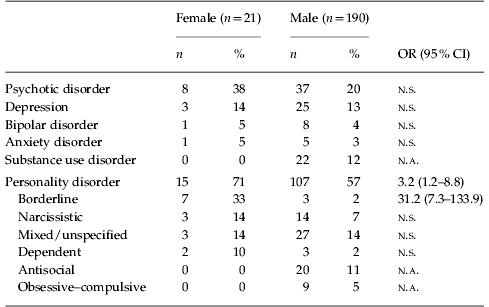
Mental disorder was prevalent, being present in 52 female stalkers (84%) and 291 male stalkers (79%). Only the Australian subsample (n=211, 21 women) could be reliably evaluated for specific Axis I and II diagnoses and a gender comparison is shown in Table 1. Women were significantly more likely to be diagnosed with personality disorder (OR 3.2, 95% CI 1.2–8.8), with borderline personality disorder being most common. Thirteen women (62%) and 119 men (63%) were diagnosed with an Axis I disorder. Psychotic disorders were more prevalent among women, although this difference only approached significance [χ2(1)=3.57, p=0.06]. Four women had schizophrenia with persecutory and/or grandiose delusions, one had schizophrenia with erotomanic delusions, and two had mono-delusional disorders, one paranoid and one erotomanic.
Frequency of psychiatric diagnoses among Australian male and female stalkers

OR, Odds ratio; CI, confidence interval; n.s., not significant; n.a., not applicable.
Prior relationship to victim
In 94% of cases the female stalker pursued someone known to them. Thirty-one (44%) targeted a former intimate partner, 10 (14%) a neighbour, nine (13%) prior professional contacts, another nine (13%) former friends or family members, four (6%) stalked a casual contact, four (6%) a stranger, and one a workplace contact. Prior relationship types differed significantly by gender, with female stalkers more likely to have stalked a professional contact (13% v. 5%, OR 3.0, 95% CI 1.3–6.8), friend/family member (13% v. 5%, OR 2.8, 95% CI 1.2–6.3), or neighbour (14% v. 4%, OR 3.8, 95% CI 1.7–8.4). Men were more likely to target an ex-intimate partner (60% v. 40%, OR 1.9, 95% CI 1.2–3.2) or a stranger (17% v. 6%, OR 3.3, 95% CI 1.2–9.4). The rate of same-gender stalking was significantly higher among women (50% v. 13%, OR 6.7, 95% CI 3.9–11.7).
Stalking motivation
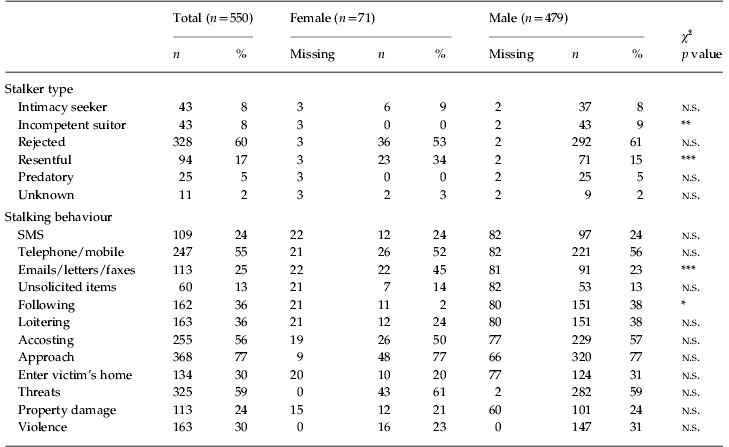
Thirty-five (52%) women were classified as Rejected stalkers, the majority coming from the Swedish sample. In these cases the stalking arose out of the breakdown of an intimate relationship (sexual or platonic). Two notable stalkers in this category were older women who began stalking the former partner of a male relative in an attempt to make the victim return to the family. A further 36% (n=24) had a Resentful motivation and the stalking was an attempt to punish the victim for a perceived slight or mistreatment. These women varied from those who perceived mistreatment in the workplace to strangers responding to paranoid delusions. A further six women were Intimacy Seekers (9%) (predominantly from the Australian sample), whose stalking arose from a desire to establish a loving, intimate relationship with the victim. The majority of Intimacy Seekers suffered from erotomanic delusions or had a morbid infatuation with the victim. No female stalkers were classified as Incompetent Suitors (those using socially unacceptable means of obtaining a date) or Predatory (those pursuing sexually deviant gratification through stalking behaviour). Six individuals were unable to be classified by motivation (five Swedish). The proportion of Rejected and Intimacy Seeking motivations did not differ between genders, although women were significantly less likely to stalk with a Resentful motive (15% v. 34%, OR 0.3, 95% CI 0.2–0.6). An additional 43 (9%) of the male sample were classified as Incompetent Suitors, and 25 (5%) as Predatory stalkers.
Stalking behaviours and duration
There were few gender differences in stalking behaviours (see Table 2). Female stalkers were more likely to communicate by email, letter or fax (OR 2.7, 95% CI 1.5–5.1) and less likely to follow (OR 0.4, 95% CI 0.2–0.9). There was no gender difference in the rates of threats or property damage.
Gender comparisons of the frequency of different stalking motivations and types of stalking behaviour

n.s., not significant (p>0.05); SMS, Short Message Service (text messaging).
Differences were calculated with the χ2 test (df=1) and Fisher's exact test.
* p<0.05, ** p<0.01, *** p<0.001.
The duration of stalking ranged between 1 week and 11 years for the female group (median=31 weeks), and between 1 week and 20 years for the male group (median=21 weeks), a difference approaching significance (U=13 407, p=0.06).
Female stalking violence
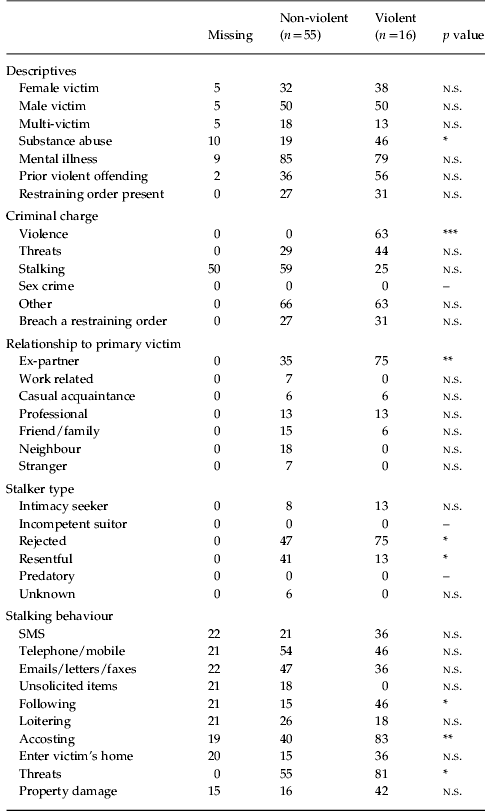
Sixteen of 71 (23%) female stalkers and 147 of 479 (31%) male stalkers used violence during the stalking episode. There was no significant difference between genders in the frequency of violence (χ2=2.0, p=0.16, OR 1.5, 95% CI 0.8–2.7). The nature of female stalker violence ranged from minor acts such as slapping and pushing to serious assaults and the two aforementioned thwarted attempts to harm the victim. Table 3 shows comparisons of violent and non-violent women. Violent female stalkers were significantly more likely to be misusing substances at the time of the stalking behaviour (OR 3.7, 95% CI 1.0–13.8), to be a former sexual intimate (OR 5.7, 95% CI 1.6–20.1), and to have a Rejected motivation (OR 3.4, 95% CI 1.0–11.9). Women with a Resentful motivation were significantly less likely than others to be violent (OR 0.2, 95% CI 0.04–0.99). Violence was significantly related to two types of approach behaviour, following (OR 4.7, 95% CI 1.1–20.0) and accosting the victim (OR 7.5, 95% CI 1.5–38.9), and the relationship between threats and violence approached significance (OR 3.6, 95% CI 0.9–14.1).
Demographic, offence-related and behavioural differences between violent and non-violent female stalkers (n=71)

n.s., not significant (p>0.05); SMS, Short Message Service (text messaging).
Differences were calculated with the χ2 test (df=1) and Fisher's exact test.
* p<0.05, ** p<0.01, *** p<0.001.
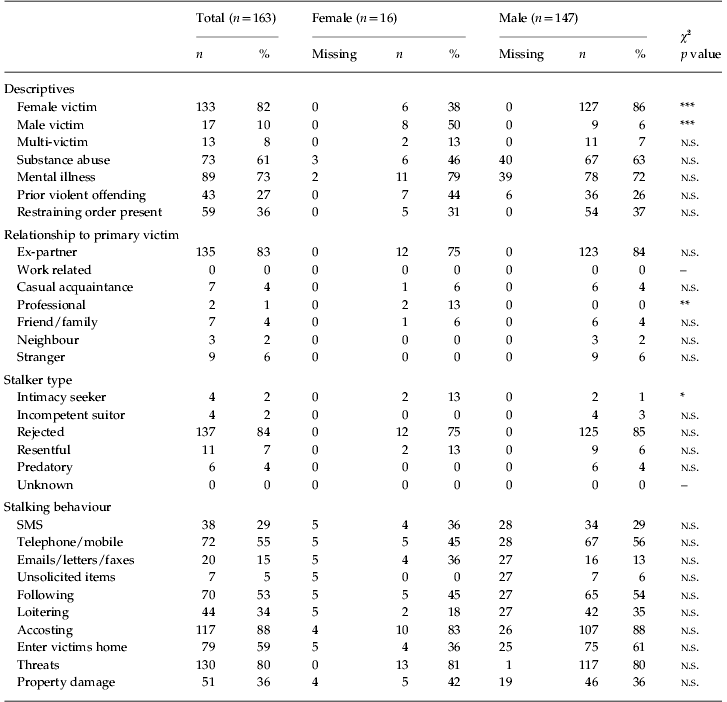
Every variable associated with female stalker violence also effectively differentiated between violent and non-violent male stalkers. Direct comparison of male and female violent stalkers (shown in Table 4) identified only three variables that differentiated between genders. Both were significantly more likely to be violent towards an opposite-gender victim: 94% of violent male stalkers targeted a female victim (OR 15.4, 95% CI 4.7–50.0) and 63% of violent female stalker targeted males (OR 10.6, 95% CI 3.5–32.3). Prior professional contacts were targets of only female stalking violence (one victim was a university lecturer and the other a counsellor). Both women stalked with an Intimacy Seeking motivation and together meant that women were more likely than men to be violent when stalking with this motivation (12% v. 1%, OR 11.1, 95% CI 1.4–76.9). The nature of violence in these cases was notable as it involved unauthorized entry into the victims' homes, and violence was directed towards both the victim and a third party (in one case the victim's partner and in the other the victim's daughter).
Demographic, offence-related and behavioural differences between violent female and male stalkers

n.s., not significant (p>0.05); SMS, Short Message Service (text messaging).
Differences were calculated with the χ2 test (df=1) and Fisher's exact test.
* p<0.05, ** p<0.01, *** p<0.001.
A multivariate model for stalker violence
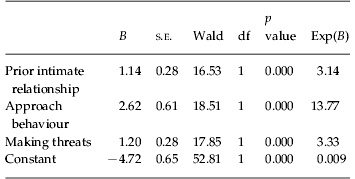
After excluding cases with missing data, 62 women remained in the sample (14 violent). As univariate predictors of violence showed few gender differences, a single logistic regression model was calculated for stalkers of both genders. All variables positively related to violence were entered into the binary logistic regression model. Different types of approach behaviour were combined into a single variable for consistency with proximity variables used in previous research (Palarea et al. Reference Palarea, Zona, Lane and Langhinrichsen-Rohling1999; McEwan et al. Reference McEwan, Mullen, MacKenzie and Ogloff2009). The final model showed that the combination of a prior intimate relationship, approach behaviours and threats best predicted violence (see Table 5). The value of this model was then tested separately within each gender. Among female stalkers the model had a sensitivity of 50% and a specificity of 85%. The area under the curve (AUC) in the ROC was 0.80 (95% CI 0.69–0.91). Among the 412 male stalkers the model had a sensitivity of 67% and a specificity of 79%. ROC analysis produced an AUC of 0.78 (95% CI 0.74–0.83).
Logistic regression model predicting stalking violence

s.e., Standard error; df, degrees of freedom.
Nagelkerke R 2=0.31, Hosmer–Lemeshow test χ2=12.90, p=0.012.
Discussion
Female stalkers in this sample were as violent as their male counterparts. Violence was as prevalent as in previous research, used by approximately one in every four female stalkers.
Risk factors for female stalking violence
The same general behavioural, motivational and relationship factors were relevant to violence for women and men. Although more univariate risk factors were identified among male stalkers, this may be the result of a larger sample size allowing for greater diversity among males. Consistent with previous research into stalking violence, the multivariate model showed that, regardless of gender, angry, threatening ex-partners whose behaviour places them in close physical proximity to the victim are the most likely to be violent (Palarea et al. Reference Palarea, Zona, Lane and Langhinrichsen-Rohling1999; Rosenfeld & Harmon, Reference Rosenfeld and Harmon2002; Rosenfeld & Lewis, Reference Rosenfeld and Lewis2005; McEwan et al. Reference McEwan, Mullen, MacKenzie and Ogloff2009). For stalkers of both genders there was an approximately 80% chance that violence would be present if the stalker had all three model characteristics. These results echo those of Meloy et al. (Reference Meloy, James, Mullen, Pathé, Farnham, Preston and Darnley2011), who found that prior sexual relationship and uttering threats had the strongest relationship with female stalking violence in their sample (they did not examine the role of approach behaviours).
Although the model effectively identified violence among individuals with these characteristics, it performed no better than chance when predicting all female stalker violence. Among the seven violent female stalkers not detected by the model, two of the three predictors were present in each case. In three cases violence was directed towards the primary victim's current or former partner, and the stalker approached but did not threaten. A fourth woman resentfully targeted a former friend and threatened and approached her. The final three were all psychotic stalkers (two intimacy seeking and one resentful) whose violence was motivated by delusional beliefs about the victim. All three threatened prior to the assault and two had previously approached the victim.
Implications for risk assessment of female stalkers
Victims of female stalkers frequently report that they are taken less seriously by law enforcement agencies (Hall, Reference Hall and Meloy1998; Purcell et al. Reference Purcell, Pathé and Mullen2001). The findings of this study, combined with previous research, clearly show that there is no evidence for differential treatment. Approximately one-quarter to one-third of stalking victims are subject to physical violence, regardless of stalker gender, and the duration of stalking behaviours is equivalent in males and females. Neither victims', clinicians' nor courts' assessments of the risk posed by female stalkers should be influenced by gender, as the base rate of violence is the same for both. The consistency with which risk factors were identified between genders suggests that existing stalking risk assessment instruments can be applied to both men and women, although further research is required to establish their predictive validity.
It is notable that female ex-intimate partners were significantly more likely to be violent than other stalkers. These findings are consistent with previous data showing that violence occurs in the majority of ex-intimate stalking cases, male or female (Palarea et al. Reference Palarea, Zona, Lane and Langhinrichsen-Rohling1999; Purcell et al. Reference Purcell, Pathé and Mullen2002; Mohandie et al. Reference Mohandie, Meloy, Green-McGowan and Williams2006). Meloy et al. (Reference Meloy, James, Mullen, Pathé, Farnham, Preston and Darnley2011) posit that this disparity is a consequence of stronger attachment bonds between stalker and victim in ex-intimate cases. These findings support the notion that ex-intimate partners should be considered as a discrete group when undertaking risk assessments for violence, as the base rate of violence is considerably higher than among other stalkers (McEwan et al. Reference McEwan, Mullen, MacKenzie and Ogloff2009; Meloy et al. Reference Meloy, James, Mullen, Pathé, Farnham, Preston and Darnley2011).
Although these findings show that threatening female stalkers who approach their ex-partner (or their ex-partner's new lover) account for a significant proportion of female stalking violence, this combination of characteristics should not be relied upon as the only indicator of increased risk. There was a small group of female stalkers who targeted strangers and acquaintances in the context of a severe mental illness and psychotic symptoms.
The relationship between psychosis and stalking violence is unclear. Early studies suggested a negative relationship (Kienlen et al. Reference Kienlen, Birmingham, Solberg, O'Regan and Meloy1997), but more recent work has indicated that a positive relationship exists but is mediated by other factors (Rosenfeld & Lewis, Reference Rosenfeld and Lewis2005; McEwan et al. Reference McEwan, Mullen, MacKenzie and Ogloff2009). As has been discussed in the wider literature on psychosis and violence, it may be that, in the context of other specific acute risk factors, the risk of violence by a psychotic stalker increases dramatically (see Douglas et al. Reference Douglas, Guy and Hart2009). In studies of stalking violence towards public figures, delusional beliefs and concomitant emotional states have been shown to play a key role in precipitating violence (James et al. Reference James, Mullen, Meloy, Pathé, Farnham, Preston and Darnley2007, Reference James, Mullen, Pathé, Meloy, Farnham, Preston and Darnley2008). They suggest that there are particular circumstances in which actively psychotic stalkers are at heightened risk of violence, particularly when they perceive that they have no other options (MacKenzie et al. Reference MacKenzie, McEwan, Pathé, James, Ogloff and Mullen2009; J. R. Meloy, personal communication, 20 November 2010). There is also some evidence indicating that the manner and intent of approaches and the type and nature of threats that precede violence by a psychotic stalker may differ from those associated with violence by other stalkers (James et al. Reference James, Mullen, Pathé, Meloy, Farnham, Preston and Darnley2008; Meloy et al. Reference Meloy, James, Mullen, Pathé, Farnham, Preston and Darnley2011). A small but significant relationship between psychosis and violence has been repeatedly demonstrated (Walsh et al. Reference Walsh, Buchanan and Fahy2002), with positive symptoms thought to play a central role (Douglas et al. Reference Douglas, Guy and Hart2009). Further research is required drawing on findings from the general violence literature to investigate the role of psychosis in stalking violence.
Clinical and behavioural characteristics of female stalkers
The results of all four studies of female stalkers to date indicate that male and female stalkers are more similar than different (Purcell et al. Reference Purcell, Pathé and Mullen2001; Meloy & Boyd, Reference Meloy and Boyd2003; Meloy et al. Reference Meloy, James, Mullen, Pathé, Farnham, Preston and Darnley2011). Nonetheless, the few notable differences may have implications for assessment and treatment. It is reasonable to conclude, based on the four studies to date, that women are less likely than men to stalk ex-intimate partners and more likely to target acquaintances (and perhaps public figures; Purcell et al. Reference Purcell, Pathé and Mullen2001; Galeazzi et al. Reference Galeazzi, Elkins and Curci2005; Meloy et al. Reference Meloy, James, Mullen, Pathé, Farnham, Preston and Darnley2011). Female stalkers were no more likely than males to suffer from mental disorder generally, yet personality and psychotic disorders seem to be more common among women. This provides further support for the argument that stalkers, and particularly female stalkers, should be subject to routine psychiatric assessment as part of any criminal justice procedures (Meloy et al. Reference Meloy, James, Mullen, Pathé, Farnham, Preston and Darnley2011). Personality disorder is clearly highly prevalent among female stalkers, presenting considerable challenges for the management and treatment of this group. As in previous studies, borderline, narcissistic and dependent personality disorders were most prevalent among women, and antisocial personality disorder absent. Meloy & Boyd (Reference Meloy and Boyd2003) hypothesized that this pattern represents gender differences in underlying attachment, with female stalkers having a preoccupied style whereas male stalkers tend to have a dismissing style. This hypothesis was investigated using the self-reported attachment styles of 176 of the Australian stalkers (see MacKenzie et al. Reference MacKenzie, Mullen, Ogloff, McEwan and James2008). Although proportionally more women endorsed a preoccupied attachment style (24% v. 15%), and more men a dismissing attachment style (22% v. 14%), the differences were not significant (data available on request).
With regard to stalking behaviour, women were equally likely to use approach behaviours overall, but significantly less likely to follow the victim. Meloy & Boyd (Reference Meloy and Boyd2003) suggested that this may be because women are less overtly aggressive in their stalking behaviour, although, given the similar rates of violence, this is questionable. Female stalkers were more likely than men to use written communications to stalk. Written communication has previously been shown to be more prevalent among stalkers with psychosis, which may also explain the greater prevalence among women in this sample (James et al. Reference James, McEwan, MacKenzie, Meloy, Mullen, Pathé, Farnham, Preston and Darnley2010). It is possible that the time devoted to writing reflects a more consuming preoccupation with the victim, as may be found in the context of delusional beliefs.
Limitations
Both samples are unlikely to include the most violent stalkers as these stalkers are usually charged with the more serious violent offence and no charge of stalking is brought. A further significant limitation was our inability to determine the temporal relationship between approach behaviours and violence across the entire sample. In a previous analysis of risk factors for stalking violence using only the Australian data, approach behaviours were found to co-occur with stalking violence in 60–90% of cases, reducing their practical value as risk factors (McEwan et al. Reference McEwan, Mullen, MacKenzie and Ogloff2009). Unfortunately, the Swedish data did not allow for the timing of approach to be analysed, meaning it is possible that in a significant proportion of cases the stalker approached and was violent in a consecutive sequence. Nonetheless, several studies have shown that stalkers who approach once are both more likely to do so again (Dietz & Martell, Reference Dietz and Martell2010) and more likely to engage in violence (James & Farnham, Reference James and Farnham2003). Future studies need to be more attentive to the timing of various stalking behaviours so as to provide reliable information about prediction to clinicians. A further limitation is that the regression model is unvalidated and may be specific to the sample in which it was developed.
Conclusions
This is the first study to examine and compare predictive relationships between stalker characteristics and violence between genders. The findings show that although women target different victims to men, and are less often motivated by rejection from a relationship, they are equally violent and should be taken equally seriously. Moreover, risk factors for violence did not differ by gender, providing the first evidence that existing stalking risk assessment tools may be appropriate for all stalkers. The high prevalence of mental disorder, and particularly personality and psychotic disorders, among female stalkers indicates that psychiatric interventions are crucial to resolving stalking behaviour and preventing associated harm to victims.
Acknowledgements
We thank Dr R. MacKenzie and Professor H. Belfrage for their assistance in conducting this research. Dr T. E. McEwan received support from the Australian Research Council (DP1092840) to undertake research into stalking risk assessment.
Declaration of Interest
Dr T. E. McEwan is co-author of a risk assessment manual for stalkers: Stalking Risk Profile: Guidelines for the Assessment and Management of Stalkers.