Introduction
The history of Bengal opium and the Dutch East India Company (the Verenigde Oostindische Compagnie, the VOC or the Company) over the long eighteenth century (or from 1684–1796) is examined in this article.Footnote 1 From the Company's perspective, it was a period that may be characterised as the end of the age of commerce,Footnote 2 metamorphosis from a commercial organisation deriving its profits from maritime trade to the exploitation and colonial administration of agricultural production and mineral resources and revenues from tax farming, and of decline. The Company was not omnipotent. By 1684, the Company may be characterised as being more pragmatic than bellicose in its commercial inter-relationships with other states and Asian and European merchants. By 1796, with its maritime trading activities long surpassed in Asia and Europe by European competitors, especially the English East India Company (EIC), the VOC had to declare bankruptcy.Footnote 3
A series of specific questions are raised and answered in the first and second sections of this article: how important was Bengal opium in the Company's commercial and imperial activities? What was the relationship of the Company's maritime trade in opium between Bengal and Batavia with the non-Company maritime trade of Asian and other European merchants at Batavia? And, specifically, how important was the revenue from the sale of Bengal opium at Batavia in the Company's local and imperial finances? The Company's prodigious records were examined to find answers to those questions.Footnote 4 The empirical data that was found and examined was subjected to a series of traditional quantitative economic—supply or commodity chain, trend and transactional—analyses.
This article concentrates on the structure, composition and participation of the Company, Asian and other European merchants in maritime trade; and the composition at the micro level of the Company's local comptoir accounts at Batavia, its operating expenditures and revenues derived from maritime trade (including opium),Footnote 5 tax farming and other sources, and relates them to the finances and functioning of the Company's imperial headquarters in Asia.Footnote 6 It is an approach that is in contrast with a relatively recent work by Els Jacobs on the Company, who observed that the role and importance of opium was limited in the history of the Company in the eighteenth century.Footnote 7 Since her selected data and criteria focused at the macro level on the relatively smaller volumes and values of opium in comparison with much larger volumes and values of other commodities in the history of the Company's trading patterns and results, Jacobs' view is technically correct. It is suggested, however, that there is an equally acceptable alternative view, which demonstrates at the micro or comptoir level an extraordinary, almost dependent relationship by the Company on the trade of Bengal opium to provide significant streams of operating revenues at Batavia.
Prominent differences in the importance of opium in the fortunes of the Company have been found by contrasting the macro versus micro view. This contrast raises additional implications for this research. These broader ramifications, which will be discussed in our conclusions, include questions about the role and nature of commodities and of commerce at this time. What is the spatial importance of locality and the nature and availability of commodities in shaping the early modern global economy? What do these relationships tell us more broadly about the trading capabilities of early modern European commercial institutions—the Dutch and English East India Companies? What implications did the emergence and the proclivity to consume opium by smoking it have on Southeast Asia and China and did this transformation make the trade of these areas and in this commodity distinctive from others in the early modern period?
This discussion of opium mentions three centres of cultivation and production in the early modern period that were heavily involved in the regional and global maritime exchanges of the commodity: two in India (in Bihar and via Bengal; and Malwa via Daman and other western Indian ports of extraction) and the other being from the Levant (Turkey or Anatolia via Smyrna), and concentrates upon the production from Bihar that became known as Bengal opium, which the Company claimed as a distribution monopoly in the Indonesian Archipelago.
Opium is viewed in this article as a transformed, transformational and global commodity. Prior to the long eighteenth century, the use of opium worldwide was limited to a method of ingestion by chewing and/or swallowing that physiologically was handled in the human stomach, which limited and regulated the effect and the amount of the drug that could be consumed. After the introduction and dissemination of American tobacco and the habit of smoking throughout Asia, the practice of including and adding small amounts of opium to be smoked with tobacco developed over this period in particular, in parts of Southeast Asia and South China. The linking of the use of opium to the habit of smoking was a major transformation in the pattern of use of the commodity in social, cultural and commercial terms. While many consumers elsewhere continued to ingest the drug only through chewing and swallowing, ingesting by smoking and inhaling opium meant that the lungs with a different physiological capacity in handling and delivering the drugs narcotic properties produced an enhanced reaction for users and the doses that could be consumed were increased. It was late in this period that the bowl design of pipes developed and incorporated the use of metal bowls that permitted the smoking of pure opium, which excluded altogether the incorporation of tobacco and strengthened the drug's impact on consumers. These shifts in the areas that incorporated these new and transformed patterns of opium use also produced increased demand for the commodity.Footnote 8
Opium was a transformational commodity in several respects. In economic terms, it became one of the primary commodities of exchange that dominated and transformed local Company finances and, similarly, contributed significantly to the commercial fortunes of individual European, indigenous and overseas Chinese community's merchants in the region. It was also transformational in the lives of the consumer to the degree that its consumption provided medicinal or physical or mental relief and/or recreational pleasure and, of course, to the degree that its use became habitual and/or addictive.
The emergence of opium as a global commodity occurred in the Indonesian Archipelago in the later half of the eighteenth century when the Company faced disruption of the supplies of deliveries of opium from Bengal and deliveries of opium from Anatolia began to arrive at Batavia. Contemporaneously, there was rapid expansion in its cultivation in southeastern ChinaFootnote 9 and slightly later, there was an attempt at cultivar diffusion by the Portuguese, when the poppy was transferred, cultivated and produced opium on the island of Madeira in the Atlantic Ocean for sale to China.Footnote 10
Finally, the author intends to place the social biography of opium centre stage in the economic and social history of Southeast Asia. This approach, which will incorporate the findings of this article and additional recent research in future publication on the topic, raises intriguing supplemental questions that are raised, but will not be discussed. For example, who and how did different commercial groups participate in the purchase of opium from the Company (and later, a sub-company, the Opium Society) and what role did those groups play in the commercial intermediation and distribution of Bengal and Levantine opium on Java and throughout the Indonesian Archipelago? And, what role did opium play in their communal, commercial and political lives? This discussion, however, is confined for the sake of brevity to the maritime trade of the Company and Bengal opium at Batavia.
This article is organised and presented in three sections: (1) the Company, Maritime Trade and Opium at Batavia; (2) Comptoir Accounts and Imperial Finances; and (3) Conclusions.
The Company, Maritime Trade and Opium at Batavia
The VOC was a significant early modern commercial organisation with global reach and connections. Recognising the imperative for the Company to possess and develop a port city independent of Asian interference, the VOC's iron-willed Governor-General, J. P. Coen, ordered the seizure of an appropriate site from the Pangeran of Jacatra on the northeast coast of Java in 1619.Footnote 11 The Company re-named the site, Batavia, which is present-day Jakarta.Footnote 12 Batavia became an archetypical Asian colonial port city, defined as a gateway ‘through which European power and influence, economic dominance and technological modernization (to which could be added disease and health care) flowed from overseas to the furthest corners of the continent and as primate cities controlling their hinterlands and acting as vital lynchpins in the development of the world economic system’.Footnote 13
Batavia was the primary centre of the Company's imperial and commercial activities in Asia. It was the centre of the Company's naval and military forces and its primary port for preparing and handling the Company's ships. It was the emporium that accumulated and handled deliveries of Asian commodities from near and far and loaded them on the Company's ships for their annual voyages to Europe. It was the emporium from which Asian, European and New World commodities were re-distributed on Java and throughout the Indonesian Archipelago. It also was a commercial and maritime trading centre, where the Company sold the intra-Asian commodities that it controlled or commercialised, (including opium, spices, Indian textiles and other goods), controlled and taxed the local and migrant populations and their commerceFootnote 14 and controlled and provided incentives or not for the maritime trade of Asian and other Europeans at this port. The Company instigated policies that attracted foreign merchants, Asian (primarily, the Chinese from South China)Footnote 15 and other Europeans (primarily, the Portuguese from Macao)Footnote 16 to trade at this port. The trade that centred on the port of Batavia on Java was an important nexus for regional, intra-regional and global maritime trade in the seventeenth and eighteenth centuries. Because of the idiosyncrasies in the Company's imperial organisation and accounting practices, the local comptoir at Batavia was responsible for all of the above expenditures and revenues.Footnote 17
The numbers of shipping and indices of trading activity at Batavia by the Company, foreign and indigenous merchants was prodigious over the period under study. Without including the numbers and movements of arriving and departing smaller inland shippingFootnote 18 or limited numbers of Dutch private traders and the regular arrivals and departures of the Company's fleets from Europe,Footnote 19 the total number of foreign ships arriving at Batavia from 1684 to 1792 was recorded at 2,606. This number included all of the registered arrivals and departures of foreign ships that called and/or traded at Batavia. Out of that total (2,606), 1,680 ships belonged to the six foreign merchant groups and crowns: the Chinese, Portuguese, Spanish, Armenians, Muslim/Moors and the Siamese, who regularly called and traded at Batavia.Footnote 20
The numbers of vessels in general, and the number that actually traded at Batavia is best employed as an indicator of their presence in the market and to a lesser degree, in market trend analysis.Footnote 21 The Chinese and the Portuguese from Macao shipping and trading activities predominated.Footnote 22 In general, the remaining 914 ships that called at Batavia did not trade and were registered to different European Companies, private traders and powers: English, Portuguese, French, Spanish, Ostend, Danish, Prussian, Swedish and Americans. Around 1755, however, the above characterisation has to be modified, since some of the arriving private merchant European (English, French and Danish) owned ships within this number are recorded in the Company's records as being commercially active.Footnote 23
The Company's sales and purchases records or Samengetrokken Lijsten are an invaluable summary of the maritime trade by the principal foreign merchant groups, primarily the Chinese, the Portuguese from Macao and the Spanish from Manila, that were commercially active at Batavia for 1684–1796.Footnote 24 A thorough examination of 51 of these annual reports over a slightly shorter period from 1693–1764 reveals the composition, quantities and values of the commodities sold and purchased by the VOC.
The maritime trade by Asian and other European merchants at Batavia, as suggested in these records, was overwhelmingly oriented and structured towards the supply and demand of goods and commodities from and for the China market, with one important exception, that of Manila. The overall composition of the individual goods and commodities sold by the VOC to foreign traders was pepper, cinnamon, cloves, nutmeg, finished silk and diverse finished Indian cotton textiles, gold, silver, tin, lead, iron, Japanese and European copper and others. Chinese and Portuguese merchants were the primary buyers of pepper, cloves, nutmeg, silver, tin and sappanwood from the Company for the China market(s). Although of a lesser scale and dimension in comparison with the goods in demand for China, Manila demanded cinnamon, other spices and Asian textiles and had critical supplies of New World silver. This indirect trade was an important integral link in and an outlet for the VOC's intra-Asian trade. Portuguese and Spanish merchants, primarily, along with Armenian and Muslim/Moor merchants bought cinnamon, silk and diverse Indian cotton textiles, and undeterminable amounts of pepper, cloves and nutmeg from the Company at Batavia for Manila, where these goods were transshipped for trans-Pacific shipment via the Manila Galleon to the New World.
The overall composition of the individual goods and commodities purchased by the VOC from Asian and other European merchants at Batavia was tea, raw silk and finished silk textiles, finished linen textiles, sappanwood, finished cotton textiles, silver, gold, cowries, copper, zinc and others. China supplied: tea, raw silk and finished silk textiles, finished linen textiles and zinc. The trade in tea from China at Batavia was adversely impacted by the Company's decision in 1723 to initiate direct trading contacts from Europe to Canton.Footnote 25 Manila supplied silver, cowries, leather and sappanwood. Other markets supplied raw silk and finished silk textiles from Tonkin and India (Surat), finished cotton textiles, sappanwood (Bima and Thailand) and gold.
The total recorded quantity of the principal commodities sold by the VOC to foreign traders at Batavia in the fifty-one annual reports examined for the period from 1693–1764 was 615,589 picols Footnote 26 and 5,965 chests. The total recorded sales value of all commodities sold by the VOC over the same period was 15,791,901 rijksdaalers (or 16,623,054 Chinese taels or 18,950,281 Spanish pesos).Footnote 27 This amount is an indicator of the relative order of magnitude of the Company's sales activity.Footnote 28
Over the same period, the total recorded quantity of commodities purchased by the VOC from foreign traders at Batavia was 188,728 picols. The total recorded value of all the commodities reportedly purchased by the VOC was 5,137,375 rijksdaalers (or 5,407,763 Chinese taels or Spanish 6,164,850 pesos). Again, this amount is best employed as an indicator of the relative order of magnitude of the Company's purchases from the maritime activity of foreign merchants at Batavia.Footnote 29
Based upon this detailed examination of these records from 1693–1764 and over the entire period, maritime trade at Batavia did meet the Company's predominant short-term commercial objective: to sell more goods than the VOC purchased. During the period from 1693–1764, the total recorded value of goods sold by the Company versus the goods they purchased at Batavia was 9,136,418 rijksdaalers (or 9,617,282 Chinese taels or 10,963,702 Spanish pesos). Over the entire period, in general, the longer term commercial objectives for maritime trade at Batavia for the VOC's Director's and the Company's administrators were also met and fulfilled. The Batavia market supplied commodities in the quality, quantities and at the price that the Company demanded and it was a market that provided an outlet for commodities in the quality, quantities and at the price that the Company wanted to sell to Asian and other European merchants. In the case of tea, as is commonly known, the Company's commercial strategy for Batavia did not work and the VOC had to re-initiate direct trading activities with China.Footnote 30
However, while the research on the principal foreign merchant groups trading at Batavia, primarily the Chinese, the Portuguese from Macao and the Spanish from Manila, is invaluable in the discussion of maritime trade at Batavia, in China's development and in the New World's global involvement, there is a danger that that work, unintentionally, negates or relegates the Company's maritime trade, commerce and intermediation of opium at Batavia and throughout the Indonesian Archipelago to a level of diminished importance. In order to better understand this observation, this article will synthesise and recapitulate some of the salient features of the Company's maritime trade and commerce in opium at Batavia.
The Company initiated its commercial interest in Indian opium just before the middle of the seventeenth century. At that time, it exported small quantities of Malwa opium from Surat to Batavia. The Company shifted in the 1650s from opium sourced from Malwa to supplies from Bihar, which they began exporting from Bengal to Malabar and Batavia. It is from that date that the Company concentrated its dealings in opium supplied from Bihar, which became known as from Bengal, since it was shipped from Hugli in Bengal.Footnote 31 By the 1670s, although the Company continued to export the commodity from Bengal to Malabar, the trend overwhelmingly favoured exports of opium from Bengal to Batavia.
The Company ordered, purchased and exported opium from Bengal that was almost entirely sourced from Patna in Bihar. It was presented in a standardised format and purchase and sale prices and quantities were reported by chest.Footnote 32 The Company estimated in 1688 that ‘the annual output of opium in Bihar in a normal year at 8,700 maunds [595,950 ponden or 4,350 chests]’ and the VOC's participation ‘was approximately 1,000 maunds [500 chests], accounting for about 11.5 percent of the total output’.Footnote 33 The VOC's interest in this trade grew and the quantity of opium produced in Bihar, apparently, expanded significantly over the long eighteenth century. The VOC exported 67,831 chests from Bengal to Batavia from 1659 to 1771.
The VOC encountered and managed a variety of political and economic difficulties in their activities in Bengal long before the Battle of Plassey in 1757 and the implementation of the EIC's monopsonistic policies towards the procurement of opium by others in 1773.Footnote 34 One of their foremost problems was competition. The quantity of opium that the Company wanted purchased in Bengal on an annual basis was determined at Batavia. These orders may be interpreted as indications of the demand for opium at Batavia and throughout the consuming markets in the Indonesian Archipelago.Footnote 35 The evidence suggests that the Company was able to secure and purchase in Bengal the amount of opium ordered at Batavia only around a quarter of the time.Footnote 36 IndigenousFootnote 37 and other European private merchants including the Portuguese,Footnote 38 Danes,Footnote 39 and, as well as other European companies, especially the English and French,Footnote 40 competed in procuring opium in Bihar and Bengal and selling it throughout Asia.
Since the Company could not establish direct control over the supply of opium in Bengal, it claimed a monopoly over the sale of opium in and throughout the Indonesian Archipelago and in parts of the Malay world. This monopoly was implemented via negotiation with the different indigenous state systems in the region.Footnote 41 It proved to be costly and burdensome on Company resources to enforce.Footnote 42 Commercialisation by other merchant groups, what the Company considered smuggling, was rampant.
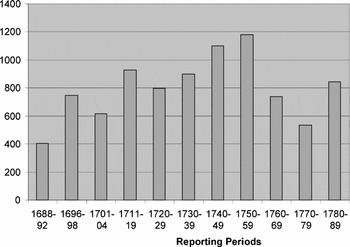
A trend analysis of the quantities of opium sold by the Company at Batavia from 1688 to 1789 is presented in Figure 1. Initially, there are an irregular number of reporting periods (the years 1688 to 1692, 1696 to 1698, 1701 to 1704 and 1711 to 1719). Average annual sales of chests of opium for these reporting periods were: 403, 745, 617 and 928. Subsequently, in this trend analysis, the reporting periods are for the decades from 1711 to 1789 in which sales of opium on an average annual basis per decade were: 928, 795, 897, 897, 1,100, 1,180, 739, 537 and 845 chests.
Opium sales at Batavia, 1688–1789 (annual average number of chests/reporting period).

The Company's sales of opium in this period reached their apogee in the decades just before and after the Company decided to shift its primary channel of distribution at Batavia from public auction to the Amfioen Sociëteit (Opium Society).Footnote 43 Opium sales declined because of supply difficulties in Bengal, the eventual exclusion of the Company from purchasing and exporting opium from Bengal to Batavia by the English East India Company and wartime conditions between England and the Netherlands from 1775 to 1781. But, they recovered over the next decade.
The VOC continued its involvement in the trade by buying Bengal opium from whomever that could obtain and deliver it to them at Batavia. And the Company continued to re-sell it to the Amfioen Sociëteit. From 1769 to 1792, for example, the Company purchased 5,850 chests of opium mostly from Bengal from British private traders at Batavia.Footnote 44 For the remainder of our period and beyond, the Company or Dutch colonial administration bought Bengal and increasing quantities of Levantine opium from diverse suppliers, including Danish, American and other private traders.Footnote 45
Over 1677 to 1789, the Company reported total net revenues or profit earnings of 48,540,377 florins from the sale of opium at Batavia.Footnote 46 This figure may be converted and is the equivalent of 16,180,125 rsd., which for the purpose of comparison of the magnitude of this figure is equal to 19,416,150 Spanish pesos and 17,651,046 Chinese taels.
Comptoir Accounts and Imperial Finances
Within the Company's imperial organisation and accounting practices, the local comptoir was the administrative unit, in general, that reported its overhead and operating expenditures and its income or revenues for a specific geographical area. These expenditures and incomes were prepared in an annual report covering an operating period from the 1st of September till the 31st of August of the following year. Batavia, one imagines, might have been considered an exceptional case, since as the Company's imperial administrative centre, it carried and registered significant overhead and operating expenditures relating to defence, personnel, preparing and maintaining shipping and others. But, there was no variation in this accounting practice or exemption for Batavia.Footnote 47
A significant number (61), nearly two-thirds of these accounts for the Batavia comptoir have been examined for the eighteenth century. In modern accounting terms, they are a combination of a profit and loss balance sheet and an income and expenditure report. They are denominated in florins or guilders. The conversion of florins or guilders to the rijksdaalder was 3 to 1 over the period. Care must be taken in the evaluation of the magnitude of the values in these accounts. The revenues or profits from opium in these accounts are in agreement with Baud's figures. Examples and distribution of these accounts are nearly evenly distributed over this period with the exception that there were no records found or consulted in the decade of the 1760s. It is argued that the potential for significant skewing or deviation statistically in one direction or another in the absence of an example for that time period is minimal in the trend and other analysis that was performed on these accounts.
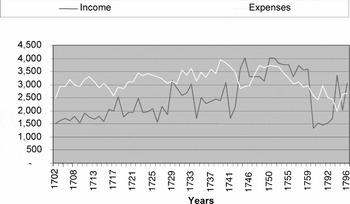
In the first instance, as shown in Figure 2, the examination and analysis of these accounts reveal that regardless of the Company's control over extraordinary wealth, expenditures were usually greater than income revenues or in deficit in the Batavia comptoir's annual accounts for most of this period. The salient point being for the development of our argument is not that the accounts were usually in deficit and they were covered by the Company. Neither the existence of a deficit, per se, nor the method of how the Company covered this deficit is of interest or importance to the development of our argument in relation to opium. These deficits existed and they were covered. The point is to imagine or calculate the size of the deficit in these accounts if opium had not been traded and/or if it had not been as profitable for the Company as these accounts attest.
Batavia comptoir accounts, 1702–1796: Income and expense distribution florins (‘000's).

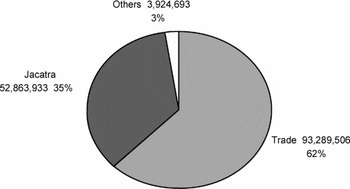
In the second instance, the composition of the Company's income or revenues was three-fold. It was derived from (1) trade (in essence, from sales revenues and profits from maritime trade including opium); (2) tax farming or Jacatra tax payments; and (3) other sources. Figure 3 graphically presents the breakdown of these three revenue streams by category, total value and percentage over the period. As it may be seen, revenues from trade generated slightly under two-thirds; tax farming or Jacatra payments slightly over one-third; and the other category generated an insignificant 3% of the Batavia compoir's revenues.
Batavia comptoir accounts, 1702–1796: Income sources and distribution (Total in florins and percentages).

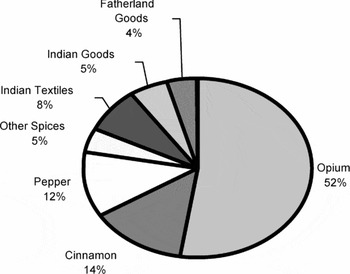
In the third instance, a detailed examination of the composition of the quantities and net revenues or profits from the trade revenue receipts confirms that the sales of opium and all other Company-controlled and commercialised commodities from maritime trade by the Company to Asian and other European merchants at Batavia did enter this comptoir's accounts. The breakdown of the revenues generated by trade, their composition and percentage distribution by individual major commodities and category groupings of goods (opium; cinnamon; pepper; other spices; Asian textiles, predominantly, Indian; Indian goods, such as saltpetre and others; and Fatherland or European woollen textiles and other goods) is shown in Figure 4. And they generally agree with the sales and purchases reports for maritime trade at Batavia. That opium sales and profits figured prominently in the comptoir's commercial accounts was to be expected, but that opium sales generated over one-half of the net income from trade in the comptoir's accounts is a major contribution. It is so sizeable that it is difficult to imagine the counter-factual scenario mentioned earlier: how or from what other sources of revenue would the Company have kept the Batavia comptoir deficits down and covered them? By the 1690s, although the Company would continue to commercialise textiles, the sales values of Bengal opium surpassed those of Indian cottons, silks and all other Asian textiles at Batavia. One of the two real surprises in these accounts is that the sales profits from Sri Lankan cinnamon at Batavia generated 14% of the comptoir's revenue from trade. After opium, cinnamon was the second most important and largest individual commodity contributor to the Batavia comptoir's financial results from trade.
Batavia comptoir accounts, 1702–1781: Trade revenue (composition and percentage distribution).

In the fourth instance and the second surprise in the revision of these accounts, are the volume and the value of the revenue contributed to the comptoir from tax farming revenues. They accounted for slightly over one-third of all the revenues accruing to the comptoir in the eighteenth century. Described in the accounts as contributions or payments from Jacatra, it should be remembered that this was the term that the Company used for Batavia and its environs after seizing the site from the Pengeran of Jacatra in 1619. This revenue farming system or pacht, the Dutch term for a rented monopoly privilege, was not new; ‘they represented 27 per cent of total revenues of the VOC in Asia in 1653’.Footnote 48 While there is additional detailed serial data in the archives indicating the composition and contribution of the individual tax farms and revenues that were collected at Batavia, it is sufficient to observe for the purpose and space constraints of this article that these revenues grew significantly over the latter half of the seventeenth and eighteenth centuries in absolute value and volume and as a percentage from 27 to 35 per cent of total Company revenues.
Conclusions
By examining the structure, composition and participation of the Company, Asian and other European merchants in maritime trade and the composition of the Company's comptoir operating expenditures and revenues derived from maritime trade (including opium), tax farming and other sources at Batavia, opium's importance to the Company was discussed in this article. Through a series of traditional economic analyses, the commercialisation of Bengal opium was shown to have been a dramatically important source of revenue for the Company's imperial headquarters—the Batavia comptoir. It dwarfed all other individual or groups of commodities that were available to the Company to sell profitably on Java and in the Indonesian Archipelago over the long eighteenth century. Its sales revenues kept the deficits in the comptoir's accounts to a lesser level than they otherwise might have been. The repercussions of these historical developments and antecedents directly and significantly contributed to the emergence of opium farming, which as James Rush has shown became a major source of revenue in the colonial administration of the Dutch East Indies in the nineteenth century.Footnote 49
The commercialisation of opium, as Els Jacobs has capably discussed, was relatively unimportant and insignificant in the overall commercial results of the Company in the eighteenth century. This contrast between macro versus micro views of the importance of opium to the Company raises additional implications about the role and nature of commodities and of commerce at this time. Locality was certainly of importance as were consumer proclivities towards the value and utility and the nature and availability of individual commodities in shaping the early modern global economy. Despite the commercial expertise of the trading capabilities of early modern European commercial institutions—the Dutch and English East India Companies, neither of these institutions could find or develop alternatives in European or Asian commodities to the profits that could be made in trafficking opium in Southeast Asia and China, although Indian raw cotton exports to China in the late eighteenth into the early nineteenth century were a temporary exception to this claim. The same observation is true of other local and regional profit maximisation competitors and collaborators of the Companies, indigenous and European private traders as individuals, groups and networks. Of additional importance, as our examination of the revenues of the Batavia comptoir reveal, neither could the Dutch East India Company escape from its dependency on revenues generated from the commercialisation of monopolised nor monopoly claimed commodities. Finally, while relating consumer to commercial behaviour is always difficult, the emergence and the proclivity to consume opium by smoking in Southeast Asia and China, which did not occur to the same degree or intensity elsewhere in the early modern world, created the opportunity for the trade in this commodity to become distinctive from other parts of the globe. This first transformation of opium and its consumption was significant. Much later, there would be subsequent transformations in the history of opium history beyond being smoked with the development of heroin and alternate intravenous delivery systems that would expand its consumption beyond the markets that emerged in Southeast Asia and China in the early modern period.
A brief reference was made in the introduction to this article that an examination of the social life or biography of opium as a vehicle or artifice could and should be usefully employed in a broader examination of the economic and social history of Southeast Asia—especially, on Java and elsewhere throughout the Indonesian Archipelago—in the long eighteenth century. While this article did not concentrate upon developing this approach, it did, however, establish the commercial primacy of this commodity in the economy on Java, which was the necessary first step prior to developing opium's social life or biography. With opium's primacy established in the commercial and economic lives of rulers, merchants, growers, producers and consumers, it is now possible to develop the social biography approach further and incorporate and employ it in a broader, economic, social and cultural examination of opium at Batavia, in Southeast Asia, and in global history.