Introduction
Invasive species constitute a major threat to biodiversity and agricultural ecosystems and may have a significant ecological and economic impact (Williamson, Reference Williamson1996; Pimentel et al., Reference Pimentel, McNair, Janecka, Wightman, Simmonds, O'Connell, Wong, Russel, Zern, Aquino and Tsomondo2001; Kenis et al., Reference Kenis, Auger-Rozenberg, Roques, Timms, Péré, Cock, Settele, Augustin and Lopez-Vaamonde2009). Scale insects are typical invasive pests; due to their small size and cryptic behaviour, they often remain undetected during quarantine inspections (Miller et al., Reference Miller, Miller, Hodges and Davidson2005; Hulme et al., Reference Hulme, Bacher, Kenis, Klotz, Kühn, Minchin, Nentwig, Olenin, Panov, Pergl, Pyšek, Roques, Sol, Solarz and Vilà2008; Pellizzari & Germain, Reference Pellizzari and Germain2010). One particular group of scale insects, mealybugs (Hemiptera: Pseudococcidae), constitutes the third most common family of alien insects in Europe, with about 40 new established species (Roques et al., Reference Roques, Rabitsch, Rasplus, Lopez-Vaamonde, Nentwig and Kenis2009; Pellizzari & Germain, Reference Pellizzari and Germain2010). Mealybugs are common pests of a wide range of agricultural and ornamental plants (Ben-Dov, Reference Ben-Dov1994) and may cause serious problems if they become established in new environments lacking natural enemies (Miller et al., Reference Miller, Miller and Watson2002). They damage the plant by sucking its sap and transmitting viruses. Furthermore, the honeydew they produce may also favour the development of mould fungi and decrease ornamental plant quality (Williams, Reference Williams1985; Kosztarab & Kozár, Reference Kosztarab and Kozar1988; Franco et al., Reference Franco, Silva and Carvalho2000).
Mealybug management is currently challenged by frequent species misidentification that decreases the efficiency of crop protection methods and increases pesticide use. This situation can be explained by the lack of reliable surveys and characterisations of mealybug species, mainly because their identification has been difficult or even sometimes impossible until recently. Indeed, taxonomy and identification of members of the family Pseudococcidae have generally been based on comparisons of the morphological characters of adult females. However, there are several drawbacks to this method. Firstly, it is a time-consuming process requiring specialised taxonomic knowledge, which is not available on a daily basis for most practitioners. Secondly, some environmental conditions may induce morphological variation in mealybugs, making it impossible in some cases to differentiate between complexes of cryptic species (Cox, Reference Cox1983; Charles et al., Reference Charles, Froud and Henderson2000). Thirdly, mealybug morphological identification is generally impossible when specimens are collected at larval stage (a common situation in the field and of special concern in quarantine controls).
These difficulties can be dealt with by taking profit from the complementarities between morphological and molecular characterization to identify the species. Indeed, once a reference specimen is taxonomically identified by morphological examination and characterized by DNA sequencing, any new sample displaying the same DNA sequence can be identified quickly without the need of any competence in taxonomy. For taxonomists, such an approach also avoids repetitive identification of the most common species. This method is the basis of the so-called DNA barcoding international projects (Hebert et al., Reference Hebert, Cywinska, Ball and deWaard2003). The main barcode region used in international projects is a 648 bp region of the cytochrome c oxidase subunit I (COI) (Hebert et al., Reference Hebert, Cywinska, Ball and deWaard2003). However, despite COI having been used in various taxonomic studies of mealybugs (Gullan et al., Reference Gullan, Downie and Steffan2003, Reference Gullan, Kaydan and Hardy2010; Demontis et al., Reference Demontis, Ortu, Cocco, Lentini and Migheli2007; Cavalieri et al., Reference Cavalieri, Mazzeo, Garzia, Buonocore and Russo2008; Rung et al., Reference Rung, Scheffer, Evans and Miller2008, Reference Rung, Miller and Scheffer2009; Saccaggi et al., Reference Saccaggi, Pietersen and Kruger2008; Ashfaq et al., Reference Ashfaq, Noor and Mansoor2010; Pieterse et al., Reference Pieterse, Muller and van Vuuren2010; Park et al., Reference Park, Suh, Hebert, Oh and Hong2011), the universal primers used to amplify this region do not work well in several species of this family (Malausa et al., Reference Malausa, Fenis, Warot, Germain, Ris, Prado, Botton, Vanlerberghe-Masutti, Sforza, Cruaud, Couloux and Kreiter2011). Therefore, new primers for this region have been recently designed (Malausa et al., Reference Malausa, Fenis, Warot, Germain, Ris, Prado, Botton, Vanlerberghe-Masutti, Sforza, Cruaud, Couloux and Kreiter2011; Park et al., Reference Park, Suh, Hebert, Oh and Hong2011). Moreover, the use of combinations of different DNA markers as nuclear DNA, mitochondrial DNA and endosymbiont DNA (from Tremblaya Princeps) proved to be successful not only for DNA barcoding but also to better estimate the genetic distance between species and for disentangle complexes of cryptic taxa (Malausa et al., Reference Malausa, Fenis, Warot, Germain, Ris, Prado, Botton, Vanlerberghe-Masutti, Sforza, Cruaud, Couloux and Kreiter2011).
In this study, we coupled the morphological examination of slide-mounted samples and their DNA sequencing at five markers to generate multi-criterion identification of 33 mealybug populations infesting crops and ornamental plants in eastern Spain. This work provides a comprehensive characterisation of ten species found in eastern Spain and will be used as basis for the routine identification of mealybugs in Spain and more generally in southern Europe, by DNA sequencing or with molecular identification tools derived from DNA sequences.
Materials and methods
Sample collections
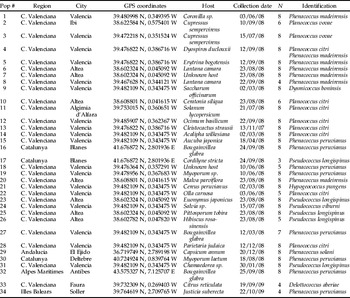
Thirty-three mealybug populations damaging crops and ornamental plants were sampled in eastern Spain between the years of 2007 and 2009 (table 1). An additional sample of Phenacoccus peruvianus Granara de Willink was collected from southern France, for comparison of the populations of this new invasive species in the two countries. The samples consisted mostly of adult females and immature instars, which were just taken when adults were not available. Individuals were checked under a stereoscope and discarded if any parasitoids were detected. The collected insects were preserved in 70% ethanol and stored at −20°C for molecular analysis and morphological identification.
List of the material sampled: Population codes, geographic origin and host origin of the samples and number of individuals used for DNA extraction and morphological identification.

DNA extraction and amplification
DNA was extracted from 239 specimens by using the DNeasy Tissue Kit (QIAGEN). The extraction was performed without crushing the insect body, which enabled us to recover the specimen for its posterior morphological identification. Therefore, the process followed the manufacturer's guidelines with two small variations to improve DNA extraction: cell lysis was carried out over a period of six to eight hours and two elution steps (2×50 μl of AE buffer) (Malausa et al., Reference Malausa, Fenis, Warot, Germain, Ris, Prado, Botton, Vanlerberghe-Masutti, Sforza, Cruaud, Couloux and Kreiter2011).
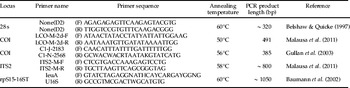
DNA was amplified from five different loci, chosen for analysis on the basis of their suitability for DNA barcoding, population genetics and phylogenetic studies: two regions of mitochondrial mealybug DNA (the 2183–2568 and LCO regions of COI), two regions of nuclear DNA (28 s-D2 and the entire ITS2 region) and one region of DNA from the bacterium Tremblaya princeps (leuA-16 s) (Malausa et al., Reference Malausa, Fenis, Warot, Germain, Ris, Prado, Botton, Vanlerberghe-Masutti, Sforza, Cruaud, Couloux and Kreiter2011). PCR was performed with a 23 μl reaction mixture and 2 μl of diluted DNA (1–20 ng). The reagent concentrations were 1×Phusion HF buffer (Phusion High-Fidelity DNA polymerase 530 (FINNZYMES, Espoo, Finland)), 0.01 U μl−1 Phusion enzyme, 200 μM dNTPs and 0.5 μM of each primer (table 2).
Molecular markers and annealing temperatures used in the study and PCR products obtained.

PCR was carried out as follows: initial denaturation at 98°C for 30 s, followed by 35 cycles of denaturation at 98°C for 10 s, annealing for 15 s at a temperature of 48°C–60°C, depending on the primer (table 2), and elongation at 72°C for 5 min. The final products were separated by electrophoresis in a 2% agarose gel, to check their quality. They were then sequenced in both directions, by capillary electrophoresis on an ABI 3130XL automatic sequencer (Applied Biosystems, Foster City, CA, USA) at Genoscreen (Lille, France). Consensus sequences were generated and analysed with Seqscape v2.5 (ABI), and alignments were manually edited with Bioedit (Hall, Reference Hall1999). When a sequence of a specimen displayed a genetic variation at one or more nucleotide(s), it was considered as a different haplotype. The analysed sequences were deposited in GenBank to ensure future access and use (accession numbers JF714157–JF714210).
Morphological identification
Mealybug populations were identified on the basis of morphological characters. All the individuals sequenced were recovered after the DNA extraction, preserved in 70% ethanol and stored at −20°C. Individuals were posteriorly mounted on slides as described by Williams & Granara de Willink (Reference Williams and Granara de Willink1992), with the modifications described by Malausa et al. (Reference Malausa, Fenis, Warot, Germain, Ris, Prado, Botton, Vanlerberghe-Masutti, Sforza, Cruaud, Couloux and Kreiter2011) and a few additional changes: a small ventral incision was made behind the back leg, with a micro scalpel (BioQuip Products Inc., Rancho Dominguez, CA, USA). The specimen was heated at 60°C in 10% KOH for 20 min and washed in distilled water for 20 min. It was then stained with a 1:1:1 acid fuchsin (1% solution), lactic acid and glycerol. Specimens were then immersed in acetic acid for one hour and transferred to lavender oil for an additional one hour. Finally, the insects were mounted on a slide in Heinze Mounting Medium (Heinze, Reference Heinze1952) and covered with a coverslip. Slides were then heated at 30°C for 48 h.
Specimens were identified principally with the keys of Williams & Granara de Willink (Reference Williams and Granara de Willink1992), Gimpel & Miller (Reference Gimpel and Miller1996), Williams (Reference Williams2004) and Granara de Willink & Szumik (Reference Granara de Willink and Szumik2007). For nymph voucher specimen identification, some species for which immature instars have never been described were identified to genus level only. The slides are available from the Polytechnic University of Valencia (Valencia, Spain).
Phylogenetic analysis
Phylogenetic studies were performed by merging our populations with other samples for which the same loci had been sequenced by Malausa et al. (Reference Malausa, Fenis, Warot, Germain, Ris, Prado, Botton, Vanlerberghe-Masutti, Sforza, Cruaud, Couloux and Kreiter2011). Bayesian inference was carried out with BayesPhylogenies (Pagel & Meade, Reference Pagel and Meade2004). Interspecific variability was too high for the alignment of ITS2 sequences. Thus, for this region, we inferred the phylogenetic relationships from a mixture model based on the other four loci. Analyses were carried out with nQ+C mixture models, with n varying between one and six independent rate matrices (Qs). The best model was chosen by comparing Bayes factors. We also applied a general time-reversible model, as recommended by Pagel & Meade (Reference Pagel and Meade2004). Four Markov chains were used for ten million iterations and a print frequency of 1000 iterations. The length of the burn-in period was determined by plotting likelihood across iterations. All iterations corresponding to the burn-in period (around one million iterations) were removed from the output of BayesPhylogenies before subsequent analyses. We used the sump command of MrBayes (Ronquist & Huelsenbeck, Reference Ronquist and Huelsenbeck2003) to obtain a summary of BayesPhylogenies outputs and to calculate Bayes factors. Majority rule consensus trees were then drawn with PAUP 4.0b10 (Swofford, Reference Swofford2003) (‘contree/Majrule’ command) from the output of the BayesPhylogenies analysis (9000 trees) using the best model selected. Phenacoccus species was used as outgroups because they are the most divergent taxa of this study (Hardy et al., Reference Hardy, Gullan and Hodgson2008).
Results
We surveyed a total of 33 mealybug populations from eastern Spain and one from southern France between 2007 and 2009. We identified 239 specimens from these samples morphologically, and DNA was sequenced, when possible, at five loci.
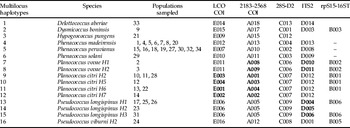
This resulted in the occurrence of 16 multi-locus haplotypes (table 3), which corresponded to ten species in terms of taxonomic identification: Delottococcus aberiae (De Lotto), Dysmicoccus boninsis (Kuwana), Hypogeococcus pungens Granara de Willink, Phenacoccus madeirensis Green, P. peruvianus, Phenacoccus solani Ferris, Planococcus citri Risso, Planococcus vovae (Nasonov), Pseudococcus longispinus (Targioni Tozzetti) and Pseudococcus viburni (Signoret). DNA sequences from the species D. aberiae, P. peruvianus and P. vovae were obtained for the first time in this study, and the universal barcode region cytochrome c oxidase subunit I (COI) was also sequenced for the first time from D. boninsis and P. madeirensis (table S1, supporting information). The genetic markers of the various DNA regions studied generated sequences that distinguished successfully between all the taxa studied.
Summary of the mealybug species identified, populations sampled (see table 1) and different haplotypes obtained for each genetic marker. Haplotype numbers are as in the paper by Malausa et al. (Reference Malausa, Fenis, Warot, Germain, Ris, Prado, Botton, Vanlerberghe-Masutti, Sforza, Cruaud, Couloux and Kreiter2011) and are based on Genbank accession number. The rpS 15-16ST is expected to fail in Phenacoccus spp. because T. princeps is absent from these species. Different haplotypes obtained for the same species are shown in bold.

For five mealybug species, we could sequence more than one population. Among those five species, three species displayed intraspecific variations among or within populations. Four different multi-locus haplotypes were recovered from six populations of P. citri, three multi-locus haplotypes were recovered from five populations of P. longispinus and two multi-locus haplotypes were recovered from two populations of P. vovae (table 3). The distribution of these different haplotypes did not follow any obvious geographic pattern (fig. 1). Other species, such as P. peruvianus and P. madeirensis, displayed high levels of genetic homogeneity, even though several populations from different hosts and geographic regions were studied. Intraspecific differences were observed at the sequences obtained from both regions of COI and ITS2. The regions rpS15–16 s and 28sD2 displayed no intraspecific variation.
Distribution of the mealybug populations surveyed in eastern Spain and France. The different symbols indicate the population species and colors denote the haplotypes.

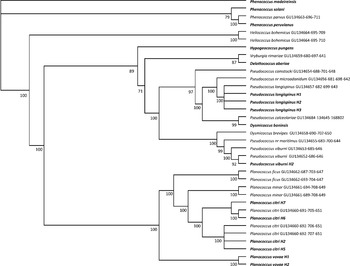
The phylogenetic tree revealed that the genera Phenacoccus and Planococcus formed monophyletic groups. On the contrary, the genus Pseudococcus appeared paraphyletic. Indeed, in the topology, the Pseudococcus species are found in two separate clusters, each containing several Pseudococcus species and one Dysmicoccus species (fig. 2). In addition, the species for which no DNA sequence was previously available were positioned in the topology with good support: P. peruvianus was located close to Phenacoccus parvus Morrison populations of Neotropical origin. Planococcus vovae differed slightly from the other three species of the genus Planococcus. Delottococcus aberiae was found in a cluster with Vryburgia rimariae Tranfaglia located inside part of the tree corresponding to the tribe Pseudococcini.
Bayesian phylogenetic tree of mealybug multilocus haplotypes generated by this study (shown in bold) or by Malausa et al. (Reference Malausa, Fenis, Warot, Germain, Ris, Prado, Botton, Vanlerberghe-Masutti, Sforza, Cruaud, Couloux and Kreiter2011) for multilocus haplotypes including information for at least three loci: 2183–2568 and LCO regions of COI, 28 s-D2 and rpS15-16 s when possible. The majority-rule consensus tree was calculated from the Bayesian analysis, based on the best selected mixture model (three matrices). Bayesian posterior probabilities are represented beyond the nodes (9000 trees, values <70% not shown). Haplotypes are named according to Genbank accession numbers.

Discussion
The main interest of this study is probably to provide a solid basis for further works focusing on mealybug management. For researchers or practitioners with an access to DNA sequencing facilities, our data makes it possible to quickly identify taxa based on simple DNA sequence comparisons. This study also provides the raw data to design rapid identification kits based on the use of species-specific PCR: the large set of sequences available makes it possible to design species-specific PCR primers annealing to regions displaying variations among species but not among populations or individuals of the same species. One additional piece of information directly relevant for pest management is the occurrence of two species (P. peruvianus and D. aberiae) that represent two cases of recent introductions in Europe.
However, such a survey using multi-criteria sample characterisation also generates valuable data for researches on the evolutionary history of Pseudococcidae.
First, by generating DNA data for various species that had not been sequenced before (P. peruvianus, P. vovae and D. aberiae), this study gives insights into the phylogenetic relationships inside the family Pseudococcidae. Phenacoccus peruvianus appears more closely related to P. parvus than P. solani or P. madeirensis. This result is in conflict with the findings of Granara de Willink & Szumik (Reference Granara de Willink and Szumik2007), whose morphological phylogenetic studies placed P. peruvianus closer to P. madeirensis. Planococcus vovae mapped close to the other species of the same genus, but did not come between P. ficus and the cryptic species P. citri and P. minor (Rung et al., Reference Rung, Scheffer, Evans and Miller2008; Saccaggi et al., Reference Saccaggi, Pietersen and Kruger2008). Moreover, the South African species D. aberiae was located close to V. rimariae on the phylogenetic tree, providing further evidence for the existence of a southern African clade, as proposed by Hardy et al. (Reference Hardy, Gullan and Hodgson2008). In addition, the phylogenetic tree computed in this study confirms several trends observed in previous studies (Hardy et al., Reference Hardy, Gullan and Hodgson2008; Malausa et al., Reference Malausa, Fenis, Warot, Germain, Ris, Prado, Botton, Vanlerberghe-Masutti, Sforza, Cruaud, Couloux and Kreiter2011): (i) the genera Phenacoccus and Planococcus were found monophyletic, although few closely related species of other genera were in this study; (ii) the presence of two Dysmicoccus species among the Pseudococcus species suggests that these two genera are paraphyletic, as proposed by Downie & Gullan (Reference Downie and Gullan2004), Hardy et al. (Reference Hardy, Gullan and Hodgson2008) and Malausa et al. (Reference Malausa, Fenis, Warot, Germain, Ris, Prado, Botton, Vanlerberghe-Masutti, Sforza, Cruaud, Couloux and Kreiter2011).
Second, the contrasted patterns of intraspecific variability found in P. vovae, P. citri, P. longispinus, P. peruvianus and P. madeirensis may be explained by the species histories. Indeed, the extent of intraspecific variation observed in those species does not display any geographic pattern and may rather be accounted for by the time elapsed since these species first began their invasion of Europe. Substantial divergences were observed in the populations of the native species P. vovae, as well as in the exotic species P. citri and P. longispinus. These two exotic species have been present in the Mediterranean Basin for more than a century (Pellizzari & Germain, Reference Pellizzari and Germain2010), long enough for population divergence to have occurred in the new area or for repeated introductions from different regions of the world (Thompson, Reference Thompson1998; Dlugosch & Parker, Reference Dlugosch and Parker2008). By contrast, the invasive species P. peruvianus and P. madeirensis displayed little or no DNA variability in the multilocus analysis. This suggests (i) that the populations experienced a genetic bottleneck, probably caused by their recent introduction into Europe and specifically in Spain (Marotta & Tranfaglia, Reference Marotta and Tranfaglia1990; Beltrà et al., Reference Beltrà, Soto, Germain, Matile-Ferrero, Mazzeo, Pellizzari, Russo, Franco and Williams2010; Beltrà & Soto, Reference Beltrà and Soto2011), and (ii) that the invasive populations came from the same geographic region or spread in Spain and France from a single introduced population.
In conclusion, this study provided a molecular characterisation at several DNA markers and a taxonomic identification for a set of 239 mealybug samples from 33 populations of eastern Spain. Among them, ten different species were identified, and this study provided the first molecular data for three species. In addition, this multi-criteria characterization produced new data for the study of the Pseudococcidae phylogeny and revealed various patterns of intraspecific variations among populations of five mealybug species that may be related to their invasion histories.
Acknowledgements
We would like to thank Jean François Germain (ANSES Montpellier) for assistance with the morphological identification of some mealybug species. We would also like to thank Dr Douglass Miller and Dr Jan Giliomee for providing the key characters for identifying Delottococcus aberiae populations and for confirming species identification. This work was funded by the grants FP7-IRSES #269196 ‘Iprabio’, FP7-KBBE ‘PURE’, Bibliothèque du Vivant and the French Agropolis Fondation (RTRA – Montpellier, BIOFIS project).
Supplementary material
The online table can be viewed at http://journals.cambridge.org/ber.