Introduction
Castor (Ricinus communis L.) is an important industrial crop. It is a diploid (2n = 20) species in the Euphorbiaceae family. Its seed oil and derivatives are widely used in the manufacturing of several products such as lubricants, cosmetics, pharmaceuticals, nylon and plastics (Ogunniyi, Reference Ogunniyi2006; Mutlu and Meier, Reference Mutlu and Meier2010). Castor oil is a promising second-generation feedstock for biodiesel production (Naseem et al., Reference Naseem, Sadaf, Bibi, Habib-ur-Rehman, Mehmood-ul-Hassan, Aziz and Ullah2019). Castor is cultivated in more than 30 countries, among which India, China, Mozambique and Brazil are the major producers. India ranks first in castor production with 1.56 million tonnes per annum (FAOSTAT, 2017) and caters to more than 85% of the world demand.
Since castor belongs to a monotypic genus, its genetic improvement relies only on the variability available in the primary gene pool (Kulkarni and Ramanamurthy, Reference Kulkarni and Ramanamurthy1977; Moshkin, Reference Moshkin and Moshkin1986; Weiss, Reference Weiss2000). Therefore, creating additional variability in the existing gene pool is desirable. ‘Induced mutagenesis’ is an essential plant breeding tool that generates allelic variants of genes, thereby modulating the expression of traits. Colchicine is a well-known mutagenic agent, originally extracted from the plants of the genus Colchicum. It prevents microtubule formation during cell division, leading to chromosome doubling (Eigsti and Dustin, Reference Eigsti and Dustin1955). Polyploids thus produced would have an increase in cell size (Levin, Reference Levin1983). The cell size increase in polyploids generally leads to enlarged plant organs resulting in a higher biomass yield. These autopolyploid plants could also serve as a source of variability in the gene pool. In this context, the present study was undertaken to identify the optimal dose of colchicine for the treatment of castor seed in order to generate viable tetraploid plants and study the meiotic behaviour of the tetraploidized plants.
Materials and methods
Plant material
Three castor inbred lines viz. 48-1, DCS-107 and AP-41 were treated with colchicine. Among the selected lines, 48-1 and DCS-107 are commercial varieties developed at ICAR-Indian Institute of Oilseeds Research (ICAR-IIOR) and AP-41 is an elite inbred line maintained at ICAR-IIOR.
Colchicine treatment
The seeds were soaked in aqueous solutions of colchicine in beakers at room temperature. Various concentrations (w/v) of colchicine namely, 0.1, 0.3, 0.5 and 1%, were used. Seeds were soaked for various durations: 12, 24 and 48 h. The seeds soaked only in water for the previously mentioned durations were used as controls. A total of 50 seeds per genotype were used for each treatment. After incubation, seeds were thoroughly washed in running tap water and dibbled in the field in rows with a spacing of 90 cm between rows and 45 cm between plants. The number of seedlings was counted after 30 d from the date of sowing to determine the germination percentage. The germination percentage was subjected to Probit analysis (Finney, Reference Finney1971) and the LD50 value for colchicine was determined.
Identification of putative tetraploids
The initial screening for tetraploid plants was done based on the number and size of stomata in comparison with the control plants. The stomatal traits have been successfully used in differentiating diploid from other higher ploidys in many plant species (Speckmann et al., Reference Speckmann, Post and Dijkstra1965; Beck et al., Reference Beck, Dunlop and Fossey2003; Liu et al., Reference Liu, Li and Bao2007). To count the number of stomata, leaf samples were dipped in a solution prepared by dissolving thermocol [poly(1-phenylethene)] in xylene. The thin film with the leaf impression was carefully peeled off and the impression of the abaxial surface of leaf was observed under a light microscope for the assessment of stomatal density and size. The plants having reduced stomatal density (number of stomata per unit area) and increased size compared to control plants were considered putative polyploids.
Analysis of meiosis and pollen fertility
The inflorescences of the putative polyploid plants were selfed. The seeds collected from selfed plants were sown in the field. Young male flowers were collected from the plants and fixed in Carnoy's fluid for 24 h before storing in 70% ethanol at 4°C. Temporary smears of microsporocytes were prepared with 1% propionic carmine and examined after de-staining with 25% HCl. At least 20 cells per plant at diakinesis and metaphase-I stages were counted to confirm chromosome pairing (Dahmer et al., Reference Dahmer, Schifino-Wittmann, Dall'Agnol and Castro2008; Simioni and Valle, Reference Simioni and Valle2011). Pollen fertility was assessed by extracting the pollen from mature male flowers and staining it with 1% acetocarmine mixed with glycerol (1:1) for 3 h. The pollen grains were observed under a light microscope for stainability. The fully stained pollen grains were counted as ‘fertile’ and the partially stained, unstained and shrunken pollen grains were counted as ‘sterile’.
Results
This study was undertaken to generate polyploid castor plants through colchicine treatment of castor seeds. The frequency of germination of colchicine treated seeds of three genotypes viz., 48-1, DCS-107 and AP-41 with four different concentrations of colchicine for three different durations are presented in Table 1. Colchicine treatment at high concentrations, coupled with long durations, impacted the germination. Very low germination (0–10%) was noted in the treatment of 48 h at 1% concentration. Germination percentage increased with reduced concentration and duration (Table 1). The Probit curve generated from the germination percentage indicated that the LD50 values of colchicine were 0.25% (2.44 mg/l), 0.32% (3.21 mg/l) and 0.33% (3.28 mg/l) for 48, 24 and 12 h of treatment, respectively. To the best of our knowledge, this is the first report on the LD50 value of colchicine for seed treatment in castor.
Effect of colchicine treatment on germination of seeds

Initial screening of 1001 plants for polyploidy on the basis of stomatal traits resulted in the identification of three plants (two plants of 48-1 and one plant of AP-41) from the treatment with a 0.3% aqueous solution of colchicine for 24 h were identified with fewer stomata per unit area and increased stomata sizes (Fig. 1). These plants were suspected to possess increased numbers of chromosomes. Out of three putative polyploid plants, one plant (48-1) died. The pollen fertilities of the remaining two plants (one each from 48-1 and AP-41) were severely affected. The pollen fertility was 0% in the mutant of 48-1 and 15–20% in the mutant of AP-41 during October and November. However, the pollen fertility increased during the months of February and March (20–25% in 48-1 and 30–35% in AP-41). Both the plants were subsequently selfed. Reduced seed setting with one or two cocci in capsules containing aborted ovules was observed. A total of 12 progeny of 48-1 and 10 progeny of AP-41 were obtained from seeds obtained through selfing of putative tetraploid plants.
Stomatal density and size in diploid (A) and tetraploid (B) castor plants.

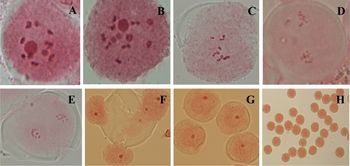
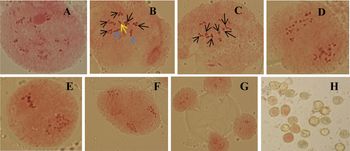
A subset of the progeny (4 of 48-1 and 3 of AP-41) were subjected to meiotic analysis to count the chromosomes and study the pairing pattern. The control (diploid) plants showed ten bivalents during diakinesis. The immature pollen grains each contained a single nucleus. The nucleolus organizer region (NOR) was found in two chromosomes. Pollen fertility was >99% and the pollen grains were of uniform size (Fig. 2). The chromosome numbers in all the selected progeny of colchicine-treated plants were found to be doubled (2n = 4x = 40). The chromosome association in diakinesis and metaphase-I showed tetraploid behaviour with univalents, bivalents, quadrivalents and other associations (Table 2). The pairing was abnormal with high order chromosome configurations (Fig. 3) but the division was normal. In tetraploid plants, chromosomes associated with NOR varied from four to six. Univalents were detected in the metaphase-I stage but interestingly micronuclei/polysporads were not observed and normal tetrad formation was seen.
Cytological behaviour of diploid castor plant [A: diplotene, B: diakinesis with 10II, C: metaphase (10II), D: anaphase I, E: metaphase II, F & G: microspores with single nucleus, H: pollen Fertility].

Cytological behaviour of tetraploid castor plant 48-1-P1 [A: NOR associations, B: metaphase with 1II + 2IV + 5VI (black arrow – hexavalent; blue arrow – quadrivalent; yellow arrow – bivalent), C: metaphase with 8II + 6IV (black arrows indicating quadrivalent), D: anaphase I, E: metaphase II (equatorial and polar view), F: anaphase II, G: microspore with more than two nuclei, H: pollen fertility].

Meiotic chromosome associations at diakinesis/metaphase-I and pollen fertility

The tetraploid plants were phenotypically comparable with their diploid counterparts except for a few reproductive and economic traits. The flower and seed sizes were substantially bigger in tetraploids than in diploid plants (Fig. 4). The average 100-seed weight of tetraploid plants of 48-1 was 48.5 g, whereas it was 26.5 g in diploid plants. The amount of pollen released from the anthers of tetraploid plants appeared to be less than that of the diploid plants (data not shown). The pollen fertility of tetraploid plants varied from 3.9–54.7% in 48-1 and 32.5–62.3% in AP-41 during the months of February and March. The plants in which more bivalents were observed during metaphase-I had high pollen fertility. In general, the progeny of 48-1 showed less fertility compared to the progeny of AP-41. There were few hexavalent associations also found in some progeny of 48-1.
Comparison of male flowers, female flowers and seeds of diploid and tetraploid castor [A: male flowers, B: female flowers, C: seeds].

Discussion
This study describes the generation of polyploid castor plants as genetic stocks. Polyploid plants are more valuable compared to diploid plants, especially when the vegetative parts are economically important (Shao et al., Reference Shao, Chen and Den2003). Among seed crops, autotetraploid rye is a commercial success, with larger ears (Hagberg and Ellerström, Reference Hagberg and Ellerström1959). Two features viz., low chromosome number (2n = 14) and allogamous nature were considered desirable for a favourable response to induced polyploidy in pearl millet (Jauhar, Reference Jauhar1970). Castor is also an outbreeding species with relatively fewer chromosomes (2n = 20). Therefore, there is an opportunity for exploiting autotetraploidy for the genetic improvement of castor. Additionally, polyploids generate new variability, which would be highly useful in a monotypic genus such as castor.
There have been only a few studies on polyploid castor. Narain and Singh (Reference Narain and Singh1968) reported colchicine-induced chromosomal interchanges in castor. They induced polyploidy by treating the apical meristem of castor seedlings with colchicine. Timko et al. (Reference Timko, Vasconcelos and Fairbrothers1980) studied the gene dosage effects on cellular proteins in a euploid series of castor consisting of haploid, diploid and tetraploid individuals. The diploid and tetraploid clones used in their studies were derived from colchicine treatments of a haploid plant discovered in the field.
In contrast to the previous studies, we attempted to induce polyploidy in castor by treating the seeds instead of meristematic tissues because seed treatment is a convenient and more efficient method for inducing polyploidy in plants. Moreover, the problem of high frequencies of chimeras was often associated with the treatment of meristematic tissues and can be avoided via seed treatment. However, the optimal dose of colchicine needed to be identified, as high concentrations of colchicine may be detrimental to the seeds. Liu et al. (Reference Liu, Li and Bao2007) had found that seed treatment of colchicine was the most efficient method for chromosome doubling in London Plane trees (Platanus acerifolia), but this method produced no mature tetraploid plants due to the deleterious effect of colchicine on subsequent root growth.
The initial screening of plants for polyploidy was done based on the evaluation of stomatal traits viz., increased stomatal size and decreases in stomatal density in comparison with the control plants (diploid). Such alterations in the leaf stomata size due to colchicine treatment have been reported in other plants (Chakraborti et al., Reference Chakraborti, Vijayan, Roy and Qadri1998; Mohammadi et al., Reference Mohammadi, Moieni, Ebrahimi and Javidfar2012). The screening of large populations for chromosome doubling through cytological analysis is tedious and time consuming; whereas stomatal analysis helps to identify the putative polyploidy plants quickly. A small set of putative plants identified through stomatal analysis can be confirmed later through chromosome counting.
The results of meiotic analysis revealed that quadrivalent associations were most frequently observed as in other autotetraploids. In Paspalum notatum Flugge, Karine et al. (Reference Karine, Carine and Miguel2016) found that chromosome pairing was typical for tetraploids with univalent, bivalent, trivalent and quadrivalent chromosome associations. According to Ramsey and Schemske (Reference Ramsey and Schemske2002), genotypes with polysomic inheritance have tendencies for multivalent formation.
Despite the presence of univalent in the metaphase-I stage, laggards, micronuclei or polysporads were not observed in the subsequent phases and normal tetrad formation was seen. This indicated that univalent, instead of being laggards and forming micronuclei, could have entered into one of the nuclei at the end of meiosis-I. This kind of situation was found to be the standard behaviour for univalent of many species (Koduru and Rao, Reference Koduru and Rao1981; Pagliarini, Reference Pagliarini1990).
When we examined the causes of the reduced fertility, the possibility of aneuploid production was ruled out, as non-disjunction was not observed during anaphase-I and anaphase-II. The possibility of chromosome stickiness was also rejected, as there were no clumps of chromosomes found. It would be interesting to determine whether the limited pollen release in tetraploid is due to lower pollen production or difficulty in pollen release induced by abnormal post-meiotic pollen maturation. Scott and Longden (Reference Scott and Longden1970) have also found that tetraploid sugar beet plants produced on average of only 66% of the amount of pollen produced by its diploid counterpart.
Hexavalents observed in the present study could be due to chromosomal aberrations such as interchange or inversion, which needs to be investigated further. Narain and Singh (Reference Narain and Singh1968), when treating castor seedlings with colchicine, found a plant with a tetraploid main stem and a diploid lateral branch with an interchange complex with quadrivalent formation. It was assumed that two short segments might have been involved in the interchange. They also reported the collapse of 30–35% pollen grains from the translocation heterozygote raceme and reduced seed setting with one or sometimes two cocci in capsules containing aborted ovules. Such seed sets were also observed in this study. Seeds set with aborted ovules and endosperm might be due to selective embryo abortion by mother plant because of competition among zygotes for nutrition.
Substantial increases in the level of pollen fertility during summer months indicated the possibility of temperature-sensitive male sterility. The phenomenon of low temperatures causing sterility i.e. reverse temperature-sensitive male sterility has been reported in rice (Ali and Siddiq, Reference Ali and Siddiq1999), pearl millet (Kaushal et al., Reference Kaushal, Roy, Zadoo and Choubey2004) and rapeseed (Xu et al., Reference Xu, Hu, Ge, Guo, Yu, Dong and Hu2014).
In the absence of micronuclei, polysporads and aneuploid pollens, high sterility could have resulted due chromosomal aberrations during meiosis such as inversions, translocations etc. as there were rings, rods and other orientations were observed during metaphase and diakinesis or the post-meiotic factors involved in the maturation of pollen grains. Pollen grain production is a complex process involving many tissues undergoing a series of events including many biochemical processes from PMC formation to pollen maturation (Scott et al., Reference Scott, Spielman and Dickinson2004). If any of these processes are hampered, the pollen grains thus formed are supposed to remain unviable. The reverse temperature-sensitive male sterility in rapeseed was associated with abnormal post-meiotic pollen development stages. Yu et al., (Reference Yu, Xu, Ge, Guo, Dong and Dong2016) found that rTGMS in male-sterile rapeseed lines was associated with premature breakdown of tapetum, which plays an important role in pollen grain maturation. Therefore, the other stages of pollen development need to be investigated to ascertain the cause for high pollen sterility in the tetraploid plants.
The male sterility found in the autopolyploids arising due to multivalent formation can be reduced by selection for few generations (selfing enhanced diploidization) as reported for pearl millet. Gill et al. (Reference Gill, Minocha, Gupta and Kumar1969) and Jauhar (Reference Jauhar1970) studied chromosome pairing in the initial and advanced generation tetraploids and noted a gradual shift from a multivalent to bivalent type of association. This was probably due to the natural selection of genes that condition regular meiosis with bivalent formations without an increase in the univalent frequency; hence, the fertility of the tetraploids improved in later generations (Jauhar, Reference Jauhar1981). Similarly, Singh (Reference Singh1992) has reported increases in pollen fertility from 66–83% in a single generation from selfing of autotetraploid sunflower plants. In our study, the maximum pollen fertility also increased from 35% (C0 generation) to 65% (C1 generation) in one generation of selfing, showing the opportunity for further improvement. Once the pollen fertility and seed setting are improved by the selection and the role of reverse temperature-sensitive male sterility is clarified, the agronomic potential (seed yield and oil content) of the tetraploid plants can be evaluated and exploited for further cultivar development.
Acknowledgement
This work was supported by the Indian Council of Agricultural Research, New Delhi