Introduction
Consanguineous unions are customarily practised in many sub-populations of Pakistan. About 50–60% of all marriages in Pakistan are reported to be consanguineous (Hussain & Bittles, Reference Hussain and Bittles1998). Various studies have documented consanguinity and its socio-biological differentials in mostly urban populations of Pakistan. For instance, in the city of Rawalpindi in Punjab, 48.10% of marriages have been reported to be consanguineous (Shami & Siddiqui, Reference Shami and Siddiqui1984). The consanguinity rate was found to be 44.3% in the city of Jhelum, 48.50% in Gujrat, 52.1% in Faisalabad, 52% in Sialkot and 56.1% in Sahiwal (Shami et al., Reference Shami, Schmitt and Bittles1989, Reference Shami, Grant and Bittles1994; Bittles et al., Reference Bittles, Grant and Shami1993). Furthermore, the consanguinity rates in the cosmopolitan areas of Lahore and Quetta have been observed to be 46% and 31%, respectively (Yaqoob et al., Reference Yaqoob, Gustavson, Jalil, Karlberg and Iselius1993; Mian & Mushtaq, Reference Mian and Mushtaq1994). In Khyber Pakhtunkhwa province, the consanguinity rate has been reported to be 34%, 55% and 66% in Swat, Peshawar and Malakand districts, respectively (Wahab & Ahmad, Reference Wahab and Ahmad1996; Wahab et al., Reference Wahab, Ahmad and Akram2006; Sthanadar et al., Reference Sthanadar, Bittles and Zahid2014). A recent study showed the consanguinity rate in the Kashmiri population of Bhimber to be 62% (Jabeen & Malik, Reference Jabeen and Malik2014). However, consanguinity in rural Pakistani communities has been less well researched.
Among consanguineous unions, four marital types have been recognized: double first cousins, first cousins, first cousins once removed and second cousins (Bittles, Reference Bittles, Speicher, Antonarakis and Motulsky2010). The relative proportion of these types may reveal interesting socio-biological and cultural aspects of a population. First cousin marriages are the most prevalent type and studies have showed that up to 80% of consanguineous unions in Pakistan are between first cousins (Hussain & Bittles, Reference Hussain and Bittles1998). Despite a general appreciation of consanguineous unions there is substantial regional and local heterogeneity in the pattern of endogamy and its underlying factors. Hence, it is pertinent to document consanguinity in different sub-populations in order to observe micro-scale variation. In this communication, various aspects of consanguinity have been studied in the Sargodha district of the upper Punjab region of Pakistan, which is primarily a rural population.
Methods
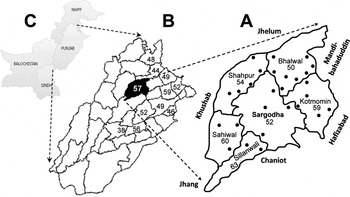
Sargodha district is located in the north-east of Punjab, Pakistan (co-ordinates: 32.05–32.08°N/73.42–73.7°E). In the 1998 Pakistan census, the district's population was estimated to be 2.67 million with an annual growth rate of 2.4%. Sargodha district has six tehsils: Bhalwal, Kotmomin, Sahiwal, Sargodha, Shahpur and Sillanwali (Fig. 1). Punjabi is the predominant language of the district. It has a large number of occupational castes, and Jatt, Syed, Malik and Rajput are the most common non-occupational castes. The literacy rates of males and females are 49% and 22%, respectively (Population Census Organization, 1998).
Map of Sargodha district (A) superimposed on a map of Punjab (B) and Pakistan (C). There were 27 sampling sites in Sargodha district, depicted as black dots (A). There were five sampling sites in Kotmomin tehsil, eight in Bhalwal, four in Sargodha, five in Shahpur, two in Sillanwali and three in Sahiwal tehsil. The distribution of consanguinity rate (%) in various cities of Punjab and the six tehsils of Sargodha district are given on maps B and A, respectively.

Sargodha district has an area of 5864 km2. An estimated 72% of the population reside in rural areas with a density of 455/km2 and average household size of 6.4 (Population Census Organization, 1998). A rural neighbourhood in Pakistan is generally characterized by a scattered population, poor infrastructure (roads, hospitals, schools, electricity and sanitation), an agriculture-based economy with few job opportunities, and high rates of poverty, illiteracy and migration towards cities. Extended households with large sibships and overlapping generations are the norm.
The present cross-sectional study was carried out during 2010–11. Subjects were approached through door-to-door visits and in public places like hospitals and community centres. A structured questionnaire was filled in with face-to-face interviews. Only married female subjects belonging to Sargodha district were included. There were 27 different sampling sites (sample size: 132–801; mean±SD: 300±255) (Fig. 1). Data on marital union types and socio-demographic attributes of the respondent were acquired. Self-identified ‘occupation’ and ‘economic status’ were recorded. Three family/household types were recognized, i.e. ‘nuclear’, ‘more than one couple’ and ‘extended’. In nuclear families, one couple and their children were living as a unit. In ‘more than one couple’ households, there were two brothers with their wives and children dwelling in the same house. ‘Extended’ households had three-generation families. Data were also recorded on marriage arrangements, i.e. arranged, reciprocal and self-arranged/arranged-love marriages. ‘Arranged marriages’ were those in which parents of the subject made the decision about the marriage partner; ‘reciprocal marriages’ or watta-satta were arranged marriages that involved two exchanged marriages in two families, and ‘self-arranged or arranged-love marriages’ were those in which the subject identified the marriage partner and the marriage went ahead with the consent of both families (Shaw, Reference Shaw2001; Jabeen & Malik, Reference Jabeen and Malik2014).
Seven types of marital unions were recognized, which were coalesced into consanguineous unions and non-consanguineous unions (Wahab & Ahmad, Reference Wahab and Ahmad1996; Bittles, Reference Bittles, Speicher, Antonarakis and Motulsky2010). The inbreeding coefficient (F) was calculated from the weighted average of consanguineous union types (Bittles, Reference Bittles, Speicher, Antonarakis and Motulsky2010), and was established across demographic categories of subjects.
Results
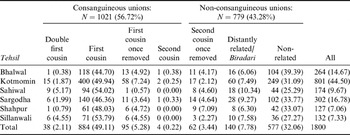
A total of 1800 married females ranging in age from 14 to 86 years (mean±SD: 39.32±13.98) were recruited. The consanguinity rate was calculated to be 56.72% (n=1021), while the non-consanguinity rate was 43.28% (n=779) (Table 1). The overall inbreeding coefficient, F, was estimated to be 0.0348. Marriages up to distantly related/Biradari constituted 67.94% of all marriages (n=1223). Among the individual marriage types, first cousin unions had the highest representation (49.11%), followed by marriages among ‘non-related’ (32.06%).
Distribution of marital union types in the six tehsils of Sargodha district, Pakistan a

a Number and percentage.
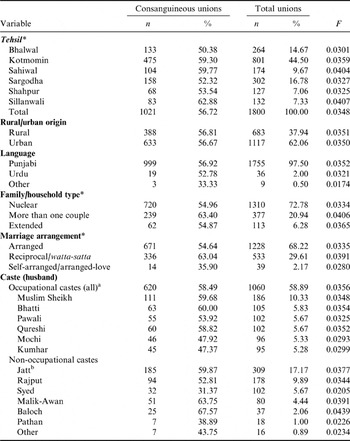
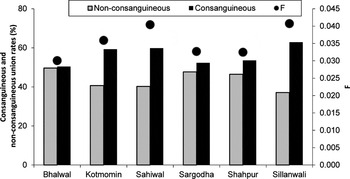
Among the six tehsils the consanguinity rate ranged from 50.38% in Bhalwal to 62.88% in Sillanwali (Table 2 and Fig. 2). The differences in the distribution of consanguineous and non-consanguineous unions in the six tehsils were statistically significant (p=0.033). With respect to their origins, the rural representatives were 38%; however, estimates of consanguinity rate and F were almost the same in the rural and urban categories. With respect to the mother tongue, consanguinity rates were 56.92% and 52.78% in Punjabi- and Urdu-speaking subjects, respectively. Likewise, with respect to family structure/household categories, consanguinity rates were observed to be highest in subjects belonging to ‘more than one couple’ households (63.4%; F=0.0406), followed by ‘nuclear family’ (55%; F=0.334) (differences were significant; p=0.013). Regarding marriage arrangements, the highest proportion of consanguineous union was observed in reciprocal marriages (63.04%; F=0.0391) (p=0.0132).
Distribution of consanguineous and total marital union rates and inbreeding coefficients (F) by socio-demographic variables, Sargodha district, Pakistan

a Thirty different ethnicities.
b Thirty-three types.
* Significant differences.
Bar graph depicting consanguinity and non-consanguinity rates (left y-axis) and inbreeding coefficients, F (black dots; right y-axis) in the six tehsils of Sargodha district.

A remarkable ethnic diversity was witnessed in the population of Sargodha district when the sample was distributed by caste system. For instance, there were at least 30 different occupational castes, the most prominent of which were Muslim Sheikh, Bhatti, Pawali, Qureshi, Mochi and Kumhar, and among the non-occupational castes, Jatt and Rajput were prominent. The consanguinity rate ranged from 47% to 63% in the prominent (n>45) castes (Table 2).
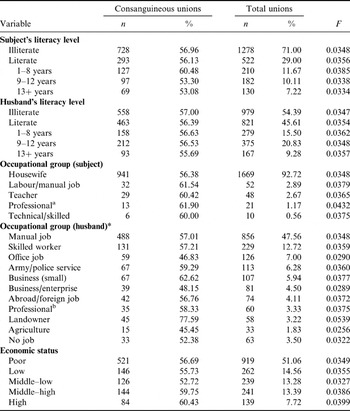
Respondents and their spouses/husbands had literacy rates of 29% and 46%, respectively. There were no differences in the prevalence of consanguineous unions among the literate and illiterate samples. Interestingly, however, among the literate sample a declining trend in consanguinity rate was observed, with increasing literacy levels in both subjects and husbands (Table 3). With respect to their occupational status, 92.72% of women were housewives. The consanguinity rates were observed to be highest in subjects with professional jobs (61.9%; F=0.0432), followed by those engaged in labour/manual jobs (61.54%; F=0.0379) (p=0.893). Housewives generally had lower consanguinity levels than women engaged in certain occupations (56.38%; F=0.0348) (Table 3). Among the husbands, a wide range of occupations were observed that could be lumped into eleven categories. The highest rate of consanguinity was witnessed among the landowners (77.59%; F=0.0539) and businessmen (small-business holders) (62.62%; F=0.0377). On the other hand, the lowest number of consanguineous unions was witnessed in subjects engaged in agriculture (45.45%; F=0.0256) and office jobs (46.83%; F=0.029) (differences were significant; p=0.016). Finally, five self-identified socioeconomic categories were observed (i.e. no specific indices were utilized). The highest proportion were poor subjects (51%). Generally, the consanguinity rate was highest in subjects belonging to the lowest or highest socioeconomic status categories; the inbreeding coefficient, F, was observed to be lowest (0.0327) in subjects belonging to the ‘middle–low’ category (p=0.502) (Table 3).
Distribution of consanguineous and total marital union rates and inbreeding coefficients (F) by educational, occupational and economic categories of subjects/husbands

aDoctor or office worker; bbanker, doctor, engineer, lawyer, teacher.
* Statistically significant.
Discussion
This study is the first record of consanguinity and inbreeding coefficient (F) in Sargodha district, Pakistan, which mainly comprises a rural population. The consanguinity rate was observed to be 56.72% in the study sample. This estimate is higher than previous estimates in the urban Pakistani populations of Jhelum, Gujrat, Rawalpindi, Sialkot, Sahiwal, Faisalabad, Lahore and Quetta (Shami et al., Reference Shami, Schmitt and Bittles1989; Reference Shami, Grant and Bittles1994; Yaqoob et al., Reference Yaqoob, Gustavson, Jalil, Karlberg and Iselius1993; Mian & Mushtaq, Reference Mian and Mushtaq1994). The observed consanguinity level in the Sargodha population is, however, less than the estimates reported for Gujranwala, Bhimber and Malakand districts, and the overall estimates for the Pakistani population (Shami et al., Reference Shami, Schmitt and Bittles1989; Jabeen & Malik, Reference Jabeen and Malik2014; Sthanadar et al., Reference Sthanadar, Bittles and Zahid2014). This study nonetheless confirms that first cousin marriages remain the most common type of marital union, constituting 87% of consanguineous unions and 49% of total marriages, respectively (Shami et al., Reference Shami, Schmitt and Bittles1989; Hussain & Bittles, Reference Hussain and Bittles1998).
Interestingly, no difference was found in the prevalence of consanguineous unions in rural and urban samples from Sargodha district. This lack of difference could be due to the heterogeneous nature of the urban population. Due to the rapid population growth in Pakistan, cities are expanding rapidly engulfing suburban rural communities. There has been an increasing trend of urbanization. Furthermore, socioeconomic life and the household structure in rural areas are transforming (Arif & Hamid, Reference Arif and Hamid2009). This situation may create confusion in defining rural and urban communities. Several researchers employ the definitions of ‘rural’, ‘urban’ and ‘peri-urban’, to avoid this dichotomy (Jabeen & Malik, Reference Jabeen and Malik2014). Therefore, the lack of difference between the rural and urban samples could be in part explained by the notional dichotomy. This notion could be supported by the fact that most common household type encountered in the present sample was ‘nuclear family’. In a typical rural area, one would expect a high proportion of ‘extended families’.
These analyses showed that literacy (of subject and husband) was not associated with consanguinity. This contrasts with various previous studies (Bittles, Reference Bittles, Speicher, Antonarakis and Motulsky2010). However, the present data showed that among the literates there was a slight decline in the proportion of consanguineous unions with increasing education level. It has generally been argued that increased women's literacy (as measured in number of years at school) increases the chances of participation in the labour market. This not only delays the age at marriage but also leads to a decline in the proportion of consanguineous unions (Hussain & Bittles, Reference Hussain and Bittles2004). In the present data, it was further observed that housewives generally had lower consanguinity levels than women engaged in certain occupations. However, it is not clear whether the occupational status of subjects raises the possibility of consanguineous union, or women with consanguineous unions are more inclined to adopt a certain profession than women with non-consanguineous unions.
In the present study, an estimated 68% of marriages were ‘arranged marriages’ in which marriage decisions are primarily made by the couple's parents/guardians. ‘Reciprocal marriages’ or watta-satta are exchanged marital unions, which comprised 30% of the total marriages. Reciprocal marriages are generally convened among the land-owning families mainly for the protection of land and economic adjustments. Such marriages are uncommon in urban areas but are still prevalent in rural and remote communities with agriculture-based economies. Furthermore, 2.17% of subjects had ‘self-arranged or arranged-love marriages’, which are also convened by the parents/guardians and are usually between close relatives; in these marriages the bride/bridegroom has influence over parents' decisions or have engineered the situation almost entirely themselves. Studies have shown that such marriages had been relatively infrequent, but have been increasing with time (Shaw, Reference Shaw2001). The consanguinity rate and inbreeding coefficient were observed to be significantly higher in subjects with reciprocal unions (F=0.0391).
In conclusion, this paper describes consanguinity differentials in a representative rural population of Punjab, which is characterized by low literacy, poor socioeconomic status, is Punjabi speaking with a high incidence of nuclear family households, a high prevalence of arranged and reciprocal marriages and extensive ethnic diversity. This study provides useful data on consanguinity and the inbreeding coefficient in a previously unexplored population. The data show a wide variation in consanguinity and inbreeding coefficient across the socio-demographic strata of the Sargodha district population. Furthermore, comparison of Sargodha with other populations of Punjab demonstrated substantial regional heterogeneity in the distribution of consanguinity. Further studies in the adjoining areas would be helpful to understand the consanguinity landscape in the region.
Acknowledgments
The voluntary participation of the subjects in the study is gratefully acknowledged. Research support was provided by HEC-Pakistan and PSF-Islamabad.